——
Topic :- HARMONE INSULIN
MBH-4.3 : MICROBIAL BIOTECHNOLOGY
PRESENTING BY :
Shivanand RV
NAAC Accredited with
A++ Grade
CONTENTS
05. TYPES OF HUMAN INSULIN
02. MODERNIZING INSULIN
03. Insulin Ti m e l i ne
04. IN S U LIN S TR U C TU R E
07.
TECHNIQUES IN PRODUCTION OF
INSULIN
06.
INDUSTRIAL INSULIN
08. RECOMBINANT INSULIN
APPROACHES IN INDUSTRIES
01. History of Insulin Discovery &
Producti on
10.
09. Steps in rDNA Technology of insulin
Production
I. WHY E-COLI IS MOST PREFERRED THAN
YEAST IN PRODUCTION OF INSULINE
II. WHAT DOES A DOSE OF INSULIN DO?
III. REASON BEHIND GENETICALLY
ENGINEERED INSULIN IS MOST
PREFERABL RATHER THAN ANIMAL
INSULIN
General Doubts on this
10.
Various Manufacturers and
Their Insulin brands
CONCLUSION
10.
• On May 30, 1922, Eli Lilly signed an agreement to pay royalties to the
University to increase production.
• 3 to 5 cc were injected at a time .
• Pain & abscesses were common until U-40
available.
• In 1982, The first licensed drug produced using
recombinant DNA technology was human insulin,
• which was developed by Genentech & licensed as well as
marketed by Eli Lily.

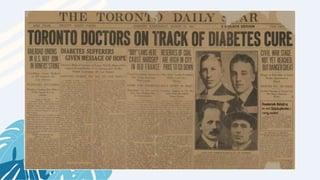
• In 1921, Canadian Scientist Frederic G. Banting & Charles H. Best purified
Insulin from Dogs pancreas at Laboratories in University of Toronto. Later it
extracted to Cattle & Pig also .
History of Insulin Discovery &
Production
Frederick Banting
in oct 1923 phone
rang,nobel
MODERNIZING INSULIN
 Until the 1980s, doctors treated diabetes with insulin sourced from animals — primarily
pigs and cows.
 DNA-editing experts at Genentech partnered with Eli Lilly & Co to developed and
marketed
 Later of “recombinant DNA” advancements produces insulin from bacteria with 98%
purity.

 in 1982, Humulin® is a first FDA-approved recombinant drug.
 Humulin success made a strong for genetic engineering in pharmaceutical industry
because of their higher purity rates
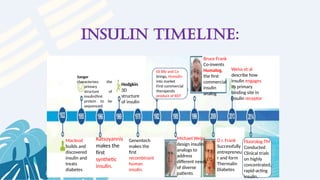
Sanger
characterizes the
primary
structure of
insulin(first
protein to be
sequenced)
Hodgkin
3D
structure
of insulin
Bruce Frank
Co-invents
Humalog,
the first
commercial
insulin
analog
Weiss et al
describe how
insulin engages
its primary
binding site in
insulin receptor
Michael Weiss
design insulin
analogs to
address
different needs
of diverse
patients
D r. Frank
Successfully
entrepreneu
r and form
Thermalin
Diabetes
Macleod
builds and
discovered
insulin and
treats
diabetes
Katsoyannis
makes the
first
synthetic
insulin.
Genentech
makes the
first
recombinant
human
insulin.
FFF
Fluorolog TM
Conducted
Clinical trials
on highly
concentrated,
rapid-acting
insulin.
Eli lilly and Co
brings, Humulin
into market
First commercial
therapeutic
product of RDT
Insulin Timeline:
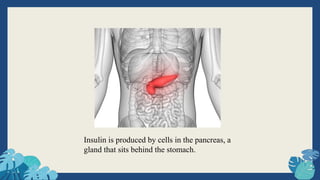
Insulin is produced by cells in the pancreas, a
gland that sits behind the stomach.
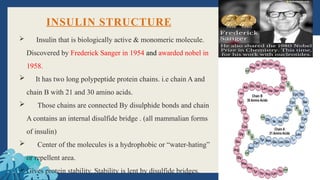
 Insulin that is biologically active & monomeric molecule.
Discovered by Frederick Sanger in 1954 and awarded nobel in
1958.
 It has two long polypeptide protein chains. i.e chain A and
chain B with 21 and 30 amino acids.
 Those chains are connected By disulphide bonds and chain
A contains an internal disulfide bridge . (all mammalian forms
of insulin)
 Center of the molecules is a hydrophobic or “water-hating”
or repellent area.
 Gives protein stability. Stability is lent by disulfide bridges.
INSULIN STRUCTURE
1. Mealtime(Bolus)insulin:
I. Rapid-acting insulin (e.g., insulin aspart, insulin lispro, insulin glulisine)
II. Regular Human insulin
TYPES OF HUMAN INSULIN
There are two types of human insulin
2. Background (Basal) insulin:
I. Intermediate-acting form (e.g. NPH insulin)
II. Long-acting insulin analogs (e.g., insulin glargine, insulin detemir)
Industrial insulin
 Mass production of insulin extracted from animals began in the wake of
successful clinical trials in Toronto and elsewhere in 1922.
 In addition to Lilly, others began to produce insulin, including the non-profit
Nordisk Insulin Laboratory ( later became Novo Nordisk)
 The ability to make a pure, reproducible product importance to pharmaceutical
companies looking to scale up
 In 1923, Lilly began full-scale animal insulin production based on this
separation technique. This become revolutionizes the purity and stability of the
final product That is Insulin.
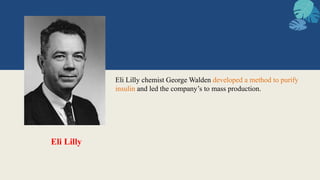
Eli Lilly chemist George Walden developed a method to purify
insulin and led the company’s to mass production.
Eli Lilly
TECHNIQUES IN PRODUCTION
OF MICROBIAL INSULIN IN
INDUSTRY
1. Recombinant DNA Technology
2. Bioreactor Cultivation
3. PROTEIN PURIFICATION TECHNIQUES
RECOMBINANT INSULIN
APPROACHES IN INDUSTRIES
1. Eli Lilly
(bacterial host)
2. Novo nordisk
(Yeast host)
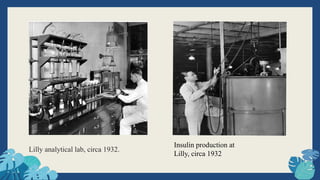
Lilly analytical lab, circa 1932.
Insulin production at
Lilly, circa 1932
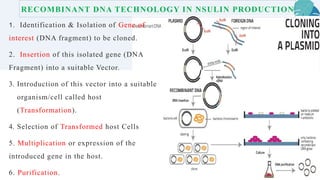
1. Identification & Isolation of Gene of
interest (DNA fragment) to be cloned.
2. Insertion of this isolated gene (DNA
Fragment) into a suitable Vector.
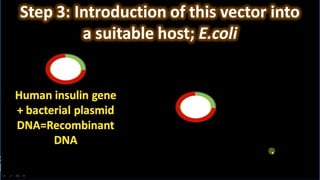
3. Introduction of this vector into a suitable
organism/cell called host
(Transformation).
4. Selection of Transformed host Cells
5. Multiplication or expression of the
introduced gene in the host.
6. Purification.
RECOMBINANT DNA TECHNOLOGY IN NSULIN PRODUCTION
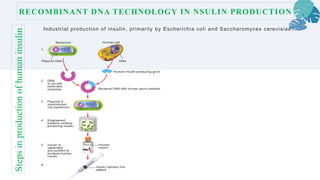
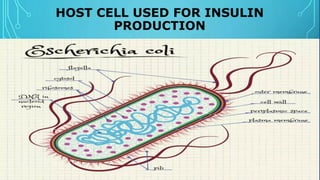
Industrial production of insulin, primarily by Escherichia coli and Saccharomyces cerevisiae.
Steps
in
production
of
human
insulin
Steps involved in Insulin Production Using Bioreactor Cultivation
1. Preparing the Insulin Gene
Gene Cloning:
Scientists take the gene responsible for producing human insulin and insert it into a small piece of
DNA called a plasmid.
This plasmid is introduced into a host cell, often a bacterium like E. coli or yeast.
Transformation:
The host cells are made to take up the plasmid with the insulin gene, transforming them into insulin
producers.
2. Growing the Bacteria or Yeast
Inoculum Preparation:
The transformed cells are first grown in a small culture to increase their numbers.
BIOREACTOR CULTIVATION
3. Scaling Up in Bioreactors
Bioreactors: These are large tanks that provide a controlled environment for the
cells to grow and produce insulin.
The cells of small culture are transferred to the bioreactor.
4. Making the Cells Produce Insulin
In E. coli is a chemical (IPTG) is added to start the production of insulin.
In yeast, conditions are changed to trigger insulin production.
5. Harvesting the Insulin
Cell Harvesting:
produced insulin, they are collected from the bioreactor.
Cell Lysis:
The cells are broken open to release the insulin they have produced.
6. Purifying the Insulin
Purification:
The mixture containing the broken cells and insulin is filtered and cleaned to separate pure insulin
from other cell parts.
Chromatography:
Various techniques, such as ion exchange and size exclusion, are used to ensure the insulin is pure
and safe.
7. Final Processing
Formulation:
The pure insulin is mixed with other substances to stabilize it and ensure it works properly when
injected.
Packaging:
The insulin is sterilized and filled into vials, cartridges, or pens for use by patients.
Protein purification is the process of isolating a specific protein, like insulin, from a mixture of other proteins and cell components.
Purification ensures the insulin is safe, pure, and effective for medical use.
Steps in Protein Purification
1. Initial Preparation
Harvesting Cells:
After the cells (bacteria or yeast) have produced insulin, they are collected from the bioreactor.
Breaking Open Cells:
The cells are broken open (lysed) to release the insulin. This can be done using mechanical methods like blending or using chemicals.
2. Removing Cell Debris
Centrifugation:
The mixture is spun at high speed to separate the heavy cell debris from the liquid containing insulin. The clear liquid (supernatant)
contains the insulin.
PROTEIN PURIFICATION TECHNIQUES
3. Purification Techniques
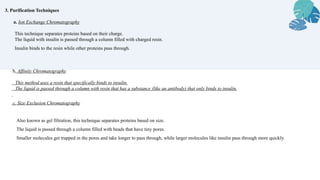
a. Ion Exchange Chromatography
This technique separates proteins based on their charge.
The liquid with insulin is passed through a column filled with charged resin.
Insulin binds to the resin while other proteins pass through.
b. Affinity Chromatography
This method uses a resin that specifically binds to insulin.
The liquid is passed through a column with resin that has a substance (like an antibody) that only binds to insulin.
c. Size Exclusion Chromatography
Also known as gel filtration, this technique separates proteins based on size.
The liquid is passed through a column filled with beads that have tiny pores.
Smaller molecules get trapped in the pores and take longer to pass through, while larger molecules like insulin pass through more quickly.
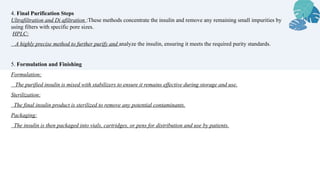
4. Final Purification Steps
Ultrafiltration and Di afiltration :These methods concentrate the insulin and remove any remaining small impurities by
using filters with specific pore sizes.
HPLC:
A highly precise method to further purify and analyze the insulin, ensuring it meets the required purity standards.
5. Formulation and Finishing
Formulation:
The purified insulin is mixed with stabilizers to ensure it remains effective during storage and use.
Sterilization:
The final insulin product is sterilized to remove any potential contaminants.
Packaging:
The insulin is then packaged into vials, cartridges, or pens for distribution and use by patients.
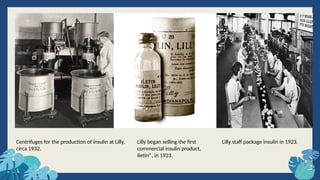
Lilly staff package insulin in 1923.
Centrifuges for the production of insulin at Lilly,
circa 1932.
Lilly began selling the first
commercial insulin product,
Iletin®, in 1923.
 Simple, well-understood genetics
 Ease of genetic manipulation
 Minimal culturing cost
 Fast expression (doubling time is only 20 - 30 mins).
 Established regulatory track record.
 Fermentation: ease of scaling up.
 Ease of Inclusion bodies purification.
ADVANTAGES OF USING E.COLI AS A SYSTEM
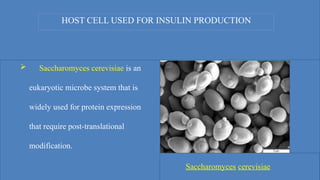
 Saccharomyces cerevisiae is an
eukaryotic microbe system that is
widely used for protein expression
that require post-translational
modification.
HOST CELL USED FOR INSULIN PRODUCTION
Saccharomyces cerevisiae
• •
: I
ADVANTAGES OF USING
SACCHAROMYCES CEREVISIAE
 Non pathogenic
 Rapid growth
 Dispersed cells
 Ease of replica plating and mutant isolation
 Can be grown on defined media giving the investigator complete control
over environmental parameters
 Well-defined genetic system
 Highly versatile DNA transformation system
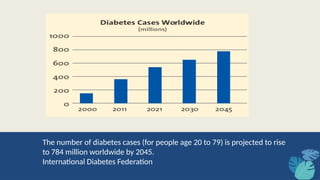
The number of diabetes cases (for people age 20 to 79) is projected to rise
to 784 million worldwide by 2045.
International Diabetes Federation
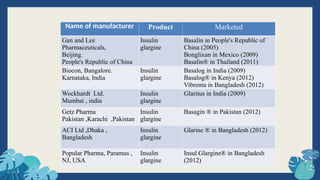
Name of manufacturer Product Marketed
Gan and Lee
Pharmaceuticals,
Beijing.
People's Republic of China
Insulin
glargine
Basalin in People's Republic of
China (2005)
Bonglixan in Mexico (2009)
Basalin® in Thailand (2011)
Biocon, Bangalore.
Karnataka, India
Insulin
glargine
Basalog in India (2009)
Basalog® in Kenya (2012)
Vibrenta in Bangladesh (2012)
Wockhardt Ltd.
Mumbai , india
Insulin
glargine
Glaritus in India (2009)
Getz Pharma
Pakistan ,Karachi ,Pakistan
Insulin
glargine
Basagin ® in Pakistan (2012)
ACI Ltd ,Dhaka ,
Bangladesh
Insulin
glargine
Glarine ® in Bangladesh (2012)
Popular Pharma, Paramus ,
NJ, USA
Insulin
glargine
Insul Glargine® in Bangladesh
(2012)
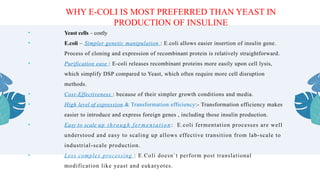
• Yeast cells – costly
• E.coli – Simpler genetic manipulation : E.coli allows easier insertion of insulin gene.
Process of cloning and expression of recombinant protein is relatively straightforward.
• Purification ease : E-coli releases recombinant proteins more easily upon cell lysis,
which simplify DSP compared to Yeast, which often require more cell disruption
methods.
• Cost-Effectiveness : because of their simpler growth conditions and media.
• High level of expression.& Transformation efficiency:- Transformation efficiency makes
easier to introduce and express foreign genes , including those insulin production.
• Easy to scale up through fermentation : E.coli fermentation processes are well
understood and easy to scaling up allows effective transition from lab-scale to
industrial-scale production.
• Less complex processing : E.Coli doesn`t perform post translational
modification like yeast and eukaryotes.
WHY E-COLI IS MOST PREFERRED THAN YEAST IN
PRODUCTION OF INSULINE
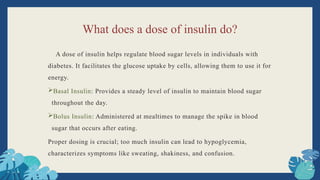
What does a dose of insulin do?
A dose of insulin helps regulate blood sugar levels in individuals with
diabetes. It facilitates the glucose uptake by cells, allowing them to use it for
energy.
Basal Insulin: Provides a steady level of insulin to maintain blood sugar
throughout the day.
Bolus Insulin: Administered at mealtimes to manage the spike in blood
sugar that occurs after eating.
Proper dosing is crucial; too much insulin can lead to hypoglycemia,
characterizes symptoms like sweating, shakiness, and confusion.
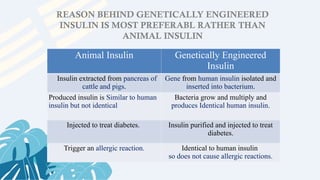
REASON BEHIND GENETICALLY ENGINEERED
INSULIN IS MOST PREFERABL RATHER THAN
ANIMAL INSULIN
Animal Insulin Genetically Engineered
Insulin
Insulin extracted from pancreas of
cattle and pigs.
Gene from human insulin isolated and
inserted into bacterium.
Produced insulin is Similar to human
insulin but not identical
Bacteria grow and multiply and
produces Identical human insulin.
Injected to treat diabetes. Insulin purified and injected to treat
diabetes.
Trigger an allergic reaction. Identical to human insulin
so does not cause allergic reactions.
CONCLUSION
- Insulin is essential for managing diabetes and is life-saving for many patients.
- Modern insulin production often uses genetically engineered bacteria or yeast
grown in bioreactors, ensuring a reliable and scalable supply.
- Advanced purification techniques, such as chromatography, ensure the insulin is
pure, safe, and effective.
- Techniques to refold insulin from its inactive form are crucial for its
functionality.
- Using plants to produce insulin is a promising, cost-effective, and scalable
alternative.
https://forms.gle/DP3DaXTqXwzsPDus6
• Center of insulin is hydrophobic – because of presence of non polar AA residues(Leucine,isoleucine,valine,phenylalanine)
that facilitate proteins folding and stability.
• until purer U-40 became available. Concentration and formulation per milliliter differ from u40 and u10
• NPH insulin : Neutral Protamine Hagedorn insulin is an intermediate acting insulin of diabetes
• Low production cast and availability , growth rate & time simple media requirement , high yield of E.coli is most
preferred rather than the choose of yeast

Harmone insulin production in industry using Microbes

  • 1.
    —— Topic :- HARMONEINSULIN MBH-4.3 : MICROBIAL BIOTECHNOLOGY PRESENTING BY : Shivanand RV NAAC Accredited with A++ Grade
  • 2.
    CONTENTS 05. TYPES OFHUMAN INSULIN 02. MODERNIZING INSULIN 03. Insulin Ti m e l i ne 04. IN S U LIN S TR U C TU R E 07. TECHNIQUES IN PRODUCTION OF INSULIN 06. INDUSTRIAL INSULIN 08. RECOMBINANT INSULIN APPROACHES IN INDUSTRIES 01. History of Insulin Discovery & Producti on 10. 09. Steps in rDNA Technology of insulin Production I. WHY E-COLI IS MOST PREFERRED THAN YEAST IN PRODUCTION OF INSULINE II. WHAT DOES A DOSE OF INSULIN DO? III. REASON BEHIND GENETICALLY ENGINEERED INSULIN IS MOST PREFERABL RATHER THAN ANIMAL INSULIN General Doubts on this 10. Various Manufacturers and Their Insulin brands CONCLUSION 10.
  • 3.
    • On May30, 1922, Eli Lilly signed an agreement to pay royalties to the University to increase production. • 3 to 5 cc were injected at a time . • Pain & abscesses were common until U-40 available. • In 1982, The first licensed drug produced using recombinant DNA technology was human insulin, • which was developed by Genentech & licensed as well as marketed by Eli Lily. • In 1921, Canadian Scientist Frederic G. Banting & Charles H. Best purified Insulin from Dogs pancreas at Laboratories in University of Toronto. Later it extracted to Cattle & Pig also . History of Insulin Discovery & Production
  • 4.
    Frederick Banting in oct1923 phone rang,nobel
  • 5.
    MODERNIZING INSULIN  Untilthe 1980s, doctors treated diabetes with insulin sourced from animals — primarily pigs and cows.  DNA-editing experts at Genentech partnered with Eli Lilly & Co to developed and marketed  Later of “recombinant DNA” advancements produces insulin from bacteria with 98% purity.  in 1982, Humulin® is a first FDA-approved recombinant drug.  Humulin success made a strong for genetic engineering in pharmaceutical industry because of their higher purity rates
  • 6.
    Sanger characterizes the primary structure of insulin(first proteinto be sequenced) Hodgkin 3D structure of insulin Bruce Frank Co-invents Humalog, the first commercial insulin analog Weiss et al describe how insulin engages its primary binding site in insulin receptor Michael Weiss design insulin analogs to address different needs of diverse patients D r. Frank Successfully entrepreneu r and form Thermalin Diabetes Macleod builds and discovered insulin and treats diabetes Katsoyannis makes the first synthetic insulin. Genentech makes the first recombinant human insulin. FFF Fluorolog TM Conducted Clinical trials on highly concentrated, rapid-acting insulin. Eli lilly and Co brings, Humulin into market First commercial therapeutic product of RDT Insulin Timeline:
  • 7.
    Insulin is producedby cells in the pancreas, a gland that sits behind the stomach.
  • 8.
     Insulin thatis biologically active & monomeric molecule. Discovered by Frederick Sanger in 1954 and awarded nobel in 1958.  It has two long polypeptide protein chains. i.e chain A and chain B with 21 and 30 amino acids.  Those chains are connected By disulphide bonds and chain A contains an internal disulfide bridge . (all mammalian forms of insulin)  Center of the molecules is a hydrophobic or “water-hating” or repellent area.  Gives protein stability. Stability is lent by disulfide bridges. INSULIN STRUCTURE
  • 9.
    1. Mealtime(Bolus)insulin: I. Rapid-actinginsulin (e.g., insulin aspart, insulin lispro, insulin glulisine) II. Regular Human insulin TYPES OF HUMAN INSULIN There are two types of human insulin 2. Background (Basal) insulin: I. Intermediate-acting form (e.g. NPH insulin) II. Long-acting insulin analogs (e.g., insulin glargine, insulin detemir)
  • 10.
    Industrial insulin  Massproduction of insulin extracted from animals began in the wake of successful clinical trials in Toronto and elsewhere in 1922.  In addition to Lilly, others began to produce insulin, including the non-profit Nordisk Insulin Laboratory ( later became Novo Nordisk)  The ability to make a pure, reproducible product importance to pharmaceutical companies looking to scale up  In 1923, Lilly began full-scale animal insulin production based on this separation technique. This become revolutionizes the purity and stability of the final product That is Insulin.
  • 11.
    Eli Lilly chemistGeorge Walden developed a method to purify insulin and led the company’s to mass production. Eli Lilly
  • 12.
    TECHNIQUES IN PRODUCTION OFMICROBIAL INSULIN IN INDUSTRY 1. Recombinant DNA Technology 2. Bioreactor Cultivation 3. PROTEIN PURIFICATION TECHNIQUES
  • 13.
    RECOMBINANT INSULIN APPROACHES ININDUSTRIES 1. Eli Lilly (bacterial host) 2. Novo nordisk (Yeast host)
  • 14.
    Lilly analytical lab,circa 1932. Insulin production at Lilly, circa 1932
  • 15.
    1. Identification &Isolation of Gene of interest (DNA fragment) to be cloned. 2. Insertion of this isolated gene (DNA Fragment) into a suitable Vector. 3. Introduction of this vector into a suitable organism/cell called host (Transformation). 4. Selection of Transformed host Cells 5. Multiplication or expression of the introduced gene in the host. 6. Purification. RECOMBINANT DNA TECHNOLOGY IN NSULIN PRODUCTION
  • 16.
    RECOMBINANT DNA TECHNOLOGYIN NSULIN PRODUCTION Industrial production of insulin, primarily by Escherichia coli and Saccharomyces cerevisiae. Steps in production of human insulin
  • 17.
    Steps involved inInsulin Production Using Bioreactor Cultivation 1. Preparing the Insulin Gene Gene Cloning: Scientists take the gene responsible for producing human insulin and insert it into a small piece of DNA called a plasmid. This plasmid is introduced into a host cell, often a bacterium like E. coli or yeast. Transformation: The host cells are made to take up the plasmid with the insulin gene, transforming them into insulin producers. 2. Growing the Bacteria or Yeast Inoculum Preparation: The transformed cells are first grown in a small culture to increase their numbers. BIOREACTOR CULTIVATION
  • 18.
    3. Scaling Upin Bioreactors Bioreactors: These are large tanks that provide a controlled environment for the cells to grow and produce insulin. The cells of small culture are transferred to the bioreactor. 4. Making the Cells Produce Insulin In E. coli is a chemical (IPTG) is added to start the production of insulin. In yeast, conditions are changed to trigger insulin production. 5. Harvesting the Insulin Cell Harvesting: produced insulin, they are collected from the bioreactor. Cell Lysis: The cells are broken open to release the insulin they have produced.
  • 19.
    6. Purifying theInsulin Purification: The mixture containing the broken cells and insulin is filtered and cleaned to separate pure insulin from other cell parts. Chromatography: Various techniques, such as ion exchange and size exclusion, are used to ensure the insulin is pure and safe. 7. Final Processing Formulation: The pure insulin is mixed with other substances to stabilize it and ensure it works properly when injected. Packaging: The insulin is sterilized and filled into vials, cartridges, or pens for use by patients.
  • 20.
    Protein purification isthe process of isolating a specific protein, like insulin, from a mixture of other proteins and cell components. Purification ensures the insulin is safe, pure, and effective for medical use. Steps in Protein Purification 1. Initial Preparation Harvesting Cells: After the cells (bacteria or yeast) have produced insulin, they are collected from the bioreactor. Breaking Open Cells: The cells are broken open (lysed) to release the insulin. This can be done using mechanical methods like blending or using chemicals. 2. Removing Cell Debris Centrifugation: The mixture is spun at high speed to separate the heavy cell debris from the liquid containing insulin. The clear liquid (supernatant) contains the insulin. PROTEIN PURIFICATION TECHNIQUES
  • 21.
    3. Purification Techniques a.Ion Exchange Chromatography This technique separates proteins based on their charge. The liquid with insulin is passed through a column filled with charged resin. Insulin binds to the resin while other proteins pass through. b. Affinity Chromatography This method uses a resin that specifically binds to insulin. The liquid is passed through a column with resin that has a substance (like an antibody) that only binds to insulin. c. Size Exclusion Chromatography Also known as gel filtration, this technique separates proteins based on size. The liquid is passed through a column filled with beads that have tiny pores. Smaller molecules get trapped in the pores and take longer to pass through, while larger molecules like insulin pass through more quickly.
  • 22.
    4. Final PurificationSteps Ultrafiltration and Di afiltration :These methods concentrate the insulin and remove any remaining small impurities by using filters with specific pore sizes. HPLC: A highly precise method to further purify and analyze the insulin, ensuring it meets the required purity standards. 5. Formulation and Finishing Formulation: The purified insulin is mixed with stabilizers to ensure it remains effective during storage and use. Sterilization: The final insulin product is sterilized to remove any potential contaminants. Packaging: The insulin is then packaged into vials, cartridges, or pens for distribution and use by patients.
  • 23.
    Lilly staff packageinsulin in 1923. Centrifuges for the production of insulin at Lilly, circa 1932. Lilly began selling the first commercial insulin product, Iletin®, in 1923.
  • 25.
     Simple, well-understoodgenetics  Ease of genetic manipulation  Minimal culturing cost  Fast expression (doubling time is only 20 - 30 mins).  Established regulatory track record.  Fermentation: ease of scaling up.  Ease of Inclusion bodies purification. ADVANTAGES OF USING E.COLI AS A SYSTEM
  • 26.
     Saccharomyces cerevisiaeis an eukaryotic microbe system that is widely used for protein expression that require post-translational modification. HOST CELL USED FOR INSULIN PRODUCTION Saccharomyces cerevisiae
  • 27.
    • • : I ADVANTAGESOF USING SACCHAROMYCES CEREVISIAE  Non pathogenic  Rapid growth  Dispersed cells  Ease of replica plating and mutant isolation  Can be grown on defined media giving the investigator complete control over environmental parameters  Well-defined genetic system  Highly versatile DNA transformation system
  • 28.
    The number ofdiabetes cases (for people age 20 to 79) is projected to rise to 784 million worldwide by 2045. International Diabetes Federation
  • 29.
    Name of manufacturerProduct Marketed Gan and Lee Pharmaceuticals, Beijing. People's Republic of China Insulin glargine Basalin in People's Republic of China (2005) Bonglixan in Mexico (2009) Basalin® in Thailand (2011) Biocon, Bangalore. Karnataka, India Insulin glargine Basalog in India (2009) Basalog® in Kenya (2012) Vibrenta in Bangladesh (2012) Wockhardt Ltd. Mumbai , india Insulin glargine Glaritus in India (2009) Getz Pharma Pakistan ,Karachi ,Pakistan Insulin glargine Basagin ® in Pakistan (2012) ACI Ltd ,Dhaka , Bangladesh Insulin glargine Glarine ® in Bangladesh (2012) Popular Pharma, Paramus , NJ, USA Insulin glargine Insul Glargine® in Bangladesh (2012)
  • 30.
    • Yeast cells– costly • E.coli – Simpler genetic manipulation : E.coli allows easier insertion of insulin gene. Process of cloning and expression of recombinant protein is relatively straightforward. • Purification ease : E-coli releases recombinant proteins more easily upon cell lysis, which simplify DSP compared to Yeast, which often require more cell disruption methods. • Cost-Effectiveness : because of their simpler growth conditions and media. • High level of expression.& Transformation efficiency:- Transformation efficiency makes easier to introduce and express foreign genes , including those insulin production. • Easy to scale up through fermentation : E.coli fermentation processes are well understood and easy to scaling up allows effective transition from lab-scale to industrial-scale production. • Less complex processing : E.Coli doesn`t perform post translational modification like yeast and eukaryotes. WHY E-COLI IS MOST PREFERRED THAN YEAST IN PRODUCTION OF INSULINE
  • 31.
    What does adose of insulin do? A dose of insulin helps regulate blood sugar levels in individuals with diabetes. It facilitates the glucose uptake by cells, allowing them to use it for energy. Basal Insulin: Provides a steady level of insulin to maintain blood sugar throughout the day. Bolus Insulin: Administered at mealtimes to manage the spike in blood sugar that occurs after eating. Proper dosing is crucial; too much insulin can lead to hypoglycemia, characterizes symptoms like sweating, shakiness, and confusion.
  • 32.
    REASON BEHIND GENETICALLYENGINEERED INSULIN IS MOST PREFERABL RATHER THAN ANIMAL INSULIN Animal Insulin Genetically Engineered Insulin Insulin extracted from pancreas of cattle and pigs. Gene from human insulin isolated and inserted into bacterium. Produced insulin is Similar to human insulin but not identical Bacteria grow and multiply and produces Identical human insulin. Injected to treat diabetes. Insulin purified and injected to treat diabetes. Trigger an allergic reaction. Identical to human insulin so does not cause allergic reactions.
  • 34.
    CONCLUSION - Insulin isessential for managing diabetes and is life-saving for many patients. - Modern insulin production often uses genetically engineered bacteria or yeast grown in bioreactors, ensuring a reliable and scalable supply. - Advanced purification techniques, such as chromatography, ensure the insulin is pure, safe, and effective. - Techniques to refold insulin from its inactive form are crucial for its functionality. - Using plants to produce insulin is a promising, cost-effective, and scalable alternative.
  • 35.
  • 37.
    • Center ofinsulin is hydrophobic – because of presence of non polar AA residues(Leucine,isoleucine,valine,phenylalanine) that facilitate proteins folding and stability. • until purer U-40 became available. Concentration and formulation per milliliter differ from u40 and u10 • NPH insulin : Neutral Protamine Hagedorn insulin is an intermediate acting insulin of diabetes • Low production cast and availability , growth rate & time simple media requirement , high yield of E.coli is most preferred rather than the choose of yeast