Protein Microarray For Disease Analysis Methods
And Protocols 1st Edition Tanya Knickerbocker
download
https://ebookbell.com/product/protein-microarray-for-disease-
analysis-methods-and-protocols-1st-edition-tanya-
knickerbocker-2108254
Explore and download more ebooks at ebookbell.com
Here are some recommended products that we believe you will be
interested in. You can click the link to download.
Protein Microarrays For Disease Analysis 1st Rodrigo Barderas
https://ebookbell.com/product/protein-microarrays-for-disease-
analysis-1st-rodrigo-barderas-47694890
Protein And Peptidebased Microarrays For Multiplex Detection Navid
Rabiee
https://ebookbell.com/product/protein-and-peptidebased-microarrays-
for-multiplex-detection-navid-rabiee-46124752
Exploration And Analysis Of Dna Microarray And Protein Array Data
Wiley Series In Probability And Statistics 1st Edition Dhammika
Amaratunga
https://ebookbell.com/product/exploration-and-analysis-of-dna-
microarray-and-protein-array-data-wiley-series-in-probability-and-
statistics-1st-edition-dhammika-amaratunga-2117612
Proteomics Today Protein Assessment And Biomarkers Using Mass
Spectrometry 2d Electrophoresisand Microarray Technology 1st Edition
Mahmoud H Hamdan
https://ebookbell.com/product/proteomics-today-protein-assessment-and-
biomarkers-using-mass-spectrometry-2d-electrophoresisand-microarray-
technology-1st-edition-mahmoud-h-hamdan-1378906
Protein Microarrays Methods And Protocols 1st Edition Mariaelena
Pierobon
https://ebookbell.com/product/protein-microarrays-methods-and-
protocols-1st-edition-mariaelena-pierobon-2452848
Functional Protein Microarrays In Drug Discovery 1st Edition Paul F
Predki
https://ebookbell.com/product/functional-protein-microarrays-in-drug-
discovery-1st-edition-paul-f-predki-2483418
Protein Chemistry Lars Backman
https://ebookbell.com/product/protein-chemistry-lars-backman-46408822
Protein Degradation With New Chemical Modalities Successful Strategies
In Drug Discovery And Chemical Biology 1st Edition Craig Crews Hilmar
Weinmann
https://ebookbell.com/product/protein-degradation-with-new-chemical-
modalities-successful-strategies-in-drug-discovery-and-chemical-
biology-1st-edition-craig-crews-hilmar-weinmann-47664674
Proteinligand Interactions And Drug Design 1st Flavio Ballante
https://ebookbell.com/product/proteinligand-interactions-and-drug-
design-1st-flavio-ballante-47699402


Me t h o d s i n Mo l e c u l a r Bi o l o g y ™
Series Editor
John M. Walker
School of Life Sciences
University of Hertfordshire
Hatfield, Hertfordshire, AL10 9AB, UK
For other titles published in this series, go to
www.springer.com/series/7651
wwwwwwwwwwwwwwww
Protein Microarray
for Disease Analysis
Methods and Protocols
Edited by
Catherine J.Wu
DivisionofHematologicNeoplasia,DepartmentofMedicalOncology,CancerVaccineCenter,
Dana-FarberCancerInstitute,Boston,MA,USA
Editor
Catherine J. Wu
Division of Hematologic Neoplasia
Department of Medical Oncology
Cancer Vaccine Center
Dana-Farber Cancer Institute
Boston, MA 02115
USA
cwu@partners.org
ISSN 1064-3745 e-ISSN 1940-6029
ISBN 978-1-61779-042-3 e-ISBN 978-1-61779-043-0
DOI 10.1007/978-1-61779-043-0
Springer New York Dordrecht Heidelberg London
Library of Congress Control Number: 2011921931
© Springer Science+Business Media, LLC 2011
All rights reserved. This work may not be translated or copied in whole or in part without the written permission of
the publisher (Humana Press, c/o Springer Science+Business Media, LLC, 233 Spring Street, New York, NY 10013,
USA), except for brief excerpts in connection with reviews or scholarly analysis. Use in connection with any form of
information storage and retrieval, electronic adaptation, computer software, or by similar or ­
dissimilar methodology
now known or hereafter developed is forbidden.
The use in this publication of trade names, trademarks, service marks, and similar terms, even if they are not identified
as such, is not to be taken as an expression of opinion as to whether or not they are subject to proprietary rights.
While the advice and information in this book are believed to be true and accurate at the date of going to press, ­
neither
the authors nor the editors nor the publisher can accept any legal responsibility for any errors or omissions that may
be made. The publisher makes no warranty, express or implied, with respect to the material contained herein.
Printed on acid-free paper
Humana Press is part of Springer Science+Business Media (www.springer.com)
v
Preface
Protein microarrays are a rapidly growing segment of proteomics that enable high-
throughput discovery-driven research through direct measurement of the molecular end-
points of various physiological and pathological states. The human genome has some
30,000 protein-coding genes, while the human proteome is estimated to have at least
90,000 proteins. By now, protein microarrays have been used for identifying protein–
protein interactions, discovering disease biomarkers, identifying DNA-binding specificity
by protein variants, and for characterization of the humoral immune response. In this
volume, we provide concise descriptions of the methodologies to fabricate microarrays for
comprehensive analysis of proteins or the response to proteins that can be used to dissect
human disease. These methodologies are the toolbox for revolutionizing drug develop-
ment and cell-level biochemical understanding of human disease processes.
Three general categories of arrays have been developed, which we describe in detail in
this volume. The first and most commonly used are the protein-detecting analytical
microarrays, described in Part I. Conventionally, the design of these arrays is based on the
principle of a sandwich immunoassay. Thus, these capture protein on an array surface from
biologic samples and quantify presence of those specific analytes using a detection reagent.
Arrays may be coated with antigen-specific antibodies to detect specific proteins from
body fluids (Chap. 1), whose identity can be confirmed using label-free detection based
on mass spectrometry (Chap. 2). An alternative to detection on solid phase uses newly
available bead-based strategies (Chap. 3). Antibody-based detection can be also imple-
mented in a high-throughput fashion on reverse-phase protein arrays. Here, cell lysates
are printed to a solid support, followed by quantitative immunodetection, as described in
Chap. 4. These general designs have been further modified by other investigators to opti-
mize exploration of specific biologic problems. For example, aptamer (Chap. 5) and
recombinant lectin (Chap. 6) arrays have been successfully developed.
A second category of protein microarray is antigen microarrays that seek to detect
antigen-specific antibody from biologic samples (primarily serum and plasma), covered in
Part II. Here, arrays are coated with tens to thousands of proteins in order to detect spe-
cific reactive antibodies. These have proven valuable for biomarker discovery and detec-
tion. Many possible formats of antigen expression on microarrays are now available. Both
commercial high-density protein microarrays that express recombinant protein for serum
profiling, as well as technology for custom production of arrays to express a tailored col-
lection of proteins, are now available (Chap. 7). Technology to synthesize comprehensive
arrays of peptides has also been established (Chap. 8). Finally, high-throughput protein
fractionation strategies have been developed that enable array spotting of antigens in their
native format (Chap. 9). Production and isolation of proteins can be cost- and labor-
intensive. As an alternative, programmable arrays, in which cDNA-containing plasmids are
spotted on solid support and protein is freshly translated in situ, offer a versatile solution
to the problem of recombinant protein production (Chap. 10).
vi Preface
The final category of protein microarray is protein function microarrays to interrogate
direct biochemical and physical interactions among biomolecules (Part III). These include
profiling of protein–protein, protein–lipid, protein–DNA/RNA, and small molecule inter-
actions. In Chap. 11, we provide protocols for high-throughput mammalian-based detec-
tion of protein–protein interactions, operating on the principle of two-hybrid screening
techniques. Programmable arrays have been also developed for this purpose (Chap. 12).
Among the many specific applications of protein function arrays are the detection of kinase–
substrates interactions (Chap. 13) and the characterization of posttranslational modifica-
tions that can serve important regulatory functions in eukaryotic cells (Chap. 14).
In most cases, discovery by protein microarray screening requires validation of candi-
date targets, in order to focus subsequent biologic studies. Part IV of this volume offers
two separate approaches to candidate target validation. Both require independent produc-
tion of the protein analyte to confirm specific reactivity.
Both the generation of protein microarrays and the implementation of validation steps
have been greatly accelerated by the recent availability of large insect and mammalian pro-
teome libraries. Within these libraries, numerous open reading frames have been cloned
and deposited in vector formats that are amenable to protein expression (Part V).
The two final sections of the volume are devoted to signal detection strategies (Part
VI) as well as data analysis techniques (Part VII). The most conventional and widely used
methods are based on fluorometric or colorimetric methods (Chap. 18), while newer
label-free detection systems, such as using FRET (Chap. 19) or surface plasmon resonance
(SPR) (Chap. 20), will likely be increasingly employed in the future. Validated software for
analysis of protein microarrays is only developing now and is obviously critically important
for data analysis (Chap. 21). Finally, knowledge of the publicly available databases that are
relevant to proteomics studies can enable more efficient data analysis (Chap. 22).
We hope that this volume provides a solid framework for understanding how protein
microarray technology is developing and how it can be applied to transform our analysis
of human disease. I am grateful to all the authors for their outstanding contributions to
this edition.
Boston, MA Catherine J. Wu
vii
Acknowledgments
I want to thank my family for their support for all my academic endeavors. I want to also
acknowledge the excellent assistance from Diana Ng in preparing this volume.
wwwwwwwwwwwwwwww
ix
Contents
Preface . . . . . . . . . . . . . . . . . . . . . . . . . . . . . . . . . . . . . . . . . . . . . . . . . . . . . . . . . . . .  v
Contributors .  .  .  .  .  .  .  .  .  .  .  .  .  .  .  .  .  .  .  .  .  .  .  .  .  .  .  .  .  .  .  .  .  .  .  .  .  .  .  .  .  .  .  .  .  .  .  .  .  .  .  .  .  .  .  .  .  .  .  . xi
Part I Protein-Detecting Analytical Microarrays
1 Detecting and Quantifying Multiple Proteins in Clinical Samples
in High-Throughput Using Antibody Microarrays . . . . . . . . . . . . . . . . . . . . . . . .  3
Tanya Knickerbocker and Gavin MacBeath
2 Analysis of Serum Protein Glycosylation with Antibody–Lectin Microarray
for High-Throughput Biomarker Screening . . . . . . . . . . . . . . . . . . . . . . . . . . . . .  15
Chen Li and David M. Lubman
3 Antibody Suspension Bead Arrays  . . . . . . . . . . . . . . . . . . . . . . . . . . . . . . . . . . . .  29
Jochen M. Schwenk and Peter Nilsson
4 Reverse Protein Arrays Applied to Host–Pathogen Interaction Studies . . . . . . . . .  37
Víctor J. Cid, Ekkehard Kauffmann, and María Molina
5 Identification and Optimization of DNA Aptamer Binding Regions
Using DNA Microarrays . . . . . . . . . . . . . . . . . . . . . . . . . . . . . . . . . . . . . . . . . . .  57
Nicholas O. Fischer and Theodore M. Tarasow
6 Recombinant Lectin Microarrays for Glycomic Analysis . . . . . . . . . . . . . . . . . . . .  67
Daniel C. Propheter, Ku-Lung Hsu, and Lara K. Mahal
Part II Antigen Microarrays for Immunoprofiling
7 Recombinant Antigen Microarrays for Serum/Plasma Antibody Detection  . . . . .  81
Persis P. Wadia, Bita Sahaf, and David B. Miklos
8 SPOT Synthesis as a Tool to Study Protein–Protein Interactions  . . . . . . . . . . . . .  105
Dirk F.H. Winkler, Heiko Andresen, and Kai Hilpert
9 Native Antigen Fractionation Protein Microarrays for Biomarker Discovery . . . . .  129
Robert J. Caiazzo, Jr., Dennis J. O’Rourke, Timothy J. Barder,
Bryce P. Nelson, and Brian C.-S. Liu
10 Immunoprofiling Using NAPPA Protein Microarrays . . . . . . . . . . . . . . . . . . . . . .  149
Sahar Sibani and Joshua LaBaer
Part III Protein Function Microarrays
11 High-Throughput Mammalian Two-Hybrid Screening for Protein–Protein
Interactions Using Transfected Cell Arrays (CAPPIA) . . . . . . . . . . . . . . . . . . . . .  165
Andrea Fiebitz and Dominique Vanhecke
12 Protein–Protein Interactions: An Application of Tus-Ter Mediated
Protein Microarray System . . . . . . . . . . . . . . . . . . . . . . . . . . . . . . . . . . . . . . . . . .  185
Kalavathy Sitaraman and Deb K. Chatterjee
13 Kinase Substrate Interactions . . . . . . . . . . . . . . . . . . . . . . . . . . . . . . . . . . . . . . . .  201
Michael G. Smith, Jason Ptacek, and Michael Snyder
x Contents
14 A Functional Protein Microarray Approach to Characterizing
Posttranslational Modifications on Lysine Residues  . . . . . . . . . . . . . . . . . . . . . . .  213
Jun Seop Jeong, Hee-Sool Rho, and Heng Zhu
Part IV Strategies for Validation of Candidate Targets
15 Multiplexed Detection of Antibodies Using Programmable Bead Arrays . . . . . . . .  227
Karen S. Anderson
16 A Coprecipitation-Based Validation Methodology for Interactions
Identified Using Protein Microarrays . . . . . . . . . . . . . . . . . . . . . . . . . . . . . . . . . .  239
Ovidiu Marina, Jonathan S. Duke-Cohan, and Catherine J. Wu
Part V Generation of Proteomic Libraries
17 Development of Expression-Ready Constructs for Generation
of Proteomic Libraries . . . . . . . . . . . . . . . . . . . . . . . . . . . . . . . . . . . . . . . . . . . . .  257
Charles Yu, Kenneth H. Wan, Ann S. Hammonds, Mark Stapleton,
Joseph W. Carlson, and Susan E. Celniker
Part VI Detection Methods
18 Reverse Phase Protein Microarrays: Fluorometric and Colorimetric Detection . . .  275
Rosa I. Gallagher, Alessandra Silvestri, Emanuel F. Petricoin III,
Lance A. Liotta, and Virginia Espina
19 Förster Resonance Energy Transfer Methods for Quantification
of Protein–Protein Interactions on Microarrays . . . . . . . . . . . . . . . . . . . . . . . . . .  303
Michael Schäferling and Stefan Nagl
20 Label-Free Detection with Surface Plasmon Resonance Imaging  . . . . . . . . . . . . .  321
Christopher Lausted, Zhiyuan Hu, and Leroy Hood
Part VII Data Analysis Techniques for Protein Function Microarrays
21 Data Processing and Analysis for Protein Microarrays . . . . . . . . . . . . . . . . . . . . . .  337
David S. DeLuca, Ovidiu Marina, Surajit Ray, Guang Lan Zhang,
Catherine J. Wu, and Vladimir Brusic
22 Database Resources for Proteomics-Based Analysis of Cancer . . . . . . . . . . . . . . . .  349
Guang Lan Zhang, David S. DeLuca, and Vladimir Brusic
Index . . . . . . . . . . . . . . . . . . . . . . . . . . . . . . . . . . . . . . . . . . . . . . . . . . . . . . . . . . . . .  365
xi
Contributors
Karen S. Anderson • Cancer Vaccine Center, Dana-Farber Cancer Institute,
Harvard Medical School, Boston, MA, USA
Heiko Andresen • Karlsruhe Institute of Technology, Karlsruhe, Germany
Timothy J. Barder • Eprogen, Darien, IL, USA
Vladimir Brusic • Cancer Vaccine Center, Department of Medical Oncology,
Dana-Farber Cancer Institute, Boston, MA, USA
Robert J. Caiazzo, Jr. • Molecular Urology Laboratory, Division of Urology,
Brigham and Women’s Hospital, Harvard Medical School, Boston, MA, USA
Joseph W. Carlson • Department of Genome Dynamics, Lawrence Berkeley National
Laboratory, Berkeley, CA, USA
Susan E. Celniker • Department of Genome Dynamics, Lawrence Berkeley National
Laboratory, Berkeley, CA, USA
Deb K. Chatterjee • Protein Expression Laboratory, Advanced Technology Program,
SAIC-Frederick, Inc., NCI-Frederick, Frederick, MD, USA
Víctor J. Cid • Departamento de Microbiología II, Facultad de Farmacia,
Universidad Complutense de Madrid, Madrid, Spain
David S. DeLuca • Cancer Vaccine Center, Department of Medical Oncology,
Dana-Farber Cancer Institute, Boston, MA, USA
Jonathan S. Duke-Cohan • Immunobiology Laboratory, Department of Medical
Oncology, Dana-Farber Cancer Institute, Boston, MA, USA
Virginia Espina • Center for Applied Proteomics and Molecular Medicine,
George Mason University, Manassas, VA, USA
Andrea Fiebitz • Campus Benjamin Franklin, Charité, Berlin, Germany
Nicholas O. Fischer • Physical and Life Sciences Directorate, Lawrence
Livermore National Laboratory, Livermore, CA, USA
Rosa I. Gallagher • George Mason University, Manassas, VA, USA
Ann S. Hammonds • Department of Genome Dynamics, Lawrence Berkeley
National Laboratory, Berkeley, CA, USA
Kai Hilpert • Karlsruhe Institute of Technology, Karlsruhe, Germany
Leroy Hood • Institute for Systems Biology, Seattle, WA, USA
Ku-Lung Hsu • Department of Chemistry and Biochemistry, University
of Texas at Austin, Austin, TX, USA
Zhiyuan Hu • Institute for Systems Biology, Seattle, WA, USA
Jun Seop Jeong • Department of Pharmacology and Molecular Sciences, High
Throughput Biology Center, Johns Hopkins School of Medicine, Baltimore, MD, USA
Ekkehard Kauffmann • Zeptosens – A Division of Bayer (Schweiz) AG-,
Witterswil, Switzerland
Tanya Knickerbocker • Department of Chemistry and Chemical Biology,
Harvard University, Cambridge, MA, USA
Joshua LaBaer • Virginia G. Piper Center for Personalized Medicine,
Biodesign Institute, Arizona State University, Tempe, AZ, USA
Lance A. Liotta • George Mason University, Manassas, VA, USA
xii Contributors
Christopher Lausted • Institute for Systems Biology, Seattle, WA, USA
Chen Li • Department of Chemistry, The University of Michigan, Ann Arbor,
MI, USA
Brian C.-S. Liu • Molecular Urology Laboratory, Division of Urology, Brigham
and Women’s Hospital, Harvard Medical School, Boston, MA, USA
David M. Lubman • Department of Chemistry, Comprehensive Cancer Center,
The University of Michigan, Ann Arbor, MI, USA; Department of Surgery,
The University of Michigan Medical Center, Ann Arbor, MI, USA
Gavin MacBeath • Department of Chemistry and Chemical Biology,
Harvard University, Cambridge, MA, USA
Lara K. Mahal • Department of Chemistry and Biochemistry, University
of Texas at Austin, Austin, TX, USA; Department of Chemistry, New York
University, New York, NY, USA
Ovidiu Marina • Department of Radiation Oncology, William Beaumont
Hospital, Royal Oak, MI, USA
David B. Miklos • Department of Medicine, Blood and Marrow Transplantation
Division, Stanford University, Stanford, CA, USA
María Molina • Departamento de Microbiología II, Facultad de Farmacia,
Universidad Complutense de Madrid, Madrid, Spain
Stefan Nagl • Institute of Analytical Chemistry, University of Leipzig, Leipzig,
Germany
Bryce P. Nelson • Gentel Biosciences, Inc., Madison, WI, USA
Peter Nilsson • Science for Life Laboratory, Department of Proteomics,
School of Biotechnology, KTH – Royal Institute of Technology,
10691 Stockholm, Sweden
Dennis J. O’Rourke • Molecular Urology Laboratory, Division of Urology,
Brigham and Women’s Hospital, Harvard Medical School, Boston, MA, USA
Emanuel F. Petricoin III • George Mason University, Manassas, VA, USA
Daniel C. Propheter • Department of Chemistry and Biochemistry,
University of Texas at Austin, Austin, TX, USA
Jason Ptacek • The Baxter Laboratory for Stem Cell Biology, Department
of Microbiology and Immunology, Stanford University School of Medicine,
Stanford, CA, USA
Surajit Ray • Department of Mathematics and Statistics, Boston University,
Boston, MA, USA
Hee-Sool Rho • Department of Pharmacology and Molecular Sciences, High
Throughput Biology Center, Johns Hopkins School of Medicine, Baltimore, MD, USA
Bita Sahaf • Department of Medicine, Blood and Marrow Transplantation Division,
Stanford University, Stanford, CA, USA
Michael Schäferling • Institute of Analytical Chemistry, Chemo- and Biosensors,
University of Regensburg, Regensburg, Germany
Jochen M. Schwenk • Science for Life Laboratory, Department of Proteomics,
School of Biotechnology, KTH – Royal Institute of Technology,
10691 Stockholm, Sweden
Sahar Sibani • Virginia G. Piper Center for Personalized Medicine,
Biodesign Institute, Arizona State University, Tempe, AZ, USA
xiii
Contributors
Alessandra Silvestri • George Mason University, Manassas, VA, USA;
CRO-IRCCS, National Cancer Institute, Aviano, Italy
Kalavathy Sitaraman • Protein Expression Laboratory, Advanced Technology
Program, SAIC-Frederick, Inc., NCI-Frederick, Frederick, MD, USA
Michael G. Smith • Illumina, Inc., San Diego, CA, USA
Michael Snyder • Department of Genetics, Stanford University School
of Medicine, Stanford, CA, USA
Mark Stapleton • NuGEN Technologies, Inc., San Carlos, CA, USA
Theodore M. Tarasow • Tethys Bioscience, Inc., Emeryville, CA, USA
Dominique Vanhecke • Center for Biomedicine, University Basel, Basel, Switzerland
Persis P. Wadia • Department of Medicine, Blood and Marrow Transplantation
Division, Stanford University, Stanford, CA, USA
Kenneth H. Wan • Department of Genome Dynamics, Lawrence Berkeley
National Laboratory, Berkeley, CA, USA
Dirk F.H. Winkler • Peptide Facility, Kinexus Bioinformatics Corporation,
Vancouver, BC, Canada
Catherine J. Wu • Division of Hematologic Neoplasia, Department of Medical
Oncology, Cancer Vaccine Center, Dana-Farber Cancer Institute, Boston, MA, USA
Charles Yu • Department of Genome Dynamics, Lawrence Berkeley National
Laboratory, Berkeley, CA, USA
Guang Lan Zhang • Cancer Vaccine Center, Department of Medical Oncology,
Dana-Farber Cancer Institute, Harvard Medical School, Boston, MA, USA
Heng Zhu • Departments of Pharmacology and Molecular Sciences and Oncology,
High Throughput Biology Center, Johns Hopkins School of Medicine,
Baltimore, MD, USA
wwwwwwwww
Part I
Protein-Detecting Analytical Microarrays
wwwwwwwwwwwwwwww
3
Catherine J. Wu (ed.), Protein Microarray for Disease Analysis: Methods and Protocols, Methods in Molecular Biology, vol. 723,
DOI 10.1007/978-1-61779-043-0_1, © Springer Science+Business Media, LLC 2011
Chapter 1
Detecting and Quantifying Multiple Proteins in Clinical
Samples in High-Throughput Using Antibody Microarrays
Tanya Knickerbocker and Gavin MacBeath
Abstract
Many diagnostic and prognostic tests performed in the clinic today rely on the sensitive detection and
quantification of a single protein, usually by means of an immunoassay. Even in the case of monogenic
diseases, however, single markers are often insufficient to provide highly reliable predictions of disease
onset, and the accuracy of these predictions only decreases for polygenic diseases and for very early detec-
tion or prediction. Recent studies have shown that predictive reliability increases dramatically when mul-
tiple markers are analyzed simultaneously. Antibody microarrays provide a powerful way to quantify the
abundance of many different proteins simultaneously in a variety of sample types, including serum, urine,
and tissue explants. Because the assay is highly miniaturized, very little sample is required and the assay
can be performed in high-throughput. Using antibody microarrays, we have been able to identify prog-
nostic markers of early mortality in patients with end-stage renal disease and have built multivariate
models based on these markers. We anticipate that antibody microarrays will prove similarly useful in
other discovery-based efforts and may ultimately enjoy routine use in clinical labs.
Key words: Antibody microarray, Prognosis, Diagnosis, ELISA, Sandwich immunoassay, High-
throughput
Although some diseases can be accurately diagnosed by detecting
a single mutation in a gene or by observing elevated serum levels
of a single protein marker, most disease states are much more
complex. For example, conditions such as high blood pressure,
heart disease, or renal failure have both a genetic and environmen-
tal component and even diseases such as cancer, which are largely
genetic in origin, are often difficult to diagnose using a simple,
univariate test. Several recent studies have shown that the accuracy
ofcancerdiagnosescanbeenhancedsubstantiallyusing­
multivariate
approaches based on gene expression profiles (1–3). In addition,
1. Introduction
4 Knickerbocker and MacBeath
multivariate signatures based on DNA polymorphisms (4) or
­
protein levels (5, 6) are proving useful in predicting how patients
respond to targeted therapies. To usher in this era of personalized
medicine, we need tools that can accurately, sensitively, and simul-
taneously measure the levels of many different proteins in a variety
of clinical samples (serum, urine, and tissue explants). In addition,
to enable the discovery of new diagnostic or prognostic signa-
tures, we need methods that are relatively inexpensive and are
compatible with high-throughput investigations.
Antibody microarrays offer all of these features. They mimic
an enzyme-linked immunosorbant assay (ELISA), but in a minia-
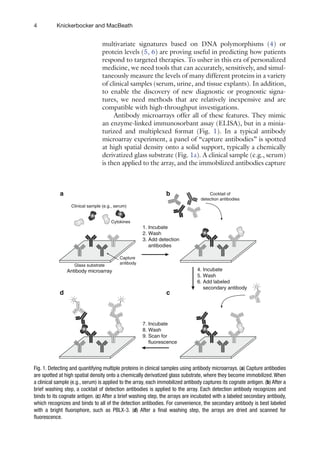
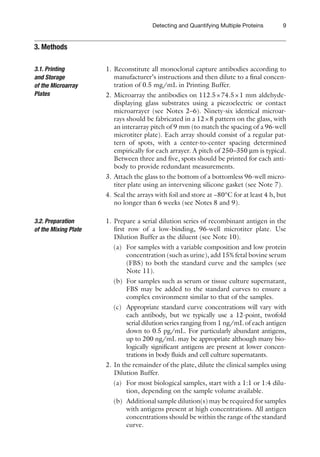
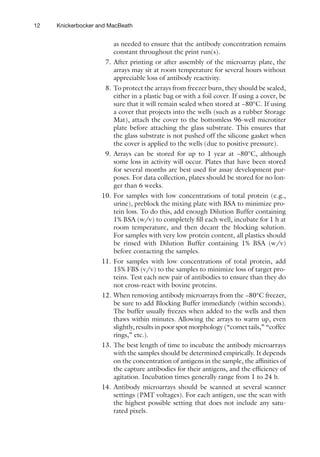
turized and multiplexed format (Fig. 1). In a typical antibody
microarray experiment, a panel of “capture antibodies” is spotted
at high spatial density onto a solid support, typically a chemically
derivatized glass substrate (Fig. 1a). A clinical sample (e.g., serum)
is then applied to the array, and the immobilized antibodies capture
Glass substrate
Capture
antibody
Clinical sample (e.g., serum)
1. Incubate
2. Wash
3. Add detection
antibodies
Cocktail of
detection antibodies
4. Incubate
5. Wash
6. Add labeled
secondary antibody
7. Incubate
8. Wash
9. Scan for
fluorescence
Cytokines
Antibody microarray
a b
c
d
Fig. 1. Detecting and quantifying multiple proteins in clinical samples using antibody microarrays. (a) Capture antibodies
are spotted at high spatial density onto a chemically derivatized glass substrate, where they become immobilized. When
a clinical sample (e.g., serum) is applied to the array, each immobilized antibody captures its cognate antigen. (b) After a
brief washing step, a cocktail of detection antibodies is applied to the array. Each detection antibody recognizes and
binds to its cognate antigen. (c) After a brief washing step, the arrays are incubated with a labeled secondary antibody,
which recognizes and binds to all of the detection antibodies. For convenience, the secondary antibody is best labeled
with a bright fluorophore, such as PBLX-3. (d) After a final washing step, the arrays are dried and scanned for
fluorescence.
5
Detecting and Quantifying Multiple Proteins
their cognate antigens. After a brief washing step, the ­
captured
proteins are detected by applying a cocktail of “detection
antibodies­
” (Fig. 1b). To visualize and quantify the detection anti-
bodies, the arrays are again washed and probed with a labeled
secondary antibody (Fig. 1c).
In a standard ELISA, highly sensitive detection is achieved
using an enzyme label, such as horseradish peroxidase, which
amplifies the signal by catalytically converting a soluble substrate
into a chromophoric product. In an antibody microarray experi-
ment, the final signal must be localized to each spot. A variety of
strategies have been developed to achieve highly sensitive detec-
tion in a spatially localized fashion. For example, the process of
rolling circle replication has been exploited to achieve enzyme-
mediated signal amplification (7, 8). This method enables the
detection of many proteins at concentrations as low as 1 pg/mL.
We have found, however, that equally sensitive detection can be
achieved in a more straightforward fashion without enzyme-
mediated signal amplification using a secondary antibody that has
been coupled directly to an extremely bright fluorophore (9).
(PBXL-3, a phycobilisome protein complex isolated from red
algae and cyanobacteria.)
The biggest limitation of antibody microarrays, as well as
other multiplexed technologies such as the Luminex®
bead-based
immunoassay, is the availability of suitable antibodies. Sandwich-
style immunoassays require two highly specific antibodies that
recognize distinct, nonoverlapping epitopes on their target pro-
teins. For this reason, most studies using antibody microarray
technology have focused on cytokines, chemokines, and other
frequently studied serum protein for which high quality, matched
pairs of antibodies are commercially available (10). To date, anti-
body microarrays have been used to discover multivariate signa-
tures for diagnostic purposes. For example, antibody microarrays
were recently used to detect differential glycosylation patterns on
a variety of serum proteins, which may prove useful for the early
detection of pancreatic cancer (11). Similarly, antibody microar-
rays directed at a large panel of cluster of differentiation (CD)
antigens on leukemias and lymphomas from peripheral blood and
bone marrow aspirates showed high levels of consistency with
diagnoses obtained using conventional clinical and laboratory
­
criteria (12).
In our own lab, we have used antibody microarrays to iden-
tify prognostic markers of early mortality in patients with end-
stage renal disease (ESRD) (9). This study serves as an example
for how antibody microarrays can be used for discovery purposes.
Approximately, 10% of patients with ESRD die within the first
3–4 months of initiating hemodialysis and, to date, no single
marker has been found that accurately predicts outcome. We set
out to develop a multivariate model that predicts which patients
6 Knickerbocker and MacBeath
are most at risk of dying within the first 15 weeks of initiating
treatment. To do this, we collected serum samples from 468
patients initiating dialysis (13). We then assembled a panel of 14
matched pairs of antibodies directed at cytokines and other serum
proteins that had previously been associated with ESRD, hyper-
tension, or diabetes (14). To facilitate the rapid and accurate mea-
surement of all 14 proteins in all 468 patient samples, we developed
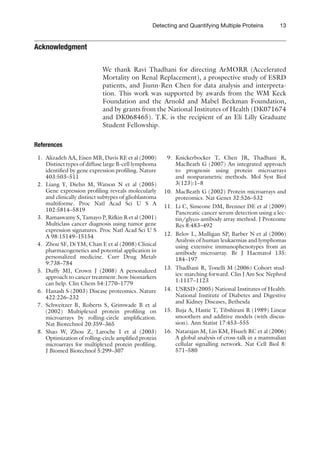
a high-throughput assay in which the capture antibodies were
microarrayed in individual wells of 96-well microtiter plates
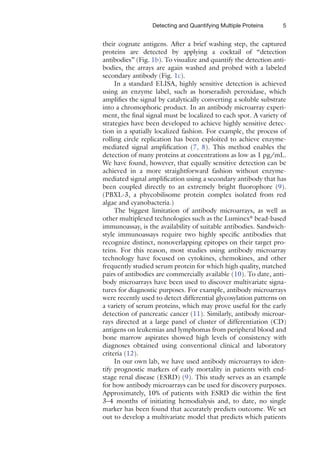
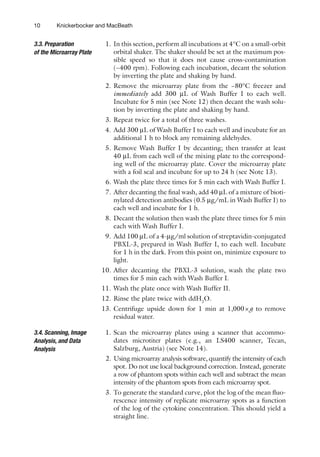
(Fig. 2a). Serum samples were applied to each array and the cap-
tured cytokines were detected using a cocktail of biotinylated
detection antibodies. The detection antibodies were subsequently
visualized and quantified using PBXL-3-labeled streptavidin.
Using this simple procedure, we were able to achieve exquisite
sensitivity: most cytokines could be detected at a concentration of
1 pg/mL (Fig. 2b).
The absolute concentration of each cytokine in each sample
was determined by relating the fluorescence intensity of the
microarray spots to a standard curve, generated for each cytokine
in a multiplexed fashion using one column of each microtiter
plate (Fig. 2a, b). For redundancy, each array contained five rep-
licate spots of the capture antibodies and every sample was ana-
lyzed on two arrays. Overall, the average coefficient of variation
was 6.6% for replicate spots within an array and 11% for replicate
samples on separate arrays. Using these microarrays, cytokine lev-
els were measured in all 468 patient samples (Fig. 2c).
To develop a multivariate prognostic test, we started by build-
ing linear, additive models using logistic regression (9). To avoid
overfitting and to construct a model that incorporates only as
many variables as are necessary, we adopted the following strat-
egy. If n is the number of variables in the model, we started with
n=1 and, in an incremental fashion, performed an exhaustive
search for the best n-variable model. We continued to increment
n until no n-variable model could be found in which all of the
parameters were statistically significant (P    0.05 for each
cytokine). Based on this criterion, the best model was obtained
using three cytokines: angiogenin (Ang), interleukin-12 (IL-12),
and vascular cell adhesion molecule-1 (VCAM-1).
We then refined our efforts by building generalized additive
models (15). As anticipated, the nonparametric models picked up
fine features in the relationship between death risk and each
cytokine (Fig. 2d). We found that high levels of IL-12 and Ang are
associated with low risk of early mortality, whereas increased levels
ofVCAM-1areassociatedwithincreasedriskofdeath.Interestingly,
the three molecular markers are produced by and act on different
cell populations. This may explain why a simple additive model is
sufficient to capture their associations with early mortality.
7
Detecting and Quantifying Multiple Proteins
Cytokines acting on the same cell often exhibit ­
synergistic or
antagonistic effects (16), but IL-12, Ang, and VCAM-1 are, to a
first approximation, independent. We also found in this study that
molecular markers are not uniformly prognostic, but instead vary
in their value depending on a combination of clinical variables
(age, diastolic blood pressure, serum albumin, and method of vas-
cular access) (9). This may explain why previous reports aiming to
Outcome
Ang
EGF
Fet-A
ICAM
IL-12
IL-1α
IL-8
MIP-1β
RANTES
TNF-β
TNFR2
TNFR1
VCAM-1
VEGF
d
a
c
b
1.0
1.5
2.0
2.5
3.0
3.5
4.0
4.5
0.5 1.0 1.5 2.0 2.5 3.0 3.5 4.0
Ang
EGF
Fet-A
ICAM
IL-12
IL-1α
IL-8
MIP-1β
RANTES
TNFβ
TNFR2
TNFR1
VCAM-1
VEGF
Log
10
{
fluorescence
}
Log10 { [cytokine] (pg/mL) }
200 500 1000 2000
−4
−2
0
2
[Ang] (pg/ml)
log-odds
of
death
100 1000 10000
−2
0
2
[VCAM-1] (pg/ml)
log-odds
of
death
1 10 50
−2
−1
0
1
[IL-12] (pg/ml)
log-odds
of
death
Fig. 2. Serum cytokine levels measured using antibody microarrays. (a) 14 anticytokine capture antibodies were spotted
in quintuplicate in each well of a 96-well microtiter plate. Serum samples were applied to each well in columns 1–11 and
twofold serial dilutions of a mixture of the 14 cognate cytokines were applied to the wells in column 12. (b) Standard
curves generated from the purified cytokines in column 12 of the microtiter plate. (c) Serum cytokine levels of 468
patients initiating hemodialysis. For visualization only, each cytokine was normalized relative to its mean over all the
samples and the patients were ordered according to the first principle component of the cytokine profiles. The outcome
of each patient is shown at the top (red died with 15 weeks of initiating dialysis; black survived more than 15 weeks).
(d) Model built using the cytokine levels that represent the best three-variable model.The solid red lines are the mean of
100 bootstrap samples and the dashed black lines show the variance.
8 Knickerbocker and MacBeath
identify prognostic markers without taking into account clinical
variables were either conflicting or showed that markers have mar-
ginal prognostic value.
Just as treatments are now being tailored to specific subsets of
patients, our results show that prognosis can also benefit from a
personalized approach. We anticipate that antibody microarray
technology will play an increasingly important role in biomarker
discovery and may ultimately be used on a routine basis in a clini-
cal setting for the purposes of diagnosis, prognosis, patient selec-
tion in clinical trials, and theragnostics.
1. 10× HBS: 100 mM HEPES, 100 mM NaCl, 0.4% NaN3
,
pH 7.4.
2. Cy3-BSA: Bovine serum albumin (BSA) can be labeled
according to manufacturer’s protocol (Amersham CyDye™
Antibody Labeling Kit, Piscataway, NJ). The Cy3-labeled
BSA may be stored at 4°C wrapped in aluminum foil for
approximately 3 months.
3. Printing Buffer: 1× HBS, 20% glycerol and 0.005 mg/mL
Cy3-labeled BSA. This buffer should be freshly prepared from
stock (1) for each print.
4. Dilution Buffer: The dilution buffer should be made so that
the final concentration of the solution in each well after the
addition of both the dilution buffer and the sample is 10 mM
in HEPES, 10 mM in NaCl, 0.04% NaN3
, pH 7.4. The actual
concentrations of reagents in the dilution buffer will vary
with the amount of sample added to each well.
5. Wash buffer I: 1× HBS with 1% BSA (w/v).
6. Wash buffer II: 1× HBS with 0.1% Tween-20.
1. Aldehyde-displaying glass substrates (112.5×74.5×1mm)
(Erie Scientific Company, Portsmouth, NH).
2. A piezoelectric or contact microarrayer.
3. Bottomless 96-well microtiter plates (Greiner BioOne,
Kremsmünster, Austria).
4. Silicone gaskets (Grace Bio-Labs, Bend, OR).
5. Streptavidin-conjugated PBXL-3 (Martek Biosciences,
Columbia, MD).
6. A small-orbit orbital shaker.
7. A microarray plate scanner.
2. Materials
2.1. Buffers
(see Note 1)
2.2. Additional
Equipment
and Reagents
9
Detecting and Quantifying Multiple Proteins
1. Reconstitute all monoclonal capture antibodies according to
manufacturer’s instructions and then dilute to a final concen-
tration of 0.5 mg/mL in Printing Buffer.
2. Microarray the antibodies on 112.5×74.5×1 mm aldehyde-
displaying glass substrates using a piezoelectric or contact
microarrayer (see Notes 2–6). Ninety-six identical microar-
rays should be fabricated in a 12×8 pattern on the glass, with
an interarray pitch of 9 mm (to match the spacing of a 96-well
microtiter plate). Each array should consist of a regular pat-
tern of spots, with a center-to-center spacing determined
empirically for each arrayer. A pitch of 250–350 mm is typical.
Between three and five, spots should be printed for each anti-
body to provide redundant measurements.
3. Attach the glass to the bottom of a bottomless 96-well micro-
titer plate using an intervening silicone gasket (see Note 7).
4. Seal the arrays with foil and store at −80°C for at least 4 h, but
no longer than 6 weeks (see Notes 8 and 9).
1. Prepare a serial dilution series of recombinant antigen in the
first row of a low-binding, 96-well microtiter plate. Use
Dilution Buffer as the diluent (see Note 10).
(a) For samples with a variable composition and low protein
concentration (such as urine), add 15% fetal bovine serum
(FBS) to both the standard curve and the samples (see
Note 11).
(b) For samples such as serum or tissue culture supernatant,
FBS may be added to the standard curves to ensure a
complex environment similar to that of the samples.
(c) Appropriate standard curve concentrations will vary with
each antibody, but we typically use a 12-point, twofold
serial dilution series ranging from 1 ng/mL of each antigen
down to 0.5 pg/mL. For particularly abundant antigens,
up to 200 ng/mL may be appropriate although many bio-
logically significant antigens are present at lower concen-
trations in body fluids and cell culture supernatants.
2. In the remainder of the plate, dilute the clinical samples using
Dilution Buffer.
(a) For most biological samples, start with a 1:1 or 1:4 dilu-
tion, depending on the sample volume available.
(b) Additional sample dilution(s) may be required for ­
samples
with antigens present at high concentrations. All antigen
concentrations should be within the range of the ­
standard
curve.
3. Methods
3.1. Printing
and Storage
of the Microarray
Plates
3.2. Preparation
of the Mixing Plate
10 Knickerbocker and MacBeath
1. In this section, perform all incubations at 4°C on a ­
small-orbit
orbital shaker. The shaker should be set at the maximum pos-
sible speed so that it does not cause cross-contamination
(~400 rpm). Following each incubation, decant the solution
by inverting the plate and shaking by hand.
2. Remove the microarray plate from the −80°C freezer and
immediately add 300 mL of Wash Buffer I to each well.
Incubate for 5 min (see Note 12) then decant the wash solu-
tion by inverting the plate and shaking by hand.
3. Repeat twice for a total of three washes.
4. Add 300 mL of Wash Buffer I to each well and incubate for an
additional 1 h to block any remaining aldehydes.
5. Remove Wash Buffer I by decanting; then transfer at least
40 mL from each well of the mixing plate to the correspond-
ing well of the microarray plate. Cover the microarray plate
with a foil seal and incubate for up to 24 h (see Note 13).
6. Wash the plate three times for 5 min each with Wash Buffer I.
7. After decanting the final wash, add 40 mL of a mixture of bioti-
nylated detection antibodies (0.5 mg/mL in Wash Buffer I) to
each well and incubate for 1 h.
8. Decant the solution then wash the plate three times for 5 min
each with Wash Buffer I.
9. Add 100 mL of a 4-mg/ml solution of streptavidin-conjugated
PBXL-3, prepared in Wash Buffer I, to each well. Incubate
for 1 h in the dark. From this point on, minimize exposure to
light.
10. After decanting the PBXL-3 solution, wash the plate two
times for 5 min each with Wash Buffer I.
11. Wash the plate once with Wash Buffer II.
12. Rinse the plate twice with ddH2
O.
13. Centrifuge upside down for 1 min at 1,000×g to remove
residual water.
1. Scan the microarray plates using a scanner that accommo-
dates microtiter plates (e.g., an LS400 scanner, Tecan,
Salzburg, Austria) (see Note 14).
2. Using microarray analysis software, quantify the intensity of each
spot. Do not use local background correction. Instead, generate
a row of phantom spots within each well and subtract the mean
intensity of the phantom spots from each microarray spot.
3. To generate the standard curve, plot the log of the mean fluo-
rescence intensity of replicate microarray spots as a function
of the log of the cytokine concentration. This should yield a
straight line.
3.3. Preparation
of the Microarray Plate
3.4. Scanning, Image
Analysis, and Data
Analysis
11
Detecting and Quantifying Multiple Proteins
4. Relate the mean intensity of replicate spots for each antibody
and each clinical sample back to the standard curve to obtain
values for the concentration of each cytokine in each clinical
sample.
5. Calculate the mean concentration of replicate measurements
of each sample (replicate arrays).
1. Unless otherwise noted, all buffers may be stored at room
temperature for up to 1 year or until visible signs of contami-
nation appear.
2. Not all antibodies that work for Western blots and other tech-
niques will work on antibody microarrays. Be sure to validate
each pair of antibodies using purified antigens. Mix all anti-
gens together and use detection antibodies one at a time and
in combination to ensure that detection antibodies do not
cross-react with any of the other analytes under investigation.
R  D Systems (Minneapolis, MN) is an excellent source of
matched pairs of antibodies and their cognate antigens, par-
ticularly for the study of cytokines and chemokines.
3. In general, monoclonal antibodies are used as the capture
antibody while biotinylated polyclonal antibodies are used for
detection. If no monoclonal antibody is available, two poly-
clonal antibodies may be used. Ideally, these two polyclonal
antibodies will have been raised against distinct and nonover-
lapping epitopes.
4. When preparing the source plate, mix the antibody in Printing
Buffer in an eppendorf tube and then transfer it to the source
plate (microtiter plate). This ensures adequate mixing of the
solution and increases reproducibility between wells when
multiple pins are used to print the same sample.
5. In general, we have found aldehyde-displaying glass surfaces
to be more robust and reproducible than epoxide- or amine-
displaying glass, nitrocellulose-coated glass, or hydragels.
6. Pay close attention to the liquid level in the source plate while
fabricatingmicroarrays.Evenwhenusinga384-wellmicrotiter­
plate as a source plate, substantial evaporation can occur
­
during extended print runs. To minimize evaporation, use a
cooling block set to between 4 and 10°C, if available, and set
the relative humidity at 70–80%. If these options are not
available, use an aluminum foil seal with a small hole over
each well to allow tip/pin access. Check the liquid level after
each print run (or more often, if necessary) and add ddH2
O
4. Notes
12 Knickerbocker and MacBeath
as needed to ensure that the antibody concentration remains
constant throughout the print run(s).
7. After printing or after assembly of the microarray plate, the
arrays may sit at room temperature for several hours without
appreciable loss of antibody reactivity.
8. To protect the arrays from freezer burn, they should be sealed,
either in a plastic bag or with a foil cover. If using a cover, be
sure that it will remain sealed when stored at −80°C. If using
a cover that projects into the wells (such as a rubber Storage
Mat), attach the cover to the bottomless 96-well microtiter
plate before attaching the glass substrate. This ensures that
the glass substrate is not pushed off the silicone gasket when
the cover is applied to the wells (due to positive pressure).
9. Arrays can be stored for up to 1 year at −80°C, although
some loss in activity will occur. Plates that have been stored
for several months are best used for assay development pur-
poses. For data collection, plates should be stored for no lon-
ger than 6 weeks.
10. For samples with low concentrations of total protein (e.g.,
urine), preblock the mixing plate with BSA to minimize pro-
tein loss. To do this, add enough Dilution Buffer containing
1% BSA (w/v) to completely fill each well, incubate for 1 h at
room temperature, and then decant the blocking solution.
For samples with very low protein content, all plastics should
be rinsed with Dilution Buffer containing 1% BSA (w/v)
before contacting the samples.
11. For samples with low concentrations of total protein, add
15% FBS (v/v) to the samples to minimize loss of target pro-
teins. Test each new pair of antibodies to ensure than they do
not cross-react with bovine proteins.
12. When removing antibody microarrays from the −80°C freezer,
be sure to add Blocking Buffer immediately (within seconds).
The buffer usually freezes when added to the wells and then
thaws within minutes. Allowing the arrays to warm up, even
slightly, results in poor spot morphology (“comet tails,” “­
coffee
rings,” etc.).
13. The best length of time to incubate the antibody microarrays
with the samples should be determined empirically. It depends
on the concentration of antigens in the sample, the affinities of
the capture antibodies for their antigens, and the efficiency of
agitation. Incubation times generally range from 1 to 24 h.
14. Antibody microarrays should be scanned at several scanner
settings (PMT voltages). For each antigen, use the scan with
the highest possible setting that does not include any satu-
rated pixels.
13
Detecting and Quantifying Multiple Proteins
Acknowledgment
We thank Ravi Thadhani for directing ArMORR (Accelerated
Mortality on Renal Replacement), a prospective study of ESRD
patients, and Jiunn-Ren Chen for data analysis and interpreta-
tion. This work was supported by awards from the WM Keck
Foundation and the Arnold and Mabel Beckman Foundation,
and by grants from the National Institutes of Health (DK071674
and DK068465). T.K. is the recipient of an Eli Lilly Graduate
Student Fellowship.
References
1. Alizadeh AA, Eisen MB, Davis RE et al (2000)
Distinct types of diffuse large B-cell lymphoma
identified by gene expression profiling. Nature
403:503–511
2. Liang Y, Diehn M, Watson N et al (2005)
Gene expression profiling reveals molecularly
and clinically distinct subtypes of glioblastoma
multiforme. Proc Natl Acad Sci U S A
102:5814–5819
3. Ramaswamy S, Tamayo P, Rifkin R et al (2001)
Multiclass cancer diagnosis using tumor gene
expression signatures. Proc Natl Acad Sci U S
A 98:15149–15154
4. Zhou SF, Di YM, Chan E et al (2008) Clinical
pharmacogenetics and potential application in
personalized medicine. Curr Drug Metab
9:738–784
5. Duffy MJ, Crown J (2008) A personalized
approach to cancer treatment: how biomarkers
can help. Clin Chem 54:1770–1779
6. Hanash S (2003) Disease proteomics. Nature
422:226–232
7. Schweitzer B, Roberts S, Grimwade B et al
(2002) Multiplexed protein profiling on
microarrays by rolling-circle amplification.
Nat Biotechnol 20:359–365
8. Shao W, Zhou Z, Laroche I et al (2003)
Optimization of rolling-circle amplified protein
microarrays for multiplexed ­
protein profiling.
J Biomed Biotechnol 5:299–307
9. Knickerbocker T, Chen JR, Thadhani R,
MacBeath G (2007) An integrated approach
to prognosis using protein microarrays
and nonparametric methods. Mol Syst Biol
3(123):1–8
10. MacBeath G (2002) Protein microarrays and
proteomics. Nat Genet 32:526–532
11. Li C, Simeone DM, Brenner DE et al (2009)
Pancreatic cancer serum detection using a lec-
tin/glyco-antibody array method. J Proteome
Res 8:483–492
12. Belov L, Mulligan SP, Barber N et al (2006)
Analysis of human leukaemias and lymphomas
using extensive immunophenotypes from an
antibody microarray. Br J Haematol 135:
184–197
13. Thadhani R, Tonelli M (2006) Cohort stud-
ies: marching forward. Clin J Am Soc Nephrol
1:1117–1123
14. USRSD (2005) National Institutes of Health.
National Institute of Diabetes and Digestive
and Kidney Diseases, Bethesda
15. Buja A, Hastie T, Tibshirani R (1989) Linear
smoothers and additive models (with discus-
sion). Ann Statist 17:453–555
16. Natarajan M, Lin KM, Hsueh RC et al (2006)
A global analysis of cross-talk in a mammalian
cellular signalling network. Nat Cell Biol 8:
571–580
wwwwwwwwwwwwwwww
15
Catherine J. Wu (ed.), Protein Microarray for Disease Analysis: Methods and Protocols, Methods in Molecular Biology, vol. 723,
DOI 10.1007/978-1-61779-043-0_2, © Springer Science+Business Media, LLC 2011
Chapter 2
Analysis of Serum Protein Glycosylation
with Antibody–Lectin Microarray
for High-Throughput Biomarker Screening
Chen Li and David M. Lubman
Abstract
The complexity of carbohydrate structures and their derivatives makes the study of the glycome a
­
challenging subset of proteomic research. The microarray platform has become an essential tool to
­
characterize glycan structure and to study glycosylation-related biological interactions, by using probes
as a means to interrogate the spotted or captured glycosylated molecules on the arrays. The high-
throughput and reproducible nature of microarray platforms have been highlighted by their extensive
applications in the field of biomarker validation, where a large number of samples must be analyzed
­
multiple times. This chapter presents an antibody–lectin microarray approach, which allows the efficient,
multiplexed study of the glycosylation of multiple individual proteins from complex mixtures with both
fluorescence labeling detection and label-free detection based on mass spectrometry.
Key words: Microarray, Antibody, Glycoprotein, Biomarker, Serum, Lectin, MALDI, Mass
spectrometry
Glycosylation is the most commonly occurring posttranslational
modification on proteins involved in numerous biological
­
processes, such as protein–protein interactions, protein folding,
immune recognition, cell adhesion, and intercellular signaling.
The function of glycoproteins is highly dependent on their carbo-
hydrate structure. The alteration on the glycans is associated with
multiple biological events and has been reported in a variety of
diseases, especially cancer (1–4). In the search for effective
­
glycosylated biomarkers for targeted diseases, there has been a
great deal of effort invested in profiling and characterization of
1. Introduction
16 Li and Lubman
­
glycoproteins in complex samples. Cell lines, tissue, and other
types of biofluids have been studied by mass spectrometry,
­
fractionation techniques, and microarrays (5–9). Although a
microarray assay does not usually provide in-depth structural
information on the glycans compared to mass spectrometry, it is
able to identify and quantify numerous glycosylation patterns and
simultaneously analyze hundreds of samples in a high-throughput
manner with excellent reproducibility (9–13).
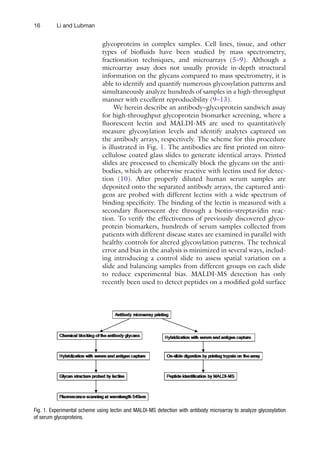
We herein describe an antibody–glycoprotein sandwich assay
for high-throughput glycoprotein biomarker screening, where a
fluorescent lectin and MALDI-MS are used to quantitatively
measure glycosylation levels and identify analytes captured on
the antibody arrays, respectively. The scheme for this procedure
is illustrated in Fig. 1. The antibodies are first printed on nitro-
cellulose coated glass slides to generate identical arrays. Printed
slides are processed to chemically block the glycans on the anti-
bodies, which are otherwise reactive with lectins used for detec-
tion (10). After properly diluted human serum samples are
deposited onto the separated antibody arrays, the captured anti-
gens are probed with different lectins with a wide spectrum of
binding specificity. The binding of the lectin is measured with a
secondary fluorescent dye through a biotin–streptavidin reac-
tion. To verify the effectiveness of previously discovered glyco-
protein biomarkers, hundreds of serum samples collected from
patients with different disease states are examined in parallel with
healthy controls for altered glycosylation patterns. The technical
error and bias in the analysis is minimized in several ways, includ-
ing introducing a control slide to assess spatial variation on a
slide and balancing samples from different groups on each slide
to reduce experimental bias. MALDI-MS detection has only
recently been used to detect peptides on a modified gold surface
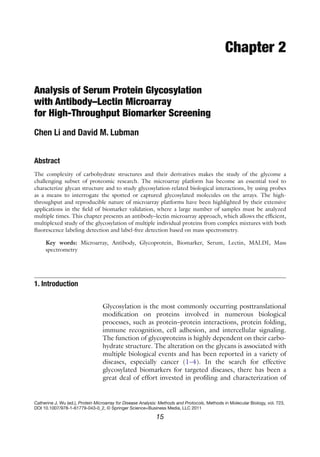
Fig. 1. Experimental scheme using lectin and MALDI-MS detection with antibody microarray to analyze glycosylation
of serum glycoproteins.
17
Analysis of Serum Protein Glycosylation
coated with antibodies (14). An on-slide digestion method,
developed in our previous work (15), exploited the utility of
MALDI-MS to ­
identify antibody-captured proteins. The whole
digestion, including automatic trypsin spotting and incubation,
requires less than 10 min.
While the antibody–lectin sandwich microarray provides a
means to measure glycosylation changes on specific proteins cap-
turedfromcomplexsamplesusinglectinprobesina­
high-throughput
array format, fluorescence-based detection ­
provides limited struc-
tural information and cannot distinguish some ­
glycoforms that
have ­
similar affinity with lectins, such as (GlcNAc)2
(Man)8
and
(GlcNAc)2
(Man)9
. Therefore, the MALDI-MS detection of the
tryptic products of the captured protein on the antibody array serves
as a complementary technique to verify the identity of the target of
the antibody and a means to monitor the nonspecific binding so as
to optimize the dilution fold for the experiment. As such, mass spec-
trometry is a powerful alternative to fluorescent detection, as it con-
firms the identity of the captured analyte and detects any undesired
binding.
1. Monoclonal antibodies, for serum amyloid P component
(SAP; Abcam), Alpha-1-beta glycoprotein (A1BG; Abnova),
Antithrombin III (Abcam).
2. Nanoplotter 2.0 (GeSiM).
3. Nova nitrocellulose slides (GraceBio), PATH nitrocellulose
slides (Gentel).
4. Printing buffer: 30% phosphate buffering saline (PBS), con-
centration of antibody diluted by water to 0.3 mg/mL.
5. 96-Well sample plate (BioRad).
1. Washing buffer: PBS-T 0.1 (0.1% Tween-20).
2. Coupling buffer: 0.02 M sodium acetate, pH 5.5.
3. Oxidation buffer: 0.2 M sodium peroidate in coupling buffer.
4. 4-(4-N-maleimidophenyl)butyric acid hydrazide hydrochlo-
ride (MPBH) (Pierce), Cys–Gly (Sigma).
1. Blocking buffer: 1% w/v BSA in PBS-T 0.5 (0.5% ­
Tween-20).
2. Sample buffer: 0.1% Brij-45, 0.1% Tween-20 in PBS.
3. Primary detection solution: For Aleuria aurentia (AAL),
Maackia amurensis (MAL), Lens culinaris agglutinin (LCA),
2. Materials
2.1. Antibody–Lectin
Microarray with
Fluorescence
Detection
2.1.1. 
Printing
2.1.2. 
Antibody Blocking
2.1.3. Hybridization
of Slides
18 Li and Lubman
and Sambuccus Nigra (SNA) – 10 mg/mL biotinylated lectin
solution in PBS-T 0.1; and for Concanavalin A (ConA),
1 mg/mL lectin in PBS-T 0.1. All biotinylated lectins were
purchased from Vector Laboratories (Burlingame, CA).
4. Washing buffer: PBS-T 0.1 (0.1% Tween-20).
5. Secondary detection solution: 1:1,000 solution of 1 mg/mL
Streptavidin conjugated to Alexafluor555 (Invitrogen) in
PBS-T 0.1.
6. Speedvac.
7. SIMplex Multiplexing system (Gentel).
1. Axon 4000A scanner (Molecular Devices, Sunnyvale, CA).
1. Sequencing grade modified trypsin (Sigma).
2. Acetonitrile (ACN).
3. Ammonia bicarbonate.
4. Oven.
5. Nanoplotter 2.0 (GeSiM).
6. Wetted paper box.
1. MALDI-QIT-TOF (Shimadzu Biotech, Manchester, UK).
2. Trifluoroacetic acid (TFA).
3. 2,5-Dihydroxybenzoic acid (DHB), prepare 10 mg/mL solu-
tion in 50% ACN, 0.1% TFA.
4. Stainless steel plate adaptor.
The number of antibody arrays that can be printed on each slide
is determined by the size of the arrays. The most popular format
involves 16 coated pads on a standard 1×3 in. slide. Each pad is
able to contain more than 9×9 spots with 0.6 mm spacing. For
MALDI-MS detection, the sensitivity is much lower than fluores-
cence. Therefore to generate a spectrum with good S/N, addi-
tional sample needs to be printed on each spot.
1. Antibodies are diluted to 0.5 mg/mL in printing buffer and
transferred to a 96-well sample plate.
2. Edit the spot layout in the NanoPlotter program to produce
a 2×7 format of identical arrays with a 9 mm row and column
distance from each other. The spacing between the spots is
0.6mm.Eachantibodyisprintedintriplicate.ForMALDI-MS
detection, the spacing between the spots is 1.5 mm.
2.1.4. Slide Scanning
2.1.5. On-Slide Digestion
2.1.6. MALDI-QIT-TOF
3. Methods
3.1. Antibody Array
Printing
19
Analysis of Serum Protein Glycosylation
3. Antibody solution is spotted onto nine ultrathin ­
nitrocellulose
coated slides. The first slide is discarded because of high varia-
tion of printing; the other eight are used for the experiment.
Each spotting event results in 500 pL of sample being depos-
ited and is programmed to occur 5 times/spot to ensure that
2.5 nL is being spotted per sample. The spot diameter is
around 250 mm. For MALDI-MS detection, the amount of
antibody on each of the spots in the antibody array is increased
from 5 to 100 droplets. The spot diameter is around 700 mm
(see Note 1).
The IgG antibodies are usually glycosylated (15). The antibody
glycans are reactive to detection lectins, thus need to be modi-
fied. To prevent the reaction between the antibody glycan and
lectin, the antibodies on the slides are chemically derivatized
with a modified method described in the previous work of
Haab (10).
1. The printed slides are dried at room temperature overnight
before gently being washed with PBS-T 0.1 and incubated in
coupling buffer with 0.1% Tween 20 for 10 min. The slides
are washed again with coupling buffer without Tween 20
before oxidation (see Note 2).
2. The slides are incubated in freshly made oxidation solution at
4°C in the dark. After 3 h the slides are removed from the
oxidizing solution and rinsed with coupling buffer with 0.1%
Tween 20 until the white precipitation disappears. The wash-
ing usually takes 30–60 min (see Note 3).
3. The slides are immersed in fresh 1 mM MPBH (in coupling
buffer) at room temperature for 2 h to derivatize the carbonyl
groups, then incubated with 1 mM Cys-Gly (in PBS-T 0.1) at
4°C overnight to stabilize the −SH group on MPBH. The
slides are subsequently blocked with blocking buffer for 1 h
and dried by spinning the slide at 1,000 rpm in a centrifuge
(see Note 4).
Before screening a large number of samples, the optimum con-
centration of the serum is determined by a serial dilution test. In
the dilution test, serum is diluted with sample buffer by 2–600
folds and incubated with different blocks of antibody arrays on
a single slide (details of the experiment in Subheading 3.2.4).
The signal is detected by lectin SNA (or any lectin) and plotted
in Fig. 2. The figure depicts how the intensity of the signal
changes for three antibodies (against Serum Amyloid P compo-
nent, A1BG, and Antithrombin III) with decreasing dilution
fold. A rising trend was noted from the 600× dilution to the
50× dilution for the three glycoproteins shown. In the 50× dilu-
tion to the 20× dilution, the signal was relatively unchanged
3.2. Antibody–Lectin
Array with
Fluorescence
Detection
3.2.1. Antibody Array
Blocking
3.2.2. Optimizing
Conditions
20 Li and Lubman
except for Antithrombin III, where the signal increased 20%
from the 50× dilution to the 20×. The signal remained the same
from the 20× dilution until it reached the 5× dilution, where a
saturation of the signal has occurred. A decrease of signal for all
three glycoproteins from the 5× dilution to the 2× dilution of
serum sample can be seen in Fig. 3, likely due to competing
nonspecific binding on the antibodies.
The result of the dilution test demonstrates that the antibod-
ies were saturated by their target protein at 20× dilution or above
in the process of hybridization. Below 50× dilution, the antibod-
ies were not completely occupied so the signal decreased with
additional dilution. The nonlinear relation between the concen-
tration of the serum and the intensity of the signal could be attrib-
uted to various factors that may affect the antibody–antigen
reaction, including accessibility of the antibodies, diffusion rate,
and solubility of the antigen in the hybridization buffer.
Nonspecific binding on the antibodies was also considered as a
possibility, but was further investigated and excluded by on-target
digestion and MALDI-MS analysis.
To analyze the difference of the glycosylation on potential
biomarker proteins, protein expression levels must be normal-
ized. Under saturation conditions, the amount of target biomark-
ers captured on the antibody spots was equal to the capacity of
the printed antibody which should be the same in all the replicate
blocks. As a result, protein assay is no longer needed and the
intensity of the signal on the microarray directly represents the
level of glycosylation.
Fig.2.Saturation curve showing how the antibodies (against serumAmyloid C component,
A1BG, Antithrombin III) respond to different dilution of serum with SNA lectin detection.
X-axis shows fold serum dilution before hybridization on the antibody array. The y-axis is
the intensity of the signal. Reprinted with permission from Li et al. (15).
21
Analysis of Serum Protein Glycosylation
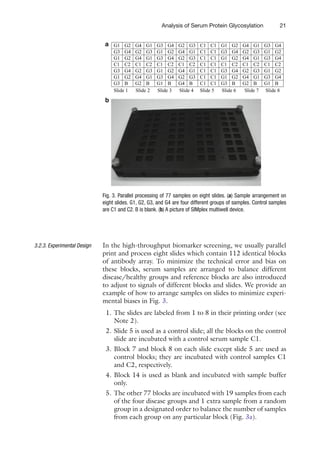
In the high-throughput biomarker screening, we usually parallel
print and process eight slides which contain 112 identical blocks
of antibody array. To minimize the technical error and bias on
these blocks, serum samples are arranged to balance different
­
disease/healthy groups and reference blocks are also introduced
to adjust to signals of different blocks and slides. We provide an
example of how to arrange samples on slides to minimize experi-
mental biases in Fig. 3.
1. The slides are labeled from 1 to 8 in their printing order (see
Note 2).
2. Slide 5 is used as a control slide; all the blocks on the control
slide are incubated with a control serum sample C1.
3. Block 7 and block 8 on each slide except slide 5 are used as
control blocks; they are incubated with control samples C1
and C2, respectively.
4. Block 14 is used as blank and incubated with sample buffer
only.
5. The other 77 blocks are incubated with 19 samples from each
of the four disease groups and 1 extra sample from a random
group in a designated order to balance the number of samples
from each group on any particular block (Fig. 3a).
3.2.3. Experimental Design
G1 G2 G4 G1 G3 G4 G2 G3 C1 C1 G1 G2 G4 G1 G3 G4
G3 G4 G2 G3 G1 G2 G4 G1 C1 C1 G3 G4 G2 G3 G1 G2
G1 G2 G4 G1 G3 G4 G2 G3 C1 C1 G1 G2 G4 G1 G3 G4
C1 C2 C1 C2 C1 C2 C1 C2 C1 C1 C1 C2 C1 C2 C1 C2
G3 G4 G2 G3 G1 G2 G4 G1 C1 C1 G3 G4 G2 G3 G1 G2
G1 G2 G4 G1 G3 G4 G2 G3 C1 C1 G1 G2 G4 G1 G3 G4
G3 B G2 B G1 B G4 B C1 C1 G3 B G2 B G1 B
Slide 1 Slide 2 Slide 3 Slide 4 Slide 5 Slide 6 Slide 7 Slide 8
a
b
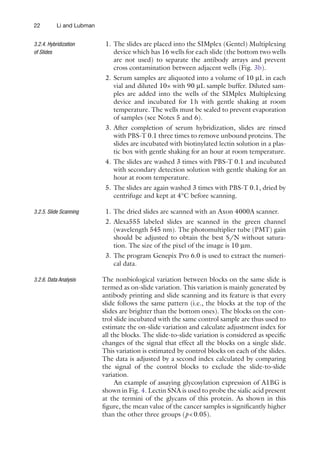
Fig. 3. Parallel processing of 77 samples on eight slides. (a) Sample arrangement on
eight slides. G1, G2, G3, and G4 are four different groups of samples. Control samples
are C1 and C2. B is blank. (b) A picture of SIMplex multiwell device.
22 Li and Lubman
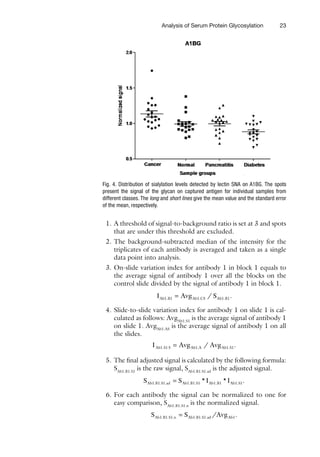
1. The slides are placed into the SIMplex (Gentel) Multiplexing
device which has 16 wells for each slide (the bottom two wells
are not used) to separate the antibody arrays and prevent
cross contamination between adjacent wells (Fig. 3b).
2. Serum samples are aliquoted into a volume of 10 mL in each
vial and diluted 10× with 90 mL sample buffer. Diluted sam-
ples are added into the wells of the SIMplex Multiplexing
device and incubated for 1h with gentle shaking at room
temperature. The wells must be sealed to prevent evaporation
of samples (see Notes 5 and 6).
3. After completion of serum hybridization, slides are rinsed
with PBS-T 0.1 three times to remove unbound proteins. The
slides are incubated with biotinylated lectin solution in a plas-
tic box with gentle shaking for an hour at room temperature.
4. The slides are washed 3 times with PBS-T 0.1 and incubated
with secondary detection solution with gentle shaking for an
hour at room temperature.
5. The slides are again washed 3 times with PBS-T 0.1, dried by
centrifuge and kept at 4°C before scanning.
1. The dried slides are scanned with an Axon 4000A scanner.
2. Alexa555 labeled slides are scanned in the green channel
(wavelength 545 nm). The photomultiplier tube (PMT) gain
should be adjusted to obtain the best S/N without satura-
tion. The size of the pixel of the image is 10 mm.
3. The program Genepix Pro 6.0 is used to extract the numeri-
cal data.
The nonbiological variation between blocks on the same slide is
termed as on-slide variation. This variation is mainly generated by
antibody printing and slide scanning and its feature is that every
slide follows the same pattern (i.e., the blocks at the top of the
slides are brighter than the bottom ones). The blocks on the con-
trol slide incubated with the same control sample are thus used to
estimate the on-slide variation and calculate adjustment index for
all the blocks. The slide-to-slide variation is considered as specific
changes of the signal that effect all the blocks on a single slide.
This variation is estimated by control blocks on each of the slides.
The data is adjusted by a second index calculated by comparing
the signal of the control blocks to exclude the slide-to-slide
variation.
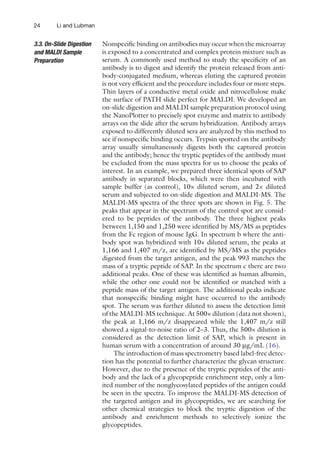
An example of assaying glycosylation expression of A1BG is
shown in Fig. 4. Lectin SNA is used to probe the sialic acid ­
present
at the termini of the glycans of this protein. As shown in this
­
figure, the mean value of the cancer samples is significantly higher
than the other three groups (p0.05).
3.2.4. Hybridization
of Slides
3.2.5. 
Slide Scanning
3.2.6. Data Analysis
23
Analysis of Serum Protein Glycosylation
1. A threshold of signal-to-background ratio is set at 3 and spots
that are under this threshold are excluded.
2. The background-subtracted median of the intensity for the
triplicates of each antibody is averaged and taken as a single
data point into analysis.
3. On-slide variation index for antibody 1 in block 1 equals to
the average signal of antibody 1 over all the blocks on the
control slide divided by the signal of antibody 1 in block 1.
I S
=
Ab1.B1 Ab1.CS Ab1.B1
A g /
v .
4. Slide-to-slide variation index for antibody 1 on slide 1 is cal-
culated as follows: AvgAb1.S1
is the average signal of antibody 1
on slide 1. AvgAb1.AS
is the average signal of antibody 1 on all
the slides.
=
Ab1.S1 S Ab1.A Ab1.S1
Avg / Avg .
I
5. The final adjusted signal is calculated by the following formula:
SAb1.B1.S1
is the raw signal, SAb1.B1.S1.ad
is the adjusted signal.
S S I I
=
Ab1.B1.S1.ad Ab1.B1.S1 Ab1.B1 Ab1.S1
* * .
6. For each antibody the signal can be normalized to one for
easy comparison, SAb1.B1.S1.n
is the normalized signal.
S S
=
Ab1.B1.S1.n Ab1.B1.S1.ad Ab1
/Avg .
Fig. 4. Distribution of sialylation levels detected by lectin SNA on A1BG. The spots
present the signal of the glycan on captured antigen for individual samples from
­
different classes. The long and short lines give the mean value and the standard error
of the mean, respectively.
24 Li and Lubman
Nonspecific binding on antibodies may occur when the ­
microarray
is exposed to a concentrated and complex protein mixture such as
serum. A commonly used method to study the specificity of an
antibody is to digest and identify the protein released from anti-
body-conjugated medium, whereas eluting the captured protein
is not very efficient and the procedure includes four or more steps.
Thin layers of a conductive metal oxide and nitrocellulose make
the surface of PATH slide perfect for MALDI. We developed an
on-slide digestion and MALDI sample preparation protocol using
the NanoPlotter to precisely spot enzyme and matrix to antibody
arrays on the slide after the serum hybridization. Antibody arrays
exposed to differently diluted sera are analyzed by this method to
see if nonspecific binding occurs. Trypsin spotted on the antibody
array usually simultaneously digests both the captured protein
and the antibody; hence the tryptic peptides of the antibody must
be excluded from the mass spectra for us to choose the peaks of
interest. In an example, we prepared three identical spots of SAP
antibody in separated blocks, which were then incubated with
sample buffer (as control), 10× diluted serum, and 2× diluted
serum and subjected to on-slide digestion and MALDI-MS. The
MALDI-MS spectra of the three spots are shown in Fig. 5. The
peaks that appear in the spectrum of the control spot are consid-
ered to be peptides of the antibody. The three highest peaks
between 1,150 and 1,250 were identified by MS/MS as peptides
from the Fc region of mouse IgG. In spectrum b where the anti-
body spot was hybridized with 10× diluted serum, the peaks at
1,166 and 1,407 m/z, are identified by MS/MS as the peptides
digested from the target antigen, and the peak 993 matches the
mass of a tryptic peptide of SAP. In the spectrum c there are two
additional peaks. One of these was identified as human albumin,
while the other one could not be identified or matched with a
peptide mass of the target antigen. The additional peaks indicate
that nonspecific binding might have occurred to the antibody
spot. The serum was further diluted to assess the detection limit
of the MALDI-MS technique. At 500× dilution (data not shown),
the peak at 1,166 m/z disappeared while the 1,407 m/z still
showed a signal-to-noise ratio of 2–3. Thus, the 500× dilution is
considered as the detection limit of SAP, which is present in
human serum with a concentration of around 30 mg/mL (16).
The introduction of mass spectrometry based label-free detec-
tion has the potential to further characterize the glycan structure.
However, due to the presence of the tryptic peptides of the anti-
body and the lack of a glycopeptide enrichment step, only a lim-
ited number of the nonglycosylated peptides of the antigen could
be seen in the spectra. To improve the MALDI-MS detection of
the targeted antigen and its glycopeptides, we are searching for
other chemical strategies to block the tryptic digestion of the
antibody and enrichment methods to selectively ionize the
glycopeptides.
3.3. On-Slide Digestion
and MALDI Sample
Preparation
25
Analysis of Serum Protein Glycosylation
1. Antibody slide is printed and hybridized with diluted serum
as described above.
2. Trypsin is diluted with 50 mM ammonium bicarbonate in
20% ACN and kept on ice before use.
3. Keep the humidity of the Nanoplotter chamber higher than
70% (use a humidifier or lay a wet paper towel on the deck).
Fig. 5. The MALDI-MS spectra generated on the microarray spots of Amyloid p component antibody after on-target
­
digestion.The peaks identified as Amyloid p component were marked with bold arrows where the extra peaks appearing
in (c) were marked with regular arrows. (a) Control spot, without incubation of serum; (b) incubated with10× diluted
serum; (c) incubated with 2× diluted serum. Reprinted with permission from Li et al. (15).
26 Li and Lubman
4. In the program, set the same spot layout on the slide, print
100 droplets (0.5 nL per droplet) of trypsin on each spot (see
Note 7).
5. Move the printed slide to a wet paper box and incubate them
in an oven at 37°C for 5 min. Make sure the trypsin solution
does not dry out on the spots.
6. Take the slide out from the oven, print the DHB solution on
the slide with the same spot layout (50 droplets per spot).
1. Tape the slide onto a stainless steel MALDI plate adaptor,
insert it into the MALDI-MS instrument.
2. Mass spectrometric analysis of the microarray slides was per-
formedusingtheAximaquadrupoleiontrap-TOF.Acquisition
and data processing were controlled by Launchpad software
(Kratos, Manchester, UK). A pulsed N2
laser light (337 nm)
with a pulse rate of 5 Hz was used for ionization. Each profile
resulted from two laser shots. Argon was used as the collision
gas for CID and helium was used for cooling the trapped
ions.
3. TOF was externally calibrated using 500 fmol/mL of bradyki-
ninfragment1–7(757.40m/z),angiotensinII(1046.54m/z),
P14R (1533.86 m/z), and ACTH (2465.20 m/z) (Sigma-
Aldrich). The mass accuracy of the measurement under these
conditions was 50 ppm.
4. The power of the laser is set at 80 to ionize the spots on the
microarray. The focus of the laser can be moved from spot to
spot manually under the camera or by using the Raster func-
tion to set up an automatic scan for all the spots.
1. When the pin on the Nanoplotter is in poor condition or the
instrument is not set up correctly, the quality of antibody
printing may fluctuate or gradually worsen as the printing
continues. Sticky components, such as glycerol, in the
­
antibody printing solution may also cause unstable printing.
A simple test can be done in advance to assess the perfor-
mance of the pin. Print 1,000 spots with a random antibody
on a transparent slide. Observe the residue after the spots are
dried. If the residues are in an intact round shape and their
sizes and colors do not vary significantly, then the printing is
acceptable, otherwise the printer needs to be checked or the
printing solution must be changed.
3.4. 
MALDI-MS
4. 
Notes
27
Analysis of Serum Protein Glycosylation
2. Many types of chemicals can contaminate the nitrocellulose
coating on the slide, resulting in increased background.
The slides should not be labeled with any kind of marker.
A ­
disposable plastic box is a very good container for slide
washing.
3. In the glycan blocking procedure, after the antibody is oxi-
dized by NaIO4
, white precipitation forms on the slides. This
precipitation must be completely washed away before moving
on to the next step.
4. Blocked slides should not be kept in solution for too long,
while dried ones can be stored at 4°C for a long period of
time.
5. Serum sample must be aliquoted immediately upon arrival
and stored at −80°C. Serum frozen and thawed more than
twice should not be used. When the sample set consists of
multiple groups, all the samples must be in the same frozen
and thaw cycle for bias-free comparison.
6. All the incubation should be done with gentle shaking to pre-
vent uneven binding.
7. The higher number of droplets of antibody solution printed
on the slides does not result in a higher density of antibody
on the spot because the coating of the PATH slides is so
thin that a few droplets are able to saturate the surface.
The concern for the minimum amount of antibody solu-
tion printed on each spot is position variation, i.e., repeated
printings on the same spot do not perfectly overlap.
Printing 100 droplets of antibody solution produces a
larger spot size which guarantees a certain area of overlap
between the antibody spot and the printing of trypsin and
matrix.
Acknowledgements
Our work on microarray development described herein has been
supported in part under grants from the National Cancer Institute
under grant NCI R21 12441, R01 CA106402. This work has
also received partial support from the National Institutes of
Health under R01GM49500.
We would like to thank Dr. Brian Haab and Dr. Chen
Songming of the Van Andel Institute for sharing with us the pro-
cedures of preparing the antibody arrays. We would also like to
thank Stephanie Laurinec, Jes Pedroza, and Missy Tuck for col-
lection of the samples used in this work.
28 Li and Lubman
References
1. Rudd PM, Elliott T, Cresswell P, Wilson IA,
Dwek RA (2001) Glycosylation and the
immune system. Science 291:2370–2376
2. Kobata A, Amano J (2005) Altered glycosyla-
tion of proteins produced by malignant cells,
and application for the diagnosis and immu-
notherapy of tumours. Immunol Cell Biol
83:429–439
3. Gessner P, Riedl S, Quentmaier A et al (1993)
(1993) Enhanced activity of cmp-newac-gal-
beta-1–4glcnac-alpha-2, 6-sialyltransferase in
metastasizing human colorectal tumor-tissue
and serum of tumor patients. Cancer Lett
75:143–149
4. Gorelik E, Galili U, Raz A (2001) On the role
of cell surface carbohydrates and their binding
proteins (lectins) in tumor metastasis. Cancer
Metastasis Rev 20:245–277
5. Zhao J, Simeone DM, Heidt D, Anderson
MA, Lubman DM (2006) Comparative serum
glycoproteomics using lectin selected sialic
acid glycoproteins with mass spectrometric
analysis: application to pancreatic cancer
serum. J Proteome Res 5:1792–1802
6. Ressom HW, Varghese RS, Goldman L et al
(2008) Analysis of MALDI-TOF mass spec-
trometry data for discovery of peptide and
glycan biomarkers of hepatocellular carci-
noma. J Proteome Res 7:603–610
7. An HJ, Peavy TR, Hedrick JL et al (2003)
(2003) Determination of N-glycosylation
sites and site heterogeneity in glycoproteins.
Anal Chem 75:5628–5637
8. Block TM, Comunale MA, Lowman M et al
(2005) Use of targeted glycoproteomics to
identify serum glycoproteins that correlate with
liver cancer in woodchucks and humans. Proc
Natl Acad Sci U S A 102:779–784
9. Patwa TH, Zhao J, Anderson MA, Simone
DM et al (2006) Screening of glycosylation
patterns in serum using natural glycoprotein
microarrays and multi-lectin fluorescence
detection. Anal Chem 78:6411–6421
10. Chen SM, LaRoche T, Hamelinck D et al
(2007) Multiplexed analysis of glycan varia-
tion on native proteins captured by antibody
microarrays. Nat Methods 5:437–444
11. Zhao J, Patwa TH, Qiu WL et al (2007)
Glycoprotein microarray with multi-lectin
detection: unique lectin binding patterns as
tools for classifying normal, chronic pancreati-
tis, and pancreatic cancer sera. J Proteome Res
5:1864–1874
12. Wu YM, Nowack DD, Omenn GS et al (2008)
Mucin glycosylation is altered by pro-inflam-
matory signaling in pancreatic-cancer cells.
Pancreas 37:502
13. Yue TT, Goldstein IJ, Hollingsworth MA et al
(2009) The prevalence and nature of glycan
alterations on specific proteins in pancreatic can-
cer patients revealed using antibody-lectin sand-
wich arrays. Mol Cell Proteomics 7:1697–1707
14. Evans-Nguyen KM, Tao SC, Zhu H et al
(2008) Protein arrays on patterned porous
gold substrates interrogated with mass spec-
trometry: detection of peptides in plasma.
Anal Chem 5:1448–1458
15. Li C, Simeone DM, Brenner DE et al (2009)
Pancreatic cancer serum detection using a lec-
tin/glyco-antibody array method. J Proteome
Res 8:483–492
16. Nyboa M, Olsenb H, Jeuneb B et al (1998)
Increased plasma concentration of serum amy-
loidPcomponentincentenarianswithimpaired
cognitive performance. Dement Geriatr Cogn
9:126–129
29
Catherine J. Wu (ed.), Protein Microarray for Disease Analysis: Methods and Protocols, Methods in Molecular Biology, vol. 723,
DOI 10.1007/978-1-61779-043-0_3, © Springer Science+Business Media, LLC 2011
Chapter 3
Antibody Suspension Bead Arrays
Jochen M. Schwenk and Peter Nilsson
Abstract
Alongside the increasing availability of affinity reagents, antibody microarrays have been developed to
become a powerful tool to screen for target proteins in complex samples. Besides multiplexed sandwich
immunoassays, the application of directly applying labeled sample onto arrays with immobilized capture
reagents offers an approach to facilitate a systematic, high-throughput analysis of body fluids such as
serum or plasma. An alternative to commonly used planar arrays has become available in form of a system
based on color-coded beads for the creation of antibody arrays in suspension. The assay procedure offers
an uncomplicated option to screen larger numbers of serum or plasma samples with variable sets of cap-
ture reagents. In addition, the established procedure of whole sample biotinylation circumvents the
purification steps, which are generally required to remove excess labeling substance. We have shown that
this assay system allows detecting proteins down into lower pico-molar and higher picogram per milliliter
levels with dynamic ranges over three orders of magnitude. Presently, this workflow enables the profiling
of 384 clinical samples for up to 100 proteins per assay.
Key words: Suspension bead array, Antibody array, Serum, Plasma, Labeling
The exploration of the human proteome is one of the major
­
challenges of the postgenomics era, focusing on a better under-
standing of disease-related processes (1). Recent developments of
miniaturized and parallelized technology platforms now offer
affinity-based alternatives to widely used mass spectrometric
­
analysis. Among these methods, various protein microarrays have
been implemented into proteomic profiling approaches demon-
strating their applicability in high-throughput screening for
marker proteins in patient samples (2). Two alternative formats
have been developed; reverse-phase microarrays, where large
numbers of lysates from tissues and cells or serum samples are
spotted onto array surfaces for the parallel analysis of a single
1. 
Introduction
30 Schwenk and Nilsson
parameter, and the forward-phase setting, such as multiplexed
sandwich immunoassays or antibody arrays, which both utilize
immobilized capture reagents to analyze many parameters (3).
While dedicated robotic devices, which arrange molecules on
microscopic slides with functionalized surfaces, are needed pro-
duce planar protein microarrays, alternative platforms have been
employed for a parallelized and miniaturized analysis. One of
these is based on a flow cytometeric system that currently allows
to determine the identity of up to 500 color-coded micrometer
sized beads in cooccurrence to protein interaction dependent
reporter fluorescence (4). Arrays are thereby created in suspen-
sion by mixing beads with different codes, denoted here as bead
IDs, and immobilized capturing reagents. This platform has
recently been utilized to adapt the concept of antibody arrays
from previously described planar arrays (5). The described work-
flow, summarized in Fig. 1, offers a microtiter plate-based alter-
native to methods based on planar microarrays for the analysis of
labeled serum and plasma protein profiling and can be used for
highly multiplexing in both the dimension of parameters mea-
sured per sample as well as samples studied per analysis. An exam-
ple of a protein profile obtained from this approach is given in
Fig. 2. Here, intensity levels over more that two orders of magni-
tude and a low intensity variability of £20% are observed.
1. Beads: MagPlex or MicroPlex microspheres (Luminex Corp).
2. Activation buffer (1×): 100 mM Monobasic Sodium
Phosphate (Sigma), pH 6.2, stored at +4°C for up to 3
months and at −20°C for long term.
3. EDC solution: 1-ethyl-3-(3-dimethylaminopropyl) carbodi-
imide hydrochloride (EDC, Pierce), aliquoted in screw-
capped tubes and stored at +4°C. Dissolve in activation buffer
to 50 mg/ml directly prior usage.
4. S-NHS solution: 50 mg/ml Sulfo-N-Hydroxysuccinimide
(NHS, Pierce), prepared as aliquots in screw-capped tubes
and stored at −20°C. Dissolve in activation buffer to final
concentration directly prior usage.
5. Coupling buffer: 100 mM 2-(N-morpholino)ethanesulfonic acid
(MES) pH 5.0, stored at +4°C for up to 3 months and at −20°C
for long term.
6. Wash buffer: 0.05% (v/v) Tween20 in 1× PBS pH 7.4 (PBST).
7. Antibody detection solution: 0.25 mg/ml R-Phycoerythrin
modified antispecies antibodies (e.g., Jackson), diluted to this
concentration in PBST (see Note 1).
2. 
Materials
2.1. 
Bead Coupling
31
Antibody Suspension Bead Arrays
1. Sample dilution buffer: 1× PBS pH 7.4.
2. Labeling solution: 10 mg/ml Sulfo-N-Hydroxysuccinimide-
polyethylene oxide biotin (NHS-PEO4
-Biotin, Pierce), dissolved
in dimethyl sulfoxide (DMSO, Sigma) directly before use.
3. Stop solution: 1 M Tris–HCl pH 8.0, stored at +4°C and
added cold.
1. Assay buffer (1×): 0.1% (w/v) casein, 0.5% (w/v) polyvinylalco-
hol, and 0.8% (w/v) polyvinylpyrrolidone (all Sigma), prepared
in PBST and stored at +4°C for up to 3 months and at −20°C for
the long term. Supplement before use with 0.5 mg/ml rabbit
IgG (Bethyl).
2.2. 
Sample Labeling
2.3. 
Assay Procedure
Fig. 1. Workflow overview.
32 Schwenk and Nilsson
2. Stop solution (4×): 4% paraformaldehyde (PFA) solution, to
store at +4°C. Dilute 1:4 in PBS prior to usage.
3. Detection solution: R-Phycoerythrin modified streptavidin
(Invitrogen) diluted to 0.5 mg/ml in PBST directly before
use and protected from light.
In the following, a method for antibody coupling is described, for
which magnetic and nonmagnetic beads can be utilized. The
main difference between these two bead types is the handling of
the beads during an exchange of surrounding liquid solution. For
coupling quantities not exceeding the amount of positions found
in bench top microcentrifuges, we suggest using microcentrifuge
tubes or tubes with filter inserts to pellet the beads via centrifuga-
tion, while magnetic beads can additionally be manipulated by
magnetic forces without centrifugation. For more than 24 cou-
plings in parallel, microtiter plate based protocols are preferred.
Hereby, proteins can be immobilized on nonmagnetic beads in
filter bottomed microtiter plates (Millipore) with a filter pore
sizes below bead diameter and vacuum devices (Millipore) accom-
modate these plates to remove liquid. For magnetic bead cou-
pling in plates, dedicated plate magnets are available (LifeSept,
Dexter Magnetic Technologies) to facilitate bead sedimentation
and fixation.
1. Prepare antibodies at the desired concentration (e.g., 3 mg or
a solution with antibody concentration of 30 mg/ml per
1×10⁶
beads) in coupling buffer (see Note 2).
3. 
Methods
3.1. 
Bead Coupling
1
10
100
1000
10000
MFI
[AU]
Antibodies
A
b
-
6
5
A
b
-
6
0
A
b
-
5
5
A
b
-
5
0
A
b
-
4
5
A
b
-
4
0
A
b
-
3
5
A
b
-
3
0
A
b
-
2
5
A
b
-
2
0
A
b
-
1
5
A
b
-
1
0
A
b
-
0
5
A
b
-
0
1
Fig. 2. Intensity profile of a plasma sample. A bead mixture composed of 68 antibodies was employed to determine
intensity levels for the targeted proteins in a plasma sample. Such profiles typically cover intensity range over more than
two orders of magnitude (50–20,000 AU). Standard deviations of £20% can be commonly obtained from replicates.
33
Antibody Suspension Bead Arrays
2. The beads are to be distributed in desired portions (e.g.,
80 ml=1×10⁶
beads) into the wells of a half-area plate and the
beads are washed with 3× 100 ml activation buffer (see Note 3).
3. Prepare fresh solutions of NHS and EDC, both at 50 mg/ml
in activation buffer. Prepare 0.5 mg of each chemical per bead
ID and coupling, and add 10 ml NHS, 10 ml EDC, and 80 ml
activation buffer to each bead ID.
4. Incubate 20 min under continuous, gentle shaking, and wash
thereafter with 3× 100 ml coupling buffer.
5. Continue without interruption (see Note 4) by adding the
antibody solution to the activated beads and incubate for 2 h
under continuous, gentle shaking.
6. The beads are washed 3× with 100 ml wash buffer.
7. The beads are then recovered from the wells into microcen-
trifuge tubes with 3× 100 ml wash buffer. The liquid is
removed and 100 ml storage buffer is added prior to the bead
storage at +4°C in the dark for at least 1 h.
The yield of antibodies immobilized on beads should be judged
after the coupling. To allow a balanced and economic amount of
beads to be applied and counted during the measurements, equal
numbers of beads should be combined in a bead mixture. To
facilitate this, the beads can be counted and an initial bead con-
centration can be determined which allows calculating the
required volumes to be added in a common stock solution.
During this bead counting procedure, the rate of antibody immo-
bilization can be additionally approximated via fluorescently
labeled antispecies specific antibodies.
1. The tubes with antibody-coupled beads are to be vortexed
and sonicated for 5 min.
2. Each bead solution is diluted 1/100 in antibody detection
solution (see Notes 1 and 5) in a microtiter plate.
3. The plates are incubated for 20 min and measured.
4. The number of counts per bead ID is multiplied by a correc-
tion factor of 3.3 for a 1/100 dilution to obtain a first estima-
tion of beads per microliter storage solution. From this
number the volumes of beads in storage solution can be cal-
culated which are to be applied into the bead mixture. The
required number of beads supplied should be adjusted for
each assay procedure and be based on the quantity of beads
being counted by the instruments. We suggest to always
obtain ³32 counts per bead ID.
5. After each measurement and for the preparation of new bead
mixtures, the count average is to be calculated for each bead
ID and new volumes can be determined. We suggest adjusting
3.2. Bead Mixture
Preparation
34 Schwenk and Nilsson
these volumes to a theoretical bead count, which is 20% above
the estimate: For 100 beads to be counted from the new bead
mixture, the previously obtained volumes should be calculated
for 120 beads per assay and bead ID.
1. The serum or plasma samples are to be thawed according to
the preferred protocol (see Note 6).
2. The samples are vortexed and centrifuged for 10 min at
10,000×g to pellet insoluble components.
3. A previously designed plate layout, in which samples should
be located randomly, is followed by transfer of 30 ml of serum/
plasma into the respective wells of a PCR plate, which is then
sealed and centrifuged for 2 min at 1,500×g.
4. As an option, the samples are incubated for 30 min at elevated
temperatures such as 56°C (see Note 7) followed by 15 min
at 20°C using in a thermo cycler. Using the heated lid func-
tion of the cycler helps to prevent the samples to evaporate
into the lid/seal.
5. Transfer 3 ml into a second PCR plate containing 27 ml PBS,
seal the plate, vortex, and centrifuge for 2 min at 1,500×g.
6. Add 2.5 ml of NHS-Biotin to each well (see Note 8), then seal
the plate, vortex and centrifuge for 2 min at 1,500×g, and
incubate for 2 h at 4°C under continuous shaking in a micro-
titer plate mixer.
7. Add 25 ml of 1 M Tris–HCl pH 8.0 to each well, seal the
plate, vortex, and centrifuge for 2 min at 1,500×g.
8. Store the plates at −20°C until usage or use directly.
1. The labeled samples are thawed and diluted 1/50 in assay
buffer, which had been prepared in a PCR plate. Seal the
plate, vortex, and centrifuge for 2 min at 1,500×g.
2. The samples incubated for 30 min. As an option, the samples
are treated for 30 min at elevated temperatures such as 56°C
(see Note 7), followed by 15 min at 20°C using the heated lid
function of the thermo cycler. Thereafter, the plate is vor-
texed and centrifuged for 2 min at 1,500×g.
3. The previously prepared bead mixture is distributed into the
wells of a half-area plate and protected from light. Then 45 ml
of the diluted, labeled samples are added to the wells (see
Note 5) and incubated at 23°C over night under continuous
shaking on a microtiter plate mixer.
4. The plates are then washed 3× with 75 ml wash buffer, incu-
bated with stop solution for 10 min and washed 1× with 75 ml
wash buffer again.
3.3. 
Sample Labeling
3.4. 
Assay Procedure
35
Antibody Suspension Bead Arrays
5. R-PE labeled streptavidin is then added to each well at
0.5 mg/ml and 30 ml and the plates are incubated for 20 min
under continuous shaking.
6. The plates are then finally washed 3× with 75 ml wash buffer
and 100 ml of wash buffer are added before the plates are
measured with the Luminex instrumentation.
7. Set the instrumentation setting according to the bead IDs
included in the mixture and count at least 50 beads per bead ID.
We suggest using the “median fluorescence intensity” to further
process your data. An example of a plasma protein profile is
shown in Fig. 2.
1. Other fluorescent dyes than R-Phycoerythrin such as
Alexa546, Alexa532, or Cy3 can be utilized as well, but
Luminex Corp. has indicated that lower reporter signal inten-
sities are to be observed.
2. Employ solutions of purified proteins and avoid other stabi-
lizing proteins, Tris or other amine-based buffers as they
reduce the coupling efficiency.
3. At all times, try to minimize the light exposure, especially to
direct sunlight, as the internal fluorescence of the beads as
well as reporter fluorophores could be bleached. During
incubation, protect the plates with an opaque cover or place
plate into a light-tight box.
4. Do not interrupt the activation process after dissolving EDC
and NHS, as these active substances are susceptible to hydro-
lysis resulting in a loss in activity.
5. When combining beads with solutions for counting and assay
procedure, always distribute small volume bead solution (e.g.,
5 ml) into the well first, then add larger volume buffer portion
(e.g., 45 ml) to allow an instant distribution of the beads.
6. We have found that thawing overnight at +4°C was most
practical if a larger number of samples were to be processed.
Otherwise, place tube(s) into a 42°C water bath until a minor
fraction of ice was still visible.
7. We have observed that heat treatment of labeled samples in
combination with the applied multiplexed assay procedure affects
antibody performance (5). This can lead to improved protein
detectability by changing the accessibility of the epitopes in a
complex sample solution but should be tested and balanced with
the tendency of proteins to precipitate at higher temperatures.
4. 
Notes
Other documents randomly have
different content
The Project Gutenberg eBook of In the Days of
Giants: A Book of Norse Tales
This ebook is for the use of anyone anywhere in the United
States and most other parts of the world at no cost and with
almost no restrictions whatsoever. You may copy it, give it away
or re-use it under the terms of the Project Gutenberg License
included with this ebook or online at www.gutenberg.org. If you
are not located in the United States, you will have to check the
laws of the country where you are located before using this
eBook.
Title: In the Days of Giants: A Book of Norse Tales
Author: Abbie Farwell Brown
Illustrator: E. Boyd Smith
Release date: January 8, 2014 [eBook #44622]
Most recently updated: October 23, 2024
Language: English
Credits: Produced by David Edwards, Charlie Howard, and the
Online
Distributed Proofreading Team at http://www.pgdp.net
(This
file was produced from images generously made
available
by The Internet Archive)
*** START OF THE PROJECT GUTENBERG EBOOK IN THE DAYS OF
GIANTS: A BOOK OF NORSE TALES ***
By Abbie Farwell Brown
SONGS OF SIXPENCE. Illustrated.
THEIR CITY CHRISTMAS. Illustrated.
THE CHRISTMAS ANGEL. Illustrated.
JOHN OF THE WOODS. Illustrated.
FRESH POSIES. Illustrated.
FRIENDS AND COUSINS. Illustrated.
BROTHERS AND SISTERS. Illustrated.
THE STAR JEWELS AND OTHER WONDERS. Illustrated.
THE FLOWER PRINCESS. Illustrated.
THE CURIOUS BOOK OF BIRDS. Illustrated.
A POCKETFUL OF POSIES. Illustrated.
IN THE DAYS OF GIANTS. Illustrated.
THE BOOK OF SAINTS AND FRIENDLY BEASTS. Illustrated.
THE LONESOMEST DOLL. Illustrated.
HOUGHTON MIFFLIN COMPANY
Boston and New York
IN THE DAYS OF GIANTS
I AM THE GIANT SKRYMIR
(page 150)
IN THE DAYS OF
GIANTS A BOOK OF
NORSE TALES BY ABBIE
FARWELL BROWN
WITH
ILLUSTRATIONS
BY E. BOYD SMITH
HOUGHTON MIFFLIN COMPANY
BOSTON AND NEW YORK
COPYRIGHT 1902 BY ABBIE FARWELL BROWN. ALL RIGHTS RESERVED
Published April, 1902
N
OW I LIKE A REALLY GOOD SAGA,
ABOUT GODS AND GIANTS, AND THE
FIRE KINGDOMS, AND THE SNOW
KINGDOMS, AND THE ÆSIR MAKING MEN
AND WOMEN OUT OF TWO STICKS, AND
ALL THAT.
KINGSLEY'S HYPATIA
CONTENTS
PAGE
I. The Beginning of Things 1
II. How Odin Lost His Eye 11
III. Kvasir's Blood 21
IV. The Giant Builder 35
V. The Magic Apples 50
VI. Skadi's Choice 70
VII. The Dwarf's Gifts 80
VIII. Loki's Children 98
IX. The Quest of the Hammer 110
X. The Giantess Who Would Not 132
XI. Thor's Visit to the Giants 146
XII. Thor's Fishing 172
XIII. Thor's Duel 192
XIV. In the Giant's House 208
XV. Balder and the Mistletoe 226
XVI. The Punishment of Loki 243
Six of these Tales, namely, The Magic Apples, The Dwarf's Gifts,
The Quest of the Hammer, In the Giant's House, Balder and the
Mistletoe, and The Punishment of Loki are, by the courteous
permission of the publishers of The Churchman, reprinted from that
magazine.
ILLUSTRATIONS
PAGE
I am the giant Skrymir (page 150) Frontispiece
He flapped away with her, magic
apples and all 62
The third gift—an enormous hammer 88
Ah, what a lovely maid it is! 122
Each arrow overshot his head 232
Kill him! Kill him! 256
IN THE DAYS OF GIANTS
T
THE BEGINNING OF THINGS
he oldest stories of every race of people tell about the
Beginning of Things. But the various folk who first told
them were so very different, the tales are so very old, and
have changed so greatly in the telling from one generation
to another, that there are almost as many accounts of the way in
which the world began as there are nations upon the earth. So it is
not strange that the people of the North have a legend of the
Beginning quite different from that of the Southern, Eastern, and
Western folk.
This book is made of the stories told by the Northern folk,—the
people who live in the land of the midnight sun, where summer is
green and pleasant, but winter is a terrible time of cold and gloom;
where rocky mountains tower like huge giants, over whose heads
the thunder rolls and crashes, and under whose feet are mines of
precious metals. Therefore you will find the tales full of giants and
dwarfs,—spirits of the cold mountains and dark caverns.
You will find the hero to be Thor, with his thunderbolt hammer,
who dwells in the happy heaven of Asgard, where All-Father Odin is
king, and where Balder the beautiful makes springtime with his
smile. In the north countries, winter, cold, and frost are very real and
terrible enemies; while spring, sunshine, and warmth are near and
dear friends. So the story of the Beginning of Things is a story of
cold and heat, of the wicked giants who loved the cold, and of the
good Æsir, who basked in pleasant warmth.
In the very beginning of things, the stories say, there were two
worlds, one of burning heat and one of icy cold. The cold world was
in the north, and from it flowed Elivâgar, a river of poisonous water
which hardened into ice and piled up into great mountains, filling the
space which had no bottom. The other world in the south was on
fire with bright flame, a place of heat most terrible. And in those
days through all space there was nothing beside these two worlds of
heat and cold.
But then began a fierce combat. Heat and cold met and strove
to destroy each other, as they have tried to do ever since. Flaming
sparks from the hot world fell upon the ice river which flowed from
the place of cold. And though the bright sparks were quenched, in
dying they wrought mischief, as they do to-day; for they melted the
ice, which dripped and dripped, like tears from the suffering world of
cold. And then, wonderful to say, these chilly drops became alive;
became a huge, breathing mass, a Frost-Giant with a wicked heart
of ice. And he was the ancestor of all the giants who came
afterwards, a bad and cruel race.
At that time there was no earth nor sea nor heaven, nothing but
the icy abyss without bottom, whence Ymir the giant had sprung.
And there he lived, nourished by the milk of a cow which the heat
had formed. Now the cow had nothing for her food but the snow
and ice of Elivâgar, and that was cold victuals indeed! One day she
was licking the icy rocks, which tasted salty to her, when Ymir
noticed that the mass was taking a strange shape. The more the
cow licked it, the plainer became the outline of the shape. And when
evening came Ymir saw thrusting itself through the icy rock a head
of hair. The next day the cow went on with her meal, and at night-
time a man's head appeared above the rock. On the third day the
cow licked away the ice until forth stepped a man, tall and powerful
and handsome. This was no evil giant, for he was good; and,
strangely, though he came from the ice his heart was warm. He was
the ancestor of the kind Æsir; for All-Father Odin and his brothers
Vili and Ve, the first of the gods, were his grandsons, and as soon as
they were born they became the enemies of the race of giants.
Now after a few giant years,—ages and ages of time as we
reckon it,—there was a great battle, for Odin and his brothers
wished to destroy all the evil in the world and to leave only good.
They attacked the wicked giant Ymir, first of all his race, and after
hard fighting slew him. Ymir was so huge that when he died a
mighty river of blood flowed from the wounds which Odin had given
him; a stream so large that it flooded all space, and the frost-giants,
his children and grandchildren, were drowned, except one who
escaped with his wife in a chest. And but for the saving of these
two, that would have been the end of the race of giants.
All-Father and his brothers now had work to do. Painfully they
dragged the great bulk of Ymir into the bottomless space of ice, and
from it they built the earth, the sea, and the heavens. Not an atom
of his body went to waste. His blood made the great ocean, the
rivers, lakes, and springs. His mighty bones became mountains. His
teeth and broken bones made sand and pebbles. From his skull they
fashioned the arching heaven, which they set up over the earth and
sea. His brain became the heavy clouds. His hair sprouted into trees,
grass, plants, and flowers. And last of all, the Æsir set his bristling
eyebrows as a high fence around the earth, to keep the giants away
from the race of men whom they had planned to create for this
pleasant globe.
So the earth was made. And next the gods brought light for the
heavens. They caught the sparks and cinders blown from the world
of heat, and set them here and there, above and below, as sun and
moon and stars. To each they gave its name and told what its duties
were to be, and how it must perform them, day after day, and year
after year, and century after century, till the ending of all things; so
that the children of men might reckon time without mistake.
Sôl and Mâni, who drove the bright chariots of the sun and
moon across the sky, were a fair sister and brother whose father
named them Sun and Moon because they were so beautiful. So Odin
gave them each a pair of swift, bright horses to drive, and set them
in the sky forever. Once upon a time,—but that was many, many
years later,—Mâni, the Man in the Moon, stole two children from the
earth. Hiuki and Bil were going to a well to draw a pail of water. The
little boy and girl carried a pole and a bucket across their shoulders,
and looked so pretty that Mâni thrust down a long arm and snatched
them up to his moon. And there they are to this day, as you can see
on any moonlight night,—two little black shadows on the moon's
bright face, the boy and the girl, with the bucket between them.
The gods also made Day and Night. Day was fair, bright, and
beautiful, for he was of the warm-hearted Æsir race. But Night was
dark and gloomy, because she was one of the cold giant-folk. Day
and Night had each a chariot drawn by a swift horse, and each in
turn drove about the world in a twenty-four hours' journey. Night
rode first behind her dark horse, Hrîmfaxi, who scattered dew from
his bit upon the sleeping earth. After her came Day with his beautiful
horse, Glad, whose shining mane shot rays of light through the sky.
All these wonders the kind gods wrought that they might make a
pleasant world for men to call their home. And now the gods, or
Æsir as they were called, must choose a place for their own
dwelling, for there were many of them, a glorious family. Outside of
everything, beyond the great ocean which surrounded the world,
was Jotunheim, the cold country where the giants lived. The green
earth was made for men. The gods therefore decided to build their
city above men in the heavens, where they could watch the doings
of their favorites and protect them from the wicked giants. Asgard
was to be their city, and from Asgard to Midgard, the home of men,
stretched a wonderful bridge, a bridge of many colors. For it was the
rainbow that we know and love. Up and down the rainbow bridge
the Æsir could travel to the earth, and thus keep close to the doings
of men.
Next, from the remnants of Ymir's body the gods made the race
of little dwarfs, a wise folk and skillful, but in nature more like the
giants than like the good Æsir; for they were spiteful and often
wicked, and they loved the dark and the cold better than light and
warmth. They lived deep down below the ground in caves and rocky
dens, and it was their business to dig the precious metals and
glittering gems that were hidden in the rocks, and to make
wonderful things from the treasures of the under-world. Pouf! pouf!
went their little bellows. Tink-tank! went their little hammers on their
little anvils all day and all night. Sometimes they were friendly to the
giants, and sometimes they did kindly deeds for the Æsir. But always
after men came upon the earth they hated these new folk who
eagerly sought for the gold and the jewels which the dwarfs kept
hidden in the ground. The dwarfs lost no chance of doing evil to the
race of men.
Now the gods were ready for the making of men. They longed to
have a race of creatures whom they could love and protect and bless
with all kinds of pleasures. So Odin, with his brothers Hœnir and
Loki, crossed the rainbow bridge and came down to the earth. They
were walking along the seashore when they found two trees, an ash
and an elm. These would do as well as anything for their purpose.
Odin took the two trees and warmly breathed upon them; and lo!
they were alive, a man and a woman. Hœnir then gently touched
their foreheads, and they became wise. Lastly Loki softly stroked
their faces; their skin grew pink with ruddy color, and they received
the gifts of speech, hearing, and sight. Ask and Embla were their
names, and the ash and the elm became the father and mother of
the whole human race whose dwelling was Midgard, under the eyes
of the Æsir who had made them.
This is the story of the Beginning of Things.
I
HOW ODIN LOST HIS EYE
n the beginning of things, before there was any world or sun,
moon, and stars, there were the giants; for these were the
oldest creatures that ever breathed. They lived in Jotunheim,
the land of frost and darkness, and their hearts were evil.
Next came the gods, the good Æsir, who made earth and sky and
sea, and who dwelt in Asgard, above the heavens. Then were
created the queer little dwarfs, who lived underground in the
caverns of the mountains, working at their mines of metal and
precious stones. Last of all, the gods made men to dwell in Midgard,
the good world that we know, between which and the glorious home
of the Æsir stretched Bifröst, the bridge of rainbows.
In those days, folk say, there was a mighty ash-tree named
Yggdrasil, so vast that its branches shaded the whole earth and
stretched up into heaven where the Æsir dwelt, while its roots sank
far down below the lowest depth. In the branches of the big ash-
tree lived a queer family of creatures. First, there was a great eagle,
who was wiser than any bird that ever lived—except the two ravens,
Thought and Memory, who sat upon Father Odin's shoulders and
told him the secrets which they learned in their flight over the wide
world. Near the great eagle perched a hawk, and four antlered deer
browsed among the buds of Yggdrasil. At the foot of the tree coiled
a huge serpent, who was always gnawing hungrily at its roots, with
a whole colony of little snakes to keep him company,—so many that
they could never be counted. The eagle at the top of the tree and
the serpent at its foot were enemies, always saying hard things of
each other. Between the two skipped up and down a little squirrel, a
tale-bearer and a gossip, who repeated each unkind remark and, like
the malicious neighbor that he was, kept their quarrel ever fresh and
green.
In one place at the roots of Yggdrasil was a fair fountain called
the Urdar-well, where the three Norn-maidens, who knew the past,
present, and future, dwelt with their pets, the two white swans. This
was magic water in the fountain, which the Norns sprinkled every
day upon the giant tree to keep it green,—water so sacred that
everything which entered it became white as the film of an eggshell.
Close beside this sacred well the Æsir had their council hall, to which
they galloped every morning over the rainbow bridge.
But Father Odin, the king of all the Æsir, knew of another
fountain more wonderful still; the two ravens whom he sent forth to
bring him news had told him. This also was below the roots of
Yggdrasil, in the spot where the sky and ocean met. Here for
centuries and centuries the giant Mimer had sat keeping guard over
his hidden well, in the bottom of which lay such a treasure of
wisdom as was to be found nowhere else in the world. Every
morning Mimer dipped his glittering horn Giöll into the fountain and
drew out a draught of the wondrous water, which he drank to make
him wise. Every day he grew wiser and wiser; and as this had been
going on ever since the beginning of things, you can scarcely
imagine how wise Mimer was.
Now it did not seem right to Father Odin that a giant should
have all this wisdom to himself; for the giants were the enemies of
the Æsir, and the wisdom which they had been hoarding for ages
before the gods were made was generally used for evil purposes.
Moreover, Odin longed and longed to become the wisest being in the
world. So he resolved to win a draught from Mimer's well, if in any
way that could be done.
One night, when the sun had set behind the mountains of
Midgard, Odin put on his broad-brimmed hat and his striped cloak,
and taking his famous staff in his hand, trudged down the long
bridge to where it ended by Mimer's secret grotto.
Good-day, Mimer, said Odin, entering; I have come for a drink
from your well.
The giant was sitting with his knees drawn up to his chin, his
long white beard falling over his folded arms, and his head nodding;
for Mimer was very old, and he often fell asleep while watching over
his precious spring. He woke with a frown at Odin's words. You
want a drink from my well, do you? he growled. Hey! I let no one
drink from my well.
Nevertheless, you must let me have a draught from your
glittering horn, insisted Odin, and I will pay you for it.
Oho, you will pay me for it, will you? echoed Mimer, eyeing his
visitor keenly. For now that he was wide awake, his wisdom taught
him that this was no ordinary stranger. What will you pay for a drink
from my well, and why do you wish it so much?
I can see with my eyes all that goes on in heaven and upon
earth, said Odin, but I cannot see into the depths of ocean. I lack
the hidden wisdom of the deep,—the wit that lies at the bottom of
your fountain. My ravens tell me many secrets; but I would know all.
And as for payment, ask what you will, and I will pledge anything in
return for the draught of wisdom.
Then Mimer's keen glance grew keener. You are Odin, of the
race of gods, he cried. We giants are centuries older than you, and
our wisdom which we have treasured during these ages, when we
were the only creatures in all space, is a precious thing. If I grant
you a draught from my well, you will become as one of us, a wise
and dangerous enemy. It is a goodly price, Odin, which I shall
demand for a boon so great.
Now Odin was growing impatient for the sparkling water. Ask
your price, he frowned. I have promised that I will pay.
What say you, then, to leaving one of those far-seeing eyes of
yours at the bottom of my well? asked Mimer, hoping that he would
refuse the bargain. This is the only payment I will take.
Odin hesitated. It was indeed a heavy price, and one that he
could ill afford, for he was proud of his noble beauty. But he glanced
at the magic fountain bubbling mysteriously in the shadow, and he
knew that he must have the draught.
Give me the glittering horn, he answered. I pledge you my
eye for a draught to the brim.
Very unwillingly Mimer filled the horn from the fountain of
wisdom and handed it to Odin. Drink, then, he said; drink and
grow wise. This hour is the beginning of trouble between your race
and mine. And wise Mimer foretold the truth.
Odin thought merely of the wisdom which was to be his. He
seized the horn eagerly, and emptied it without delay. From that
moment he became wiser than any one else in the world except
Mimer himself.
Now he had the price to pay, which was not so pleasant. When
he went away from the grotto, he left at the bottom of the dark pool
one of his fiery eyes, which twinkled and winked up through the
magic depths like the reflection of a star. This is how Odin lost his
eye, and why from that day he was careful to pull his gray hat low
over his face when he wanted to pass unnoticed. For by this oddity
folk could easily recognize the wise lord of Asgard.
In the bright morning, when the sun rose over the mountains of
Midgard, old Mimer drank from his bubbly well a draught of the wise
water that flowed over Odin's pledge. Doing so, from his
underground grotto he saw all that befell in heaven and on earth. So
that he also was wiser by the bargain. Mimer seemed to have
secured rather the best of it; for he lost nothing that he could not
spare, while Odin lost what no man can well part with,—one of the
good windows wherethrough his heart looks out upon the world. But
there was a sequel to these doings which made the balance swing
down in Odin's favor.
Not long after this, the Æsir quarreled with the Vanir, wild
enemies of theirs, and there was a terrible battle. But in the end the
two sides made peace; and to prove that they meant never to
quarrel again, they exchanged hostages. The Vanir gave to the Æsir
old Niörd the rich, the lord of the sea and the ocean wind, with his
two children, Frey and Freia. This was indeed a gracious gift; for
Freia was the most beautiful maid in the world, and her twin brother
was almost as fair. To the Vanir in return Father Odin gave his own
brother Hœnir. And with Hœnir he sent Mimer the wise, whom he
took from his lonely well.
Now the Vanir made Hœnir their chief, thinking that he must be
very wise because he was the brother of great Odin, who had lately
become famous for his wisdom. They did not know the secret of
Mimer's well, how the hoary old giant was far more wise than any
one who had not quaffed of the magic water. It is true that in the
assemblies of the Vanir Hœnir gave excellent counsel. But this was
because Mimer whispered in Hœnir's ear all the wisdom that he
uttered. Witless Hœnir was quite helpless without his aid, and did
not know what to do or say. Whenever Mimer was absent he would
look nervous and frightened, and if folk questioned him he always
answered:—
Yes, ah yes! Now go and consult some one else.
Of course the Vanir soon grew very angry at such silly answers
from their chief, and presently they began to suspect the truth.
Odin has deceived us, they said. He has sent us his foolish
brother with a witch to tell him what to say. Ha! We will show him
that we understand the trick. So they cut off poor old Mimer's head
and sent it to Odin as a present.
The tales do not say what Odin thought of the gift. Perhaps he
was glad that now there was no one in the whole world who could
be called so wise as himself. Perhaps he was sorry for the danger
into which he had thrust a poor old giant who had never done him
any wrong, except to be a giant of the race which the Æsir hated.
Perhaps he was a little ashamed of the trick which he had played the
Vanir. Odin's new wisdom showed him how to prepare Mimer's head
with herbs and charms, so that it stood up by itself quite naturally
and seemed not dead. Thenceforth Odin kept it near him, and
learned from it many useful secrets which it had not forgotten.
So in the end Odin fared better than the unhappy Mimer, whose
worst fault was that he knew more than most folk. That is a
dangerous fault, as others have found; though it is not one for which
many of us need fear being punished.
O
KVASIR'S BLOOD
nce upon a time there lived a man named Kvasir, who was
so wise that no one could ask him a question to which
he did not know the answer, and who was so eloquent
that his words dripped from his lips like notes of music
from a lute. For Kvasir was the first poet who ever lived, the first of
those wise makers of songs whom the Norse folk named skalds. This
Kvasir received his precious gifts wonderfully; for he was made by
the gods and the Vanir, those two mighty races, to celebrate the
peace which was evermore to be between them.
Up and down the world Kvasir traveled, lending his wisdom to
the use of men, his brothers; and wherever he went he brought
smiles and joy and comfort, for with his wisdom he found the cause
of all men's troubles, and with his songs he healed them. This is
what the poets have been doing in all the ages ever since. Folk
declare that every skald has a drop of Kvasir's blood in him. This is
the tale which is told to show how it happened that Kvasir's blessed
skill has never been lost to the world.
There were two wicked dwarfs named Fialar and Galar who
envied Kvasir his power over the hearts of men, and who plotted to
destroy him. So one day they invited him to dine, and while he was
there, they begged him to come aside with them, for they had a
very secret question to ask, which only he could answer. Kvasir
never refused to turn his wisdom to another's help; so, nothing
suspecting, he went with them to hear their trouble.
Thereupon this sly pair of wicked dwarfs led him into a lonely
corner. Treacherously they slew Kvasir; and because their cunning
taught them that his blood must be precious, they saved it in three
huge kettles, and mixing it with honey, made thereof a magic drink.
Truly, a magic drink it was; for whoever tasted of Kvasir's blood was
straightway filled with Kvasir's spirit, so that his heart taught wisdom
and his lips uttered the sweetest poesy. Thus the wicked dwarfs
became possessed of a wonderful treasure.
When the gods missed the silver voice of Kvasir echoing up from
the world below, they were alarmed, for Kvasir was very dear to
them. They inquired what had become of him, and finally the wily
dwarfs answered that the good poet had been drowned in his own
wisdom. But Father Odin, who had tasted another wise draught from
Mimer's well, knew that this was not the truth, and kept his watchful
eye upon the dark doings of Fialar and Galar.
Not long after this the dwarfs committed another wicked deed.
They invited the giant Gilling to row out to sea with them, and when
they were a long distance from shore, the wicked fellows upset the
boat and drowned the giant, who could not swim. They rowed back
to land, and told the giant's wife how the accident had happened.
Then there were giant shrieks and howls enough to deafen all the
world, for the poor giantess was heartbroken, and her grief was a
giant grief. Her sobs annoyed the cruel-hearted dwarfs. So Fialar,
pretending to sympathize, offered to take her where she could look
upon the spot where her dear husband had last been seen. As she
passed through the gateway, the other dwarf, to whom his brother
had made a sign, let a huge millstone fall upon her head. That was
the ending of her, poor thing, and of her sorrow, which had so
disturbed the little people, crooked in heart as in body.
But punishment was in store for them. Suttung, the huge son of
Gilling, learned the story of his parents' death, and presently, in a
dreadful rage, he came roaring to the home of the dwarfs. He seized
one of them in each big fist, and wading far out to sea, set the
wretched little fellows on a rock which at high tide would be covered
with water.
Stay there, he cried, and drown as my father drowned! The
dwarfs screamed thereat for mercy so loudly that he had to listen
before he went away.
Only let us off, Suttung, they begged, and you shall have the
precious mead made from Kvasir's blood.
Now Suttung was very anxious to own this same mead, so at
last he agreed to the bargain. He carried them back to land, and
they gave him the kettles in which they had mixed the magic fluid.
Suttung took them away to his cave in the mountains, and gave
them in charge of his fair daughter Gunnlöd. All day and all night
she watched by the precious kettles, to see that no one came to
steal or taste of the mead; for Suttung thought of it as his greatest
treasure, and no wonder.
Father Odin had seen all these deeds from his seat above the
heavens, and his eye had followed longingly the passage of the
wondrous mead, for Odin longed to have a draught of it. Odin had
wisdom, he had drained that draught from the bottom of Mimer's
mystic fountain; but he lacked the skill of speech which comes of
drinking Kvasir's blood. He wanted the mead for himself and for his
children in Asgard, and it seemed a shame that this precious
treasure should be wasted upon the wicked giants who were their
enemies. So he resolved to try if it might not be won in some sly
way.
One day he put on his favorite disguise as a wandering old man,
and set out for Giant Land, where Suttung dwelt. By and by he came
to a field where nine workmen were cutting hay. Now these were the
servants of Baugi, the brother of Suttung, and this Odin knew. He
walked up to the men and watched them working for a little while.
Ho! he exclaimed at last, your scythes are dull. Shall I whet
them for you? The men were glad enough to accept his offer, so
Odin took a whetstone from his pocket and sharpened all the
scythes most wonderfully. Then the men wanted to buy the stone;
each man would have it for his own, and they fell to quarreling over
it. To make matters more exciting, Odin tossed the whetstone into
their midst, saying:—
Let him have it who catches it! Then indeed there was trouble!
The men fought with one another for the stone, slashing right and
left with their sharp scythes until every one was killed. Odin
hastened away, and went up to the house where Baugi lived.
Presently home came Baugi, complaining loudly and bitterly because
his quarrelsome servants had killed one another, so that there was
not one left to do his work.
What am I going to do? he cried. Here it is mowing time, and
I have not a single man to help me in the field!
Then Odin spoke up. I will help you, he said. I am a stout
fellow, and I can do the work of nine men if I am paid the price I
ask.
What is the price which you ask? queried Baugi eagerly, for he
saw that this stranger was a mighty man, and he thought that
perhaps he could do as he boasted.
I ask that you get for me a drink of Suttung's mead, Odin
answered.
Then Baugi eyed him sharply. You are one of the gods, he
said, or you would not know about the precious mead. Therefore I
know that you can do my work, the work of nine men. I cannot give
you the mead. It is my brother's, and he is very jealous of it, for he
wishes it all himself. But if you will work for me all the summer,
when winter comes I will go with you to Suttung's home and try
what I can do to get a draught for you.
So they made the bargain, and all summer Father Odin worked
in the fields of Baugi, doing the work of nine men. When the winter
came, he demanded his pay. So then they set out for Suttung's
home, which was a cave deep down in the mountains, where it
seems not hard to hide one's treasures. First Baugi went to his
brother and told him of the agreement between him and the
stranger, begging for a gift of the magic mead wherewith to pay the
stout laborer who had done the work of nine. But Suttung refused to
spare even a taste of the precious liquor.
This laborer of yours is one of the gods, our enemies, he said.
Indeed, I will not give him of the precious mead. What are you
thinking of, brother! Then he talked to Baugi till the giant was ready
to forget his promise to Odin, and to desire only the death of the
stranger who had come forward to help him.
Baugi returned to Odin with the news that the mead was not to
be had with Suttung's consent. Then we must get it without his
consent, declared Odin. We must use our wits to steal it from
under his nose. You must help me, Baugi, for you have promised.
Baugi agreed to this; but in his heart he meant to entrap Odin to
his death. Odin now took from his pocket an auger such as one uses
to bore holes. Look, now, he said. You shall bore a hole into the
roof of Suttung's cave, and when the hole is large enough, I will
crawl through and get the mead.
Very well, nodded Baugi, and he began to bore into the
mountain with all his might and main. At last he cried, There, it is
done; the mountain is pierced through! But when Odin blew into
the hole to see whether it did indeed go through into the cave, the
dust made by the auger flew into his face. Thus he knew that Baugi
was deceiving him, and thenceforth he was on his guard, which was
fortunate.
Try again, said Odin sternly. Bore a little deeper, friend Baugi.
So Baugi went at the work once more, and this time when he said
the hole was finished, Odin found that his word was true, for the
dust blew through the hole and disappeared in the cave. Now Odin
was ready to try the plan which he had been forming.
Odin's wisdom taught him many tricks, and among them he
knew the secret of changing his form into that of any creature he
chose. He turned himself into a worm,—a long, slender, wiggly
worm, just small enough to be able to enter the hole that Baugi had
pierced. In a moment he had thrust his head into the opening, and
was wriggling out of sight before Baugi had even guessed what he
meant to do. Baugi jumped forward and made a stab at him with the
pointed auger, but it was too late. The worm's striped tail quivered in
out of sight, and Baugi's wicked attempt was spoiled.
When Odin had crept through the hole, he found himself in a
dark, damp cavern, where at first he could see nothing. He changed
himself back into his own noble form, and then he began to hunt
about for the kettles of magic mead. Presently he came to a little
chamber, carefully hidden in a secret corner of this secret grotto,—a
chamber locked and barred and bolted on the inside, so that no one
could enter by the door. Suttung had never thought of such a thing
as that a stranger might enter by a hole in the roof!
At the back of this tiny room stood three kettles upon the floor;
and beside them, with her head resting on her elbow, sat a beautiful
maiden, sound asleep. It was Gunnlöd, Suttung's daughter, the
guardian of the mead. Odin stepped up to her very softly, and
bending over, kissed her gently upon the forehead. Gunnlöd awoke
with a start, and at first she was horrified to find a stranger in the
cave where it seemed impossible that a stranger could enter. But
when she saw the beauty of Odin's face and the kind look of his eye,
she was no longer afraid, but glad that he had come. For poor
Gunnlöd often grew lonesome in this gloomy cellar-home, where
Suttung kept her prisoner day and night to watch over the three
kettles.
Dear maiden, said Odin, I have come a long, long distance to
see you. Will you not bid me stay a little while?
Gunnlöd looked at him kindly. Who are you, and whence do you
come so far to see me? she asked.
I am Odin, from Asgard. The way is long and I am thirsty. Shall
I not taste the liquor which you have there?
Gunnlöd hesitated. My father bade me never let soul taste of
the mead, she said I am sorry for you, however, poor fellow. You
look very tired and thirsty. You may have one little sip. Then Odin
kissed her and thanked her, and tarried there with such pleasant
words for the maiden that before he was ready to go she granted
him what he asked,—three draughts, only three draughts of the
mead.
Now Odin took up the first kettle to drink, and with one draught
he drained the whole. He did the same by the next, and the next, till
before she knew it, Gunnlöd found herself guarding three empty
kettles. Odin had gained what he came for, and it was time for him
to be gone before Suttung should come to seek him in the cave. He
kissed fair Gunnlöd once again, with a sigh to think that he must
treat her so unfairly. Then he changed himself into an eagle, and
away he flew to carry the precious mead home to Asgard.
Meanwhile Baugi had told the giant Suttung how Odin the worm
had pierced through into his treasure-cave; and when Suttung, who
was watching, saw the great eagle fly forth, he guessed who this
eagle must be. Suttung also put on an eagle's plumage, and a
wonderful chase began. Whirr, whirr! The two enormous birds
winged their way toward Asgard, Suttung close upon the other's
flight. Over the mountains they flew, and the world was darkened as
if by the passage of heavy storm-clouds, while the trees, blown by
the breeze from their wings, swayed, and bent almost to the ground.
It was a close race; but Odin was the swifter of the two, and at
last he had the mead safe in Asgard, where the gods were waiting
with huge dishes to receive it from his mouth. Suttung was so close
upon him, however, that he jostled Odin even as he was filling the
last dish, and some of the mead was spilled about in every direction
over the world. Men rushed from far and near to taste of these
wasted drops of Kvasir's blood, and many had just enough to make
them dizzy, but not enough to make them wise. These folk are the
poor poets, the makers of bad verses, whom one finds to this day
satisfied with their meagre, stolen portion, scattered drops of the
sacred draught.
The mead that Odin had captured he gave to the gods, a
wondrous gift; and they in turn cherished it as their most precious
treasure. It was given into the special charge of old Bragi of the
white beard, because his taste of the magic mead had made him
wise and eloquent above all others. He was the sweetest singer of
all the Æsir, and his speech was poetry. Sometimes Bragi gave a
draught of Kvasir's blood to some favored mortal, and then he also
became a great poet. He did not do this often,—only once or twice
in the memory of an old man; for the precious mead must be made
to last a long, long time, until the world be ready to drop to pieces,
because this world without its poets would be too dreadful a place to
imagine.
Welcome to our website – the perfect destination for book lovers and
knowledge seekers. We believe that every book holds a new world,
offering opportunities for learning, discovery, and personal growth.
That’s why we are dedicated to bringing you a diverse collection of
books, ranging from classic literature and specialized publications to
self-development guides and children's books.
More than just a book-buying platform, we strive to be a bridge
connecting you with timeless cultural and intellectual values. With an
elegant, user-friendly interface and a smart search system, you can
quickly find the books that best suit your interests. Additionally,
our special promotions and home delivery services help you save time
and fully enjoy the joy of reading.
Join us on a journey of knowledge exploration, passion nurturing, and
personal growth every day!
ebookbell.com

Protein Microarray For Disease Analysis Methods And Protocols 1st Edition Tanya Knickerbocker

  • 1.
    Protein Microarray ForDisease Analysis Methods And Protocols 1st Edition Tanya Knickerbocker download https://ebookbell.com/product/protein-microarray-for-disease- analysis-methods-and-protocols-1st-edition-tanya- knickerbocker-2108254 Explore and download more ebooks at ebookbell.com

  • 2.
    Here are somerecommended products that we believe you will be interested in. You can click the link to download. Protein Microarrays For Disease Analysis 1st Rodrigo Barderas https://ebookbell.com/product/protein-microarrays-for-disease- analysis-1st-rodrigo-barderas-47694890 Protein And Peptidebased Microarrays For Multiplex Detection Navid Rabiee https://ebookbell.com/product/protein-and-peptidebased-microarrays- for-multiplex-detection-navid-rabiee-46124752 Exploration And Analysis Of Dna Microarray And Protein Array Data Wiley Series In Probability And Statistics 1st Edition Dhammika Amaratunga https://ebookbell.com/product/exploration-and-analysis-of-dna- microarray-and-protein-array-data-wiley-series-in-probability-and- statistics-1st-edition-dhammika-amaratunga-2117612 Proteomics Today Protein Assessment And Biomarkers Using Mass Spectrometry 2d Electrophoresisand Microarray Technology 1st Edition Mahmoud H Hamdan https://ebookbell.com/product/proteomics-today-protein-assessment-and- biomarkers-using-mass-spectrometry-2d-electrophoresisand-microarray- technology-1st-edition-mahmoud-h-hamdan-1378906
  • 3.
    Protein Microarrays MethodsAnd Protocols 1st Edition Mariaelena Pierobon https://ebookbell.com/product/protein-microarrays-methods-and- protocols-1st-edition-mariaelena-pierobon-2452848 Functional Protein Microarrays In Drug Discovery 1st Edition Paul F Predki https://ebookbell.com/product/functional-protein-microarrays-in-drug- discovery-1st-edition-paul-f-predki-2483418 Protein Chemistry Lars Backman https://ebookbell.com/product/protein-chemistry-lars-backman-46408822 Protein Degradation With New Chemical Modalities Successful Strategies In Drug Discovery And Chemical Biology 1st Edition Craig Crews Hilmar Weinmann https://ebookbell.com/product/protein-degradation-with-new-chemical- modalities-successful-strategies-in-drug-discovery-and-chemical- biology-1st-edition-craig-crews-hilmar-weinmann-47664674 Proteinligand Interactions And Drug Design 1st Flavio Ballante https://ebookbell.com/product/proteinligand-interactions-and-drug- design-1st-flavio-ballante-47699402
  • 6.
      Me t ho d s i n Mo l e c u l a r Bi o l o g y ™ Series Editor John M. Walker School of Life Sciences University of Hertfordshire Hatfield, Hertfordshire, AL10 9AB, UK For other titles published in this series, go to www.springer.com/series/7651
  • 7.
  • 8.
    Protein Microarray for DiseaseAnalysis Methods and Protocols Edited by Catherine J.Wu DivisionofHematologicNeoplasia,DepartmentofMedicalOncology,CancerVaccineCenter, Dana-FarberCancerInstitute,Boston,MA,USA
  • 9.
    Editor Catherine J. Wu Divisionof Hematologic Neoplasia Department of Medical Oncology Cancer Vaccine Center Dana-Farber Cancer Institute Boston, MA 02115 USA cwu@partners.org ISSN 1064-3745 e-ISSN 1940-6029 ISBN 978-1-61779-042-3 e-ISBN 978-1-61779-043-0 DOI 10.1007/978-1-61779-043-0 Springer New York Dordrecht Heidelberg London Library of Congress Control Number: 2011921931 © Springer Science+Business Media, LLC 2011 All rights reserved. This work may not be translated or copied in whole or in part without the written permission of the publisher (Humana Press, c/o Springer Science+Business Media, LLC, 233 Spring Street, New York, NY 10013, USA), except for brief excerpts in connection with reviews or scholarly analysis. Use in connection with any form of information storage and retrieval, electronic adaptation, computer software, or by similar or ­ dissimilar methodology now known or hereafter developed is forbidden. The use in this publication of trade names, trademarks, service marks, and similar terms, even if they are not identified as such, is not to be taken as an expression of opinion as to whether or not they are subject to proprietary rights. While the advice and information in this book are believed to be true and accurate at the date of going to press, ­ neither the authors nor the editors nor the publisher can accept any legal responsibility for any errors or omissions that may be made. The publisher makes no warranty, express or implied, with respect to the material contained herein. Printed on acid-free paper Humana Press is part of Springer Science+Business Media (www.springer.com)
  • 10.
    v Preface Protein microarrays area rapidly growing segment of proteomics that enable high- throughput discovery-driven research through direct measurement of the molecular end- points of various physiological and pathological states. The human genome has some 30,000 protein-coding genes, while the human proteome is estimated to have at least 90,000 proteins. By now, protein microarrays have been used for identifying protein– protein interactions, discovering disease biomarkers, identifying DNA-binding specificity by protein variants, and for characterization of the humoral immune response. In this volume, we provide concise descriptions of the methodologies to fabricate microarrays for comprehensive analysis of proteins or the response to proteins that can be used to dissect human disease. These methodologies are the toolbox for revolutionizing drug develop- ment and cell-level biochemical understanding of human disease processes. Three general categories of arrays have been developed, which we describe in detail in this volume. The first and most commonly used are the protein-detecting analytical microarrays, described in Part I. Conventionally, the design of these arrays is based on the principle of a sandwich immunoassay. Thus, these capture protein on an array surface from biologic samples and quantify presence of those specific analytes using a detection reagent. Arrays may be coated with antigen-specific antibodies to detect specific proteins from body fluids (Chap. 1), whose identity can be confirmed using label-free detection based on mass spectrometry (Chap. 2). An alternative to detection on solid phase uses newly available bead-based strategies (Chap. 3). Antibody-based detection can be also imple- mented in a high-throughput fashion on reverse-phase protein arrays. Here, cell lysates are printed to a solid support, followed by quantitative immunodetection, as described in Chap. 4. These general designs have been further modified by other investigators to opti- mize exploration of specific biologic problems. For example, aptamer (Chap. 5) and recombinant lectin (Chap. 6) arrays have been successfully developed. A second category of protein microarray is antigen microarrays that seek to detect antigen-specific antibody from biologic samples (primarily serum and plasma), covered in Part II. Here, arrays are coated with tens to thousands of proteins in order to detect spe- cific reactive antibodies. These have proven valuable for biomarker discovery and detec- tion. Many possible formats of antigen expression on microarrays are now available. Both commercial high-density protein microarrays that express recombinant protein for serum profiling, as well as technology for custom production of arrays to express a tailored col- lection of proteins, are now available (Chap. 7). Technology to synthesize comprehensive arrays of peptides has also been established (Chap. 8). Finally, high-throughput protein fractionation strategies have been developed that enable array spotting of antigens in their native format (Chap. 9). Production and isolation of proteins can be cost- and labor- intensive. As an alternative, programmable arrays, in which cDNA-containing plasmids are spotted on solid support and protein is freshly translated in situ, offer a versatile solution to the problem of recombinant protein production (Chap. 10).
  • 11.
    vi Preface The finalcategory of protein microarray is protein function microarrays to interrogate direct biochemical and physical interactions among biomolecules (Part III). These include profiling of protein–protein, protein–lipid, protein–DNA/RNA, and small molecule inter- actions. In Chap. 11, we provide protocols for high-throughput mammalian-based detec- tion of protein–protein interactions, operating on the principle of two-hybrid screening techniques. Programmable arrays have been also developed for this purpose (Chap. 12). Among the many specific applications of protein function arrays are the detection of kinase– substrates interactions (Chap. 13) and the characterization of posttranslational modifica- tions that can serve important regulatory functions in eukaryotic cells (Chap. 14). In most cases, discovery by protein microarray screening requires validation of candi- date targets, in order to focus subsequent biologic studies. Part IV of this volume offers two separate approaches to candidate target validation. Both require independent produc- tion of the protein analyte to confirm specific reactivity. Both the generation of protein microarrays and the implementation of validation steps have been greatly accelerated by the recent availability of large insect and mammalian pro- teome libraries. Within these libraries, numerous open reading frames have been cloned and deposited in vector formats that are amenable to protein expression (Part V). The two final sections of the volume are devoted to signal detection strategies (Part VI) as well as data analysis techniques (Part VII). The most conventional and widely used methods are based on fluorometric or colorimetric methods (Chap. 18), while newer label-free detection systems, such as using FRET (Chap. 19) or surface plasmon resonance (SPR) (Chap. 20), will likely be increasingly employed in the future. Validated software for analysis of protein microarrays is only developing now and is obviously critically important for data analysis (Chap. 21). Finally, knowledge of the publicly available databases that are relevant to proteomics studies can enable more efficient data analysis (Chap. 22). We hope that this volume provides a solid framework for understanding how protein microarray technology is developing and how it can be applied to transform our analysis of human disease. I am grateful to all the authors for their outstanding contributions to this edition. Boston, MA Catherine J. Wu
  • 12.
    vii Acknowledgments I want tothank my family for their support for all my academic endeavors. I want to also acknowledge the excellent assistance from Diana Ng in preparing this volume.
  • 13.
  • 14.
    ix Contents Preface . .. . . . . . . . . . . . . . . . . . . . . . . . . . . . . . . . . . . . . . . . . . . . . . . . . . . . . . . . . . v Contributors . . . . . . . . . . . . . . . . . . . . . . . . . . . . . . . . . . . . . . . . . . . . . . . . . . . . . . . . . . . . xi Part I Protein-Detecting Analytical Microarrays 1 Detecting and Quantifying Multiple Proteins in Clinical Samples in High-Throughput Using Antibody Microarrays . . . . . . . . . . . . . . . . . . . . . . . . 3 Tanya Knickerbocker and Gavin MacBeath 2 Analysis of Serum Protein Glycosylation with Antibody–Lectin Microarray for High-Throughput Biomarker Screening . . . . . . . . . . . . . . . . . . . . . . . . . . . . . 15 Chen Li and David M. Lubman 3 Antibody Suspension Bead Arrays . . . . . . . . . . . . . . . . . . . . . . . . . . . . . . . . . . . . 29 Jochen M. Schwenk and Peter Nilsson 4 Reverse Protein Arrays Applied to Host–Pathogen Interaction Studies . . . . . . . . . 37 Víctor J. Cid, Ekkehard Kauffmann, and María Molina 5 Identification and Optimization of DNA Aptamer Binding Regions Using DNA Microarrays . . . . . . . . . . . . . . . . . . . . . . . . . . . . . . . . . . . . . . . . . . . 57 Nicholas O. Fischer and Theodore M. Tarasow 6 Recombinant Lectin Microarrays for Glycomic Analysis . . . . . . . . . . . . . . . . . . . . 67 Daniel C. Propheter, Ku-Lung Hsu, and Lara K. Mahal Part II Antigen Microarrays for Immunoprofiling 7 Recombinant Antigen Microarrays for Serum/Plasma Antibody Detection . . . . . 81 Persis P. Wadia, Bita Sahaf, and David B. Miklos 8 SPOT Synthesis as a Tool to Study Protein–Protein Interactions . . . . . . . . . . . . . 105 Dirk F.H. Winkler, Heiko Andresen, and Kai Hilpert 9 Native Antigen Fractionation Protein Microarrays for Biomarker Discovery . . . . . 129 Robert J. Caiazzo, Jr., Dennis J. O’Rourke, Timothy J. Barder, Bryce P. Nelson, and Brian C.-S. Liu 10 Immunoprofiling Using NAPPA Protein Microarrays . . . . . . . . . . . . . . . . . . . . . . 149 Sahar Sibani and Joshua LaBaer Part III Protein Function Microarrays 11 High-Throughput Mammalian Two-Hybrid Screening for Protein–Protein Interactions Using Transfected Cell Arrays (CAPPIA) . . . . . . . . . . . . . . . . . . . . . 165 Andrea Fiebitz and Dominique Vanhecke 12 Protein–Protein Interactions: An Application of Tus-Ter Mediated Protein Microarray System . . . . . . . . . . . . . . . . . . . . . . . . . . . . . . . . . . . . . . . . . . 185 Kalavathy Sitaraman and Deb K. Chatterjee 13 Kinase Substrate Interactions . . . . . . . . . . . . . . . . . . . . . . . . . . . . . . . . . . . . . . . . 201 Michael G. Smith, Jason Ptacek, and Michael Snyder

  • 15.
    x Contents 14 AFunctional Protein Microarray Approach to Characterizing Posttranslational Modifications on Lysine Residues . . . . . . . . . . . . . . . . . . . . . . . 213 Jun Seop Jeong, Hee-Sool Rho, and Heng Zhu Part IV Strategies for Validation of Candidate Targets 15 Multiplexed Detection of Antibodies Using Programmable Bead Arrays . . . . . . . . 227 Karen S. Anderson 16 A Coprecipitation-Based Validation Methodology for Interactions Identified Using Protein Microarrays . . . . . . . . . . . . . . . . . . . . . . . . . . . . . . . . . . 239 Ovidiu Marina, Jonathan S. Duke-Cohan, and Catherine J. Wu Part V Generation of Proteomic Libraries 17 Development of Expression-Ready Constructs for Generation of Proteomic Libraries . . . . . . . . . . . . . . . . . . . . . . . . . . . . . . . . . . . . . . . . . . . . . 257 Charles Yu, Kenneth H. Wan, Ann S. Hammonds, Mark Stapleton, Joseph W. Carlson, and Susan E. Celniker Part VI Detection Methods 18 Reverse Phase Protein Microarrays: Fluorometric and Colorimetric Detection . . . 275 Rosa I. Gallagher, Alessandra Silvestri, Emanuel F. Petricoin III, Lance A. Liotta, and Virginia Espina 19 Förster Resonance Energy Transfer Methods for Quantification of Protein–Protein Interactions on Microarrays . . . . . . . . . . . . . . . . . . . . . . . . . . 303 Michael Schäferling and Stefan Nagl 20 Label-Free Detection with Surface Plasmon Resonance Imaging . . . . . . . . . . . . . 321 Christopher Lausted, Zhiyuan Hu, and Leroy Hood Part VII Data Analysis Techniques for Protein Function Microarrays 21 Data Processing and Analysis for Protein Microarrays . . . . . . . . . . . . . . . . . . . . . . 337 David S. DeLuca, Ovidiu Marina, Surajit Ray, Guang Lan Zhang, Catherine J. Wu, and Vladimir Brusic 22 Database Resources for Proteomics-Based Analysis of Cancer . . . . . . . . . . . . . . . . 349 Guang Lan Zhang, David S. DeLuca, and Vladimir Brusic Index . . . . . . . . . . . . . . . . . . . . . . . . . . . . . . . . . . . . . . . . . . . . . . . . . . . . . . . . . . . . . 365
  • 16.
    xi Contributors Karen S. Anderson• Cancer Vaccine Center, Dana-Farber Cancer Institute, Harvard Medical School, Boston, MA, USA Heiko Andresen • Karlsruhe Institute of Technology, Karlsruhe, Germany Timothy J. Barder • Eprogen, Darien, IL, USA Vladimir Brusic • Cancer Vaccine Center, Department of Medical Oncology, Dana-Farber Cancer Institute, Boston, MA, USA Robert J. Caiazzo, Jr. • Molecular Urology Laboratory, Division of Urology, Brigham and Women’s Hospital, Harvard Medical School, Boston, MA, USA Joseph W. Carlson • Department of Genome Dynamics, Lawrence Berkeley National Laboratory, Berkeley, CA, USA Susan E. Celniker • Department of Genome Dynamics, Lawrence Berkeley National Laboratory, Berkeley, CA, USA Deb K. Chatterjee • Protein Expression Laboratory, Advanced Technology Program, SAIC-Frederick, Inc., NCI-Frederick, Frederick, MD, USA Víctor J. Cid • Departamento de Microbiología II, Facultad de Farmacia, Universidad Complutense de Madrid, Madrid, Spain David S. DeLuca • Cancer Vaccine Center, Department of Medical Oncology, Dana-Farber Cancer Institute, Boston, MA, USA Jonathan S. Duke-Cohan • Immunobiology Laboratory, Department of Medical Oncology, Dana-Farber Cancer Institute, Boston, MA, USA Virginia Espina • Center for Applied Proteomics and Molecular Medicine, George Mason University, Manassas, VA, USA Andrea Fiebitz • Campus Benjamin Franklin, Charité, Berlin, Germany Nicholas O. Fischer • Physical and Life Sciences Directorate, Lawrence Livermore National Laboratory, Livermore, CA, USA Rosa I. Gallagher • George Mason University, Manassas, VA, USA Ann S. Hammonds • Department of Genome Dynamics, Lawrence Berkeley National Laboratory, Berkeley, CA, USA Kai Hilpert • Karlsruhe Institute of Technology, Karlsruhe, Germany Leroy Hood • Institute for Systems Biology, Seattle, WA, USA Ku-Lung Hsu • Department of Chemistry and Biochemistry, University of Texas at Austin, Austin, TX, USA Zhiyuan Hu • Institute for Systems Biology, Seattle, WA, USA Jun Seop Jeong • Department of Pharmacology and Molecular Sciences, High Throughput Biology Center, Johns Hopkins School of Medicine, Baltimore, MD, USA Ekkehard Kauffmann • Zeptosens – A Division of Bayer (Schweiz) AG-, Witterswil, Switzerland Tanya Knickerbocker • Department of Chemistry and Chemical Biology, Harvard University, Cambridge, MA, USA Joshua LaBaer • Virginia G. Piper Center for Personalized Medicine, Biodesign Institute, Arizona State University, Tempe, AZ, USA Lance A. Liotta • George Mason University, Manassas, VA, USA
  • 17.
    xii Contributors Christopher Lausted• Institute for Systems Biology, Seattle, WA, USA Chen Li • Department of Chemistry, The University of Michigan, Ann Arbor, MI, USA Brian C.-S. Liu • Molecular Urology Laboratory, Division of Urology, Brigham and Women’s Hospital, Harvard Medical School, Boston, MA, USA David M. Lubman • Department of Chemistry, Comprehensive Cancer Center, The University of Michigan, Ann Arbor, MI, USA; Department of Surgery, The University of Michigan Medical Center, Ann Arbor, MI, USA Gavin MacBeath • Department of Chemistry and Chemical Biology, Harvard University, Cambridge, MA, USA Lara K. Mahal • Department of Chemistry and Biochemistry, University of Texas at Austin, Austin, TX, USA; Department of Chemistry, New York University, New York, NY, USA Ovidiu Marina • Department of Radiation Oncology, William Beaumont Hospital, Royal Oak, MI, USA David B. Miklos • Department of Medicine, Blood and Marrow Transplantation Division, Stanford University, Stanford, CA, USA María Molina • Departamento de Microbiología II, Facultad de Farmacia, Universidad Complutense de Madrid, Madrid, Spain Stefan Nagl • Institute of Analytical Chemistry, University of Leipzig, Leipzig, Germany Bryce P. Nelson • Gentel Biosciences, Inc., Madison, WI, USA Peter Nilsson • Science for Life Laboratory, Department of Proteomics, School of Biotechnology, KTH – Royal Institute of Technology, 10691 Stockholm, Sweden Dennis J. O’Rourke • Molecular Urology Laboratory, Division of Urology, Brigham and Women’s Hospital, Harvard Medical School, Boston, MA, USA Emanuel F. Petricoin III • George Mason University, Manassas, VA, USA Daniel C. Propheter • Department of Chemistry and Biochemistry, University of Texas at Austin, Austin, TX, USA Jason Ptacek • The Baxter Laboratory for Stem Cell Biology, Department of Microbiology and Immunology, Stanford University School of Medicine, Stanford, CA, USA Surajit Ray • Department of Mathematics and Statistics, Boston University, Boston, MA, USA Hee-Sool Rho • Department of Pharmacology and Molecular Sciences, High Throughput Biology Center, Johns Hopkins School of Medicine, Baltimore, MD, USA Bita Sahaf • Department of Medicine, Blood and Marrow Transplantation Division, Stanford University, Stanford, CA, USA Michael Schäferling • Institute of Analytical Chemistry, Chemo- and Biosensors, University of Regensburg, Regensburg, Germany Jochen M. Schwenk • Science for Life Laboratory, Department of Proteomics, School of Biotechnology, KTH – Royal Institute of Technology, 10691 Stockholm, Sweden Sahar Sibani • Virginia G. Piper Center for Personalized Medicine, Biodesign Institute, Arizona State University, Tempe, AZ, USA
  • 18.
    xiii Contributors Alessandra Silvestri •George Mason University, Manassas, VA, USA; CRO-IRCCS, National Cancer Institute, Aviano, Italy Kalavathy Sitaraman • Protein Expression Laboratory, Advanced Technology Program, SAIC-Frederick, Inc., NCI-Frederick, Frederick, MD, USA Michael G. Smith • Illumina, Inc., San Diego, CA, USA Michael Snyder • Department of Genetics, Stanford University School of Medicine, Stanford, CA, USA Mark Stapleton • NuGEN Technologies, Inc., San Carlos, CA, USA Theodore M. Tarasow • Tethys Bioscience, Inc., Emeryville, CA, USA Dominique Vanhecke • Center for Biomedicine, University Basel, Basel, Switzerland Persis P. Wadia • Department of Medicine, Blood and Marrow Transplantation Division, Stanford University, Stanford, CA, USA Kenneth H. Wan • Department of Genome Dynamics, Lawrence Berkeley National Laboratory, Berkeley, CA, USA Dirk F.H. Winkler • Peptide Facility, Kinexus Bioinformatics Corporation, Vancouver, BC, Canada Catherine J. Wu • Division of Hematologic Neoplasia, Department of Medical Oncology, Cancer Vaccine Center, Dana-Farber Cancer Institute, Boston, MA, USA Charles Yu • Department of Genome Dynamics, Lawrence Berkeley National Laboratory, Berkeley, CA, USA Guang Lan Zhang • Cancer Vaccine Center, Department of Medical Oncology, Dana-Farber Cancer Institute, Harvard Medical School, Boston, MA, USA Heng Zhu • Departments of Pharmacology and Molecular Sciences and Oncology, High Throughput Biology Center, Johns Hopkins School of Medicine, Baltimore, MD, USA
  • 19.
  • 20.
  • 21.
  • 22.
    3 Catherine J. Wu(ed.), Protein Microarray for Disease Analysis: Methods and Protocols, Methods in Molecular Biology, vol. 723, DOI 10.1007/978-1-61779-043-0_1, © Springer Science+Business Media, LLC 2011 Chapter 1 Detecting and Quantifying Multiple Proteins in Clinical Samples in High-Throughput Using Antibody Microarrays Tanya Knickerbocker and Gavin MacBeath Abstract Many diagnostic and prognostic tests performed in the clinic today rely on the sensitive detection and quantification of a single protein, usually by means of an immunoassay. Even in the case of monogenic diseases, however, single markers are often insufficient to provide highly reliable predictions of disease onset, and the accuracy of these predictions only decreases for polygenic diseases and for very early detec- tion or prediction. Recent studies have shown that predictive reliability increases dramatically when mul- tiple markers are analyzed simultaneously. Antibody microarrays provide a powerful way to quantify the abundance of many different proteins simultaneously in a variety of sample types, including serum, urine, and tissue explants. Because the assay is highly miniaturized, very little sample is required and the assay can be performed in high-throughput. Using antibody microarrays, we have been able to identify prog- nostic markers of early mortality in patients with end-stage renal disease and have built multivariate models based on these markers. We anticipate that antibody microarrays will prove similarly useful in other discovery-based efforts and may ultimately enjoy routine use in clinical labs. Key words: Antibody microarray, Prognosis, Diagnosis, ELISA, Sandwich immunoassay, High- throughput Although some diseases can be accurately diagnosed by detecting a single mutation in a gene or by observing elevated serum levels of a single protein marker, most disease states are much more complex. For example, conditions such as high blood pressure, heart disease, or renal failure have both a genetic and environmen- tal component and even diseases such as cancer, which are largely genetic in origin, are often difficult to diagnose using a simple, univariate test. Several recent studies have shown that the accuracy ofcancerdiagnosescanbeenhancedsubstantiallyusing­ multivariate approaches based on gene expression profiles (1–3). In addition, 1. Introduction

  • 23.
    4 Knickerbocker andMacBeath multivariate signatures based on DNA polymorphisms (4) or ­ protein levels (5, 6) are proving useful in predicting how patients respond to targeted therapies. To usher in this era of personalized medicine, we need tools that can accurately, sensitively, and simul- taneously measure the levels of many different proteins in a variety of clinical samples (serum, urine, and tissue explants). In addition, to enable the discovery of new diagnostic or prognostic signa- tures, we need methods that are relatively inexpensive and are compatible with high-throughput investigations. Antibody microarrays offer all of these features. They mimic an enzyme-linked immunosorbant assay (ELISA), but in a minia- turized and multiplexed format (Fig. 1). In a typical antibody microarray experiment, a panel of “capture antibodies” is spotted at high spatial density onto a solid support, typically a chemically derivatized glass substrate (Fig. 1a). A clinical sample (e.g., serum) is then applied to the array, and the immobilized antibodies capture Glass substrate Capture antibody Clinical sample (e.g., serum) 1. Incubate 2. Wash 3. Add detection antibodies Cocktail of detection antibodies 4. Incubate 5. Wash 6. Add labeled secondary antibody 7. Incubate 8. Wash 9. Scan for fluorescence Cytokines Antibody microarray a b c d Fig. 1. Detecting and quantifying multiple proteins in clinical samples using antibody microarrays. (a) Capture antibodies are spotted at high spatial density onto a chemically derivatized glass substrate, where they become immobilized. When a clinical sample (e.g., serum) is applied to the array, each immobilized antibody captures its cognate antigen. (b) After a brief washing step, a cocktail of detection antibodies is applied to the array. Each detection antibody recognizes and binds to its cognate antigen. (c) After a brief washing step, the arrays are incubated with a labeled secondary antibody, which recognizes and binds to all of the detection antibodies. For convenience, the secondary antibody is best labeled with a bright fluorophore, such as PBLX-3. (d) After a final washing step, the arrays are dried and scanned for fluorescence.
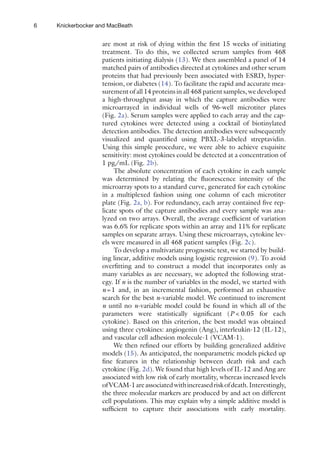
  • 24.
    5 Detecting and QuantifyingMultiple Proteins their cognate antigens. After a brief washing step, the ­ captured proteins are detected by applying a cocktail of “detection antibodies­ ” (Fig. 1b). To visualize and quantify the detection anti- bodies, the arrays are again washed and probed with a labeled secondary antibody (Fig. 1c). In a standard ELISA, highly sensitive detection is achieved using an enzyme label, such as horseradish peroxidase, which amplifies the signal by catalytically converting a soluble substrate into a chromophoric product. In an antibody microarray experi- ment, the final signal must be localized to each spot. A variety of strategies have been developed to achieve highly sensitive detec- tion in a spatially localized fashion. For example, the process of rolling circle replication has been exploited to achieve enzyme- mediated signal amplification (7, 8). This method enables the detection of many proteins at concentrations as low as 1 pg/mL. We have found, however, that equally sensitive detection can be achieved in a more straightforward fashion without enzyme- mediated signal amplification using a secondary antibody that has been coupled directly to an extremely bright fluorophore (9). (PBXL-3, a phycobilisome protein complex isolated from red algae and cyanobacteria.) The biggest limitation of antibody microarrays, as well as other multiplexed technologies such as the Luminex® bead-based immunoassay, is the availability of suitable antibodies. Sandwich- style immunoassays require two highly specific antibodies that recognize distinct, nonoverlapping epitopes on their target pro- teins. For this reason, most studies using antibody microarray technology have focused on cytokines, chemokines, and other frequently studied serum protein for which high quality, matched pairs of antibodies are commercially available (10). To date, anti- body microarrays have been used to discover multivariate signa- tures for diagnostic purposes. For example, antibody microarrays were recently used to detect differential glycosylation patterns on a variety of serum proteins, which may prove useful for the early detection of pancreatic cancer (11). Similarly, antibody microar- rays directed at a large panel of cluster of differentiation (CD) antigens on leukemias and lymphomas from peripheral blood and bone marrow aspirates showed high levels of consistency with diagnoses obtained using conventional clinical and laboratory ­ criteria (12). In our own lab, we have used antibody microarrays to iden- tify prognostic markers of early mortality in patients with end- stage renal disease (ESRD) (9). This study serves as an example for how antibody microarrays can be used for discovery purposes. Approximately, 10% of patients with ESRD die within the first 3–4 months of initiating hemodialysis and, to date, no single marker has been found that accurately predicts outcome. We set out to develop a multivariate model that predicts which patients
  • 25.
    6 Knickerbocker andMacBeath are most at risk of dying within the first 15 weeks of initiating treatment. To do this, we collected serum samples from 468 patients initiating dialysis (13). We then assembled a panel of 14 matched pairs of antibodies directed at cytokines and other serum proteins that had previously been associated with ESRD, hyper- tension, or diabetes (14). To facilitate the rapid and accurate mea- surement of all 14 proteins in all 468 patient samples, we developed a high-throughput assay in which the capture antibodies were microarrayed in individual wells of 96-well microtiter plates (Fig. 2a). Serum samples were applied to each array and the cap- tured cytokines were detected using a cocktail of biotinylated detection antibodies. The detection antibodies were subsequently visualized and quantified using PBXL-3-labeled streptavidin. Using this simple procedure, we were able to achieve exquisite sensitivity: most cytokines could be detected at a concentration of 1 pg/mL (Fig. 2b). The absolute concentration of each cytokine in each sample was determined by relating the fluorescence intensity of the microarray spots to a standard curve, generated for each cytokine in a multiplexed fashion using one column of each microtiter plate (Fig. 2a, b). For redundancy, each array contained five rep- licate spots of the capture antibodies and every sample was ana- lyzed on two arrays. Overall, the average coefficient of variation was 6.6% for replicate spots within an array and 11% for replicate samples on separate arrays. Using these microarrays, cytokine lev- els were measured in all 468 patient samples (Fig. 2c). To develop a multivariate prognostic test, we started by build- ing linear, additive models using logistic regression (9). To avoid overfitting and to construct a model that incorporates only as many variables as are necessary, we adopted the following strat- egy. If n is the number of variables in the model, we started with n=1 and, in an incremental fashion, performed an exhaustive search for the best n-variable model. We continued to increment n until no n-variable model could be found in which all of the parameters were statistically significant (P    0.05 for each cytokine). Based on this criterion, the best model was obtained using three cytokines: angiogenin (Ang), interleukin-12 (IL-12), and vascular cell adhesion molecule-1 (VCAM-1). We then refined our efforts by building generalized additive models (15). As anticipated, the nonparametric models picked up fine features in the relationship between death risk and each cytokine (Fig. 2d). We found that high levels of IL-12 and Ang are associated with low risk of early mortality, whereas increased levels ofVCAM-1areassociatedwithincreasedriskofdeath.Interestingly, the three molecular markers are produced by and act on different cell populations. This may explain why a simple additive model is sufficient to capture their associations with early mortality.
  • 26.
    7 Detecting and QuantifyingMultiple Proteins Cytokines acting on the same cell often exhibit ­ synergistic or antagonistic effects (16), but IL-12, Ang, and VCAM-1 are, to a first approximation, independent. We also found in this study that molecular markers are not uniformly prognostic, but instead vary in their value depending on a combination of clinical variables (age, diastolic blood pressure, serum albumin, and method of vas- cular access) (9). This may explain why previous reports aiming to Outcome Ang EGF Fet-A ICAM IL-12 IL-1α IL-8 MIP-1β RANTES TNF-β TNFR2 TNFR1 VCAM-1 VEGF d a c b 1.0 1.5 2.0 2.5 3.0 3.5 4.0 4.5 0.5 1.0 1.5 2.0 2.5 3.0 3.5 4.0 Ang EGF Fet-A ICAM IL-12 IL-1α IL-8 MIP-1β RANTES TNFβ TNFR2 TNFR1 VCAM-1 VEGF Log 10 { fluorescence } Log10 { [cytokine] (pg/mL) } 200 500 1000 2000 −4 −2 0 2 [Ang] (pg/ml) log-odds of death 100 1000 10000 −2 0 2 [VCAM-1] (pg/ml) log-odds of death 1 10 50 −2 −1 0 1 [IL-12] (pg/ml) log-odds of death Fig. 2. Serum cytokine levels measured using antibody microarrays. (a) 14 anticytokine capture antibodies were spotted in quintuplicate in each well of a 96-well microtiter plate. Serum samples were applied to each well in columns 1–11 and twofold serial dilutions of a mixture of the 14 cognate cytokines were applied to the wells in column 12. (b) Standard curves generated from the purified cytokines in column 12 of the microtiter plate. (c) Serum cytokine levels of 468 patients initiating hemodialysis. For visualization only, each cytokine was normalized relative to its mean over all the samples and the patients were ordered according to the first principle component of the cytokine profiles. The outcome of each patient is shown at the top (red died with 15 weeks of initiating dialysis; black survived more than 15 weeks). (d) Model built using the cytokine levels that represent the best three-variable model.The solid red lines are the mean of 100 bootstrap samples and the dashed black lines show the variance.
  • 27.
    8 Knickerbocker andMacBeath identify prognostic markers without taking into account clinical variables were either conflicting or showed that markers have mar- ginal prognostic value. Just as treatments are now being tailored to specific subsets of patients, our results show that prognosis can also benefit from a personalized approach. We anticipate that antibody microarray technology will play an increasingly important role in biomarker discovery and may ultimately be used on a routine basis in a clini- cal setting for the purposes of diagnosis, prognosis, patient selec- tion in clinical trials, and theragnostics. 1. 10× HBS: 100 mM HEPES, 100 mM NaCl, 0.4% NaN3 , pH 7.4. 2. Cy3-BSA: Bovine serum albumin (BSA) can be labeled according to manufacturer’s protocol (Amersham CyDye™ Antibody Labeling Kit, Piscataway, NJ). The Cy3-labeled BSA may be stored at 4°C wrapped in aluminum foil for approximately 3 months. 3. Printing Buffer: 1× HBS, 20% glycerol and 0.005 mg/mL Cy3-labeled BSA. This buffer should be freshly prepared from stock (1) for each print. 4. Dilution Buffer: The dilution buffer should be made so that the final concentration of the solution in each well after the addition of both the dilution buffer and the sample is 10 mM in HEPES, 10 mM in NaCl, 0.04% NaN3 , pH 7.4. The actual concentrations of reagents in the dilution buffer will vary with the amount of sample added to each well. 5. Wash buffer I: 1× HBS with 1% BSA (w/v). 6. Wash buffer II: 1× HBS with 0.1% Tween-20. 1. Aldehyde-displaying glass substrates (112.5×74.5×1mm) (Erie Scientific Company, Portsmouth, NH). 2. A piezoelectric or contact microarrayer. 3. Bottomless 96-well microtiter plates (Greiner BioOne, Kremsmünster, Austria). 4. Silicone gaskets (Grace Bio-Labs, Bend, OR). 5. Streptavidin-conjugated PBXL-3 (Martek Biosciences, Columbia, MD). 6. A small-orbit orbital shaker. 7. A microarray plate scanner. 2. Materials 2.1. Buffers (see Note 1) 2.2. Additional Equipment and Reagents
  • 28.
    9 Detecting and QuantifyingMultiple Proteins 1. Reconstitute all monoclonal capture antibodies according to manufacturer’s instructions and then dilute to a final concen- tration of 0.5 mg/mL in Printing Buffer. 2. Microarray the antibodies on 112.5×74.5×1 mm aldehyde- displaying glass substrates using a piezoelectric or contact microarrayer (see Notes 2–6). Ninety-six identical microar- rays should be fabricated in a 12×8 pattern on the glass, with an interarray pitch of 9 mm (to match the spacing of a 96-well microtiter plate). Each array should consist of a regular pat- tern of spots, with a center-to-center spacing determined empirically for each arrayer. A pitch of 250–350 mm is typical. Between three and five, spots should be printed for each anti- body to provide redundant measurements. 3. Attach the glass to the bottom of a bottomless 96-well micro- titer plate using an intervening silicone gasket (see Note 7). 4. Seal the arrays with foil and store at −80°C for at least 4 h, but no longer than 6 weeks (see Notes 8 and 9). 1. Prepare a serial dilution series of recombinant antigen in the first row of a low-binding, 96-well microtiter plate. Use Dilution Buffer as the diluent (see Note 10). (a) For samples with a variable composition and low protein concentration (such as urine), add 15% fetal bovine serum (FBS) to both the standard curve and the samples (see Note 11). (b) For samples such as serum or tissue culture supernatant, FBS may be added to the standard curves to ensure a complex environment similar to that of the samples. (c) Appropriate standard curve concentrations will vary with each antibody, but we typically use a 12-point, twofold serial dilution series ranging from 1 ng/mL of each antigen down to 0.5 pg/mL. For particularly abundant antigens, up to 200 ng/mL may be appropriate although many bio- logically significant antigens are present at lower concen- trations in body fluids and cell culture supernatants. 2. In the remainder of the plate, dilute the clinical samples using Dilution Buffer. (a) For most biological samples, start with a 1:1 or 1:4 dilu- tion, depending on the sample volume available. (b) Additional sample dilution(s) may be required for ­ samples with antigens present at high concentrations. All antigen concentrations should be within the range of the ­ standard curve. 3. Methods 3.1. Printing and Storage of the Microarray Plates 3.2. Preparation of the Mixing Plate
  • 29.
    10 Knickerbocker andMacBeath 1. In this section, perform all incubations at 4°C on a ­ small-orbit orbital shaker. The shaker should be set at the maximum pos- sible speed so that it does not cause cross-contamination (~400 rpm). Following each incubation, decant the solution by inverting the plate and shaking by hand. 2. Remove the microarray plate from the −80°C freezer and immediately add 300 mL of Wash Buffer I to each well. Incubate for 5 min (see Note 12) then decant the wash solu- tion by inverting the plate and shaking by hand. 3. Repeat twice for a total of three washes. 4. Add 300 mL of Wash Buffer I to each well and incubate for an additional 1 h to block any remaining aldehydes. 5. Remove Wash Buffer I by decanting; then transfer at least 40 mL from each well of the mixing plate to the correspond- ing well of the microarray plate. Cover the microarray plate with a foil seal and incubate for up to 24 h (see Note 13). 6. Wash the plate three times for 5 min each with Wash Buffer I. 7. After decanting the final wash, add 40 mL of a mixture of bioti- nylated detection antibodies (0.5 mg/mL in Wash Buffer I) to each well and incubate for 1 h. 8. Decant the solution then wash the plate three times for 5 min each with Wash Buffer I. 9. Add 100 mL of a 4-mg/ml solution of streptavidin-conjugated PBXL-3, prepared in Wash Buffer I, to each well. Incubate for 1 h in the dark. From this point on, minimize exposure to light. 10. After decanting the PBXL-3 solution, wash the plate two times for 5 min each with Wash Buffer I. 11. Wash the plate once with Wash Buffer II. 12. Rinse the plate twice with ddH2 O. 13. Centrifuge upside down for 1 min at 1,000×g to remove residual water. 1. Scan the microarray plates using a scanner that accommo- dates microtiter plates (e.g., an LS400 scanner, Tecan, Salzburg, Austria) (see Note 14). 2. Using microarray analysis software, quantify the intensity of each spot. Do not use local background correction. Instead, generate a row of phantom spots within each well and subtract the mean intensity of the phantom spots from each microarray spot. 3. To generate the standard curve, plot the log of the mean fluo- rescence intensity of replicate microarray spots as a function of the log of the cytokine concentration. This should yield a straight line. 3.3. Preparation of the Microarray Plate 3.4. Scanning, Image Analysis, and Data Analysis
  • 30.
    11 Detecting and QuantifyingMultiple Proteins 4. Relate the mean intensity of replicate spots for each antibody and each clinical sample back to the standard curve to obtain values for the concentration of each cytokine in each clinical sample. 5. Calculate the mean concentration of replicate measurements of each sample (replicate arrays). 1. Unless otherwise noted, all buffers may be stored at room temperature for up to 1 year or until visible signs of contami- nation appear. 2. Not all antibodies that work for Western blots and other tech- niques will work on antibody microarrays. Be sure to validate each pair of antibodies using purified antigens. Mix all anti- gens together and use detection antibodies one at a time and in combination to ensure that detection antibodies do not cross-react with any of the other analytes under investigation. R D Systems (Minneapolis, MN) is an excellent source of matched pairs of antibodies and their cognate antigens, par- ticularly for the study of cytokines and chemokines. 3. In general, monoclonal antibodies are used as the capture antibody while biotinylated polyclonal antibodies are used for detection. If no monoclonal antibody is available, two poly- clonal antibodies may be used. Ideally, these two polyclonal antibodies will have been raised against distinct and nonover- lapping epitopes. 4. When preparing the source plate, mix the antibody in Printing Buffer in an eppendorf tube and then transfer it to the source plate (microtiter plate). This ensures adequate mixing of the solution and increases reproducibility between wells when multiple pins are used to print the same sample. 5. In general, we have found aldehyde-displaying glass surfaces to be more robust and reproducible than epoxide- or amine- displaying glass, nitrocellulose-coated glass, or hydragels. 6. Pay close attention to the liquid level in the source plate while fabricatingmicroarrays.Evenwhenusinga384-wellmicrotiter­ plate as a source plate, substantial evaporation can occur ­ during extended print runs. To minimize evaporation, use a cooling block set to between 4 and 10°C, if available, and set the relative humidity at 70–80%. If these options are not available, use an aluminum foil seal with a small hole over each well to allow tip/pin access. Check the liquid level after each print run (or more often, if necessary) and add ddH2 O 4. Notes
  • 31.
    12 Knickerbocker andMacBeath as needed to ensure that the antibody concentration remains constant throughout the print run(s). 7. After printing or after assembly of the microarray plate, the arrays may sit at room temperature for several hours without appreciable loss of antibody reactivity. 8. To protect the arrays from freezer burn, they should be sealed, either in a plastic bag or with a foil cover. If using a cover, be sure that it will remain sealed when stored at −80°C. If using a cover that projects into the wells (such as a rubber Storage Mat), attach the cover to the bottomless 96-well microtiter plate before attaching the glass substrate. This ensures that the glass substrate is not pushed off the silicone gasket when the cover is applied to the wells (due to positive pressure). 9. Arrays can be stored for up to 1 year at −80°C, although some loss in activity will occur. Plates that have been stored for several months are best used for assay development pur- poses. For data collection, plates should be stored for no lon- ger than 6 weeks. 10. For samples with low concentrations of total protein (e.g., urine), preblock the mixing plate with BSA to minimize pro- tein loss. To do this, add enough Dilution Buffer containing 1% BSA (w/v) to completely fill each well, incubate for 1 h at room temperature, and then decant the blocking solution. For samples with very low protein content, all plastics should be rinsed with Dilution Buffer containing 1% BSA (w/v) before contacting the samples. 11. For samples with low concentrations of total protein, add 15% FBS (v/v) to the samples to minimize loss of target pro- teins. Test each new pair of antibodies to ensure than they do not cross-react with bovine proteins. 12. When removing antibody microarrays from the −80°C freezer, be sure to add Blocking Buffer immediately (within seconds). The buffer usually freezes when added to the wells and then thaws within minutes. Allowing the arrays to warm up, even slightly, results in poor spot morphology (“comet tails,” “­ coffee rings,” etc.). 13. The best length of time to incubate the antibody microarrays with the samples should be determined empirically. It depends on the concentration of antigens in the sample, the affinities of the capture antibodies for their antigens, and the efficiency of agitation. Incubation times generally range from 1 to 24 h. 14. Antibody microarrays should be scanned at several scanner settings (PMT voltages). For each antigen, use the scan with the highest possible setting that does not include any satu- rated pixels.
  • 32.
    13 Detecting and QuantifyingMultiple Proteins Acknowledgment We thank Ravi Thadhani for directing ArMORR (Accelerated Mortality on Renal Replacement), a prospective study of ESRD patients, and Jiunn-Ren Chen for data analysis and interpreta- tion. This work was supported by awards from the WM Keck Foundation and the Arnold and Mabel Beckman Foundation, and by grants from the National Institutes of Health (DK071674 and DK068465). T.K. is the recipient of an Eli Lilly Graduate Student Fellowship. References 1. Alizadeh AA, Eisen MB, Davis RE et al (2000) Distinct types of diffuse large B-cell lymphoma identified by gene expression profiling. Nature 403:503–511 2. Liang Y, Diehn M, Watson N et al (2005) Gene expression profiling reveals molecularly and clinically distinct subtypes of glioblastoma multiforme. Proc Natl Acad Sci U S A 102:5814–5819 3. Ramaswamy S, Tamayo P, Rifkin R et al (2001) Multiclass cancer diagnosis using tumor gene expression signatures. Proc Natl Acad Sci U S A 98:15149–15154 4. Zhou SF, Di YM, Chan E et al (2008) Clinical pharmacogenetics and potential application in personalized medicine. Curr Drug Metab 9:738–784 5. Duffy MJ, Crown J (2008) A personalized approach to cancer treatment: how biomarkers can help. Clin Chem 54:1770–1779 6. Hanash S (2003) Disease proteomics. Nature 422:226–232 7. Schweitzer B, Roberts S, Grimwade B et al (2002) Multiplexed protein profiling on microarrays by rolling-circle amplification. Nat Biotechnol 20:359–365 8. Shao W, Zhou Z, Laroche I et al (2003) Optimization of rolling-circle amplified protein microarrays for multiplexed ­ protein profiling. J Biomed Biotechnol 5:299–307 9. Knickerbocker T, Chen JR, Thadhani R, MacBeath G (2007) An integrated approach to prognosis using protein microarrays and nonparametric methods. Mol Syst Biol 3(123):1–8 10. MacBeath G (2002) Protein microarrays and proteomics. Nat Genet 32:526–532 11. Li C, Simeone DM, Brenner DE et al (2009) Pancreatic cancer serum detection using a lec- tin/glyco-antibody array method. J Proteome Res 8:483–492 12. Belov L, Mulligan SP, Barber N et al (2006) Analysis of human leukaemias and lymphomas using extensive immunophenotypes from an antibody microarray. Br J Haematol 135: 184–197 13. Thadhani R, Tonelli M (2006) Cohort stud- ies: marching forward. Clin J Am Soc Nephrol 1:1117–1123 14. USRSD (2005) National Institutes of Health. National Institute of Diabetes and Digestive and Kidney Diseases, Bethesda 15. Buja A, Hastie T, Tibshirani R (1989) Linear smoothers and additive models (with discus- sion). Ann Statist 17:453–555 16. Natarajan M, Lin KM, Hsueh RC et al (2006) A global analysis of cross-talk in a mammalian cellular signalling network. Nat Cell Biol 8: 571–580
  • 33.
  • 34.
    15 Catherine J. Wu(ed.), Protein Microarray for Disease Analysis: Methods and Protocols, Methods in Molecular Biology, vol. 723, DOI 10.1007/978-1-61779-043-0_2, © Springer Science+Business Media, LLC 2011 Chapter 2 Analysis of Serum Protein Glycosylation with Antibody–Lectin Microarray for High-Throughput Biomarker Screening Chen Li and David M. Lubman Abstract The complexity of carbohydrate structures and their derivatives makes the study of the glycome a ­ challenging subset of proteomic research. The microarray platform has become an essential tool to ­ characterize glycan structure and to study glycosylation-related biological interactions, by using probes as a means to interrogate the spotted or captured glycosylated molecules on the arrays. The high- throughput and reproducible nature of microarray platforms have been highlighted by their extensive applications in the field of biomarker validation, where a large number of samples must be analyzed ­ multiple times. This chapter presents an antibody–lectin microarray approach, which allows the efficient, multiplexed study of the glycosylation of multiple individual proteins from complex mixtures with both fluorescence labeling detection and label-free detection based on mass spectrometry. Key words: Microarray, Antibody, Glycoprotein, Biomarker, Serum, Lectin, MALDI, Mass spectrometry Glycosylation is the most commonly occurring posttranslational modification on proteins involved in numerous biological ­ processes, such as protein–protein interactions, protein folding, immune recognition, cell adhesion, and intercellular signaling. The function of glycoproteins is highly dependent on their carbo- hydrate structure. The alteration on the glycans is associated with multiple biological events and has been reported in a variety of diseases, especially cancer (1–4). In the search for effective ­ glycosylated biomarkers for targeted diseases, there has been a great deal of effort invested in profiling and characterization of 1. Introduction
  • 35.
    16 Li andLubman ­ glycoproteins in complex samples. Cell lines, tissue, and other types of biofluids have been studied by mass spectrometry, ­ fractionation techniques, and microarrays (5–9). Although a microarray assay does not usually provide in-depth structural information on the glycans compared to mass spectrometry, it is able to identify and quantify numerous glycosylation patterns and simultaneously analyze hundreds of samples in a high-throughput manner with excellent reproducibility (9–13). We herein describe an antibody–glycoprotein sandwich assay for high-throughput glycoprotein biomarker screening, where a fluorescent lectin and MALDI-MS are used to quantitatively measure glycosylation levels and identify analytes captured on the antibody arrays, respectively. The scheme for this procedure is illustrated in Fig. 1. The antibodies are first printed on nitro- cellulose coated glass slides to generate identical arrays. Printed slides are processed to chemically block the glycans on the anti- bodies, which are otherwise reactive with lectins used for detec- tion (10). After properly diluted human serum samples are deposited onto the separated antibody arrays, the captured anti- gens are probed with different lectins with a wide spectrum of binding specificity. The binding of the lectin is measured with a secondary fluorescent dye through a biotin–streptavidin reac- tion. To verify the effectiveness of previously discovered glyco- protein biomarkers, hundreds of serum samples collected from patients with different disease states are examined in parallel with healthy controls for altered glycosylation patterns. The technical error and bias in the analysis is minimized in several ways, includ- ing introducing a control slide to assess spatial variation on a slide and balancing samples from different groups on each slide to reduce experimental bias. MALDI-MS detection has only recently been used to detect peptides on a modified gold surface Fig. 1. Experimental scheme using lectin and MALDI-MS detection with antibody microarray to analyze glycosylation of serum glycoproteins.
  • 36.
    17 Analysis of SerumProtein Glycosylation coated with antibodies (14). An on-slide digestion method, developed in our previous work (15), exploited the utility of MALDI-MS to ­ identify antibody-captured proteins. The whole digestion, including automatic trypsin spotting and incubation, requires less than 10 min. While the antibody–lectin sandwich microarray provides a means to measure glycosylation changes on specific proteins cap- turedfromcomplexsamplesusinglectinprobesina­ high-throughput array format, fluorescence-based detection ­ provides limited struc- tural information and cannot distinguish some ­ glycoforms that have ­ similar affinity with lectins, such as (GlcNAc)2 (Man)8 and (GlcNAc)2 (Man)9 . Therefore, the MALDI-MS detection of the tryptic products of the captured protein on the antibody array serves as a complementary technique to verify the identity of the target of the antibody and a means to monitor the nonspecific binding so as to optimize the dilution fold for the experiment. As such, mass spec- trometry is a powerful alternative to fluorescent detection, as it con- firms the identity of the captured analyte and detects any undesired binding. 1. Monoclonal antibodies, for serum amyloid P component (SAP; Abcam), Alpha-1-beta glycoprotein (A1BG; Abnova), Antithrombin III (Abcam). 2. Nanoplotter 2.0 (GeSiM). 3. Nova nitrocellulose slides (GraceBio), PATH nitrocellulose slides (Gentel). 4. Printing buffer: 30% phosphate buffering saline (PBS), con- centration of antibody diluted by water to 0.3 mg/mL. 5. 96-Well sample plate (BioRad). 1. Washing buffer: PBS-T 0.1 (0.1% Tween-20). 2. Coupling buffer: 0.02 M sodium acetate, pH 5.5. 3. Oxidation buffer: 0.2 M sodium peroidate in coupling buffer. 4. 4-(4-N-maleimidophenyl)butyric acid hydrazide hydrochlo- ride (MPBH) (Pierce), Cys–Gly (Sigma). 1. Blocking buffer: 1% w/v BSA in PBS-T 0.5 (0.5% ­ Tween-20). 2. Sample buffer: 0.1% Brij-45, 0.1% Tween-20 in PBS. 3. Primary detection solution: For Aleuria aurentia (AAL), Maackia amurensis (MAL), Lens culinaris agglutinin (LCA), 2. Materials 2.1. Antibody–Lectin Microarray with Fluorescence Detection 2.1.1. Printing 2.1.2. Antibody Blocking 2.1.3. Hybridization of Slides
  • 37.
    18 Li andLubman and Sambuccus Nigra (SNA) – 10 mg/mL biotinylated lectin solution in PBS-T 0.1; and for Concanavalin A (ConA), 1 mg/mL lectin in PBS-T 0.1. All biotinylated lectins were purchased from Vector Laboratories (Burlingame, CA). 4. Washing buffer: PBS-T 0.1 (0.1% Tween-20). 5. Secondary detection solution: 1:1,000 solution of 1 mg/mL Streptavidin conjugated to Alexafluor555 (Invitrogen) in PBS-T 0.1. 6. Speedvac. 7. SIMplex Multiplexing system (Gentel). 1. Axon 4000A scanner (Molecular Devices, Sunnyvale, CA). 1. Sequencing grade modified trypsin (Sigma). 2. Acetonitrile (ACN). 3. Ammonia bicarbonate. 4. Oven. 5. Nanoplotter 2.0 (GeSiM). 6. Wetted paper box. 1. MALDI-QIT-TOF (Shimadzu Biotech, Manchester, UK). 2. Trifluoroacetic acid (TFA). 3. 2,5-Dihydroxybenzoic acid (DHB), prepare 10 mg/mL solu- tion in 50% ACN, 0.1% TFA. 4. Stainless steel plate adaptor. The number of antibody arrays that can be printed on each slide is determined by the size of the arrays. The most popular format involves 16 coated pads on a standard 1×3 in. slide. Each pad is able to contain more than 9×9 spots with 0.6 mm spacing. For MALDI-MS detection, the sensitivity is much lower than fluores- cence. Therefore to generate a spectrum with good S/N, addi- tional sample needs to be printed on each spot. 1. Antibodies are diluted to 0.5 mg/mL in printing buffer and transferred to a 96-well sample plate. 2. Edit the spot layout in the NanoPlotter program to produce a 2×7 format of identical arrays with a 9 mm row and column distance from each other. The spacing between the spots is 0.6mm.Eachantibodyisprintedintriplicate.ForMALDI-MS detection, the spacing between the spots is 1.5 mm. 2.1.4. Slide Scanning 2.1.5. On-Slide Digestion 2.1.6. MALDI-QIT-TOF 3. Methods 3.1. Antibody Array Printing
  • 38.
    19 Analysis of SerumProtein Glycosylation 3. Antibody solution is spotted onto nine ultrathin ­ nitrocellulose coated slides. The first slide is discarded because of high varia- tion of printing; the other eight are used for the experiment. Each spotting event results in 500 pL of sample being depos- ited and is programmed to occur 5 times/spot to ensure that 2.5 nL is being spotted per sample. The spot diameter is around 250 mm. For MALDI-MS detection, the amount of antibody on each of the spots in the antibody array is increased from 5 to 100 droplets. The spot diameter is around 700 mm (see Note 1). The IgG antibodies are usually glycosylated (15). The antibody glycans are reactive to detection lectins, thus need to be modi- fied. To prevent the reaction between the antibody glycan and lectin, the antibodies on the slides are chemically derivatized with a modified method described in the previous work of Haab (10). 1. The printed slides are dried at room temperature overnight before gently being washed with PBS-T 0.1 and incubated in coupling buffer with 0.1% Tween 20 for 10 min. The slides are washed again with coupling buffer without Tween 20 before oxidation (see Note 2). 2. The slides are incubated in freshly made oxidation solution at 4°C in the dark. After 3 h the slides are removed from the oxidizing solution and rinsed with coupling buffer with 0.1% Tween 20 until the white precipitation disappears. The wash- ing usually takes 30–60 min (see Note 3). 3. The slides are immersed in fresh 1 mM MPBH (in coupling buffer) at room temperature for 2 h to derivatize the carbonyl groups, then incubated with 1 mM Cys-Gly (in PBS-T 0.1) at 4°C overnight to stabilize the −SH group on MPBH. The slides are subsequently blocked with blocking buffer for 1 h and dried by spinning the slide at 1,000 rpm in a centrifuge (see Note 4). Before screening a large number of samples, the optimum con- centration of the serum is determined by a serial dilution test. In the dilution test, serum is diluted with sample buffer by 2–600 folds and incubated with different blocks of antibody arrays on a single slide (details of the experiment in Subheading 3.2.4). The signal is detected by lectin SNA (or any lectin) and plotted in Fig. 2. The figure depicts how the intensity of the signal changes for three antibodies (against Serum Amyloid P compo- nent, A1BG, and Antithrombin III) with decreasing dilution fold. A rising trend was noted from the 600× dilution to the 50× dilution for the three glycoproteins shown. In the 50× dilu- tion to the 20× dilution, the signal was relatively unchanged 3.2. Antibody–Lectin Array with Fluorescence Detection 3.2.1. Antibody Array Blocking 3.2.2. Optimizing Conditions
  • 39.
    20 Li andLubman except for Antithrombin III, where the signal increased 20% from the 50× dilution to the 20×. The signal remained the same from the 20× dilution until it reached the 5× dilution, where a saturation of the signal has occurred. A decrease of signal for all three glycoproteins from the 5× dilution to the 2× dilution of serum sample can be seen in Fig. 3, likely due to competing nonspecific binding on the antibodies. The result of the dilution test demonstrates that the antibod- ies were saturated by their target protein at 20× dilution or above in the process of hybridization. Below 50× dilution, the antibod- ies were not completely occupied so the signal decreased with additional dilution. The nonlinear relation between the concen- tration of the serum and the intensity of the signal could be attrib- uted to various factors that may affect the antibody–antigen reaction, including accessibility of the antibodies, diffusion rate, and solubility of the antigen in the hybridization buffer. Nonspecific binding on the antibodies was also considered as a possibility, but was further investigated and excluded by on-target digestion and MALDI-MS analysis. To analyze the difference of the glycosylation on potential biomarker proteins, protein expression levels must be normal- ized. Under saturation conditions, the amount of target biomark- ers captured on the antibody spots was equal to the capacity of the printed antibody which should be the same in all the replicate blocks. As a result, protein assay is no longer needed and the intensity of the signal on the microarray directly represents the level of glycosylation. Fig.2.Saturation curve showing how the antibodies (against serumAmyloid C component, A1BG, Antithrombin III) respond to different dilution of serum with SNA lectin detection. X-axis shows fold serum dilution before hybridization on the antibody array. The y-axis is the intensity of the signal. Reprinted with permission from Li et al. (15).
  • 40.
    21 Analysis of SerumProtein Glycosylation In the high-throughput biomarker screening, we usually parallel print and process eight slides which contain 112 identical blocks of antibody array. To minimize the technical error and bias on these blocks, serum samples are arranged to balance different ­ disease/healthy groups and reference blocks are also introduced to adjust to signals of different blocks and slides. We provide an example of how to arrange samples on slides to minimize experi- mental biases in Fig. 3. 1. The slides are labeled from 1 to 8 in their printing order (see Note 2). 2. Slide 5 is used as a control slide; all the blocks on the control slide are incubated with a control serum sample C1. 3. Block 7 and block 8 on each slide except slide 5 are used as control blocks; they are incubated with control samples C1 and C2, respectively. 4. Block 14 is used as blank and incubated with sample buffer only. 5. The other 77 blocks are incubated with 19 samples from each of the four disease groups and 1 extra sample from a random group in a designated order to balance the number of samples from each group on any particular block (Fig. 3a). 3.2.3. Experimental Design G1 G2 G4 G1 G3 G4 G2 G3 C1 C1 G1 G2 G4 G1 G3 G4 G3 G4 G2 G3 G1 G2 G4 G1 C1 C1 G3 G4 G2 G3 G1 G2 G1 G2 G4 G1 G3 G4 G2 G3 C1 C1 G1 G2 G4 G1 G3 G4 C1 C2 C1 C2 C1 C2 C1 C2 C1 C1 C1 C2 C1 C2 C1 C2 G3 G4 G2 G3 G1 G2 G4 G1 C1 C1 G3 G4 G2 G3 G1 G2 G1 G2 G4 G1 G3 G4 G2 G3 C1 C1 G1 G2 G4 G1 G3 G4 G3 B G2 B G1 B G4 B C1 C1 G3 B G2 B G1 B Slide 1 Slide 2 Slide 3 Slide 4 Slide 5 Slide 6 Slide 7 Slide 8 a b Fig. 3. Parallel processing of 77 samples on eight slides. (a) Sample arrangement on eight slides. G1, G2, G3, and G4 are four different groups of samples. Control samples are C1 and C2. B is blank. (b) A picture of SIMplex multiwell device.
  • 41.
    22 Li andLubman 1. The slides are placed into the SIMplex (Gentel) Multiplexing device which has 16 wells for each slide (the bottom two wells are not used) to separate the antibody arrays and prevent cross contamination between adjacent wells (Fig. 3b). 2. Serum samples are aliquoted into a volume of 10 mL in each vial and diluted 10× with 90 mL sample buffer. Diluted sam- ples are added into the wells of the SIMplex Multiplexing device and incubated for 1h with gentle shaking at room temperature. The wells must be sealed to prevent evaporation of samples (see Notes 5 and 6). 3. After completion of serum hybridization, slides are rinsed with PBS-T 0.1 three times to remove unbound proteins. The slides are incubated with biotinylated lectin solution in a plas- tic box with gentle shaking for an hour at room temperature. 4. The slides are washed 3 times with PBS-T 0.1 and incubated with secondary detection solution with gentle shaking for an hour at room temperature. 5. The slides are again washed 3 times with PBS-T 0.1, dried by centrifuge and kept at 4°C before scanning. 1. The dried slides are scanned with an Axon 4000A scanner. 2. Alexa555 labeled slides are scanned in the green channel (wavelength 545 nm). The photomultiplier tube (PMT) gain should be adjusted to obtain the best S/N without satura- tion. The size of the pixel of the image is 10 mm. 3. The program Genepix Pro 6.0 is used to extract the numeri- cal data. The nonbiological variation between blocks on the same slide is termed as on-slide variation. This variation is mainly generated by antibody printing and slide scanning and its feature is that every slide follows the same pattern (i.e., the blocks at the top of the slides are brighter than the bottom ones). The blocks on the con- trol slide incubated with the same control sample are thus used to estimate the on-slide variation and calculate adjustment index for all the blocks. The slide-to-slide variation is considered as specific changes of the signal that effect all the blocks on a single slide. This variation is estimated by control blocks on each of the slides. The data is adjusted by a second index calculated by comparing the signal of the control blocks to exclude the slide-to-slide variation. An example of assaying glycosylation expression of A1BG is shown in Fig. 4. Lectin SNA is used to probe the sialic acid ­ present at the termini of the glycans of this protein. As shown in this ­ figure, the mean value of the cancer samples is significantly higher than the other three groups (p0.05). 3.2.4. Hybridization of Slides 3.2.5. Slide Scanning 3.2.6. Data Analysis
  • 42.
    23 Analysis of SerumProtein Glycosylation 1. A threshold of signal-to-background ratio is set at 3 and spots that are under this threshold are excluded. 2. The background-subtracted median of the intensity for the triplicates of each antibody is averaged and taken as a single data point into analysis. 3. On-slide variation index for antibody 1 in block 1 equals to the average signal of antibody 1 over all the blocks on the control slide divided by the signal of antibody 1 in block 1. I S = Ab1.B1 Ab1.CS Ab1.B1 A g / v . 4. Slide-to-slide variation index for antibody 1 on slide 1 is cal- culated as follows: AvgAb1.S1 is the average signal of antibody 1 on slide 1. AvgAb1.AS is the average signal of antibody 1 on all the slides. = Ab1.S1 S Ab1.A Ab1.S1 Avg / Avg . I 5. The final adjusted signal is calculated by the following formula: SAb1.B1.S1 is the raw signal, SAb1.B1.S1.ad is the adjusted signal. S S I I = Ab1.B1.S1.ad Ab1.B1.S1 Ab1.B1 Ab1.S1 * * . 6. For each antibody the signal can be normalized to one for easy comparison, SAb1.B1.S1.n is the normalized signal. S S = Ab1.B1.S1.n Ab1.B1.S1.ad Ab1 /Avg . Fig. 4. Distribution of sialylation levels detected by lectin SNA on A1BG. The spots present the signal of the glycan on captured antigen for individual samples from ­ different classes. The long and short lines give the mean value and the standard error of the mean, respectively.
  • 43.
    24 Li andLubman Nonspecific binding on antibodies may occur when the ­ microarray is exposed to a concentrated and complex protein mixture such as serum. A commonly used method to study the specificity of an antibody is to digest and identify the protein released from anti- body-conjugated medium, whereas eluting the captured protein is not very efficient and the procedure includes four or more steps. Thin layers of a conductive metal oxide and nitrocellulose make the surface of PATH slide perfect for MALDI. We developed an on-slide digestion and MALDI sample preparation protocol using the NanoPlotter to precisely spot enzyme and matrix to antibody arrays on the slide after the serum hybridization. Antibody arrays exposed to differently diluted sera are analyzed by this method to see if nonspecific binding occurs. Trypsin spotted on the antibody array usually simultaneously digests both the captured protein and the antibody; hence the tryptic peptides of the antibody must be excluded from the mass spectra for us to choose the peaks of interest. In an example, we prepared three identical spots of SAP antibody in separated blocks, which were then incubated with sample buffer (as control), 10× diluted serum, and 2× diluted serum and subjected to on-slide digestion and MALDI-MS. The MALDI-MS spectra of the three spots are shown in Fig. 5. The peaks that appear in the spectrum of the control spot are consid- ered to be peptides of the antibody. The three highest peaks between 1,150 and 1,250 were identified by MS/MS as peptides from the Fc region of mouse IgG. In spectrum b where the anti- body spot was hybridized with 10× diluted serum, the peaks at 1,166 and 1,407 m/z, are identified by MS/MS as the peptides digested from the target antigen, and the peak 993 matches the mass of a tryptic peptide of SAP. In the spectrum c there are two additional peaks. One of these was identified as human albumin, while the other one could not be identified or matched with a peptide mass of the target antigen. The additional peaks indicate that nonspecific binding might have occurred to the antibody spot. The serum was further diluted to assess the detection limit of the MALDI-MS technique. At 500× dilution (data not shown), the peak at 1,166 m/z disappeared while the 1,407 m/z still showed a signal-to-noise ratio of 2–3. Thus, the 500× dilution is considered as the detection limit of SAP, which is present in human serum with a concentration of around 30 mg/mL (16). The introduction of mass spectrometry based label-free detec- tion has the potential to further characterize the glycan structure. However, due to the presence of the tryptic peptides of the anti- body and the lack of a glycopeptide enrichment step, only a lim- ited number of the nonglycosylated peptides of the antigen could be seen in the spectra. To improve the MALDI-MS detection of the targeted antigen and its glycopeptides, we are searching for other chemical strategies to block the tryptic digestion of the antibody and enrichment methods to selectively ionize the glycopeptides. 3.3. On-Slide Digestion and MALDI Sample Preparation
  • 44.
    25 Analysis of SerumProtein Glycosylation 1. Antibody slide is printed and hybridized with diluted serum as described above. 2. Trypsin is diluted with 50 mM ammonium bicarbonate in 20% ACN and kept on ice before use. 3. Keep the humidity of the Nanoplotter chamber higher than 70% (use a humidifier or lay a wet paper towel on the deck). Fig. 5. The MALDI-MS spectra generated on the microarray spots of Amyloid p component antibody after on-target ­ digestion.The peaks identified as Amyloid p component were marked with bold arrows where the extra peaks appearing in (c) were marked with regular arrows. (a) Control spot, without incubation of serum; (b) incubated with10× diluted serum; (c) incubated with 2× diluted serum. Reprinted with permission from Li et al. (15).
  • 45.
    26 Li andLubman 4. In the program, set the same spot layout on the slide, print 100 droplets (0.5 nL per droplet) of trypsin on each spot (see Note 7). 5. Move the printed slide to a wet paper box and incubate them in an oven at 37°C for 5 min. Make sure the trypsin solution does not dry out on the spots. 6. Take the slide out from the oven, print the DHB solution on the slide with the same spot layout (50 droplets per spot). 1. Tape the slide onto a stainless steel MALDI plate adaptor, insert it into the MALDI-MS instrument. 2. Mass spectrometric analysis of the microarray slides was per- formedusingtheAximaquadrupoleiontrap-TOF.Acquisition and data processing were controlled by Launchpad software (Kratos, Manchester, UK). A pulsed N2 laser light (337 nm) with a pulse rate of 5 Hz was used for ionization. Each profile resulted from two laser shots. Argon was used as the collision gas for CID and helium was used for cooling the trapped ions. 3. TOF was externally calibrated using 500 fmol/mL of bradyki- ninfragment1–7(757.40m/z),angiotensinII(1046.54m/z), P14R (1533.86 m/z), and ACTH (2465.20 m/z) (Sigma- Aldrich). The mass accuracy of the measurement under these conditions was 50 ppm. 4. The power of the laser is set at 80 to ionize the spots on the microarray. The focus of the laser can be moved from spot to spot manually under the camera or by using the Raster func- tion to set up an automatic scan for all the spots. 1. When the pin on the Nanoplotter is in poor condition or the instrument is not set up correctly, the quality of antibody printing may fluctuate or gradually worsen as the printing continues. Sticky components, such as glycerol, in the ­ antibody printing solution may also cause unstable printing. A simple test can be done in advance to assess the perfor- mance of the pin. Print 1,000 spots with a random antibody on a transparent slide. Observe the residue after the spots are dried. If the residues are in an intact round shape and their sizes and colors do not vary significantly, then the printing is acceptable, otherwise the printer needs to be checked or the printing solution must be changed. 3.4. MALDI-MS 4. Notes
  • 46.
    27 Analysis of SerumProtein Glycosylation 2. Many types of chemicals can contaminate the nitrocellulose coating on the slide, resulting in increased background. The slides should not be labeled with any kind of marker. A ­ disposable plastic box is a very good container for slide washing. 3. In the glycan blocking procedure, after the antibody is oxi- dized by NaIO4 , white precipitation forms on the slides. This precipitation must be completely washed away before moving on to the next step. 4. Blocked slides should not be kept in solution for too long, while dried ones can be stored at 4°C for a long period of time. 5. Serum sample must be aliquoted immediately upon arrival and stored at −80°C. Serum frozen and thawed more than twice should not be used. When the sample set consists of multiple groups, all the samples must be in the same frozen and thaw cycle for bias-free comparison. 6. All the incubation should be done with gentle shaking to pre- vent uneven binding. 7. The higher number of droplets of antibody solution printed on the slides does not result in a higher density of antibody on the spot because the coating of the PATH slides is so thin that a few droplets are able to saturate the surface. The concern for the minimum amount of antibody solu- tion printed on each spot is position variation, i.e., repeated printings on the same spot do not perfectly overlap. Printing 100 droplets of antibody solution produces a larger spot size which guarantees a certain area of overlap between the antibody spot and the printing of trypsin and matrix. Acknowledgements Our work on microarray development described herein has been supported in part under grants from the National Cancer Institute under grant NCI R21 12441, R01 CA106402. This work has also received partial support from the National Institutes of Health under R01GM49500. We would like to thank Dr. Brian Haab and Dr. Chen Songming of the Van Andel Institute for sharing with us the pro- cedures of preparing the antibody arrays. We would also like to thank Stephanie Laurinec, Jes Pedroza, and Missy Tuck for col- lection of the samples used in this work.
  • 47.
    28 Li andLubman References 1. Rudd PM, Elliott T, Cresswell P, Wilson IA, Dwek RA (2001) Glycosylation and the immune system. Science 291:2370–2376 2. Kobata A, Amano J (2005) Altered glycosyla- tion of proteins produced by malignant cells, and application for the diagnosis and immu- notherapy of tumours. Immunol Cell Biol 83:429–439 3. Gessner P, Riedl S, Quentmaier A et al (1993) (1993) Enhanced activity of cmp-newac-gal- beta-1–4glcnac-alpha-2, 6-sialyltransferase in metastasizing human colorectal tumor-tissue and serum of tumor patients. Cancer Lett 75:143–149 4. Gorelik E, Galili U, Raz A (2001) On the role of cell surface carbohydrates and their binding proteins (lectins) in tumor metastasis. Cancer Metastasis Rev 20:245–277 5. Zhao J, Simeone DM, Heidt D, Anderson MA, Lubman DM (2006) Comparative serum glycoproteomics using lectin selected sialic acid glycoproteins with mass spectrometric analysis: application to pancreatic cancer serum. J Proteome Res 5:1792–1802 6. Ressom HW, Varghese RS, Goldman L et al (2008) Analysis of MALDI-TOF mass spec- trometry data for discovery of peptide and glycan biomarkers of hepatocellular carci- noma. J Proteome Res 7:603–610 7. An HJ, Peavy TR, Hedrick JL et al (2003) (2003) Determination of N-glycosylation sites and site heterogeneity in glycoproteins. Anal Chem 75:5628–5637 8. Block TM, Comunale MA, Lowman M et al (2005) Use of targeted glycoproteomics to identify serum glycoproteins that correlate with liver cancer in woodchucks and humans. Proc Natl Acad Sci U S A 102:779–784 9. Patwa TH, Zhao J, Anderson MA, Simone DM et al (2006) Screening of glycosylation patterns in serum using natural glycoprotein microarrays and multi-lectin fluorescence detection. Anal Chem 78:6411–6421 10. Chen SM, LaRoche T, Hamelinck D et al (2007) Multiplexed analysis of glycan varia- tion on native proteins captured by antibody microarrays. Nat Methods 5:437–444 11. Zhao J, Patwa TH, Qiu WL et al (2007) Glycoprotein microarray with multi-lectin detection: unique lectin binding patterns as tools for classifying normal, chronic pancreati- tis, and pancreatic cancer sera. J Proteome Res 5:1864–1874 12. Wu YM, Nowack DD, Omenn GS et al (2008) Mucin glycosylation is altered by pro-inflam- matory signaling in pancreatic-cancer cells. Pancreas 37:502 13. Yue TT, Goldstein IJ, Hollingsworth MA et al (2009) The prevalence and nature of glycan alterations on specific proteins in pancreatic can- cer patients revealed using antibody-lectin sand- wich arrays. Mol Cell Proteomics 7:1697–1707 14. Evans-Nguyen KM, Tao SC, Zhu H et al (2008) Protein arrays on patterned porous gold substrates interrogated with mass spec- trometry: detection of peptides in plasma. Anal Chem 5:1448–1458 15. Li C, Simeone DM, Brenner DE et al (2009) Pancreatic cancer serum detection using a lec- tin/glyco-antibody array method. J Proteome Res 8:483–492 16. Nyboa M, Olsenb H, Jeuneb B et al (1998) Increased plasma concentration of serum amy- loidPcomponentincentenarianswithimpaired cognitive performance. Dement Geriatr Cogn 9:126–129
  • 48.
    29 Catherine J. Wu(ed.), Protein Microarray for Disease Analysis: Methods and Protocols, Methods in Molecular Biology, vol. 723, DOI 10.1007/978-1-61779-043-0_3, © Springer Science+Business Media, LLC 2011 Chapter 3 Antibody Suspension Bead Arrays Jochen M. Schwenk and Peter Nilsson Abstract Alongside the increasing availability of affinity reagents, antibody microarrays have been developed to become a powerful tool to screen for target proteins in complex samples. Besides multiplexed sandwich immunoassays, the application of directly applying labeled sample onto arrays with immobilized capture reagents offers an approach to facilitate a systematic, high-throughput analysis of body fluids such as serum or plasma. An alternative to commonly used planar arrays has become available in form of a system based on color-coded beads for the creation of antibody arrays in suspension. The assay procedure offers an uncomplicated option to screen larger numbers of serum or plasma samples with variable sets of cap- ture reagents. In addition, the established procedure of whole sample biotinylation circumvents the purification steps, which are generally required to remove excess labeling substance. We have shown that this assay system allows detecting proteins down into lower pico-molar and higher picogram per milliliter levels with dynamic ranges over three orders of magnitude. Presently, this workflow enables the profiling of 384 clinical samples for up to 100 proteins per assay. Key words: Suspension bead array, Antibody array, Serum, Plasma, Labeling The exploration of the human proteome is one of the major ­ challenges of the postgenomics era, focusing on a better under- standing of disease-related processes (1). Recent developments of miniaturized and parallelized technology platforms now offer affinity-based alternatives to widely used mass spectrometric ­ analysis. Among these methods, various protein microarrays have been implemented into proteomic profiling approaches demon- strating their applicability in high-throughput screening for marker proteins in patient samples (2). Two alternative formats have been developed; reverse-phase microarrays, where large numbers of lysates from tissues and cells or serum samples are spotted onto array surfaces for the parallel analysis of a single 1. Introduction
  • 49.
    30 Schwenk andNilsson parameter, and the forward-phase setting, such as multiplexed sandwich immunoassays or antibody arrays, which both utilize immobilized capture reagents to analyze many parameters (3). While dedicated robotic devices, which arrange molecules on microscopic slides with functionalized surfaces, are needed pro- duce planar protein microarrays, alternative platforms have been employed for a parallelized and miniaturized analysis. One of these is based on a flow cytometeric system that currently allows to determine the identity of up to 500 color-coded micrometer sized beads in cooccurrence to protein interaction dependent reporter fluorescence (4). Arrays are thereby created in suspen- sion by mixing beads with different codes, denoted here as bead IDs, and immobilized capturing reagents. This platform has recently been utilized to adapt the concept of antibody arrays from previously described planar arrays (5). The described work- flow, summarized in Fig. 1, offers a microtiter plate-based alter- native to methods based on planar microarrays for the analysis of labeled serum and plasma protein profiling and can be used for highly multiplexing in both the dimension of parameters mea- sured per sample as well as samples studied per analysis. An exam- ple of a protein profile obtained from this approach is given in Fig. 2. Here, intensity levels over more that two orders of magni- tude and a low intensity variability of £20% are observed. 1. Beads: MagPlex or MicroPlex microspheres (Luminex Corp). 2. Activation buffer (1×): 100 mM Monobasic Sodium Phosphate (Sigma), pH 6.2, stored at +4°C for up to 3 months and at −20°C for long term. 3. EDC solution: 1-ethyl-3-(3-dimethylaminopropyl) carbodi- imide hydrochloride (EDC, Pierce), aliquoted in screw- capped tubes and stored at +4°C. Dissolve in activation buffer to 50 mg/ml directly prior usage. 4. S-NHS solution: 50 mg/ml Sulfo-N-Hydroxysuccinimide (NHS, Pierce), prepared as aliquots in screw-capped tubes and stored at −20°C. Dissolve in activation buffer to final concentration directly prior usage. 5. Coupling buffer: 100 mM 2-(N-morpholino)ethanesulfonic acid (MES) pH 5.0, stored at +4°C for up to 3 months and at −20°C for long term. 6. Wash buffer: 0.05% (v/v) Tween20 in 1× PBS pH 7.4 (PBST). 7. Antibody detection solution: 0.25 mg/ml R-Phycoerythrin modified antispecies antibodies (e.g., Jackson), diluted to this concentration in PBST (see Note 1). 2. Materials 2.1. Bead Coupling
  • 50.
    31 Antibody Suspension BeadArrays 1. Sample dilution buffer: 1× PBS pH 7.4. 2. Labeling solution: 10 mg/ml Sulfo-N-Hydroxysuccinimide- polyethylene oxide biotin (NHS-PEO4 -Biotin, Pierce), dissolved in dimethyl sulfoxide (DMSO, Sigma) directly before use. 3. Stop solution: 1 M Tris–HCl pH 8.0, stored at +4°C and added cold. 1. Assay buffer (1×): 0.1% (w/v) casein, 0.5% (w/v) polyvinylalco- hol, and 0.8% (w/v) polyvinylpyrrolidone (all Sigma), prepared in PBST and stored at +4°C for up to 3 months and at −20°C for the long term. Supplement before use with 0.5 mg/ml rabbit IgG (Bethyl). 2.2. Sample Labeling 2.3. Assay Procedure Fig. 1. Workflow overview.
  • 51.
    32 Schwenk andNilsson 2. Stop solution (4×): 4% paraformaldehyde (PFA) solution, to store at +4°C. Dilute 1:4 in PBS prior to usage. 3. Detection solution: R-Phycoerythrin modified streptavidin (Invitrogen) diluted to 0.5 mg/ml in PBST directly before use and protected from light. In the following, a method for antibody coupling is described, for which magnetic and nonmagnetic beads can be utilized. The main difference between these two bead types is the handling of the beads during an exchange of surrounding liquid solution. For coupling quantities not exceeding the amount of positions found in bench top microcentrifuges, we suggest using microcentrifuge tubes or tubes with filter inserts to pellet the beads via centrifuga- tion, while magnetic beads can additionally be manipulated by magnetic forces without centrifugation. For more than 24 cou- plings in parallel, microtiter plate based protocols are preferred. Hereby, proteins can be immobilized on nonmagnetic beads in filter bottomed microtiter plates (Millipore) with a filter pore sizes below bead diameter and vacuum devices (Millipore) accom- modate these plates to remove liquid. For magnetic bead cou- pling in plates, dedicated plate magnets are available (LifeSept, Dexter Magnetic Technologies) to facilitate bead sedimentation and fixation. 1. Prepare antibodies at the desired concentration (e.g., 3 mg or a solution with antibody concentration of 30 mg/ml per 1×10⁶ beads) in coupling buffer (see Note 2). 3. Methods 3.1. Bead Coupling 1 10 100 1000 10000 MFI [AU] Antibodies A b - 6 5 A b - 6 0 A b - 5 5 A b - 5 0 A b - 4 5 A b - 4 0 A b - 3 5 A b - 3 0 A b - 2 5 A b - 2 0 A b - 1 5 A b - 1 0 A b - 0 5 A b - 0 1 Fig. 2. Intensity profile of a plasma sample. A bead mixture composed of 68 antibodies was employed to determine intensity levels for the targeted proteins in a plasma sample. Such profiles typically cover intensity range over more than two orders of magnitude (50–20,000 AU). Standard deviations of £20% can be commonly obtained from replicates.
  • 52.
    33 Antibody Suspension BeadArrays 2. The beads are to be distributed in desired portions (e.g., 80 ml=1×10⁶ beads) into the wells of a half-area plate and the beads are washed with 3× 100 ml activation buffer (see Note 3). 3. Prepare fresh solutions of NHS and EDC, both at 50 mg/ml in activation buffer. Prepare 0.5 mg of each chemical per bead ID and coupling, and add 10 ml NHS, 10 ml EDC, and 80 ml activation buffer to each bead ID. 4. Incubate 20 min under continuous, gentle shaking, and wash thereafter with 3× 100 ml coupling buffer. 5. Continue without interruption (see Note 4) by adding the antibody solution to the activated beads and incubate for 2 h under continuous, gentle shaking. 6. The beads are washed 3× with 100 ml wash buffer. 7. The beads are then recovered from the wells into microcen- trifuge tubes with 3× 100 ml wash buffer. The liquid is removed and 100 ml storage buffer is added prior to the bead storage at +4°C in the dark for at least 1 h. The yield of antibodies immobilized on beads should be judged after the coupling. To allow a balanced and economic amount of beads to be applied and counted during the measurements, equal numbers of beads should be combined in a bead mixture. To facilitate this, the beads can be counted and an initial bead con- centration can be determined which allows calculating the required volumes to be added in a common stock solution. During this bead counting procedure, the rate of antibody immo- bilization can be additionally approximated via fluorescently labeled antispecies specific antibodies. 1. The tubes with antibody-coupled beads are to be vortexed and sonicated for 5 min. 2. Each bead solution is diluted 1/100 in antibody detection solution (see Notes 1 and 5) in a microtiter plate. 3. The plates are incubated for 20 min and measured. 4. The number of counts per bead ID is multiplied by a correc- tion factor of 3.3 for a 1/100 dilution to obtain a first estima- tion of beads per microliter storage solution. From this number the volumes of beads in storage solution can be cal- culated which are to be applied into the bead mixture. The required number of beads supplied should be adjusted for each assay procedure and be based on the quantity of beads being counted by the instruments. We suggest to always obtain ³32 counts per bead ID. 5. After each measurement and for the preparation of new bead mixtures, the count average is to be calculated for each bead ID and new volumes can be determined. We suggest adjusting 3.2. Bead Mixture Preparation
  • 53.
    34 Schwenk andNilsson these volumes to a theoretical bead count, which is 20% above the estimate: For 100 beads to be counted from the new bead mixture, the previously obtained volumes should be calculated for 120 beads per assay and bead ID. 1. The serum or plasma samples are to be thawed according to the preferred protocol (see Note 6). 2. The samples are vortexed and centrifuged for 10 min at 10,000×g to pellet insoluble components. 3. A previously designed plate layout, in which samples should be located randomly, is followed by transfer of 30 ml of serum/ plasma into the respective wells of a PCR plate, which is then sealed and centrifuged for 2 min at 1,500×g. 4. As an option, the samples are incubated for 30 min at elevated temperatures such as 56°C (see Note 7) followed by 15 min at 20°C using in a thermo cycler. Using the heated lid func- tion of the cycler helps to prevent the samples to evaporate into the lid/seal. 5. Transfer 3 ml into a second PCR plate containing 27 ml PBS, seal the plate, vortex, and centrifuge for 2 min at 1,500×g. 6. Add 2.5 ml of NHS-Biotin to each well (see Note 8), then seal the plate, vortex and centrifuge for 2 min at 1,500×g, and incubate for 2 h at 4°C under continuous shaking in a micro- titer plate mixer. 7. Add 25 ml of 1 M Tris–HCl pH 8.0 to each well, seal the plate, vortex, and centrifuge for 2 min at 1,500×g. 8. Store the plates at −20°C until usage or use directly. 1. The labeled samples are thawed and diluted 1/50 in assay buffer, which had been prepared in a PCR plate. Seal the plate, vortex, and centrifuge for 2 min at 1,500×g. 2. The samples incubated for 30 min. As an option, the samples are treated for 30 min at elevated temperatures such as 56°C (see Note 7), followed by 15 min at 20°C using the heated lid function of the thermo cycler. Thereafter, the plate is vor- texed and centrifuged for 2 min at 1,500×g. 3. The previously prepared bead mixture is distributed into the wells of a half-area plate and protected from light. Then 45 ml of the diluted, labeled samples are added to the wells (see Note 5) and incubated at 23°C over night under continuous shaking on a microtiter plate mixer. 4. The plates are then washed 3× with 75 ml wash buffer, incu- bated with stop solution for 10 min and washed 1× with 75 ml wash buffer again. 3.3. Sample Labeling 3.4. Assay Procedure
  • 54.
    35 Antibody Suspension BeadArrays 5. R-PE labeled streptavidin is then added to each well at 0.5 mg/ml and 30 ml and the plates are incubated for 20 min under continuous shaking. 6. The plates are then finally washed 3× with 75 ml wash buffer and 100 ml of wash buffer are added before the plates are measured with the Luminex instrumentation. 7. Set the instrumentation setting according to the bead IDs included in the mixture and count at least 50 beads per bead ID. We suggest using the “median fluorescence intensity” to further process your data. An example of a plasma protein profile is shown in Fig. 2. 1. Other fluorescent dyes than R-Phycoerythrin such as Alexa546, Alexa532, or Cy3 can be utilized as well, but Luminex Corp. has indicated that lower reporter signal inten- sities are to be observed. 2. Employ solutions of purified proteins and avoid other stabi- lizing proteins, Tris or other amine-based buffers as they reduce the coupling efficiency. 3. At all times, try to minimize the light exposure, especially to direct sunlight, as the internal fluorescence of the beads as well as reporter fluorophores could be bleached. During incubation, protect the plates with an opaque cover or place plate into a light-tight box. 4. Do not interrupt the activation process after dissolving EDC and NHS, as these active substances are susceptible to hydro- lysis resulting in a loss in activity. 5. When combining beads with solutions for counting and assay procedure, always distribute small volume bead solution (e.g., 5 ml) into the well first, then add larger volume buffer portion (e.g., 45 ml) to allow an instant distribution of the beads. 6. We have found that thawing overnight at +4°C was most practical if a larger number of samples were to be processed. Otherwise, place tube(s) into a 42°C water bath until a minor fraction of ice was still visible. 7. We have observed that heat treatment of labeled samples in combination with the applied multiplexed assay procedure affects antibody performance (5). This can lead to improved protein detectability by changing the accessibility of the epitopes in a complex sample solution but should be tested and balanced with the tendency of proteins to precipitate at higher temperatures. 4. Notes
  • 55.
    Other documents randomlyhave different content
  • 59.
    The Project GutenbergeBook of In the Days of Giants: A Book of Norse Tales
  • 60.
    This ebook isfor the use of anyone anywhere in the United States and most other parts of the world at no cost and with almost no restrictions whatsoever. You may copy it, give it away or re-use it under the terms of the Project Gutenberg License included with this ebook or online at www.gutenberg.org. If you are not located in the United States, you will have to check the laws of the country where you are located before using this eBook. Title: In the Days of Giants: A Book of Norse Tales Author: Abbie Farwell Brown Illustrator: E. Boyd Smith Release date: January 8, 2014 [eBook #44622] Most recently updated: October 23, 2024 Language: English Credits: Produced by David Edwards, Charlie Howard, and the Online Distributed Proofreading Team at http://www.pgdp.net (This file was produced from images generously made available by The Internet Archive) *** START OF THE PROJECT GUTENBERG EBOOK IN THE DAYS OF GIANTS: A BOOK OF NORSE TALES ***
  • 62.
    By Abbie FarwellBrown SONGS OF SIXPENCE. Illustrated. THEIR CITY CHRISTMAS. Illustrated. THE CHRISTMAS ANGEL. Illustrated. JOHN OF THE WOODS. Illustrated. FRESH POSIES. Illustrated. FRIENDS AND COUSINS. Illustrated. BROTHERS AND SISTERS. Illustrated. THE STAR JEWELS AND OTHER WONDERS. Illustrated. THE FLOWER PRINCESS. Illustrated. THE CURIOUS BOOK OF BIRDS. Illustrated. A POCKETFUL OF POSIES. Illustrated. IN THE DAYS OF GIANTS. Illustrated. THE BOOK OF SAINTS AND FRIENDLY BEASTS. Illustrated. THE LONESOMEST DOLL. Illustrated. HOUGHTON MIFFLIN COMPANY Boston and New York IN THE DAYS OF GIANTS
  • 63.
    I AM THEGIANT SKRYMIR (page 150)
  • 64.
    IN THE DAYSOF GIANTS A BOOK OF NORSE TALES BY ABBIE FARWELL BROWN WITH ILLUSTRATIONS BY E. BOYD SMITH HOUGHTON MIFFLIN COMPANY BOSTON AND NEW YORK COPYRIGHT 1902 BY ABBIE FARWELL BROWN. ALL RIGHTS RESERVED Published April, 1902
  • 65.
    N OW I LIKEA REALLY GOOD SAGA, ABOUT GODS AND GIANTS, AND THE FIRE KINGDOMS, AND THE SNOW KINGDOMS, AND THE ÆSIR MAKING MEN AND WOMEN OUT OF TWO STICKS, AND ALL THAT. KINGSLEY'S HYPATIA
  • 66.
    CONTENTS PAGE I. The Beginningof Things 1 II. How Odin Lost His Eye 11 III. Kvasir's Blood 21 IV. The Giant Builder 35 V. The Magic Apples 50 VI. Skadi's Choice 70 VII. The Dwarf's Gifts 80 VIII. Loki's Children 98 IX. The Quest of the Hammer 110 X. The Giantess Who Would Not 132 XI. Thor's Visit to the Giants 146 XII. Thor's Fishing 172 XIII. Thor's Duel 192 XIV. In the Giant's House 208 XV. Balder and the Mistletoe 226 XVI. The Punishment of Loki 243 Six of these Tales, namely, The Magic Apples, The Dwarf's Gifts, The Quest of the Hammer, In the Giant's House, Balder and the Mistletoe, and The Punishment of Loki are, by the courteous
  • 67.
    permission of thepublishers of The Churchman, reprinted from that magazine.
  • 68.
    ILLUSTRATIONS PAGE I am thegiant Skrymir (page 150) Frontispiece He flapped away with her, magic apples and all 62 The third gift—an enormous hammer 88 Ah, what a lovely maid it is! 122 Each arrow overshot his head 232 Kill him! Kill him! 256
  • 69.
    IN THE DAYSOF GIANTS
  • 70.
    T THE BEGINNING OFTHINGS he oldest stories of every race of people tell about the Beginning of Things. But the various folk who first told them were so very different, the tales are so very old, and have changed so greatly in the telling from one generation to another, that there are almost as many accounts of the way in which the world began as there are nations upon the earth. So it is not strange that the people of the North have a legend of the Beginning quite different from that of the Southern, Eastern, and Western folk. This book is made of the stories told by the Northern folk,—the people who live in the land of the midnight sun, where summer is green and pleasant, but winter is a terrible time of cold and gloom; where rocky mountains tower like huge giants, over whose heads the thunder rolls and crashes, and under whose feet are mines of precious metals. Therefore you will find the tales full of giants and dwarfs,—spirits of the cold mountains and dark caverns. You will find the hero to be Thor, with his thunderbolt hammer, who dwells in the happy heaven of Asgard, where All-Father Odin is king, and where Balder the beautiful makes springtime with his smile. In the north countries, winter, cold, and frost are very real and terrible enemies; while spring, sunshine, and warmth are near and dear friends. So the story of the Beginning of Things is a story of cold and heat, of the wicked giants who loved the cold, and of the good Æsir, who basked in pleasant warmth. In the very beginning of things, the stories say, there were two worlds, one of burning heat and one of icy cold. The cold world was
  • 71.
    in the north,and from it flowed Elivâgar, a river of poisonous water which hardened into ice and piled up into great mountains, filling the space which had no bottom. The other world in the south was on fire with bright flame, a place of heat most terrible. And in those days through all space there was nothing beside these two worlds of heat and cold. But then began a fierce combat. Heat and cold met and strove to destroy each other, as they have tried to do ever since. Flaming sparks from the hot world fell upon the ice river which flowed from the place of cold. And though the bright sparks were quenched, in dying they wrought mischief, as they do to-day; for they melted the ice, which dripped and dripped, like tears from the suffering world of cold. And then, wonderful to say, these chilly drops became alive; became a huge, breathing mass, a Frost-Giant with a wicked heart of ice. And he was the ancestor of all the giants who came afterwards, a bad and cruel race. At that time there was no earth nor sea nor heaven, nothing but the icy abyss without bottom, whence Ymir the giant had sprung. And there he lived, nourished by the milk of a cow which the heat had formed. Now the cow had nothing for her food but the snow and ice of Elivâgar, and that was cold victuals indeed! One day she was licking the icy rocks, which tasted salty to her, when Ymir noticed that the mass was taking a strange shape. The more the cow licked it, the plainer became the outline of the shape. And when evening came Ymir saw thrusting itself through the icy rock a head of hair. The next day the cow went on with her meal, and at night- time a man's head appeared above the rock. On the third day the cow licked away the ice until forth stepped a man, tall and powerful and handsome. This was no evil giant, for he was good; and, strangely, though he came from the ice his heart was warm. He was the ancestor of the kind Æsir; for All-Father Odin and his brothers Vili and Ve, the first of the gods, were his grandsons, and as soon as they were born they became the enemies of the race of giants.
  • 72.
    Now after afew giant years,—ages and ages of time as we reckon it,—there was a great battle, for Odin and his brothers wished to destroy all the evil in the world and to leave only good. They attacked the wicked giant Ymir, first of all his race, and after hard fighting slew him. Ymir was so huge that when he died a mighty river of blood flowed from the wounds which Odin had given him; a stream so large that it flooded all space, and the frost-giants, his children and grandchildren, were drowned, except one who escaped with his wife in a chest. And but for the saving of these two, that would have been the end of the race of giants. All-Father and his brothers now had work to do. Painfully they dragged the great bulk of Ymir into the bottomless space of ice, and from it they built the earth, the sea, and the heavens. Not an atom of his body went to waste. His blood made the great ocean, the rivers, lakes, and springs. His mighty bones became mountains. His teeth and broken bones made sand and pebbles. From his skull they fashioned the arching heaven, which they set up over the earth and sea. His brain became the heavy clouds. His hair sprouted into trees, grass, plants, and flowers. And last of all, the Æsir set his bristling eyebrows as a high fence around the earth, to keep the giants away from the race of men whom they had planned to create for this pleasant globe. So the earth was made. And next the gods brought light for the heavens. They caught the sparks and cinders blown from the world of heat, and set them here and there, above and below, as sun and moon and stars. To each they gave its name and told what its duties were to be, and how it must perform them, day after day, and year after year, and century after century, till the ending of all things; so that the children of men might reckon time without mistake. Sôl and Mâni, who drove the bright chariots of the sun and moon across the sky, were a fair sister and brother whose father named them Sun and Moon because they were so beautiful. So Odin gave them each a pair of swift, bright horses to drive, and set them in the sky forever. Once upon a time,—but that was many, many
  • 73.
    years later,—Mâni, theMan in the Moon, stole two children from the earth. Hiuki and Bil were going to a well to draw a pail of water. The little boy and girl carried a pole and a bucket across their shoulders, and looked so pretty that Mâni thrust down a long arm and snatched them up to his moon. And there they are to this day, as you can see on any moonlight night,—two little black shadows on the moon's bright face, the boy and the girl, with the bucket between them. The gods also made Day and Night. Day was fair, bright, and beautiful, for he was of the warm-hearted Æsir race. But Night was dark and gloomy, because she was one of the cold giant-folk. Day and Night had each a chariot drawn by a swift horse, and each in turn drove about the world in a twenty-four hours' journey. Night rode first behind her dark horse, Hrîmfaxi, who scattered dew from his bit upon the sleeping earth. After her came Day with his beautiful horse, Glad, whose shining mane shot rays of light through the sky. All these wonders the kind gods wrought that they might make a pleasant world for men to call their home. And now the gods, or Æsir as they were called, must choose a place for their own dwelling, for there were many of them, a glorious family. Outside of everything, beyond the great ocean which surrounded the world, was Jotunheim, the cold country where the giants lived. The green earth was made for men. The gods therefore decided to build their city above men in the heavens, where they could watch the doings of their favorites and protect them from the wicked giants. Asgard was to be their city, and from Asgard to Midgard, the home of men, stretched a wonderful bridge, a bridge of many colors. For it was the rainbow that we know and love. Up and down the rainbow bridge the Æsir could travel to the earth, and thus keep close to the doings of men. Next, from the remnants of Ymir's body the gods made the race of little dwarfs, a wise folk and skillful, but in nature more like the giants than like the good Æsir; for they were spiteful and often wicked, and they loved the dark and the cold better than light and warmth. They lived deep down below the ground in caves and rocky
  • 74.
    dens, and itwas their business to dig the precious metals and glittering gems that were hidden in the rocks, and to make wonderful things from the treasures of the under-world. Pouf! pouf! went their little bellows. Tink-tank! went their little hammers on their little anvils all day and all night. Sometimes they were friendly to the giants, and sometimes they did kindly deeds for the Æsir. But always after men came upon the earth they hated these new folk who eagerly sought for the gold and the jewels which the dwarfs kept hidden in the ground. The dwarfs lost no chance of doing evil to the race of men. Now the gods were ready for the making of men. They longed to have a race of creatures whom they could love and protect and bless with all kinds of pleasures. So Odin, with his brothers Hœnir and Loki, crossed the rainbow bridge and came down to the earth. They were walking along the seashore when they found two trees, an ash and an elm. These would do as well as anything for their purpose. Odin took the two trees and warmly breathed upon them; and lo! they were alive, a man and a woman. Hœnir then gently touched their foreheads, and they became wise. Lastly Loki softly stroked their faces; their skin grew pink with ruddy color, and they received the gifts of speech, hearing, and sight. Ask and Embla were their names, and the ash and the elm became the father and mother of the whole human race whose dwelling was Midgard, under the eyes of the Æsir who had made them. This is the story of the Beginning of Things.
  • 75.
    I HOW ODIN LOSTHIS EYE n the beginning of things, before there was any world or sun, moon, and stars, there were the giants; for these were the oldest creatures that ever breathed. They lived in Jotunheim, the land of frost and darkness, and their hearts were evil. Next came the gods, the good Æsir, who made earth and sky and sea, and who dwelt in Asgard, above the heavens. Then were created the queer little dwarfs, who lived underground in the caverns of the mountains, working at their mines of metal and precious stones. Last of all, the gods made men to dwell in Midgard, the good world that we know, between which and the glorious home of the Æsir stretched Bifröst, the bridge of rainbows. In those days, folk say, there was a mighty ash-tree named Yggdrasil, so vast that its branches shaded the whole earth and stretched up into heaven where the Æsir dwelt, while its roots sank far down below the lowest depth. In the branches of the big ash- tree lived a queer family of creatures. First, there was a great eagle, who was wiser than any bird that ever lived—except the two ravens, Thought and Memory, who sat upon Father Odin's shoulders and told him the secrets which they learned in their flight over the wide world. Near the great eagle perched a hawk, and four antlered deer browsed among the buds of Yggdrasil. At the foot of the tree coiled a huge serpent, who was always gnawing hungrily at its roots, with a whole colony of little snakes to keep him company,—so many that they could never be counted. The eagle at the top of the tree and the serpent at its foot were enemies, always saying hard things of each other. Between the two skipped up and down a little squirrel, a
  • 76.
    tale-bearer and agossip, who repeated each unkind remark and, like the malicious neighbor that he was, kept their quarrel ever fresh and green. In one place at the roots of Yggdrasil was a fair fountain called the Urdar-well, where the three Norn-maidens, who knew the past, present, and future, dwelt with their pets, the two white swans. This was magic water in the fountain, which the Norns sprinkled every day upon the giant tree to keep it green,—water so sacred that everything which entered it became white as the film of an eggshell. Close beside this sacred well the Æsir had their council hall, to which they galloped every morning over the rainbow bridge. But Father Odin, the king of all the Æsir, knew of another fountain more wonderful still; the two ravens whom he sent forth to bring him news had told him. This also was below the roots of Yggdrasil, in the spot where the sky and ocean met. Here for centuries and centuries the giant Mimer had sat keeping guard over his hidden well, in the bottom of which lay such a treasure of wisdom as was to be found nowhere else in the world. Every morning Mimer dipped his glittering horn Giöll into the fountain and drew out a draught of the wondrous water, which he drank to make him wise. Every day he grew wiser and wiser; and as this had been going on ever since the beginning of things, you can scarcely imagine how wise Mimer was. Now it did not seem right to Father Odin that a giant should have all this wisdom to himself; for the giants were the enemies of the Æsir, and the wisdom which they had been hoarding for ages before the gods were made was generally used for evil purposes. Moreover, Odin longed and longed to become the wisest being in the world. So he resolved to win a draught from Mimer's well, if in any way that could be done. One night, when the sun had set behind the mountains of Midgard, Odin put on his broad-brimmed hat and his striped cloak, and taking his famous staff in his hand, trudged down the long bridge to where it ended by Mimer's secret grotto.
  • 77.
    Good-day, Mimer, saidOdin, entering; I have come for a drink from your well. The giant was sitting with his knees drawn up to his chin, his long white beard falling over his folded arms, and his head nodding; for Mimer was very old, and he often fell asleep while watching over his precious spring. He woke with a frown at Odin's words. You want a drink from my well, do you? he growled. Hey! I let no one drink from my well. Nevertheless, you must let me have a draught from your glittering horn, insisted Odin, and I will pay you for it. Oho, you will pay me for it, will you? echoed Mimer, eyeing his visitor keenly. For now that he was wide awake, his wisdom taught him that this was no ordinary stranger. What will you pay for a drink from my well, and why do you wish it so much? I can see with my eyes all that goes on in heaven and upon earth, said Odin, but I cannot see into the depths of ocean. I lack the hidden wisdom of the deep,—the wit that lies at the bottom of your fountain. My ravens tell me many secrets; but I would know all. And as for payment, ask what you will, and I will pledge anything in return for the draught of wisdom. Then Mimer's keen glance grew keener. You are Odin, of the race of gods, he cried. We giants are centuries older than you, and our wisdom which we have treasured during these ages, when we were the only creatures in all space, is a precious thing. If I grant you a draught from my well, you will become as one of us, a wise and dangerous enemy. It is a goodly price, Odin, which I shall demand for a boon so great. Now Odin was growing impatient for the sparkling water. Ask your price, he frowned. I have promised that I will pay. What say you, then, to leaving one of those far-seeing eyes of yours at the bottom of my well? asked Mimer, hoping that he would refuse the bargain. This is the only payment I will take.
  • 78.
    Odin hesitated. Itwas indeed a heavy price, and one that he could ill afford, for he was proud of his noble beauty. But he glanced at the magic fountain bubbling mysteriously in the shadow, and he knew that he must have the draught. Give me the glittering horn, he answered. I pledge you my eye for a draught to the brim. Very unwillingly Mimer filled the horn from the fountain of wisdom and handed it to Odin. Drink, then, he said; drink and grow wise. This hour is the beginning of trouble between your race and mine. And wise Mimer foretold the truth. Odin thought merely of the wisdom which was to be his. He seized the horn eagerly, and emptied it without delay. From that moment he became wiser than any one else in the world except Mimer himself. Now he had the price to pay, which was not so pleasant. When he went away from the grotto, he left at the bottom of the dark pool one of his fiery eyes, which twinkled and winked up through the magic depths like the reflection of a star. This is how Odin lost his eye, and why from that day he was careful to pull his gray hat low over his face when he wanted to pass unnoticed. For by this oddity folk could easily recognize the wise lord of Asgard. In the bright morning, when the sun rose over the mountains of Midgard, old Mimer drank from his bubbly well a draught of the wise water that flowed over Odin's pledge. Doing so, from his underground grotto he saw all that befell in heaven and on earth. So that he also was wiser by the bargain. Mimer seemed to have secured rather the best of it; for he lost nothing that he could not spare, while Odin lost what no man can well part with,—one of the good windows wherethrough his heart looks out upon the world. But there was a sequel to these doings which made the balance swing down in Odin's favor. Not long after this, the Æsir quarreled with the Vanir, wild enemies of theirs, and there was a terrible battle. But in the end the
  • 79.
    two sides madepeace; and to prove that they meant never to quarrel again, they exchanged hostages. The Vanir gave to the Æsir old Niörd the rich, the lord of the sea and the ocean wind, with his two children, Frey and Freia. This was indeed a gracious gift; for Freia was the most beautiful maid in the world, and her twin brother was almost as fair. To the Vanir in return Father Odin gave his own brother Hœnir. And with Hœnir he sent Mimer the wise, whom he took from his lonely well. Now the Vanir made Hœnir their chief, thinking that he must be very wise because he was the brother of great Odin, who had lately become famous for his wisdom. They did not know the secret of Mimer's well, how the hoary old giant was far more wise than any one who had not quaffed of the magic water. It is true that in the assemblies of the Vanir Hœnir gave excellent counsel. But this was because Mimer whispered in Hœnir's ear all the wisdom that he uttered. Witless Hœnir was quite helpless without his aid, and did not know what to do or say. Whenever Mimer was absent he would look nervous and frightened, and if folk questioned him he always answered:— Yes, ah yes! Now go and consult some one else. Of course the Vanir soon grew very angry at such silly answers from their chief, and presently they began to suspect the truth. Odin has deceived us, they said. He has sent us his foolish brother with a witch to tell him what to say. Ha! We will show him that we understand the trick. So they cut off poor old Mimer's head and sent it to Odin as a present. The tales do not say what Odin thought of the gift. Perhaps he was glad that now there was no one in the whole world who could be called so wise as himself. Perhaps he was sorry for the danger into which he had thrust a poor old giant who had never done him any wrong, except to be a giant of the race which the Æsir hated. Perhaps he was a little ashamed of the trick which he had played the Vanir. Odin's new wisdom showed him how to prepare Mimer's head with herbs and charms, so that it stood up by itself quite naturally
  • 80.
    and seemed notdead. Thenceforth Odin kept it near him, and learned from it many useful secrets which it had not forgotten. So in the end Odin fared better than the unhappy Mimer, whose worst fault was that he knew more than most folk. That is a dangerous fault, as others have found; though it is not one for which many of us need fear being punished.
  • 81.
    O KVASIR'S BLOOD nce upona time there lived a man named Kvasir, who was so wise that no one could ask him a question to which he did not know the answer, and who was so eloquent that his words dripped from his lips like notes of music from a lute. For Kvasir was the first poet who ever lived, the first of those wise makers of songs whom the Norse folk named skalds. This Kvasir received his precious gifts wonderfully; for he was made by the gods and the Vanir, those two mighty races, to celebrate the peace which was evermore to be between them. Up and down the world Kvasir traveled, lending his wisdom to the use of men, his brothers; and wherever he went he brought smiles and joy and comfort, for with his wisdom he found the cause of all men's troubles, and with his songs he healed them. This is what the poets have been doing in all the ages ever since. Folk declare that every skald has a drop of Kvasir's blood in him. This is the tale which is told to show how it happened that Kvasir's blessed skill has never been lost to the world. There were two wicked dwarfs named Fialar and Galar who envied Kvasir his power over the hearts of men, and who plotted to destroy him. So one day they invited him to dine, and while he was there, they begged him to come aside with them, for they had a very secret question to ask, which only he could answer. Kvasir never refused to turn his wisdom to another's help; so, nothing suspecting, he went with them to hear their trouble. Thereupon this sly pair of wicked dwarfs led him into a lonely corner. Treacherously they slew Kvasir; and because their cunning
  • 82.
    taught them thathis blood must be precious, they saved it in three huge kettles, and mixing it with honey, made thereof a magic drink. Truly, a magic drink it was; for whoever tasted of Kvasir's blood was straightway filled with Kvasir's spirit, so that his heart taught wisdom and his lips uttered the sweetest poesy. Thus the wicked dwarfs became possessed of a wonderful treasure. When the gods missed the silver voice of Kvasir echoing up from the world below, they were alarmed, for Kvasir was very dear to them. They inquired what had become of him, and finally the wily dwarfs answered that the good poet had been drowned in his own wisdom. But Father Odin, who had tasted another wise draught from Mimer's well, knew that this was not the truth, and kept his watchful eye upon the dark doings of Fialar and Galar. Not long after this the dwarfs committed another wicked deed. They invited the giant Gilling to row out to sea with them, and when they were a long distance from shore, the wicked fellows upset the boat and drowned the giant, who could not swim. They rowed back to land, and told the giant's wife how the accident had happened. Then there were giant shrieks and howls enough to deafen all the world, for the poor giantess was heartbroken, and her grief was a giant grief. Her sobs annoyed the cruel-hearted dwarfs. So Fialar, pretending to sympathize, offered to take her where she could look upon the spot where her dear husband had last been seen. As she passed through the gateway, the other dwarf, to whom his brother had made a sign, let a huge millstone fall upon her head. That was the ending of her, poor thing, and of her sorrow, which had so disturbed the little people, crooked in heart as in body. But punishment was in store for them. Suttung, the huge son of Gilling, learned the story of his parents' death, and presently, in a dreadful rage, he came roaring to the home of the dwarfs. He seized one of them in each big fist, and wading far out to sea, set the wretched little fellows on a rock which at high tide would be covered with water.
  • 83.
    Stay there, hecried, and drown as my father drowned! The dwarfs screamed thereat for mercy so loudly that he had to listen before he went away. Only let us off, Suttung, they begged, and you shall have the precious mead made from Kvasir's blood. Now Suttung was very anxious to own this same mead, so at last he agreed to the bargain. He carried them back to land, and they gave him the kettles in which they had mixed the magic fluid. Suttung took them away to his cave in the mountains, and gave them in charge of his fair daughter Gunnlöd. All day and all night she watched by the precious kettles, to see that no one came to steal or taste of the mead; for Suttung thought of it as his greatest treasure, and no wonder. Father Odin had seen all these deeds from his seat above the heavens, and his eye had followed longingly the passage of the wondrous mead, for Odin longed to have a draught of it. Odin had wisdom, he had drained that draught from the bottom of Mimer's mystic fountain; but he lacked the skill of speech which comes of drinking Kvasir's blood. He wanted the mead for himself and for his children in Asgard, and it seemed a shame that this precious treasure should be wasted upon the wicked giants who were their enemies. So he resolved to try if it might not be won in some sly way. One day he put on his favorite disguise as a wandering old man, and set out for Giant Land, where Suttung dwelt. By and by he came to a field where nine workmen were cutting hay. Now these were the servants of Baugi, the brother of Suttung, and this Odin knew. He walked up to the men and watched them working for a little while. Ho! he exclaimed at last, your scythes are dull. Shall I whet them for you? The men were glad enough to accept his offer, so Odin took a whetstone from his pocket and sharpened all the scythes most wonderfully. Then the men wanted to buy the stone; each man would have it for his own, and they fell to quarreling over
  • 84.
    it. To makematters more exciting, Odin tossed the whetstone into their midst, saying:— Let him have it who catches it! Then indeed there was trouble! The men fought with one another for the stone, slashing right and left with their sharp scythes until every one was killed. Odin hastened away, and went up to the house where Baugi lived. Presently home came Baugi, complaining loudly and bitterly because his quarrelsome servants had killed one another, so that there was not one left to do his work. What am I going to do? he cried. Here it is mowing time, and I have not a single man to help me in the field! Then Odin spoke up. I will help you, he said. I am a stout fellow, and I can do the work of nine men if I am paid the price I ask. What is the price which you ask? queried Baugi eagerly, for he saw that this stranger was a mighty man, and he thought that perhaps he could do as he boasted. I ask that you get for me a drink of Suttung's mead, Odin answered. Then Baugi eyed him sharply. You are one of the gods, he said, or you would not know about the precious mead. Therefore I know that you can do my work, the work of nine men. I cannot give you the mead. It is my brother's, and he is very jealous of it, for he wishes it all himself. But if you will work for me all the summer, when winter comes I will go with you to Suttung's home and try what I can do to get a draught for you. So they made the bargain, and all summer Father Odin worked in the fields of Baugi, doing the work of nine men. When the winter came, he demanded his pay. So then they set out for Suttung's home, which was a cave deep down in the mountains, where it seems not hard to hide one's treasures. First Baugi went to his brother and told him of the agreement between him and the stranger, begging for a gift of the magic mead wherewith to pay the
  • 85.
    stout laborer whohad done the work of nine. But Suttung refused to spare even a taste of the precious liquor. This laborer of yours is one of the gods, our enemies, he said. Indeed, I will not give him of the precious mead. What are you thinking of, brother! Then he talked to Baugi till the giant was ready to forget his promise to Odin, and to desire only the death of the stranger who had come forward to help him. Baugi returned to Odin with the news that the mead was not to be had with Suttung's consent. Then we must get it without his consent, declared Odin. We must use our wits to steal it from under his nose. You must help me, Baugi, for you have promised. Baugi agreed to this; but in his heart he meant to entrap Odin to his death. Odin now took from his pocket an auger such as one uses to bore holes. Look, now, he said. You shall bore a hole into the roof of Suttung's cave, and when the hole is large enough, I will crawl through and get the mead. Very well, nodded Baugi, and he began to bore into the mountain with all his might and main. At last he cried, There, it is done; the mountain is pierced through! But when Odin blew into the hole to see whether it did indeed go through into the cave, the dust made by the auger flew into his face. Thus he knew that Baugi was deceiving him, and thenceforth he was on his guard, which was fortunate. Try again, said Odin sternly. Bore a little deeper, friend Baugi. So Baugi went at the work once more, and this time when he said the hole was finished, Odin found that his word was true, for the dust blew through the hole and disappeared in the cave. Now Odin was ready to try the plan which he had been forming. Odin's wisdom taught him many tricks, and among them he knew the secret of changing his form into that of any creature he chose. He turned himself into a worm,—a long, slender, wiggly worm, just small enough to be able to enter the hole that Baugi had pierced. In a moment he had thrust his head into the opening, and
  • 86.
    was wriggling outof sight before Baugi had even guessed what he meant to do. Baugi jumped forward and made a stab at him with the pointed auger, but it was too late. The worm's striped tail quivered in out of sight, and Baugi's wicked attempt was spoiled. When Odin had crept through the hole, he found himself in a dark, damp cavern, where at first he could see nothing. He changed himself back into his own noble form, and then he began to hunt about for the kettles of magic mead. Presently he came to a little chamber, carefully hidden in a secret corner of this secret grotto,—a chamber locked and barred and bolted on the inside, so that no one could enter by the door. Suttung had never thought of such a thing as that a stranger might enter by a hole in the roof! At the back of this tiny room stood three kettles upon the floor; and beside them, with her head resting on her elbow, sat a beautiful maiden, sound asleep. It was Gunnlöd, Suttung's daughter, the guardian of the mead. Odin stepped up to her very softly, and bending over, kissed her gently upon the forehead. Gunnlöd awoke with a start, and at first she was horrified to find a stranger in the cave where it seemed impossible that a stranger could enter. But when she saw the beauty of Odin's face and the kind look of his eye, she was no longer afraid, but glad that he had come. For poor Gunnlöd often grew lonesome in this gloomy cellar-home, where Suttung kept her prisoner day and night to watch over the three kettles. Dear maiden, said Odin, I have come a long, long distance to see you. Will you not bid me stay a little while? Gunnlöd looked at him kindly. Who are you, and whence do you come so far to see me? she asked. I am Odin, from Asgard. The way is long and I am thirsty. Shall I not taste the liquor which you have there? Gunnlöd hesitated. My father bade me never let soul taste of the mead, she said I am sorry for you, however, poor fellow. You look very tired and thirsty. You may have one little sip. Then Odin
  • 87.
    kissed her andthanked her, and tarried there with such pleasant words for the maiden that before he was ready to go she granted him what he asked,—three draughts, only three draughts of the mead. Now Odin took up the first kettle to drink, and with one draught he drained the whole. He did the same by the next, and the next, till before she knew it, Gunnlöd found herself guarding three empty kettles. Odin had gained what he came for, and it was time for him to be gone before Suttung should come to seek him in the cave. He kissed fair Gunnlöd once again, with a sigh to think that he must treat her so unfairly. Then he changed himself into an eagle, and away he flew to carry the precious mead home to Asgard. Meanwhile Baugi had told the giant Suttung how Odin the worm had pierced through into his treasure-cave; and when Suttung, who was watching, saw the great eagle fly forth, he guessed who this eagle must be. Suttung also put on an eagle's plumage, and a wonderful chase began. Whirr, whirr! The two enormous birds winged their way toward Asgard, Suttung close upon the other's flight. Over the mountains they flew, and the world was darkened as if by the passage of heavy storm-clouds, while the trees, blown by the breeze from their wings, swayed, and bent almost to the ground. It was a close race; but Odin was the swifter of the two, and at last he had the mead safe in Asgard, where the gods were waiting with huge dishes to receive it from his mouth. Suttung was so close upon him, however, that he jostled Odin even as he was filling the last dish, and some of the mead was spilled about in every direction over the world. Men rushed from far and near to taste of these wasted drops of Kvasir's blood, and many had just enough to make them dizzy, but not enough to make them wise. These folk are the poor poets, the makers of bad verses, whom one finds to this day satisfied with their meagre, stolen portion, scattered drops of the sacred draught. The mead that Odin had captured he gave to the gods, a wondrous gift; and they in turn cherished it as their most precious
  • 88.
    treasure. It wasgiven into the special charge of old Bragi of the white beard, because his taste of the magic mead had made him wise and eloquent above all others. He was the sweetest singer of all the Æsir, and his speech was poetry. Sometimes Bragi gave a draught of Kvasir's blood to some favored mortal, and then he also became a great poet. He did not do this often,—only once or twice in the memory of an old man; for the precious mead must be made to last a long, long time, until the world be ready to drop to pieces, because this world without its poets would be too dreadful a place to imagine.
  • 89.
    Welcome to ourwebsite – the perfect destination for book lovers and knowledge seekers. We believe that every book holds a new world, offering opportunities for learning, discovery, and personal growth. That’s why we are dedicated to bringing you a diverse collection of books, ranging from classic literature and specialized publications to self-development guides and children's books. More than just a book-buying platform, we strive to be a bridge connecting you with timeless cultural and intellectual values. With an elegant, user-friendly interface and a smart search system, you can quickly find the books that best suit your interests. Additionally, our special promotions and home delivery services help you save time and fully enjoy the joy of reading. Join us on a journey of knowledge exploration, passion nurturing, and personal growth every day! ebookbell.com