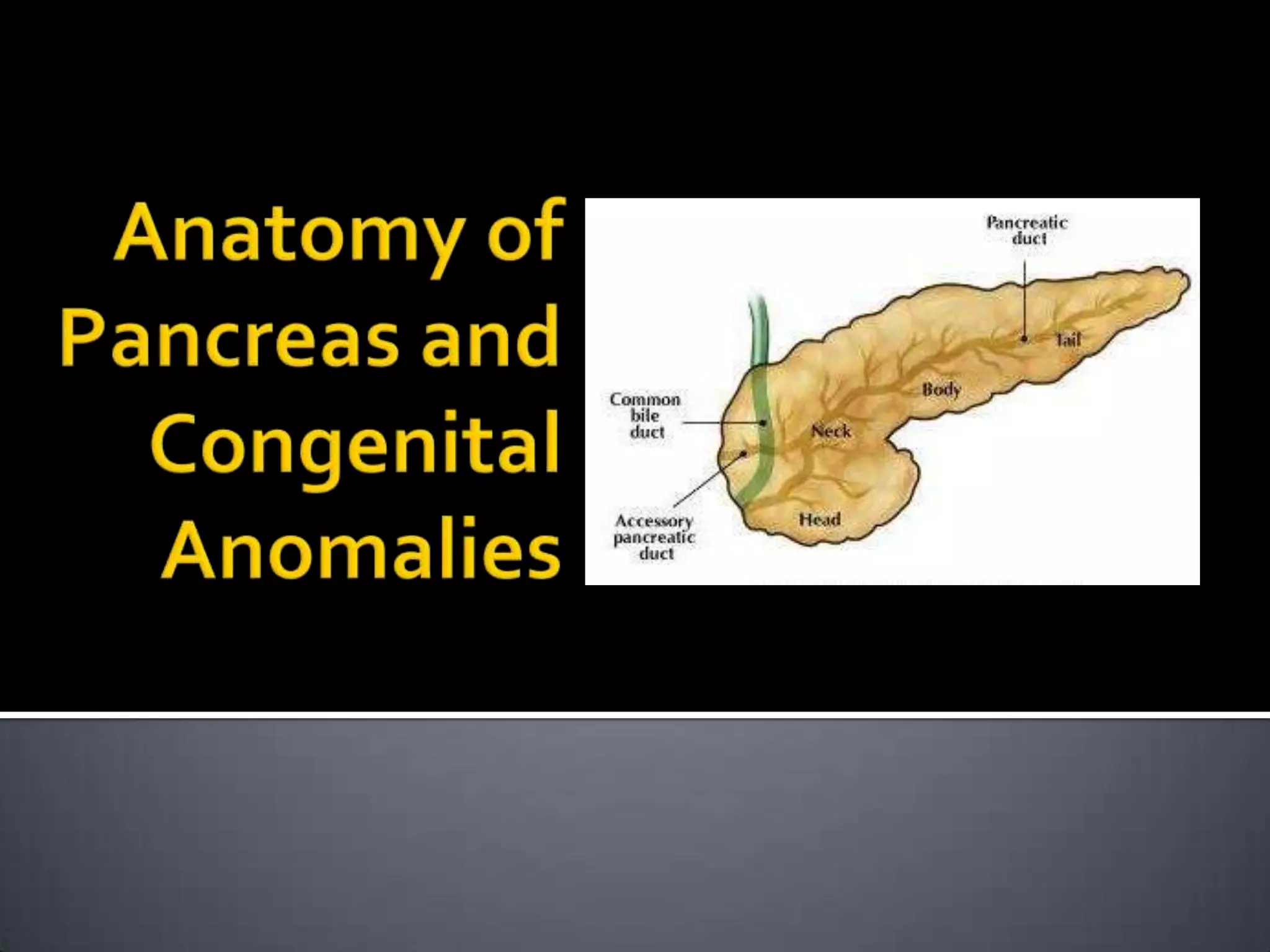
• To explain about anatomy of pancreas:
– Gross : blood supply, lymphatic drainage, innervations,
ducts system, embryology
– Histology : exocrine, endocrine
• To explain about congenital anomalies of pancreas:
1. Agenesis
2. Pancreas Divisum
3. Annular Pancreas
4. Ectopic Pancreas
5. Congenital Cysts
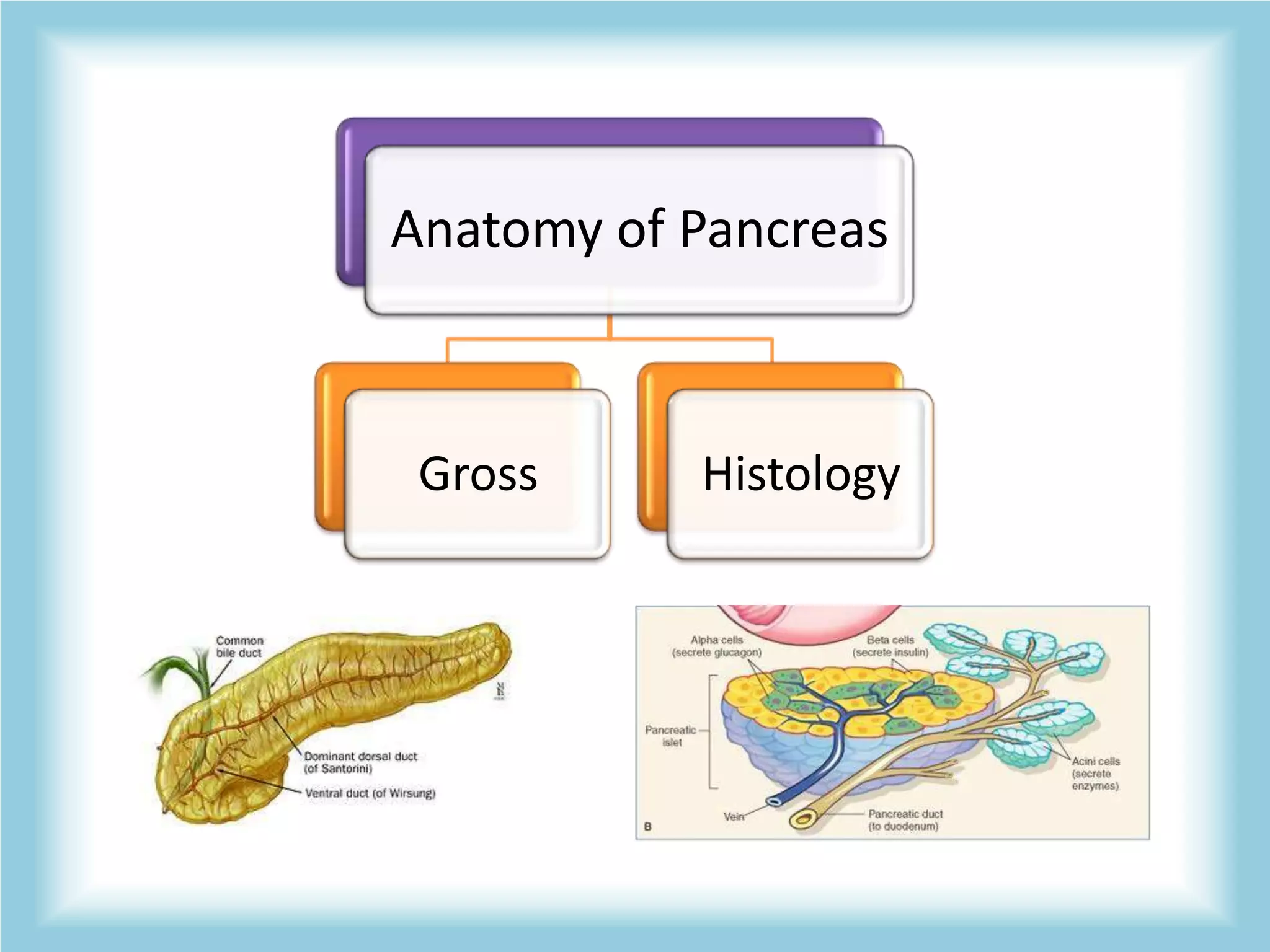
Anatomy of Pancreas
Gross Histology
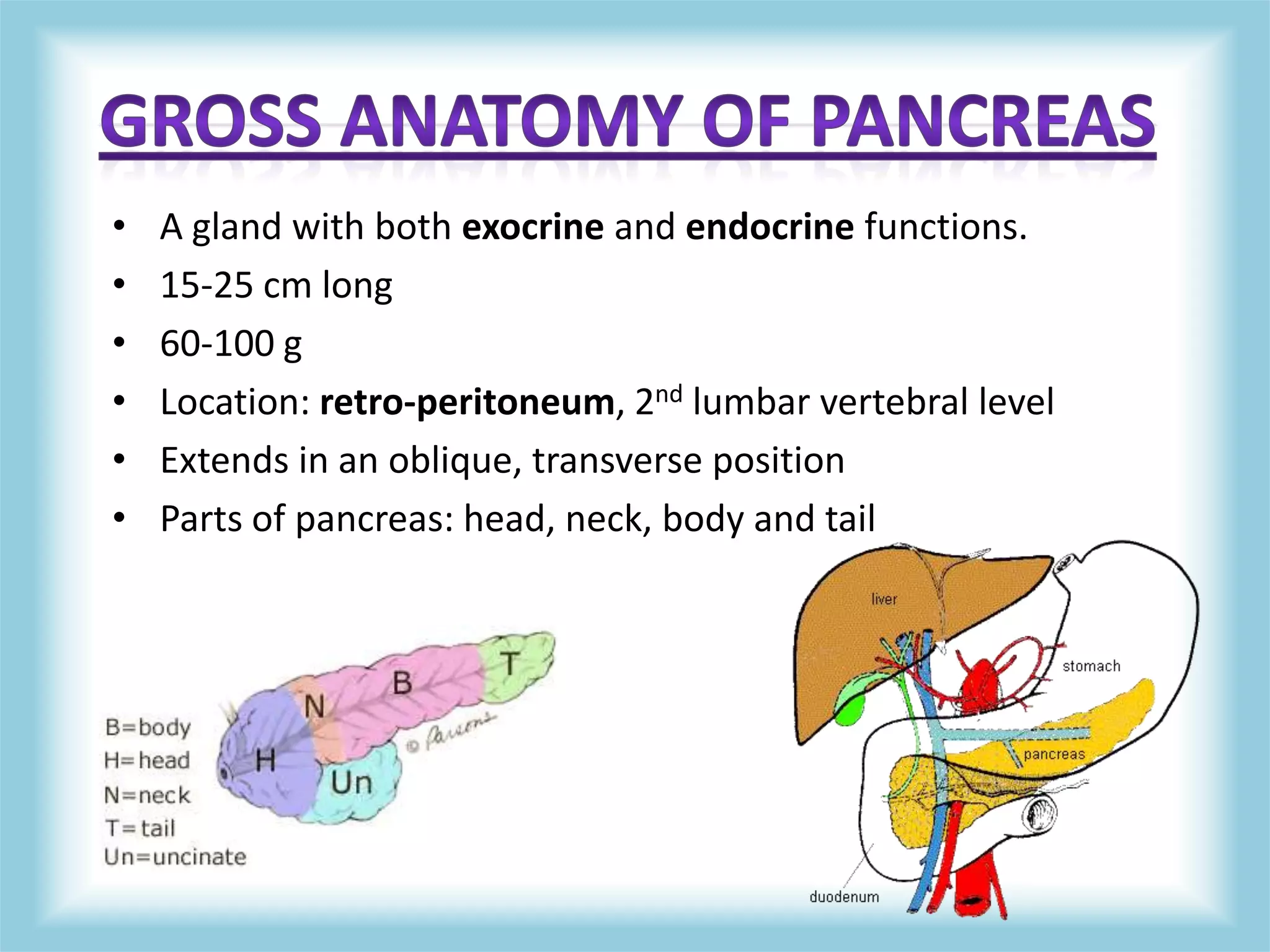
• A gland with both exocrine and endocrine functions.
• 15-25 cm long
• 60-100 g
• Location: retro-peritoneum, 2nd lumbar vertebral level
• Extends in an oblique, transverse position
• Parts of pancreas: head, neck, body and tail
Arterial Supply:
– splenic artery
– pancreaticoduodenal arteries
Venous Drainage:
 Suprapancreatic PV
 Retropancreatic PV
 Splenic vein
 Infrapancreatic SMV
• Ultimately, drains into portal vein
Innervations:
• Sympathetic fibers (from the splanchnic nerves)
• Parasympathetic fibers (from the vagus)
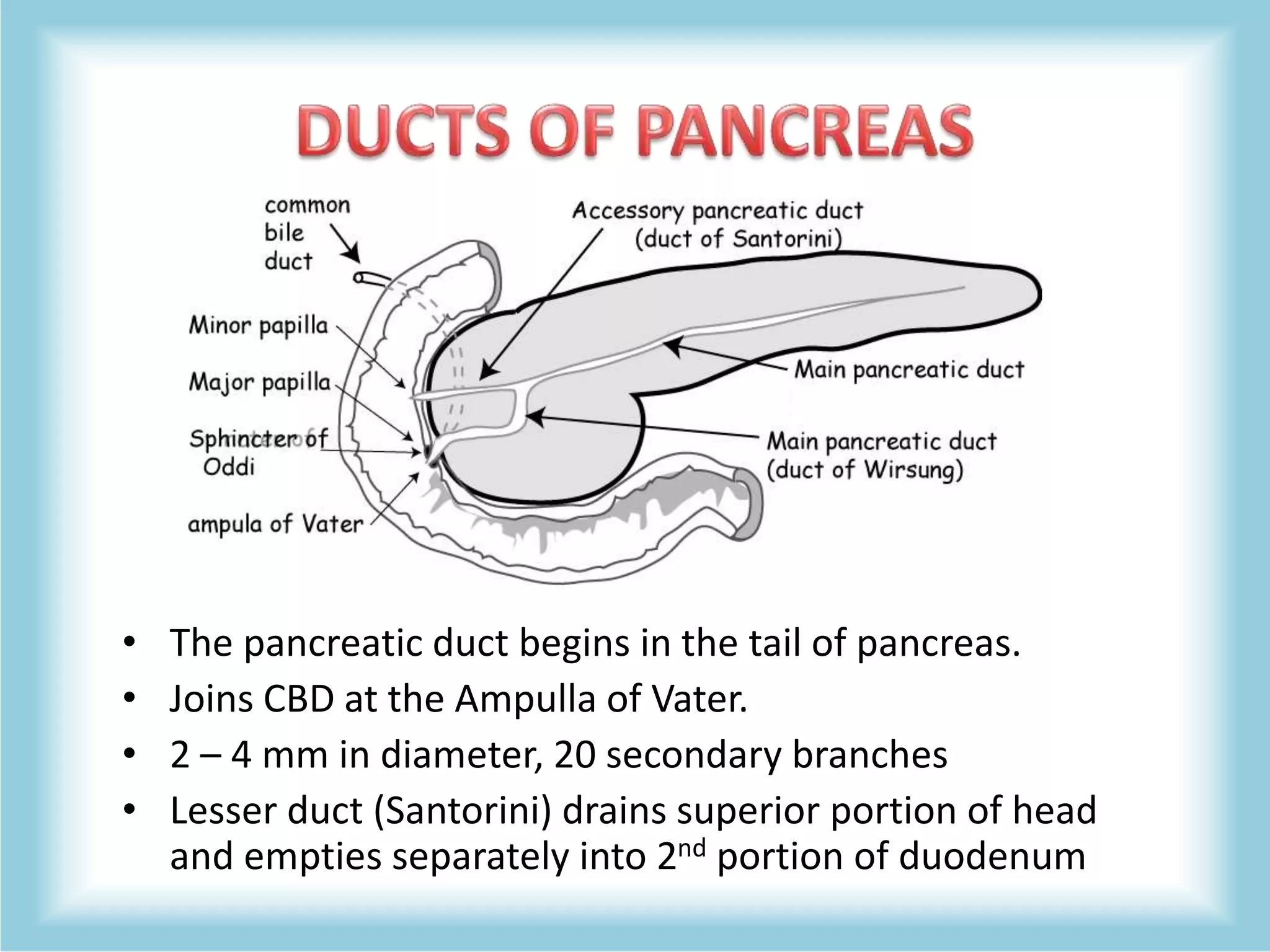
• The pancreatic duct begins in the tail of pancreas.
• Joins CBD at the Ampulla of Vater.
• 2 – 4 mm in diameter, 20 secondary branches
• Lesser duct (Santorini) drains superior portion of head
and empties separately into 2nd portion of duodenum
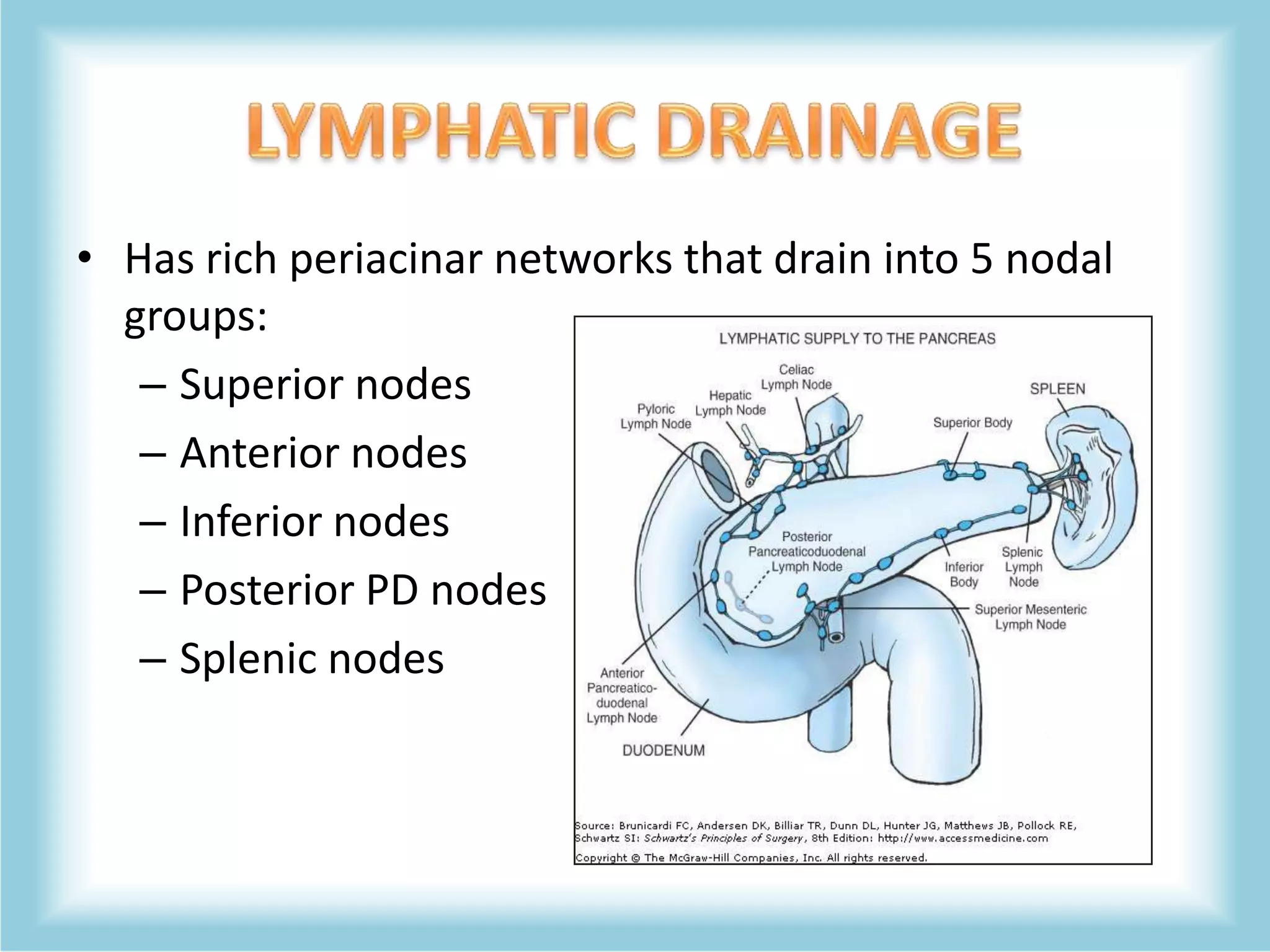
• Has rich periacinar networks that drain into 5 nodal
groups:
– Superior nodes
– Anterior nodes
– Inferior nodes
– Posterior PD nodes
– Splenic nodes
• Pancreatic acini + duct
system.
• Produces digestive enzymes
(amylase, trypsin, lipase) and
alkaline fluid.
Exocrine Parts
Endocrine Parts
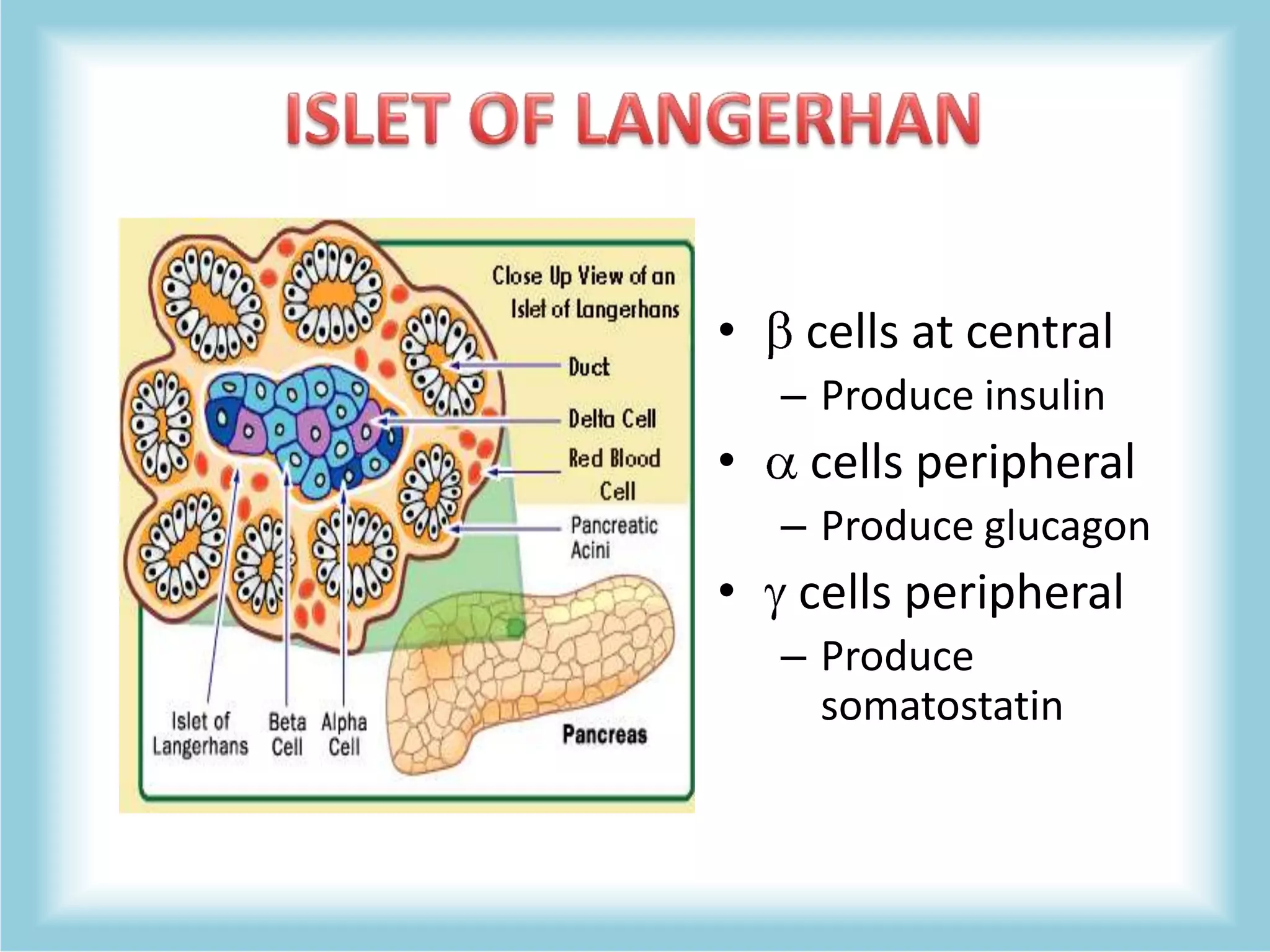
• Islets of Langerhans
(pancreatic islets)
• Regulator of glucose, lipid,
protein homeostasis.
• cells at central
– Produce insulin
• cells peripheral
– Produce glucagon
• cells peripheral
– Produce
somatostatin
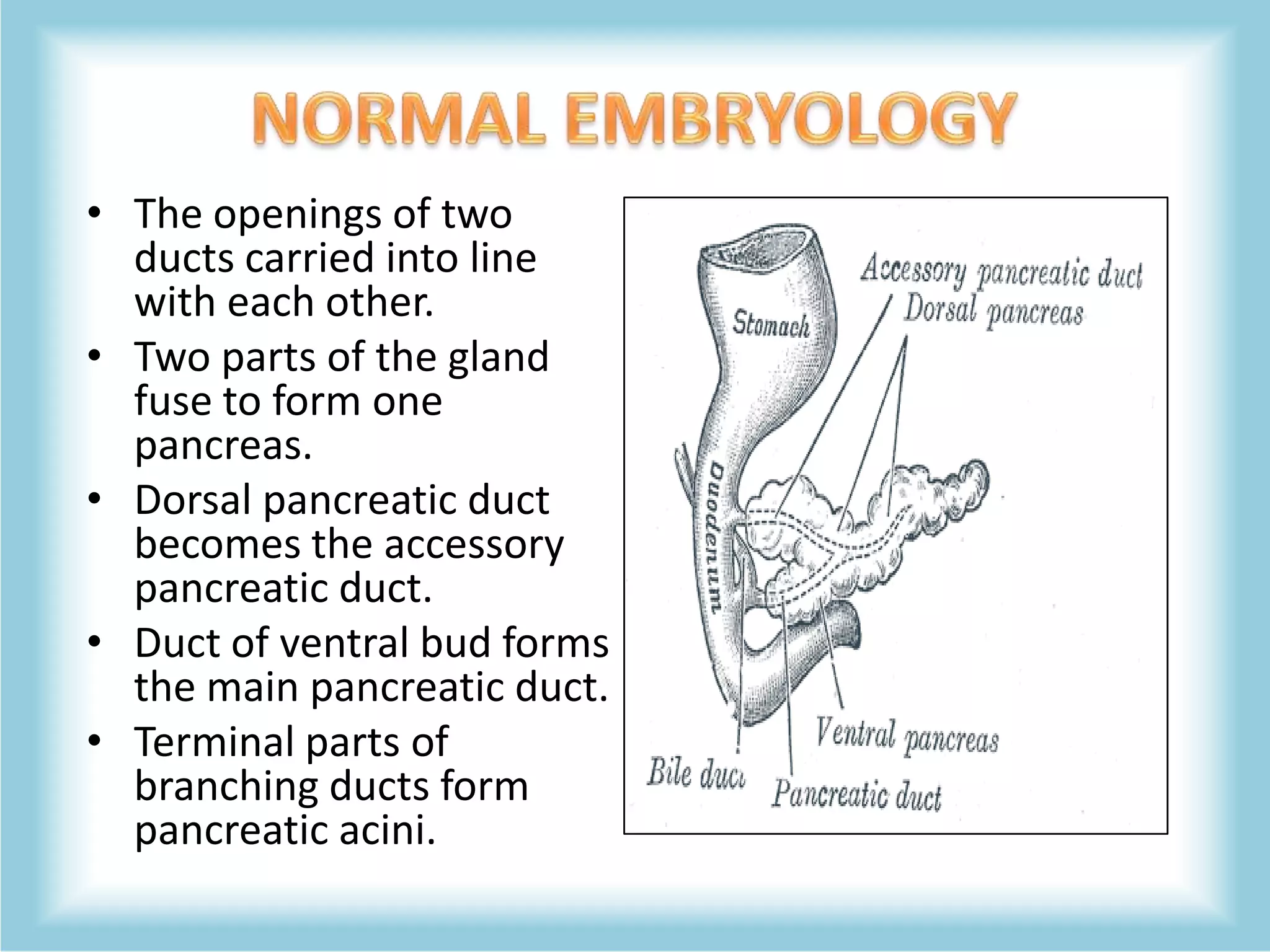
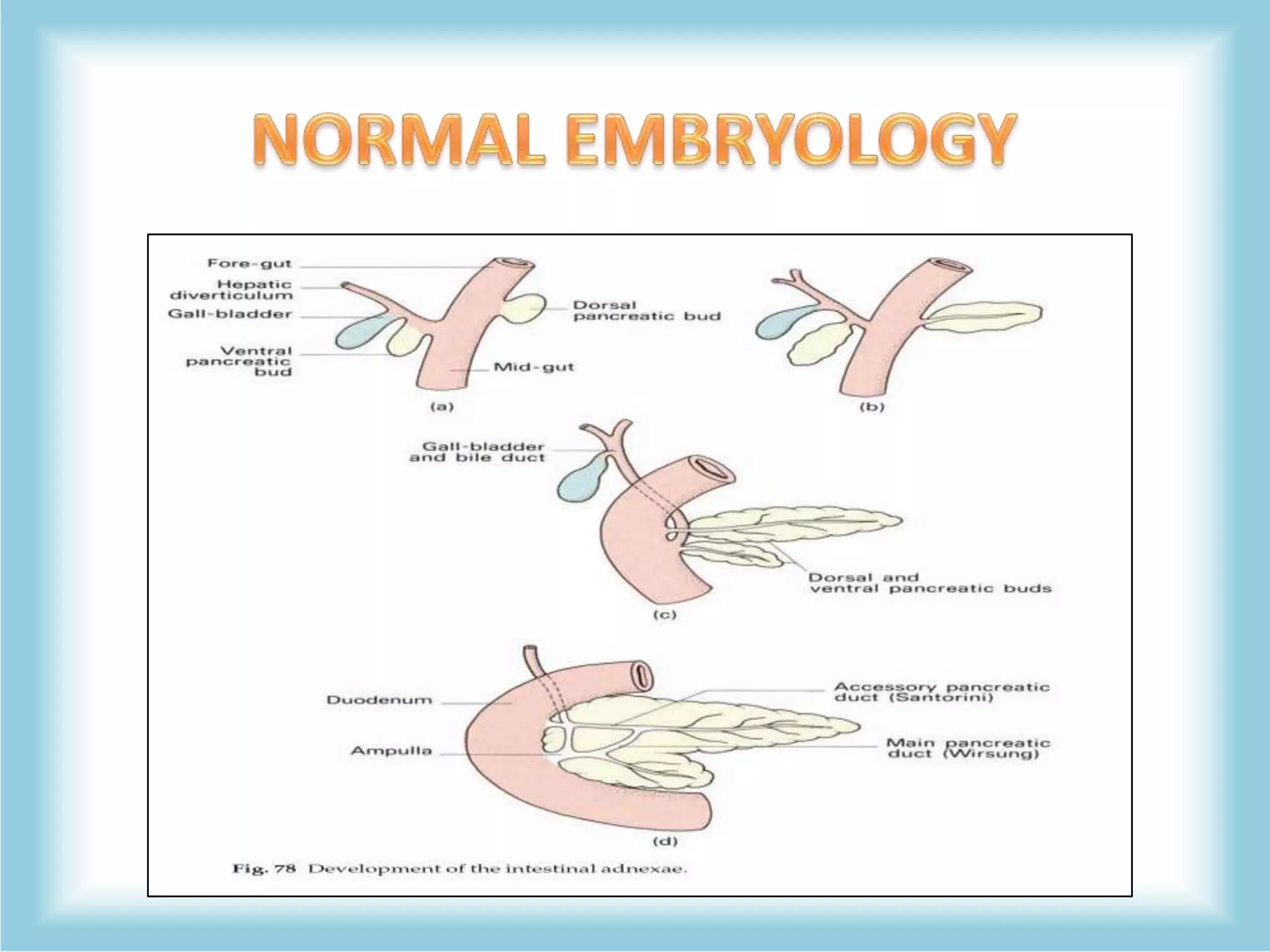
• The openings of two
ducts carried into line
with each other.
• Two parts of the gland
fuse to form one
pancreas.
• Dorsal pancreatic duct
becomes the accessory
pancreatic duct.
• Duct of ventral bud forms
the main pancreatic duct.
• Terminal parts of
branching ducts form
pancreatic acini.
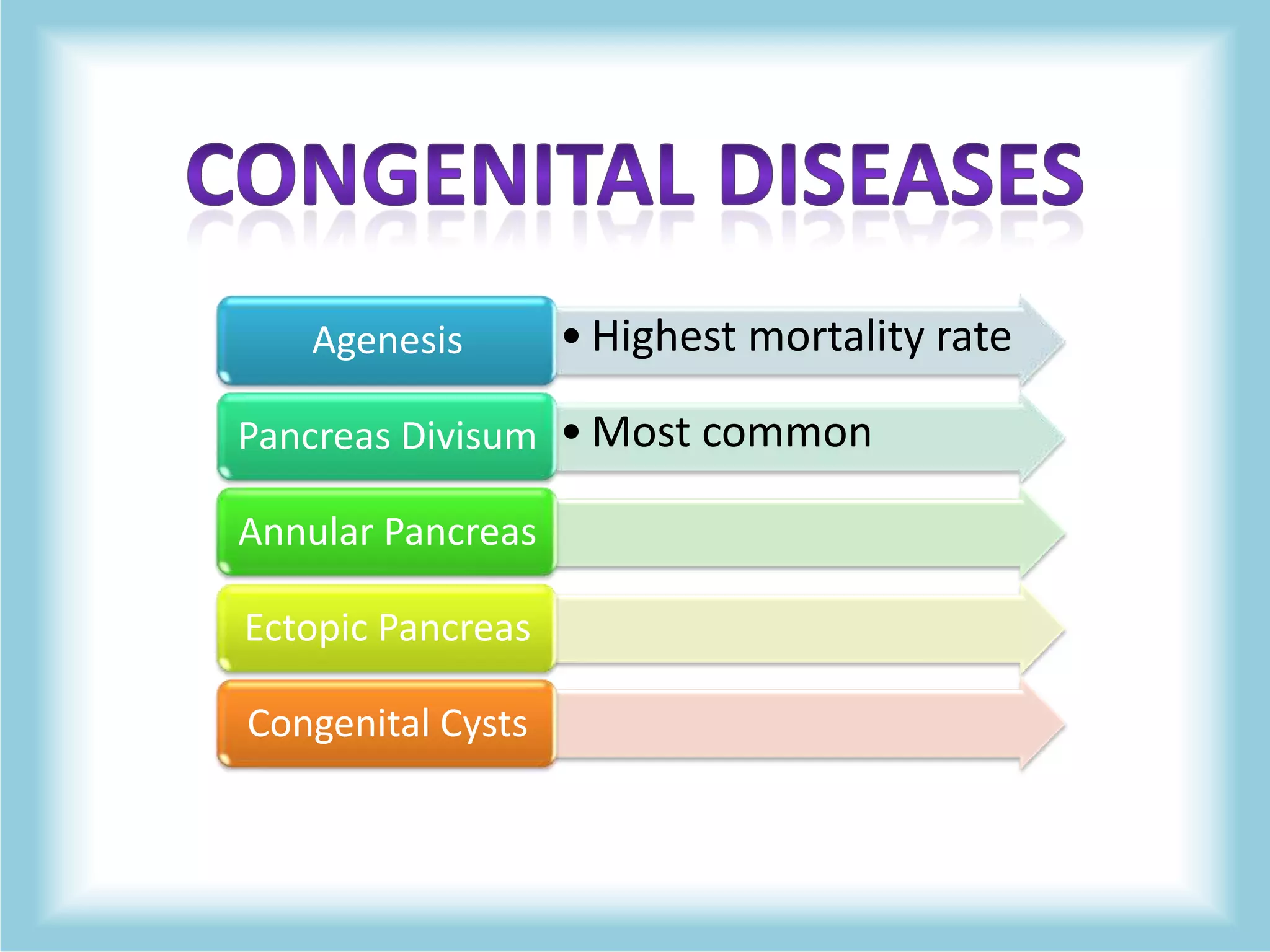
• Highest mortality rateAgenesis
• Most commonPancreas Divisum
Annular Pancreas
Ectopic Pancreas
Congenital Cysts
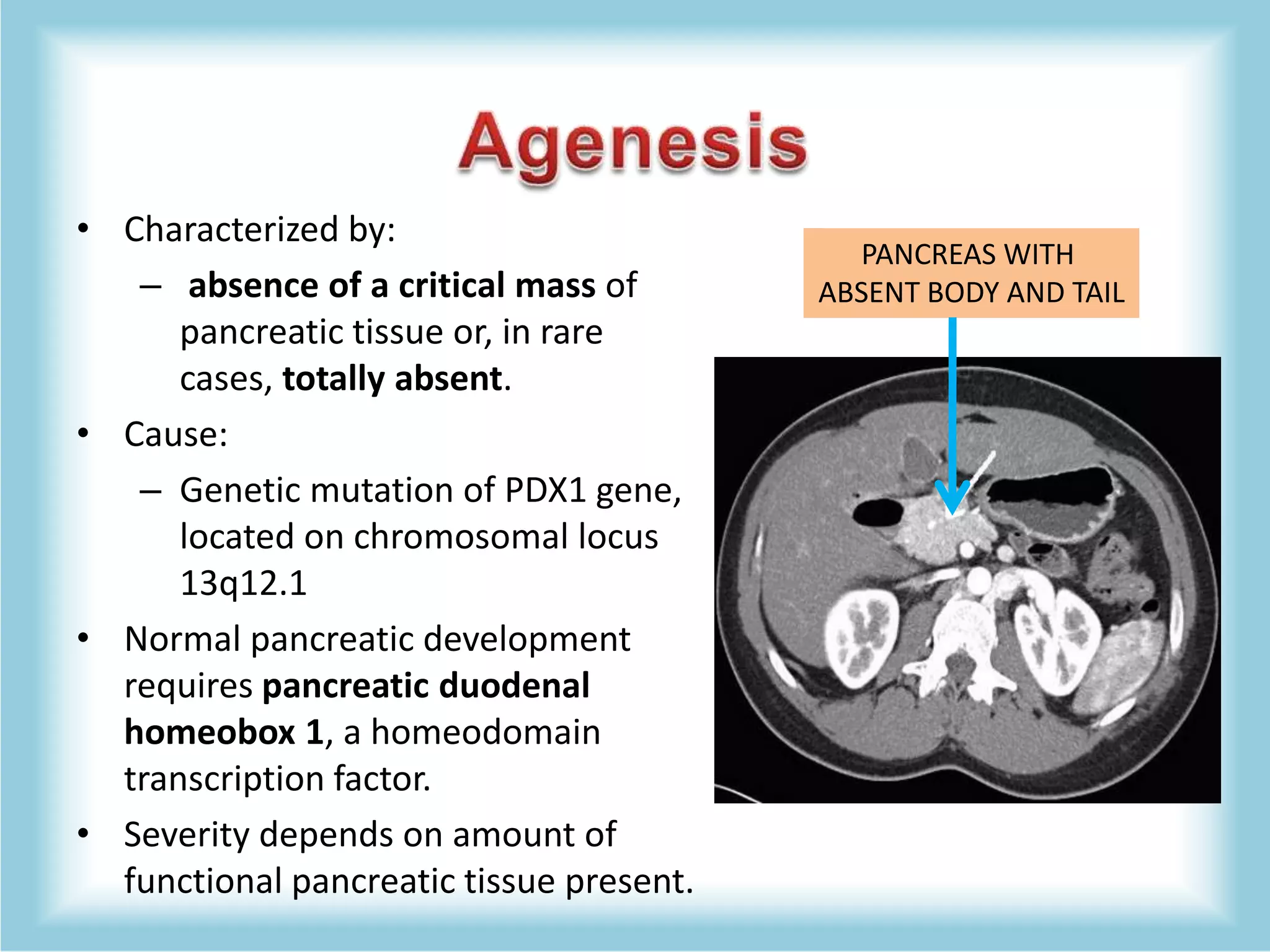
• Characterized by:
– absence of a critical mass of
pancreatic tissue or, in rare
cases, totally absent.
• Cause:
– Genetic mutation of PDX1 gene,
located on chromosomal locus
13q12.1
• Normal pancreatic development
requires pancreatic duodenal
homeobox 1, a homeodomain
transcription factor.
• Severity depends on amount of
functional pancreatic tissue present.
PANCREAS WITH
ABSENT BODY AND TAIL
Associated disease:
• Pancreaticobiliary duct anomalies – can lead to acute/chronic
pancreatitis
Symptoms:
• Abdominal pain
• Diabetes (dorsal pancreas agenesis)
• Lipid-rich stool (caused by defect of pancreatic enzymes)
Exam and Tests:
• Abdominal ultrasound
• Abdominal CT scan
Management:
• treatment of the diabetes and exocrine deficiency, when present.
• Infusion of subcutaneous insulin, administration of pancreatic
enzyme.
Prognosis:
• Variable, depending on the quality of treatment received.
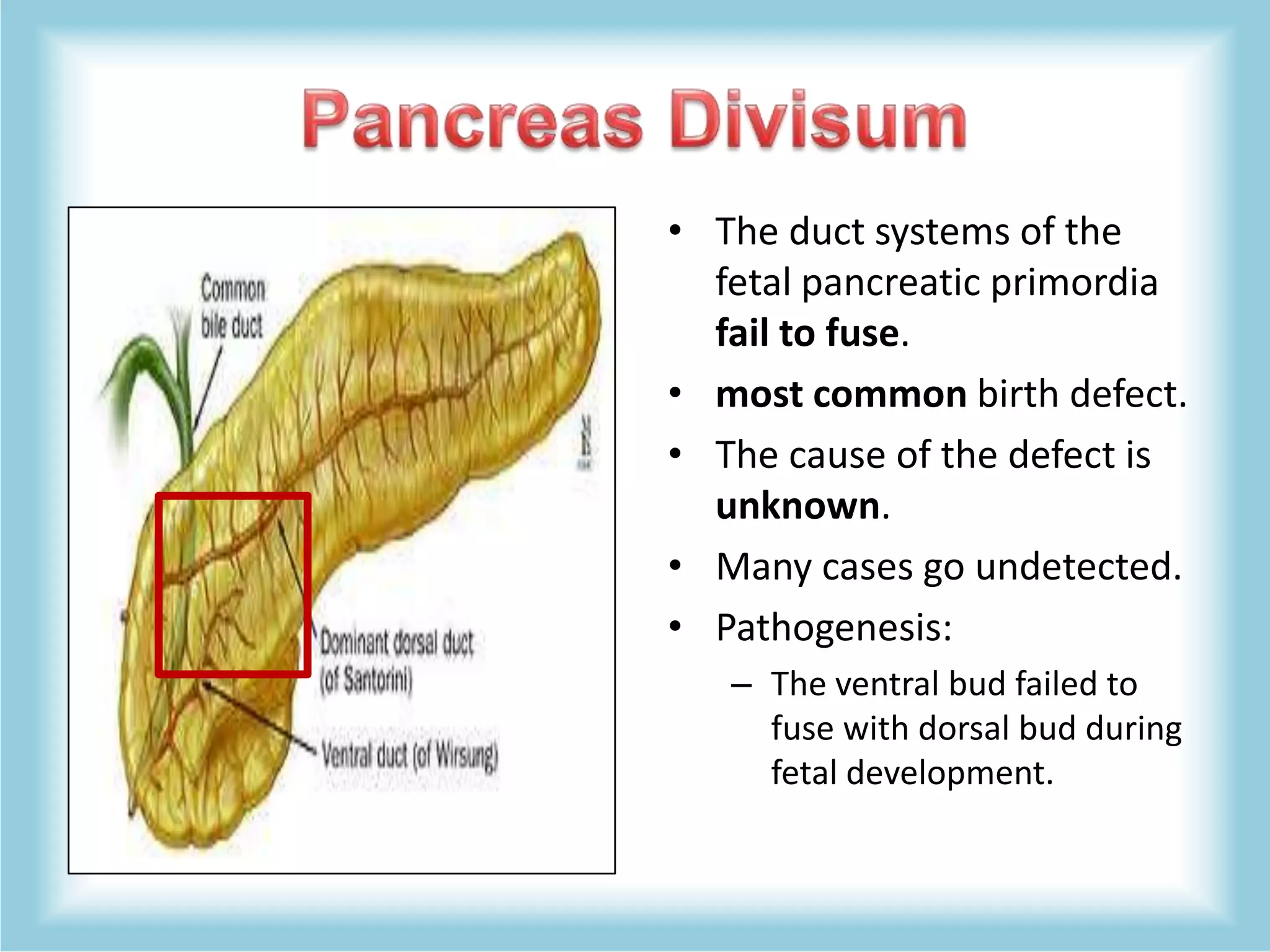
• The duct systems of the
fetal pancreatic primordia
fail to fuse.
• most common birth defect.
• The cause of the defect is
unknown.
• Many cases go undetected.
• Pathogenesis:
– The ventral bud failed to
fuse with dorsal bud during
fetal development.
Clinical features:
• Abdominal pain and swelling, nausea or vomiting.
• Note: symptoms absent without pancreatitis
Exams and Tests:
• Abdominal ultrasound
• Abdominal CT scan
• Amylase and lipase blood test
Treatment:
• Surgery.
Complication:
• Pancreatitis
Prognosis:
• The outcome is usually good.
• A ring of pancreatic tissue
that completely encircles
the duodenum.
• Pathogenesis:
– May occur when the ventral bud
splits (become bifid), the two
segments may encircle the
duodenum .
• Symptoms:
 Newborns  spit up more than normal, do not drink enough milk
 Adult  fullness after eating, nausea or vomiting
• Symptoms occur when the ring of pancreas squeezes and
narrows the small intestine.
• Conditions that may be associated with annular pancreas
include:
– Down syndrome
– Excess amniotic fluid during pregnancy (polyhydramnios)
– Other congenital gastrointestinal problems
– Peritonitis
Exams and Tests:
• Abdominal ultrasound
• Abdominal x-ray
Treatment:
• Surgical bypass of the blocked part of the duodenum.
Prognosis:
• Good outcome with surgery.
Complications:
• Obstructive jaundice
• Pancreatic cancer
• Peptic ulcer
• Perforation (tearing a hole) of the intestine due to obstruction
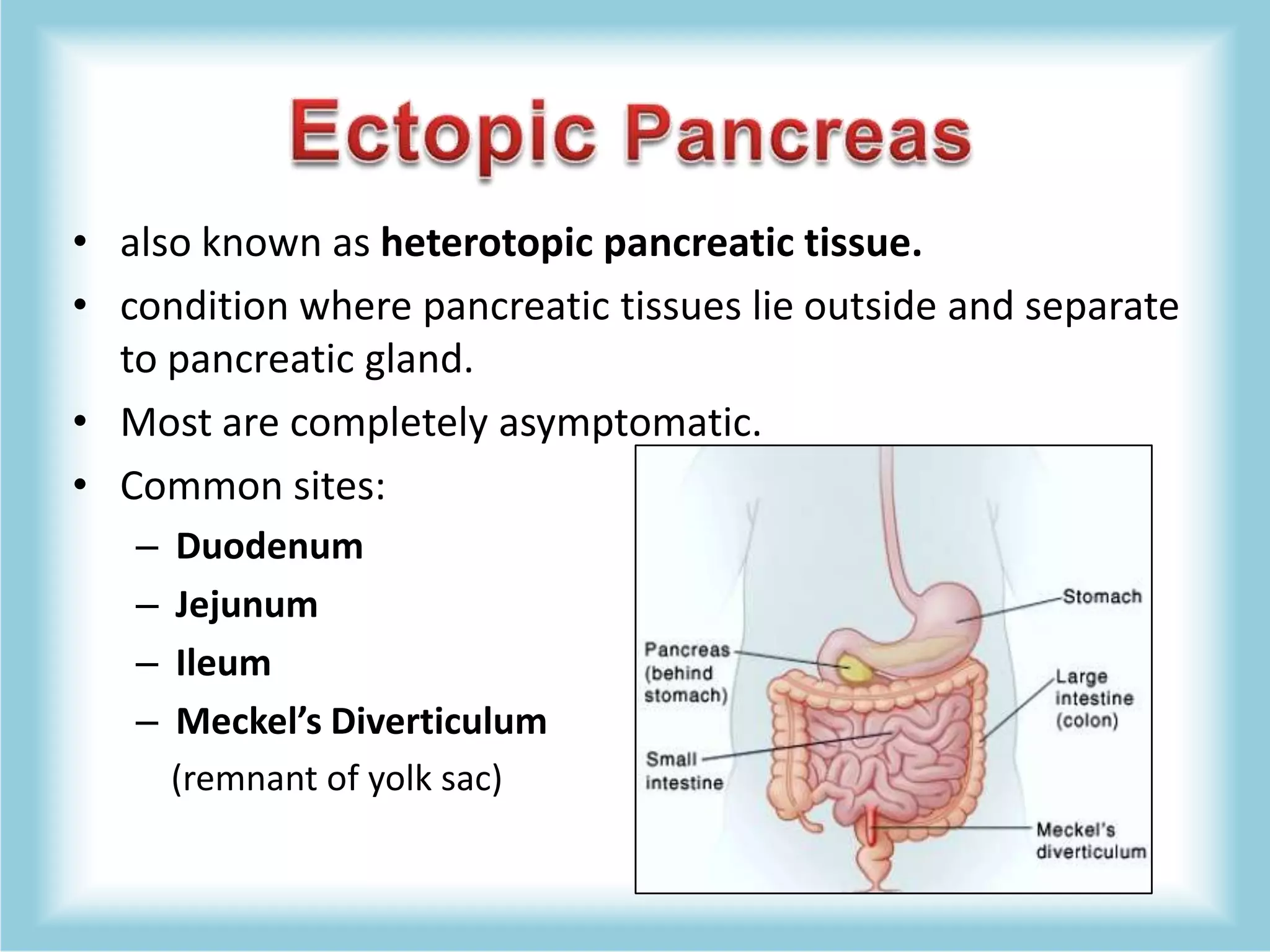
• also known as heterotopic pancreatic tissue.
• condition where pancreatic tissues lie outside and separate
to pancreatic gland.
• Most are completely asymptomatic.
• Common sites:
– Duodenum
– Jejunum
– Ileum
– Meckel’s Diverticulum
(remnant of yolk sac)
Symptoms:
• Usually non-specific
• Abnominal pain & dyspepsia
Diagnosis:
• GI endoscopy
Complication:
• Intestinal obstruction
• Carcinoma of the ectopic pancreatic tissue
Treatment:
• Surgery if symptomatic
• Results from anomalous development of the
pancreatic ducts.
• Morphology:
– unilocular cysts, range from 5cm in diameter.
– Lined by either uniform cuboidal or flattened
epithelium and are enclosed in a thin, fibrous
capsule.
– Contains clear serous fluid – important point from
pancreatic cystic neoplasms (which is mucinous)
Symptoms:
• Abdominal swelling
• Palpable mass
• Vomit
Exams and Tests:
• Ultrasonography
Management:
• Surgery
• There are five congenital diseases, agenesis, pancreas
divisum, annular pancreas, ectopic pancreas, and
congenital cysts.
• The most common is pancreas divisum.
• Agenesis has the highest mortality rate.
• All treatments are via surgery except in agenesis,
insulin infusion (and other pancreatic secretion
components) is needed.
• Polyhydramnios can occur in annular pancreas cases.
• Cancer mostly occurs in the head of pancreas.
• Textbook of Robbins Basic Pathology
• Textbook of Gray’s Anatomy
• www.healthline.com
• www.medscape.com
1 2 3 4 5
1. The following are congenital diseases of pancreas
A. Congenital cysts
B. Pancreatic divisum
C. Heterotopic pancreatic tissue
D. Agenesis
E. Annular pancreas
TTTTT
C. Other name for Ectopic Pancreas
2. Pancreas divisum is the most common congenital
disease. T/F
1 2 3 4 5
T
3. Annular pancreas is the incomplete fusion of the
ducts of pancreas during fetal development. T/F
1 2 3 4 5
F
Pancreas divisum incomplete fusion
Annular pancreas encircling duodenum
4. Congenital cysts can be managed by cystectomy. T/F
1 2 3 4 5
T
5. Common sites for ectopic pancreas are
A. Jejunum
B. Meckel’s diverticulum
C. Caecum
D. Rectum
E. Ileum
1 2 3 4 5
TTFFT
THANK YOU

Pancreas Congenital Anomalies (agenesis, pancreas divisum, annular pancreas, ectopic pancreas, congenital cysts) - reference mostly from Textbook of Robbins Pathology

  • 2.
    • To explainabout anatomy of pancreas: – Gross : blood supply, lymphatic drainage, innervations, ducts system, embryology – Histology : exocrine, endocrine • To explain about congenital anomalies of pancreas: 1. Agenesis 2. Pancreas Divisum 3. Annular Pancreas 4. Ectopic Pancreas 5. Congenital Cysts
  • 3.
  • 4.
    • A glandwith both exocrine and endocrine functions. • 15-25 cm long • 60-100 g • Location: retro-peritoneum, 2nd lumbar vertebral level • Extends in an oblique, transverse position • Parts of pancreas: head, neck, body and tail
  • 5.
    Arterial Supply: – splenicartery – pancreaticoduodenal arteries Venous Drainage:  Suprapancreatic PV  Retropancreatic PV  Splenic vein  Infrapancreatic SMV • Ultimately, drains into portal vein Innervations: • Sympathetic fibers (from the splanchnic nerves) • Parasympathetic fibers (from the vagus)
  • 6.
    • The pancreaticduct begins in the tail of pancreas. • Joins CBD at the Ampulla of Vater. • 2 – 4 mm in diameter, 20 secondary branches • Lesser duct (Santorini) drains superior portion of head and empties separately into 2nd portion of duodenum
  • 7.
    • Has richperiacinar networks that drain into 5 nodal groups: – Superior nodes – Anterior nodes – Inferior nodes – Posterior PD nodes – Splenic nodes
  • 8.
    • Pancreatic acini+ duct system. • Produces digestive enzymes (amylase, trypsin, lipase) and alkaline fluid. Exocrine Parts Endocrine Parts • Islets of Langerhans (pancreatic islets) • Regulator of glucose, lipid, protein homeostasis.
  • 9.
    • cells atcentral – Produce insulin • cells peripheral – Produce glucagon • cells peripheral – Produce somatostatin
  • 10.
    • The openingsof two ducts carried into line with each other. • Two parts of the gland fuse to form one pancreas. • Dorsal pancreatic duct becomes the accessory pancreatic duct. • Duct of ventral bud forms the main pancreatic duct. • Terminal parts of branching ducts form pancreatic acini.
  • 12.
    • Highest mortalityrateAgenesis • Most commonPancreas Divisum Annular Pancreas Ectopic Pancreas Congenital Cysts
  • 13.
    • Characterized by: –absence of a critical mass of pancreatic tissue or, in rare cases, totally absent. • Cause: – Genetic mutation of PDX1 gene, located on chromosomal locus 13q12.1 • Normal pancreatic development requires pancreatic duodenal homeobox 1, a homeodomain transcription factor. • Severity depends on amount of functional pancreatic tissue present. PANCREAS WITH ABSENT BODY AND TAIL
  • 14.
    Associated disease: • Pancreaticobiliaryduct anomalies – can lead to acute/chronic pancreatitis Symptoms: • Abdominal pain • Diabetes (dorsal pancreas agenesis) • Lipid-rich stool (caused by defect of pancreatic enzymes) Exam and Tests: • Abdominal ultrasound • Abdominal CT scan Management: • treatment of the diabetes and exocrine deficiency, when present. • Infusion of subcutaneous insulin, administration of pancreatic enzyme. Prognosis: • Variable, depending on the quality of treatment received.
  • 15.
    • The ductsystems of the fetal pancreatic primordia fail to fuse. • most common birth defect. • The cause of the defect is unknown. • Many cases go undetected. • Pathogenesis: – The ventral bud failed to fuse with dorsal bud during fetal development.
  • 16.
    Clinical features: • Abdominalpain and swelling, nausea or vomiting. • Note: symptoms absent without pancreatitis Exams and Tests: • Abdominal ultrasound • Abdominal CT scan • Amylase and lipase blood test Treatment: • Surgery. Complication: • Pancreatitis Prognosis: • The outcome is usually good.
  • 17.
    • A ringof pancreatic tissue that completely encircles the duodenum. • Pathogenesis: – May occur when the ventral bud splits (become bifid), the two segments may encircle the duodenum .
  • 18.
    • Symptoms:  Newborns spit up more than normal, do not drink enough milk  Adult  fullness after eating, nausea or vomiting • Symptoms occur when the ring of pancreas squeezes and narrows the small intestine. • Conditions that may be associated with annular pancreas include: – Down syndrome – Excess amniotic fluid during pregnancy (polyhydramnios) – Other congenital gastrointestinal problems – Peritonitis
  • 19.
    Exams and Tests: •Abdominal ultrasound • Abdominal x-ray Treatment: • Surgical bypass of the blocked part of the duodenum. Prognosis: • Good outcome with surgery. Complications: • Obstructive jaundice • Pancreatic cancer • Peptic ulcer • Perforation (tearing a hole) of the intestine due to obstruction
  • 20.
    • also knownas heterotopic pancreatic tissue. • condition where pancreatic tissues lie outside and separate to pancreatic gland. • Most are completely asymptomatic. • Common sites: – Duodenum – Jejunum – Ileum – Meckel’s Diverticulum (remnant of yolk sac)
  • 21.
    Symptoms: • Usually non-specific •Abnominal pain & dyspepsia Diagnosis: • GI endoscopy Complication: • Intestinal obstruction • Carcinoma of the ectopic pancreatic tissue Treatment: • Surgery if symptomatic
  • 22.
    • Results fromanomalous development of the pancreatic ducts. • Morphology: – unilocular cysts, range from 5cm in diameter. – Lined by either uniform cuboidal or flattened epithelium and are enclosed in a thin, fibrous capsule. – Contains clear serous fluid – important point from pancreatic cystic neoplasms (which is mucinous)
  • 24.
    Symptoms: • Abdominal swelling •Palpable mass • Vomit Exams and Tests: • Ultrasonography Management: • Surgery
  • 25.
    • There arefive congenital diseases, agenesis, pancreas divisum, annular pancreas, ectopic pancreas, and congenital cysts. • The most common is pancreas divisum. • Agenesis has the highest mortality rate. • All treatments are via surgery except in agenesis, insulin infusion (and other pancreatic secretion components) is needed. • Polyhydramnios can occur in annular pancreas cases. • Cancer mostly occurs in the head of pancreas.
  • 26.
    • Textbook ofRobbins Basic Pathology • Textbook of Gray’s Anatomy • www.healthline.com • www.medscape.com
  • 27.
    1 2 34 5 1. The following are congenital diseases of pancreas A. Congenital cysts B. Pancreatic divisum C. Heterotopic pancreatic tissue D. Agenesis E. Annular pancreas TTTTT C. Other name for Ectopic Pancreas
  • 28.
    2. Pancreas divisumis the most common congenital disease. T/F 1 2 3 4 5 T
  • 29.
    3. Annular pancreasis the incomplete fusion of the ducts of pancreas during fetal development. T/F 1 2 3 4 5 F Pancreas divisum incomplete fusion Annular pancreas encircling duodenum
  • 30.
    4. Congenital cystscan be managed by cystectomy. T/F 1 2 3 4 5 T
  • 31.
    5. Common sitesfor ectopic pancreas are A. Jejunum B. Meckel’s diverticulum C. Caecum D. Rectum E. Ileum 1 2 3 4 5 TTFFT
  • 32.