
DR ZIKRULLAH
PROPOFOL
INTRODUCTION
 Propofol is the most frequently used intravenous
anaesthetic today.
 Work in the early 1970’s on the substituted
derivatives of phenol with hypnotic properties
results in the development of 2,6-di-isopropofol
 The first clinical trial, reported by Kay and Rolly in
1977, confirmed the potential of propofol as an
anaesthetic induction agent
 Propofol is insoluble in water and was therefore
initially prepared with Cremophor EL
 As Cremophor EL was associated with side effects
in form of hypersensitive reactions, the drug was
reformulated as a lipid emulsion and relaunched in
1986 with brand name Diprivan (Di –IsoPRopyl-
IV-ANaesthetic)
Physical properties
 Propofol is a white ,oil in water, isotonic emulsion
for intravenous injection only
 Highly lipid soluble
 Insoluble in water
Chemical Nature
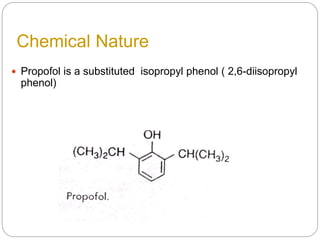
 Propofol is a substituted isopropyl phenol ( 2,6-diisopropyl
phenol)
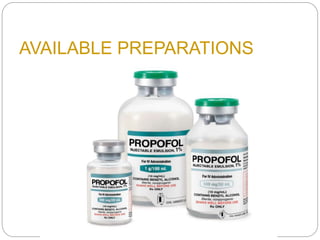
AVAILABLE PREPARATIONS
 Available as 1% solution of propofol in an aqueous solution
of
o 10% soybean oil (oil phase)
o 2.25% glycerol
o 1.2% purified egg phosphatide (emulsifying agent)
 Available in a strength of 10 mg per ml in 10ml , 20ml ,
50ml vials and 100ml bottle and 20ml ampoule.
GENERIC FORMULATION
 This preparation uses sodium metabisulfite (0.25
mg/ml )as preservative
 The pH is low  4.5 - 6.4
 It has the preservative disodium edetate
(0.005%)
 Uses sodium hydroxide to adjust pH to 7 to 8.5
DIPRIVAN
 A low lipid emulsion of propofol contain
 5% soybean oil
 0.6% egg lecithin
 Higher incidence of pain on injection,
 Doesn't need a preservative or microbial growth
retardant
 Equipotent to diprivan.
AMPOFOL
Fospropofol (Aquavan)
 Prodrug
 Phosphono-o-methyl-2,6-diisoprpylphenol
 Undergo hydrolysis by endothelial cell surface alkaline
phosphatases liberating propofol, phosphate and
formaldehyde
 1mg of fospropofol would liberate 0.54 mg of propofol
 Alternative to emulsion formulation to reduce associated
side effects (pain on injection, risk of infection,
hypertriglyceridemia, pulmonary embolism)
 Phosphate Monoesters, Hemisuccinate groups added to
the parent compound to increase its water solubility
Non Lipid Formulations
 CYCLODEXTRINS as solublizing agents is used.
 Cyclodextrin are ring sugars, and form a carrier (host)
complex to carry guest drugs (propofol)
 This makes propofol water soluble
 Propofol migrates out of the cyclodextrin ring in the
blood.
Pharmaco kinetics
 Absoption
 Available only for iv administration.
 Distribution-
 High lipid solubility
 Awakening from a single bolus dose is rapid due to
a very short initial distribution half life(2-8)min.
 Biotransformation-
 Rate of clearence exceeds hepatic blood flow
suggesting extrahepatic site of metabolism.
Metabolism
 Metabolism occurs at hepatic (mainly) and
extrahepatic sites.
 Hepatic
 Inactive, water soluble sulphate and glucoronic acid
metabolite, excreted by kidney
 Extrahepatic
 lung-pulmonary uptake of propofol occurs in first pass
but most of drug is released back in circulation .
 kidney/ brain – glucoronidation is major metabolic
pathway.
Excretion
 Metabolites are primarily excreted in urine.
 The elimination half time is 0.5 – 1.5 hrs
 The context sensitive half time of propofol
infusion lasting upto 8 hrs is < 40 min
Mechanism of action
 It is relatively selective modulator of GABAA receptors
(ß subunit)
 Exerts its sedative hypnotic effects through a GABAA
receptor interaction
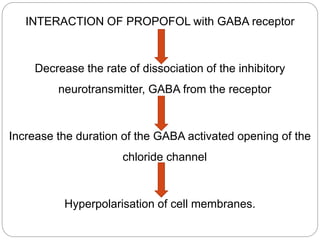
INTERACTION OF PROPOFOL with GABA receptor
Decrease the rate of dissociation of the inhibitory
neurotransmitter, GABA from the receptor
Increase the duration of the GABA activated opening of the
chloride channel
Hyperpolarisation of cell membranes.
EFFECTS ON
ORGAN SYSTEMS
CNS
 Propofol decreases
 cerebral blood flow
 intracranial pressure
 cerebral metabolic rate for oxygen(CMRO2)
 Cerebrovascular auto regulation in responses to
changes in systemic BP and reactivity of the
cerebral blood flow to changes in PaCO2 are not
affected by Propofol
 GABAA receptor mediated CNS depression.
 Inhibits NMDA subtype of glutamate receptors
through modulation of sodium channel gating.
 Sense of well being, Pleasure seeking behaviour
which leads to its abuse potential is due to
increased dopamine concentration in Nucleus
Accumbens.
 Tolerance to propofol doesn't develop in children
undergoing repeated exposure to the drug during
CVS
 Decreases systemic BP
 Decrease in BP is often accompanied by corresponding
changes in cardiac output.
 Vasodilation is due to
 Reduction in sympathetic activity
 Direct effect on intracellular smooth muscle calcium
mobilization
 Inhibition of prostacyclin synthesis in endothelial cells
 Reduction in angiotensin II elicited Ca++ entry
 A negative ionotropic effect of propofol may result
from a decrease in intracellular calcium availability
secondary to inhibition of trans-sclerolemmal Ca+
influx.
 The BP effect of propofol may be exaggerated in
hypovolumic Patienst, elderly, and Patients with
compromised LVF due to CAD
 Adequate hydration before rapid IV infusion is
recommended to minimize the BP effect.
 Propofol may decrease sympath .N. system activity to
a greater extent than parasympathetic. N. system
activity resulting in a predominant of the latter
 It doesn’t alter SA or AV node function in normal
patients or in Pt of WPW syndrome - acceptable drug
during ablative period
 Baroreceptor reflex control of heart rate may be
depressed by propofol.
 Profound bradycardia and asystole reported in healthy adult
Pt despite prophylactic anticholinergics
 Risk of bradycardia – related death during propofol
anaesthesia has been estimated to 1.4 in 100,000
 Heart rate responses to IV administration of atropine may be
attenuated in Pt receiving propofol due to suppression of
sympathetic nervous system by propofol
 Treatment may require beta agonist such as isoproterenol
Respiratory System
 Dose dependant depression of ventilation
 Apnea occurring in 25 – 35 % of patient after
induction of anaesthesia.
 Opioids in premedication enhance ventilatory
depressant effect
 A maintenance infusion of propofol decreases
tidal volume and frequency of breathing
 Ventilatory response to CO2 and hypoxemia are
decreased
 Propofol depresses the ventilatory response to
hypercapnia due to an effect at the central
chemoreceptors
 Peripheral chemoreceptor reflex response to CO2
remain intact
 Propofol can produce broncho-dilatation and
decrease the incidence of intraop wheezing in Pt
of asthma
 Hypoxic pulmonary vasoconstriction seems to
Hepatic and renal system
 Prolonged infusions have been associated with
hepatocellular injury accompanied by lactic
acidosis, bradyarrthythmia and rhabdomyolysis
 Prolonged infusion may also result in excretion of
green urine, reflecting the presence of phenols in
the urine this discoloration doesn’t alter renal
function
 Uric acid in urine is increased cloudy urine.
 This is d/t uric acid crystallization in urine at low
pH and temperature not considered to be
detrimental or indicative of adverse renal effect of
propofol
IOP
 Causes significant decrease in IOP
 Doesn’t alter tests of coagulation or platelet
function
 Inhibits platelet aggregation that is induced by
proinflammatory lipid mediators including
thromboxaneA2 and platelet activating factor
COAGULATION
USES OF PROPOFOL
Induction Of Anaesthesia
 Drug of choice for day care surgery
 For healthy adult 
 1.5 – 2.5 mg / kg body wt
 Blood level of 2- 6 mg /ml producing
unconsciousness
 Children
 Require higher induction dose
 d/t larger central distribution volume and higher
clearance rate
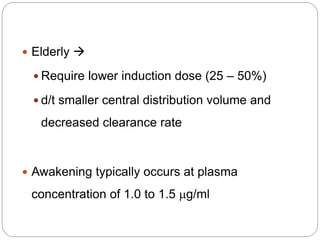
 Elderly 
 Require lower induction dose (25 – 50%)
 d/t smaller central distribution volume and
decreased clearance rate
 Awakening typically occurs at plasma
concentration of 1.0 to 1.5 mg/ml
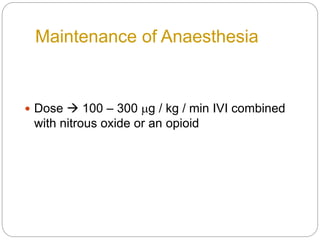
Maintenance of Anaesthesia
 Dose  100 – 300 mg / kg / min IVI combined
with nitrous oxide or an opioid
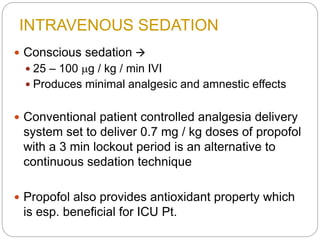
INTRAVENOUS SEDATION
 Conscious sedation 
 25 – 100 mg / kg / min IVI
 Produces minimal analgesic and amnestic effects
 Conventional patient controlled analgesia delivery
system set to deliver 0.7 mg / kg doses of propofol
with a 3 min lockout period is an alternative to
continuous sedation technique
 Propofol also provides antioxidant property which
is esp. beneficial for ICU Pt.
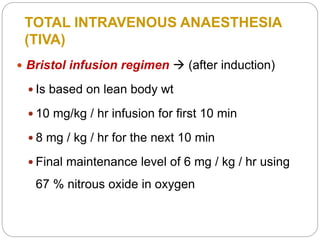
TOTAL INTRAVENOUS ANAESTHESIA
(TIVA)
 Bristol infusion regimen  (after induction)
 Is based on lean body wt
 10 mg/kg / hr infusion for first 10 min
 8 mg / kg / hr for the next 10 min
 Final maintenance level of 6 mg / kg / hr using
67 % nitrous oxide in oxygen
NON HYPNOTIC THERAPEUTIC
APPLICATIONS
 Antiemetic effects
 Sub hypnotic doses, 10 - 20 mg IV, repeat 5 – 10 min, or start
infusion @ 10 mg / kg /min
 Useful esp. if PONV is not of vagal origin
 Effective against chemotherpy induced nausea and vomiting
 More effective in preventing nausea and vomiting than ondansetron
when used to induce and maintain anaesthesia
 Mechanism:
 Modulate subcortical pathways
 Direct depressant effect on vomiting centre
 Decreased serotonin level in area postrema through GABA
receptor activation
 Antipruritic action 
 Propofol 10.0 mg IV
 Effective in the treatment of pruritus associated
with nueroaxial opioids or cholestasis.
 Mechanism: Depress the spinal cord activity.
 Anticonvulsive action
 GABA mediated presynaptic and post synaptic
inhibition of chloride ion channel.
 Propofol in doses of > 1 mg / kg IVI decreases
seizure duration 35 – 45 % of Pt undergoing
ECT.
 Attenuation of bronchoconstriction
 Propofol decreases the prevalence of wheezing
after induction of anaesthesia and tracheal
intubation, in healthy and asthmatic Pt
 Preparations of propofol using meta-bisulfite as
preservative causes bronchoconstriction in
asthmatics
ADVERSE EFFECTS
 Pain on injection:
 is reduced by using a large vein, avoiding veins in
the dorsum of the hand
 by prior lignocaine or short acting opioid
administration (mixing in same syringe might cause
pulm embolism – not recommended)
 Changing composition of carrier fat emulsion for
propofol to medium chain triglyceride.
 Apnoea
 Greater incidence of apnoea lasting longer than 30 sec, increased
by addition of opioid.
 Decrease in arterial BP:
 Most significant side effect
 Addition of opioid augments fall in BP
 Thrombophlebitis in the injected vein
 Pulmonary Embolism
 Hypertriglyceridemia
 Myoclonus
 More frequently seen in propofol than thiopentone
 Propofol infusion syndrome
 Rare but lethal complication
 Associated with propofol infusion of > 75 mg /kg /min
for 24 hr or more.
 C/F 
 Acute refractory bradycardia leading to asystole
 Cardiomyopathy with acute cardiac failure
 Metabolic acidosis
 Rhabdomyolysis, hyperlipidemia,enlarged or fatty liver
 Skeletal myopathy, hyperkalemia , hepatomegaly and
lipaemia
 Mechanism:
 Cytopathic hypoxia of electron transport chain
 Impaired oxidation of long chain fatty acids
 Propofol metabolite in susceptible patients
 Risk Factors:
 Poor O2 delivery
 Sepsis
 Serious Cerebral Injury
 High propofol dosage
 Treatment:
 Metabolic Acidosis is reversible in in early stages with
discontinuation of propofol
 Cardiogenic shock may require assistance with
extracorpreal membrane oxygenation
 Allergic Reactions
 Allergic component include phenyl nucleus and
diisopropyl side chain
 Bacterial Growth:
 Propofol strongly supports the growth of E.coli
and Pseudomonas aeruginosa,
 Postoperative surgical infection is attributed to
extrinsic contamination of propofol
Recommendations for Safe Propofol Use:
 Aseptic Technique in handling propofol as reflected
by disinfecting ampule neck surface or vial rubber
stopper by 70% alcohol
 To be withdrawn in a sterile syringe immediately after
opening and administered promptly
 Contents of opened ampule to be discarded if they
are not used with in 6 hours
 In ICU, tubing and unused portin of propofol must be
discarded after 12 hours.
Contraindications
 No absolute contraindication
 Not to be used in Pt known to be hypersensitivity to
propofol injection or its components
 Not recommended in children less than 3 yrs of age
INTERACTIONS
 Induction dose is reduced when premeditation is
done with narcotics ( morphine, meperidine and
fentanyl) and opioid-sedative combination ( BZD,
barbiturates)
 These agents also enhanced decrease in systolic
diastolic and mean arterial BP and cardiac output.
 Inhalational agents enhance anaesthetic action of
propofol.
 No significant interaction with neuromuscular
blockers, local anaesthetics analgesics
 Not recommended for obstetric anaesthesia as it
crosses the placenta and may cause neonatal
depression
 Has been used for termination of pregnancy in
first trimester
 Safety in lactation has not been established
Effects on fetus and pregnancy
Propofol - pharmacology, MOA USES, SIDE EFFECTS

Propofol - pharmacology, MOA USES, SIDE EFFECTS

  • 1.
  • 2.
    INTRODUCTION  Propofol isthe most frequently used intravenous anaesthetic today.  Work in the early 1970’s on the substituted derivatives of phenol with hypnotic properties results in the development of 2,6-di-isopropofol  The first clinical trial, reported by Kay and Rolly in 1977, confirmed the potential of propofol as an anaesthetic induction agent
  • 3.
     Propofol isinsoluble in water and was therefore initially prepared with Cremophor EL  As Cremophor EL was associated with side effects in form of hypersensitive reactions, the drug was reformulated as a lipid emulsion and relaunched in 1986 with brand name Diprivan (Di –IsoPRopyl- IV-ANaesthetic)
  • 4.
    Physical properties  Propofolis a white ,oil in water, isotonic emulsion for intravenous injection only  Highly lipid soluble  Insoluble in water
  • 5.
    Chemical Nature  Propofolis a substituted isopropyl phenol ( 2,6-diisopropyl phenol)
  • 6.
  • 7.
     Available as1% solution of propofol in an aqueous solution of o 10% soybean oil (oil phase) o 2.25% glycerol o 1.2% purified egg phosphatide (emulsifying agent)  Available in a strength of 10 mg per ml in 10ml , 20ml , 50ml vials and 100ml bottle and 20ml ampoule.
  • 8.
    GENERIC FORMULATION  Thispreparation uses sodium metabisulfite (0.25 mg/ml )as preservative  The pH is low  4.5 - 6.4
  • 9.
     It hasthe preservative disodium edetate (0.005%)  Uses sodium hydroxide to adjust pH to 7 to 8.5 DIPRIVAN
  • 10.
     A lowlipid emulsion of propofol contain  5% soybean oil  0.6% egg lecithin  Higher incidence of pain on injection,  Doesn't need a preservative or microbial growth retardant  Equipotent to diprivan. AMPOFOL
  • 11.
    Fospropofol (Aquavan)  Prodrug Phosphono-o-methyl-2,6-diisoprpylphenol  Undergo hydrolysis by endothelial cell surface alkaline phosphatases liberating propofol, phosphate and formaldehyde  1mg of fospropofol would liberate 0.54 mg of propofol  Alternative to emulsion formulation to reduce associated side effects (pain on injection, risk of infection, hypertriglyceridemia, pulmonary embolism)  Phosphate Monoesters, Hemisuccinate groups added to the parent compound to increase its water solubility
  • 12.
    Non Lipid Formulations CYCLODEXTRINS as solublizing agents is used.  Cyclodextrin are ring sugars, and form a carrier (host) complex to carry guest drugs (propofol)  This makes propofol water soluble  Propofol migrates out of the cyclodextrin ring in the blood.
  • 13.
  • 14.
     Absoption  Availableonly for iv administration.  Distribution-  High lipid solubility  Awakening from a single bolus dose is rapid due to a very short initial distribution half life(2-8)min.  Biotransformation-  Rate of clearence exceeds hepatic blood flow suggesting extrahepatic site of metabolism.
  • 15.
    Metabolism  Metabolism occursat hepatic (mainly) and extrahepatic sites.  Hepatic  Inactive, water soluble sulphate and glucoronic acid metabolite, excreted by kidney  Extrahepatic  lung-pulmonary uptake of propofol occurs in first pass but most of drug is released back in circulation .  kidney/ brain – glucoronidation is major metabolic pathway.
  • 16.
    Excretion  Metabolites areprimarily excreted in urine.  The elimination half time is 0.5 – 1.5 hrs  The context sensitive half time of propofol infusion lasting upto 8 hrs is < 40 min
  • 17.
    Mechanism of action It is relatively selective modulator of GABAA receptors (ß subunit)  Exerts its sedative hypnotic effects through a GABAA receptor interaction
  • 18.
    INTERACTION OF PROPOFOLwith GABA receptor Decrease the rate of dissociation of the inhibitory neurotransmitter, GABA from the receptor Increase the duration of the GABA activated opening of the chloride channel Hyperpolarisation of cell membranes.
  • 19.
  • 20.
    CNS  Propofol decreases cerebral blood flow  intracranial pressure  cerebral metabolic rate for oxygen(CMRO2)  Cerebrovascular auto regulation in responses to changes in systemic BP and reactivity of the cerebral blood flow to changes in PaCO2 are not affected by Propofol
  • 21.
     GABAA receptormediated CNS depression.  Inhibits NMDA subtype of glutamate receptors through modulation of sodium channel gating.  Sense of well being, Pleasure seeking behaviour which leads to its abuse potential is due to increased dopamine concentration in Nucleus Accumbens.  Tolerance to propofol doesn't develop in children undergoing repeated exposure to the drug during
  • 22.
    CVS  Decreases systemicBP  Decrease in BP is often accompanied by corresponding changes in cardiac output.  Vasodilation is due to  Reduction in sympathetic activity  Direct effect on intracellular smooth muscle calcium mobilization  Inhibition of prostacyclin synthesis in endothelial cells  Reduction in angiotensin II elicited Ca++ entry
  • 23.
     A negativeionotropic effect of propofol may result from a decrease in intracellular calcium availability secondary to inhibition of trans-sclerolemmal Ca+ influx.  The BP effect of propofol may be exaggerated in hypovolumic Patienst, elderly, and Patients with compromised LVF due to CAD  Adequate hydration before rapid IV infusion is recommended to minimize the BP effect.
  • 24.
     Propofol maydecrease sympath .N. system activity to a greater extent than parasympathetic. N. system activity resulting in a predominant of the latter  It doesn’t alter SA or AV node function in normal patients or in Pt of WPW syndrome - acceptable drug during ablative period  Baroreceptor reflex control of heart rate may be depressed by propofol.
  • 25.
     Profound bradycardiaand asystole reported in healthy adult Pt despite prophylactic anticholinergics  Risk of bradycardia – related death during propofol anaesthesia has been estimated to 1.4 in 100,000  Heart rate responses to IV administration of atropine may be attenuated in Pt receiving propofol due to suppression of sympathetic nervous system by propofol  Treatment may require beta agonist such as isoproterenol
  • 26.
    Respiratory System  Dosedependant depression of ventilation  Apnea occurring in 25 – 35 % of patient after induction of anaesthesia.  Opioids in premedication enhance ventilatory depressant effect  A maintenance infusion of propofol decreases tidal volume and frequency of breathing  Ventilatory response to CO2 and hypoxemia are decreased
  • 27.
     Propofol depressesthe ventilatory response to hypercapnia due to an effect at the central chemoreceptors  Peripheral chemoreceptor reflex response to CO2 remain intact  Propofol can produce broncho-dilatation and decrease the incidence of intraop wheezing in Pt of asthma  Hypoxic pulmonary vasoconstriction seems to
  • 28.
    Hepatic and renalsystem  Prolonged infusions have been associated with hepatocellular injury accompanied by lactic acidosis, bradyarrthythmia and rhabdomyolysis  Prolonged infusion may also result in excretion of green urine, reflecting the presence of phenols in the urine this discoloration doesn’t alter renal function
  • 29.
     Uric acidin urine is increased cloudy urine.  This is d/t uric acid crystallization in urine at low pH and temperature not considered to be detrimental or indicative of adverse renal effect of propofol IOP  Causes significant decrease in IOP
  • 30.
     Doesn’t altertests of coagulation or platelet function  Inhibits platelet aggregation that is induced by proinflammatory lipid mediators including thromboxaneA2 and platelet activating factor COAGULATION
  • 31.
  • 32.
    Induction Of Anaesthesia Drug of choice for day care surgery  For healthy adult   1.5 – 2.5 mg / kg body wt  Blood level of 2- 6 mg /ml producing unconsciousness  Children  Require higher induction dose  d/t larger central distribution volume and higher clearance rate
  • 33.
     Elderly  Require lower induction dose (25 – 50%)  d/t smaller central distribution volume and decreased clearance rate  Awakening typically occurs at plasma concentration of 1.0 to 1.5 mg/ml
  • 34.
    Maintenance of Anaesthesia Dose  100 – 300 mg / kg / min IVI combined with nitrous oxide or an opioid
  • 35.
    INTRAVENOUS SEDATION  Conscioussedation   25 – 100 mg / kg / min IVI  Produces minimal analgesic and amnestic effects  Conventional patient controlled analgesia delivery system set to deliver 0.7 mg / kg doses of propofol with a 3 min lockout period is an alternative to continuous sedation technique  Propofol also provides antioxidant property which is esp. beneficial for ICU Pt.
  • 36.
    TOTAL INTRAVENOUS ANAESTHESIA (TIVA) Bristol infusion regimen  (after induction)  Is based on lean body wt  10 mg/kg / hr infusion for first 10 min  8 mg / kg / hr for the next 10 min  Final maintenance level of 6 mg / kg / hr using 67 % nitrous oxide in oxygen
  • 37.
    NON HYPNOTIC THERAPEUTIC APPLICATIONS Antiemetic effects  Sub hypnotic doses, 10 - 20 mg IV, repeat 5 – 10 min, or start infusion @ 10 mg / kg /min  Useful esp. if PONV is not of vagal origin  Effective against chemotherpy induced nausea and vomiting  More effective in preventing nausea and vomiting than ondansetron when used to induce and maintain anaesthesia  Mechanism:  Modulate subcortical pathways  Direct depressant effect on vomiting centre  Decreased serotonin level in area postrema through GABA receptor activation
  • 38.
     Antipruritic action  Propofol 10.0 mg IV  Effective in the treatment of pruritus associated with nueroaxial opioids or cholestasis.  Mechanism: Depress the spinal cord activity.
  • 39.
     Anticonvulsive action GABA mediated presynaptic and post synaptic inhibition of chloride ion channel.  Propofol in doses of > 1 mg / kg IVI decreases seizure duration 35 – 45 % of Pt undergoing ECT.
  • 40.
     Attenuation ofbronchoconstriction  Propofol decreases the prevalence of wheezing after induction of anaesthesia and tracheal intubation, in healthy and asthmatic Pt  Preparations of propofol using meta-bisulfite as preservative causes bronchoconstriction in asthmatics
  • 41.
    ADVERSE EFFECTS  Painon injection:  is reduced by using a large vein, avoiding veins in the dorsum of the hand  by prior lignocaine or short acting opioid administration (mixing in same syringe might cause pulm embolism – not recommended)  Changing composition of carrier fat emulsion for propofol to medium chain triglyceride.
  • 42.
     Apnoea  Greaterincidence of apnoea lasting longer than 30 sec, increased by addition of opioid.  Decrease in arterial BP:  Most significant side effect  Addition of opioid augments fall in BP  Thrombophlebitis in the injected vein  Pulmonary Embolism  Hypertriglyceridemia  Myoclonus  More frequently seen in propofol than thiopentone
  • 43.
     Propofol infusionsyndrome  Rare but lethal complication  Associated with propofol infusion of > 75 mg /kg /min for 24 hr or more.  C/F   Acute refractory bradycardia leading to asystole  Cardiomyopathy with acute cardiac failure  Metabolic acidosis  Rhabdomyolysis, hyperlipidemia,enlarged or fatty liver  Skeletal myopathy, hyperkalemia , hepatomegaly and lipaemia
  • 44.
     Mechanism:  Cytopathichypoxia of electron transport chain  Impaired oxidation of long chain fatty acids  Propofol metabolite in susceptible patients  Risk Factors:  Poor O2 delivery  Sepsis  Serious Cerebral Injury  High propofol dosage  Treatment:  Metabolic Acidosis is reversible in in early stages with discontinuation of propofol  Cardiogenic shock may require assistance with extracorpreal membrane oxygenation
  • 45.
     Allergic Reactions Allergic component include phenyl nucleus and diisopropyl side chain  Bacterial Growth:  Propofol strongly supports the growth of E.coli and Pseudomonas aeruginosa,  Postoperative surgical infection is attributed to extrinsic contamination of propofol
  • 46.
    Recommendations for SafePropofol Use:  Aseptic Technique in handling propofol as reflected by disinfecting ampule neck surface or vial rubber stopper by 70% alcohol  To be withdrawn in a sterile syringe immediately after opening and administered promptly  Contents of opened ampule to be discarded if they are not used with in 6 hours  In ICU, tubing and unused portin of propofol must be discarded after 12 hours.
  • 47.
    Contraindications  No absolutecontraindication  Not to be used in Pt known to be hypersensitivity to propofol injection or its components  Not recommended in children less than 3 yrs of age
  • 48.
    INTERACTIONS  Induction doseis reduced when premeditation is done with narcotics ( morphine, meperidine and fentanyl) and opioid-sedative combination ( BZD, barbiturates)  These agents also enhanced decrease in systolic diastolic and mean arterial BP and cardiac output.  Inhalational agents enhance anaesthetic action of propofol.  No significant interaction with neuromuscular blockers, local anaesthetics analgesics
  • 49.
     Not recommendedfor obstetric anaesthesia as it crosses the placenta and may cause neonatal depression  Has been used for termination of pregnancy in first trimester  Safety in lactation has not been established Effects on fetus and pregnancy

Editor's Notes

  • #4 Cremophor EL-polyethoxylated castor oil
  • #15 Absoption Availabe only for iv administration. Distribution High lipid solubility, Awakening from a single bolus dose is rapid due to a very short initial distibution haf life(2-8)min. Biotransformation- Rate of clearence exceeds hepatic blood flow suggesting extrahepatic site of metabolism.
  • #16 Excretion- metabolites are primarily excreated in urine
  • #20 EFFCTS ON ORGAN SYSTEMS