Objectives
To identify types of pronouns
To use pronoun correctly in writing
Definition
A pronoun is a word that takes the place of a noun, a
group of words acting as a noun, or another pronoun.
The word or words that a pronoun replaces is called
the antecedent.
The pronoun must match the antecedent in number
and gender.
Types:Personal
Possessive
Reflexive
Intensive
Demonstrative
Interrogative
Relative
Indefinite
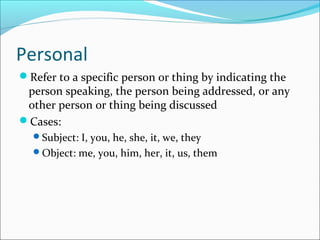
Personal
Refer to a specific person or thing by indicating the
person speaking, the person being addressed, or any
other person or thing being discussed
Cases:
Subject: I, you, he, she, it, we, they
Object: me, you, him, her, it, us, them
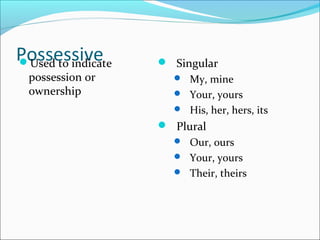
PossessiveUsed to indicate
possession or
ownership
 Singular
 My, mine
 Your, yours
 His, her, hers, its
 Plural
 Our, ours
 Your, yours
 Their, theirs
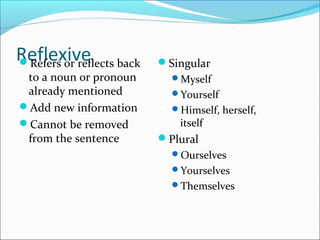
ReflexiveRefers or reflects back
to a noun or pronoun
already mentioned
Add new information
Cannot be removed
from the sentence
Singular
Myself
Yourself
Himself, herself,
itself
Plural
Ourselves
Yourselves
Themselves
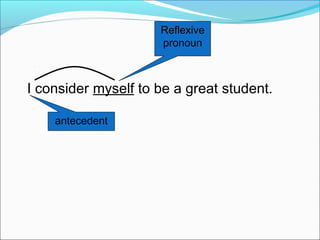
I consider myself to be a great student.
Reflexive
pronoun
antecedent
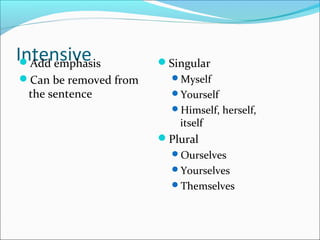
IntensiveAdd emphasis
Can be removed from
the sentence
Singular
Myself
Yourself
Himself, herself,
itself
Plural
Ourselves
Yourselves
Themselves
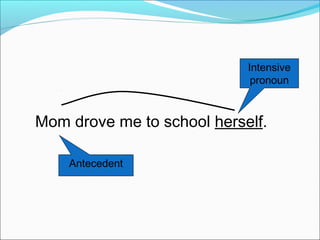
Mom drove me to school herself.
Intensive
pronoun
Antecedent
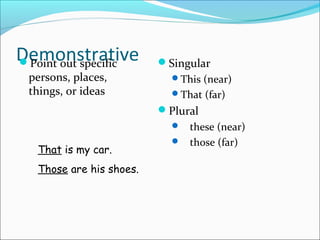
DemonstrativePoint out specific
persons, places,
things, or ideas
Singular
This (near)
That (far)
Plural
 these (near)
 those (far)
That is my car.
Those are his shoes.
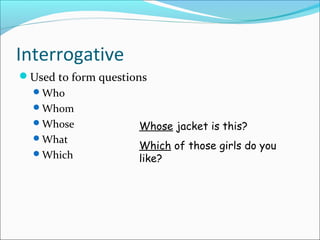
Interrogative
Used to form questions
Who
Whom
Whose
What
Which
Whose jacket is this?
Which of those girls do you
like?
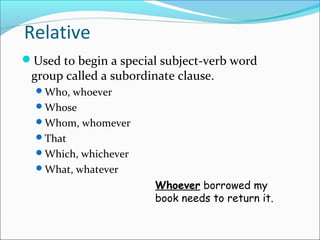
Relative
Used to begin a special subject-verb word
group called a subordinate clause.
Who, whoever
Whose
Whom, whomever
That
Which, whichever
What, whatever
Whoever borrowed my
book needs to return it.
`
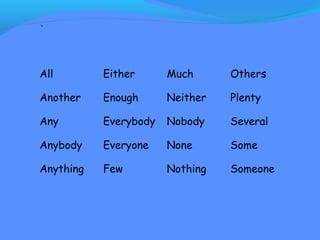
All Either Much Others
Another Enough Neither Plenty
Any Everybody Nobody Several
Anybody Everyone None Some
Anything Few Nothing Someone
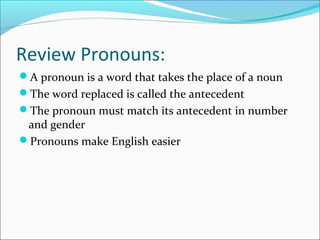
Review Pronouns:
A pronoun is a word that takes the place of a noun
The word replaced is called the antecedent
The pronoun must match its antecedent in number
and gender
Pronouns make English easier
What does reference mean?
When you refer to something, you point to
something specific.
A reference is a way of pointing out a connection or
relationship between two things.
If your references are unclear, your readers and
listeners can’t make connections.
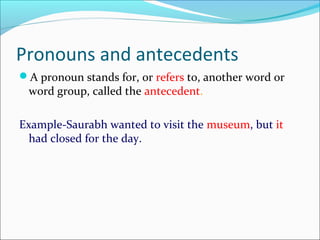
Pronouns and antecedents
A pronoun stands for, or refers to, another word or
word group, called the antecedent.
Example-Saurabh wanted to visit the museum, but it
had closed for the day.
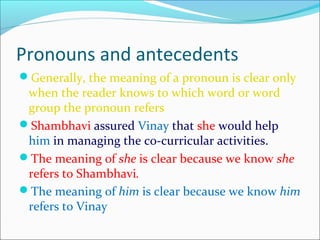
Pronouns and antecedents
Generally, the meaning of a pronoun is clear only
when the reader knows to which word or word
group the pronoun refers
Shambhavi assured Vinay that she would help
him in managing the co-curricular activities.
The meaning of she is clear because we know she
refers to Shambhavi.
The meaning of him is clear because we know him
refers to Vinay .
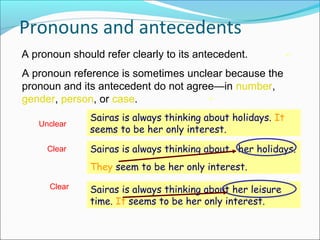
A pronoun should refer clearly to its antecedent.
A pronoun reference is sometimes unclear because the
pronoun and its antecedent do not agree—in number,
gender, person, or case.
Sairas is always thinking about holidays. It
seems to be her only interest.
Sairas is always thinking about her holidays.
They seem to be her only interest.
Sairas is always thinking about her leisure
time. It seems to be her only interest.
Unclear
Clear
Clear
Pronouns and antecedents
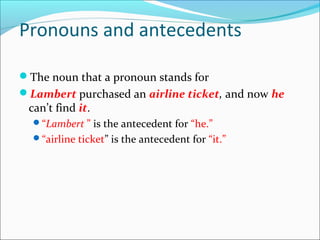
The noun that a pronoun stands for
Lambert purchased an airline ticket, and now he
can’t find it.
“Lambert ” is the antecedent for “he.”
“airline ticket” is the antecedent for “it.”
Pronouns and antecedents
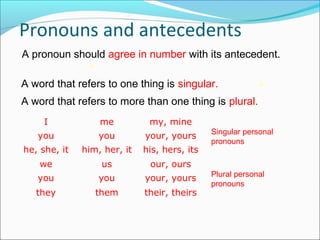
I me my, mine
you you your, yours
he, she, it him, her, it his, hers, its
we us our, ours
you you your, yours
they them their, theirs
A pronoun should agree in number with its antecedent.
A word that refers to one thing is singular.
A word that refers to more than one thing is plural.
Singular personal
pronouns
Plural personal
pronouns
Pronouns and antecedents
Number
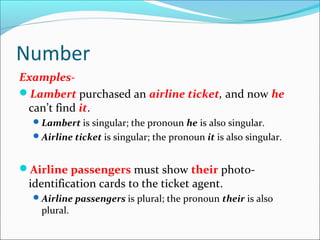
Examples-
Lambert purchased an airline ticket, and now he
can’t find it.
Lambert is singular; the pronoun he is also singular.
Airline ticket is singular; the pronoun it is also singular.
Airline passengers must show their photo-
identification cards to the ticket agent.
Airline passengers is plural; the pronoun their is also
plural.
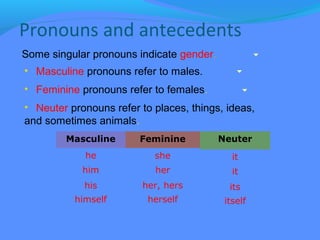
Some singular pronouns indicate gender.
Masculine
he
him
his
himself
• Masculine pronouns refer to males.
• Feminine pronouns refer to females.
• Neuter pronouns refer to places, things, ideas,
and sometimes animals.
Feminine
she
her
her, hers
herself
Neuter
it
it
its
itself
Pronouns and antecedents
Gender
Examples-
Each passenger is responsible for getting his or her
passport.
Each passenger is a singular genderless antecedent, so the
singular pronoun his or her is preferred usage.
The university has changed its recommendations
for the new parking lot facility.
University is a singular neuter antecedent, so the singular
neuter pronoun its is used.
Person indicates whether a pronoun refers to
• the one(s) speaking
I reminded myself to finish my chores.
first person
• the one(s) spoken to
Did you plant your garden by yourself?
second person
• the one(s) spoken about
They should be ashamed of themselves.
third person
Pronouns and antecedents
Person
Examples-
Incorrect: When a person turns twenty, your
perspective on life changes in many ways. (The first
half of the sentence is written in third person, while the
second half is in second person.)
Correct: When a person turns twenty, his or her
perspective on life changes in many ways. (The entire
sentence is written in third person.)
Some Tips to Keep in MindWHO and WHOM refer to PEOPLE
WHICH refers to PLACES and THINGS
WHERE refers to PLACES
THAT refers to any of the above and anonymous groups
The novels that are on my book club’s reading list are all
bestsellers.
WHOSE refers to PEOPLE, PLACES, and THINGS
The book whose pages are torn is an antique.
HISSELF, THEYSELF, THEIRSELF, and THEIRSELVES are
NOT words!
POSSESSIVE PRONOUNS DO NOT REQUIRE
APOSTROPHES: his, hers, its, ours, yours, theirs
RULE #1
Every pronoun must have a clear and
conspicuous antecedent (word to which it
refers). The antecedent must be a single
noun, not an entire sentence or idea.
Therefore, do not use the pronouns it, which,
that, and this to refer to an entire sentence.
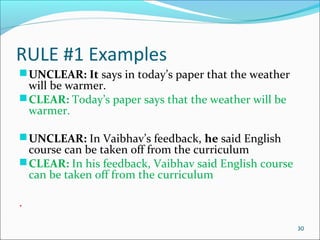
RULE #1 Examples
UNCLEAR: It says in today’s paper that the weather
will be warmer.
CLEAR: Today’s paper says that the weather will be
warmer.
UNCLEAR: In Vaibhav’s feedback, he said English
course can be taken off from the curriculum
CLEAR: In his feedback, Vaibhav said English course
can be taken off from the curriculum
.
30
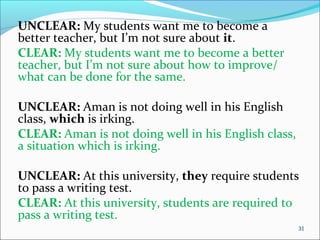
UNCLEAR: My students want me to become a
better teacher, but I’m not sure about it.
CLEAR: My students want me to become a better
teacher, but I’m not sure about how to improve/
what can be done for the same.
UNCLEAR: Aman is not doing well in his English
class, which is irking.
CLEAR: Aman is not doing well in his English class,
a situation which is irking.
UNCLEAR: At this university, they require students
to pass a writing test.
CLEAR: At this university, students are required to
pass a writing test.
31
RULE #2
Every pronoun must agree with/match its antecedent
in number: If the antecedent is singular, the pronoun
must be singular too; Use masculine, feminine, or
neuter pronouns (it or its) to match the masculine,
feminine, or neuter antecedents.
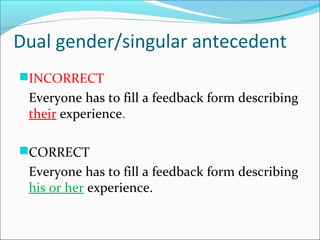
Dual gender/singular antecedent
INCORRECT
Everyone has to fill a feedback form describing
their experience.
CORRECT
Everyone has to fill a feedback form describing
his or her experience.
Pronouns ending with body, thing,
etc. are singular.
Every, no , some, any }body, one, thing
Use singular pronouns with the above
antecedents. Use his or her since the gender
could be masculine or feminine.
Singular Indefinite Pronouns
continued
 INCORRECT
When someone has not been attentive, they are more likely
to miss the content.
 CORRECT
When someone has not been attentive, he or she is more
likely to miss the content.
When students have not been attentive, they are more likely
to miss the content.
Someone who has not been attentive is more likely to miss
the content than someone who has been attentive.
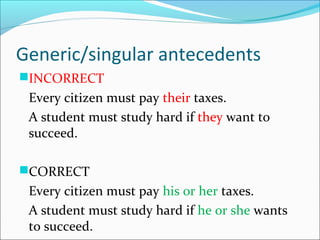
Generic/singular antecedents
INCORRECT
Every citizen must pay their taxes.
A student must study hard if they want to
succeed.
CORRECT
Every citizen must pay his or her taxes.
A student must study hard if he or she wants
to succeed.
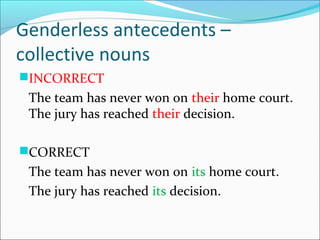
Genderless antecedents –
collective nouns
INCORRECT
The team has never won on their home court.
The jury has reached their decision.
CORRECT
The team has never won on its home court.
The jury has reached its decision.
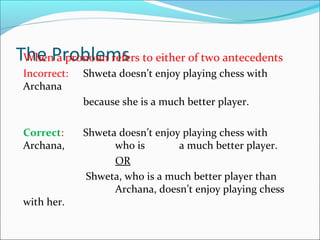
The ProblemsWhen a pronoun refers to either of two antecedents
Incorrect: Shweta doesn’t enjoy playing chess with
Archana
because she is a much better player.
Correct: Shweta doesn’t enjoy playing chess with
Archana, who is a much better player.
OR
Shweta, who is a much better player than
Archana, doesn’t enjoy playing chess
with her.
The Problems
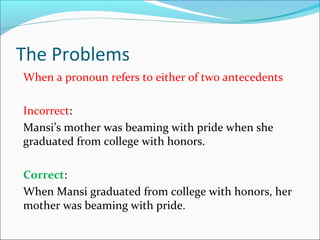
When a pronoun refers to either of two antecedents
Incorrect:
Mansi’s mother was beaming with pride when she
graduated from college with honors.
Correct:
When Mansi graduated from college with honors, her
mother was beaming with pride.
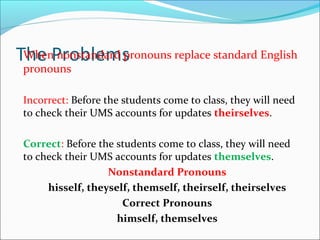
The ProblemsWhen nonstandard pronouns replace standard English
pronouns
Incorrect: Before the students come to class, they will need
to check their UMS accounts for updates theirselves.
Correct: Before the students come to class, they will need
to check their UMS accounts for updates themselves.
Nonstandard Pronouns
hisself, theyself, themself, theirself, theirselves
Correct Pronouns
himself, themselves
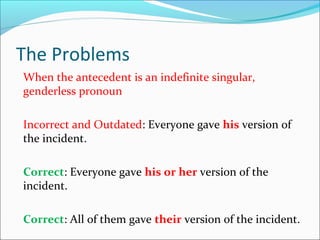
The Problems
When the antecedent is an indefinite singular,
genderless pronoun
Incorrect and Outdated: Everyone gave his version of
the incident.
Correct: Everyone gave his or her version of the
incident.
Correct: All of them gave their version of the incident.
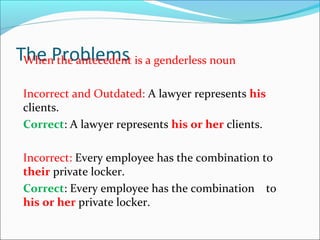
The ProblemsWhen the antecedent is a genderless noun
Incorrect and Outdated: A lawyer represents his
clients.
Correct: A lawyer represents his or her clients.
Incorrect: Every employee has the combination to
their private locker.
Correct: Every employee has the combination to
his or her private locker.
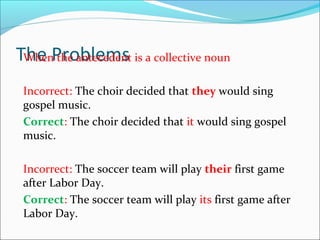
The ProblemsWhen the antecedent is a collective noun
Incorrect: The choir decided that they would sing
gospel music.
Correct: The choir decided that it would sing gospel
music.
Incorrect: The soccer team will play their first game
after Labor Day.
Correct: The soccer team will play its first game after
Labor Day.
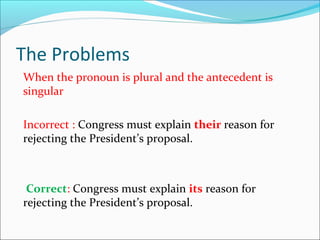
The Problems
When the pronoun is plural and the antecedent is
singular
Incorrect : Congress must explain their reason for
rejecting the President’s proposal.
Correct: Congress must explain its reason for
rejecting the President’s proposal.
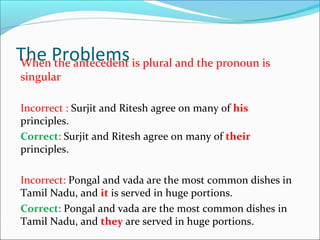
The ProblemsWhen the antecedent is plural and the pronoun is
singular
Incorrect : Surjit and Ritesh agree on many of his
principles.
Correct: Surjit and Ritesh agree on many of their
principles.
Incorrect: Pongal and vada are the most common dishes in
Tamil Nadu, and it is served in huge portions.
Correct: Pongal and vada are the most common dishes in
Tamil Nadu, and they are served in huge portions.
SUMMARY
A Pronoun is a word that takes the place of a
noun.
An antecedent is the word to which the
pronoun refers
An antecedent should appear in the same
sentence as its pronoun (or in the sentence
immediately preceding the pronoun.
A Pronoun should agree with its antecedent.
They should agree in terms of gender and in
terms of how many persons or things are
involved.
SUMMARY (Contd.)
Some indefinite pronouns – such as everyone,
everything, somebody and anyone – are
especially likely to be involved in agreement
errors
 They seem to be plural but actually they are
singular.
Avoid creating an agreement error when
attempting to avoid outdated language. By using
a plural pronoun such as they, them, or their
along with a plural antecedent, you can avoid

pronouns

  • 2.
    Objectives To identify typesof pronouns To use pronoun correctly in writing
  • 3.
    Definition A pronoun isa word that takes the place of a noun, a group of words acting as a noun, or another pronoun. The word or words that a pronoun replaces is called the antecedent. The pronoun must match the antecedent in number and gender.
  • 4.
  • 5.
    Personal Refer to aspecific person or thing by indicating the person speaking, the person being addressed, or any other person or thing being discussed Cases: Subject: I, you, he, she, it, we, they Object: me, you, him, her, it, us, them
  • 6.
    PossessiveUsed to indicate possessionor ownership  Singular  My, mine  Your, yours  His, her, hers, its  Plural  Our, ours  Your, yours  Their, theirs
  • 7.
    ReflexiveRefers or reflectsback to a noun or pronoun already mentioned Add new information Cannot be removed from the sentence Singular Myself Yourself Himself, herself, itself Plural Ourselves Yourselves Themselves
  • 8.
    I consider myselfto be a great student. Reflexive pronoun antecedent
  • 9.
    IntensiveAdd emphasis Can beremoved from the sentence Singular Myself Yourself Himself, herself, itself Plural Ourselves Yourselves Themselves
  • 10.
    Mom drove meto school herself. Intensive pronoun Antecedent
  • 11.
    DemonstrativePoint out specific persons,places, things, or ideas Singular This (near) That (far) Plural  these (near)  those (far) That is my car. Those are his shoes.
  • 12.
    Interrogative Used to formquestions Who Whom Whose What Which Whose jacket is this? Which of those girls do you like?
  • 13.
    Relative Used to begina special subject-verb word group called a subordinate clause. Who, whoever Whose Whom, whomever That Which, whichever What, whatever Whoever borrowed my book needs to return it.
  • 14.
    ` All Either MuchOthers Another Enough Neither Plenty Any Everybody Nobody Several Anybody Everyone None Some Anything Few Nothing Someone
  • 15.
    Review Pronouns: A pronounis a word that takes the place of a noun The word replaced is called the antecedent The pronoun must match its antecedent in number and gender Pronouns make English easier
  • 17.
    What does referencemean? When you refer to something, you point to something specific. A reference is a way of pointing out a connection or relationship between two things. If your references are unclear, your readers and listeners can’t make connections.
  • 18.
    Pronouns and antecedents Apronoun stands for, or refers to, another word or word group, called the antecedent. Example-Saurabh wanted to visit the museum, but it had closed for the day.
  • 19.
    Pronouns and antecedents Generally,the meaning of a pronoun is clear only when the reader knows to which word or word group the pronoun refers Shambhavi assured Vinay that she would help him in managing the co-curricular activities. The meaning of she is clear because we know she refers to Shambhavi. The meaning of him is clear because we know him refers to Vinay .
  • 20.
    A pronoun shouldrefer clearly to its antecedent. A pronoun reference is sometimes unclear because the pronoun and its antecedent do not agree—in number, gender, person, or case. Sairas is always thinking about holidays. It seems to be her only interest. Sairas is always thinking about her holidays. They seem to be her only interest. Sairas is always thinking about her leisure time. It seems to be her only interest. Unclear Clear Clear Pronouns and antecedents
  • 21.
    The noun thata pronoun stands for Lambert purchased an airline ticket, and now he can’t find it. “Lambert ” is the antecedent for “he.” “airline ticket” is the antecedent for “it.” Pronouns and antecedents
  • 22.
    I me my,mine you you your, yours he, she, it him, her, it his, hers, its we us our, ours you you your, yours they them their, theirs A pronoun should agree in number with its antecedent. A word that refers to one thing is singular. A word that refers to more than one thing is plural. Singular personal pronouns Plural personal pronouns Pronouns and antecedents
  • 23.
    Number Examples- Lambert purchased anairline ticket, and now he can’t find it. Lambert is singular; the pronoun he is also singular. Airline ticket is singular; the pronoun it is also singular. Airline passengers must show their photo- identification cards to the ticket agent. Airline passengers is plural; the pronoun their is also plural.
  • 24.
    Some singular pronounsindicate gender. Masculine he him his himself • Masculine pronouns refer to males. • Feminine pronouns refer to females. • Neuter pronouns refer to places, things, ideas, and sometimes animals. Feminine she her her, hers herself Neuter it it its itself Pronouns and antecedents
  • 25.
    Gender Examples- Each passenger isresponsible for getting his or her passport. Each passenger is a singular genderless antecedent, so the singular pronoun his or her is preferred usage. The university has changed its recommendations for the new parking lot facility. University is a singular neuter antecedent, so the singular neuter pronoun its is used.
  • 26.
    Person indicates whethera pronoun refers to • the one(s) speaking I reminded myself to finish my chores. first person • the one(s) spoken to Did you plant your garden by yourself? second person • the one(s) spoken about They should be ashamed of themselves. third person Pronouns and antecedents
  • 27.
    Person Examples- Incorrect: When aperson turns twenty, your perspective on life changes in many ways. (The first half of the sentence is written in third person, while the second half is in second person.) Correct: When a person turns twenty, his or her perspective on life changes in many ways. (The entire sentence is written in third person.)
  • 28.
    Some Tips toKeep in MindWHO and WHOM refer to PEOPLE WHICH refers to PLACES and THINGS WHERE refers to PLACES THAT refers to any of the above and anonymous groups The novels that are on my book club’s reading list are all bestsellers. WHOSE refers to PEOPLE, PLACES, and THINGS The book whose pages are torn is an antique. HISSELF, THEYSELF, THEIRSELF, and THEIRSELVES are NOT words! POSSESSIVE PRONOUNS DO NOT REQUIRE APOSTROPHES: his, hers, its, ours, yours, theirs
  • 29.
    RULE #1 Every pronounmust have a clear and conspicuous antecedent (word to which it refers). The antecedent must be a single noun, not an entire sentence or idea. Therefore, do not use the pronouns it, which, that, and this to refer to an entire sentence.
  • 30.
    RULE #1 Examples UNCLEAR:It says in today’s paper that the weather will be warmer. CLEAR: Today’s paper says that the weather will be warmer. UNCLEAR: In Vaibhav’s feedback, he said English course can be taken off from the curriculum CLEAR: In his feedback, Vaibhav said English course can be taken off from the curriculum . 30
  • 31.
    UNCLEAR: My studentswant me to become a better teacher, but I’m not sure about it. CLEAR: My students want me to become a better teacher, but I’m not sure about how to improve/ what can be done for the same. UNCLEAR: Aman is not doing well in his English class, which is irking. CLEAR: Aman is not doing well in his English class, a situation which is irking. UNCLEAR: At this university, they require students to pass a writing test. CLEAR: At this university, students are required to pass a writing test. 31
  • 32.
    RULE #2 Every pronounmust agree with/match its antecedent in number: If the antecedent is singular, the pronoun must be singular too; Use masculine, feminine, or neuter pronouns (it or its) to match the masculine, feminine, or neuter antecedents.
  • 33.
    Dual gender/singular antecedent INCORRECT Everyonehas to fill a feedback form describing their experience. CORRECT Everyone has to fill a feedback form describing his or her experience.
  • 34.
    Pronouns ending withbody, thing, etc. are singular. Every, no , some, any }body, one, thing Use singular pronouns with the above antecedents. Use his or her since the gender could be masculine or feminine.
  • 35.
    Singular Indefinite Pronouns continued INCORRECT When someone has not been attentive, they are more likely to miss the content.  CORRECT When someone has not been attentive, he or she is more likely to miss the content. When students have not been attentive, they are more likely to miss the content. Someone who has not been attentive is more likely to miss the content than someone who has been attentive.
  • 36.
    Generic/singular antecedents INCORRECT Every citizenmust pay their taxes. A student must study hard if they want to succeed. CORRECT Every citizen must pay his or her taxes. A student must study hard if he or she wants to succeed.
  • 37.
    Genderless antecedents – collectivenouns INCORRECT The team has never won on their home court. The jury has reached their decision. CORRECT The team has never won on its home court. The jury has reached its decision.
  • 38.
    The ProblemsWhen apronoun refers to either of two antecedents Incorrect: Shweta doesn’t enjoy playing chess with Archana because she is a much better player. Correct: Shweta doesn’t enjoy playing chess with Archana, who is a much better player. OR Shweta, who is a much better player than Archana, doesn’t enjoy playing chess with her.
  • 39.
    The Problems When apronoun refers to either of two antecedents Incorrect: Mansi’s mother was beaming with pride when she graduated from college with honors. Correct: When Mansi graduated from college with honors, her mother was beaming with pride.
  • 40.
    The ProblemsWhen nonstandardpronouns replace standard English pronouns Incorrect: Before the students come to class, they will need to check their UMS accounts for updates theirselves. Correct: Before the students come to class, they will need to check their UMS accounts for updates themselves. Nonstandard Pronouns hisself, theyself, themself, theirself, theirselves Correct Pronouns himself, themselves
  • 41.
    The Problems When theantecedent is an indefinite singular, genderless pronoun Incorrect and Outdated: Everyone gave his version of the incident. Correct: Everyone gave his or her version of the incident. Correct: All of them gave their version of the incident.
  • 42.
    The ProblemsWhen theantecedent is a genderless noun Incorrect and Outdated: A lawyer represents his clients. Correct: A lawyer represents his or her clients. Incorrect: Every employee has the combination to their private locker. Correct: Every employee has the combination to his or her private locker.
  • 43.
    The ProblemsWhen theantecedent is a collective noun Incorrect: The choir decided that they would sing gospel music. Correct: The choir decided that it would sing gospel music. Incorrect: The soccer team will play their first game after Labor Day. Correct: The soccer team will play its first game after Labor Day.
  • 44.
    The Problems When thepronoun is plural and the antecedent is singular Incorrect : Congress must explain their reason for rejecting the President’s proposal. Correct: Congress must explain its reason for rejecting the President’s proposal.
  • 45.
    The ProblemsWhen theantecedent is plural and the pronoun is singular Incorrect : Surjit and Ritesh agree on many of his principles. Correct: Surjit and Ritesh agree on many of their principles. Incorrect: Pongal and vada are the most common dishes in Tamil Nadu, and it is served in huge portions. Correct: Pongal and vada are the most common dishes in Tamil Nadu, and they are served in huge portions.
  • 46.
    SUMMARY A Pronoun isa word that takes the place of a noun. An antecedent is the word to which the pronoun refers An antecedent should appear in the same sentence as its pronoun (or in the sentence immediately preceding the pronoun. A Pronoun should agree with its antecedent. They should agree in terms of gender and in terms of how many persons or things are involved.
  • 47.
    SUMMARY (Contd.) Some indefinitepronouns – such as everyone, everything, somebody and anyone – are especially likely to be involved in agreement errors  They seem to be plural but actually they are singular. Avoid creating an agreement error when attempting to avoid outdated language. By using a plural pronoun such as they, them, or their along with a plural antecedent, you can avoid