PRONOUNS
What is a pronoun? Every name is called a  noun:  as “field” and “fountain”, “street” and “town”,  in place of noun the  pronoun  stands, as “he” and “she” can clap their hands. A  pronoun  can replace a noun or another pronoun.  A pronoun is used to make sentences less repetitive.  It is usually defined  as a word that stands for a noun or a noun phrase or something related to one.
Pronouns vs. adjectives It is important to identify a pronoun from an adjective.  A pronoun substitutes, an adjective modifies. This  is the book  he  gave  me  last week.  Whatever  means  you  use will be  appreciated.  Which  car do  you  prefer?
Demonstrative Pronouns A demonstrative pronoun  points to and identifies  a noun or a pronoun and relates it to space and time.  This, that, these, those, the others "This" and "these" refer to things that are nearby either in space or in time, while "that" and "those" refer to things that are farther away in space or time. This  has to stop.. This  is puny;  that  is the tree I want. Three customers wanted  these .
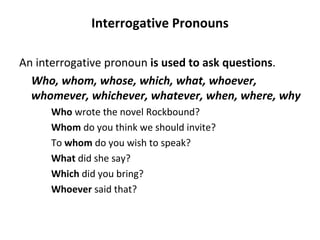
Interrogative Pronouns An interrogative pronoun  is used to ask questions .  Who, whom, whose, which, what, whoever, whomever, whichever, whatever, when, where, why Who  wrote the novel Rockbound? Whom  do you think we should invite? To  whom  do you wish to speak? What  did she say? Which  did you bring? Whoever  said that?
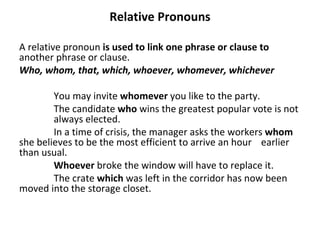
Relative Pronouns A relative pronoun  is used to link one phrase or clause to  another phrase or   clause.  Who, whom, that, which, whoever, whomever, whichever You may invite  whomever  you like to the party. The candidate  who  wins the greatest popular vote is not  always elected. In a time of crisis, the manager asks the workers  whom   she believes to be the most efficient to arrive an hour  earlier than usual. Whoever  broke the window will have to replace it. The crate  which  was left in the corridor has now been  moved into the storage closet.
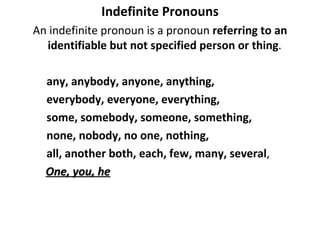
Indefinite Pronouns An indefinite pronoun is a pronoun  referring to an identifiable but not specified person or thing .  any, anybody, anyone, anything,  everybody, everyone, everything,  some, somebody, someone, something,  none, nobody, no one, nothing, all, another both, each, few, many, several ,  One, you, he
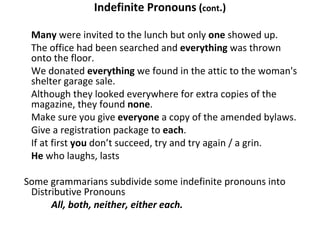
Indefinite Pronouns  ( cont .) Many  were invited to the lunch but only  one  showed up. The office had been searched and  everything  was thrown onto the floor. We donated  everything  we found in the attic to the woman's shelter garage sale. Although they looked everywhere for extra copies of the magazine, they found  none . Make sure you give  everyone  a copy of the amended bylaws. Give a registration package to  each . If at first  you  don’t succeed, try and try again / a grin. He  who laughs, lasts   Some grammarians subdivide some indefinite pronouns into Distributive Pronouns All, both, neither, either each.
Reciprocal Pronouns They are only two pronouns:  each other and one another. They are used to convey a two-way relationship. They accused each other of the betrayal. (two) The Browns and the Smiths are always fighting  one another (more than two)
Reflexive Pronouns A reflexive pronoun is used to refer back to the subject of the clause or sentence. myself, yourself, herself, himself, itself, ourselves,  yourselves, themselves Diabetics give  themselves  insulin shots several  times a day. After the party, I asked  mysel f why I had faxed  invitations to everyone in my office building. Richard usually remembered to send a copy of his  e-mail to  himself . Note each of these can also act as an intensive pronoun
Intensive Pronouns An  intensive pronoun  is a pronoun used to emphasize its antecedent.  Intensive pronouns are  identical in form  to reflexive pronouns. I  myself  believe that aliens should abduct my  sister. The Prime Minister  himself  said that he  would lower taxes.
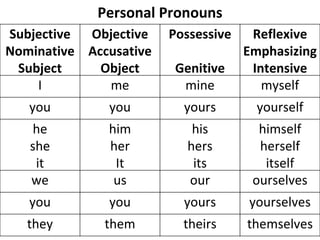
Personal Pronouns Personal pronouns are those used more frequently.  They are used to refer back to something or someone that has already been mentioned.  They are also used to refer to people and things directly.  They are called personal because they refer to the people or things involved in the text.  They indicate persons.
Personal Pronouns Subjective Nominative Subject Objective Accusative Object Possessive Genitive Reflexive Emphasizing Intensive I me mine myself you you yours yourself he she it him her It his hers its himself herself itself we us our ourselves you you yours yourselves they them theirs themselves
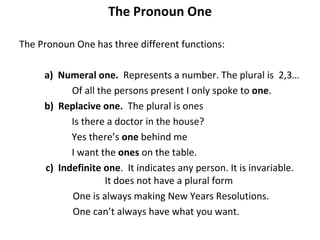
The Pronoun One The Pronoun One has three different functions: a)  Numeral one.  Represents a number. The plural is  2,3… Of all the persons present I only spoke to  one . b)  Replacive one.  The plural is ones Is there a doctor in the house?  Yes there’s  one  behind me I want the  ones  on the table.  c)  Indefinite one .  It indicates any person. It is invariable.    It does not have a plural form   One is always making New Years Resolutions.   One can’t always have what you want.
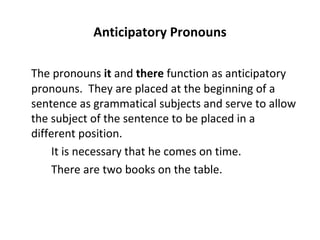
Anticipatory Pronouns The pronouns  it  and  there  function as anticipatory pronouns.  They are placed at the beginning of a sentence as grammatical subjects and serve to allow the subject of the sentence to be placed in a different position. It is necessary that he comes on time. There are two books on the table.
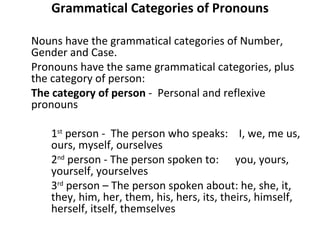
Grammatical Categories of Pronouns Nouns have the grammatical categories of Number, Gender and Case.  Pronouns have the same grammatical categories, plus the category of person: The category of person  -  Personal and reflexive pronouns  1 st  person -  The person who speaks:  I, we, me us,  ours, myself, ourselves  2 nd  person - The person spoken to:  you, yours,  yourself, yourselves 3 rd  person – The person spoken about: he, she, it,  they, him, her, them, his, hers, its, theirs, himself,  herself, itself, themselves  
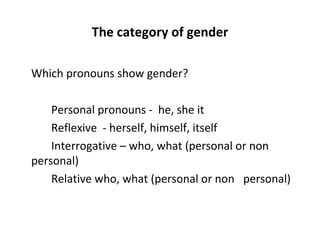
The category of gender Which pronouns show gender?  Personal pronouns -  he, she it  Reflexive  - herself, himself, itself  Interrogative – who, what (personal or non  personal) Relative who, what (personal or non  personal)
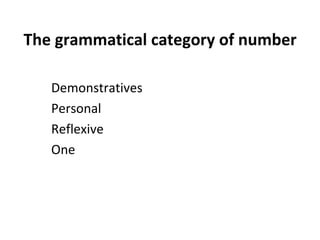
The grammatical category of number Demonstratives  Personal  Reflexive  One
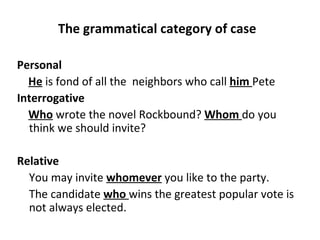
The grammatical category of case  Personal  He  is fond of all the  neighbors who call  him   Pete Interrogative  Who  wrote the novel Rockbound?  Whom   do you think we should invite?   Relative  You may invite  whomever  you like to the party. The candidate  who   wins the greatest popular vote is not always elected.  
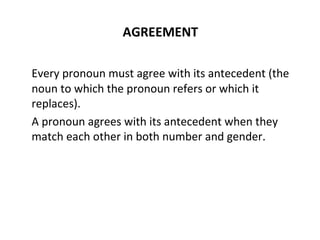
AGREEMENT Every pronoun must agree with its antecedent (the noun to which the pronoun refers or which it replaces).  A pronoun agrees with its antecedent when they match each other in both number and gender.
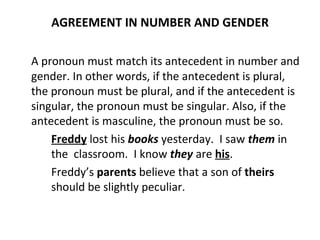
AGREEMENT IN NUMBER AND GENDER A pronoun must match its antecedent in number and gender. In other words, if the antecedent is plural, the pronoun must be plural, and if the antecedent is singular, the pronoun must be singular. Also, if the antecedent is masculine, the pronoun must be so. Freddy   lost his   books  yesterday.  I saw  them  in  the  classroom.  I know  they  are  his .  Freddy’s  parents  believe that a son of  theirs  should be slightly peculiar.   
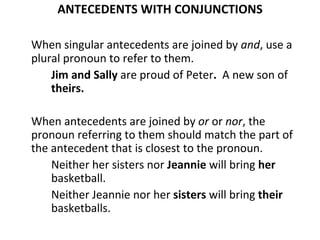
ANTECEDENTS WITH CONJUNCTIONS When singular antecedents are joined by  and , use a plural pronoun to refer to them. Jim and Sally  are proud of Peter .  A new son of   theirs. When antecedents are joined by  or  or  nor , the pronoun referring to them should match the part of the antecedent that is closest to the pronoun. Neither her sisters nor  Jeannie  will bring  her  basketball. Neither Jeannie nor her  sisters  will bring  their  basketballs.
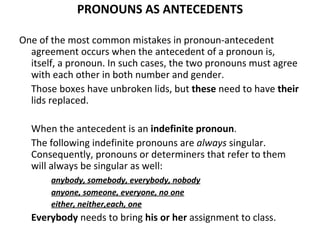
PRONOUNS AS ANTECEDENTS One of the most common mistakes in pronoun-antecedent agreement occurs when the antecedent of a pronoun is, itself, a pronoun. In such cases, the two pronouns must   agree with each other in both number and gender. Those boxes have unbroken lids, but  these  need to have  their  lids replaced. When the antecedent is an  indefinite pronoun .  The   following indefinite pronouns are  always  singular. Consequently, pronouns or determiners that refer to them will   always be singular as well: anybody, somebody, everybody, nobody anyone, someone, everyone, no one either, neither,each, one Everybody  needs to bring  his or her  assignment to class.

Pronouns[1]

  • 1.
  • 2.
    What is apronoun? Every name is called a noun: as “field” and “fountain”, “street” and “town”, in place of noun the pronoun stands, as “he” and “she” can clap their hands. A pronoun can replace a noun or another pronoun. A pronoun is used to make sentences less repetitive. It is usually defined as a word that stands for a noun or a noun phrase or something related to one.
  • 3.
    Pronouns vs. adjectivesIt is important to identify a pronoun from an adjective. A pronoun substitutes, an adjective modifies. This is the book he gave me last week. Whatever means you use will be appreciated. Which car do you prefer?
  • 4.
    Demonstrative Pronouns Ademonstrative pronoun points to and identifies a noun or a pronoun and relates it to space and time. This, that, these, those, the others "This" and "these" refer to things that are nearby either in space or in time, while "that" and "those" refer to things that are farther away in space or time. This has to stop.. This is puny; that is the tree I want. Three customers wanted these .
  • 5.
    Interrogative Pronouns Aninterrogative pronoun is used to ask questions . Who, whom, whose, which, what, whoever, whomever, whichever, whatever, when, where, why Who wrote the novel Rockbound? Whom do you think we should invite? To whom do you wish to speak? What did she say? Which did you bring? Whoever said that?
  • 6.
    Relative Pronouns Arelative pronoun is used to link one phrase or clause to another phrase or clause. Who, whom, that, which, whoever, whomever, whichever You may invite whomever you like to the party. The candidate who wins the greatest popular vote is not always elected. In a time of crisis, the manager asks the workers whom she believes to be the most efficient to arrive an hour earlier than usual. Whoever broke the window will have to replace it. The crate which was left in the corridor has now been moved into the storage closet.
  • 7.
    Indefinite Pronouns Anindefinite pronoun is a pronoun referring to an identifiable but not specified person or thing . any, anybody, anyone, anything, everybody, everyone, everything, some, somebody, someone, something, none, nobody, no one, nothing, all, another both, each, few, many, several , One, you, he
  • 8.
    Indefinite Pronouns ( cont .) Many were invited to the lunch but only one showed up. The office had been searched and everything was thrown onto the floor. We donated everything we found in the attic to the woman's shelter garage sale. Although they looked everywhere for extra copies of the magazine, they found none . Make sure you give everyone a copy of the amended bylaws. Give a registration package to each . If at first you don’t succeed, try and try again / a grin. He who laughs, lasts   Some grammarians subdivide some indefinite pronouns into Distributive Pronouns All, both, neither, either each.
  • 9.
    Reciprocal Pronouns Theyare only two pronouns: each other and one another. They are used to convey a two-way relationship. They accused each other of the betrayal. (two) The Browns and the Smiths are always fighting one another (more than two)
  • 10.
    Reflexive Pronouns Areflexive pronoun is used to refer back to the subject of the clause or sentence. myself, yourself, herself, himself, itself, ourselves, yourselves, themselves Diabetics give themselves insulin shots several times a day. After the party, I asked mysel f why I had faxed invitations to everyone in my office building. Richard usually remembered to send a copy of his e-mail to himself . Note each of these can also act as an intensive pronoun
  • 11.
    Intensive Pronouns An intensive pronoun is a pronoun used to emphasize its antecedent. Intensive pronouns are identical in form to reflexive pronouns. I myself believe that aliens should abduct my sister. The Prime Minister himself said that he would lower taxes.
  • 12.
    Personal Pronouns Personalpronouns are those used more frequently. They are used to refer back to something or someone that has already been mentioned. They are also used to refer to people and things directly. They are called personal because they refer to the people or things involved in the text. They indicate persons.
  • 13.
    Personal Pronouns SubjectiveNominative Subject Objective Accusative Object Possessive Genitive Reflexive Emphasizing Intensive I me mine myself you you yours yourself he she it him her It his hers its himself herself itself we us our ourselves you you yours yourselves they them theirs themselves
  • 14.
    The Pronoun OneThe Pronoun One has three different functions: a) Numeral one. Represents a number. The plural is 2,3… Of all the persons present I only spoke to one . b) Replacive one. The plural is ones Is there a doctor in the house? Yes there’s one behind me I want the ones on the table. c) Indefinite one . It indicates any person. It is invariable. It does not have a plural form One is always making New Years Resolutions. One can’t always have what you want.
  • 15.
    Anticipatory Pronouns Thepronouns it and there function as anticipatory pronouns. They are placed at the beginning of a sentence as grammatical subjects and serve to allow the subject of the sentence to be placed in a different position. It is necessary that he comes on time. There are two books on the table.
  • 16.
    Grammatical Categories ofPronouns Nouns have the grammatical categories of Number, Gender and Case. Pronouns have the same grammatical categories, plus the category of person: The category of person - Personal and reflexive pronouns 1 st person - The person who speaks: I, we, me us, ours, myself, ourselves 2 nd person - The person spoken to: you, yours, yourself, yourselves 3 rd person – The person spoken about: he, she, it, they, him, her, them, his, hers, its, theirs, himself, herself, itself, themselves  
  • 17.
    The category ofgender Which pronouns show gender? Personal pronouns - he, she it Reflexive - herself, himself, itself Interrogative – who, what (personal or non personal) Relative who, what (personal or non personal)
  • 18.
    The grammatical categoryof number Demonstratives Personal Reflexive One
  • 19.
    The grammatical categoryof case Personal He is fond of all the neighbors who call him Pete Interrogative Who wrote the novel Rockbound? Whom do you think we should invite?   Relative You may invite whomever you like to the party. The candidate who wins the greatest popular vote is not always elected.  
  • 20.
    AGREEMENT Every pronounmust agree with its antecedent (the noun to which the pronoun refers or which it replaces). A pronoun agrees with its antecedent when they match each other in both number and gender.
  • 21.
    AGREEMENT IN NUMBERAND GENDER A pronoun must match its antecedent in number and gender. In other words, if the antecedent is plural, the pronoun must be plural, and if the antecedent is singular, the pronoun must be singular. Also, if the antecedent is masculine, the pronoun must be so. Freddy lost his books yesterday. I saw them in the classroom. I know they are his . Freddy’s parents believe that a son of theirs should be slightly peculiar.  
  • 22.
    ANTECEDENTS WITH CONJUNCTIONSWhen singular antecedents are joined by and , use a plural pronoun to refer to them. Jim and Sally are proud of Peter . A new son of theirs. When antecedents are joined by or or nor , the pronoun referring to them should match the part of the antecedent that is closest to the pronoun. Neither her sisters nor Jeannie will bring her basketball. Neither Jeannie nor her sisters will bring their basketballs.
  • 23.
    PRONOUNS AS ANTECEDENTSOne of the most common mistakes in pronoun-antecedent agreement occurs when the antecedent of a pronoun is, itself, a pronoun. In such cases, the two pronouns must agree with each other in both number and gender. Those boxes have unbroken lids, but these need to have their lids replaced. When the antecedent is an indefinite pronoun . The following indefinite pronouns are always singular. Consequently, pronouns or determiners that refer to them will always be singular as well: anybody, somebody, everybody, nobody anyone, someone, everyone, no one either, neither,each, one Everybody needs to bring his or her assignment to class.