Q:What are Adjectives?
A:Adjectives are words which are
  used to describe nouns or
  pronouns.
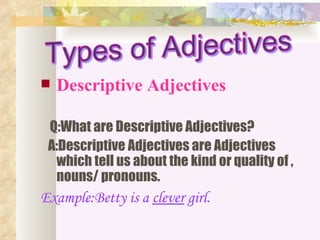
   Descriptive Adjectives

 Q:What are Descriptive Adjectives?
 A:Descriptive Adjectives are Adjectives
  which tell us about the kind or quality of ,
  nouns/ pronouns.
Example:Betty is a clever girl.
   Adjectives of Number / Quantity

Q:What are Adjectives of Number /Quantity?
A:Adjectives of Number /Quantity are
   Adjectives which come before a noun
   showing how many or how much of the
   noun there is.
Example:Mary gave me five oranges.
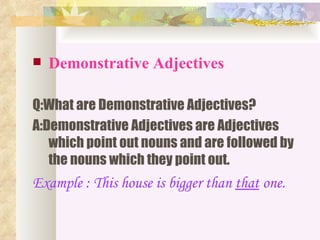
   Demonstrative Adjectives

Q:What are Demonstrative Adjectives?
A:Demonstrative Adjectives are Adjectives
   which point out nouns and are followed by
   the nouns which they point out.
Example : This house is bigger than that one.
   Interrogative Adjectives

Q:What are Interrogative Adjectives?
A:Interrogative Adjectives are Adjectives
   which ask questions and come before a
   noun.
Example:Which way shall we go?
   Possessive Adjectives


Q:What are Possessive Adjectives?
A:Possesses Adjectives are Adjectives which
   are used to show possession.
Example:I have given my book to your brother.
Q:What are the 3 Degrees of
   Comparison ?
A:The 3 Degree of Comparison are
   (1) the Positive Degree,
   (2) the Comparative Degree and
   (3) the Superlative Degree.
   (a) The Positive Degree of Comparison
        is used when we are speaking of
        or describing an object.
Example: Peter is a short boy.
   (b) The Comparative Degree of
        Comparison is used when we are
        speaking of or describing two
        objects.

    Example:Peter is taller than
    Paul .
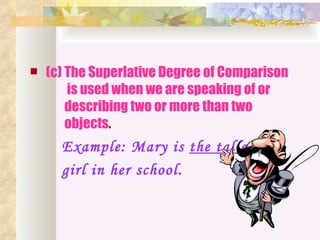
   (c) The Superlative Degree of Comparison
        is used when we are speaking of or
        describing two or more than two
        objects.
      Example: Mary is the tallest
      girl in her school.
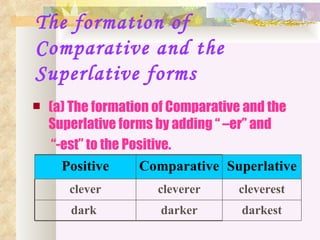
The formation of
Comparative and the
Superlative forms
   (a) The formation of Comparative and the
    Superlative forms by adding “ –er” and
     “-est” to the Positive.
       Positive      Comparative Superlative
       clever        cleverer     cleverest
       dark           darker       darkest
   (b) The formation of Comparative and
    the Superlative forms by dropping “y”
    and “-iest”to the Positive.


    Positive Comparative Superlative
     dirty       dirtier       dirtiest
      lazy        lazier        laziest
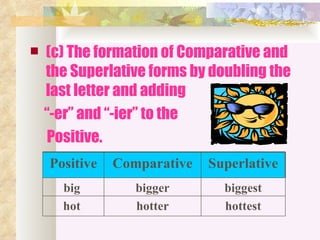
   (c) The formation of Comparative and
    the Superlative forms by doubling the
    last letter and adding
    “-er” and “-ier” to the
     Positive.
    Positive   Comparative   Superlative
      big         bigger       biggest
      hot         hotter       hottest
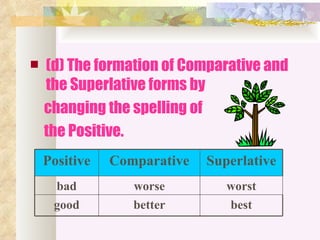
   (d) The formation of Comparative and
    the Superlative forms by
    changing the spelling of
    the Positive.
    Positive   Comparative   Superlative
     bad          worse         worst
     good         better        best
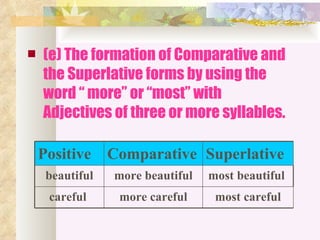
   (e) The formation of Comparative and
    the Superlative forms by using the
    word “ more” or “most” with
    Adjectives of three or more syllables.

    Positive     Comparative Superlative
     beautiful   more beautiful   most beautiful
     careful      more careful     most careful
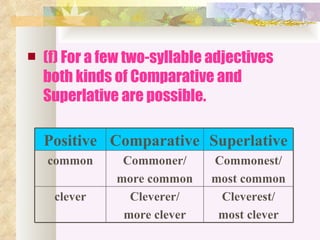
   (f) For a few two-syllable adjectives
    both kinds of Comparative and
    Superlative are possible.

    Positive Comparative Superlative
    common      Commoner/      Commonest/
               more common     most common
     clever      Cleverer/      Cleverest/
                more clever     most clever
(a) “The+Adjectives” =
     a class of persons.
Example: The welfare society
 organised a party for the poor.
(b) “The+Adjectives” =
      an abstract noun.
Example:The future is
 unknown to us.
            (the future =
 futurity)
•(c) Some adjectives have
become Nouns.
Example:Australians
          Italians
There are compound Adjectives
 formed by adding a “ – ” between the
 words. Notice that the noun in a
 compound Adjective should normally
 be in singular form.
Example:Mary is an eighteen-
 year-old girl.
Prepared by
Münevver ÇELEBİ

Adjectives 1

  • 2.
    Q:What are Adjectives? A:Adjectivesare words which are used to describe nouns or pronouns.
  • 3.
    Descriptive Adjectives Q:What are Descriptive Adjectives? A:Descriptive Adjectives are Adjectives which tell us about the kind or quality of , nouns/ pronouns. Example:Betty is a clever girl.
  • 4.
    Adjectives of Number / Quantity Q:What are Adjectives of Number /Quantity? A:Adjectives of Number /Quantity are Adjectives which come before a noun showing how many or how much of the noun there is. Example:Mary gave me five oranges.
  • 5.
    Demonstrative Adjectives Q:What are Demonstrative Adjectives? A:Demonstrative Adjectives are Adjectives which point out nouns and are followed by the nouns which they point out. Example : This house is bigger than that one.
  • 6.
    Interrogative Adjectives Q:What are Interrogative Adjectives? A:Interrogative Adjectives are Adjectives which ask questions and come before a noun. Example:Which way shall we go?
  • 7.
    Possessive Adjectives Q:What are Possessive Adjectives? A:Possesses Adjectives are Adjectives which are used to show possession. Example:I have given my book to your brother.
  • 8.
    Q:What are the3 Degrees of Comparison ? A:The 3 Degree of Comparison are (1) the Positive Degree, (2) the Comparative Degree and (3) the Superlative Degree.
  • 9.
    (a) The Positive Degree of Comparison is used when we are speaking of or describing an object. Example: Peter is a short boy.
  • 10.
    (b) The Comparative Degree of Comparison is used when we are speaking of or describing two objects. Example:Peter is taller than Paul .
  • 11.
    (c) The Superlative Degree of Comparison is used when we are speaking of or describing two or more than two objects. Example: Mary is the tallest girl in her school.
  • 12.
    The formation of Comparativeand the Superlative forms  (a) The formation of Comparative and the Superlative forms by adding “ –er” and “-est” to the Positive. Positive Comparative Superlative clever cleverer cleverest dark darker darkest
  • 13.
    (b) The formation of Comparative and the Superlative forms by dropping “y” and “-iest”to the Positive. Positive Comparative Superlative dirty dirtier dirtiest lazy lazier laziest
  • 14.
    (c) The formation of Comparative and the Superlative forms by doubling the last letter and adding “-er” and “-ier” to the Positive. Positive Comparative Superlative big bigger biggest hot hotter hottest
  • 15.
    (d) The formation of Comparative and the Superlative forms by changing the spelling of the Positive. Positive Comparative Superlative bad worse worst good better best
  • 16.
    (e) The formation of Comparative and the Superlative forms by using the word “ more” or “most” with Adjectives of three or more syllables. Positive Comparative Superlative beautiful more beautiful most beautiful careful more careful most careful
  • 17.
    (f) For a few two-syllable adjectives both kinds of Comparative and Superlative are possible. Positive Comparative Superlative common Commoner/ Commonest/ more common most common clever Cleverer/ Cleverest/ more clever most clever
  • 18.
    (a) “The+Adjectives” = a class of persons. Example: The welfare society organised a party for the poor.
  • 19.
    (b) “The+Adjectives” = an abstract noun. Example:The future is unknown to us. (the future = futurity)
  • 20.
    •(c) Some adjectiveshave become Nouns. Example:Australians Italians
  • 21.
    There are compoundAdjectives formed by adding a “ – ” between the words. Notice that the noun in a compound Adjective should normally be in singular form. Example:Mary is an eighteen- year-old girl.
  • 22.