Pronouns and Antecedents
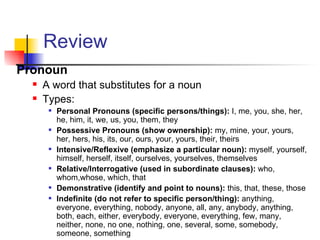
Review Pronoun A word that substitutes for a noun Types: Personal Pronouns (specific persons/things):  I, me, you, she, her, he, him, it, we, us, you, them, they Possessive Pronouns (show ownership):  my, mine, your, yours, her, hers, his, its, our, ours, your, yours, their, theirs Intensive/Reflexive (emphasize a particular noun):  myself, yourself, himself, herself, itself, ourselves, yourselves, themselves Relative/Interrogative (used in subordinate clauses):  who, whom,whose, which, that Demonstrative (identify and point to nouns):  this, that, these, those Indefinite (do not refer to specific person/thing):  anything, everyone, everything, nobody, anyone, all, any, anybody, anything, both, each, either, everybody, everyone, everything, few, many, neither, none, no one, nothing, one, several, some, somebody, someone, something
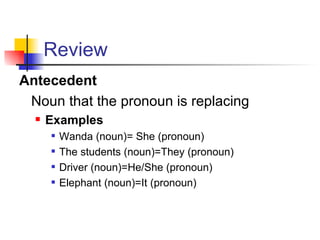
Review Antecedent Noun that the pronoun is replacing Examples Wanda (noun)= She (pronoun) The students (noun)=They (pronoun) Driver (noun)=He/She (pronoun) Elephant (noun)=It (pronoun)
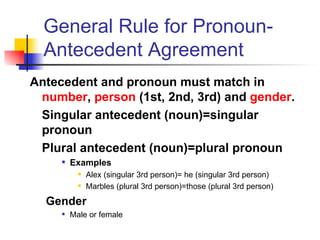
General Rule for Pronoun-Antecedent Agreement Antecedent and pronoun must match in  number ,  person  (1st, 2nd, 3rd) and  gender . Singular antecedent (noun)=singular pronoun Plural antecedent (noun)=plural pronoun Examples Alex (singular 3rd person)= he (singular 3rd person) Marbles (plural 3rd person)=those (plural 3rd person) Gender Male or female
Note about Gender If you aren’t sure of the gender of the antecedent, use “she or he”, “his/her”, “him/her” as the pronoun Example: The  police officer  always carries  his/her  badge when on duty. Things and animals don’t have gender—use “it”, “its” to refer to non-human objects/groups. Example: The  team  won  its  game.
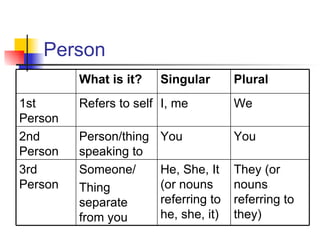
Person What is it? Singular Plural 1st Person Refers to self I, me We 2nd Person Person/thing speaking to You You 3rd Person Someone/ Thing separate from you He, She, It (or nouns referring to he, she, it) They (or nouns referring to they)
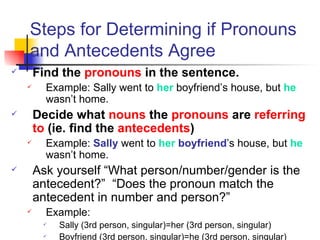
Steps for Determining if Pronouns and Antecedents Agree Find the  pronouns  in the sentence. Example: Sally went to  her  boyfriend’s house, but  he  wasn’t home. Decide what  nouns  the  pronouns  are  referring to  (ie. find the  antecedents ) Example:  Sally  went to  her   boyfriend ’s house, but  he  wasn’t home. Ask yourself “What person/number/gender is the antecedent?”  “Does the pronoun match the antecedent in number and person?” Example:  Sally (3rd person, singular)=her (3rd person, singular) Boyfriend (3rd person, singular)=he (3rd person, singular)
Special Cases Tricky Pronoun-Antecedent Situations
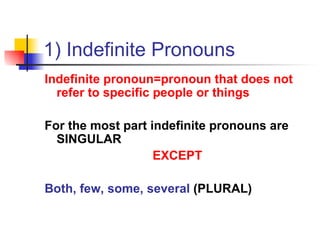
1) Indefinite Pronouns Indefinite pronoun=pronoun that does not refer to specific people or things For the most part indefinite pronouns are SINGULAR EXCEPT Both, few, some, several  (PLURAL)
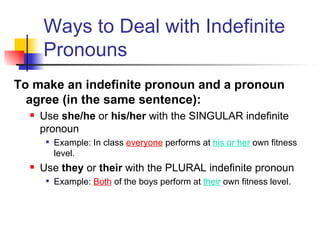
Ways to Deal with Indefinite Pronouns To make an indefinite pronoun and a pronoun agree (in the same sentence): Use  she/he  or  his/her  with the SINGULAR indefinite pronoun Example: In class  everyone  performs at  his or her  own fitness level. Use  they  or  their  with the PLURAL indefinite pronoun Example:  Both  of the boys perform at  their  own fitness level.
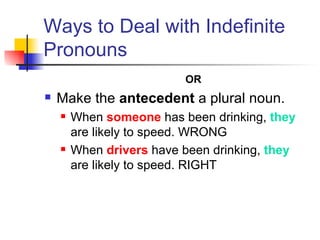
Ways to Deal with Indefinite Pronouns OR Make the  antecedent  a plural noun.  When  someone  has been drinking,  they  are likely to speed. WRONG When  drivers  have been drinking,  they   are likely to speed. RIGHT
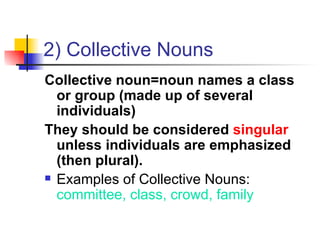
2) Collective Nouns Collective noun=noun names a class or group (made up of several individuals)  They should be considered  singular  unless individuals are emphasized (then plural). Examples of Collective Nouns:  committee, class, crowd, family
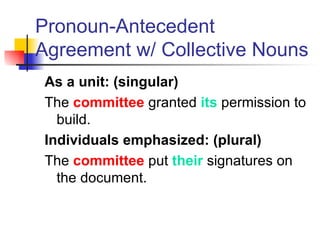
Pronoun-Antecedent Agreement w/ Collective Nouns As a unit: (singular) The  committee  granted  its  permission to build. Individuals emphasized: (plural) The  committee  put  their  signatures on the document.
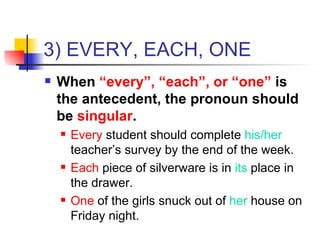
3) EVERY, EACH, ONE When  “every”, “each”, or “one”  is the antecedent, the pronoun should be  singular . Every  student should complete  his/her  teacher’s survey by the end of the week. Each  piece of silverware is in  its  place in the drawer. One  of the girls snuck out of  her  house on Friday night.
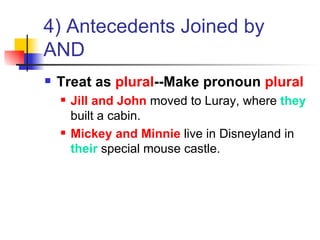
4) Antecedents Joined by AND Treat as  plural --Make pronoun  plural Jill and John  moved to Luray, where  they  built a cabin. Mickey and Minnie  live in Disneyland in  their  special mouse castle.
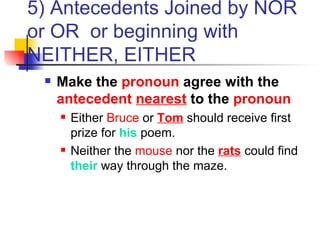
5) Antecedents Joined by NOR or OR  or beginning with NEITHER, EITHER Make the  pronoun  agree with the  antecedent   nearest  to the  pronoun Either  Bruce  or  Tom  should receive first prize for  his  poem. Neither the  mouse  nor the  rats  could find  their  way through the maze.
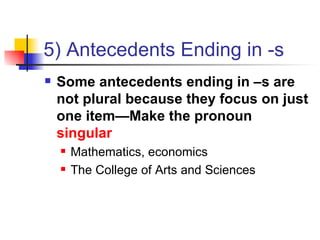
5) Antecedents Ending in -s Some antecedents ending in –s are not plural because they focus on just one item—Make the pronoun  singular Mathematics, economics The College of Arts and Sciences
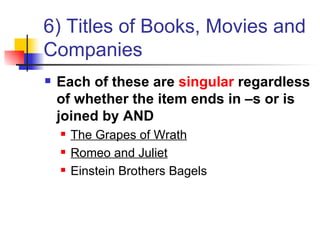
6) Titles of Books, Movies and Companies Each of these are  singular  regardless of whether the item ends in –s or is joined by AND The Grapes of Wrath Romeo and Juliet Einstein Brothers Bagels

Pronoun antecedent powerpoint

  • 1.
  • 2.
    Review Pronoun Aword that substitutes for a noun Types: Personal Pronouns (specific persons/things): I, me, you, she, her, he, him, it, we, us, you, them, they Possessive Pronouns (show ownership): my, mine, your, yours, her, hers, his, its, our, ours, your, yours, their, theirs Intensive/Reflexive (emphasize a particular noun): myself, yourself, himself, herself, itself, ourselves, yourselves, themselves Relative/Interrogative (used in subordinate clauses): who, whom,whose, which, that Demonstrative (identify and point to nouns): this, that, these, those Indefinite (do not refer to specific person/thing): anything, everyone, everything, nobody, anyone, all, any, anybody, anything, both, each, either, everybody, everyone, everything, few, many, neither, none, no one, nothing, one, several, some, somebody, someone, something
  • 3.
    Review Antecedent Nounthat the pronoun is replacing Examples Wanda (noun)= She (pronoun) The students (noun)=They (pronoun) Driver (noun)=He/She (pronoun) Elephant (noun)=It (pronoun)
  • 4.
    General Rule forPronoun-Antecedent Agreement Antecedent and pronoun must match in number , person (1st, 2nd, 3rd) and gender . Singular antecedent (noun)=singular pronoun Plural antecedent (noun)=plural pronoun Examples Alex (singular 3rd person)= he (singular 3rd person) Marbles (plural 3rd person)=those (plural 3rd person) Gender Male or female
  • 5.
    Note about GenderIf you aren’t sure of the gender of the antecedent, use “she or he”, “his/her”, “him/her” as the pronoun Example: The police officer always carries his/her badge when on duty. Things and animals don’t have gender—use “it”, “its” to refer to non-human objects/groups. Example: The team won its game.
  • 6.
    Person What isit? Singular Plural 1st Person Refers to self I, me We 2nd Person Person/thing speaking to You You 3rd Person Someone/ Thing separate from you He, She, It (or nouns referring to he, she, it) They (or nouns referring to they)
  • 7.
    Steps for Determiningif Pronouns and Antecedents Agree Find the pronouns in the sentence. Example: Sally went to her boyfriend’s house, but he wasn’t home. Decide what nouns the pronouns are referring to (ie. find the antecedents ) Example: Sally went to her boyfriend ’s house, but he wasn’t home. Ask yourself “What person/number/gender is the antecedent?” “Does the pronoun match the antecedent in number and person?” Example: Sally (3rd person, singular)=her (3rd person, singular) Boyfriend (3rd person, singular)=he (3rd person, singular)
  • 8.
    Special Cases TrickyPronoun-Antecedent Situations
  • 9.
    1) Indefinite PronounsIndefinite pronoun=pronoun that does not refer to specific people or things For the most part indefinite pronouns are SINGULAR EXCEPT Both, few, some, several (PLURAL)
  • 10.
    Ways to Dealwith Indefinite Pronouns To make an indefinite pronoun and a pronoun agree (in the same sentence): Use she/he or his/her with the SINGULAR indefinite pronoun Example: In class everyone performs at his or her own fitness level. Use they or their with the PLURAL indefinite pronoun Example: Both of the boys perform at their own fitness level.
  • 11.
    Ways to Dealwith Indefinite Pronouns OR Make the antecedent a plural noun. When someone has been drinking, they are likely to speed. WRONG When drivers have been drinking, they are likely to speed. RIGHT
  • 12.
    2) Collective NounsCollective noun=noun names a class or group (made up of several individuals) They should be considered singular unless individuals are emphasized (then plural). Examples of Collective Nouns: committee, class, crowd, family
  • 13.
    Pronoun-Antecedent Agreement w/Collective Nouns As a unit: (singular) The committee granted its permission to build. Individuals emphasized: (plural) The committee put their signatures on the document.
  • 14.
    3) EVERY, EACH,ONE When “every”, “each”, or “one” is the antecedent, the pronoun should be singular . Every student should complete his/her teacher’s survey by the end of the week. Each piece of silverware is in its place in the drawer. One of the girls snuck out of her house on Friday night.
  • 15.
    4) Antecedents Joinedby AND Treat as plural --Make pronoun plural Jill and John moved to Luray, where they built a cabin. Mickey and Minnie live in Disneyland in their special mouse castle.
  • 16.
    5) Antecedents Joinedby NOR or OR or beginning with NEITHER, EITHER Make the pronoun agree with the antecedent nearest to the pronoun Either Bruce or Tom should receive first prize for his poem. Neither the mouse nor the rats could find their way through the maze.
  • 17.
    5) Antecedents Endingin -s Some antecedents ending in –s are not plural because they focus on just one item—Make the pronoun singular Mathematics, economics The College of Arts and Sciences
  • 18.
    6) Titles ofBooks, Movies and Companies Each of these are singular regardless of whether the item ends in –s or is joined by AND The Grapes of Wrath Romeo and Juliet Einstein Brothers Bagels