Nouns
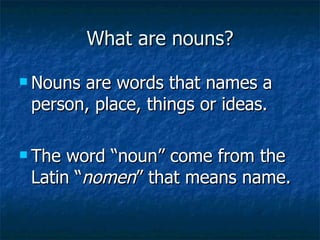
What are nouns? Nouns are words that names a person, place, things or ideas. The word “noun” come from the Latin “ nomen ” that means name.
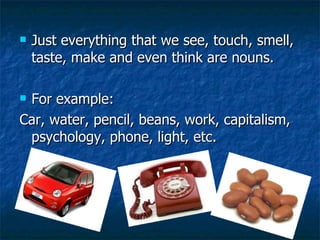
Just everything that we see, touch, smell, taste, make and even think are nouns. For example: Car, water, pencil, beans, work, capitalism, psychology, phone, light, etc.
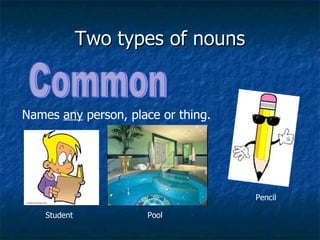
Two types of nouns Common Names  any  person, place or thing. Student Pool Pencil
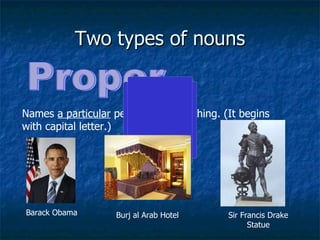
Two types of nouns Proper Names  a particular  person, place or thing. (It begins with capital letter.) Barack Obama Burj al Arab Hotel Sir Francis Drake Statue
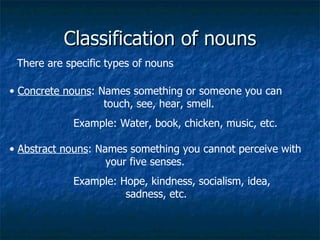
Classification of nouns There are specific types of nouns Concrete nouns : Names something or someone you can    touch, see, hear, smell. Example: Water, book, chicken, music, etc. Abstract nouns : Names something you cannot perceive with  your five senses. Example: Hope, kindness, socialism, idea,    sadness, etc.
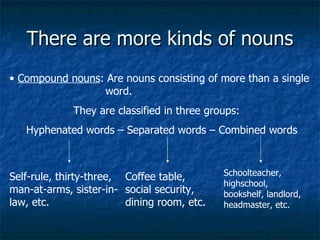
There are more kinds of nouns Compound nouns : Are nouns consisting of more than a single  word. They are classified in three groups: Hyphenated words – Separated words – Combined words Self-rule, thirty-three, man-at-arms, sister-in-law, etc. Coffee table, social security, dining room, etc. Schoolteacher, highschool, bookshelf, landlord, headmaster, etc.
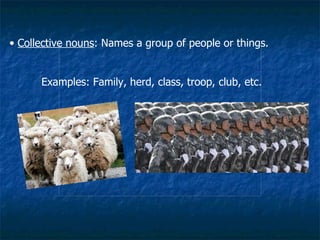
Collective nouns : Names a group of people or things.  Examples: Family, herd, class, troop, club, etc.
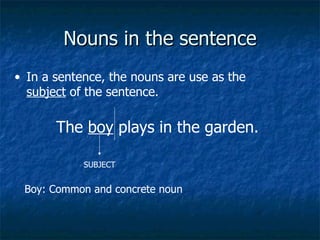
Nouns in the sentence In a sentence, the nouns are use as the  subject  of the sentence. The  boy  plays in the garden. SUBJECT Boy: Common and concrete noun
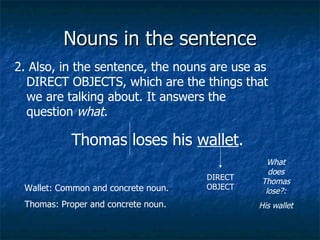
Nouns in the sentence 2. Also, in the sentence, the nouns are use as DIRECT OBJECTS, which are the things that we are talking about. It answers the question  what. Thomas loses his  wallet . DIRECT OBJECT What does Thomas lose?: His wallet Wallet: Common and concrete noun. Thomas: Proper and concrete noun.
To remember A noun is also an “open word”. That means that it accepts the addition of new kind of words. It can be invented thanks to new technologies or borrowed from other languages. For example: Google, sushi, siesta,    tubing, etc.
Thank You!

Presentation of nouns

  • 1.
  • 2.
    What are nouns?Nouns are words that names a person, place, things or ideas. The word “noun” come from the Latin “ nomen ” that means name.
  • 3.
    Just everything thatwe see, touch, smell, taste, make and even think are nouns. For example: Car, water, pencil, beans, work, capitalism, psychology, phone, light, etc.
  • 4.
    Two types ofnouns Common Names any person, place or thing. Student Pool Pencil
  • 5.
    Two types ofnouns Proper Names a particular person, place or thing. (It begins with capital letter.) Barack Obama Burj al Arab Hotel Sir Francis Drake Statue
  • 6.
    Classification of nounsThere are specific types of nouns Concrete nouns : Names something or someone you can touch, see, hear, smell. Example: Water, book, chicken, music, etc. Abstract nouns : Names something you cannot perceive with your five senses. Example: Hope, kindness, socialism, idea, sadness, etc.
  • 7.
    There are morekinds of nouns Compound nouns : Are nouns consisting of more than a single word. They are classified in three groups: Hyphenated words – Separated words – Combined words Self-rule, thirty-three, man-at-arms, sister-in-law, etc. Coffee table, social security, dining room, etc. Schoolteacher, highschool, bookshelf, landlord, headmaster, etc.
  • 8.
    Collective nouns :Names a group of people or things. Examples: Family, herd, class, troop, club, etc.
  • 9.
    Nouns in thesentence In a sentence, the nouns are use as the subject of the sentence. The boy plays in the garden. SUBJECT Boy: Common and concrete noun
  • 10.
    Nouns in thesentence 2. Also, in the sentence, the nouns are use as DIRECT OBJECTS, which are the things that we are talking about. It answers the question what. Thomas loses his wallet . DIRECT OBJECT What does Thomas lose?: His wallet Wallet: Common and concrete noun. Thomas: Proper and concrete noun.
  • 11.
    To remember Anoun is also an “open word”. That means that it accepts the addition of new kind of words. It can be invented thanks to new technologies or borrowed from other languages. For example: Google, sushi, siesta, tubing, etc.
  • 12.