

Pronouns
Pronouns - are words that we use in 
place of Nouns (or other Pronouns) in a 
sentence to make it less repetitive and 
less awkward. Some of the most 
common Pronouns are - he, she, you, 
they, it, etc.
Categories 
of 
Pronouns
Personal Pronouns 
These pronouns are used for a specific 
object or person and they change their 
forms to indicate the different genders, 
numbers, case and persons speaking -
Examples: 
 Tanya told him to take the food to them 
as soon as possible as it was urgently 
needed. 
 ‘Him’ is a Pronoun of gender.
Examples: 
 ‘Them’ is a Pronoun of number showing 
that there is more than one person, and 
it is also a Pronoun of case as it is 
referring to a specific group in an 
objective manner. 
 ‘It’ is also a Pronoun of gender showing 
the object (food).
So we can see that the Personal Pronouns can 
be based on - 
Gender – 
He went to the market. - He is used for the 
male gender. Other examples are - His, Him, 
He, etc. 
She is doing the laundry. - She is used for the 
female gender. Other examples are - Her, 
Hers, etc.
It is important to them. - It is gender neutral 
as it shows an object, them is also gender 
neutral as them can consist of both genders. 
Other gender neutral pronouns are - Their, 
They, Its, etc.
So we can see that the Personal Pronouns can 
be based on - 
Number – 
Singular Pronouns - Where the pronoun is 
only referring to one specific noun. 
That book belongs to me. - Me refers to one 
singular person only. 
Plural Pronouns - Where the pronoun is used 
to refer to a number of nouns.
That is their book, not yours. - Their shows a 
number of people, hence it’s a plural personal 
pronoun. Whereas the ‘yours’ in this sentence 
is another example of singular personal 
pronoun.
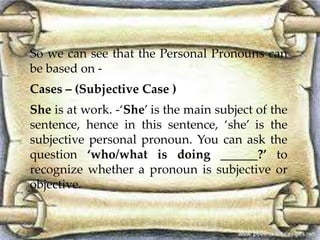
So we can see that the Personal Pronouns can 
be based on - 
Cases – (Subjective Case ) 
She is at work. -‘She’ is the main subject of the 
sentence, hence in this sentence, ‘she’ is the 
subjective personal pronoun. You can ask the 
question ‘who/what is doing ______?’ to 
recognize whether a pronoun is subjective or 
objective.
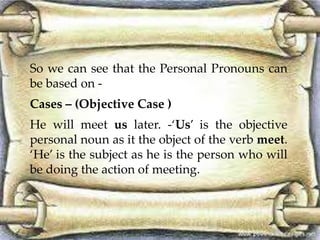
So we can see that the Personal Pronouns can 
be based on - 
Cases – (Objective Case ) 
He will meet us later. -‘Us’ is the objective 
personal noun as it the object of the verb meet. 
‘He’ is the subject as he is the person who will 
be doing the action of meeting.
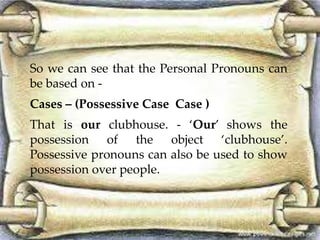
So we can see that the Personal Pronouns can 
be based on - 
Cases – (Possessive Case Case ) 
That is our clubhouse. - ‘Our’ shows the 
possession of the object ‘clubhouse’. 
Possessive pronouns can also be used to show 
possession over people.
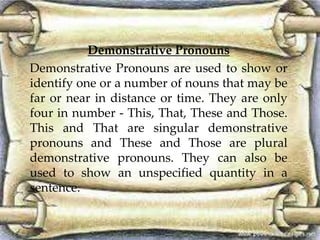
Demonstrative Pronouns 
Demonstrative Pronouns are used to show or 
identify one or a number of nouns that may be 
far or near in distance or time. They are only 
four in number - This, That, These and Those. 
This and That are singular demonstrative 
pronouns and These and Those are plural 
demonstrative pronouns. They can also be 
used to show an unspecified quantity in a 
sentence.
Examples: 
 That is a beautiful house. - That is a 
demonstrative pronoun that is referring 
to a specific noun (house). This is a 
singular pronoun as it is referring to 
only one house.
Examples: 
 These were made by me. - These is 
showing an unspecified quantity of 
something that was made by a person. 
This is a plural demonstrative pronoun 
as it’s referring to a number of objects.
Examples: 
 Everyone remembers those days. - 
Those is showing a particular time or 
period of days in the past; it is being 
used in place of a noun that could be - 
school, summer, college, etc. Here also 
those is a plural demonstrative pronoun 
as it’s indicating a number of days.
Examples: 
 This is what he is charging? - This is 
used as pronoun in place of a number 
and it is also acting as a quantifier by 
referring not only to the noun but to the 
amount/number of the noun as well. 
This is a singular demonstrative 
pronoun.
Interrogative Pronouns 
Who, Whom, Which and What are 
Interrogative Pronouns as they are used to 
ask questions about a person or object that 
we do not know about. Compounds of 
these words are made by attaching ‘-ever’ 
to the words to strengthen the emphasis on 
the word.
Examples: 
 Which one would you like? - Here, 
‘which’ is being used to ask someone to 
make a choice between different things, 
instead of naming every single choice 
that is available.
Examples: 
 What is your name? - What is used to 
ask a personal noun that the speaker 
doesn’t know.
Examples: 
 Who will be managing the buffet? - Who 
is used to ask about a specific person 
related to a task. 
 Whom did you tell about this? - Whom 
is showing/asking the person who was 
told something by ‘you’.
Examples: 
 Whoever could have done this? - 
Whoever is the compound of ‘Who’ and 
it is used here to emphasize the feeling 
of confusion in the sentence while still 
asking a question. 
 Whichever one will you choose? - 
Whichever is used here to show strong 
emotion while asking a person’s choice.
In the case of Who and Whom - 
Who is always the subject of the verb. The 
emphasis is on the identity of the person who 
did the action. 
Who rang the bell? Here, we can see that the 
verb phrase rang the bell is secondary and the 
main emphasis is on the identity of the person 
ringing the bell.
In the case of Who and Whom - 
Whom is never the subject of the verb. It is 
used to show the person to or for whom the 
action is being done. In other words, it is the 
object of the verb. 
Whom were you meeting with? Here, we can 
see that the subject of verb or the person who 
was meeting someone is ‘you’. Whom is the 
object of the verb or the person ‘you’ were 
‘meeting’.
Relative Pronouns 
Relative Pronouns are used to join or relate 
two different clauses together by referring 
to the noun in the previous clause using 
the pronouns - Who, Whom, Whose, 
Which and That. Which and That are 
generally used for objects; while Who and 
Whom are used for people, and Whose is 
used to show possession.
Examples: 
 She will choose the color which looks 
good on everyone. 
Here, which is joining the two related 
clauses about choosing a color and a color 
which would look good on everyone.
Examples: 
 She is complaining to whoever she 
comes across nowadays. 
Here, the whoever is the object of the verb 
‘complaining’ and it is linking the two 
clauses about someone complaining and 
the frequency of their complaints.
Examples: 
 There is a car in the parking lot that 
someone has painted a bright pink. 
 That is joining the two sentences related 
to the object and its location in the first 
and its appearance in the second. 
 She needs to know by tomorrow who 
will be accompanying her on the trip.
Examples: 
 Who here stands for the unknown 
person and it also joins the two different 
clauses together. 
 Is there anyone here whose mobile 
phone has a signal? 
 Whose is used here to ask if anyone has 
possession of something that the speaker 
needs.
Indefinite Pronouns 
These pronouns are used to show unspecified 
objects or people, whether in plural or in 
singular. They are used to indicate the entire 
noun or some of the noun or none of the noun. 
They are used when we want to refer to group 
of nouns without actually specifying who or 
how much. 
Some common indefinite nouns are - anyone, 
someone, none, everything, many, few, etc.
Examples: 
 If anyone has seen my notebook please 
return it to me. – Here, we see the 
pronoun anyone is being used to refer to 
everyone without any specification. 
 A few of the members were not satisfied 
with the service. - Few means a small 
number of people/objects. Hence, it is a 
plural indefinite pronoun.
Examples: 
 Nobody was answering when I called 
them last. – Here, we see a pronoun 
nobody being used to show no one at 
all. It is a singular indefinite pronoun.
Reflexive and Intensive Pronouns 
Reflexive Pronouns are those which are 
used to indicate a noun which has been 
used in an earlier part of the same 
sentence. These pronouns are - Myself, 
Themselves, Yourself, Ourselves, Herself, 
Himself and Itself.
Examples: 
 Rosa was going to take it to the shop but 
ended up fixing it herself one afternoon. 
– Here, we can see that herself is being 
used to refer to ‘Rosa’ again at the end of 
the sentence. 
 He prefers to be by himself after a 
game. – Here, himself is used to refer to 
‘him’.
Examples: 
 Apart from ordering in, they cooked a few 
snack themselves. – Here themselves is 
used to show that ‘they’ cooked something. 
 The horse hurt itself while trying to escape. 
- Since itself is a gender neutral pronoun, it 
is used to show the nouns that have no 
definite gender. E.g. : material things or 
ideas, etc.; or whose gender is unknown. E : 
animals.
These same words are also called Intensive 
Pronouns, which are used to lay emphasis on 
the pronoun that comes before them in the 
sentence. 
 They themselves knew that the prank was 
in bad taste. - Here, the pronoun 
themselves is used to emphasize ‘they’. 
 Avoid reporting things that you yourself 
haven’t witnessed. - Here yourself is used 
to emphasize the pronoun ‘you’.
Reciprocal Pronouns 
There are just two Reciprocal Pronouns - 
Each other and One another. They are 
used when two or more nouns are doing or 
being the same to one another. Both of 
these pronouns are plural in nature as they 
can only be used in situations where there 
is more than one noun.
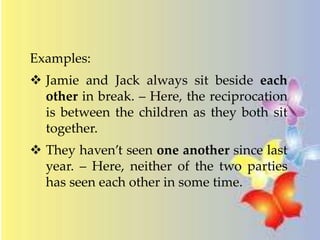
Examples: 
 Jamie and Jack always sit beside each 
other in break. – Here, the reciprocation 
is between the children as they both sit 
together. 
 They haven’t seen one another since last 
year. – Here, neither of the two parties 
has seen each other in some time.
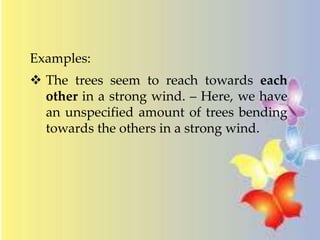
Examples: 
 The trees seem to reach towards each 
other in a strong wind. – Here, we have 
an unspecified amount of trees bending 
towards the others in a strong wind.
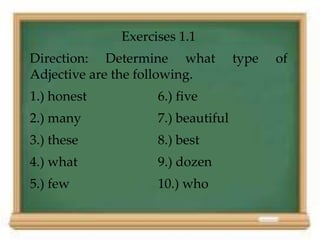
Exercises 1.1 
Direction: Determine what type of 
Adjective are the following. 
1.) honest 6.) five 
2.) many 7.) beautiful 
3.) these 8.) best 
4.) what 9.) dozen 
5.) few 10.) who
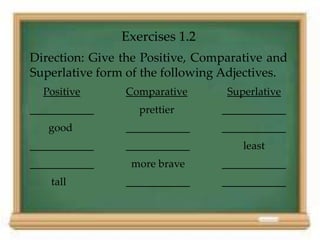
Exercises 1.2 
Direction: Give the Positive, Comparative and 
Superlative form of the following Adjectives. 
Positive Comparative Superlative 
prettier 
good 
least 
more brave 
tall
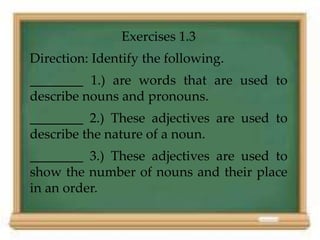
Exercises 1.3 
Direction: Identify the following. 
________ 1.) are words that are used to 
describe nouns and pronouns. 
________ 2.) These adjectives are used to 
describe the nature of a noun. 
________ 3.) These adjectives are used to 
show the number of nouns and their place 
in an order.
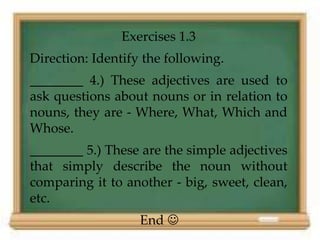
Exercises 1.3 
Direction: Identify the following. 
________ 4.) These adjectives are used to 
ask questions about nouns or in relation to 
nouns, they are - Where, What, Which and 
Whose. 
________ 5.) These are the simple adjectives 
that simply describe the noun without 
comparing it to another - big, sweet, clean, 
etc. 
End 

Pronouns

  • 1.
  • 2.
    Pronouns - arewords that we use in place of Nouns (or other Pronouns) in a sentence to make it less repetitive and less awkward. Some of the most common Pronouns are - he, she, you, they, it, etc.
  • 3.
  • 4.
    Personal Pronouns Thesepronouns are used for a specific object or person and they change their forms to indicate the different genders, numbers, case and persons speaking -
  • 5.
    Examples:  Tanyatold him to take the food to them as soon as possible as it was urgently needed.  ‘Him’ is a Pronoun of gender.
  • 6.
    Examples:  ‘Them’is a Pronoun of number showing that there is more than one person, and it is also a Pronoun of case as it is referring to a specific group in an objective manner.  ‘It’ is also a Pronoun of gender showing the object (food).
  • 7.
    So we cansee that the Personal Pronouns can be based on - Gender – He went to the market. - He is used for the male gender. Other examples are - His, Him, He, etc. She is doing the laundry. - She is used for the female gender. Other examples are - Her, Hers, etc.
  • 8.
    It is importantto them. - It is gender neutral as it shows an object, them is also gender neutral as them can consist of both genders. Other gender neutral pronouns are - Their, They, Its, etc.
  • 9.
    So we cansee that the Personal Pronouns can be based on - Number – Singular Pronouns - Where the pronoun is only referring to one specific noun. That book belongs to me. - Me refers to one singular person only. Plural Pronouns - Where the pronoun is used to refer to a number of nouns.
  • 10.
    That is theirbook, not yours. - Their shows a number of people, hence it’s a plural personal pronoun. Whereas the ‘yours’ in this sentence is another example of singular personal pronoun.
  • 11.
    So we cansee that the Personal Pronouns can be based on - Cases – (Subjective Case ) She is at work. -‘She’ is the main subject of the sentence, hence in this sentence, ‘she’ is the subjective personal pronoun. You can ask the question ‘who/what is doing ______?’ to recognize whether a pronoun is subjective or objective.
  • 12.
    So we cansee that the Personal Pronouns can be based on - Cases – (Objective Case ) He will meet us later. -‘Us’ is the objective personal noun as it the object of the verb meet. ‘He’ is the subject as he is the person who will be doing the action of meeting.
  • 13.
    So we cansee that the Personal Pronouns can be based on - Cases – (Possessive Case Case ) That is our clubhouse. - ‘Our’ shows the possession of the object ‘clubhouse’. Possessive pronouns can also be used to show possession over people.
  • 14.
    Demonstrative Pronouns DemonstrativePronouns are used to show or identify one or a number of nouns that may be far or near in distance or time. They are only four in number - This, That, These and Those. This and That are singular demonstrative pronouns and These and Those are plural demonstrative pronouns. They can also be used to show an unspecified quantity in a sentence.
  • 15.
    Examples:  Thatis a beautiful house. - That is a demonstrative pronoun that is referring to a specific noun (house). This is a singular pronoun as it is referring to only one house.
  • 16.
    Examples:  Thesewere made by me. - These is showing an unspecified quantity of something that was made by a person. This is a plural demonstrative pronoun as it’s referring to a number of objects.
  • 17.
    Examples:  Everyoneremembers those days. - Those is showing a particular time or period of days in the past; it is being used in place of a noun that could be - school, summer, college, etc. Here also those is a plural demonstrative pronoun as it’s indicating a number of days.
  • 18.
    Examples:  Thisis what he is charging? - This is used as pronoun in place of a number and it is also acting as a quantifier by referring not only to the noun but to the amount/number of the noun as well. This is a singular demonstrative pronoun.
  • 19.
    Interrogative Pronouns Who,Whom, Which and What are Interrogative Pronouns as they are used to ask questions about a person or object that we do not know about. Compounds of these words are made by attaching ‘-ever’ to the words to strengthen the emphasis on the word.
  • 20.
    Examples:  Whichone would you like? - Here, ‘which’ is being used to ask someone to make a choice between different things, instead of naming every single choice that is available.
  • 21.
    Examples:  Whatis your name? - What is used to ask a personal noun that the speaker doesn’t know.
  • 22.
    Examples:  Whowill be managing the buffet? - Who is used to ask about a specific person related to a task.  Whom did you tell about this? - Whom is showing/asking the person who was told something by ‘you’.
  • 23.
    Examples:  Whoevercould have done this? - Whoever is the compound of ‘Who’ and it is used here to emphasize the feeling of confusion in the sentence while still asking a question.  Whichever one will you choose? - Whichever is used here to show strong emotion while asking a person’s choice.
  • 24.
    In the caseof Who and Whom - Who is always the subject of the verb. The emphasis is on the identity of the person who did the action. Who rang the bell? Here, we can see that the verb phrase rang the bell is secondary and the main emphasis is on the identity of the person ringing the bell.
  • 25.
    In the caseof Who and Whom - Whom is never the subject of the verb. It is used to show the person to or for whom the action is being done. In other words, it is the object of the verb. Whom were you meeting with? Here, we can see that the subject of verb or the person who was meeting someone is ‘you’. Whom is the object of the verb or the person ‘you’ were ‘meeting’.
  • 26.
    Relative Pronouns RelativePronouns are used to join or relate two different clauses together by referring to the noun in the previous clause using the pronouns - Who, Whom, Whose, Which and That. Which and That are generally used for objects; while Who and Whom are used for people, and Whose is used to show possession.
  • 27.
    Examples:  Shewill choose the color which looks good on everyone. Here, which is joining the two related clauses about choosing a color and a color which would look good on everyone.
  • 28.
    Examples:  Sheis complaining to whoever she comes across nowadays. Here, the whoever is the object of the verb ‘complaining’ and it is linking the two clauses about someone complaining and the frequency of their complaints.
  • 29.
    Examples:  Thereis a car in the parking lot that someone has painted a bright pink.  That is joining the two sentences related to the object and its location in the first and its appearance in the second.  She needs to know by tomorrow who will be accompanying her on the trip.
  • 30.
    Examples:  Whohere stands for the unknown person and it also joins the two different clauses together.  Is there anyone here whose mobile phone has a signal?  Whose is used here to ask if anyone has possession of something that the speaker needs.
  • 31.
    Indefinite Pronouns Thesepronouns are used to show unspecified objects or people, whether in plural or in singular. They are used to indicate the entire noun or some of the noun or none of the noun. They are used when we want to refer to group of nouns without actually specifying who or how much. Some common indefinite nouns are - anyone, someone, none, everything, many, few, etc.
  • 32.
    Examples:  Ifanyone has seen my notebook please return it to me. – Here, we see the pronoun anyone is being used to refer to everyone without any specification.  A few of the members were not satisfied with the service. - Few means a small number of people/objects. Hence, it is a plural indefinite pronoun.
  • 33.
    Examples:  Nobodywas answering when I called them last. – Here, we see a pronoun nobody being used to show no one at all. It is a singular indefinite pronoun.
  • 34.
    Reflexive and IntensivePronouns Reflexive Pronouns are those which are used to indicate a noun which has been used in an earlier part of the same sentence. These pronouns are - Myself, Themselves, Yourself, Ourselves, Herself, Himself and Itself.
  • 35.
    Examples:  Rosawas going to take it to the shop but ended up fixing it herself one afternoon. – Here, we can see that herself is being used to refer to ‘Rosa’ again at the end of the sentence.  He prefers to be by himself after a game. – Here, himself is used to refer to ‘him’.
  • 36.
    Examples:  Apartfrom ordering in, they cooked a few snack themselves. – Here themselves is used to show that ‘they’ cooked something.  The horse hurt itself while trying to escape. - Since itself is a gender neutral pronoun, it is used to show the nouns that have no definite gender. E.g. : material things or ideas, etc.; or whose gender is unknown. E : animals.
  • 37.
    These same wordsare also called Intensive Pronouns, which are used to lay emphasis on the pronoun that comes before them in the sentence.  They themselves knew that the prank was in bad taste. - Here, the pronoun themselves is used to emphasize ‘they’.  Avoid reporting things that you yourself haven’t witnessed. - Here yourself is used to emphasize the pronoun ‘you’.
  • 38.
    Reciprocal Pronouns Thereare just two Reciprocal Pronouns - Each other and One another. They are used when two or more nouns are doing or being the same to one another. Both of these pronouns are plural in nature as they can only be used in situations where there is more than one noun.
  • 39.
    Examples:  Jamieand Jack always sit beside each other in break. – Here, the reciprocation is between the children as they both sit together.  They haven’t seen one another since last year. – Here, neither of the two parties has seen each other in some time.
  • 40.
    Examples:  Thetrees seem to reach towards each other in a strong wind. – Here, we have an unspecified amount of trees bending towards the others in a strong wind.
  • 41.
    Exercises 1.1 Direction:Determine what type of Adjective are the following. 1.) honest 6.) five 2.) many 7.) beautiful 3.) these 8.) best 4.) what 9.) dozen 5.) few 10.) who
  • 42.
    Exercises 1.2 Direction:Give the Positive, Comparative and Superlative form of the following Adjectives. Positive Comparative Superlative prettier good least more brave tall
  • 43.
    Exercises 1.3 Direction:Identify the following. ________ 1.) are words that are used to describe nouns and pronouns. ________ 2.) These adjectives are used to describe the nature of a noun. ________ 3.) These adjectives are used to show the number of nouns and their place in an order.
  • 44.
    Exercises 1.3 Direction:Identify the following. ________ 4.) These adjectives are used to ask questions about nouns or in relation to nouns, they are - Where, What, Which and Whose. ________ 5.) These are the simple adjectives that simply describe the noun without comparing it to another - big, sweet, clean, etc. End 