Presented by Amirul Islam (Admin)
Darus Salam On Line Model School, Bangladesh.
Passage Narration
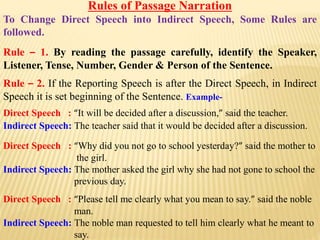
Rules of Passage Narration
To Change Direct Speech into Indirect Speech, Some Rules are
followed.
Rule – 1. By reading the passage carefully, identify the Speaker,
Listener, Tense, Number, Gender & Person of the Sentence.
Rule – 2. If the Reporting Speech is after the Direct Speech, in Indirect
Speech it is set beginning of the Sentence. Example-
Direct Speech : “It will be decided after a discussion,” said the teacher.
Indirect Speech: The teacher said that it would be decided after a discussion.
Direct Speech : “Why did you not go to school yesterday?” said the mother to
the girl.
Indirect Speech: The mother asked the girl why she had not gone to school the
previous day.
Direct Speech : “Please tell me clearly what you mean to say.” said the noble
man.
Indirect Speech: The noble man requested to tell him clearly what he meant to
say.
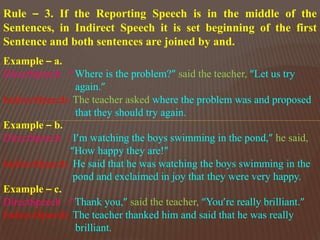
Rule – 3. If the Reporting Speech is in the middle of the
Sentences, in Indirect Speech it is set beginning of the first
Sentence and both sentences are joined by and.
Example – a.
DirectSpeech :“Where is the problem?” said the teacher, “Let us try
again.”
IndirectSpeech: The teacher asked where the problem was and proposed
that they should try again.
Example – b.
DirectSpeech : I’m watching the boys swimming in the pond,” he said,
“How happy they are!”
IndirectSpeech: He said that he was watching the boys swimming in the
pond and exclaimed in joy that they were very happy.
Example – c.
DirectSpeech :“Thank you,” said the teacher, “You’re really brilliant.”
IndirectSpeech: The teacher thanked him and said that he was really
brilliant.
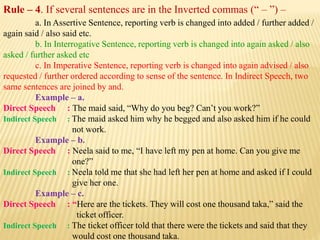
Rule – 4. If several sentences are in the Inverted commas (“ – ”) –
a. In Assertive Sentence, reporting verb is changed into added / further added /
again said / also said etc.
b. In Interrogative Sentence, reporting verb is changed into again asked / also
asked / further asked etc
c. In Imperative Sentence, reporting verb is changed into again advised / also
requested / further ordered according to sense of the sentence. In Indirect Speech, two
same sentences are joined by and.
Example – a.
Direct Speech : The maid said, “Why do you beg? Can’t you work?”
Indirect Speech : The maid asked him why he begged and also asked him if he could
not work.
Example – b.
Direct Speech : Neela said to me, “I have left my pen at home. Can you give me
one?”
Indirect Speech : Neela told me that she had left her pen at home and asked if I could
give her one.
Example – c.
Direct Speech : “Here are the tickets. They will cost one thousand taka,” said the
ticket officer.
Indirect Speech : The ticket officer told that there were the tickets and said that they
would cost one thousand taka.
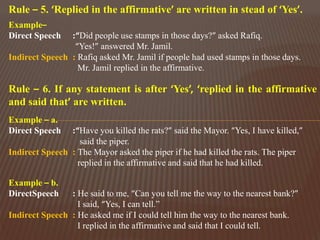
Rule – 5. ‘Replied in the affirmative’ are written in stead of ‘Yes’.
Example–
Direct Speech :“Did people use stamps in those days?” asked Rafiq.
“Yes!” answered Mr. Jamil.
Indirect Speech : Rafiq asked Mr. Jamil if people had used stamps in those days.
Mr. Jamil replied in the affirmative.
Rule – 6. If any statement is after ‘Yes’, ‘replied in the affirmative
and said that’ are written.
Example – a.
Direct Speech :“Have you killed the rats?” said the Mayor. “Yes, I have killed,”
said the piper.
Indirect Speech : The Mayor asked the piper if he had killed the rats. The piper
replied in the affirmative and said that he had killed.
Example – b.
DirectSpeech : He said to me, “Can you tell me the way to the nearest bank?”
I said, “Yes, I can tell.”
Indirect Speech : He asked me if I could tell him the way to the nearest bank.
I replied in the affirmative and said that I could tell.
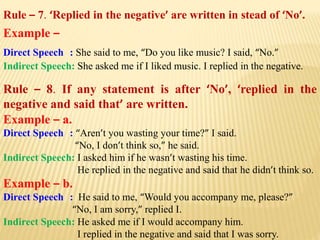
Rule – 7. ‘Replied in the negative’ are written in stead of ‘No’.
Example –
Direct Speech : She said to me, “Do you like music? I said, “No.”
Indirect Speech: She asked me if I liked music. I replied in the negative.
Rule – 8. If any statement is after ‘No’, ‘replied in the
negative and said that’ are written.
Example – a.
Direct Speech : “Aren’t you wasting your time?” I said.
“No, I don’t think so,” he said.
Indirect Speech: I asked him if he wasn’t wasting his time.
He replied in the negative and said that he didn’t think so.
Example – b.
Direct Speech : He said to me, “Would you accompany me, please?”
“No, I am sorry,” replied I.
Indirect Speech: He asked me if I would accompany him.
I replied in the negative and said that I was sorry.
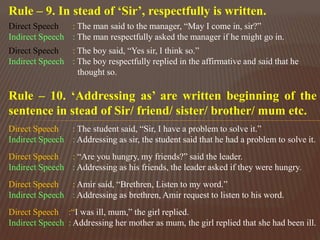
Rule – 9. In stead of ‘Sir’, respectfully is written.
Direct Speech : The man said to the manager, “May I come in, sir?”
Indirect Speech : The man respectfully asked the manager if he might go in.
Direct Speech : The boy said, “Yes sir, I think so.”
Indirect Speech : The boy respectfully replied in the affirmative and said that he
thought so.
Rule – 10. ‘Addressing as’ are written beginning of the
sentence in stead of Sir/ friend/ sister/ brother/ mum etc.
Direct Speech : The student said, “Sir, I have a problem to solve it.”
Indirect Speech : Addressing as sir, the student said that he had a problem to solve it.
Direct Speech : “Are you hungry, my friends?” said the leader.
Indirect Speech : Addressing as his friends, the leader asked if they were hungry.
Direct Speech : Amir said, “Brethren, Listen to my word.”
Indirect Speech : Addressing as brethren, Amir request to listen to his word.
Direct Speech :“I was ill, mum,” the girl replied.
Indirect Speech : Addressing her mother as mum, the girl replied that she had been ill.
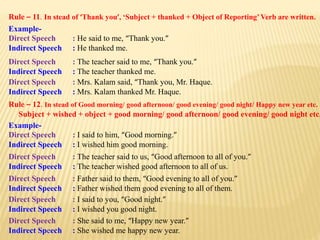
Rule – 11. In stead of ‘Thank you’, ‘Subject + thanked + Object of Reporting’Verb are written.
Example-
Direct Speech : He said to me, “Thank you.”
Indirect Speech : He thanked me.
Direct Speech : The teacher said to me, “Thank you.”
Indirect Speech : The teacher thanked me.
Direct Speech : Mrs. Kalam said, “Thank you, Mr. Haque.
Indirect Speech : Mrs. Kalam thanked Mr. Haque.
Rule – 12. In stead of Good morning/ good afternoon/ good evening/ good night/ Happy new year etc.
Subject + wished + object + good morning/ good afternoon/ good evening/ good night etc.
Example-
Direct Speech : I said to him, “Good morning.”
Indirect Speech : I wished him good morning.
Direct Speech : The teacher said to us, “Good afternoon to all of you.”
Indirect Speech : The teacher wished good afternoon to all of us.
Direct Speech : Father said to them, “Good evening to all of you.”
Indirect Speech : Father wished them good evening to all of them.
Direct Speech : I said to you, “Good night.”
Indirect Speech : I wished you good night.
Direct Speech : She said to me, “Happy new year.”
Indirect Speech : She wished me happy new year.
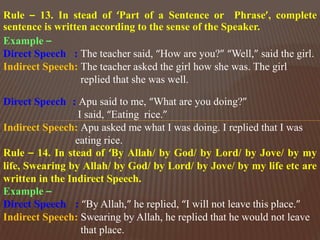
Rule – 13. In stead of ‘Part of a Sentence or Phrase’, complete
sentence is written according to the sense of the Speaker.
Example –
Direct Speech : The teacher said, “How are you?” “Well,” said the girl.
Indirect Speech: The teacher asked the girl how she was. The girl
replied that she was well.
Direct Speech : Apu said to me, “What are you doing?”
I said, “Eating rice.”
Indirect Speech: Apu asked me what I was doing. I replied that I was
eating rice.
Rule – 14. In stead of ‘By Allah/ by God/ by Lord/ by Jove/ by my
life, Swearing by Allah/ by God/ by Lord/ by Jove/ by my life etc are
written in the Indirect Speech.
Example –
Direct Speech : “By Allah,” he replied, “I will not leave this place.”
Indirect Speech: Swearing by Allah, he replied that he would not leave
that place.
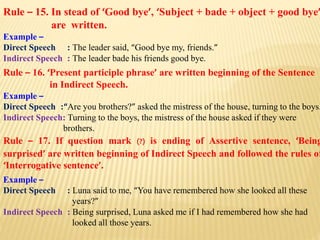
Rule – 15. In stead of ‘Good bye’, ‘Subject + bade + object + good bye’
are written.
Example –
Direct Speech : The leader said, “Good bye my, friends.”
Indirect Speech : The leader bade his friends good bye.
Rule – 16. ‘Present participle phrase’ are written beginning of the Sentence
in Indirect Speech.
Example –
Direct Speech :“Are you brothers?” asked the mistress of the house, turning to the boys.
Indirect Speech: Turning to the boys, the mistress of the house asked if they were
brothers.
Rule – 17. If question mark (?) is ending of Assertive sentence, ‘Being
surprised’ are written beginning of Indirect Speech and followed the rules of
‘Interrogative sentence’.
Example –
Direct Speech : Luna said to me, “You have remembered how she looked all these
years?”
Indirect Speech : Being surprised, Luna asked me if I had remembered how she had
looked all those years.
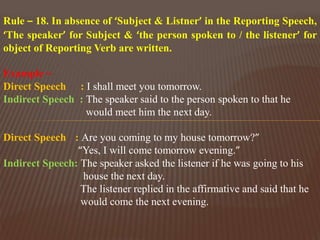
Rule – 18. In absence of ‘Subject & Listner’ in the Reporting Speech,
‘The speaker’ for Subject & ‘the person spoken to / the listener’ for
object of Reporting Verb are written.
Example –
Direct Speech : I shall meet you tomorrow.
Indirect Speech : The speaker said to the person spoken to that he
would meet him the next day.
Direct Speech : Are you coming to my house tomorrow?”
“Yes, I will come tomorrow evening.”
Indirect Speech: The speaker asked the listener if he was going to his
house the next day.
The listener replied in the affirmative and said that he
would come the next evening.
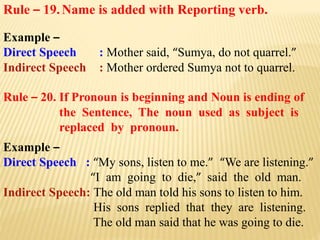
Rule – 19.Name is added with Reporting verb.
Example –
Direct Speech : Mother said, “Sumya, do not quarrel.”
Indirect Speech : Mother ordered Sumya not to quarrel.
Rule – 20. If Pronoun is beginning and Noun is ending of
the Sentence, The noun used as subject is
replaced by pronoun.
Example –
Direct Speech : “My sons, listen to me.” “We are listening.”
“I am going to die,” said the old man.
Indirect Speech: The old man told his sons to listen to him.
His sons replied that they are listening.
The old man said that he was going to die.
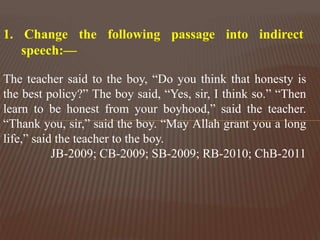
The teacher said to the boy, “Do you think that honesty is
the best policy?” The boy said, “Yes, sir, I think so.” “Then
learn to be honest from your boyhood,” said the teacher.
“Thank you, sir,” said the boy. “May Allah grant you a long
life,” said the teacher to the boy.
JB-2009; CB-2009; SB-2009; RB-2010; ChB-2011
1. Change the following passage into indirect
speech:—
1. Change the following passage into indirect
speech:—
The teacher said to the boy, “Do you think that honesty is
the best policy?” The boy said, “Yes, sir, I think so.” “Then
learn to be honest from your boyhood,” said the teacher.
“Thank you, sir,” said the boy. “May Allah grant you a long
life,” said the teacher to the boy.
Ans: The teacher asked the boy if he thought that honesty
is the best policy.
The teacher prayed that
Allah might grant him a long life.
The boy
respectfully thanked him.
The
teacher advised him to learn to be honest from his boyhood.
The boy respectfully replied in the
affirmative and said that he thought so.
2. Change the following passage into indirect
speech:—
The old man said, “Can you give me some food? I’ve
been starving for two days.” The maid said, “Why do you
beg? Can’t you work?” “No, I am unable to work.” the old
man replied.
2. Change the following passage into indirect
speech:—
The old man said, “Can you give me some food? I’ve
been starving for two days.” The maid said, “Why do you
beg? Can’t you work?” “No, I am unable to work.” the old
man replied.
Ans: The old man asked the maid if she could give him
some food. He also said that he had been starving for two
days.
The old man replied in the
negative and said that he was unable to work.
The maid asked him why he begged. She also asked
him if he could not work.
3. Change the following passage into indirect
speech:—
The man said to the manager, “May I come in, sir?”
“Yes, come in. What do you want?” said the manager. “I
want to open a bank account in your bank.” said the man,
“Can you tell me how I can open a current account?”
3. Change the following passage into indirect
speech:—
The man said to the manager, “May I come in, sir?” “Yes,
come in. What do you want?” said the manager. “I want to
open a bank account in your bank.” said the man, “Can you
tell me how I can open a current account?”
Ans: The man respectfully asked the manager if he might go
in.
The man
told that he wanted to open a bank account in his bank. The
man also asked him if he could tell him how he could open a
current account.
The manager replied in the affirmative and told him to go
in. The manager also asked him what he wanted.
4. Change the following passage into indirect
speech:—
“Nasreen, have you done your English lesson today?”
asked the teacher. “Yes sir. I have done it. But I haven’t
understood some grammatical points,” replied Nasreen.
“Where is the problem?” said the teacher. “Let us try
again.”
4. Change the following passage into indirect speech:—
“Nasreen, have you done your English lesson today?” asked the
teacher. “Yes sir. I have done it. But I haven’t understood some
grammatical points,” replied Nasreen. “Where is the problem?” said
the teacher. “Let us try again.”
Ans: The teacher asked Nasreen if she had done her English lesson
that day.
The teacher asked her where the problem was. He
also proposed that they should try again.
Nasreen respectfully replied in the affirmative and said that
she had done it. She also replied that she hadn’t understood some
grammatical points.
5. Change the following passage into indirect speech:—
A fruit seller said, “Which fruits do you want to buy? I have
apples from Australia, oranges from Darjeeling, grapes from
Kashmir.” The customer said, “What fruits of our country do
you have?” The fruit seller said, “I have coconut, guava and
jackfruit.” The customer said, “Give one kg of guava as it
will be the substitute of Australian apples.
5. Change the following passage into indirect
speech:—
A fruit seller said, “Which fruits do you want to buy? I have apples
from Australia, oranges from Darjeeling, grapes from Kashmir.” The
customer said, “What fruits of our country do you have?” The fruit
seller said, “I have coconut, guava and jackfruit.” The customer said,
“Give one kg of guava as it will be the substitute of Australian apples.
Ans: A fruit seller asked the customer which fruits he wanted to buy.
He also said that he had apples from Australia, oranges from
Darjeeling, grapes from Kashmir.
The customer told him to give one kg of guava as it
would be the substitute of Australian apples.
The customer asked what fruits of
their country had. The fruit seller replied that he had coconut, guava
and jackfruit.
6. Change the following passage into indirect speech:—
Zaman said to me, “Have you finished reading the book I gave
you yesterday?” “Yes, I have finished reading the book,” I
replied. “What an interesting book it is! I wish I would borrow
the book earlier!” I said. “Will you return the book to me
today?” he asked. RB-2007; DiB-2010
6. Change the following passage into
indirect speech:—
Zaman said to me, “Have you finished reading the book I
gave you yesterday?” “Yes, I have finished reading the
book,” I replied. “What an interesting book it is! I wish I
would borrow the book earlier!” I said. “Will you return the
book to me today?” he asked.
Ans: Zaman asked me if I had finished reading the book he
had given me the previous day.
Zaman asked me if I would
return the book to him that day.
I also exclaimed
in joy that it was an interesting book and wished that I
would borrow the book earlier.
I replied in the affirmative
and said that I had finished reading the book. .
7. Change the following passage into indirect
speech:—
“My sons, listen to me. A great treasure lies hidden in the
land. I am going to leave it to you.” “How’ll we find it?” said
the sons. “You must dig the land for it.” said the old man.
DB-2007; RB-2011
7. Change the following passage into indirect speech:—
“My sons, listen to me. A great treasure lies hidden in the
land. I am going to leave it to you.” “How’ll we find it?”
said the sons. “You must dig the land for it.” said the old
man.
Ans: The old man told his sons to listen to him and said that
a great treasure lay hidden in the land. He again said that he
was going to leave it to them. The sons asked how they
would find it. The old man replied that they had to dig the
land for it.
8. Change the following passage into indirect speech:—
“We would like to go on an excursion. Can we have your
permission, sir?” said the students. “Yes, you can arrange it
after the examination is over. And you should choose a
historical place for that,” replied the headmaster. “Thank you,
sir.” DB-2008
8. Change the following passage into indirect speech:—
“We would like to go on an excursion. Can we have your
permission, sir?” said the students. “Yes, you can arrange it
after the examination is over. And you should choose a
historical place for that,” replied the headmaster. “Thank you,
sir.”
Ans: The students respectfully asked the headmaster that
they would like to go on an excursion and also asked if they
could have his permission.
The students respectfully thanked
him.
The headmaster replied in the
affirmative and said that they could arrange it after the
examination was over. He also said that they should choose a
historical place for that.
9. Change the following passage into indirect speech:—
“What’s your programme after the examination?” asked
Salam. Kamal said, “I’ve not yet decided. Can you suggest
any?” “Let us go on a picnic,” said Salam. “What an excellent
idea! I shall certainly join you,” said Kamal. DB-2009
9. Change the following passage into indirect
speech:—
“What’s your programme after the examination?” asked
Salam. Kamal said, “I’ve not yet decided. Can you
suggest any?” “Let us go on a picnic,” said Salam. “What
an excellent idea! I shall certainly join you,” said Kamal.
Ans: Salam asked Kamal what his programme was after
the examination.
Kamal
exclaimed in joy that it was a very excellent idea. He also
said that he would certainly join him.
Salam proposed that they should go on a picnic.
Kamal replied that he had not yet
decided. He also asked if he could suggest him any.
10. Change the following passage into indirect
speech:—
“What are you doing now, Jack?” I said. “I am watching
an interesting programme on television.” “Aren’t you
wasting your time?” I said. “No, I don’t think so,” he said.
DB-2010
10. Change the following passage into indirect
speech:—
“What are you doing now, Jack?” I said. “I am
watching an interesting programme on television.”
“Aren’t you wasting your time?” I said. “No, I
don’t think so,” he said.
Ans: I asked Jack what he was doing then.
He replied in the negative
and said that he didn’t think so.
I again asked him if he
wasn’t wasting his time.
He replied that he was watching an interesting
programme on television.
11. Change the following passage into indirect speech:—
I said to the old man, “What are you doing?” I’m watching
the boys swimming in the pond,” he said. “How happy they
are! May Allah bless them.” “Let me sit by you and enjoy the
scene,” I said. DB-2011
11. Change the following passage into indirect speech:—
I said to the old man, “What are you doing?” I’m watching
the boys swimming in the pond,” he said. “How happy they
are! May Allah bless them.” “Let me sit by you and enjoy
the scene,” I said.
Ans. I asked the old man what he was doing.
I requested that I might sit by
him and enjoy the scene.
He
exclaimed in joy that they were very happy. He also prayed
that Allah might bless them.
He replied
that he was watching the boys swimming in the pond.
12. Change the following passage into indirect
speech:—
“Have you ever been to Cox’s Bazar?” asked Shabab. “No.
I have never.” replied Labib. “But I desire for visiting the
place.” “I had an opportunity to visit the sea-beach last
year.” said Shabab. “Let us go there this week.” Said Labib.
DB-2012
12. Change the following passage into indirect speech:—
“Have you ever been to Cox’s Bazar?” asked Shabab. “No. I
have never.” replied Labib. “But I desire for visiting the
place.” “I had an opportunity to visit the sea-beach last year.”
said Shabab. “Let us go there this week.” Said Labib.
Ans: Shabab asked Labib if he had ever been to Cox’s Bazar.
Labib proposed that they should go there that
week.
Shabab said
that he had had an opportunity to visit the sea-beach
previous year.
He
also said that he desired for visiting the place.
Labib replied in the negative and said that he had never.
13. Change the following passage into indirect speech:—
The new teacher entered the classroom and said, “Can you
tell me what I should do now?” “No, Sir,” one of the students
said. The teacher smiled and said, “Try to guess.” “You
should introduce yourself to us,” another student said,
“Thank you,” said the teacher, “You’re really brilliant.
”DB-2013
13. Change the following passage into indirect speech:—
The new teacher entered the classroom and said, “Can you
tell me what I should do now?” “No, Sir,” one of the
students said. The teacher smiled and said, “Try to guess.”
“You should introduce yourself to us,” another student said,
“Thank you,” said the teacher, “You’re really brilliant.
Ans: The new teacher entered the classroom and asked the
students if they could tell him what he should do then.
The teacher thanked
him and said that he was really brilliant.
Another student told
that he should introduce himself to them.
The teacher
smiled and told them to try to guess.
One
of the students respectfully replied in the negative.
14. Change the following passage into indirect
speech:—
“I came to Bogra this afternoon. I sent you a
message before starting from home,” Roka said.
“Did you receive it in time?” she asked, “No, I did
not receive it,” I replied. RB-2012
14. Change the following passage into indirect speech:—
“I came to Bogra this afternoon. I sent you a message before
starting from home,” Roka said. “Did you receive it in
time?” she asked, “No, I did not receive it,” I replied.
Ans: Roka told me that she had come to Bogra that
afternoon. She also said that she had sent me a message
before starting from home.
I replied in the negative and said that I had not
received it.
She asked me if I had received it
in time.
15. Change the following passage into indirect speech:—
Omar (R) said to the woman, “Where do you live?” The
woman said, “I live in a poor hut south end to this town. I am
hungry but there is no food in my house. Will you give me
something to eat?” Hazrat Omar (R) said, “Go home. I am
coming with food and money.” RB-2013
15. Change the following passage into indirect speech:—
Omar (R) said to the woman, “Where do you live?” The
woman said, “I live in a poor hut south end to this town. I
am hungry but there is no food in my house. Will you give
me something to eat?” Hazrat Omar (R) said, “Go home. I
am coming with food and money.”
Ans: Omar (R) asked the woman where she lived.
Hazrat Omar (R) told her to go home. He
also said that he was going with food and money.
The
woman replied that she lived in a poor hut south end to that
town. She also said that she was hungry but there was no
food in her house. She further asked if he would give her
something to eat.
16. Change the following passage into indirect
speech:—
The teacher said to the student, “Have you prepared
your lesson today?” “No sir,” replied the student.
The teacher said, “Why?” “I was suffering from
headache yesterday. I shall do my work tomorrow,”
replied the student. DiB-2012
16. Change the following passage into indirect speech:—
The teacher said to the student, “Have you prepared your
lesson today?” “No sir,” replied the student. The teacher
said, “Why?” “I was suffering from headache yesterday. I
shall do my work tomorrow,” replied the student.
Ans: The teacher asked the student if he had prepared his
lesson that day.
The student replied that he had been suffering from
headache the previous day and replied that he would do his
work the next day.
The teacher asked why he had not prepared his
lesson.
The student respectfully replied in the
negative.
17. Change the following passage into indirect
speech:—
“Have you killed the rats?” said the Mayor. “Yes, I
have,” said the piper. “Give me the promised
money.” “How funny!” said the Mayor. “We cannot
give you so much money. Take only fifty.” JB-2007
17. Change the following passage into indirect speech:—
“Have you killed the rats?” said the Mayor. “Yes, I have,”
said the piper. “Give me the promised money.” “How
funny!” said the Mayor. “We cannot give you so much
money. Take only fifty.”
Ans: The Mayor asked the piper if he had killed the rats.
and
said that they could not give him so much money. He also
told him to take only fifty.
The
Mayor exclaimed with wonder that it was very funny
And requested him to give him the promised money.
The
piper replied in the affirmative and said that he had killed
18. Change the following passage into indirect
speech:—
The class teacher of class X said to the students, “Do
you like to go on a study tour?” “Yes,” said all the
students to their class teacher. Then he said, “Take the
permission from your parents.” One of the students
said, “Where will we go, sir?” “It will be decided
after a discussion,” said the teacher. JB-2010
18. Change the following passage into indirect speech:—
The class teacher of class X said to the students, “Do you like
to go on a study tour?” “Yes,” said all the students to their
class teacher. Then he said, “Take the permission from your
parents.” One of the students said, “Where will we go, sir?”
“It will be decided after a discussion,” said the teacher.
Ans: The class teacher of class X asked the students if they
liked to go on a study tour.
The teacher replied
that it would be decided after a discussion.
One of the students
respectfully asked where they would go.
Then he told the students to
take the permission from their parents.
All the students replied in the
affirmative to their class teacher.
19. Change the following passage into indirect speech:—
“Have you completed your assignment?” said Rumana. “No, I
haven’t completed yet,” replied Farah. “But you must submit it
timely,” said Rumana. “I worked on it for several hours
yesterday,” replied Farah. JB-2011
19. Change the following passage into indirect speech:—
“Have you completed your assignment?” said Rumana. “No,
I haven’t completed yet,” replied Farah. “But you must
submit it timely,” said Rumana. “I worked on it for several
hours yesterday,” replied Farah.
Ans: Rumana asked Farah if she had completed her
assignment.
Farah also said that she had worked on it for
several hours the previous day.
Rumana told her that she had to submit
it timely.
Farah replied in the negative and said that she
hadn’t completed yet.
20. Change the following passage into indirect speech:—
Father said to his son, “Why are you making late? Go to
school now.” “No, I am not going to school today. I feel
dizzy,” said his son. CB-2007
20. Change the following passage into indirect speech:—
Father said to his son, “Why are you making late? Go to
school now.” “No, I am not going to school today. I feel
dizzy,” said his son.
Ans: Father asked his son why he was making late and also
advised him to go to school then. His son replied in the
negative and said that he was not going school that day as he
felt dizzy.
21. Change the following passage into indirect speech:—
Rashed said to Karim, “How are you? I went to your hostel
yesterday, but did not find you. Where did you go?” “I went to
the station,” Said Karim. “I had to receive my maternal uncle
there.” CB-2008
21. Change the following passage into indirect speech:—
Rashed said to Karim, “How are you? I went to your hostel
yesterday, but did not find you. Where did you go?” “I went
to the station,” Said Karim. “I had to receive my maternal
uncle there.”
Ans: Rashed asked Karim how he was. He also said that he
had gone to his hostel the previous day, but had not found
him. He further asked him where he had gone. Karim replied
that he had gone to the station. He also said that he had to
receive his maternal uncle there.
22. Change the following passage into indirect speech:—
The traveller said to the peasant, “Can you tell me the way to
the nearest inn?” The peasant said, “Yes, I can. Do you want
one in which you can spend the night?” The traveller said, “I
do not wish to stay there, but I only want a meal.” CB-2012
22. Change the following passage into indirect speech:—
The traveller said to the peasant, “Can you tell me the way to
the nearest inn?” The peasant said, “Yes, I can. Do you want
one in which you can spend the night?” The traveller said, “I
do not wish to stay there, but I only want a meal.”
Ans: The traveller asked the peasant if he could tell him the
way to the nearest inn.
The traveller said that
he did not wish to stay there, but he only wanted a meal.
The peasant replied in the affirmative
and said that he could tell. He also asked him if he wanted
one in which he could spend the night.
23. Change the following passage into indirect speech:—
The teacher said to the boy, “Why do you make noise in the
class? You are not attentive to your lessons.” “Sorry, sir,” said
the boy. “I was asking for a pen to my friend.” “Be attentive
and listen to what I say.” CB-2013
23. Change the following passage into indirect speech:—
The teacher said to the boy, “Why do you make noise in the
class? You are not attentive to your lessons.” “Sorry, sir,” said
the boy. “I was asking for a pen to my friend.” “Be attentive
and listen to what I say.”
Ans: The teacher asked the boy why he made noise in the
class. He also said that he was not attentive to his lessons.
The teacher
told the boy to be attentive and listen to what he said.
The boy respectfully replied that he was sorry. He also said
that he had been asking for a pen to his friend.
24. Change the following passage into indirect speech:—
“Did people use stamps in those days?” asked Rafiq.“Yes!”
answered Mr. Jamil, “The first stamps were used in 1840.”
“Are they easy to get now?” asked Shafiq. “They are very
difficult to get,” his uncle replied. ChB-2008
24. Change the following passage into indirect speech:—
“Did people use stamps in those days?” asked Rafiq. “Yes!”
answered Mr. Jamil, “The first stamps were used in 1840.”
“Are they easy to get now?” asked Shafiq. “They are very
difficult to get,” his uncle replied.
Ans: Rafiq asked Mr. Jamil if people had used stamps in
those days.
His uncle replied that they were
very difficult to get.
Shafiq asked if
they were easy to get then.
Mr. Jamil replied in the affirmative and answered
that the first stamps had been used in 1840.
25. Change the following passage into indirect speech:—
I said to the passer by, “What are you seeing now?” I’m seeing
the people running here and there,” he said. “How happy they
are! May God help them. Let me enjoy this,” I said. ChB-2012
25. Change the following passage into indirect speech:—
I said to the passer by, “What are you seeing now?” I’m
seeing the people running here and there,” he said. “How
happy they are! May God help them. Let me enjoy this,” I
said.
Ans: I asked the passer by what he was seeing then.
I exclaimed in joy that they were very happy. I also prayed
that God might help them. I requested that I might enjoy
that.
He
replied that he was seeing the people running here and there.
26. Change the following passage into indirect speech:—
Once I asked a sweet girl, “What is your mother’s name?”
She replied cleverly, “I know my mother’s name, but I
won’t tell you that.” I said, “What a clever girl you are!” “I
don’t tell my mother’s name to anybody whom I don’t
know,” she spoke with an air of confidence. SB-
2008
26. Change the following passage into indirect speech:—
Once I asked a sweet girl, “What is your mother’s name?”
She replied cleverly, “I know my mother’s name, but I won’t
tell you that.” I said, “What a clever girl you are!” “I don’t
tell my mother’s name to anybody whom I don’t know,” she
spoke with an air of confidence.
Ans: Once I asked a sweet girl what her mother’s name was.
She spoke with an air of confidence
that she didn’t tell her mother’s name to anybody whom she
didn’t know.
I exclaimed with wonder that she
was a very clever girl.
She replied cleverly that she knew her mother’s name, but
she would not tell me that.
27. Change the following passage into indirect speech:—
“My sons, listen to me. A great treasure lies hidden in the
land there. I am going lo leave it as I shall die soon.”“How
shall we find it?” said the sons. “You must dig the land for
it,” said the old man. SB-2010
27. Change the following passage into indirect speech:—
“My sons, listen to me. A great treasure lies hidden in the
land there. I am going lo leave it as I shall die soon.” “How
shall we find it?” said the sons. “You must dig the land for
it,” said the old man.
Ans: The old man told his sons to listen to him and said that
a great treasure had lay hidden in the land there. He also said
that he was going to leave it as he would die soon.
The old man replied that they
had to dig the land for it.
The sons
asked how they would find it.
28. Change the following passage into indirect speech:—
“Have you ever been to Cox’s Bazar?” asked Kamal. “No, I
have never gone there,” replied Hasan. “But I long for
visiting the place.” “I had an opportunity to visit the sea-
beach last year,” said Kamal. “How charming the scenery
is!” SB-2012
28. Change the following passage into indirect speech:—
“Have you ever been to Cox’s Bazar?” asked Kamal. “No, I
have never gone there,” replied Hasan. “But I long for
visiting the place.” “I had an opportunity to visit the sea-
beach last year,” said Kamal. “How charming the scenery
is!”
Ans: Kamal asked Hasan if he had ever been to Cox’s
Bazar. Hasan replied in the negative and said that he had
never gone there. But he also said that he longed for visiting
the place. Kamal said that he had an opportunity to visit the
sea-beach the previous year. He also exclaimed in joy that
the scenery was very charming.
29. Change the following passage into indirect speech:—
“I have got GPA-5 in the SSC examination,” said Kamal.
“Congratulation,” “What do you intend to do now?” asked
Hasan. “I want to study in a reputed college. I will try to get
myself admitted into Dhaka college,” said Kamal. SB-2013
29. Change the following passage into indirect speech:—
“I have got GPA-5 in the SSC examination,” said Kamal.
“Congratulation,” “What do you intend to do now?” asked
Hasan. “I want to study in a reputed college. I will try to get
myself admitted into Dhaka college,” said Kamal.
Ans: Kamal told Hasan that he had got GPA-5 in the SSC
examination.
Kamal replied that he wanted to
study in a reputed college. He also said that he would try to
get himself admitted into Dhaka college.
Hasan congratulated him. He also asked what
he intended to do then.
30. Change the following passage into indirect speech:—
“What is the time by your watch?” he said. “It is half past
nine,” I said.He said,“I want to go to the college. Would you
accompany me, please?” “No, I am sorry,” replied I.
BB-2009
30. Change the following passage into indirect speech:—
“What is the time by your watch?” he said. “It is half past
nine,” I said. He said, “I want to go to the college. Would
you accompany me, please?” “No, I am sorry,” replied I.
Ans: He asked me what the time was by my watch.
I replied in the negative and said that I was sorry.
He also said that he wanted to go
to the college. He again asked me if I would accompany
him.
I replied
that it was half past nine.
31. Change the following passage into indirect speech:—
My friend said to me, “Why are you reading this hour? It is
time for prayer. Let us go out for a walk after saying prayer.”
“Yes, I agree with you,” said I. BB-2011
31. Change the following passage into indirect speech:—
My friend said to me, “Why are you reading this hour? It is
time for prayer. Let us go out for a walk after saying prayer.”
“Yes, I agree with you,” said I.
Ans: My friend asked me why I was reading that hour. He
also said that it was time for prayer. He again proposed to me
that we should go out for a walk after saying prayer. I replied
in the affirmative and said that I agreed with him.
32. Change the following passage into indirect speech:—
“Why did you not go to school yesterday?” said the mother
to the girl. “I was ill, mum.” The girl replied. “How are you
today?” the mother asked again. “Well,” said the girl.
“Don’t worry for me.” ChB-2007; BB-2012
32. Change the following passage into indirect speech:—
“Why did you not go to school yesterday?” said the mother to
the girl. “I was ill, mum.” The girl replied. “How are you
today?” the mother asked again. “Well,” said the girl. “Don’t
worry for me.”
Ans: The mother asked the girl why he had not gone to
school the previous day. Addressing as mum, the girl replied
that she had been ill. The mother asked again how she was
that day. The girl replied that she was well. She also told her
mother not to worry for her.
33. Change the following passage into indirect speech:—
“Why are you putting up the food in your pocket, sir?” asked
the noble man. “I am doing the right thing. My dress
deserves the rich dishes,” replied Sheikh Sa’adi. “Please tell
me clearly what you mean to say,” said the noble man.
BB-2013
33. Change the following passage into indirect speech:—
“Why are you putting up the food in your pocket, sir?” asked
the noble man. “I am doing the right thing. My dress
deserves the rich dishes,” replied Sheikh Sa’adi. “Please tell
me clearly what you mean to say,” said the noble man.
The noble man respectfully asked why he was putting up the
food in his pocket.
The noble man requested him to tell him clearly
what he meant to say.
Sheikh Sa’adi replied that he was doing
the right thing. He also said that his dress deserved the rich
dishes.
34. Change the following passage into indirect speech:—
The passer by stopped me and said, “Sir, can you tell me the
way to the nearest inn?” Yes, I can. I said, “Go straight about
100 yards and turn left. You will find it.” “Thank you sir.” he
said. DiB-2009
34. Change the following passage into indirect speech:—
The passer by stopped me and said, “Sir, can you tell me the
way to the nearest inn?” Yes, I can. I said, “Go straight
about 100 yards and turn left. You will find it.” “Thank you
sir.” he said.
Ans: Addressing me as sir, the passer by stopped me and
asked me if I could tell him the way to the nearest inn.
He respectfully thanked me.
I told him to go straight about 100 yards and turn left. I also
said that he would find it.
I
replied in the affirmative and said that I could.
35. Change the following passage into indirect speech:—
“Where do you like to go, sir?” said the ticket officer to the
passenger. “I want to go to Chittagong,” said the passenger.
“How many tickets do you need?” “I need five tickets.”
“Here are the tickets. They will cost one thousand taka,” said
the ticket officer. BB-2010
35. Change the following passage into indirect speech:—
“Where do you like to go, sir?” said the ticket officer to the
passenger. “I want to go to Chittagong,” said the passenger.
“How many tickets do you need?” “I need five tickets.”
“Here are the tickets. They will cost one thousand taka,”
said the ticket officer.
Ans: Addressing him as sir, the ticket officer asked the
passenger where he liked to go.
The ticket officer told that there were the tickets
and said that they would cost one thousand taka.
The passenger said that he needed
five tickets.
The ticket officer asked how
many tickets he needed.
The passenger replied that
he wanted to go to Chittagong.
36. Change the following passage into indirect speech:—
“Great king of the genies,” called the monster. “I will never
again disobey you.” Hearing those words, the fisherman
became brave and said, “Tell me why you were locked up in
the vase. The giant angrily looked at him and said, “Speak to
me more politely or I shall kill you.” BB-2008
36. Change the following passage into indirect speech:—
“Great king of the genies,” called the monster. “I will never
again disobey you.” Hearing those words, the fisherman
became brave and said, “Tell me why you were locked up in
the vase. The giant angrily looked at him and said, “Speak to
me more politely or I shall kill you.”
Ans: Addressing him as great king of the genies, the
monster promised that he would never again disobey him.
Hearing those words, the fisherman became brave and
requested him why he had been locked up in the vase. The
giant angrily looked at him and ordered him to speak to him
more politely or he would kill him.
37. Change the following passage into indirect speech:—
“Are you ill,” he said coldly. “No,” I said. “Then why are you
sitting when all others are working?” “Go out at once and
give them a hand,” he said.
37. Change the following passage into indirect speech:—
“Are you ill,” he said coldly. “No,” I said. “Then why are you
sitting when all others are working?” “Go out at once and give
them a hand,” he said.
Ans: He asked me coldly if I was ill.
Then he asked me why I was sitting when all others were
working. He also told me to go out at once and give them a
hand.
I replied in the negative.
38. Change the following passage into indirect speech:—
“I have just one word to say to you,” said the dealer. “Either
make your purchase or walk out of my shop.” “Thank you,”
said the customer. “I am leaving your shop.”
38. Change the following passage into indirect speech:—
“I have just one word to say to you,” said the dealer. “Either
make your purchase or walk out of my shop.” “Thank you,”
said the customer. “I am leaving your shop.”
Ans: The dealer told the customer that he had just one word
to say to him.
The customer thanked him and said
that he was leaving his shop.
He also told him to make his purchase or
walk out of his shop.
39. Change the following passage into indirect speech:—
“Good morning,” said the tourist. “Have you any room
vacant?” “Yes, sir. Double or single?” “I want on double,”
said the tourist. The receptionist said, “We have a double
room on the second floor.”
39. Change the following passage into indirect speech:—
“Good morning,” said the tourist. “Have you any room
vacant?” “Yes, sir. Double or single?” “I want one double,”
said the tourist. The receptionist said, “We have a double
room on the second floor.”
Ans: The tourist wished the receptionist good morning and
asked him if they had any room vacant.
The receptionist told tourist that they had
a double room on the second floor.
The tourist replied that he wanted
one double room.
The receptionist
replied in the affirmative and asked him if he wanted a
double room or single.
40. Change the following passage into indirect speech:—
The teacher became angry with the student and said, “Why
have you again disturb the class in this way? I have told you
before that when I am speaking you should be silent. Leave
the room and do not return again today.”
40. Change the following passage into indirect speech:—
The teacher became angry with the student and said, “Why
have you again disturb the class in this way? I have told you
before that when I am speaking you should be silent. Leave
the room and do not return again today.”
Ans: The teacher became angry with the student and asked
him why he had again disturb the class in that way.
Then the teacher ordered the student to
leave the room and do not return again that day.
He also
said that he had told him before that when he was speaking
he should be silent.
41. Change the following passage into indirect speech:—
“How lovely the toy is! I’ll buy it,” said Tonim. “No, it is
not durable. Tomorrow we will visit another village fair.
Then you can buy another toy. Let’s go now,” said
mother. “You must buy me a good toy,” said Tonim.
“Yes,” replied she.
41. Change the following passage into indirect speech:—
“How lovely the toy is! I’ll buy it,” said Tonim. “No, it is not
durable. Tomorrow we will visit another village fair. Then
you can buy another toy. Let’s go now,” said mother. “You
must buy me a good toy,” said Tonim. “Yes,” replied she.
Ans: Tonim exclaimed in joy that the toy was very lovely
and told his mother that he would buy it.
She replied in the affirmative.
Tonim told his mother that she had to
buy him a good toy.
Mother replied in
the negative and said that it was not durable. She added that
they would visit another village fair the next day. Then she
told him that he could buy another toy and proposed that
they should go then.
42. Change the following passage into indirect speech:—
“Have you said your prayer today?” “No, I have forgotten,”
he said. “That’s bad,” I said. “We must pray to God every
day.”
42. Change the following passage into indirect speech:—
“Have you said your prayer today?” “No, I have forgotten,”
he said. “That’s bad,” I said. “We must pray to God every
day.”
Ans: I asked him if he had said his prayer that day.
Then I suggested that we had to pray to God every day.
I said that it was
bad.
He replied
in the negative and said that he had forgotten.
43. Change the following passage into indirect speech:—
“Where are you from?” said the teacher. “I am from Nepal,”
said the student. “How did you find Dhaka when you first
arrived?” said the teacher. “Well, I like it. I think the city is
very beautiful,” said the student.
43. Change the following passage into indirect speech:—
“Where are you from?” said the teacher. “I am from Nepal,”
said the student. “How did you find Dhaka when you first
arrived?” said the teacher. “Well, I like it. I think the city is
very beautiful,” said the student.
Ans: The teacher asked the student where he was from.
The
student replied that he liked it and added that he thought the
city was very beautiful.
The teacher asked
how he had found Dhaka when he had first arrived
The
student replied that he was from Nepal.
44. Change the following passage into indirect speech:—
“How shall I treat you?” Alexander asked Puru. “You must
treat me in the same way as one king treats another,” replied
Puru boldly.
44. Change the following passage into indirect speech:—
“How shall I treat you?” Alexander asked Puru. “You must
treat me in the same way as one king treats another,” replied
Puru boldly.
Ans: Alexander asked Puru how he would treat him. Puru
replied boldly that he had to treat him in the same way as
one king treats another.
45. Change the following passage into indirect speech:—
Hena said to Rumki, “Why don’t you get up early from
sleep?” Rumki said, “It is tough for me to leave bed early.”
Hena said, “Alas! It’s a bad habit. If you leave bed early, you
can enjoy sound health. Follow my advice.” “I will try my
best,” said Rumki.
45. Change the following passage into indirect speech:—
Hena said to Rumki, “Why don’t you get up early from
sleep?” Rumki said, “It is tough for me to leave bed early.”
Hena said, “Alas! It’s a bad habit. If you leave bed early, you
can enjoy sound health. Follow my advice.” “I will try my
best,” said Rumki.
Ans: Hena asked Rumki why she did not get up early from
sleep.
Rumki
said that she would try her best.
Hena exclaimed in sorrow that it was a bad habit. She
advised that if she left bed early, she could enjoy sound
health and also suggested her to follow her advice.
Rumki said that it was tough for her to leave bed early.
46. Change the following passage into indirect speech:—
“My dear friends,” said the stranger. “I have come here
because I have a message to give you. Lend me your ears,
please.” “Let him say whatever he likes,” said the old man.
“Oh! What a joy the message has brought for.”
46. Change the following passage into indirect speech:—
“My dear friends,” said the stranger. “I have come here
because I have a message to give you. Lend me your ears,
please.” “Let him say whatever he likes,” said the old man.
“Oh! What a joy the message has brought for.”
Ans: Addressing them as his dear friends, the stranger said
that he had gone there because he had a message to give
them. He requested them to lend him their ears.
After
hearing the message, they exclaimed with joy that the
message had brought a great joy.
Then the
old man suggested that he might say whatever he liked.
47. Change the following passage into indirect speech:—
“When will you start for Dhaka and why?” said father.
“Tomorrow, to buy some important books,” said Tareq.
“Which things do you need?” “Only money?” “Yes, father.”
“Don’t go alone. Now time isn’t going well. Take Arif with
you and come back soon.” “Yes, father. We’ll come back
before noon.”
47. Change the following passage into indirect speech:—
“When will you start for Dhaka and why?” said father. “Tomorrow, to
buy some important books,” said Tareq. “Which things do you need?”
“Only money?” “Yes, father.” “Don’t go alone. Now time isn’t going
well. Take Arif with you and come back soon.” “Yes, father. We’ll come
back before noon.”
Ans: Father asked Tareq when and why he would start for Dhaka.
Tareq replied replied in affirmative that they would
go back before noon.
Then father advised him not to go alone
because time was not going well and advised him to take Arif with him
and go back soon.
He replied in the affirmative and
said that it was only money.
Then his father asked him which things he needed
and also asked if it was only money.
Tareq
answered that he would start for Dhaka the following day to buy some
important books.
48. Change the following passage into indirect speech:—
“I’ll pay for it,” he said, “I broke it and brought the axe
down careless.” “But no one hits accurately everyone,” I told
him. “The fault was in the wood of the handle.” “I’ll see the
man from whom I bought it.”
48. Change the following passage into indirect speech:—
“I’ll pay for it,” he said, “I broke it and brought the axe
down careless.” “But no one hits accurately everyone,” I
told him. “The fault was in the wood of the handle.” “I’ll
see the man from whom I bought it.”
Ans: He said that he would pay for it because he had
broken it and had brought the axe down careless.
I also added that I
would see the man from whom I had bought it.
But I told
him that no one hit accurately everyone and added that the
fault had been in the wood of the handle.
49. Change the following passage into indirect speech:—
“Will you buy my hair?” asked Della. “I buy hair,” said
Madame. “Take your hat off and let’s have a sight at the locks
of it.” “Twenty dollars,” said Madame. “Give it to me quick,”
said Della.
49. Change the following passage into indirect speech:—
“Will you buy my hair?” asked Della. “I buy hair,” said
Madame. “Take your hat off and let’s have a sight at the locks
of it.” “Twenty dollars,” said Madame. “Give it to me
quick,” said Della.
Ans: Della asked Madame if she would buy her hair.
Della told her to give it to her quick.
Madame also told her that she wanted to give her
twenty dollars.
Then she told her to take her
hat off and proposed that they should have a sight at the
locks of it.
Madame
told her that she bought hair.
50. Change the following passage into indirect speech:—
“You look a little bit like my mother,” he said, “Specially in
the dark by the fire.” “But you were only four. Jerry when you
came here. Can you remember how she looked all these
years?” said she. “My mother lives in Mannville,” said he.
50. Change the following passage into indirect speech:—
“You look a little bit like my mother,” he said, “Specially in
the dark by the fire.” “But you were only four. Jerry when
you came here. Can you remember how she looked all these
years?” said she. “My mother lives in Manville,” said he.
Ans: Jerry told her that she looked a little bit like his
mother, specially in the dark by the fire.
Jerry said that his mother lived in Manville.
Then she
asked him if he could remember how she had looked all
those years.
Then she told him
that he had been only four when he had gone there.
Thank you for learning with
patience.

English Passage Narration - Class VI - X final

  • 1.
    Presented by AmirulIslam (Admin) Darus Salam On Line Model School, Bangladesh. Passage Narration
  • 2.
    Rules of PassageNarration To Change Direct Speech into Indirect Speech, Some Rules are followed. Rule – 1. By reading the passage carefully, identify the Speaker, Listener, Tense, Number, Gender & Person of the Sentence. Rule – 2. If the Reporting Speech is after the Direct Speech, in Indirect Speech it is set beginning of the Sentence. Example- Direct Speech : “It will be decided after a discussion,” said the teacher. Indirect Speech: The teacher said that it would be decided after a discussion. Direct Speech : “Why did you not go to school yesterday?” said the mother to the girl. Indirect Speech: The mother asked the girl why she had not gone to school the previous day. Direct Speech : “Please tell me clearly what you mean to say.” said the noble man. Indirect Speech: The noble man requested to tell him clearly what he meant to say.
  • 3.
    Rule – 3.If the Reporting Speech is in the middle of the Sentences, in Indirect Speech it is set beginning of the first Sentence and both sentences are joined by and. Example – a. DirectSpeech :“Where is the problem?” said the teacher, “Let us try again.” IndirectSpeech: The teacher asked where the problem was and proposed that they should try again. Example – b. DirectSpeech : I’m watching the boys swimming in the pond,” he said, “How happy they are!” IndirectSpeech: He said that he was watching the boys swimming in the pond and exclaimed in joy that they were very happy. Example – c. DirectSpeech :“Thank you,” said the teacher, “You’re really brilliant.” IndirectSpeech: The teacher thanked him and said that he was really brilliant.
  • 4.
    Rule – 4.If several sentences are in the Inverted commas (“ – ”) – a. In Assertive Sentence, reporting verb is changed into added / further added / again said / also said etc. b. In Interrogative Sentence, reporting verb is changed into again asked / also asked / further asked etc c. In Imperative Sentence, reporting verb is changed into again advised / also requested / further ordered according to sense of the sentence. In Indirect Speech, two same sentences are joined by and. Example – a. Direct Speech : The maid said, “Why do you beg? Can’t you work?” Indirect Speech : The maid asked him why he begged and also asked him if he could not work. Example – b. Direct Speech : Neela said to me, “I have left my pen at home. Can you give me one?” Indirect Speech : Neela told me that she had left her pen at home and asked if I could give her one. Example – c. Direct Speech : “Here are the tickets. They will cost one thousand taka,” said the ticket officer. Indirect Speech : The ticket officer told that there were the tickets and said that they would cost one thousand taka.
  • 5.
    Rule – 5.‘Replied in the affirmative’ are written in stead of ‘Yes’. Example– Direct Speech :“Did people use stamps in those days?” asked Rafiq. “Yes!” answered Mr. Jamil. Indirect Speech : Rafiq asked Mr. Jamil if people had used stamps in those days. Mr. Jamil replied in the affirmative. Rule – 6. If any statement is after ‘Yes’, ‘replied in the affirmative and said that’ are written. Example – a. Direct Speech :“Have you killed the rats?” said the Mayor. “Yes, I have killed,” said the piper. Indirect Speech : The Mayor asked the piper if he had killed the rats. The piper replied in the affirmative and said that he had killed. Example – b. DirectSpeech : He said to me, “Can you tell me the way to the nearest bank?” I said, “Yes, I can tell.” Indirect Speech : He asked me if I could tell him the way to the nearest bank. I replied in the affirmative and said that I could tell.
  • 6.
    Rule – 7.‘Replied in the negative’ are written in stead of ‘No’. Example – Direct Speech : She said to me, “Do you like music? I said, “No.” Indirect Speech: She asked me if I liked music. I replied in the negative. Rule – 8. If any statement is after ‘No’, ‘replied in the negative and said that’ are written. Example – a. Direct Speech : “Aren’t you wasting your time?” I said. “No, I don’t think so,” he said. Indirect Speech: I asked him if he wasn’t wasting his time. He replied in the negative and said that he didn’t think so. Example – b. Direct Speech : He said to me, “Would you accompany me, please?” “No, I am sorry,” replied I. Indirect Speech: He asked me if I would accompany him. I replied in the negative and said that I was sorry.
  • 7.
    Rule – 9.In stead of ‘Sir’, respectfully is written. Direct Speech : The man said to the manager, “May I come in, sir?” Indirect Speech : The man respectfully asked the manager if he might go in. Direct Speech : The boy said, “Yes sir, I think so.” Indirect Speech : The boy respectfully replied in the affirmative and said that he thought so. Rule – 10. ‘Addressing as’ are written beginning of the sentence in stead of Sir/ friend/ sister/ brother/ mum etc. Direct Speech : The student said, “Sir, I have a problem to solve it.” Indirect Speech : Addressing as sir, the student said that he had a problem to solve it. Direct Speech : “Are you hungry, my friends?” said the leader. Indirect Speech : Addressing as his friends, the leader asked if they were hungry. Direct Speech : Amir said, “Brethren, Listen to my word.” Indirect Speech : Addressing as brethren, Amir request to listen to his word. Direct Speech :“I was ill, mum,” the girl replied. Indirect Speech : Addressing her mother as mum, the girl replied that she had been ill.
  • 8.
    Rule – 11.In stead of ‘Thank you’, ‘Subject + thanked + Object of Reporting’Verb are written. Example- Direct Speech : He said to me, “Thank you.” Indirect Speech : He thanked me. Direct Speech : The teacher said to me, “Thank you.” Indirect Speech : The teacher thanked me. Direct Speech : Mrs. Kalam said, “Thank you, Mr. Haque. Indirect Speech : Mrs. Kalam thanked Mr. Haque. Rule – 12. In stead of Good morning/ good afternoon/ good evening/ good night/ Happy new year etc. Subject + wished + object + good morning/ good afternoon/ good evening/ good night etc. Example- Direct Speech : I said to him, “Good morning.” Indirect Speech : I wished him good morning. Direct Speech : The teacher said to us, “Good afternoon to all of you.” Indirect Speech : The teacher wished good afternoon to all of us. Direct Speech : Father said to them, “Good evening to all of you.” Indirect Speech : Father wished them good evening to all of them. Direct Speech : I said to you, “Good night.” Indirect Speech : I wished you good night. Direct Speech : She said to me, “Happy new year.” Indirect Speech : She wished me happy new year.
  • 9.
    Rule – 13.In stead of ‘Part of a Sentence or Phrase’, complete sentence is written according to the sense of the Speaker. Example – Direct Speech : The teacher said, “How are you?” “Well,” said the girl. Indirect Speech: The teacher asked the girl how she was. The girl replied that she was well. Direct Speech : Apu said to me, “What are you doing?” I said, “Eating rice.” Indirect Speech: Apu asked me what I was doing. I replied that I was eating rice. Rule – 14. In stead of ‘By Allah/ by God/ by Lord/ by Jove/ by my life, Swearing by Allah/ by God/ by Lord/ by Jove/ by my life etc are written in the Indirect Speech. Example – Direct Speech : “By Allah,” he replied, “I will not leave this place.” Indirect Speech: Swearing by Allah, he replied that he would not leave that place.
  • 10.
    Rule – 15.In stead of ‘Good bye’, ‘Subject + bade + object + good bye’ are written. Example – Direct Speech : The leader said, “Good bye my, friends.” Indirect Speech : The leader bade his friends good bye. Rule – 16. ‘Present participle phrase’ are written beginning of the Sentence in Indirect Speech. Example – Direct Speech :“Are you brothers?” asked the mistress of the house, turning to the boys. Indirect Speech: Turning to the boys, the mistress of the house asked if they were brothers. Rule – 17. If question mark (?) is ending of Assertive sentence, ‘Being surprised’ are written beginning of Indirect Speech and followed the rules of ‘Interrogative sentence’. Example – Direct Speech : Luna said to me, “You have remembered how she looked all these years?” Indirect Speech : Being surprised, Luna asked me if I had remembered how she had looked all those years.
  • 11.
    Rule – 18.In absence of ‘Subject & Listner’ in the Reporting Speech, ‘The speaker’ for Subject & ‘the person spoken to / the listener’ for object of Reporting Verb are written. Example – Direct Speech : I shall meet you tomorrow. Indirect Speech : The speaker said to the person spoken to that he would meet him the next day. Direct Speech : Are you coming to my house tomorrow?” “Yes, I will come tomorrow evening.” Indirect Speech: The speaker asked the listener if he was going to his house the next day. The listener replied in the affirmative and said that he would come the next evening.
  • 12.
    Rule – 19.Nameis added with Reporting verb. Example – Direct Speech : Mother said, “Sumya, do not quarrel.” Indirect Speech : Mother ordered Sumya not to quarrel. Rule – 20. If Pronoun is beginning and Noun is ending of the Sentence, The noun used as subject is replaced by pronoun. Example – Direct Speech : “My sons, listen to me.” “We are listening.” “I am going to die,” said the old man. Indirect Speech: The old man told his sons to listen to him. His sons replied that they are listening. The old man said that he was going to die.
  • 13.
    The teacher saidto the boy, “Do you think that honesty is the best policy?” The boy said, “Yes, sir, I think so.” “Then learn to be honest from your boyhood,” said the teacher. “Thank you, sir,” said the boy. “May Allah grant you a long life,” said the teacher to the boy. JB-2009; CB-2009; SB-2009; RB-2010; ChB-2011 1. Change the following passage into indirect speech:—
  • 14.
    1. Change thefollowing passage into indirect speech:— The teacher said to the boy, “Do you think that honesty is the best policy?” The boy said, “Yes, sir, I think so.” “Then learn to be honest from your boyhood,” said the teacher. “Thank you, sir,” said the boy. “May Allah grant you a long life,” said the teacher to the boy. Ans: The teacher asked the boy if he thought that honesty is the best policy. The teacher prayed that Allah might grant him a long life. The boy respectfully thanked him. The teacher advised him to learn to be honest from his boyhood. The boy respectfully replied in the affirmative and said that he thought so.
  • 15.
    2. Change thefollowing passage into indirect speech:— The old man said, “Can you give me some food? I’ve been starving for two days.” The maid said, “Why do you beg? Can’t you work?” “No, I am unable to work.” the old man replied.
  • 16.
    2. Change thefollowing passage into indirect speech:— The old man said, “Can you give me some food? I’ve been starving for two days.” The maid said, “Why do you beg? Can’t you work?” “No, I am unable to work.” the old man replied. Ans: The old man asked the maid if she could give him some food. He also said that he had been starving for two days. The old man replied in the negative and said that he was unable to work. The maid asked him why he begged. She also asked him if he could not work.
  • 17.
    3. Change thefollowing passage into indirect speech:— The man said to the manager, “May I come in, sir?” “Yes, come in. What do you want?” said the manager. “I want to open a bank account in your bank.” said the man, “Can you tell me how I can open a current account?”
  • 18.
    3. Change thefollowing passage into indirect speech:— The man said to the manager, “May I come in, sir?” “Yes, come in. What do you want?” said the manager. “I want to open a bank account in your bank.” said the man, “Can you tell me how I can open a current account?” Ans: The man respectfully asked the manager if he might go in. The man told that he wanted to open a bank account in his bank. The man also asked him if he could tell him how he could open a current account. The manager replied in the affirmative and told him to go in. The manager also asked him what he wanted.
  • 19.
    4. Change thefollowing passage into indirect speech:— “Nasreen, have you done your English lesson today?” asked the teacher. “Yes sir. I have done it. But I haven’t understood some grammatical points,” replied Nasreen. “Where is the problem?” said the teacher. “Let us try again.”
  • 20.
    4. Change thefollowing passage into indirect speech:— “Nasreen, have you done your English lesson today?” asked the teacher. “Yes sir. I have done it. But I haven’t understood some grammatical points,” replied Nasreen. “Where is the problem?” said the teacher. “Let us try again.” Ans: The teacher asked Nasreen if she had done her English lesson that day. The teacher asked her where the problem was. He also proposed that they should try again. Nasreen respectfully replied in the affirmative and said that she had done it. She also replied that she hadn’t understood some grammatical points.
  • 21.
    5. Change thefollowing passage into indirect speech:— A fruit seller said, “Which fruits do you want to buy? I have apples from Australia, oranges from Darjeeling, grapes from Kashmir.” The customer said, “What fruits of our country do you have?” The fruit seller said, “I have coconut, guava and jackfruit.” The customer said, “Give one kg of guava as it will be the substitute of Australian apples.
  • 22.
    5. Change thefollowing passage into indirect speech:— A fruit seller said, “Which fruits do you want to buy? I have apples from Australia, oranges from Darjeeling, grapes from Kashmir.” The customer said, “What fruits of our country do you have?” The fruit seller said, “I have coconut, guava and jackfruit.” The customer said, “Give one kg of guava as it will be the substitute of Australian apples. Ans: A fruit seller asked the customer which fruits he wanted to buy. He also said that he had apples from Australia, oranges from Darjeeling, grapes from Kashmir. The customer told him to give one kg of guava as it would be the substitute of Australian apples. The customer asked what fruits of their country had. The fruit seller replied that he had coconut, guava and jackfruit.
  • 23.
    6. Change thefollowing passage into indirect speech:— Zaman said to me, “Have you finished reading the book I gave you yesterday?” “Yes, I have finished reading the book,” I replied. “What an interesting book it is! I wish I would borrow the book earlier!” I said. “Will you return the book to me today?” he asked. RB-2007; DiB-2010
  • 24.
    6. Change thefollowing passage into indirect speech:— Zaman said to me, “Have you finished reading the book I gave you yesterday?” “Yes, I have finished reading the book,” I replied. “What an interesting book it is! I wish I would borrow the book earlier!” I said. “Will you return the book to me today?” he asked. Ans: Zaman asked me if I had finished reading the book he had given me the previous day. Zaman asked me if I would return the book to him that day. I also exclaimed in joy that it was an interesting book and wished that I would borrow the book earlier. I replied in the affirmative and said that I had finished reading the book. .
  • 25.
    7. Change thefollowing passage into indirect speech:— “My sons, listen to me. A great treasure lies hidden in the land. I am going to leave it to you.” “How’ll we find it?” said the sons. “You must dig the land for it.” said the old man. DB-2007; RB-2011
  • 26.
    7. Change thefollowing passage into indirect speech:— “My sons, listen to me. A great treasure lies hidden in the land. I am going to leave it to you.” “How’ll we find it?” said the sons. “You must dig the land for it.” said the old man. Ans: The old man told his sons to listen to him and said that a great treasure lay hidden in the land. He again said that he was going to leave it to them. The sons asked how they would find it. The old man replied that they had to dig the land for it.
  • 27.
    8. Change thefollowing passage into indirect speech:— “We would like to go on an excursion. Can we have your permission, sir?” said the students. “Yes, you can arrange it after the examination is over. And you should choose a historical place for that,” replied the headmaster. “Thank you, sir.” DB-2008
  • 28.
    8. Change thefollowing passage into indirect speech:— “We would like to go on an excursion. Can we have your permission, sir?” said the students. “Yes, you can arrange it after the examination is over. And you should choose a historical place for that,” replied the headmaster. “Thank you, sir.” Ans: The students respectfully asked the headmaster that they would like to go on an excursion and also asked if they could have his permission. The students respectfully thanked him. The headmaster replied in the affirmative and said that they could arrange it after the examination was over. He also said that they should choose a historical place for that.
  • 29.
    9. Change thefollowing passage into indirect speech:— “What’s your programme after the examination?” asked Salam. Kamal said, “I’ve not yet decided. Can you suggest any?” “Let us go on a picnic,” said Salam. “What an excellent idea! I shall certainly join you,” said Kamal. DB-2009
  • 30.
    9. Change thefollowing passage into indirect speech:— “What’s your programme after the examination?” asked Salam. Kamal said, “I’ve not yet decided. Can you suggest any?” “Let us go on a picnic,” said Salam. “What an excellent idea! I shall certainly join you,” said Kamal. Ans: Salam asked Kamal what his programme was after the examination. Kamal exclaimed in joy that it was a very excellent idea. He also said that he would certainly join him. Salam proposed that they should go on a picnic. Kamal replied that he had not yet decided. He also asked if he could suggest him any.
  • 31.
    10. Change thefollowing passage into indirect speech:— “What are you doing now, Jack?” I said. “I am watching an interesting programme on television.” “Aren’t you wasting your time?” I said. “No, I don’t think so,” he said. DB-2010
  • 32.
    10. Change thefollowing passage into indirect speech:— “What are you doing now, Jack?” I said. “I am watching an interesting programme on television.” “Aren’t you wasting your time?” I said. “No, I don’t think so,” he said. Ans: I asked Jack what he was doing then. He replied in the negative and said that he didn’t think so. I again asked him if he wasn’t wasting his time. He replied that he was watching an interesting programme on television.
  • 33.
    11. Change thefollowing passage into indirect speech:— I said to the old man, “What are you doing?” I’m watching the boys swimming in the pond,” he said. “How happy they are! May Allah bless them.” “Let me sit by you and enjoy the scene,” I said. DB-2011
  • 34.
    11. Change thefollowing passage into indirect speech:— I said to the old man, “What are you doing?” I’m watching the boys swimming in the pond,” he said. “How happy they are! May Allah bless them.” “Let me sit by you and enjoy the scene,” I said. Ans. I asked the old man what he was doing. I requested that I might sit by him and enjoy the scene. He exclaimed in joy that they were very happy. He also prayed that Allah might bless them. He replied that he was watching the boys swimming in the pond.
  • 35.
    12. Change thefollowing passage into indirect speech:— “Have you ever been to Cox’s Bazar?” asked Shabab. “No. I have never.” replied Labib. “But I desire for visiting the place.” “I had an opportunity to visit the sea-beach last year.” said Shabab. “Let us go there this week.” Said Labib. DB-2012
  • 36.
    12. Change thefollowing passage into indirect speech:— “Have you ever been to Cox’s Bazar?” asked Shabab. “No. I have never.” replied Labib. “But I desire for visiting the place.” “I had an opportunity to visit the sea-beach last year.” said Shabab. “Let us go there this week.” Said Labib. Ans: Shabab asked Labib if he had ever been to Cox’s Bazar. Labib proposed that they should go there that week. Shabab said that he had had an opportunity to visit the sea-beach previous year. He also said that he desired for visiting the place. Labib replied in the negative and said that he had never.
  • 37.
    13. Change thefollowing passage into indirect speech:— The new teacher entered the classroom and said, “Can you tell me what I should do now?” “No, Sir,” one of the students said. The teacher smiled and said, “Try to guess.” “You should introduce yourself to us,” another student said, “Thank you,” said the teacher, “You’re really brilliant. ”DB-2013
  • 38.
    13. Change thefollowing passage into indirect speech:— The new teacher entered the classroom and said, “Can you tell me what I should do now?” “No, Sir,” one of the students said. The teacher smiled and said, “Try to guess.” “You should introduce yourself to us,” another student said, “Thank you,” said the teacher, “You’re really brilliant. Ans: The new teacher entered the classroom and asked the students if they could tell him what he should do then. The teacher thanked him and said that he was really brilliant. Another student told that he should introduce himself to them. The teacher smiled and told them to try to guess. One of the students respectfully replied in the negative.
  • 39.
    14. Change thefollowing passage into indirect speech:— “I came to Bogra this afternoon. I sent you a message before starting from home,” Roka said. “Did you receive it in time?” she asked, “No, I did not receive it,” I replied. RB-2012
  • 40.
    14. Change thefollowing passage into indirect speech:— “I came to Bogra this afternoon. I sent you a message before starting from home,” Roka said. “Did you receive it in time?” she asked, “No, I did not receive it,” I replied. Ans: Roka told me that she had come to Bogra that afternoon. She also said that she had sent me a message before starting from home. I replied in the negative and said that I had not received it. She asked me if I had received it in time.
  • 41.
    15. Change thefollowing passage into indirect speech:— Omar (R) said to the woman, “Where do you live?” The woman said, “I live in a poor hut south end to this town. I am hungry but there is no food in my house. Will you give me something to eat?” Hazrat Omar (R) said, “Go home. I am coming with food and money.” RB-2013
  • 42.
    15. Change thefollowing passage into indirect speech:— Omar (R) said to the woman, “Where do you live?” The woman said, “I live in a poor hut south end to this town. I am hungry but there is no food in my house. Will you give me something to eat?” Hazrat Omar (R) said, “Go home. I am coming with food and money.” Ans: Omar (R) asked the woman where she lived. Hazrat Omar (R) told her to go home. He also said that he was going with food and money. The woman replied that she lived in a poor hut south end to that town. She also said that she was hungry but there was no food in her house. She further asked if he would give her something to eat.
  • 43.
    16. Change thefollowing passage into indirect speech:— The teacher said to the student, “Have you prepared your lesson today?” “No sir,” replied the student. The teacher said, “Why?” “I was suffering from headache yesterday. I shall do my work tomorrow,” replied the student. DiB-2012
  • 44.
    16. Change thefollowing passage into indirect speech:— The teacher said to the student, “Have you prepared your lesson today?” “No sir,” replied the student. The teacher said, “Why?” “I was suffering from headache yesterday. I shall do my work tomorrow,” replied the student. Ans: The teacher asked the student if he had prepared his lesson that day. The student replied that he had been suffering from headache the previous day and replied that he would do his work the next day. The teacher asked why he had not prepared his lesson. The student respectfully replied in the negative.
  • 45.
    17. Change thefollowing passage into indirect speech:— “Have you killed the rats?” said the Mayor. “Yes, I have,” said the piper. “Give me the promised money.” “How funny!” said the Mayor. “We cannot give you so much money. Take only fifty.” JB-2007
  • 46.
    17. Change thefollowing passage into indirect speech:— “Have you killed the rats?” said the Mayor. “Yes, I have,” said the piper. “Give me the promised money.” “How funny!” said the Mayor. “We cannot give you so much money. Take only fifty.” Ans: The Mayor asked the piper if he had killed the rats. and said that they could not give him so much money. He also told him to take only fifty. The Mayor exclaimed with wonder that it was very funny And requested him to give him the promised money. The piper replied in the affirmative and said that he had killed
  • 47.
    18. Change thefollowing passage into indirect speech:— The class teacher of class X said to the students, “Do you like to go on a study tour?” “Yes,” said all the students to their class teacher. Then he said, “Take the permission from your parents.” One of the students said, “Where will we go, sir?” “It will be decided after a discussion,” said the teacher. JB-2010
  • 48.
    18. Change thefollowing passage into indirect speech:— The class teacher of class X said to the students, “Do you like to go on a study tour?” “Yes,” said all the students to their class teacher. Then he said, “Take the permission from your parents.” One of the students said, “Where will we go, sir?” “It will be decided after a discussion,” said the teacher. Ans: The class teacher of class X asked the students if they liked to go on a study tour. The teacher replied that it would be decided after a discussion. One of the students respectfully asked where they would go. Then he told the students to take the permission from their parents. All the students replied in the affirmative to their class teacher.
  • 49.
    19. Change thefollowing passage into indirect speech:— “Have you completed your assignment?” said Rumana. “No, I haven’t completed yet,” replied Farah. “But you must submit it timely,” said Rumana. “I worked on it for several hours yesterday,” replied Farah. JB-2011
  • 50.
    19. Change thefollowing passage into indirect speech:— “Have you completed your assignment?” said Rumana. “No, I haven’t completed yet,” replied Farah. “But you must submit it timely,” said Rumana. “I worked on it for several hours yesterday,” replied Farah. Ans: Rumana asked Farah if she had completed her assignment. Farah also said that she had worked on it for several hours the previous day. Rumana told her that she had to submit it timely. Farah replied in the negative and said that she hadn’t completed yet.
  • 51.
    20. Change thefollowing passage into indirect speech:— Father said to his son, “Why are you making late? Go to school now.” “No, I am not going to school today. I feel dizzy,” said his son. CB-2007
  • 52.
    20. Change thefollowing passage into indirect speech:— Father said to his son, “Why are you making late? Go to school now.” “No, I am not going to school today. I feel dizzy,” said his son. Ans: Father asked his son why he was making late and also advised him to go to school then. His son replied in the negative and said that he was not going school that day as he felt dizzy.
  • 53.
    21. Change thefollowing passage into indirect speech:— Rashed said to Karim, “How are you? I went to your hostel yesterday, but did not find you. Where did you go?” “I went to the station,” Said Karim. “I had to receive my maternal uncle there.” CB-2008
  • 54.
    21. Change thefollowing passage into indirect speech:— Rashed said to Karim, “How are you? I went to your hostel yesterday, but did not find you. Where did you go?” “I went to the station,” Said Karim. “I had to receive my maternal uncle there.” Ans: Rashed asked Karim how he was. He also said that he had gone to his hostel the previous day, but had not found him. He further asked him where he had gone. Karim replied that he had gone to the station. He also said that he had to receive his maternal uncle there.
  • 55.
    22. Change thefollowing passage into indirect speech:— The traveller said to the peasant, “Can you tell me the way to the nearest inn?” The peasant said, “Yes, I can. Do you want one in which you can spend the night?” The traveller said, “I do not wish to stay there, but I only want a meal.” CB-2012
  • 56.
    22. Change thefollowing passage into indirect speech:— The traveller said to the peasant, “Can you tell me the way to the nearest inn?” The peasant said, “Yes, I can. Do you want one in which you can spend the night?” The traveller said, “I do not wish to stay there, but I only want a meal.” Ans: The traveller asked the peasant if he could tell him the way to the nearest inn. The traveller said that he did not wish to stay there, but he only wanted a meal. The peasant replied in the affirmative and said that he could tell. He also asked him if he wanted one in which he could spend the night.
  • 57.
    23. Change thefollowing passage into indirect speech:— The teacher said to the boy, “Why do you make noise in the class? You are not attentive to your lessons.” “Sorry, sir,” said the boy. “I was asking for a pen to my friend.” “Be attentive and listen to what I say.” CB-2013
  • 58.
    23. Change thefollowing passage into indirect speech:— The teacher said to the boy, “Why do you make noise in the class? You are not attentive to your lessons.” “Sorry, sir,” said the boy. “I was asking for a pen to my friend.” “Be attentive and listen to what I say.” Ans: The teacher asked the boy why he made noise in the class. He also said that he was not attentive to his lessons. The teacher told the boy to be attentive and listen to what he said. The boy respectfully replied that he was sorry. He also said that he had been asking for a pen to his friend.
  • 59.
    24. Change thefollowing passage into indirect speech:— “Did people use stamps in those days?” asked Rafiq.“Yes!” answered Mr. Jamil, “The first stamps were used in 1840.” “Are they easy to get now?” asked Shafiq. “They are very difficult to get,” his uncle replied. ChB-2008
  • 60.
    24. Change thefollowing passage into indirect speech:— “Did people use stamps in those days?” asked Rafiq. “Yes!” answered Mr. Jamil, “The first stamps were used in 1840.” “Are they easy to get now?” asked Shafiq. “They are very difficult to get,” his uncle replied. Ans: Rafiq asked Mr. Jamil if people had used stamps in those days. His uncle replied that they were very difficult to get. Shafiq asked if they were easy to get then. Mr. Jamil replied in the affirmative and answered that the first stamps had been used in 1840.
  • 61.
    25. Change thefollowing passage into indirect speech:— I said to the passer by, “What are you seeing now?” I’m seeing the people running here and there,” he said. “How happy they are! May God help them. Let me enjoy this,” I said. ChB-2012
  • 62.
    25. Change thefollowing passage into indirect speech:— I said to the passer by, “What are you seeing now?” I’m seeing the people running here and there,” he said. “How happy they are! May God help them. Let me enjoy this,” I said. Ans: I asked the passer by what he was seeing then. I exclaimed in joy that they were very happy. I also prayed that God might help them. I requested that I might enjoy that. He replied that he was seeing the people running here and there.
  • 63.
    26. Change thefollowing passage into indirect speech:— Once I asked a sweet girl, “What is your mother’s name?” She replied cleverly, “I know my mother’s name, but I won’t tell you that.” I said, “What a clever girl you are!” “I don’t tell my mother’s name to anybody whom I don’t know,” she spoke with an air of confidence. SB- 2008
  • 64.
    26. Change thefollowing passage into indirect speech:— Once I asked a sweet girl, “What is your mother’s name?” She replied cleverly, “I know my mother’s name, but I won’t tell you that.” I said, “What a clever girl you are!” “I don’t tell my mother’s name to anybody whom I don’t know,” she spoke with an air of confidence. Ans: Once I asked a sweet girl what her mother’s name was. She spoke with an air of confidence that she didn’t tell her mother’s name to anybody whom she didn’t know. I exclaimed with wonder that she was a very clever girl. She replied cleverly that she knew her mother’s name, but she would not tell me that.
  • 65.
    27. Change thefollowing passage into indirect speech:— “My sons, listen to me. A great treasure lies hidden in the land there. I am going lo leave it as I shall die soon.”“How shall we find it?” said the sons. “You must dig the land for it,” said the old man. SB-2010
  • 66.
    27. Change thefollowing passage into indirect speech:— “My sons, listen to me. A great treasure lies hidden in the land there. I am going lo leave it as I shall die soon.” “How shall we find it?” said the sons. “You must dig the land for it,” said the old man. Ans: The old man told his sons to listen to him and said that a great treasure had lay hidden in the land there. He also said that he was going to leave it as he would die soon. The old man replied that they had to dig the land for it. The sons asked how they would find it.
  • 67.
    28. Change thefollowing passage into indirect speech:— “Have you ever been to Cox’s Bazar?” asked Kamal. “No, I have never gone there,” replied Hasan. “But I long for visiting the place.” “I had an opportunity to visit the sea- beach last year,” said Kamal. “How charming the scenery is!” SB-2012
  • 68.
    28. Change thefollowing passage into indirect speech:— “Have you ever been to Cox’s Bazar?” asked Kamal. “No, I have never gone there,” replied Hasan. “But I long for visiting the place.” “I had an opportunity to visit the sea- beach last year,” said Kamal. “How charming the scenery is!” Ans: Kamal asked Hasan if he had ever been to Cox’s Bazar. Hasan replied in the negative and said that he had never gone there. But he also said that he longed for visiting the place. Kamal said that he had an opportunity to visit the sea-beach the previous year. He also exclaimed in joy that the scenery was very charming.
  • 69.
    29. Change thefollowing passage into indirect speech:— “I have got GPA-5 in the SSC examination,” said Kamal. “Congratulation,” “What do you intend to do now?” asked Hasan. “I want to study in a reputed college. I will try to get myself admitted into Dhaka college,” said Kamal. SB-2013
  • 70.
    29. Change thefollowing passage into indirect speech:— “I have got GPA-5 in the SSC examination,” said Kamal. “Congratulation,” “What do you intend to do now?” asked Hasan. “I want to study in a reputed college. I will try to get myself admitted into Dhaka college,” said Kamal. Ans: Kamal told Hasan that he had got GPA-5 in the SSC examination. Kamal replied that he wanted to study in a reputed college. He also said that he would try to get himself admitted into Dhaka college. Hasan congratulated him. He also asked what he intended to do then.
  • 71.
    30. Change thefollowing passage into indirect speech:— “What is the time by your watch?” he said. “It is half past nine,” I said.He said,“I want to go to the college. Would you accompany me, please?” “No, I am sorry,” replied I. BB-2009
  • 72.
    30. Change thefollowing passage into indirect speech:— “What is the time by your watch?” he said. “It is half past nine,” I said. He said, “I want to go to the college. Would you accompany me, please?” “No, I am sorry,” replied I. Ans: He asked me what the time was by my watch. I replied in the negative and said that I was sorry. He also said that he wanted to go to the college. He again asked me if I would accompany him. I replied that it was half past nine.
  • 73.
    31. Change thefollowing passage into indirect speech:— My friend said to me, “Why are you reading this hour? It is time for prayer. Let us go out for a walk after saying prayer.” “Yes, I agree with you,” said I. BB-2011
  • 74.
    31. Change thefollowing passage into indirect speech:— My friend said to me, “Why are you reading this hour? It is time for prayer. Let us go out for a walk after saying prayer.” “Yes, I agree with you,” said I. Ans: My friend asked me why I was reading that hour. He also said that it was time for prayer. He again proposed to me that we should go out for a walk after saying prayer. I replied in the affirmative and said that I agreed with him.
  • 75.
    32. Change thefollowing passage into indirect speech:— “Why did you not go to school yesterday?” said the mother to the girl. “I was ill, mum.” The girl replied. “How are you today?” the mother asked again. “Well,” said the girl. “Don’t worry for me.” ChB-2007; BB-2012
  • 76.
    32. Change thefollowing passage into indirect speech:— “Why did you not go to school yesterday?” said the mother to the girl. “I was ill, mum.” The girl replied. “How are you today?” the mother asked again. “Well,” said the girl. “Don’t worry for me.” Ans: The mother asked the girl why he had not gone to school the previous day. Addressing as mum, the girl replied that she had been ill. The mother asked again how she was that day. The girl replied that she was well. She also told her mother not to worry for her.
  • 77.
    33. Change thefollowing passage into indirect speech:— “Why are you putting up the food in your pocket, sir?” asked the noble man. “I am doing the right thing. My dress deserves the rich dishes,” replied Sheikh Sa’adi. “Please tell me clearly what you mean to say,” said the noble man. BB-2013
  • 78.
    33. Change thefollowing passage into indirect speech:— “Why are you putting up the food in your pocket, sir?” asked the noble man. “I am doing the right thing. My dress deserves the rich dishes,” replied Sheikh Sa’adi. “Please tell me clearly what you mean to say,” said the noble man. The noble man respectfully asked why he was putting up the food in his pocket. The noble man requested him to tell him clearly what he meant to say. Sheikh Sa’adi replied that he was doing the right thing. He also said that his dress deserved the rich dishes.
  • 79.
    34. Change thefollowing passage into indirect speech:— The passer by stopped me and said, “Sir, can you tell me the way to the nearest inn?” Yes, I can. I said, “Go straight about 100 yards and turn left. You will find it.” “Thank you sir.” he said. DiB-2009
  • 80.
    34. Change thefollowing passage into indirect speech:— The passer by stopped me and said, “Sir, can you tell me the way to the nearest inn?” Yes, I can. I said, “Go straight about 100 yards and turn left. You will find it.” “Thank you sir.” he said. Ans: Addressing me as sir, the passer by stopped me and asked me if I could tell him the way to the nearest inn. He respectfully thanked me. I told him to go straight about 100 yards and turn left. I also said that he would find it. I replied in the affirmative and said that I could.
  • 81.
    35. Change thefollowing passage into indirect speech:— “Where do you like to go, sir?” said the ticket officer to the passenger. “I want to go to Chittagong,” said the passenger. “How many tickets do you need?” “I need five tickets.” “Here are the tickets. They will cost one thousand taka,” said the ticket officer. BB-2010
  • 82.
    35. Change thefollowing passage into indirect speech:— “Where do you like to go, sir?” said the ticket officer to the passenger. “I want to go to Chittagong,” said the passenger. “How many tickets do you need?” “I need five tickets.” “Here are the tickets. They will cost one thousand taka,” said the ticket officer. Ans: Addressing him as sir, the ticket officer asked the passenger where he liked to go. The ticket officer told that there were the tickets and said that they would cost one thousand taka. The passenger said that he needed five tickets. The ticket officer asked how many tickets he needed. The passenger replied that he wanted to go to Chittagong.
  • 83.
    36. Change thefollowing passage into indirect speech:— “Great king of the genies,” called the monster. “I will never again disobey you.” Hearing those words, the fisherman became brave and said, “Tell me why you were locked up in the vase. The giant angrily looked at him and said, “Speak to me more politely or I shall kill you.” BB-2008
  • 84.
    36. Change thefollowing passage into indirect speech:— “Great king of the genies,” called the monster. “I will never again disobey you.” Hearing those words, the fisherman became brave and said, “Tell me why you were locked up in the vase. The giant angrily looked at him and said, “Speak to me more politely or I shall kill you.” Ans: Addressing him as great king of the genies, the monster promised that he would never again disobey him. Hearing those words, the fisherman became brave and requested him why he had been locked up in the vase. The giant angrily looked at him and ordered him to speak to him more politely or he would kill him.
  • 85.
    37. Change thefollowing passage into indirect speech:— “Are you ill,” he said coldly. “No,” I said. “Then why are you sitting when all others are working?” “Go out at once and give them a hand,” he said.
  • 86.
    37. Change thefollowing passage into indirect speech:— “Are you ill,” he said coldly. “No,” I said. “Then why are you sitting when all others are working?” “Go out at once and give them a hand,” he said. Ans: He asked me coldly if I was ill. Then he asked me why I was sitting when all others were working. He also told me to go out at once and give them a hand. I replied in the negative.
  • 87.
    38. Change thefollowing passage into indirect speech:— “I have just one word to say to you,” said the dealer. “Either make your purchase or walk out of my shop.” “Thank you,” said the customer. “I am leaving your shop.”
  • 88.
    38. Change thefollowing passage into indirect speech:— “I have just one word to say to you,” said the dealer. “Either make your purchase or walk out of my shop.” “Thank you,” said the customer. “I am leaving your shop.” Ans: The dealer told the customer that he had just one word to say to him. The customer thanked him and said that he was leaving his shop. He also told him to make his purchase or walk out of his shop.
  • 89.
    39. Change thefollowing passage into indirect speech:— “Good morning,” said the tourist. “Have you any room vacant?” “Yes, sir. Double or single?” “I want on double,” said the tourist. The receptionist said, “We have a double room on the second floor.”
  • 90.
    39. Change thefollowing passage into indirect speech:— “Good morning,” said the tourist. “Have you any room vacant?” “Yes, sir. Double or single?” “I want one double,” said the tourist. The receptionist said, “We have a double room on the second floor.” Ans: The tourist wished the receptionist good morning and asked him if they had any room vacant. The receptionist told tourist that they had a double room on the second floor. The tourist replied that he wanted one double room. The receptionist replied in the affirmative and asked him if he wanted a double room or single.
  • 91.
    40. Change thefollowing passage into indirect speech:— The teacher became angry with the student and said, “Why have you again disturb the class in this way? I have told you before that when I am speaking you should be silent. Leave the room and do not return again today.”
  • 92.
    40. Change thefollowing passage into indirect speech:— The teacher became angry with the student and said, “Why have you again disturb the class in this way? I have told you before that when I am speaking you should be silent. Leave the room and do not return again today.” Ans: The teacher became angry with the student and asked him why he had again disturb the class in that way. Then the teacher ordered the student to leave the room and do not return again that day. He also said that he had told him before that when he was speaking he should be silent.
  • 93.
    41. Change thefollowing passage into indirect speech:— “How lovely the toy is! I’ll buy it,” said Tonim. “No, it is not durable. Tomorrow we will visit another village fair. Then you can buy another toy. Let’s go now,” said mother. “You must buy me a good toy,” said Tonim. “Yes,” replied she.
  • 94.
    41. Change thefollowing passage into indirect speech:— “How lovely the toy is! I’ll buy it,” said Tonim. “No, it is not durable. Tomorrow we will visit another village fair. Then you can buy another toy. Let’s go now,” said mother. “You must buy me a good toy,” said Tonim. “Yes,” replied she. Ans: Tonim exclaimed in joy that the toy was very lovely and told his mother that he would buy it. She replied in the affirmative. Tonim told his mother that she had to buy him a good toy. Mother replied in the negative and said that it was not durable. She added that they would visit another village fair the next day. Then she told him that he could buy another toy and proposed that they should go then.
  • 95.
    42. Change thefollowing passage into indirect speech:— “Have you said your prayer today?” “No, I have forgotten,” he said. “That’s bad,” I said. “We must pray to God every day.”
  • 96.
    42. Change thefollowing passage into indirect speech:— “Have you said your prayer today?” “No, I have forgotten,” he said. “That’s bad,” I said. “We must pray to God every day.” Ans: I asked him if he had said his prayer that day. Then I suggested that we had to pray to God every day. I said that it was bad. He replied in the negative and said that he had forgotten.
  • 97.
    43. Change thefollowing passage into indirect speech:— “Where are you from?” said the teacher. “I am from Nepal,” said the student. “How did you find Dhaka when you first arrived?” said the teacher. “Well, I like it. I think the city is very beautiful,” said the student.
  • 98.
    43. Change thefollowing passage into indirect speech:— “Where are you from?” said the teacher. “I am from Nepal,” said the student. “How did you find Dhaka when you first arrived?” said the teacher. “Well, I like it. I think the city is very beautiful,” said the student. Ans: The teacher asked the student where he was from. The student replied that he liked it and added that he thought the city was very beautiful. The teacher asked how he had found Dhaka when he had first arrived The student replied that he was from Nepal.
  • 99.
    44. Change thefollowing passage into indirect speech:— “How shall I treat you?” Alexander asked Puru. “You must treat me in the same way as one king treats another,” replied Puru boldly.
  • 100.
    44. Change thefollowing passage into indirect speech:— “How shall I treat you?” Alexander asked Puru. “You must treat me in the same way as one king treats another,” replied Puru boldly. Ans: Alexander asked Puru how he would treat him. Puru replied boldly that he had to treat him in the same way as one king treats another.
  • 101.
    45. Change thefollowing passage into indirect speech:— Hena said to Rumki, “Why don’t you get up early from sleep?” Rumki said, “It is tough for me to leave bed early.” Hena said, “Alas! It’s a bad habit. If you leave bed early, you can enjoy sound health. Follow my advice.” “I will try my best,” said Rumki.
  • 102.
    45. Change thefollowing passage into indirect speech:— Hena said to Rumki, “Why don’t you get up early from sleep?” Rumki said, “It is tough for me to leave bed early.” Hena said, “Alas! It’s a bad habit. If you leave bed early, you can enjoy sound health. Follow my advice.” “I will try my best,” said Rumki. Ans: Hena asked Rumki why she did not get up early from sleep. Rumki said that she would try her best. Hena exclaimed in sorrow that it was a bad habit. She advised that if she left bed early, she could enjoy sound health and also suggested her to follow her advice. Rumki said that it was tough for her to leave bed early.
  • 103.
    46. Change thefollowing passage into indirect speech:— “My dear friends,” said the stranger. “I have come here because I have a message to give you. Lend me your ears, please.” “Let him say whatever he likes,” said the old man. “Oh! What a joy the message has brought for.”
  • 104.
    46. Change thefollowing passage into indirect speech:— “My dear friends,” said the stranger. “I have come here because I have a message to give you. Lend me your ears, please.” “Let him say whatever he likes,” said the old man. “Oh! What a joy the message has brought for.” Ans: Addressing them as his dear friends, the stranger said that he had gone there because he had a message to give them. He requested them to lend him their ears. After hearing the message, they exclaimed with joy that the message had brought a great joy. Then the old man suggested that he might say whatever he liked.
  • 105.
    47. Change thefollowing passage into indirect speech:— “When will you start for Dhaka and why?” said father. “Tomorrow, to buy some important books,” said Tareq. “Which things do you need?” “Only money?” “Yes, father.” “Don’t go alone. Now time isn’t going well. Take Arif with you and come back soon.” “Yes, father. We’ll come back before noon.”
  • 106.
    47. Change thefollowing passage into indirect speech:— “When will you start for Dhaka and why?” said father. “Tomorrow, to buy some important books,” said Tareq. “Which things do you need?” “Only money?” “Yes, father.” “Don’t go alone. Now time isn’t going well. Take Arif with you and come back soon.” “Yes, father. We’ll come back before noon.” Ans: Father asked Tareq when and why he would start for Dhaka. Tareq replied replied in affirmative that they would go back before noon. Then father advised him not to go alone because time was not going well and advised him to take Arif with him and go back soon. He replied in the affirmative and said that it was only money. Then his father asked him which things he needed and also asked if it was only money. Tareq answered that he would start for Dhaka the following day to buy some important books.
  • 107.
    48. Change thefollowing passage into indirect speech:— “I’ll pay for it,” he said, “I broke it and brought the axe down careless.” “But no one hits accurately everyone,” I told him. “The fault was in the wood of the handle.” “I’ll see the man from whom I bought it.”
  • 108.
    48. Change thefollowing passage into indirect speech:— “I’ll pay for it,” he said, “I broke it and brought the axe down careless.” “But no one hits accurately everyone,” I told him. “The fault was in the wood of the handle.” “I’ll see the man from whom I bought it.” Ans: He said that he would pay for it because he had broken it and had brought the axe down careless. I also added that I would see the man from whom I had bought it. But I told him that no one hit accurately everyone and added that the fault had been in the wood of the handle.
  • 109.
    49. Change thefollowing passage into indirect speech:— “Will you buy my hair?” asked Della. “I buy hair,” said Madame. “Take your hat off and let’s have a sight at the locks of it.” “Twenty dollars,” said Madame. “Give it to me quick,” said Della.
  • 110.
    49. Change thefollowing passage into indirect speech:— “Will you buy my hair?” asked Della. “I buy hair,” said Madame. “Take your hat off and let’s have a sight at the locks of it.” “Twenty dollars,” said Madame. “Give it to me quick,” said Della. Ans: Della asked Madame if she would buy her hair. Della told her to give it to her quick. Madame also told her that she wanted to give her twenty dollars. Then she told her to take her hat off and proposed that they should have a sight at the locks of it. Madame told her that she bought hair.
  • 111.
    50. Change thefollowing passage into indirect speech:— “You look a little bit like my mother,” he said, “Specially in the dark by the fire.” “But you were only four. Jerry when you came here. Can you remember how she looked all these years?” said she. “My mother lives in Mannville,” said he.
  • 112.
    50. Change thefollowing passage into indirect speech:— “You look a little bit like my mother,” he said, “Specially in the dark by the fire.” “But you were only four. Jerry when you came here. Can you remember how she looked all these years?” said she. “My mother lives in Manville,” said he. Ans: Jerry told her that she looked a little bit like his mother, specially in the dark by the fire. Jerry said that his mother lived in Manville. Then she asked him if he could remember how she had looked all those years. Then she told him that he had been only four when he had gone there.
  • 113.
    Thank you forlearning with patience.

Editor's Notes

  • #2 Narration Presented by Amirul Islam. AHM. Amlasadarpur Secondary School. Mirpur, Kushtia.