

Relative Clause

Presented by: Nanik Rahmawati
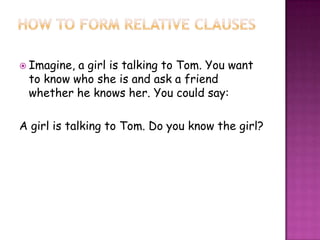
 Imagine,

a girl is talking to Tom. You want
to know who she is and ask a friend
whether he knows her. You could say:

A girl is talking to Tom. Do you know the girl?


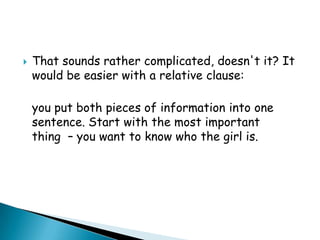
That sounds rather complicated, doesn't it? It
would be easier with a relative clause:
you put both pieces of information into one
sentence. Start with the most important
thing – you want to know who the girl is.
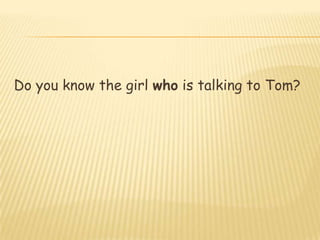
Do you know the girl who is talking to Tom?
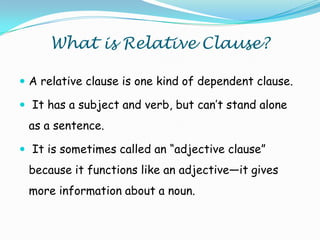
What is Relative Clause?
 A relative clause is one kind of dependent clause.
 It has a subject and verb, but can’t stand alone

as a sentence.
 It is sometimes called an ―adjective clause‖

because it functions like an adjective—it gives

more information about a noun.
Kinds of Relative Clause
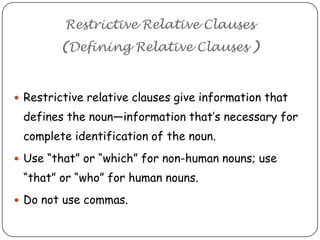
Restrictive Relative Clauses
(Defining Relative Clauses )

 Restrictive relative clauses give information that

defines the noun—information that’s necessary for
complete identification of the noun.
 Use ―that‖ or ―which‖ for non-human nouns; use

―that‖ or ―who‖ for human nouns.
 Do not use commas.
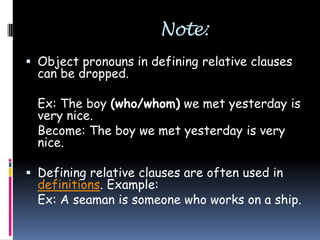
Note:
 Object pronouns in defining relative clauses

can be dropped.

Ex: The boy (who/whom) we met yesterday is
very nice.
Become: The boy we met yesterday is very
nice.
 Defining relative clauses are often used in
definitions. Example:
Ex: A seaman is someone who works on a ship.
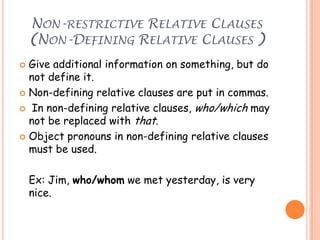
NON-RESTRICTIVE RELATIVE CLAUSES
(NON-DEFINING RELATIVE CLAUSES )
Give additional information on something, but do
not define it.
 Non-defining relative clauses are put in commas.
 In non-defining relative clauses, who/which may
not be replaced with that.
 Object pronouns in non-defining relative clauses
must be used.


Ex: Jim, who/whom we met yesterday, is very
nice.


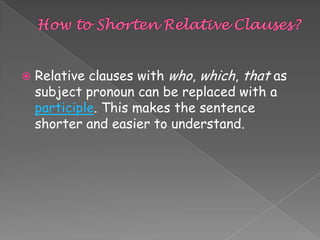
Relative clauses with who, which, that as
subject pronoun can be replaced with a
participle. This makes the sentence
shorter and easier to understand.
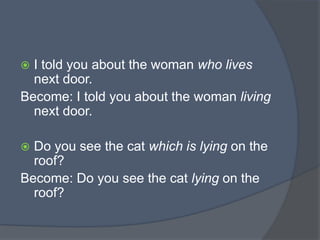
I told you about the woman who lives
next door.
Become: I told you about the woman living
next door.


Do you see the cat which is lying on the
roof?
Become: Do you see the cat lying on the
roof?

THANKYOU

Relative clause

  • 1.
  • 2.
     Imagine, a girlis talking to Tom. You want to know who she is and ask a friend whether he knows her. You could say: A girl is talking to Tom. Do you know the girl?
  • 3.
     That sounds rathercomplicated, doesn't it? It would be easier with a relative clause: you put both pieces of information into one sentence. Start with the most important thing – you want to know who the girl is.
  • 4.
    Do you knowthe girl who is talking to Tom?
  • 5.
    What is RelativeClause?  A relative clause is one kind of dependent clause.  It has a subject and verb, but can’t stand alone as a sentence.  It is sometimes called an ―adjective clause‖ because it functions like an adjective—it gives more information about a noun.
  • 6.
  • 7.
    Restrictive Relative Clauses (DefiningRelative Clauses )  Restrictive relative clauses give information that defines the noun—information that’s necessary for complete identification of the noun.  Use ―that‖ or ―which‖ for non-human nouns; use ―that‖ or ―who‖ for human nouns.  Do not use commas.
  • 8.
    Note:  Object pronounsin defining relative clauses can be dropped. Ex: The boy (who/whom) we met yesterday is very nice. Become: The boy we met yesterday is very nice.  Defining relative clauses are often used in definitions. Example: Ex: A seaman is someone who works on a ship.
  • 9.
    NON-RESTRICTIVE RELATIVE CLAUSES (NON-DEFININGRELATIVE CLAUSES ) Give additional information on something, but do not define it.  Non-defining relative clauses are put in commas.  In non-defining relative clauses, who/which may not be replaced with that.  Object pronouns in non-defining relative clauses must be used.  Ex: Jim, who/whom we met yesterday, is very nice.
  • 10.
     Relative clauses withwho, which, that as subject pronoun can be replaced with a participle. This makes the sentence shorter and easier to understand.
  • 11.
    I told youabout the woman who lives next door. Become: I told you about the woman living next door.  Do you see the cat which is lying on the roof? Become: Do you see the cat lying on the roof? 
  • 12.