Adverbs
Adverbs - are words that are used in 
sentences to describe or change the 
meaning of a Verb or Adjective or even 
another Adverb. They add description to 
the sentence to make it more detailed 
and interesting.
Examples: 
 He walked slowly across the square. 
Here, one can see that the Adverb ‘slowly’ 
is describing the Verb ‘walk’ by telling that 
the person was walking slowly.
Types 
of 
Adverbs
Adverb of Time
Adverb of Time 
Examples: 
 The results were announced yesterday. 
Here the Adverb is yesterday which is 
answering the question: When were the 
results announced? ‘Announced’ is the verb 
in this sentence.
Adverb of Time 
Examples: 
 She will visit the hospital tomorrow. 
Here the Verb is ‘visit’ and the Adverb is 
tomorrow as the question being asked is: 
When will she visit the hospital?
Other examples of Adverbs 
of Time are – Once, Never, 
Tomorrow, Daily etc.
Adverb of Place
Adverb of Place 
Examples: 
 They will meet you there. 
The Adverb here is there that is specifying 
a place for the Verb meet and the question 
being answered is: Where will they meet 
you?
Adverb of Place 
Examples: 
 In spring, flowers bloom everywhere. 
Here the Verb is bloom and the Adverb is 
everywhere, answering the question: 
Where do the flowers bloom in spring?
Other examples of Adverbs 
of Place are - Anywhere, 
Somewhere, Near, Far etc.
Adverb of Manner
Adverb of Manner 
Examples: 
 He quietly slipped away. 
The Adverb here is quietly which is telling 
the way or manner in which the action was 
carried out and the Verb is slipped which is 
telling: How did he slip away.
Adverb of Manner 
Examples: 
 She works fast. 
The Verb here is work and the Adverb is 
fast and the question being asked is: How 
does she work?
These Adverbs tell about the 
manner of the action being done, 
whether it is done happily or 
haltingly etc. Other examples of 
Adverbs of Manner are - Honestly, 
Joyfully, Cunningly etc.
Adverb 
of 
Frequency
Adverb of Frequency 
Examples: 
 He likes to watch TV everyday. 
Here, the Adverb is everyday and it is 
telling about the amount of time spent in 
doing the Verb, which is watch. The 
question in this sentence is: How often 
does he watch TV?
Adverb of Frequency 
Examples: 
 They meet every week. 
The Adverb here is every week and it is 
telling the frequency and the Verb is meet. 
The sentence is telling us: How often do 
they meet?
These Adverbs are used to show the 
duration or timing of the action that is 
happening/had happened/will happen. 
They also tell us how often and how 
long these actions would be. Other 
examples of Adverbs of Frequency are - 
Frequently, Often, Yearly, Briefly etc.
Adverbs of Degree
Adverb of Degree 
Examples: 
 She almost finished the work. 
The Verb here is finished and the Adverb is 
almost which is telling us about the 
amount of the work finished. The question 
being asked is: How much of the work did 
she finish?
Adverb of Degree 
Examples: 
 They were completely surprised by the 
windfall. 
The adverb here is completely which is 
showing the degree to which ‘they’ were 
surprised which is the Verb. The question 
being asked here is: How much were they 
surprised?
The Adverbs of Degree are used to show 
to what extent or how much has an 
action been done or will be done. Other 
examples of these Adverbs are - Fully, 
Partially, Altogether etc.
Adverbs of 
Confirmation and 
Negation
Adverb of Confirmation and Negation 
Examples: 
 They will certainly like this vase. 
The Adverb here is certainly which is 
reinforcing the Verb like in answer to the 
question:Will they like this vase?
Adverb of Confirmation and Negation 
Examples: 
 He never leaves his house. 
The Adverb never is negating the Verb 
leave. It is answering the question in 
denial: Does he ever leave his house?
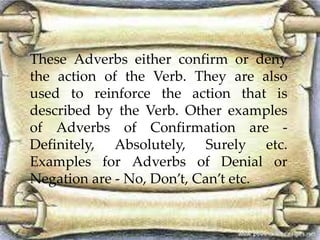
These Adverbs either confirm or deny 
the action of the Verb. They are also 
used to reinforce the action that is 
described by the Verb. Other examples 
of Adverbs of Confirmation are - 
Definitely, Absolutely, Surely etc. 
Examples for Adverbs of Denial or 
Negation are - No, Don’t, Can’t etc.
Adverbs 
of 
Comment
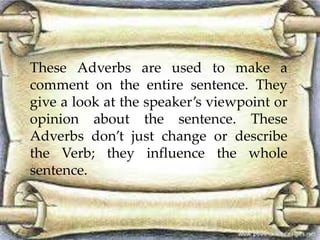
These Adverbs are used to make a 
comment on the entire sentence. They 
give a look at the speaker’s viewpoint or 
opinion about the sentence. These 
Adverbs don’t just change or describe 
the Verb; they influence the whole 
sentence.
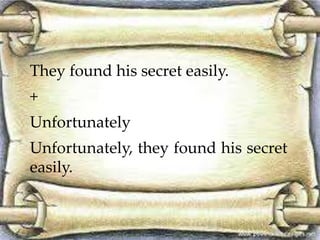
They found his secret easily. 
+ 
Unfortunately 
Unfortunately, they found his secret 
easily.
Here, we see that adding the Adverb 
unfortunately has changed the entire 
tone of the sentence. Earlier, it was a 
passive tone, now it has a negative or 
disappointed tone.
Other examples of Adverbs of Comment are - 
Luckily, the dog did not bite the 
children. 
Happily, the power returned before the 
big match.
Other examples of Adverbs of Comment are - 
Did he honestly expect me to lie for 
him? (Adverb adds comment on the anger of 
the speaker.) 
And they would win the world cup, 
obviously. (Can be said in a sarcastic as well 
as positive manner)
Adverbs 
of 
Conjunction
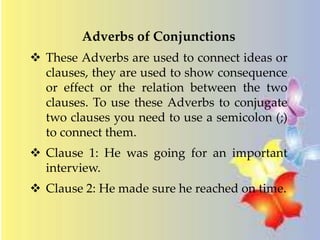
Adverbs of Conjunctions 
 These Adverbs are used to connect ideas or 
clauses, they are used to show consequence 
or effect or the relation between the two 
clauses. To use these Adverbs to conjugate 
two clauses you need to use a semicolon (;) 
to connect them. 
 Clause 1: He was going for an important 
interview. 
 Clause 2: He made sure he reached on time.
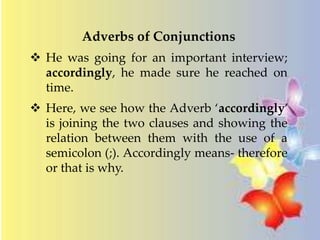
Adverbs of Conjunctions 
 He was going for an important interview; 
accordingly, he made sure he reached on 
time. 
 Here, we see how the Adverb ‘accordingly’ 
is joining the two clauses and showing the 
relation between them with the use of a 
semicolon (;). Accordingly means- therefore 
or that is why.
Adverbs of Conjunctions 
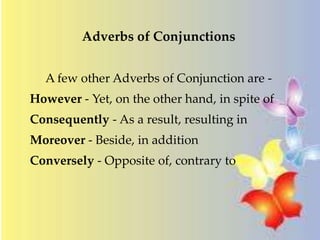
A few other Adverbs of Conjunction are - 
However - Yet, on the other hand, in spite of 
Consequently - As a result, resulting in 
Moreover - Beside, in addition 
Conversely - Opposite of, contrary to
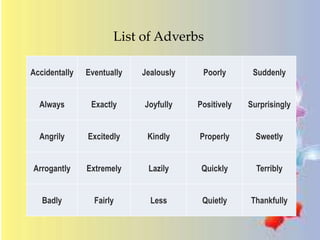
List of Adverbs 
Accidentally Eventually Jealously Poorly Suddenly 
Always Exactly Joyfully Positively Surprisingly 
Angrily Excitedly Kindly Properly Sweetly 
Arrogantly Extremely Lazily Quickly Terribly 
Badly Fairly Less Quietly Thankfully
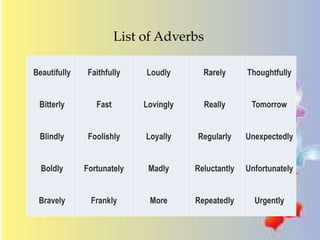
List of Adverbs 
Beautifully Faithfully Loudly Rarely Thoughtfully 
Bitterly Fast Lovingly Really Tomorrow 
Blindly Foolishly Loyally Regularly Unexpectedly 
Boldly Fortunately Madly Reluctantly Unfortunately 
Bravely Frankly More Repeatedly Urgently
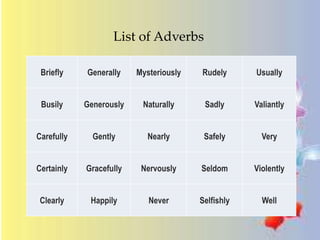
List of Adverbs 
Briefly Generally Mysteriously Rudely Usually 
Busily Generously Naturally Sadly Valiantly 
Carefully Gently Nearly Safely Very 
Certainly Gracefully Nervously Seldom Violently 
Clearly Happily Never Selfishly Well
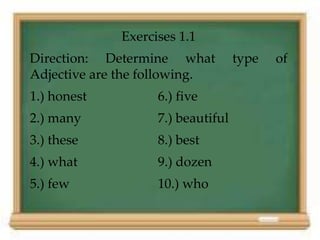
Exercises 1.1 
Direction: Determine what type of 
Adjective are the following. 
1.) honest 6.) five 
2.) many 7.) beautiful 
3.) these 8.) best 
4.) what 9.) dozen 
5.) few 10.) who
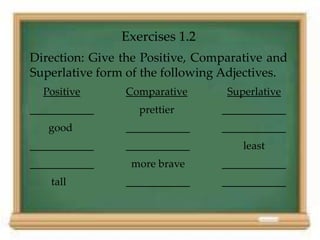
Exercises 1.2 
Direction: Give the Positive, Comparative and 
Superlative form of the following Adjectives. 
Positive Comparative Superlative 
prettier 
good 
least 
more brave 
tall
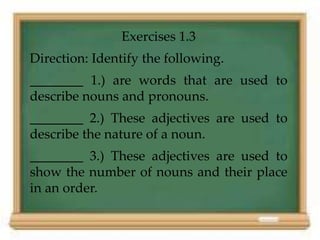
Exercises 1.3 
Direction: Identify the following. 
________ 1.) are words that are used to 
describe nouns and pronouns. 
________ 2.) These adjectives are used to 
describe the nature of a noun. 
________ 3.) These adjectives are used to 
show the number of nouns and their place 
in an order.
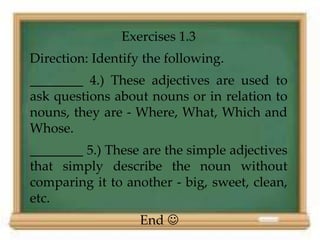
Exercises 1.3 
Direction: Identify the following. 
________ 4.) These adjectives are used to 
ask questions about nouns or in relation to 
nouns, they are - Where, What, Which and 
Whose. 
________ 5.) These are the simple adjectives 
that simply describe the noun without 
comparing it to another - big, sweet, clean, 
etc. 
End 

Adverbs

  • 1.
  • 2.
    Adverbs - arewords that are used in sentences to describe or change the meaning of a Verb or Adjective or even another Adverb. They add description to the sentence to make it more detailed and interesting.
  • 3.
    Examples:  Hewalked slowly across the square. Here, one can see that the Adverb ‘slowly’ is describing the Verb ‘walk’ by telling that the person was walking slowly.
  • 4.
  • 5.
  • 6.
    Adverb of Time Examples:  The results were announced yesterday. Here the Adverb is yesterday which is answering the question: When were the results announced? ‘Announced’ is the verb in this sentence.
  • 7.
    Adverb of Time Examples:  She will visit the hospital tomorrow. Here the Verb is ‘visit’ and the Adverb is tomorrow as the question being asked is: When will she visit the hospital?
  • 8.
    Other examples ofAdverbs of Time are – Once, Never, Tomorrow, Daily etc.
  • 9.
  • 10.
    Adverb of Place Examples:  They will meet you there. The Adverb here is there that is specifying a place for the Verb meet and the question being answered is: Where will they meet you?
  • 11.
    Adverb of Place Examples:  In spring, flowers bloom everywhere. Here the Verb is bloom and the Adverb is everywhere, answering the question: Where do the flowers bloom in spring?
  • 12.
    Other examples ofAdverbs of Place are - Anywhere, Somewhere, Near, Far etc.
  • 13.
  • 14.
    Adverb of Manner Examples:  He quietly slipped away. The Adverb here is quietly which is telling the way or manner in which the action was carried out and the Verb is slipped which is telling: How did he slip away.
  • 15.
    Adverb of Manner Examples:  She works fast. The Verb here is work and the Adverb is fast and the question being asked is: How does she work?
  • 16.
    These Adverbs tellabout the manner of the action being done, whether it is done happily or haltingly etc. Other examples of Adverbs of Manner are - Honestly, Joyfully, Cunningly etc.
  • 17.
  • 18.
    Adverb of Frequency Examples:  He likes to watch TV everyday. Here, the Adverb is everyday and it is telling about the amount of time spent in doing the Verb, which is watch. The question in this sentence is: How often does he watch TV?
  • 19.
    Adverb of Frequency Examples:  They meet every week. The Adverb here is every week and it is telling the frequency and the Verb is meet. The sentence is telling us: How often do they meet?
  • 20.
    These Adverbs areused to show the duration or timing of the action that is happening/had happened/will happen. They also tell us how often and how long these actions would be. Other examples of Adverbs of Frequency are - Frequently, Often, Yearly, Briefly etc.
  • 21.
  • 22.
    Adverb of Degree Examples:  She almost finished the work. The Verb here is finished and the Adverb is almost which is telling us about the amount of the work finished. The question being asked is: How much of the work did she finish?
  • 23.
    Adverb of Degree Examples:  They were completely surprised by the windfall. The adverb here is completely which is showing the degree to which ‘they’ were surprised which is the Verb. The question being asked here is: How much were they surprised?
  • 24.
    The Adverbs ofDegree are used to show to what extent or how much has an action been done or will be done. Other examples of these Adverbs are - Fully, Partially, Altogether etc.
  • 25.
  • 26.
    Adverb of Confirmationand Negation Examples:  They will certainly like this vase. The Adverb here is certainly which is reinforcing the Verb like in answer to the question:Will they like this vase?
  • 27.
    Adverb of Confirmationand Negation Examples:  He never leaves his house. The Adverb never is negating the Verb leave. It is answering the question in denial: Does he ever leave his house?
  • 28.
    These Adverbs eitherconfirm or deny the action of the Verb. They are also used to reinforce the action that is described by the Verb. Other examples of Adverbs of Confirmation are - Definitely, Absolutely, Surely etc. Examples for Adverbs of Denial or Negation are - No, Don’t, Can’t etc.
  • 29.
  • 30.
    These Adverbs areused to make a comment on the entire sentence. They give a look at the speaker’s viewpoint or opinion about the sentence. These Adverbs don’t just change or describe the Verb; they influence the whole sentence.
  • 31.
    They found hissecret easily. + Unfortunately Unfortunately, they found his secret easily.
  • 32.
    Here, we seethat adding the Adverb unfortunately has changed the entire tone of the sentence. Earlier, it was a passive tone, now it has a negative or disappointed tone.
  • 33.
    Other examples ofAdverbs of Comment are - Luckily, the dog did not bite the children. Happily, the power returned before the big match.
  • 34.
    Other examples ofAdverbs of Comment are - Did he honestly expect me to lie for him? (Adverb adds comment on the anger of the speaker.) And they would win the world cup, obviously. (Can be said in a sarcastic as well as positive manner)
  • 35.
  • 36.
    Adverbs of Conjunctions  These Adverbs are used to connect ideas or clauses, they are used to show consequence or effect or the relation between the two clauses. To use these Adverbs to conjugate two clauses you need to use a semicolon (;) to connect them.  Clause 1: He was going for an important interview.  Clause 2: He made sure he reached on time.
  • 37.
    Adverbs of Conjunctions  He was going for an important interview; accordingly, he made sure he reached on time.  Here, we see how the Adverb ‘accordingly’ is joining the two clauses and showing the relation between them with the use of a semicolon (;). Accordingly means- therefore or that is why.
  • 38.
    Adverbs of Conjunctions A few other Adverbs of Conjunction are - However - Yet, on the other hand, in spite of Consequently - As a result, resulting in Moreover - Beside, in addition Conversely - Opposite of, contrary to
  • 39.
    List of Adverbs Accidentally Eventually Jealously Poorly Suddenly Always Exactly Joyfully Positively Surprisingly Angrily Excitedly Kindly Properly Sweetly Arrogantly Extremely Lazily Quickly Terribly Badly Fairly Less Quietly Thankfully
  • 40.
    List of Adverbs Beautifully Faithfully Loudly Rarely Thoughtfully Bitterly Fast Lovingly Really Tomorrow Blindly Foolishly Loyally Regularly Unexpectedly Boldly Fortunately Madly Reluctantly Unfortunately Bravely Frankly More Repeatedly Urgently
  • 41.
    List of Adverbs Briefly Generally Mysteriously Rudely Usually Busily Generously Naturally Sadly Valiantly Carefully Gently Nearly Safely Very Certainly Gracefully Nervously Seldom Violently Clearly Happily Never Selfishly Well
  • 42.
    Exercises 1.1 Direction:Determine what type of Adjective are the following. 1.) honest 6.) five 2.) many 7.) beautiful 3.) these 8.) best 4.) what 9.) dozen 5.) few 10.) who
  • 43.
    Exercises 1.2 Direction:Give the Positive, Comparative and Superlative form of the following Adjectives. Positive Comparative Superlative prettier good least more brave tall
  • 44.
    Exercises 1.3 Direction:Identify the following. ________ 1.) are words that are used to describe nouns and pronouns. ________ 2.) These adjectives are used to describe the nature of a noun. ________ 3.) These adjectives are used to show the number of nouns and their place in an order.
  • 45.
    Exercises 1.3 Direction:Identify the following. ________ 4.) These adjectives are used to ask questions about nouns or in relation to nouns, they are - Where, What, Which and Whose. ________ 5.) These are the simple adjectives that simply describe the noun without comparing it to another - big, sweet, clean, etc. End 