DEFINING RELATIVE CLAUSES


  www.slideshare.net/pietvanderlaan/defrelclauses? ADAPTED
Defining Relative Clauses

 DEFINING RELATIVE CLAUSES give info
 to help identify the person/thing you are
 talking about.

• The man who you met yesterday was my
  brother.
• The car which crashed into me belonged
  to Paul.
Use THAT or WHO when
    talking about people.


• He was the man that bought my
  house.
• You are the only person here who
  knows me.
Use THAT or WHICH
when talking about things.

• There was ice cream that Mum
  had made herself.
• I will tell you the first thing which I
  can remember.
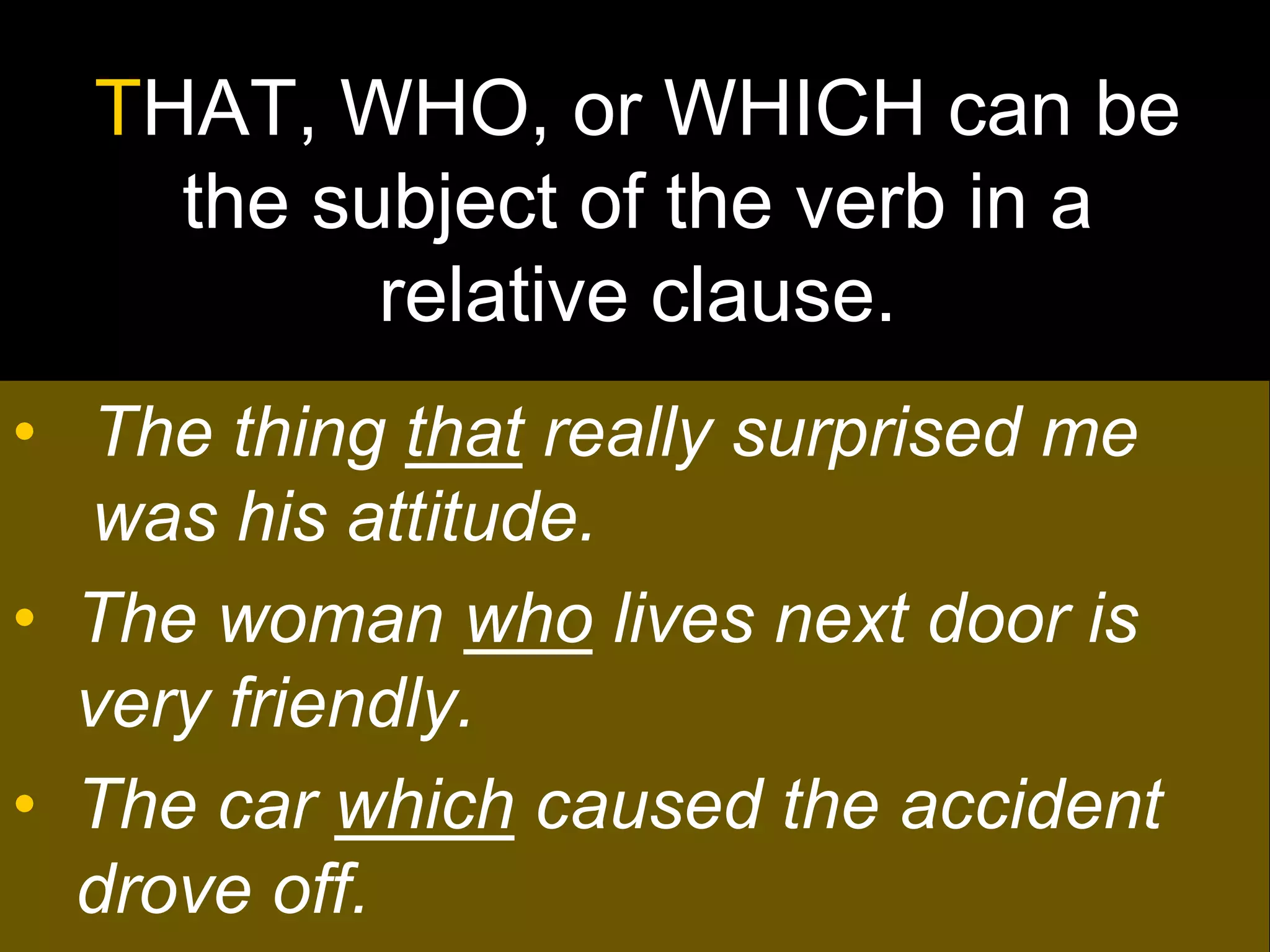
THAT, WHO, or WHICH can be
    the subject of the verb in a
          relative clause.
• The thing that really surprised me
  was his attitude.
• The woman who lives next door is
  very friendly.
• The car which caused the accident
  drove off.
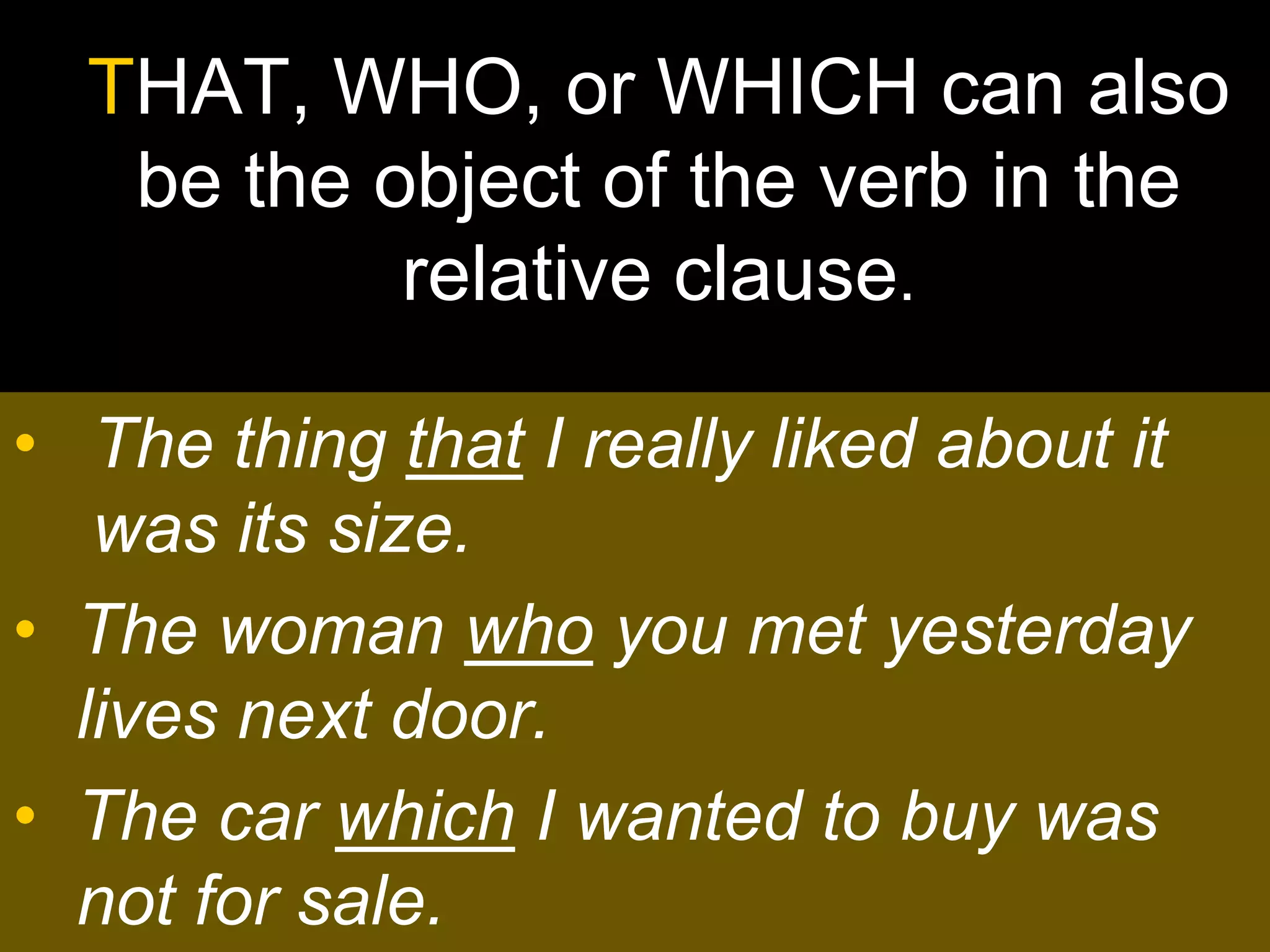
THAT, WHO, or WHICH can also
   be the object of the verb in the
           relative clause.

• The thing that I really liked about it
   was its size.
• The woman who you met yesterday
  lives next door.
• The car which I wanted to buy was
  not for sale.
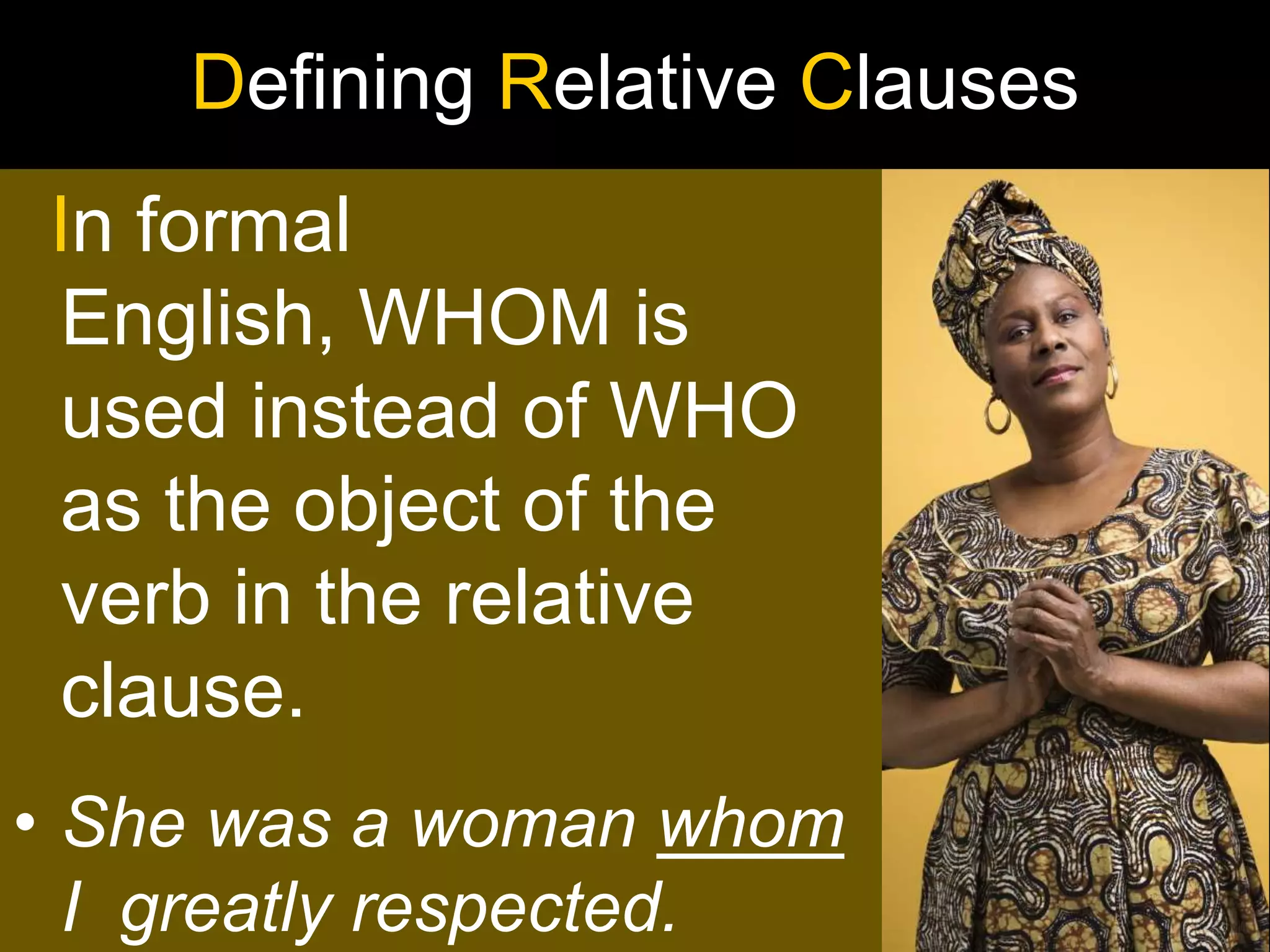
Defining Relative Clauses
In formal
English, WHOM is
used instead of WHO
as the object of the
verb in the relative
clause.
• She was a woman whom
  I greatly respected.
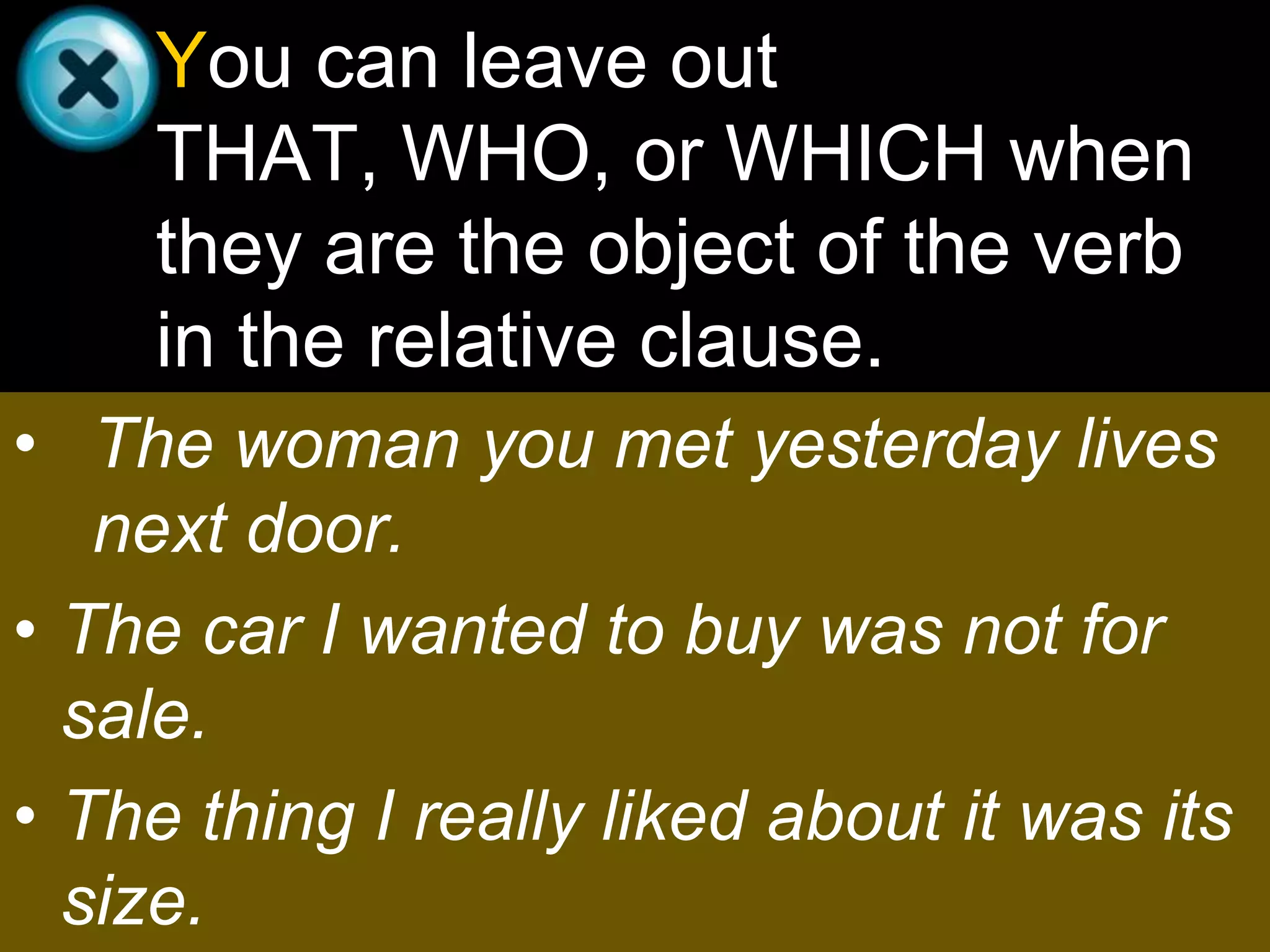
You can leave out
     THAT, WHO, or WHICH when
     they are the object of the verb
     in the relative clause.
• The woman you met yesterday lives
   next door.
• The car I wanted to buy was not for
  sale.
• The thing I really liked about it was its
  size.
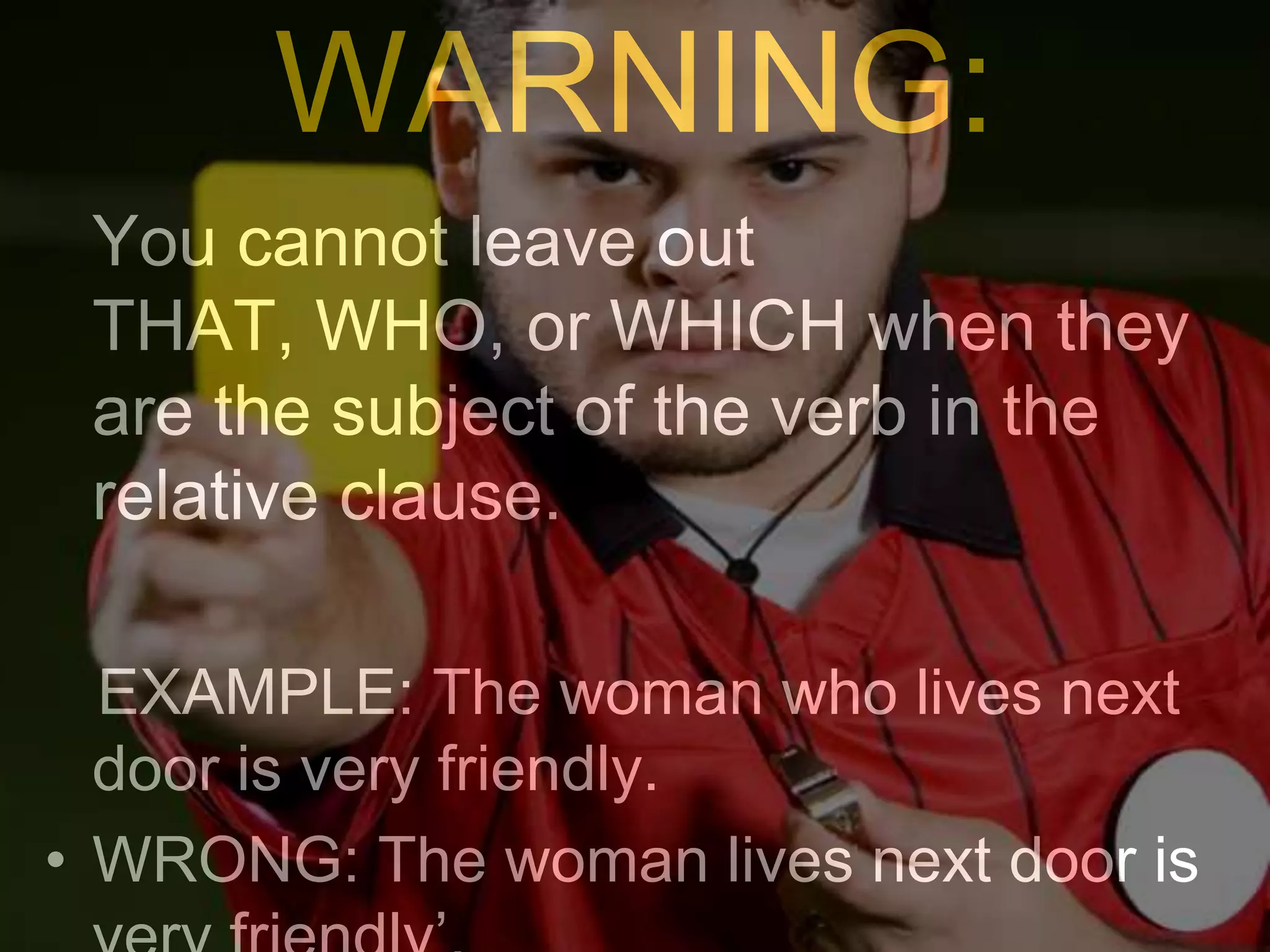
WARNING:
 You cannot leave out
 THAT, WHO, or WHICH when they
 are the subject of the verb in the
 relative clause.

  EXAMPLE: The woman who lives next
  door is very friendly.
• WRONG: The woman lives next door is
THE relative pronoun in a relative
      clause can be the object of a
               preposition.
The preposition usually goes at the
end of the clause.

• I wanted to do the job which I’d been
  training for.
• The house that we lived in was huge.
You can often omit a relative
     pronoun that is the object of a
             preposition.


• Angela was the only person I could talk to.
• She’s the girl I sang the song for.
The preposition always goes in front
  of WHOM and in front of WHICH in
           formal English.

• These are the people to whom Catherine
  was referring.
• He was asking questions to which there
  were no answers.
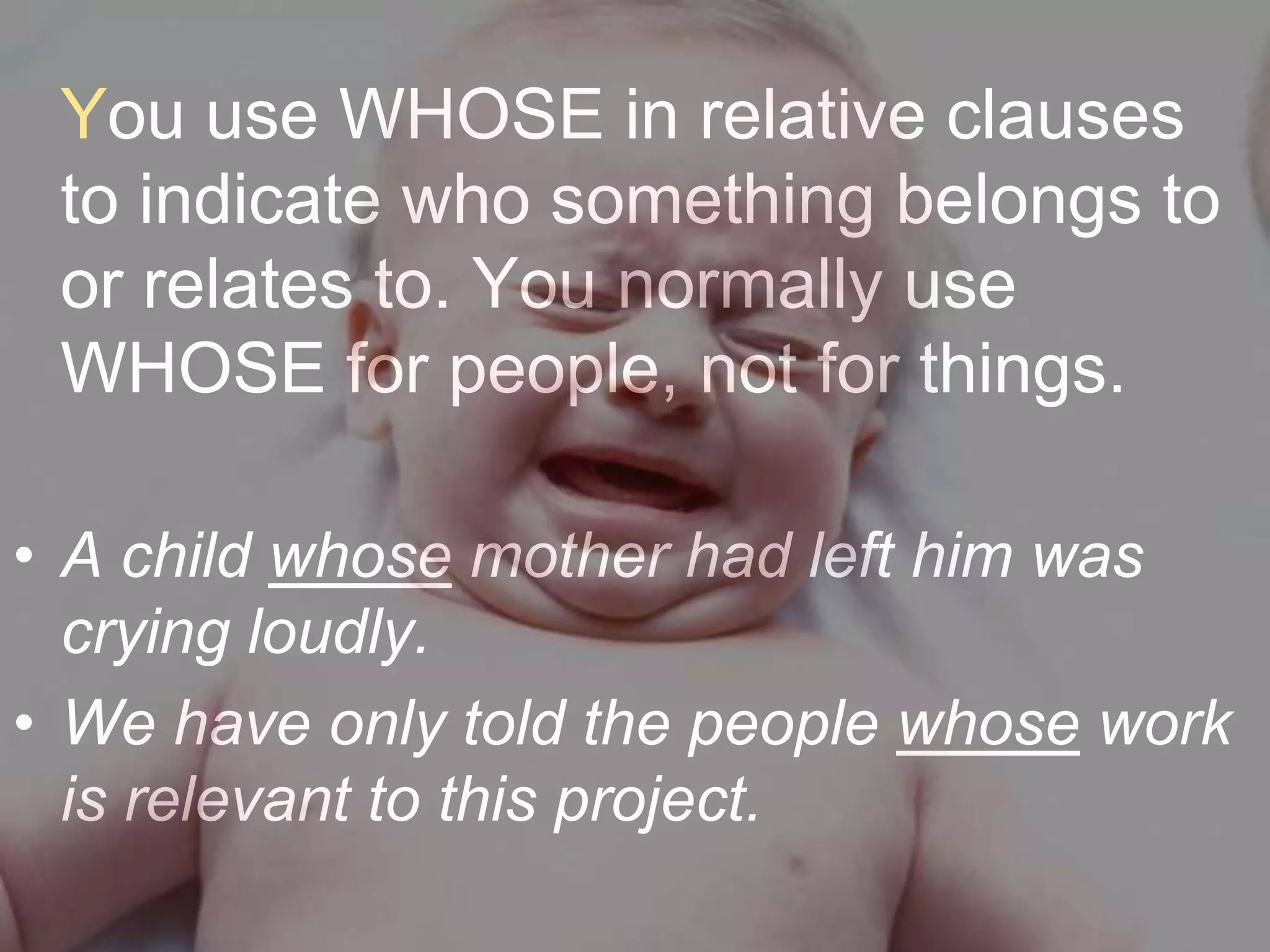
You use WHOSE in relative clauses
 to indicate who something belongs to
 or relates to. You normally use
 WHOSE for people, not for things.

• A child whose mother had left him was
  crying loudly.
• We have only told the people whose work
  is relevant to this project.
Defining Relative Clauses
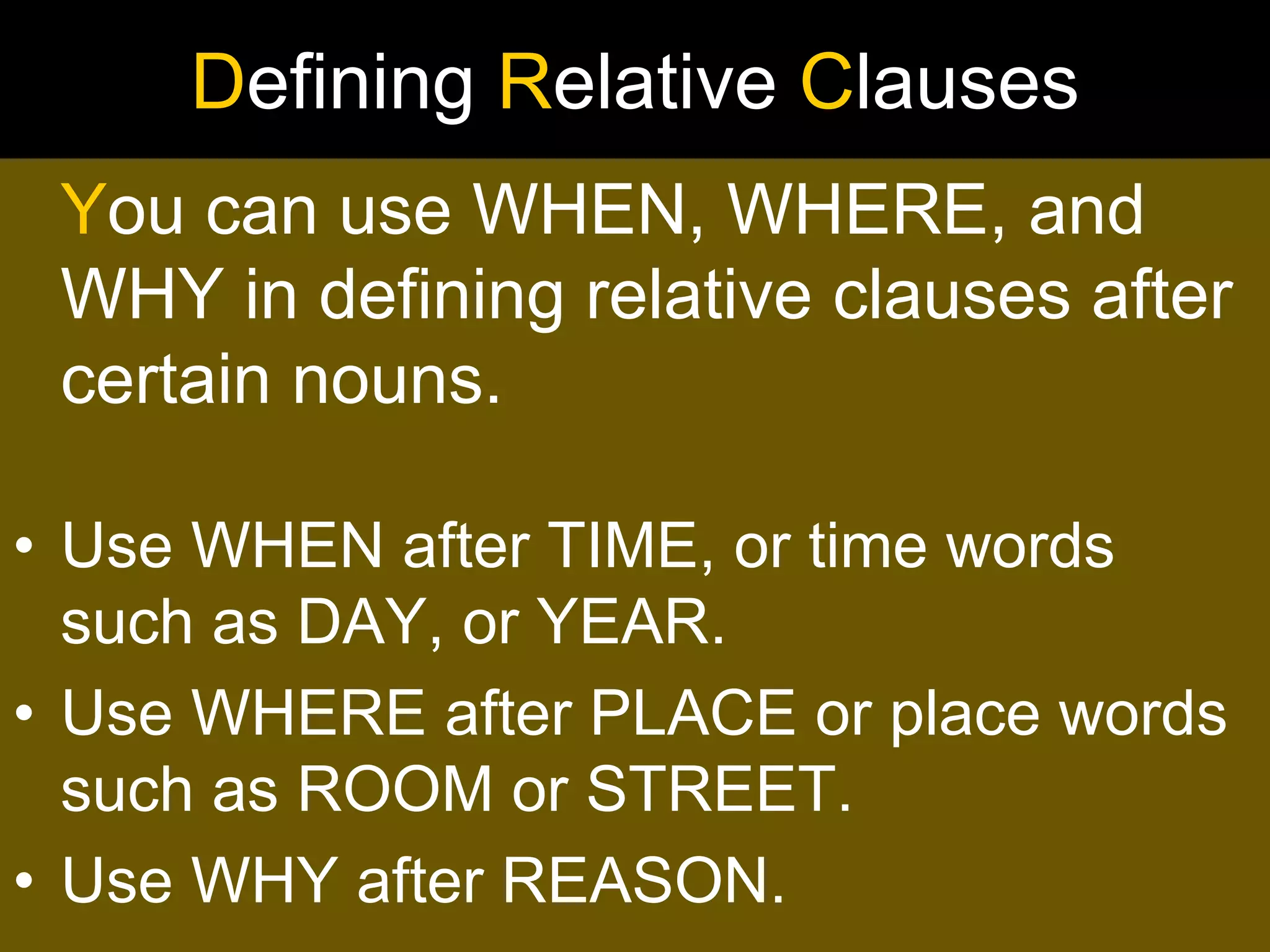
 You can use WHEN, WHERE, and
 WHY in defining relative clauses after
 certain nouns.

• Use WHEN after TIME, or time words
  such as DAY, or YEAR.
• Use WHERE after PLACE or place words
  such as ROOM or STREET.
• Use WHY after REASON.
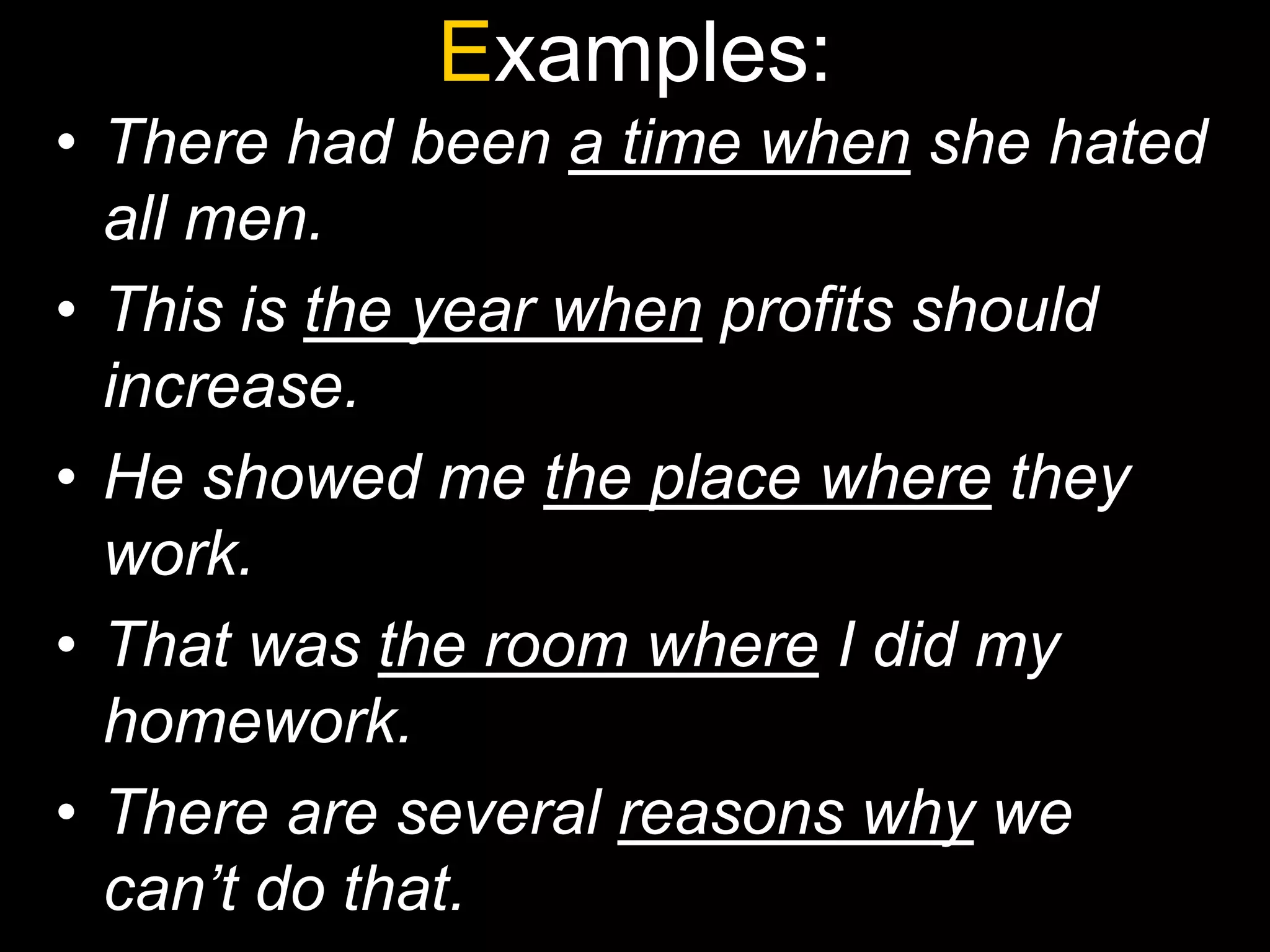
Examples:
• There had been a time when she hated
  all men.
• This is the year when profits should
  increase.
• He showed me the place where they
  work.
• That was the room where I did my
  homework.
• There are several reasons why we
  can’t do that.
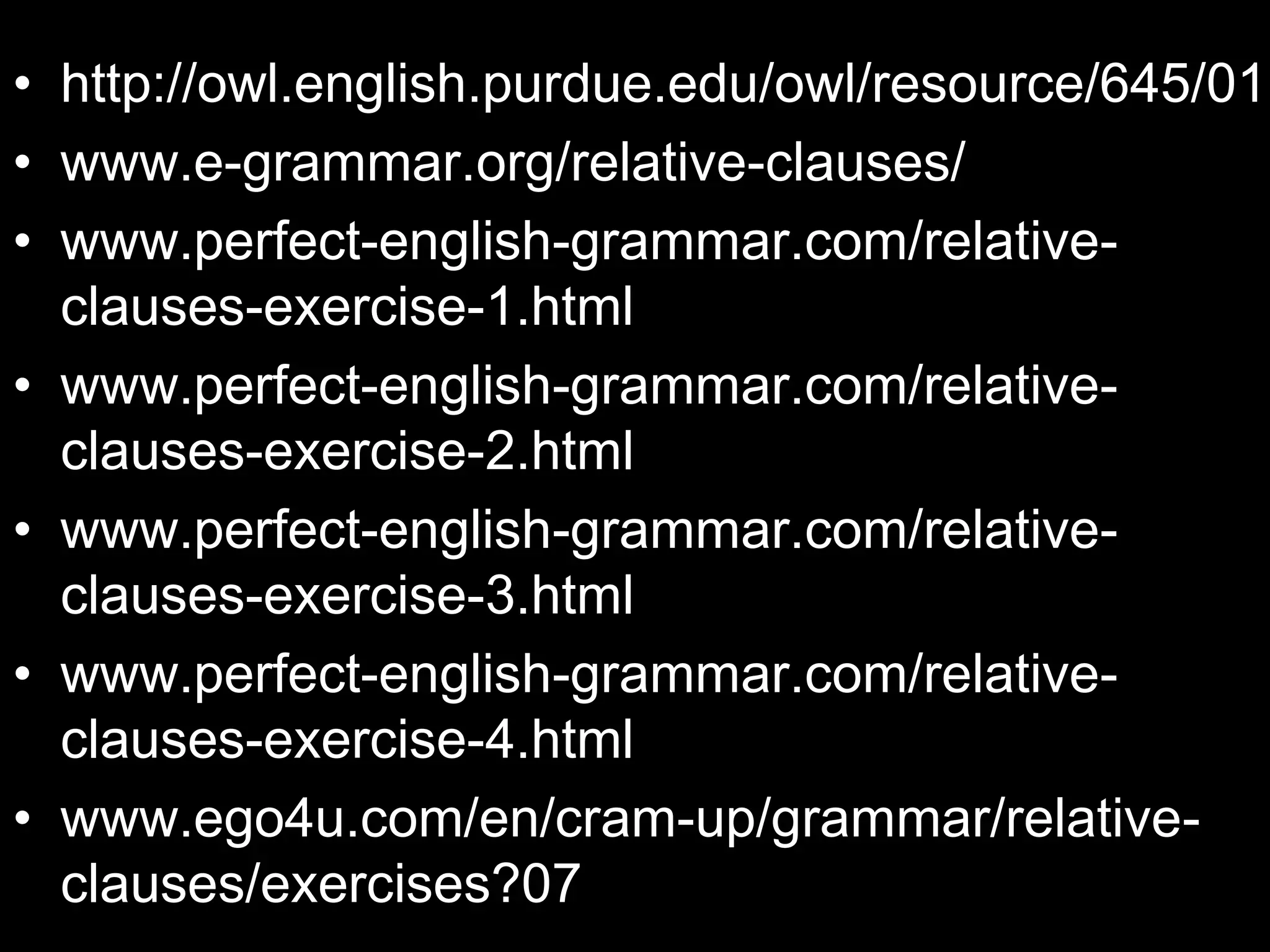
• http://owl.english.purdue.edu/owl/resource/645/01
• www.e-grammar.org/relative-clauses/
• www.perfect-english-grammar.com/relative-
  clauses-exercise-1.html
• www.perfect-english-grammar.com/relative-
  clauses-exercise-2.html
• www.perfect-english-grammar.com/relative-
  clauses-exercise-3.html
• www.perfect-english-grammar.com/relative-
  clauses-exercise-4.html
• www.ego4u.com/en/cram-up/grammar/relative-
  clauses/exercises?07
Questions?
For more slide presentations visit:

Defining relative clauses

  • 1.
    DEFINING RELATIVE CLAUSES www.slideshare.net/pietvanderlaan/defrelclauses? ADAPTED
  • 2.
    Defining Relative Clauses DEFINING RELATIVE CLAUSES give info to help identify the person/thing you are talking about. • The man who you met yesterday was my brother. • The car which crashed into me belonged to Paul.
  • 3.
    Use THAT orWHO when talking about people. • He was the man that bought my house. • You are the only person here who knows me.
  • 4.
    Use THAT orWHICH when talking about things. • There was ice cream that Mum had made herself. • I will tell you the first thing which I can remember.
  • 5.
    THAT, WHO, orWHICH can be the subject of the verb in a relative clause. • The thing that really surprised me was his attitude. • The woman who lives next door is very friendly. • The car which caused the accident drove off.
  • 6.
    THAT, WHO, orWHICH can also be the object of the verb in the relative clause. • The thing that I really liked about it was its size. • The woman who you met yesterday lives next door. • The car which I wanted to buy was not for sale.
  • 7.
    Defining Relative Clauses Informal English, WHOM is used instead of WHO as the object of the verb in the relative clause. • She was a woman whom I greatly respected.
  • 8.
    You can leaveout THAT, WHO, or WHICH when they are the object of the verb in the relative clause. • The woman you met yesterday lives next door. • The car I wanted to buy was not for sale. • The thing I really liked about it was its size.
  • 9.
    WARNING: You cannotleave out THAT, WHO, or WHICH when they are the subject of the verb in the relative clause. EXAMPLE: The woman who lives next door is very friendly. • WRONG: The woman lives next door is
  • 10.
    THE relative pronounin a relative clause can be the object of a preposition. The preposition usually goes at the end of the clause. • I wanted to do the job which I’d been training for. • The house that we lived in was huge.
  • 11.
    You can oftenomit a relative pronoun that is the object of a preposition. • Angela was the only person I could talk to. • She’s the girl I sang the song for.
  • 12.
    The preposition alwaysgoes in front of WHOM and in front of WHICH in formal English. • These are the people to whom Catherine was referring. • He was asking questions to which there were no answers.
  • 13.
    You use WHOSEin relative clauses to indicate who something belongs to or relates to. You normally use WHOSE for people, not for things. • A child whose mother had left him was crying loudly. • We have only told the people whose work is relevant to this project.
  • 14.
    Defining Relative Clauses You can use WHEN, WHERE, and WHY in defining relative clauses after certain nouns. • Use WHEN after TIME, or time words such as DAY, or YEAR. • Use WHERE after PLACE or place words such as ROOM or STREET. • Use WHY after REASON.
  • 15.
    Examples: • There hadbeen a time when she hated all men. • This is the year when profits should increase. • He showed me the place where they work. • That was the room where I did my homework. • There are several reasons why we can’t do that.
  • 16.
    • http://owl.english.purdue.edu/owl/resource/645/01 • www.e-grammar.org/relative-clauses/ •www.perfect-english-grammar.com/relative- clauses-exercise-1.html • www.perfect-english-grammar.com/relative- clauses-exercise-2.html • www.perfect-english-grammar.com/relative- clauses-exercise-3.html • www.perfect-english-grammar.com/relative- clauses-exercise-4.html • www.ego4u.com/en/cram-up/grammar/relative- clauses/exercises?07
  • 17.
    Questions? For more slidepresentations visit:

Editor's Notes

  • #17 1. She worked for a man who used to be an athlete 2.