Mark Anthony G. Arrieta BSEd – Math – 4 Math 116A
Mr. Allen C. Barbaso Presentation 1
CHAPTER 2 Whole Numbers: Introducing a Mathematical System
2.3 Algebraic Extensions of Order of Operations to Polynomials
Introduction:
 A student will be asked to lead a prayer.
 Recall the previous topic being discussed by asking a student.
 Introduce the purpose of studying the lesson.
 Ask the students about their idea on the new topic being presented.
Purpose:
1.) Introduce algebraic expressions and their meaning.
2.) Evaluate algebraic expressions.
3.) Introduce polynomials.
4.) Learn the vocabulary of polynomials.
Investigation:
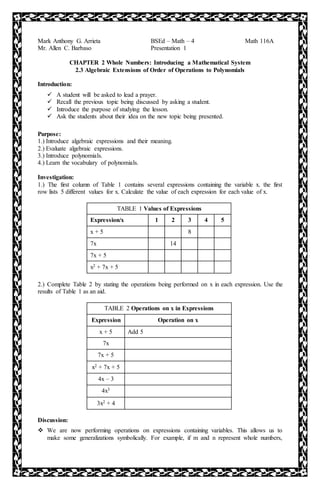
1.) The first column of Table 1 contains several expressions containing the variable x. the first
row lists 5 different values for x. Calculate the value of each expression for each value of x.
TABLE 1 Values of Expressions
Expression/x 1 2 3 4 5
x + 5 8
7x 14
7x + 5
x2 + 7x + 5
2.) Complete Table 2 by stating the operations being performed on x in each expression. Use the
results of Table 1 as an aid.
TABLE 2 Operations on x in Expressions
Expression Operation on x
x + 5 Add 5
7x
7x + 5
x2 + 7x + 5
4x – 3
4x3
3x2 + 4
Discussion:
 We are now performing operations on expressions containing variables. This allows us to
make some generalizations symbolically. For example, if m and n represent whole numbers,
we represent their sum by m + n, we represent the difference between m and n by the
expression m – n.
Points to Ponder:
 The factors of an expression are the quantities (numbers of algebraic expressions) that are
multiplied to obtain the expression.
 The input is the number we chose to substitute (1, 2, 3, 4, or 5).
 The process is defined by the operations on the variable in the expression.
 The output is the value of the expression after the number is substituted for the variable.
 We are evaluating an expression when we substitute a number for the variable and obtain
an output.
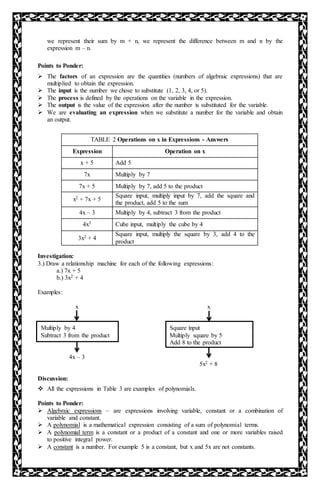
TABLE 2 Operations on x in Expressions - Answers
Expression Operation on x
x + 5 Add 5
7x Multiply by 7
7x + 5 Multiply by 7, add 5 to the product
x2 + 7x + 5
Square input, multiply input by 7, add the square and
the product, add 5 to the sum
4x – 3 Multiply by 4, subtract 3 from the product
4x3 Cube input, multiply the cube by 4
3x2 + 4
Square input, multiply the square by 3, add 4 to the
product
Investigation:
3.) Draw a relationship machine for each of the following expressions:
a.) 7x + 5
b.) 3x2 + 4
Examples:
x x
Multiply by 4 Square input
Subtract 3 from the product Multiply square by 5
Add 8 to the product
4x – 3
5x2 + 8
Discussion:
 All the expressions in Table 3 are examples of polynomials.
Points to Ponder:
 Algebraic expressions – are expressions involving variable, constant or a combination of
variable and constant.
 A polynomial is a mathematical expression consisting of a sum of polynomial terms.
 A polynomial term is a constant or a product of a constant and one or more variables raised
to positive integral power.
 A constant is a number. For example 5 is a constant, but x and 5x are not constants.
 A monomial is a polynomial with exactly one term.
 A binomial is a polynomial with exactly two terms.
 A trinomial is a polynomial with exactly three terms.
 A numerical coefficient of a term is the constant factor of the term.
 A constant term in a polynomial is the term that contains no variables. If there is no such
term, then the constant term is 0.
 A linear polynomial with only one variable is a polynomial in which the highest power on the
variable is one. The one is often implied than written.
 A quadratic polynomial with only one variable is a polynomial in which the highest power on
the variable is two.
 The degree of the polynomial with only one variable is the highest power on the variable.
 Linear polynomials have a degree of 1.
 Quadratic polynomials have a degree of 2.
Investigation:
4.) Some calculators, such as the TI-89, are capable of doing operations on polynomials. By
looking at the calculator results we may be able to discover how the operation is being done.
F1
Tools
F2
Algebra
F3
Calc
F4
Other
F5
PrgmIO
F6
Clean Up
3 • x + 5 • x 8 • x
x + 3 + 4 • x 5 • x + 3
3 • x + 2 + 5 • x + 7 8 • x + 9
3 • x2 + 2 • x + 7 + x2 + 3 • x + 2 4 • x2 + 5 • x + 9
MAIN RAD AUTO 3D
5.) Study the results of the previous investigation. Add the following polynomials.
a.) (x + 7) + 12x
b.) (2x + 3) + (4x + 7)
c.) (x2 + 3x + 5) + (4x2 + x + 2)
d.) (2x2 + 4x + 1) + (3x + 5)
Discussion:
 Addition of polynomials is similar to adding whole numbers in expanded notation as shown
below.
241 + 35 = (2 (100) + 4 (10) + 1 (1)) + (3 (10) + 5 (1))
241 + 35 = (2 (102) + 4 (101) + 1 (1)) + (3 (101) + 5 (1))
241 + 35 = 2 (102) + 4 (101) + 3 (101) + 1 (1) + 5 (1)
241 + 35 = 2 (102) + 7 (101) + 6 (1)
 The whole number 241 in expanded notation is 2 (102) + 4 (10) + 1, which has the same
structure as 2x2 + 4x + 1 (the x has replaced the 10).
 The whole number 35 in expanded notation is 3 (10) + 5, which has the same structure as 3x
+ 5.
 To add 241 and 35, we add the 102 terms together, the 10 terms together, and the unit terms
together.
 Similarly, to add 2x2 + 4x + 1 and 3x + 5, we add the
o x2 terms: 2x2 (there’s only one such term)
o x terms : 4x + 3x = 7x
o constant terms : 1 + 5 = 6
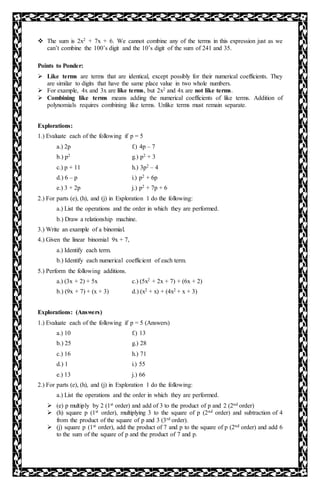
 The sum is 2x2 + 7x + 6. We cannot combine any of the terms in this expression just as we
can’t combine the 100’s digit and the 10’s digit of the sum of 241 and 35.
Points to Ponder:
 Like terms are terms that are identical, except possibly for their numerical coefficients. They
are similar to digits that have the same place value in two whole numbers.
 For example, 4x and 3x are like terms, but 2x2 and 4x are not like terms.
 Combining like terms means adding the numerical coefficients of like terms. Addition of
polynomials requires combining like terms. Unlike terms must remain separate.
Explorations:
1.) Evaluate each of the following if p = 5
a.) 2p f.) 4p – 7
b.) p2 g.) p2 + 3
c.) p + 11 h.) 3p2 – 4
d.) 6 – p i.) p2 + 6p
e.) 3 + 2p j.) p2 + 7p + 6
2.) For parts (e), (h), and (j) in Exploration 1 do the following:
a.) List the operations and the order in which they are performed.
b.) Draw a relationship machine.
3.) Write an example of a binomial.
4.) Given the linear binomial 9x + 7,
a.) Identify each term.
b.) Identify each numerical coefficient of each term.
5.) Perform the following additions.
a.) (3x + 2) + 5x c.) (5x2 + 2x + 7) + (6x + 2)
b.) (9x + 7) + (x + 3) d.) (x2 + x) + (4x2 + x + 3)
Explorations: (Answers)
1.) Evaluate each of the following if p = 5 (Answers)
a.) 10 f.) 13
b.) 25 g.) 28
c.) 16 h.) 71
d.) 1 i.) 55
e.) 13 j.) 66
2.) For parts (e), (h), and (j) in Exploration 1 do the following:
a.) List the operations and the order in which they are performed.
 (e) p multiply by 2 (1st order) and add of 3 to the product of p and 2 (2nd order)
 (h) square p (1st order), multiplying 3 to the square of p (2nd order) and subtraction of 4
from the product of the square of p and 3 (3rd order).
 (j) square p (1st order), add the product of 7 and p to the square of p (2nd order) and add 6
to the sum of the square of p and the product of 7 and p.
b.) Draw a relationship machine.
(e) (h)
p p
Multiply by 2 Square input
Add 3 before the product Multiply square by 3
Subtract 4 to the product
3 + 2p
3x2 – 4
(j)
p
Square input
Add the product of 7 and p
Add 6 to the sum of the square of p and the product of 7 and p
p2 + 7p + 6
3.) Write an example of a binomial. (Any expression in the form of ax + b).
4.) Given the linear binomial 9x + 7,
a.) Identify each term.
1st term: 9x 2nd term: 7
b.) Identify each numerical coefficient of each term.
1st term: 9 2nd term: 7
5.) Perform the following additions. (Answers)
a.) 8x + 2 c.) 5x2 + 8x + 9
b.) 10x + 10 d.) 5x2 + 2x + 3
Reflection:
Before studying this section, I used to think that in solving algebraic expression you are
just simply follow the rules of adding and subtracting such as combining like terms. But, after
this section, I now think and realize why x2 and x cannot be combined and where the like terms
derived from. This section helps me become more efficient in observing and analyzing data
which involve algebraic expression.
Reference:
De Marois, Phil; McGowen, Mercedes and Whitkanack, Darlene (2001). “Mathematical
Investigations”. Liceo de Cayagan University, Main Library. Jason Jordan Publishing.

Math 116 pres. 1

  • 1.
    Mark Anthony G.Arrieta BSEd – Math – 4 Math 116A Mr. Allen C. Barbaso Presentation 1 CHAPTER 2 Whole Numbers: Introducing a Mathematical System 2.3 Algebraic Extensions of Order of Operations to Polynomials Introduction:  A student will be asked to lead a prayer.  Recall the previous topic being discussed by asking a student.  Introduce the purpose of studying the lesson.  Ask the students about their idea on the new topic being presented. Purpose: 1.) Introduce algebraic expressions and their meaning. 2.) Evaluate algebraic expressions. 3.) Introduce polynomials. 4.) Learn the vocabulary of polynomials. Investigation: 1.) The first column of Table 1 contains several expressions containing the variable x. the first row lists 5 different values for x. Calculate the value of each expression for each value of x. TABLE 1 Values of Expressions Expression/x 1 2 3 4 5 x + 5 8 7x 14 7x + 5 x2 + 7x + 5 2.) Complete Table 2 by stating the operations being performed on x in each expression. Use the results of Table 1 as an aid. TABLE 2 Operations on x in Expressions Expression Operation on x x + 5 Add 5 7x 7x + 5 x2 + 7x + 5 4x – 3 4x3 3x2 + 4 Discussion:  We are now performing operations on expressions containing variables. This allows us to make some generalizations symbolically. For example, if m and n represent whole numbers,
  • 2.
    we represent theirsum by m + n, we represent the difference between m and n by the expression m – n. Points to Ponder:  The factors of an expression are the quantities (numbers of algebraic expressions) that are multiplied to obtain the expression.  The input is the number we chose to substitute (1, 2, 3, 4, or 5).  The process is defined by the operations on the variable in the expression.  The output is the value of the expression after the number is substituted for the variable.  We are evaluating an expression when we substitute a number for the variable and obtain an output. TABLE 2 Operations on x in Expressions - Answers Expression Operation on x x + 5 Add 5 7x Multiply by 7 7x + 5 Multiply by 7, add 5 to the product x2 + 7x + 5 Square input, multiply input by 7, add the square and the product, add 5 to the sum 4x – 3 Multiply by 4, subtract 3 from the product 4x3 Cube input, multiply the cube by 4 3x2 + 4 Square input, multiply the square by 3, add 4 to the product Investigation: 3.) Draw a relationship machine for each of the following expressions: a.) 7x + 5 b.) 3x2 + 4 Examples: x x Multiply by 4 Square input Subtract 3 from the product Multiply square by 5 Add 8 to the product 4x – 3 5x2 + 8 Discussion:  All the expressions in Table 3 are examples of polynomials. Points to Ponder:  Algebraic expressions – are expressions involving variable, constant or a combination of variable and constant.  A polynomial is a mathematical expression consisting of a sum of polynomial terms.  A polynomial term is a constant or a product of a constant and one or more variables raised to positive integral power.  A constant is a number. For example 5 is a constant, but x and 5x are not constants.
  • 3.
     A monomialis a polynomial with exactly one term.  A binomial is a polynomial with exactly two terms.  A trinomial is a polynomial with exactly three terms.  A numerical coefficient of a term is the constant factor of the term.  A constant term in a polynomial is the term that contains no variables. If there is no such term, then the constant term is 0.  A linear polynomial with only one variable is a polynomial in which the highest power on the variable is one. The one is often implied than written.  A quadratic polynomial with only one variable is a polynomial in which the highest power on the variable is two.  The degree of the polynomial with only one variable is the highest power on the variable.  Linear polynomials have a degree of 1.  Quadratic polynomials have a degree of 2. Investigation: 4.) Some calculators, such as the TI-89, are capable of doing operations on polynomials. By looking at the calculator results we may be able to discover how the operation is being done. F1 Tools F2 Algebra F3 Calc F4 Other F5 PrgmIO F6 Clean Up 3 • x + 5 • x 8 • x x + 3 + 4 • x 5 • x + 3 3 • x + 2 + 5 • x + 7 8 • x + 9 3 • x2 + 2 • x + 7 + x2 + 3 • x + 2 4 • x2 + 5 • x + 9 MAIN RAD AUTO 3D 5.) Study the results of the previous investigation. Add the following polynomials. a.) (x + 7) + 12x b.) (2x + 3) + (4x + 7) c.) (x2 + 3x + 5) + (4x2 + x + 2) d.) (2x2 + 4x + 1) + (3x + 5) Discussion:  Addition of polynomials is similar to adding whole numbers in expanded notation as shown below. 241 + 35 = (2 (100) + 4 (10) + 1 (1)) + (3 (10) + 5 (1)) 241 + 35 = (2 (102) + 4 (101) + 1 (1)) + (3 (101) + 5 (1)) 241 + 35 = 2 (102) + 4 (101) + 3 (101) + 1 (1) + 5 (1) 241 + 35 = 2 (102) + 7 (101) + 6 (1)  The whole number 241 in expanded notation is 2 (102) + 4 (10) + 1, which has the same structure as 2x2 + 4x + 1 (the x has replaced the 10).  The whole number 35 in expanded notation is 3 (10) + 5, which has the same structure as 3x + 5.  To add 241 and 35, we add the 102 terms together, the 10 terms together, and the unit terms together.  Similarly, to add 2x2 + 4x + 1 and 3x + 5, we add the o x2 terms: 2x2 (there’s only one such term) o x terms : 4x + 3x = 7x o constant terms : 1 + 5 = 6
  • 4.
     The sumis 2x2 + 7x + 6. We cannot combine any of the terms in this expression just as we can’t combine the 100’s digit and the 10’s digit of the sum of 241 and 35. Points to Ponder:  Like terms are terms that are identical, except possibly for their numerical coefficients. They are similar to digits that have the same place value in two whole numbers.  For example, 4x and 3x are like terms, but 2x2 and 4x are not like terms.  Combining like terms means adding the numerical coefficients of like terms. Addition of polynomials requires combining like terms. Unlike terms must remain separate. Explorations: 1.) Evaluate each of the following if p = 5 a.) 2p f.) 4p – 7 b.) p2 g.) p2 + 3 c.) p + 11 h.) 3p2 – 4 d.) 6 – p i.) p2 + 6p e.) 3 + 2p j.) p2 + 7p + 6 2.) For parts (e), (h), and (j) in Exploration 1 do the following: a.) List the operations and the order in which they are performed. b.) Draw a relationship machine. 3.) Write an example of a binomial. 4.) Given the linear binomial 9x + 7, a.) Identify each term. b.) Identify each numerical coefficient of each term. 5.) Perform the following additions. a.) (3x + 2) + 5x c.) (5x2 + 2x + 7) + (6x + 2) b.) (9x + 7) + (x + 3) d.) (x2 + x) + (4x2 + x + 3) Explorations: (Answers) 1.) Evaluate each of the following if p = 5 (Answers) a.) 10 f.) 13 b.) 25 g.) 28 c.) 16 h.) 71 d.) 1 i.) 55 e.) 13 j.) 66 2.) For parts (e), (h), and (j) in Exploration 1 do the following: a.) List the operations and the order in which they are performed.  (e) p multiply by 2 (1st order) and add of 3 to the product of p and 2 (2nd order)  (h) square p (1st order), multiplying 3 to the square of p (2nd order) and subtraction of 4 from the product of the square of p and 3 (3rd order).  (j) square p (1st order), add the product of 7 and p to the square of p (2nd order) and add 6 to the sum of the square of p and the product of 7 and p.
  • 5.
    b.) Draw arelationship machine. (e) (h) p p Multiply by 2 Square input Add 3 before the product Multiply square by 3 Subtract 4 to the product 3 + 2p 3x2 – 4 (j) p Square input Add the product of 7 and p Add 6 to the sum of the square of p and the product of 7 and p p2 + 7p + 6 3.) Write an example of a binomial. (Any expression in the form of ax + b). 4.) Given the linear binomial 9x + 7, a.) Identify each term. 1st term: 9x 2nd term: 7 b.) Identify each numerical coefficient of each term. 1st term: 9 2nd term: 7 5.) Perform the following additions. (Answers) a.) 8x + 2 c.) 5x2 + 8x + 9 b.) 10x + 10 d.) 5x2 + 2x + 3 Reflection: Before studying this section, I used to think that in solving algebraic expression you are just simply follow the rules of adding and subtracting such as combining like terms. But, after this section, I now think and realize why x2 and x cannot be combined and where the like terms derived from. This section helps me become more efficient in observing and analyzing data which involve algebraic expression. Reference: De Marois, Phil; McGowen, Mercedes and Whitkanack, Darlene (2001). “Mathematical Investigations”. Liceo de Cayagan University, Main Library. Jason Jordan Publishing.