CAN REPLACE A NOUN OR ANOTHER PRONOUN:PRONOUNSClarita de HoGrammar IIProfessor: Ramón Guerra			     Universidad Latina de Panamá
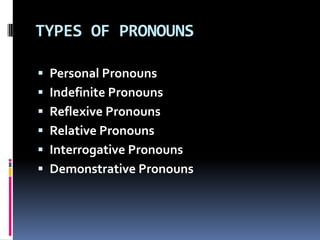
TYPES OF PRONOUNSPersonal PronounsIndefinitePronounsReflexivePronounsRelativePronounsInterrogativePronounsDemonstrativePronouns
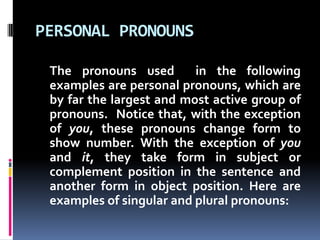
PERSONAL PRONOUNSThe pronouns used  in the following examples are personal pronouns, which are by far the largest and most active group of pronouns.  Notice that, with the exception of you, these pronouns change form to show number. With the exception of you and it, they take form in subject or complement position in the sentence and another form in object position. Here are examples of singular and plural pronouns:
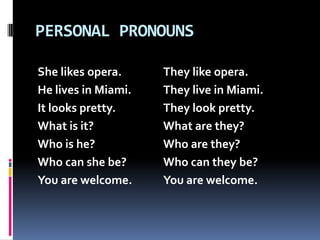
PERSONAL PRONOUNSShe likes opera.		They like opera.He lives in Miami.	They live in Miami.It looks pretty.		They look pretty.What is it?			What are they?Who is he?			Who are they?Who can she be?		Who can they be?You are welcome.	You are welcome.
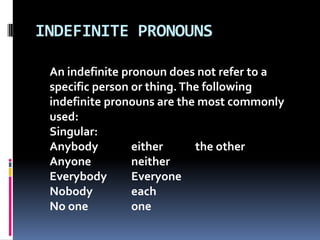
INDEFINITE PRONOUNSAn indefinite pronoun does not refer to a specific person or thing. The following  indefinite pronouns are the most commonly used:Singular:Anybody		either		the otherAnyone		neitherEverybody	EveryoneNobody		eachNo one		one
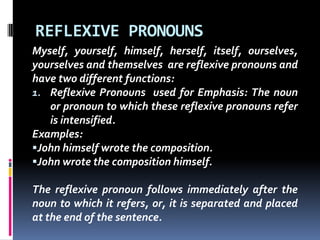
REFLEXIVE PRONOUNSMyself, yourself, himself, herself, itself, ourselves, yourselves and themselves  are reflexive pronouns and have two different functions:Reflexive Pronouns  used for Emphasis: The noun or pronoun to which these reflexive pronouns refer is intensified.  Examples:John himself wrote the composition.John wrote the composition himself. The reflexive pronoun follows immediately after the noun to which it refers, or, it is separated and placed at the end of the sentence.
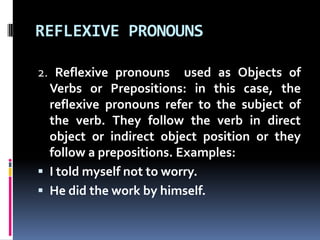
REFLEXIVE PRONOUNS2. Reflexive pronouns  used as Objects of Verbs or Prepositions: in this case, the reflexive pronouns refer to the subject of the verb. They follow the verb in direct object or indirect object position or they follow a prepositions. Examples:I told myself not to worry.He did the work by himself.
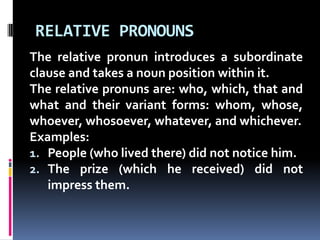
RELATIVE PRONOUNSThe relative pronun introduces a subordinate clause and takes a noun position within it.The relative pronuns are: who, which, that and what and their variant forms: whom, whose, whoever, whosoever, whatever, and whichever. Examples:People (who lived there) did not notice him.The prize (which he received) did not impress them.
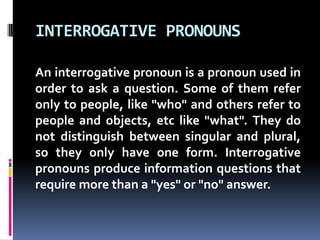
INTERROGATIVE PRONOUNSAn interrogative pronoun is a pronoun used in order to ask a question. Some of them refer only to people, like "who" and others refer to people and objects, etc like "what". They do not distinguish between singular and plural, so they only have one form. Interrogative pronouns produce information questions that require more than a "yes" or "no" answer.
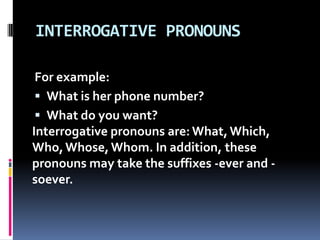
INTERROGATIVE PRONOUNSFor example: What is her phone number? What do you want? Interrogative pronouns are: What, Which, Who, Whose, Whom. In addition, these pronouns may take the suffixes -ever and -soever.
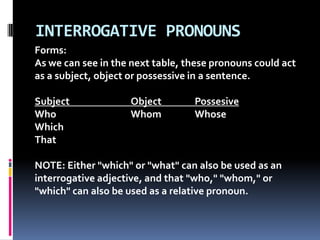
INTERROGATIVE PRONOUNSForms:As we can see in the next table, these pronouns could act as a subject, object or possessive in a sentence. Subject		Object		PossesiveWhoWhomWhoseWhichThatNOTE: Either "which" or "what" can also be used as an interrogative adjective, and that "who," "whom," or "which" can also be used as a relative pronoun.
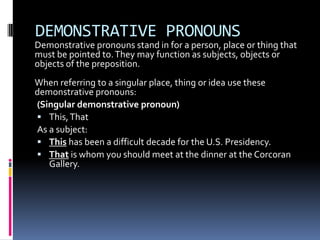
DEMONSTRATIVE PRONOUNSDemonstrative pronouns stand in for a person, place or thing that must be pointed to. They may function as subjects, objects or objects of the preposition.When referring to a singular place, thing or idea use these demonstrative pronouns:(Singular demonstrative pronoun)This, ThatAs a subject: This has been a difficult decade for the U.S. Presidency. That is whom you should meet at the dinner at the Corcoran Gallery.
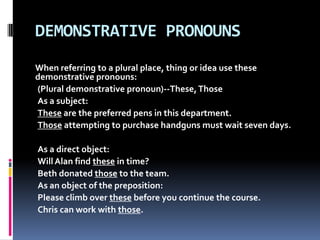
DEMONSTRATIVE PRONOUNSWhen referring to a plural place, thing or idea use these demonstrative pronouns: (Plural demonstrative pronoun)--These, ThoseAs a subject: Theseare the preferred pens in this department. Thoseattempting to purchase handguns must wait seven days. As a direct object: Will Alan find these in time? Beth donated those to the team. As an object of the preposition: Please climb over these before you continue the course. Chris can work with those.

Pronouns

  • 1.
    CAN REPLACE ANOUN OR ANOTHER PRONOUN:PRONOUNSClarita de HoGrammar IIProfessor: Ramón Guerra Universidad Latina de Panamá
  • 2.
    TYPES OF PRONOUNSPersonalPronounsIndefinitePronounsReflexivePronounsRelativePronounsInterrogativePronounsDemonstrativePronouns
  • 3.
    PERSONAL PRONOUNSThe pronounsused in the following examples are personal pronouns, which are by far the largest and most active group of pronouns. Notice that, with the exception of you, these pronouns change form to show number. With the exception of you and it, they take form in subject or complement position in the sentence and another form in object position. Here are examples of singular and plural pronouns:
  • 4.
    PERSONAL PRONOUNSShe likesopera. They like opera.He lives in Miami. They live in Miami.It looks pretty. They look pretty.What is it? What are they?Who is he? Who are they?Who can she be? Who can they be?You are welcome. You are welcome.
  • 5.
    INDEFINITE PRONOUNSAn indefinitepronoun does not refer to a specific person or thing. The following indefinite pronouns are the most commonly used:Singular:Anybody either the otherAnyone neitherEverybody EveryoneNobody eachNo one one
  • 6.
    REFLEXIVE PRONOUNSMyself, yourself,himself, herself, itself, ourselves, yourselves and themselves are reflexive pronouns and have two different functions:Reflexive Pronouns used for Emphasis: The noun or pronoun to which these reflexive pronouns refer is intensified. Examples:John himself wrote the composition.John wrote the composition himself. The reflexive pronoun follows immediately after the noun to which it refers, or, it is separated and placed at the end of the sentence.
  • 7.
    REFLEXIVE PRONOUNS2. Reflexivepronouns used as Objects of Verbs or Prepositions: in this case, the reflexive pronouns refer to the subject of the verb. They follow the verb in direct object or indirect object position or they follow a prepositions. Examples:I told myself not to worry.He did the work by himself.
  • 8.
    RELATIVE PRONOUNSThe relativepronun introduces a subordinate clause and takes a noun position within it.The relative pronuns are: who, which, that and what and their variant forms: whom, whose, whoever, whosoever, whatever, and whichever. Examples:People (who lived there) did not notice him.The prize (which he received) did not impress them.
  • 9.
    INTERROGATIVE PRONOUNSAn interrogativepronoun is a pronoun used in order to ask a question. Some of them refer only to people, like "who" and others refer to people and objects, etc like "what". They do not distinguish between singular and plural, so they only have one form. Interrogative pronouns produce information questions that require more than a "yes" or "no" answer.
  • 10.
    INTERROGATIVE PRONOUNSFor example:What is her phone number? What do you want? Interrogative pronouns are: What, Which, Who, Whose, Whom. In addition, these pronouns may take the suffixes -ever and -soever.
  • 11.
    INTERROGATIVE PRONOUNSForms:As wecan see in the next table, these pronouns could act as a subject, object or possessive in a sentence. Subject Object PossesiveWhoWhomWhoseWhichThatNOTE: Either "which" or "what" can also be used as an interrogative adjective, and that "who," "whom," or "which" can also be used as a relative pronoun.
  • 12.
    DEMONSTRATIVE PRONOUNSDemonstrative pronounsstand in for a person, place or thing that must be pointed to. They may function as subjects, objects or objects of the preposition.When referring to a singular place, thing or idea use these demonstrative pronouns:(Singular demonstrative pronoun)This, ThatAs a subject: This has been a difficult decade for the U.S. Presidency. That is whom you should meet at the dinner at the Corcoran Gallery.
  • 13.
    DEMONSTRATIVE PRONOUNSWhen referringto a plural place, thing or idea use these demonstrative pronouns: (Plural demonstrative pronoun)--These, ThoseAs a subject: Theseare the preferred pens in this department. Thoseattempting to purchase handguns must wait seven days. As a direct object: Will Alan find these in time? Beth donated those to the team. As an object of the preposition: Please climb over these before you continue the course. Chris can work with those.