Pronouns                                          P. 98
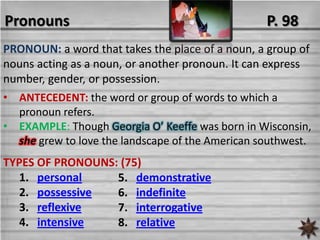
PRONOUN: a word that takes the place of a noun, a group of
nouns acting as a noun, or another pronoun. It can express
number, gender, or possession.
• ANTECEDENT: the word or group of words to which a
  pronoun refers.
• EXAMPLE: Though Georgia O’ Keeffe was born in Wisconsin,
  she grew to love the landscape of the American southwest.
TYPES OF PRONOUNS: (75)
   1. personal    5. demonstrative
   2. possessive  6. indefinite
   3. reflexive   7. interrogative
   4. intensive   8. relative
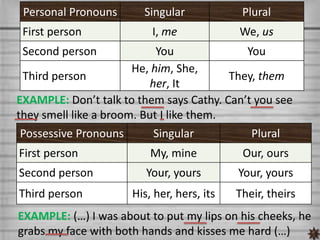
Personal Pronouns      Singular             Plural
 First person             I, me             We, us
 Second person              You              You
                       He, him, She,
 Third person                             They, them
                           her, It
EXAMPLE: Don’t talk to them says Cathy. Can’t you see
they smell like a broom. But I like them.
 Possessive Pronouns        Singular          Plural
First person              My, mine           Our, ours
Second person            Your, yours        Your, yours
Third person          His, her, hers, its   Their, theirs
EXAMPLE: (…) I was about to put my lips on his cheeks, he
grabs my face with both hands and kisses me hard (…)
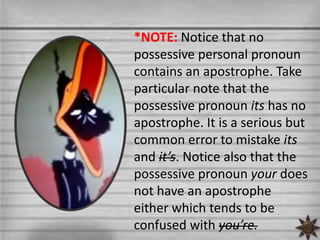
*NOTE: Notice that no
possessive personal pronoun
contains an apostrophe. Take
particular note that the
possessive pronoun its has no
apostrophe. It is a serious but
common error to mistake its
and it’s. Notice also that the
possessive pronoun your does
not have an apostrophe
either which tends to be
confused with you’re.
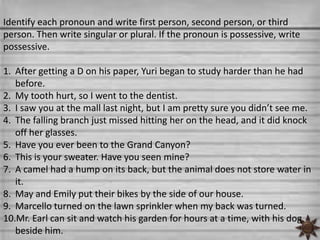
Identify each pronoun and write first person, second person, or third
person. Then write singular or plural. If the pronoun is possessive, write
possessive.

1. After getting a D on his paper, Yuri began to study harder than he had
   before.
2. My tooth hurt, so I went to the dentist.
3. I saw you at the mall last night, but I am pretty sure you didn’t see me.
4. The falling branch just missed hitting her on the head, and it did knock
   off her glasses.
5. Have you ever been to the Grand Canyon?
6. This is your sweater. Have you seen mine?
7. A camel had a hump on its back, but the animal does not store water in
   it.
8. May and Emily put their bikes by the side of our house.
9. Marcello turned on the lawn sprinkler when my back was turned.
10.Mr. Earl can sit and watch his garden for hours at a time, with his dog
   beside him.
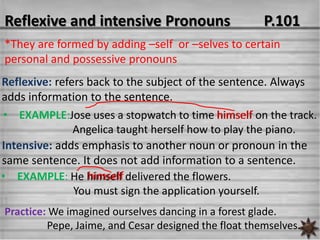
Reflexive and intensive Pronouns                      P.101
*They are formed by adding –self or –selves to certain
personal and possessive pronouns
Reflexive: refers back to the subject of the sentence. Always
adds information to the sentence.
• EXAMPLE:Jose uses a stopwatch to time himself on the track.
               Angelica taught herself how to play the piano.
Intensive: adds emphasis to another noun or pronoun in the
same sentence. It does not add information to a sentence.
• EXAMPLE: He himself delivered the flowers.
                  himself
               You must sign the application yourself.
Practice: We imagined ourselves dancing in a forest glade.
         Pepe, Jaime, and Cesar designed the float themselves.
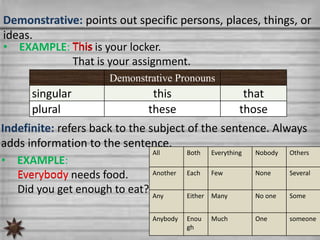
Demonstrative: points out specific persons, places, things, or
ideas.
• EXAMPLE: This is your locker.
            That is your assignment.
                         Demonstrative Pronouns
       singular                    this                     that
       plural                     these                    those
Indefinite: refers back to the subject of the sentence. Always
adds information to the sentence.
                                All     Both   Everything Nobody Others
• EXAMPLE:
   Everybody needs food.        Another Each   Few        None   Several

   Did you get enough to eat? Any       Either Many       No one Some


                                   Anybody   Enou   Much     One   someone
                                             gh
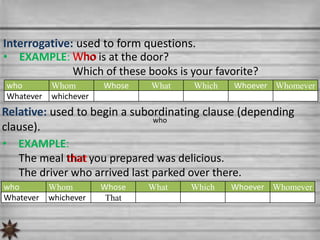
Interrogative: used to form questions.
• EXAMPLE: Who is at the door?
              Which of these books is your favorite?
who        Whom        Whose   What   Which    Whoever Whomever
Whatever   whichever
Relative: used to begin a subordinating clause (depending
                               who
clause).
• EXAMPLE:
   The meal that you prepared was delicious.
   The driver who arrived last parked over there.
who        Whom        Whose   What   Which   Whoever Whomever
Whatever   whichever    That
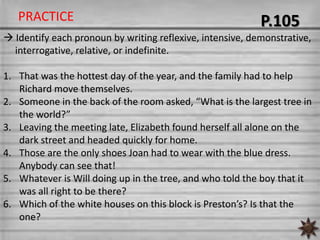
PRACTICE                                                P.105
 Identify each pronoun by writing reflexive, intensive, demonstrative,
  interrogative, relative, or indefinite.

1. That was the hottest day of the year, and the family had to help
   Richard move themselves.
2. Someone in the back of the room asked, “What is the largest tree in
   the world?”
3. Leaving the meeting late, Elizabeth found herself all alone on the
   dark street and headed quickly for home.
4. Those are the only shoes Joan had to wear with the blue dress.
   Anybody can see that!
5. Whatever is Will doing up in the tree, and who told the boy that it
   was all right to be there?
6. Which of the white houses on this block is Preston’s? Is that the
   one?

Pronouns

  • 1.
    Pronouns P. 98 PRONOUN: a word that takes the place of a noun, a group of nouns acting as a noun, or another pronoun. It can express number, gender, or possession. • ANTECEDENT: the word or group of words to which a pronoun refers. • EXAMPLE: Though Georgia O’ Keeffe was born in Wisconsin, she grew to love the landscape of the American southwest. TYPES OF PRONOUNS: (75) 1. personal 5. demonstrative 2. possessive 6. indefinite 3. reflexive 7. interrogative 4. intensive 8. relative
  • 2.
    Personal Pronouns Singular Plural First person I, me We, us Second person You You He, him, She, Third person They, them her, It EXAMPLE: Don’t talk to them says Cathy. Can’t you see they smell like a broom. But I like them. Possessive Pronouns Singular Plural First person My, mine Our, ours Second person Your, yours Your, yours Third person His, her, hers, its Their, theirs EXAMPLE: (…) I was about to put my lips on his cheeks, he grabs my face with both hands and kisses me hard (…)
  • 3.
    *NOTE: Notice thatno possessive personal pronoun contains an apostrophe. Take particular note that the possessive pronoun its has no apostrophe. It is a serious but common error to mistake its and it’s. Notice also that the possessive pronoun your does not have an apostrophe either which tends to be confused with you’re.
  • 4.
    Identify each pronounand write first person, second person, or third person. Then write singular or plural. If the pronoun is possessive, write possessive. 1. After getting a D on his paper, Yuri began to study harder than he had before. 2. My tooth hurt, so I went to the dentist. 3. I saw you at the mall last night, but I am pretty sure you didn’t see me. 4. The falling branch just missed hitting her on the head, and it did knock off her glasses. 5. Have you ever been to the Grand Canyon? 6. This is your sweater. Have you seen mine? 7. A camel had a hump on its back, but the animal does not store water in it. 8. May and Emily put their bikes by the side of our house. 9. Marcello turned on the lawn sprinkler when my back was turned. 10.Mr. Earl can sit and watch his garden for hours at a time, with his dog beside him.
  • 5.
    Reflexive and intensivePronouns P.101 *They are formed by adding –self or –selves to certain personal and possessive pronouns Reflexive: refers back to the subject of the sentence. Always adds information to the sentence. • EXAMPLE:Jose uses a stopwatch to time himself on the track. Angelica taught herself how to play the piano. Intensive: adds emphasis to another noun or pronoun in the same sentence. It does not add information to a sentence. • EXAMPLE: He himself delivered the flowers. himself You must sign the application yourself. Practice: We imagined ourselves dancing in a forest glade. Pepe, Jaime, and Cesar designed the float themselves.
  • 6.
    Demonstrative: points outspecific persons, places, things, or ideas. • EXAMPLE: This is your locker. That is your assignment. Demonstrative Pronouns singular this that plural these those Indefinite: refers back to the subject of the sentence. Always adds information to the sentence. All Both Everything Nobody Others • EXAMPLE: Everybody needs food. Another Each Few None Several Did you get enough to eat? Any Either Many No one Some Anybody Enou Much One someone gh
  • 7.
    Interrogative: used toform questions. • EXAMPLE: Who is at the door? Which of these books is your favorite? who Whom Whose What Which Whoever Whomever Whatever whichever Relative: used to begin a subordinating clause (depending who clause). • EXAMPLE: The meal that you prepared was delicious. The driver who arrived last parked over there. who Whom Whose What Which Whoever Whomever Whatever whichever That
  • 8.
    PRACTICE P.105  Identify each pronoun by writing reflexive, intensive, demonstrative, interrogative, relative, or indefinite. 1. That was the hottest day of the year, and the family had to help Richard move themselves. 2. Someone in the back of the room asked, “What is the largest tree in the world?” 3. Leaving the meeting late, Elizabeth found herself all alone on the dark street and headed quickly for home. 4. Those are the only shoes Joan had to wear with the blue dress. Anybody can see that! 5. Whatever is Will doing up in the tree, and who told the boy that it was all right to be there? 6. Which of the white houses on this block is Preston’s? Is that the one?