Self-Replication A Brief Introduction To Self-propagating Chemical Information TSRI Chemistry Journal Club 5/11/07 Brian Frezza
Why Study Chemical Self-Replication Evolution One of the requirements for an evolvable system Amplification Inherent amplification useful for Chemical and Biological sensors. Computation Differential self-replication “The Stuff of Life”
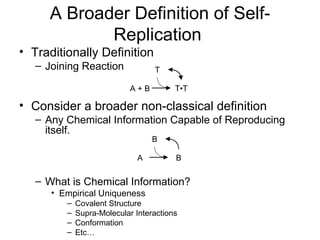
A Broader Definition of Self-Replication  Traditionally Definition Joining Reaction Consider a broader non-classical definition Any Chemical Information Capable of Reproducing itself. What is Chemical Information? Empirical Uniqueness Covalent Structure Supra-Molecular Interactions Conformation Etc… T •T A + B T B A B
Talk Outline Ligation Based Systems Bio-organic Hexadeoxynucleotide RNA Ligase Peptides Synthetic 3 Small Molecule Systems Cleavage Based Systems Ribozymes Compartmentalization Based Systems Autopoiesis (Self-replication of Compartments) Micelles and Reverse Micelles Self-replication of Location Encapsulated Reagents Conformation Based Systems Hybridization Chain Reaction Prions and Amyloids *unpublished work
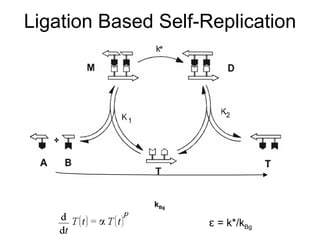
Ligation Based Self-Replication ɛ = k*/k Bg k Bg
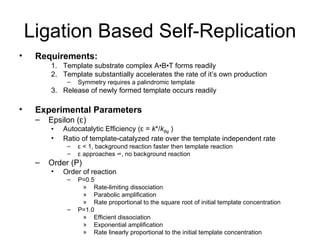
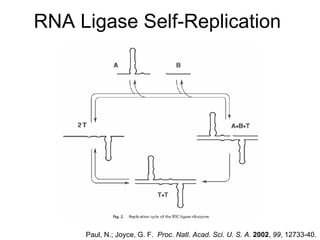
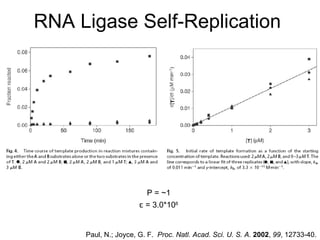
Ligation Based Self-Replication Requirements: Template substrate complex A • B • T forms readily Template substantially accelerates the rate of it’s own production Symmetry requires a palindromic template Release of newly formed template occurs readily Experimental Parameters Epsilon (ɛ) Autocatalytic Efficiency (ɛ =  k */ k Bg  ) Ratio of template-catalyzed rate over the template independent rate ɛ < 1, background reaction faster then template reaction  ɛ approaches  ∞ , no background reaction Order (P) Order of reaction P=0.5 Rate-limiting dissociation Parabolic amplification Rate proportional to the square root of initial template concentration P=1.0 Efficient dissociation Exponential amplification Rate linearly proportional to the initial template concentration
Hexadeoxynucleotide Self-Replication Kiedrowski, G.  Angew. Chem. Int. Ed.   1986 ,  25 , 932-935.
Hexadeoxynucleotide Self-Replication P = 0.48 ɛ = ~25 Kiedrowski, G.  Angew. Chem. Int. Ed.   1986 ,  25 , 932-935. 0 mM Template 0.2 mM Template 0.4 mM Template 0.8 mM Template
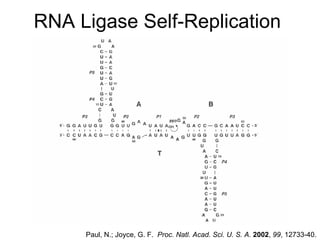
RNA Ligase Self-Replication  Paul, N.; Joyce, G. F.  Proc. Natl. Acad. Sci. U. S. A.   2002 ,  99 , 12733-40.
RNA Ligase Self-Replication  P = ~1 ɛ = 3.0*10 8 Paul, N.; Joyce, G. F.  Proc. Natl. Acad. Sci. U. S. A.   2002 ,  99 , 12733-40.
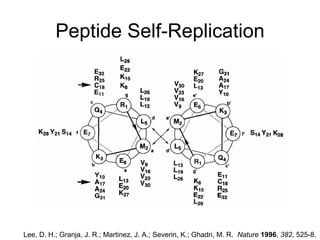
Peptide Self-Replication Lee, D. H.; Granja, J. R.; Martinez, J. A.; Severin, K.; Ghadri, M. R.  Nature   1996 ,  382 , 525-8.
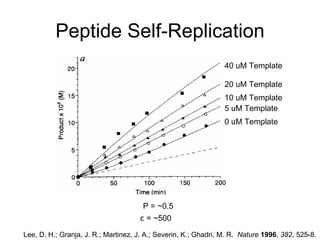
Peptide Self-Replication Lee, D. H.; Granja, J. R.; Martinez, J. A.; Severin, K.; Ghadri, M. R.  Nature   1996 ,  382 , 525-8. 0 uM Template 5 uM Template 10 uM Template 20 uM Template 40 uM Template P = ~0.5 ɛ = ~500
Peptide Self-Replication Modifications: Shorter Template Issac, R.; Chmielewski, J.  J. Am. Chem. Soc.   2002 ,  124 , 6808-9. P=0.91 ɛ=1.0*10 5 Proline “kink” substitution Li, X.; Chmielewski, J.  J. Am. Chem. Soc.   2003 ,  125 , 11820-1. P=0.91 ɛ=3.2*10 4
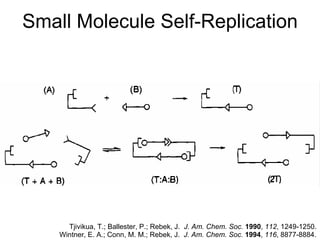
Small Molecule Self-Replication Tjivikua, T.; Ballester, P.; Rebek, J.  J. Am. Chem. Soc.   1990 ,  112 , 1249-1250. Wintner, E. A.; Conn, M. M.; Rebek, J.  J. Am. Chem. Soc.  1994 ,  116 , 8877-8884.
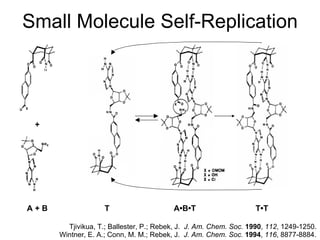
Small Molecule Self-Replication Tjivikua, T.; Ballester, P.; Rebek, J.  J. Am. Chem. Soc.   1990 ,  112 , 1249-1250. A + B T A • B • T T • T Wintner, E. A.; Conn, M. M.; Rebek, J.  J. Am. Chem. Soc.  1994 ,  116 , 8877-8884. +
Small Molecule Self-Replication Tjivikua, T.; Ballester, P.; Rebek, J.  J. Am. Chem. Soc.   1990 ,  112 , 1249-1250. Wintner, E. A.; Conn, M. M.; Rebek, J.  J. Am. Chem. Soc.  1994 ,  116 , 8877-8884. P = ~0.5 ɛ = ~22 A + B T
Small Molecule Self-Replication Terfort, A.; Kiedrowski, G.  Angew. Chem. Int. Ed.  1992 ,  31 , 654-656.
Small Molecule Self-Replication Terfort, A.; Kiedrowski, G.  Angew. Chem. Int. Ed.  1992 ,  31 , 654-656. P = ~0.5 ɛ = ~16.4 0 Equiv. Template 0.1 Equiv. Template 0.2 Equiv. Template 0.4 Equiv. Template
Small Molecule Self-Replication Pearson, R. J.; Kassianidis, E.; Slawin, A. M.; Philp, D.   Org. Biomol. Chem.  2004 ,  2 , 3434-41. Kassianidis, E.; Philp, D.  Chem. Commun.  2006 , 4072-4. Kassianidis, E.; Philp, D.  Angew. Chem. Int. Ed.  2006 ,  45 , 6344-6348. Pearson, R. J.; Kassianidis, E.; Slawin, A. M.; Philp, D.  Chen. Eur. J.  2006 ,  12 , 6829-40.
Small Molecule Self-Replication Pearson, R. J.; Kassianidis, E.; Slawin, A. M.; Philp, D.   Org. Biomol. Chem.  2004 ,  2 , 3434-41. A + B T Kassianidis, E.; Philp, D.  Chem. Commun.  2006 , 4072-4. Kassianidis, E.; Philp, D.  Angew. Chem. Int. Ed.  2006 ,  45 , 6344-6348. Pearson, R. J.; Kassianidis, E.; Slawin, A. M.; Philp, D.  Chen. Eur. J.  2006 ,  12 , 6829-40. +
Small Molecule Self-Replication Pearson, R. J.; Kassianidis, E.; Slawin, A. M.; Philp, D.   Org. Biomol. Chem.  2004 ,  2 , 3434-41. Kassianidis, E.; Philp, D.  Chem. Commun.  2006 , 4072-4. Kassianidis, E.; Philp, D.  Angew. Chem. Int. Ed.  2006 ,  45 , 6344-6348. Pearson, R. J.; Kassianidis, E.; Slawin, A. M.; Philp, D.  Chen. Eur. J.  2006 ,  12 , 6829-40. P = ~0.1 ɛ = ~8
Cleavage Based Self-Replication Rather then bond making, active self-replicators are triggered by bond breaking No Product Inhibition (P = 1) A + A A•A A
Cross-Catalytic Ribozymes Levy, M.; Ellington, A. D.  Proc. Natl. Acad. Sci. U. S. A.  2003 ,  100 , 6416-6421.
Cross-Catalytic Ribozymes Levy, M.; Ellington, A. D.  Proc. Natl. Acad. Sci. U. S. A.  2003 ,  100 , 6416-6421. P = 1 ɛ = 1.2*10 9
Autopoiesis A Compartment that catalyses the construction of more compartments.
Reverse Micelles Bachmann, P. A.; Walde, P.; Luisi, P. L.; Lang, J.  J. Am. Chem. Soc.  1990 ,  112 , 8200-8201. Bachmann, P. A.; Walde, P.; Luisi, P. L.; Lang, J.  J. Am. Chem. Soc.  1991 ,  113 , 8204-8209. Bachmann, P. A.; Luisi, P. L.; Lang, J.  Nature  1992 ,  357 , 57-59.
Locational Self-Replication Free Molecule X Can Catalyze the release of molecule X from Compartment A X X X X X X X X X X X X  + X
Encapsulated Reagents Chen, J.; Korner, S.; Craig, S. L.; Lin, S.; Rudkevich, D. M.; Rebek, J., Jr.  Proc. Natl. Acad. Sci. U. S. A.  2002 ,  99 , 2593-6.
Conformation Based Self-Replication Molecule A has multiple conformations, A* is a self-replicating conformation which templates conformational change of A into A* A* • A* A A*
Hybridization Chain Reaction (HCR) + Dirks, R. M.; Pierce, N. A.  Proc. Natl. Acad. Sci. U. S. A.  2004 ,  101 , 15275-8. B’ A’ B’ B A’ C’ + B’ B C A
Prions and Amyloids A suspected mode of action of a Prion disease is conformational self-replication that allows aggregates of the replicating conformation of a protein to accumulate in long beta sheet’s called Amyloids. A* A (A* •  A*•) n
Conclusions Examples of Classic Self-Replicating by ligation have been demonstrated. Improved catalytic efficiencies and reaction orders have been achieved.  More examples and expanded applications of self-replicators are of great interest. We have just begun to explore Non-classical forms of “Self-Replication” New examples, new forms, and new applications leave many exciting possibilities!

Self-replicating Molecules: An introduction

  • 1.
    Self-Replication A BriefIntroduction To Self-propagating Chemical Information TSRI Chemistry Journal Club 5/11/07 Brian Frezza
  • 2.
    Why Study ChemicalSelf-Replication Evolution One of the requirements for an evolvable system Amplification Inherent amplification useful for Chemical and Biological sensors. Computation Differential self-replication “The Stuff of Life”
  • 3.
    A Broader Definitionof Self-Replication Traditionally Definition Joining Reaction Consider a broader non-classical definition Any Chemical Information Capable of Reproducing itself. What is Chemical Information? Empirical Uniqueness Covalent Structure Supra-Molecular Interactions Conformation Etc… T •T A + B T B A B
  • 4.
    Talk Outline LigationBased Systems Bio-organic Hexadeoxynucleotide RNA Ligase Peptides Synthetic 3 Small Molecule Systems Cleavage Based Systems Ribozymes Compartmentalization Based Systems Autopoiesis (Self-replication of Compartments) Micelles and Reverse Micelles Self-replication of Location Encapsulated Reagents Conformation Based Systems Hybridization Chain Reaction Prions and Amyloids *unpublished work
  • 5.
  • 6.
    Ligation Based Self-ReplicationRequirements: Template substrate complex A • B • T forms readily Template substantially accelerates the rate of it’s own production Symmetry requires a palindromic template Release of newly formed template occurs readily Experimental Parameters Epsilon (ɛ) Autocatalytic Efficiency (ɛ = k */ k Bg ) Ratio of template-catalyzed rate over the template independent rate ɛ < 1, background reaction faster then template reaction ɛ approaches ∞ , no background reaction Order (P) Order of reaction P=0.5 Rate-limiting dissociation Parabolic amplification Rate proportional to the square root of initial template concentration P=1.0 Efficient dissociation Exponential amplification Rate linearly proportional to the initial template concentration
  • 7.
    Hexadeoxynucleotide Self-Replication Kiedrowski,G. Angew. Chem. Int. Ed. 1986 , 25 , 932-935.
  • 8.
    Hexadeoxynucleotide Self-Replication Kiedrowski,G. Angew. Chem. Int. Ed. 1986 , 25 , 932-935.
  • 9.
    Hexadeoxynucleotide Self-Replication P= 0.48 ɛ = ~25 Kiedrowski, G. Angew. Chem. Int. Ed. 1986 , 25 , 932-935. 0 mM Template 0.2 mM Template 0.4 mM Template 0.8 mM Template
  • 10.
    RNA Ligase Self-Replication Paul, N.; Joyce, G. F. Proc. Natl. Acad. Sci. U. S. A. 2002 , 99 , 12733-40.
  • 11.
    RNA Ligase Self-Replication Paul, N.; Joyce, G. F. Proc. Natl. Acad. Sci. U. S. A. 2002 , 99 , 12733-40.
  • 12.
    RNA Ligase Self-Replication P = ~1 ɛ = 3.0*10 8 Paul, N.; Joyce, G. F. Proc. Natl. Acad. Sci. U. S. A. 2002 , 99 , 12733-40.
  • 13.
    Peptide Self-Replication Lee,D. H.; Granja, J. R.; Martinez, J. A.; Severin, K.; Ghadri, M. R. Nature 1996 , 382 , 525-8.
  • 14.
    Peptide Self-Replication Lee,D. H.; Granja, J. R.; Martinez, J. A.; Severin, K.; Ghadri, M. R. Nature 1996 , 382 , 525-8.
  • 15.
    Peptide Self-Replication Lee,D. H.; Granja, J. R.; Martinez, J. A.; Severin, K.; Ghadri, M. R. Nature 1996 , 382 , 525-8. 0 uM Template 5 uM Template 10 uM Template 20 uM Template 40 uM Template P = ~0.5 ɛ = ~500
  • 16.
    Peptide Self-Replication Modifications:Shorter Template Issac, R.; Chmielewski, J. J. Am. Chem. Soc. 2002 , 124 , 6808-9. P=0.91 ɛ=1.0*10 5 Proline “kink” substitution Li, X.; Chmielewski, J. J. Am. Chem. Soc. 2003 , 125 , 11820-1. P=0.91 ɛ=3.2*10 4
  • 17.
    Small Molecule Self-ReplicationTjivikua, T.; Ballester, P.; Rebek, J. J. Am. Chem. Soc. 1990 , 112 , 1249-1250. Wintner, E. A.; Conn, M. M.; Rebek, J. J. Am. Chem. Soc. 1994 , 116 , 8877-8884.
  • 18.
    Small Molecule Self-ReplicationTjivikua, T.; Ballester, P.; Rebek, J. J. Am. Chem. Soc. 1990 , 112 , 1249-1250. A + B T A • B • T T • T Wintner, E. A.; Conn, M. M.; Rebek, J. J. Am. Chem. Soc. 1994 , 116 , 8877-8884. +
  • 19.
    Small Molecule Self-ReplicationTjivikua, T.; Ballester, P.; Rebek, J. J. Am. Chem. Soc. 1990 , 112 , 1249-1250. Wintner, E. A.; Conn, M. M.; Rebek, J. J. Am. Chem. Soc. 1994 , 116 , 8877-8884. P = ~0.5 ɛ = ~22 A + B T
  • 20.
    Small Molecule Self-ReplicationTerfort, A.; Kiedrowski, G. Angew. Chem. Int. Ed. 1992 , 31 , 654-656.
  • 21.
    Small Molecule Self-ReplicationTerfort, A.; Kiedrowski, G. Angew. Chem. Int. Ed. 1992 , 31 , 654-656.
  • 22.
    Small Molecule Self-ReplicationTerfort, A.; Kiedrowski, G. Angew. Chem. Int. Ed. 1992 , 31 , 654-656. P = ~0.5 ɛ = ~16.4 0 Equiv. Template 0.1 Equiv. Template 0.2 Equiv. Template 0.4 Equiv. Template
  • 23.
    Small Molecule Self-ReplicationPearson, R. J.; Kassianidis, E.; Slawin, A. M.; Philp, D. Org. Biomol. Chem. 2004 , 2 , 3434-41. Kassianidis, E.; Philp, D. Chem. Commun. 2006 , 4072-4. Kassianidis, E.; Philp, D. Angew. Chem. Int. Ed. 2006 , 45 , 6344-6348. Pearson, R. J.; Kassianidis, E.; Slawin, A. M.; Philp, D. Chen. Eur. J. 2006 , 12 , 6829-40.
  • 24.
    Small Molecule Self-ReplicationPearson, R. J.; Kassianidis, E.; Slawin, A. M.; Philp, D. Org. Biomol. Chem. 2004 , 2 , 3434-41. A + B T Kassianidis, E.; Philp, D. Chem. Commun. 2006 , 4072-4. Kassianidis, E.; Philp, D. Angew. Chem. Int. Ed. 2006 , 45 , 6344-6348. Pearson, R. J.; Kassianidis, E.; Slawin, A. M.; Philp, D. Chen. Eur. J. 2006 , 12 , 6829-40. +
  • 25.
    Small Molecule Self-ReplicationPearson, R. J.; Kassianidis, E.; Slawin, A. M.; Philp, D. Org. Biomol. Chem. 2004 , 2 , 3434-41. Kassianidis, E.; Philp, D. Chem. Commun. 2006 , 4072-4. Kassianidis, E.; Philp, D. Angew. Chem. Int. Ed. 2006 , 45 , 6344-6348. Pearson, R. J.; Kassianidis, E.; Slawin, A. M.; Philp, D. Chen. Eur. J. 2006 , 12 , 6829-40. P = ~0.1 ɛ = ~8
  • 26.
    Cleavage Based Self-ReplicationRather then bond making, active self-replicators are triggered by bond breaking No Product Inhibition (P = 1) A + A A•A A
  • 27.
    Cross-Catalytic Ribozymes Levy,M.; Ellington, A. D. Proc. Natl. Acad. Sci. U. S. A. 2003 , 100 , 6416-6421.
  • 28.
    Cross-Catalytic Ribozymes Levy,M.; Ellington, A. D. Proc. Natl. Acad. Sci. U. S. A. 2003 , 100 , 6416-6421. P = 1 ɛ = 1.2*10 9
  • 29.
    Autopoiesis A Compartmentthat catalyses the construction of more compartments.
  • 30.
    Reverse Micelles Bachmann,P. A.; Walde, P.; Luisi, P. L.; Lang, J. J. Am. Chem. Soc. 1990 , 112 , 8200-8201. Bachmann, P. A.; Walde, P.; Luisi, P. L.; Lang, J. J. Am. Chem. Soc. 1991 , 113 , 8204-8209. Bachmann, P. A.; Luisi, P. L.; Lang, J. Nature 1992 , 357 , 57-59.
  • 31.
    Reverse Micelles Bachmann,P. A.; Walde, P.; Luisi, P. L.; Lang, J. J. Am. Chem. Soc. 1990 , 112 , 8200-8201. Bachmann, P. A.; Walde, P.; Luisi, P. L.; Lang, J. J. Am. Chem. Soc. 1991 , 113 , 8204-8209. Bachmann, P. A.; Luisi, P. L.; Lang, J. Nature 1992 , 357 , 57-59.
  • 32.
    Reverse Micelles Bachmann,P. A.; Walde, P.; Luisi, P. L.; Lang, J. J. Am. Chem. Soc. 1990 , 112 , 8200-8201. Bachmann, P. A.; Walde, P.; Luisi, P. L.; Lang, J. J. Am. Chem. Soc. 1991 , 113 , 8204-8209. Bachmann, P. A.; Luisi, P. L.; Lang, J. Nature 1992 , 357 , 57-59.
  • 33.
    Locational Self-Replication FreeMolecule X Can Catalyze the release of molecule X from Compartment A X X X X X X X X X X X X + X
  • 34.
    Encapsulated Reagents Chen,J.; Korner, S.; Craig, S. L.; Lin, S.; Rudkevich, D. M.; Rebek, J., Jr. Proc. Natl. Acad. Sci. U. S. A. 2002 , 99 , 2593-6.
  • 35.
    Encapsulated Reagents Chen,J.; Korner, S.; Craig, S. L.; Lin, S.; Rudkevich, D. M.; Rebek, J., Jr. Proc. Natl. Acad. Sci. U. S. A. 2002 , 99 , 2593-6.
  • 36.
    Conformation Based Self-ReplicationMolecule A has multiple conformations, A* is a self-replicating conformation which templates conformational change of A into A* A* • A* A A*
  • 37.
    Hybridization Chain Reaction(HCR) + Dirks, R. M.; Pierce, N. A. Proc. Natl. Acad. Sci. U. S. A. 2004 , 101 , 15275-8. B’ A’ B’ B A’ C’ + B’ B C A
  • 38.
    Prions and AmyloidsA suspected mode of action of a Prion disease is conformational self-replication that allows aggregates of the replicating conformation of a protein to accumulate in long beta sheet’s called Amyloids. A* A (A* • A*•) n
  • 39.
    Conclusions Examples ofClassic Self-Replicating by ligation have been demonstrated. Improved catalytic efficiencies and reaction orders have been achieved. More examples and expanded applications of self-replicators are of great interest. We have just begun to explore Non-classical forms of “Self-Replication” New examples, new forms, and new applications leave many exciting possibilities!