16 | P a g e
2.4. Watershed hydrology
3. SOCIO-ECONOMIC ISSUES IN WATERSHED MANAGEMENT
3.1. Impact of population and local economic activities on watersheds
More people means more infrastructure needs such as domestic water, housing and
schools, etc., and also means more land, more food, and more jobs.
Rural poverty in the uplands, causing migration to crowded urban centres and/or
destroying watershed resources.
Improper land use (slopeland farming, shifting cultivation without proper fallow,
overgrazing, etc.) resulting in degradation of land and other watershed resources.
Deforestation, thereby increasing hazards of seasonal flooding and/or drought
downstream.
3.2. Institutions and watershed management
Institutions are norms, rules and regulations that mediate socio-economic interactions
17 | P a g e
between agents and facilitate exchanges, enforcement of contracts, decision making,
coordination, and conflict resolution. Institutions define property rights to productive
resources access and control over resources.
1. Government – state and federal
2. District/Woreda/ Rural Development Agency
3. Project Implementing Agency (PIA)
4. Watershed Development Team
5. Village admin council /Kebele administration
6. Watershed association/committee
7. Local user groups (for land owners)
8. Local self-help groups (land-less)
18 | P a g e
3.3. Infrastructure
Generally, the infrastructure development in watershed include:
A. Transportation
Existing road networks including
 Highways
 Secondary roads
 Feeder roads
 Forest roads, etc.
B. Housing
Types of structure; construction material (for frame, wall, floor, etc ); age of the house;
rooms per household; total area (sq. m); number of persons per household; ownership;
utility; kitchen and kind of stoves; type of toilet; present status; maintenance
C. Domestic Water Supply, Irrigation and Energy
 Present water supply system
 Capacity
 Delivery
19 | P a g e
 Distribution (in yards, into dwellings or at roadsides), and
 Potential for development, etc.
 Minor irrigation and
 Water harvesting
D. Public Services
 Marketing
 Extension services
 Credit or loan facilities, etc.
 Schools
 Health clinics
 Post offices
 Community centers, etc.
E. Agro-Industry
 cottage industry
 existing small shops
3.4. Participatory approaches in surveying and planning watershed
management
Planning is to "devise detailed methods for doing, arranging and making something".
Various participatory techniques are used to promote local participation. They originate
from different methodologies widely applied throughout the world.
Major participatory watershed management approaches adopted in many parts of the
world include:
 Bottom-up approach
 Iterative approach
20 | P a g e
 Flexible approach
Participatory watershed planning approaches in Ethiopia originated from:
 Local level Participatory Planning Approach (LLPPA)
 Participatory Rural Appraisal (PRA)
 Farming System Development (FSD)
 Participatory Land Use-Planning and the like.
These techniques are designed to ensure involvement of the whole community in
watershed management survey and planning. A participatory watershed planning is
designed to be as simple and practical as possible, so that one or more Development
Agent (s) and the community can prepare a plan together.
Participatory planning methods and techniques
 Working in an interdisciplinary team
 Participatory targeting
 Gender sensitization
 Group meetings and brainstorming
 Vulnerability/wealth ranking
 Problem identification and ranking
 Semi-structured interviews
 Transect walks
 Village and households mapping
 Soil, vegetation and topographic surveys
 Watershed and community area delineation
 Action planning
 Participatory and result-based monitoring.
21 | P a g e
3.5. Stakeholder analysis and involvement in watershed management
planning
Who are stakeholders?
 A stakeholder is a person (or group) who is responsible for making or
implementing a management action, who will be significantly affected by the
action, or who can aid or prevent its implementation
 Stakeholder groups are formal or informal assemblies that represent a variety of
interests and points of view within a watershed.
 Stakeholders are those who will make decisions, those who will be affected by
them, and those who can stop the process if they disagree.
 Stakeholders can be individuals, organizations or groups.
 Stakeholders include public-sector agencies involved in water resources (for
example, departments of agriculture, industry, transportation, recreation), various
levels of public-sector agencies in the water sector (state, regional or local),
private-sector organizations and companies with water interests, environmental
and professional NGOs, and representatives of those people likely to be affected,
specifically including people who may have little knowledge of the effects of
strategy and who may lack the means to participate.
 Any group or individual who can affect or is affected by the achievement of the
organization's objectives (Freeman, 1984)
 A stakeholder is any individual, community, group or organisation with an interest
in the outcome of a programme, either as a result of being affected by it
positively or negatively, or by being able to influence the activity in a positive or
negative way.
Why involve stakeholders?
Involving stakeholders
• Builds trust and support for the process and outcome
22 | P a g e
• Shares the responsibility for decisions or actions
• Creates solutions more likely to be adopted
• Leads to better, more cost-effective solutions
• Forges stronger working relationships
• Enhances communication and coordination of resources
• Helps to ensure that any environmental justice concerns are identified at an early
stage
It’s important to note that public involvement processes can greatly enhance watershed
management efforts, but they can’t override laws and regulations enacted by elected
officials and public agencies. In fact, stakeholder group processes are used most often
to support and complement legally required actions such as achieving water quality
standards, protecting drinking water supplies, restoring habitat, and generally making
the nation’s waters fishable and swimmable. Another important aspect of stakeholder
involvement is utility. If you convene a group and don’t somehow include their input in
the process or product, they’ll likely wonder why they wasted their time. Make sure that
stakeholders’ contributions are recognized and are used in some manner to achieve the
goals of the watershed program, and that stakeholders are informed about how their
participation has affected the outcomes. In addition, a robust stakeholder involvement
program can help to identify any potential environmental justice concerns that might be
present in the watershed. Including representatives from minority or low-income
communities in the stakeholder group can help you to identify any such concerns early
in the planning process. Then the watershed plan can include addressing situations in
which certain groups are disproportionately affected by water quality problems.
What is stakeholder analysis?
Stakeholder Analysis is the process of identifying the interests of different groups and
find ways of harnessing the support of those in favor or the activity, while managing the
risks posed by stakeholders who are against it.
Methods of stakeholder involvement
23 | P a g e
Stakeholder participation (involvement): is the process of involving those who are
affected by and thus have an interest in water resources, and hence in the formulation
of water strategy. It is a two-way communication process that explicitly seeks to
identify and to clarify the interests at stake, with the ultimate aim of producing a well-
informed water management strategy that has a good chance of being implemented.
Stakeholder involvement should be an integral part of the process of developing a
strategy, mainly because it can:
 ensure that alternatives serving a broad range of interests are considered;
 help to gather data or information, identify gaps in data or information, and
identify those who might provide data or information in the future;
 provide transparency and accountability regarding both decisions taken
and the process by which those decisions were arrived at;
 accustom stakeholders to the fact that some difficult choices may have to
be made in order to manage water resources effectively; and
 build a broad base of commitment to options by creating an environment
that rewards the realistic discussion of benefits, risks and costs of
options and that provides a meaningful basis for informed consent to
recommendations.
In certain situations there may be barriers to effective stakeholder participation in the
form of cost, access and prevailing cultural norms.
Stakeholder involvement is more than just holding a public hearing or seeking public
comment on a new regulation. Effective stakeholder involvement provides a method for
identifying public concerns and values, developing consensus among affected parties,
and producing efficient and effective solutions through an open, inclusive process.
Although not every single interested party needs to be a member of the board (it’s
important to keep the size of the group manageable and efficient), you should make
sure all the key groups in the watershed are represented. For example, there might be
three farmer organizations in a watershed, but it might not be necessary to include
24 | P a g e
representatives from all three in the stakeholder group. Instead, the participation of one,
well respected farmer from the community might be adequate.
What are the methods of identifying stakeholders?
A variety of methods can be used to identify stakeholders.
A. Self-identification,
 Simply means that individuals or groups step forward and indicate an interest in
participating.
B. Third-party identification
 Uses knowledgeable parties, such as existing advisory committees, informal or
formal community leaders, and representatives of known interests, to suggest
people or organizations that should be included.
C. Identification by the strategy team.
 Relies on the team systematically identifying and approaching stakeholders.
Criteria for stakeholders classification
1. The stakeholder's power to influence life on the watershed
2. The legitimacy of the stakeholder's relationship with the watershed region
3. The urgency of the stakeholder's claim on the watershed area
Type of stakeholders Characteristics
Key stakeholders. significantly influence or are important to
the success of an activity.
Primary stakeholders ultimately affected by an activity, either
as beneficiaries (positively impacted) or
disbeneficiaries (adversely impacted).
Secondary stakeholders with a stake, interest or intermediary role
in the activity.
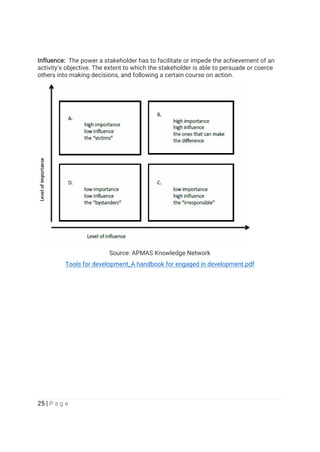
Stakeholder Analysis: Importance/Influence Matrix
Importance: The priority given to satisfying the needs and interests of each stakeholder.
25 | P a g e
Influence: The power a stakeholder has to facilitate or impede the achievement of an
activity’s objective. The extent to which the stakeholder is able to persuade or coerce
others into making decisions, and following a certain course on action.
Source: APMAS Knowledge Network
Tools for development_A handbook for engaged in development.pdf
26 | P a g e
4. PLANNING WATERSHED MANAGEMENT
What is watershed management planning?
Proper planning depends on the human element and not only on physical or technical
aspects. Therefore, planning must start from the bottom. Local farmers, other land
users and the wider community who depend on the land must be involved from the very
beginning of the planning process since they are the ones that will live with its results.
Natural resources development, conservation and management constitute the
foundation of watershed planning.
The basic elements included in the planning process are
 Soil conservation and water harvesting
 Forestry and agroforestry
 Crop and livestock production and
 Small-scale rural infrastructure (including water, feeder roads, small-scale
irrigation).
Therefore, agronomists, livestock’s specialists, foresters and conservationists should
interact together, combining skills and experience and their respective strengths.
4.1. Getting started at community level
A. Organization and formation of community watershed team (CWT)
 Call general assembly Meeting with community
 Elect a representative community watershed team (CWT)
In order to elect CWT representative, two options are considered based upon local
conditions:
1. One team
2. Two teams (by gender)
Composition of community watershed planning team involves:
The creation of one gender balanced CWT is the most challenging and therefore the
27 | P a g e
recommended option. After wealth ranking exercise, community should elect 10
people's representatives with equal gender proportion and active members of each of
the main social groups to form the “Community Watershed Team”.
In general, the community should elect a CWT that includes:
 The Community leader (also representing the community at kebele level)
 Four male-headed households representing different social groups (including
vulnerable) and living in different parts of the community
 Four female-headed households representing different social groups (including
vulnerable) and living in different strata of the community (down to top)
 One youth representative
 One religious representative
 Others as required by the community (innovative farmers, respected people,
women's group, and others).
Functions of the CWT:
 Serve as a permanent contact with the DA, the rest of the community/target
group and local leaders during planning, implementation and monitoring and
evaluation
 Responsible to ensure the watershed liaison with other communities located
within the broader watershed unit
B. Agree on timing for planning work and main tasks
4.2. Biophysical and socio-economic survey
4.2.1. Get to know the watershed, people’s interactions, opportunities and
limitations
The CWT and the DAs will proceed with a community and sub-watershed familiarization
exercise.
The main survey techniques include:
28 | P a g e
1. Participatory mapping
2. Transects
4.2.2. Get to know people’s needs, strengths and aspirations
A. Problem identification (PI) and ranking in order to:
 To identify the most important problems of the community and target group(s)
 To accomplish preliminary assessment of possible solutions.
In defining problems, it is important to pay attention to the following 3 issues:
1. Distinguishing problems from causes and effects
2. Distinguishing between symptoms and problems
3. Interactions between problems.
4 types of problem ranking commonly used in participatory planning
1. Preference ranking (ranking by voting)
2. Direct matrix ranking
3. Pair-wise ranking
4. Wealth ranking
B. Community level socio-economic survey
the sources of information and methods to undertake this survey.
I. Review of existing reports
II. Socio economic survey acts also as a baseline for Monitoring and Evaluation
4.2.3. Detailed biophysical survey and mapping
Mapping is undertaken using 1:50,000 topomaps or sketch maps for this purpose.
Mapping work include:
1. Demarcate community boundaries and sub-watersheds
2. Identify land use, topography, soils and past erosion
29 | P a g e
4.2.4. Relationship between biophysical and socio-economic survey results:
Analysis of focus areas and priorities
The DA and the CWT should then analyze the relationship between the identified
problem and socio-economic survey results, as well as the biophysical resources
assessed.
Important of analysis of the relationship between biophysical and socio-economic
surveys:
 help to identify existing opportunities
 show which areas should be focused as a key and priority needs.
 it would be possible to fulfill short, medium, and long-term objectives.
 BASE MAP is produced with suitable scale (1:2000 to 1: 5000) scale for
community maps.
 Farmers’ maps and transects should be also reported on paper for reference and
for comparing these maps with base maps.
At the end of this stage, the general assembly meeting will be conducted.
4.3. Identification and prioritization of major biophysical problems and
management options (Erosion, flood, sedimentation, deforestation etc.)
Now relate the various socio-economic issues with bio-physical elements within and
outside the community watershed to select the different interventions that bring change.
Interventions should be technically correct and implemented following quality criteria
and in the correct sequence.
4.3.1. Identification of interventions and prioritization elements
A. Pool of experience and options: To properly select from the different measures,
particularly those related to natural resource development and productivity
enhancement, the DA and the CWT should
 Carefully look at land use, soil, slope and vegetation features.
 identify the most suitable measures under different agro-ecological
30 | P a g e
conditions based on the problems and demands or priorities expressed by the
community.
B. Role of traditional knowledge:
 Regardless of their performance, traditional experience and knowledge in SWC
and farming should be capitalized by field technicians and used effectively to
identify, select, design and implement improved natural resources development
and productivity intensification measures.
C. Measures and target groups: There are measures that are implemented at
individual, group, community, and inter-community levels. They are often all
connected and need a common understanding on which activity to start first or
simultaneously that will be most logical and advantageous.
D. The Role of the Development Agent:
 The DA plays a facilitating and technical role, leaving the CWT to own the
planning process.
E. Addressing women’s needs:
 It means the promotion of activities that benefit women. For example, women
would be very much interested in treatment of upper watersheds mostly because
of their effect on water-tables, thus on springs, wells or filling of ponds.
F. Promote participatory technology development for new and untested measures.
 It is always advisable to initiate small-scale trials where the farmers (and yourself)
can assess the performance of the measures.
4.3.2. General technical and social aspects related to watershed planning
In planning development activities, the DA will notice that for problems of common
interest to households, it is easy to reach agreement on what measures should be
implemented.
4.3.3. Key integration requirements and sequencing of activities
Integration has different aspects:
31 | P a g e
A. Measures (Technologies)
 Each technology in a watershed and land-use system is not applied in isolation
and needs to be integrated with other measures to:
Important of technologies integration
 Further strengthen the measure and improve its efficiency,
 Improve its productivity
 Reduce maintenance costs
 Generate multiple benefits
B. Micro-watershed
The next level of interactions includes mutually reinforcing activities and basic linkages
between activities within a micro-watershed unit (few hectares).
C. Community watershed and the overall critical watershed
 The interactions and integration requirements at this level are essential to guide
the sequence of activities and increase the range and quality of conservation and
development opportunities that can be generated from systematic treatment
within and between sub-watershed and broader units.
D. Integration, interactions and sequencing interventions following watershed
logic
The type of treatments to consider in community-based watershed planning can be
divided into:
1. Treatment of overall community and/or inter-community-based watershed
2. Treatment of small sub-watersheds
3. Treatment of small micro-watersheds
4.3.4. Intervention areas
Different intervention are applied in different agro-ecology and several measures have
multiple functions (for instance both for forestry and fodder, for water harvesting and
32 | P a g e
conservation, for soil fertility improvement and moisture conservation, etc).
4.4. Development map, inputs and action plan preparation
A. Development map
The development map is an essential instrument that shows the actual placement of
sites of development interventions in type with respect to land use types.
Points to be considered when preparing a development map:
1. The scale should be the same as that of the base map.
2. It should show compartments of the development blocks in accordance with
phasing.
3. Any major community asset and development works that have been previously
implemented should be transferred to the development map.
4. Proposed development works, including maintenance or rehabilitation of existing
measures should be shown.
5. Symbols should be used to show the development interventions and other
necessary
information.
6. The map should be provided with standard legend so that the user can easily
read and use
the map.
B. Inputs
The inputs include the labor and planting/ working/construction materials.
Factors that influence the volume of an input are:
 The extent of the work (area)
 Specification
 Degree of slope
 Soil texture and condition (wet or dry)
 The working pattern
33 | P a g e
 Tools of the workers
 Planting materials
C. Action plan
 It should be carefully and accurately developed on the basis of what has been
agreed upon with the community for the implementation of the proposed
measures.
 It should show a multi-year plan (1st
year plan prepared in detail quarterly and
monthly and other years are strategic projections ) to be adjusted and/ or
modified after the first year implementation and results.
4.5. Implementation strategies, Monitoring and evaluation
4.5.1. Implementation strategy
Once the preparation for implementation completed,
 The DAs should send the plans to the wereda for final consolidation and approval.
 Then the WWT should forward a summary of the plans (maps and main input
requirements) to the zone and/or to the region, where necessary.
A. Institutional organization and terms of reference
General roles and responsibilities for Participatory watershed development
planning (PWDP)
1. Regional, zonal (if applicable), wereda experts and DAs are responsible to
propose
and arrange training for land users before and during implementation based on
local
conditions and specific needs.
2. DAs and wereda experts are responsible to follow-up trials and development of
on-farm participatory technology for innovative measures to be tested in specific
areas.
3. DAs and wereda experts will play a major role in strengthening the
communication between the various sector agencies operating in the area by
involving their experts and using their resources whenever required; for instance,
34 | P a g e
education and health experts, resources, NGOs and others.
4. DAs and land users will also discuss the possible modifications that may
occur to the plan during implementation
B. Resource identification and mobilization
1. Self-help contributions and empowerment
2. Linkage with existing forms of support (safety nets, food security, other projects)
Participatory monitoring and evaluation
The planned list of activities, targets, technical designs, reasons for selection, maps,
and others, should be considered as benchmarks, which allow field staff to compare
achievements and their impact against original purposes. Participatory monitoring and
evaluation (PM&E) is different from conventional monitoring and evaluation in its focus
on participation.
Benefits of PM&E:
 Increases consensus on project goals, objectives and activities
 Creates ownership over evaluation results
 Increases cost-effectiveness of ME information
 Provides timely and reliable information for decision making
 Enhances learning by local stakeholders
 Enhances skills and confidence of local people on management of development
projects
 Utilizes local knowledge.
A participatory monitoring and evaluation system with the following characteristics
should be developed for effective implementation of watershed development:
 Simple to apply
 Fully involves communities
 Should be consistent with already existing government system
35 | P a g e
 It should be universally applicable in all weredas
 Promotes accountability
 Should use existing data to the extent possible
 Should assist in replanning and correction of failed interventions
 should also assist in introducing new innovative activities.
Participatory monitoring
Monitoring: is the collection of raw data or information for evaluation purposes. It is a
management tool which facilitates continuous learning and provides quality information
on which to base evaluation.
Participatory monitoring:
 is the systematic recording and periodic analysis of information that has been
chosen and recorded by insiders with the help of outsiders.
 It means that each stakeholder is involved in identifying the indicators and in
measuring them.
Examples of data to be monitored regularly:
 Quantity of SWC measures (physical and biological) constructed/established
 Quality of the SWC measures (physical and biological) constructed/established
 Area of land treated with different measures
 Improved seeds supplied
 Participation in planning and selection of beneficiaries
 Number of planting material produced by type
 Number of trees planted
 Area under irrigation
 Participants by activity and gender segregated
 Others of relevance.
36 | P a g e
Participatory evaluation
Evaluation: is a process in which judgments on success and failures are made.
Three types of evaluations:
1. Process evaluation
 Measures the implementation of activities and how effectively this is done.
 Enables the stakeholders to develop a better understanding of the functioning of
the program.
 It allows the stakeholders to understand the links between resource use,
program activities, the intended and unintended immediate effects of those
activities, the predetermined objectives, which are pursued, and the contribution
of the program to some long-term vision.
2. Outcome evaluation
 Measures the effect of the activities that have been undertaken, mainly the more
immediate, tangible or observable changes.
 It enables the participants to apply the understanding, which they developed in
the process evaluation to assess which of their goals are achieved, and how well
it is done.
3. Impact assessment
 Measures the long-term widespread consequences of the interventions.
 Comparison is made between the situation at the beginning of interventions and
the situation after few years of interventions.
 It is also made by comparing the intervention area with an area, which did not
receive any intervention during the period under observation.

3.PDF

  • 1.
    16 | Pa g e 2.4. Watershed hydrology 3. SOCIO-ECONOMIC ISSUES IN WATERSHED MANAGEMENT 3.1. Impact of population and local economic activities on watersheds More people means more infrastructure needs such as domestic water, housing and schools, etc., and also means more land, more food, and more jobs. Rural poverty in the uplands, causing migration to crowded urban centres and/or destroying watershed resources. Improper land use (slopeland farming, shifting cultivation without proper fallow, overgrazing, etc.) resulting in degradation of land and other watershed resources. Deforestation, thereby increasing hazards of seasonal flooding and/or drought downstream. 3.2. Institutions and watershed management Institutions are norms, rules and regulations that mediate socio-economic interactions
  • 2.
    17 | Pa g e between agents and facilitate exchanges, enforcement of contracts, decision making, coordination, and conflict resolution. Institutions define property rights to productive resources access and control over resources. 1. Government – state and federal 2. District/Woreda/ Rural Development Agency 3. Project Implementing Agency (PIA) 4. Watershed Development Team 5. Village admin council /Kebele administration 6. Watershed association/committee 7. Local user groups (for land owners) 8. Local self-help groups (land-less)
  • 3.
    18 | Pa g e 3.3. Infrastructure Generally, the infrastructure development in watershed include: A. Transportation Existing road networks including  Highways  Secondary roads  Feeder roads  Forest roads, etc. B. Housing Types of structure; construction material (for frame, wall, floor, etc ); age of the house; rooms per household; total area (sq. m); number of persons per household; ownership; utility; kitchen and kind of stoves; type of toilet; present status; maintenance C. Domestic Water Supply, Irrigation and Energy  Present water supply system  Capacity  Delivery
  • 4.
    19 | Pa g e  Distribution (in yards, into dwellings or at roadsides), and  Potential for development, etc.  Minor irrigation and  Water harvesting D. Public Services  Marketing  Extension services  Credit or loan facilities, etc.  Schools  Health clinics  Post offices  Community centers, etc. E. Agro-Industry  cottage industry  existing small shops 3.4. Participatory approaches in surveying and planning watershed management Planning is to "devise detailed methods for doing, arranging and making something". Various participatory techniques are used to promote local participation. They originate from different methodologies widely applied throughout the world. Major participatory watershed management approaches adopted in many parts of the world include:  Bottom-up approach  Iterative approach
  • 5.
    20 | Pa g e  Flexible approach Participatory watershed planning approaches in Ethiopia originated from:  Local level Participatory Planning Approach (LLPPA)  Participatory Rural Appraisal (PRA)  Farming System Development (FSD)  Participatory Land Use-Planning and the like. These techniques are designed to ensure involvement of the whole community in watershed management survey and planning. A participatory watershed planning is designed to be as simple and practical as possible, so that one or more Development Agent (s) and the community can prepare a plan together. Participatory planning methods and techniques  Working in an interdisciplinary team  Participatory targeting  Gender sensitization  Group meetings and brainstorming  Vulnerability/wealth ranking  Problem identification and ranking  Semi-structured interviews  Transect walks  Village and households mapping  Soil, vegetation and topographic surveys  Watershed and community area delineation  Action planning  Participatory and result-based monitoring.
  • 6.
    21 | Pa g e 3.5. Stakeholder analysis and involvement in watershed management planning Who are stakeholders?  A stakeholder is a person (or group) who is responsible for making or implementing a management action, who will be significantly affected by the action, or who can aid or prevent its implementation  Stakeholder groups are formal or informal assemblies that represent a variety of interests and points of view within a watershed.  Stakeholders are those who will make decisions, those who will be affected by them, and those who can stop the process if they disagree.  Stakeholders can be individuals, organizations or groups.  Stakeholders include public-sector agencies involved in water resources (for example, departments of agriculture, industry, transportation, recreation), various levels of public-sector agencies in the water sector (state, regional or local), private-sector organizations and companies with water interests, environmental and professional NGOs, and representatives of those people likely to be affected, specifically including people who may have little knowledge of the effects of strategy and who may lack the means to participate.  Any group or individual who can affect or is affected by the achievement of the organization's objectives (Freeman, 1984)  A stakeholder is any individual, community, group or organisation with an interest in the outcome of a programme, either as a result of being affected by it positively or negatively, or by being able to influence the activity in a positive or negative way. Why involve stakeholders? Involving stakeholders • Builds trust and support for the process and outcome
  • 7.
    22 | Pa g e • Shares the responsibility for decisions or actions • Creates solutions more likely to be adopted • Leads to better, more cost-effective solutions • Forges stronger working relationships • Enhances communication and coordination of resources • Helps to ensure that any environmental justice concerns are identified at an early stage It’s important to note that public involvement processes can greatly enhance watershed management efforts, but they can’t override laws and regulations enacted by elected officials and public agencies. In fact, stakeholder group processes are used most often to support and complement legally required actions such as achieving water quality standards, protecting drinking water supplies, restoring habitat, and generally making the nation’s waters fishable and swimmable. Another important aspect of stakeholder involvement is utility. If you convene a group and don’t somehow include their input in the process or product, they’ll likely wonder why they wasted their time. Make sure that stakeholders’ contributions are recognized and are used in some manner to achieve the goals of the watershed program, and that stakeholders are informed about how their participation has affected the outcomes. In addition, a robust stakeholder involvement program can help to identify any potential environmental justice concerns that might be present in the watershed. Including representatives from minority or low-income communities in the stakeholder group can help you to identify any such concerns early in the planning process. Then the watershed plan can include addressing situations in which certain groups are disproportionately affected by water quality problems. What is stakeholder analysis? Stakeholder Analysis is the process of identifying the interests of different groups and find ways of harnessing the support of those in favor or the activity, while managing the risks posed by stakeholders who are against it. Methods of stakeholder involvement
  • 8.
    23 | Pa g e Stakeholder participation (involvement): is the process of involving those who are affected by and thus have an interest in water resources, and hence in the formulation of water strategy. It is a two-way communication process that explicitly seeks to identify and to clarify the interests at stake, with the ultimate aim of producing a well- informed water management strategy that has a good chance of being implemented. Stakeholder involvement should be an integral part of the process of developing a strategy, mainly because it can:  ensure that alternatives serving a broad range of interests are considered;  help to gather data or information, identify gaps in data or information, and identify those who might provide data or information in the future;  provide transparency and accountability regarding both decisions taken and the process by which those decisions were arrived at;  accustom stakeholders to the fact that some difficult choices may have to be made in order to manage water resources effectively; and  build a broad base of commitment to options by creating an environment that rewards the realistic discussion of benefits, risks and costs of options and that provides a meaningful basis for informed consent to recommendations. In certain situations there may be barriers to effective stakeholder participation in the form of cost, access and prevailing cultural norms. Stakeholder involvement is more than just holding a public hearing or seeking public comment on a new regulation. Effective stakeholder involvement provides a method for identifying public concerns and values, developing consensus among affected parties, and producing efficient and effective solutions through an open, inclusive process. Although not every single interested party needs to be a member of the board (it’s important to keep the size of the group manageable and efficient), you should make sure all the key groups in the watershed are represented. For example, there might be three farmer organizations in a watershed, but it might not be necessary to include
  • 9.
    24 | Pa g e representatives from all three in the stakeholder group. Instead, the participation of one, well respected farmer from the community might be adequate. What are the methods of identifying stakeholders? A variety of methods can be used to identify stakeholders. A. Self-identification,  Simply means that individuals or groups step forward and indicate an interest in participating. B. Third-party identification  Uses knowledgeable parties, such as existing advisory committees, informal or formal community leaders, and representatives of known interests, to suggest people or organizations that should be included. C. Identification by the strategy team.  Relies on the team systematically identifying and approaching stakeholders. Criteria for stakeholders classification 1. The stakeholder's power to influence life on the watershed 2. The legitimacy of the stakeholder's relationship with the watershed region 3. The urgency of the stakeholder's claim on the watershed area Type of stakeholders Characteristics Key stakeholders. significantly influence or are important to the success of an activity. Primary stakeholders ultimately affected by an activity, either as beneficiaries (positively impacted) or disbeneficiaries (adversely impacted). Secondary stakeholders with a stake, interest or intermediary role in the activity. Stakeholder Analysis: Importance/Influence Matrix Importance: The priority given to satisfying the needs and interests of each stakeholder.
  • 10.
    25 | Pa g e Influence: The power a stakeholder has to facilitate or impede the achievement of an activity’s objective. The extent to which the stakeholder is able to persuade or coerce others into making decisions, and following a certain course on action. Source: APMAS Knowledge Network Tools for development_A handbook for engaged in development.pdf
  • 11.
    26 | Pa g e 4. PLANNING WATERSHED MANAGEMENT What is watershed management planning? Proper planning depends on the human element and not only on physical or technical aspects. Therefore, planning must start from the bottom. Local farmers, other land users and the wider community who depend on the land must be involved from the very beginning of the planning process since they are the ones that will live with its results. Natural resources development, conservation and management constitute the foundation of watershed planning. The basic elements included in the planning process are  Soil conservation and water harvesting  Forestry and agroforestry  Crop and livestock production and  Small-scale rural infrastructure (including water, feeder roads, small-scale irrigation). Therefore, agronomists, livestock’s specialists, foresters and conservationists should interact together, combining skills and experience and their respective strengths. 4.1. Getting started at community level A. Organization and formation of community watershed team (CWT)  Call general assembly Meeting with community  Elect a representative community watershed team (CWT) In order to elect CWT representative, two options are considered based upon local conditions: 1. One team 2. Two teams (by gender) Composition of community watershed planning team involves: The creation of one gender balanced CWT is the most challenging and therefore the
  • 12.
    27 | Pa g e recommended option. After wealth ranking exercise, community should elect 10 people's representatives with equal gender proportion and active members of each of the main social groups to form the “Community Watershed Team”. In general, the community should elect a CWT that includes:  The Community leader (also representing the community at kebele level)  Four male-headed households representing different social groups (including vulnerable) and living in different parts of the community  Four female-headed households representing different social groups (including vulnerable) and living in different strata of the community (down to top)  One youth representative  One religious representative  Others as required by the community (innovative farmers, respected people, women's group, and others). Functions of the CWT:  Serve as a permanent contact with the DA, the rest of the community/target group and local leaders during planning, implementation and monitoring and evaluation  Responsible to ensure the watershed liaison with other communities located within the broader watershed unit B. Agree on timing for planning work and main tasks 4.2. Biophysical and socio-economic survey 4.2.1. Get to know the watershed, people’s interactions, opportunities and limitations The CWT and the DAs will proceed with a community and sub-watershed familiarization exercise. The main survey techniques include:
  • 13.
    28 | Pa g e 1. Participatory mapping 2. Transects 4.2.2. Get to know people’s needs, strengths and aspirations A. Problem identification (PI) and ranking in order to:  To identify the most important problems of the community and target group(s)  To accomplish preliminary assessment of possible solutions. In defining problems, it is important to pay attention to the following 3 issues: 1. Distinguishing problems from causes and effects 2. Distinguishing between symptoms and problems 3. Interactions between problems. 4 types of problem ranking commonly used in participatory planning 1. Preference ranking (ranking by voting) 2. Direct matrix ranking 3. Pair-wise ranking 4. Wealth ranking B. Community level socio-economic survey the sources of information and methods to undertake this survey. I. Review of existing reports II. Socio economic survey acts also as a baseline for Monitoring and Evaluation 4.2.3. Detailed biophysical survey and mapping Mapping is undertaken using 1:50,000 topomaps or sketch maps for this purpose. Mapping work include: 1. Demarcate community boundaries and sub-watersheds 2. Identify land use, topography, soils and past erosion
  • 14.
    29 | Pa g e 4.2.4. Relationship between biophysical and socio-economic survey results: Analysis of focus areas and priorities The DA and the CWT should then analyze the relationship between the identified problem and socio-economic survey results, as well as the biophysical resources assessed. Important of analysis of the relationship between biophysical and socio-economic surveys:  help to identify existing opportunities  show which areas should be focused as a key and priority needs.  it would be possible to fulfill short, medium, and long-term objectives.  BASE MAP is produced with suitable scale (1:2000 to 1: 5000) scale for community maps.  Farmers’ maps and transects should be also reported on paper for reference and for comparing these maps with base maps. At the end of this stage, the general assembly meeting will be conducted. 4.3. Identification and prioritization of major biophysical problems and management options (Erosion, flood, sedimentation, deforestation etc.) Now relate the various socio-economic issues with bio-physical elements within and outside the community watershed to select the different interventions that bring change. Interventions should be technically correct and implemented following quality criteria and in the correct sequence. 4.3.1. Identification of interventions and prioritization elements A. Pool of experience and options: To properly select from the different measures, particularly those related to natural resource development and productivity enhancement, the DA and the CWT should  Carefully look at land use, soil, slope and vegetation features.  identify the most suitable measures under different agro-ecological
  • 15.
    30 | Pa g e conditions based on the problems and demands or priorities expressed by the community. B. Role of traditional knowledge:  Regardless of their performance, traditional experience and knowledge in SWC and farming should be capitalized by field technicians and used effectively to identify, select, design and implement improved natural resources development and productivity intensification measures. C. Measures and target groups: There are measures that are implemented at individual, group, community, and inter-community levels. They are often all connected and need a common understanding on which activity to start first or simultaneously that will be most logical and advantageous. D. The Role of the Development Agent:  The DA plays a facilitating and technical role, leaving the CWT to own the planning process. E. Addressing women’s needs:  It means the promotion of activities that benefit women. For example, women would be very much interested in treatment of upper watersheds mostly because of their effect on water-tables, thus on springs, wells or filling of ponds. F. Promote participatory technology development for new and untested measures.  It is always advisable to initiate small-scale trials where the farmers (and yourself) can assess the performance of the measures. 4.3.2. General technical and social aspects related to watershed planning In planning development activities, the DA will notice that for problems of common interest to households, it is easy to reach agreement on what measures should be implemented. 4.3.3. Key integration requirements and sequencing of activities Integration has different aspects:
  • 16.
    31 | Pa g e A. Measures (Technologies)  Each technology in a watershed and land-use system is not applied in isolation and needs to be integrated with other measures to: Important of technologies integration  Further strengthen the measure and improve its efficiency,  Improve its productivity  Reduce maintenance costs  Generate multiple benefits B. Micro-watershed The next level of interactions includes mutually reinforcing activities and basic linkages between activities within a micro-watershed unit (few hectares). C. Community watershed and the overall critical watershed  The interactions and integration requirements at this level are essential to guide the sequence of activities and increase the range and quality of conservation and development opportunities that can be generated from systematic treatment within and between sub-watershed and broader units. D. Integration, interactions and sequencing interventions following watershed logic The type of treatments to consider in community-based watershed planning can be divided into: 1. Treatment of overall community and/or inter-community-based watershed 2. Treatment of small sub-watersheds 3. Treatment of small micro-watersheds 4.3.4. Intervention areas Different intervention are applied in different agro-ecology and several measures have multiple functions (for instance both for forestry and fodder, for water harvesting and
  • 17.
    32 | Pa g e conservation, for soil fertility improvement and moisture conservation, etc). 4.4. Development map, inputs and action plan preparation A. Development map The development map is an essential instrument that shows the actual placement of sites of development interventions in type with respect to land use types. Points to be considered when preparing a development map: 1. The scale should be the same as that of the base map. 2. It should show compartments of the development blocks in accordance with phasing. 3. Any major community asset and development works that have been previously implemented should be transferred to the development map. 4. Proposed development works, including maintenance or rehabilitation of existing measures should be shown. 5. Symbols should be used to show the development interventions and other necessary information. 6. The map should be provided with standard legend so that the user can easily read and use the map. B. Inputs The inputs include the labor and planting/ working/construction materials. Factors that influence the volume of an input are:  The extent of the work (area)  Specification  Degree of slope  Soil texture and condition (wet or dry)  The working pattern
  • 18.
    33 | Pa g e  Tools of the workers  Planting materials C. Action plan  It should be carefully and accurately developed on the basis of what has been agreed upon with the community for the implementation of the proposed measures.  It should show a multi-year plan (1st year plan prepared in detail quarterly and monthly and other years are strategic projections ) to be adjusted and/ or modified after the first year implementation and results. 4.5. Implementation strategies, Monitoring and evaluation 4.5.1. Implementation strategy Once the preparation for implementation completed,  The DAs should send the plans to the wereda for final consolidation and approval.  Then the WWT should forward a summary of the plans (maps and main input requirements) to the zone and/or to the region, where necessary. A. Institutional organization and terms of reference General roles and responsibilities for Participatory watershed development planning (PWDP) 1. Regional, zonal (if applicable), wereda experts and DAs are responsible to propose and arrange training for land users before and during implementation based on local conditions and specific needs. 2. DAs and wereda experts are responsible to follow-up trials and development of on-farm participatory technology for innovative measures to be tested in specific areas. 3. DAs and wereda experts will play a major role in strengthening the communication between the various sector agencies operating in the area by involving their experts and using their resources whenever required; for instance,
  • 19.
    34 | Pa g e education and health experts, resources, NGOs and others. 4. DAs and land users will also discuss the possible modifications that may occur to the plan during implementation B. Resource identification and mobilization 1. Self-help contributions and empowerment 2. Linkage with existing forms of support (safety nets, food security, other projects) Participatory monitoring and evaluation The planned list of activities, targets, technical designs, reasons for selection, maps, and others, should be considered as benchmarks, which allow field staff to compare achievements and their impact against original purposes. Participatory monitoring and evaluation (PM&E) is different from conventional monitoring and evaluation in its focus on participation. Benefits of PM&E:  Increases consensus on project goals, objectives and activities  Creates ownership over evaluation results  Increases cost-effectiveness of ME information  Provides timely and reliable information for decision making  Enhances learning by local stakeholders  Enhances skills and confidence of local people on management of development projects  Utilizes local knowledge. A participatory monitoring and evaluation system with the following characteristics should be developed for effective implementation of watershed development:  Simple to apply  Fully involves communities  Should be consistent with already existing government system
  • 20.
    35 | Pa g e  It should be universally applicable in all weredas  Promotes accountability  Should use existing data to the extent possible  Should assist in replanning and correction of failed interventions  should also assist in introducing new innovative activities. Participatory monitoring Monitoring: is the collection of raw data or information for evaluation purposes. It is a management tool which facilitates continuous learning and provides quality information on which to base evaluation. Participatory monitoring:  is the systematic recording and periodic analysis of information that has been chosen and recorded by insiders with the help of outsiders.  It means that each stakeholder is involved in identifying the indicators and in measuring them. Examples of data to be monitored regularly:  Quantity of SWC measures (physical and biological) constructed/established  Quality of the SWC measures (physical and biological) constructed/established  Area of land treated with different measures  Improved seeds supplied  Participation in planning and selection of beneficiaries  Number of planting material produced by type  Number of trees planted  Area under irrigation  Participants by activity and gender segregated  Others of relevance.
  • 21.
    36 | Pa g e Participatory evaluation Evaluation: is a process in which judgments on success and failures are made. Three types of evaluations: 1. Process evaluation  Measures the implementation of activities and how effectively this is done.  Enables the stakeholders to develop a better understanding of the functioning of the program.  It allows the stakeholders to understand the links between resource use, program activities, the intended and unintended immediate effects of those activities, the predetermined objectives, which are pursued, and the contribution of the program to some long-term vision. 2. Outcome evaluation  Measures the effect of the activities that have been undertaken, mainly the more immediate, tangible or observable changes.  It enables the participants to apply the understanding, which they developed in the process evaluation to assess which of their goals are achieved, and how well it is done. 3. Impact assessment  Measures the long-term widespread consequences of the interventions.  Comparison is made between the situation at the beginning of interventions and the situation after few years of interventions.  It is also made by comparing the intervention area with an area, which did not receive any intervention during the period under observation.