Data Requirements for Groundwater Modelling
National Institute of HydrologyNational Institute of Hydrology
RoorkeeRoorkee –– 247667 (India)247667 (India)
C. P. Kumar
Scientist ‘F’
All Lecture Notes and Powerpoint Presentations can be accessed at
http://www.angelfire.com/nh/cpkumar/publication/
Google Search: Publications of C. P. Kumar
Presentation OutlinePresentation Outline
Groundwater in Hydrologic Cycle
Why Groundwater Modelling is needed?
Data Requirements for Groundwater Modelling
Boundary Conditions
Groundwater Modelling Software
Difference between MODFLOW and MIKE SHE
Online Discussion Groups
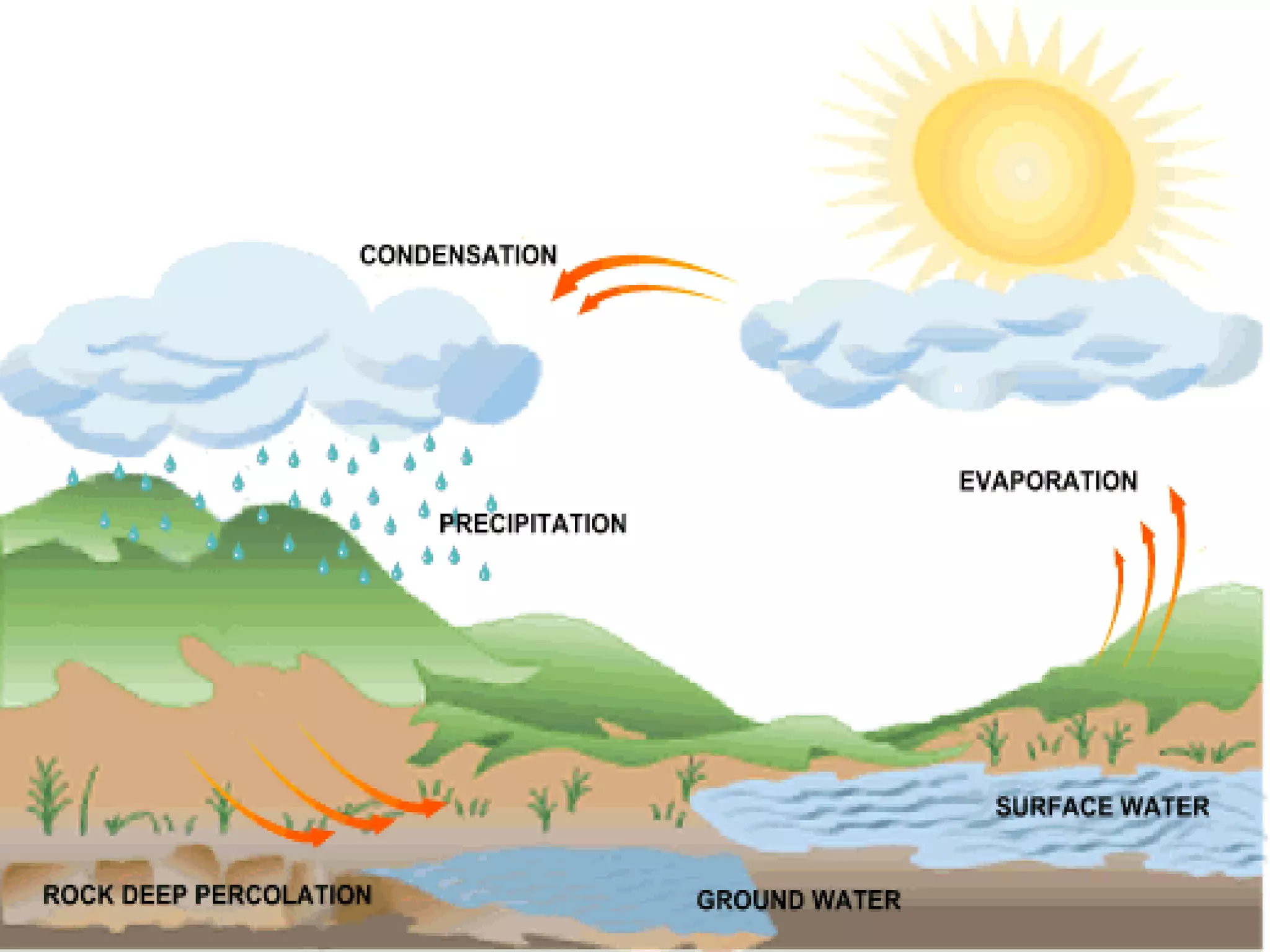
Groundwater in Hydrologic Cycle
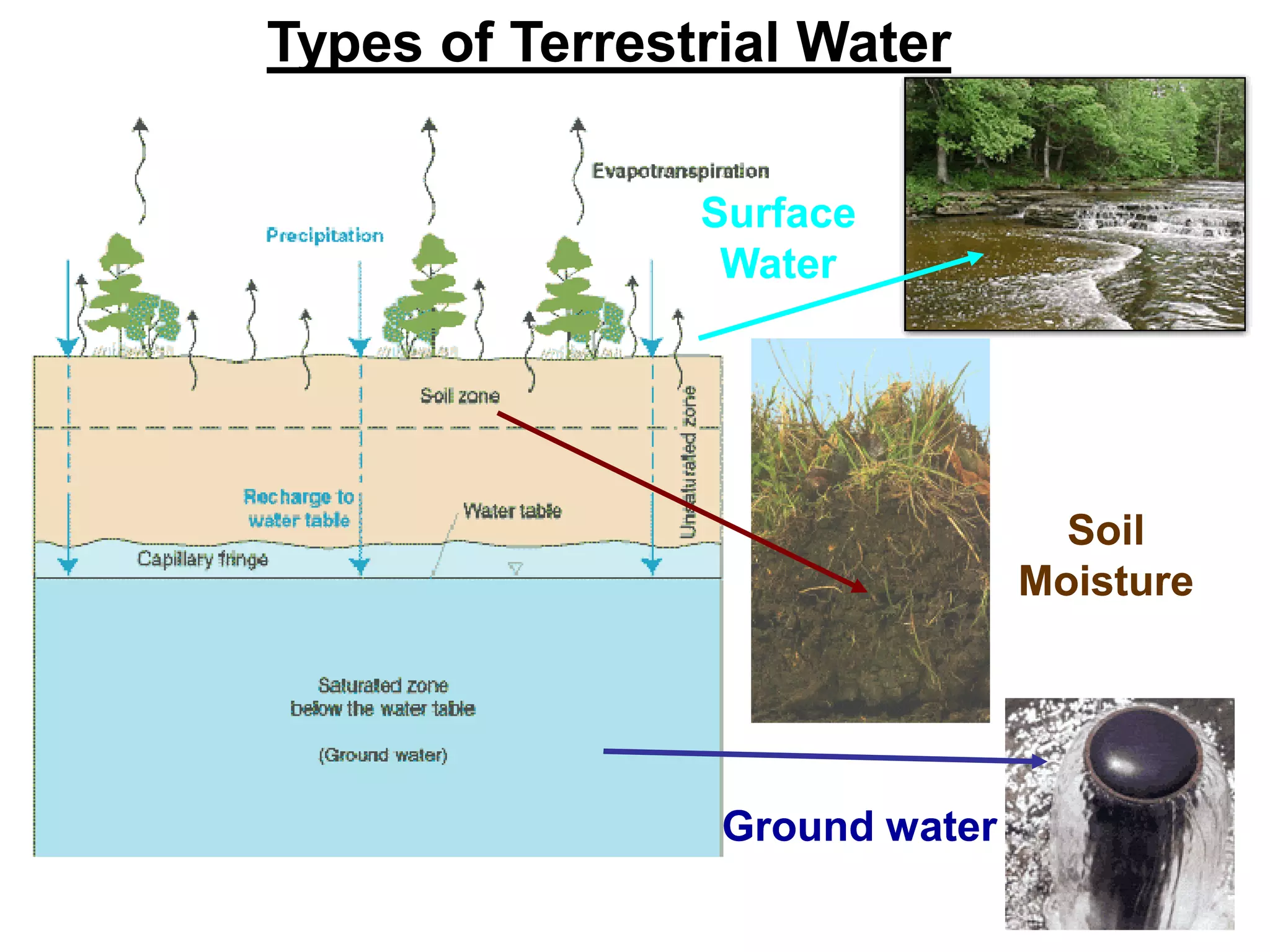
Types of Terrestrial WaterTypes of Terrestrial Water
Ground waterGround water
SoilSoil
MoistureMoisture
Surface
Water
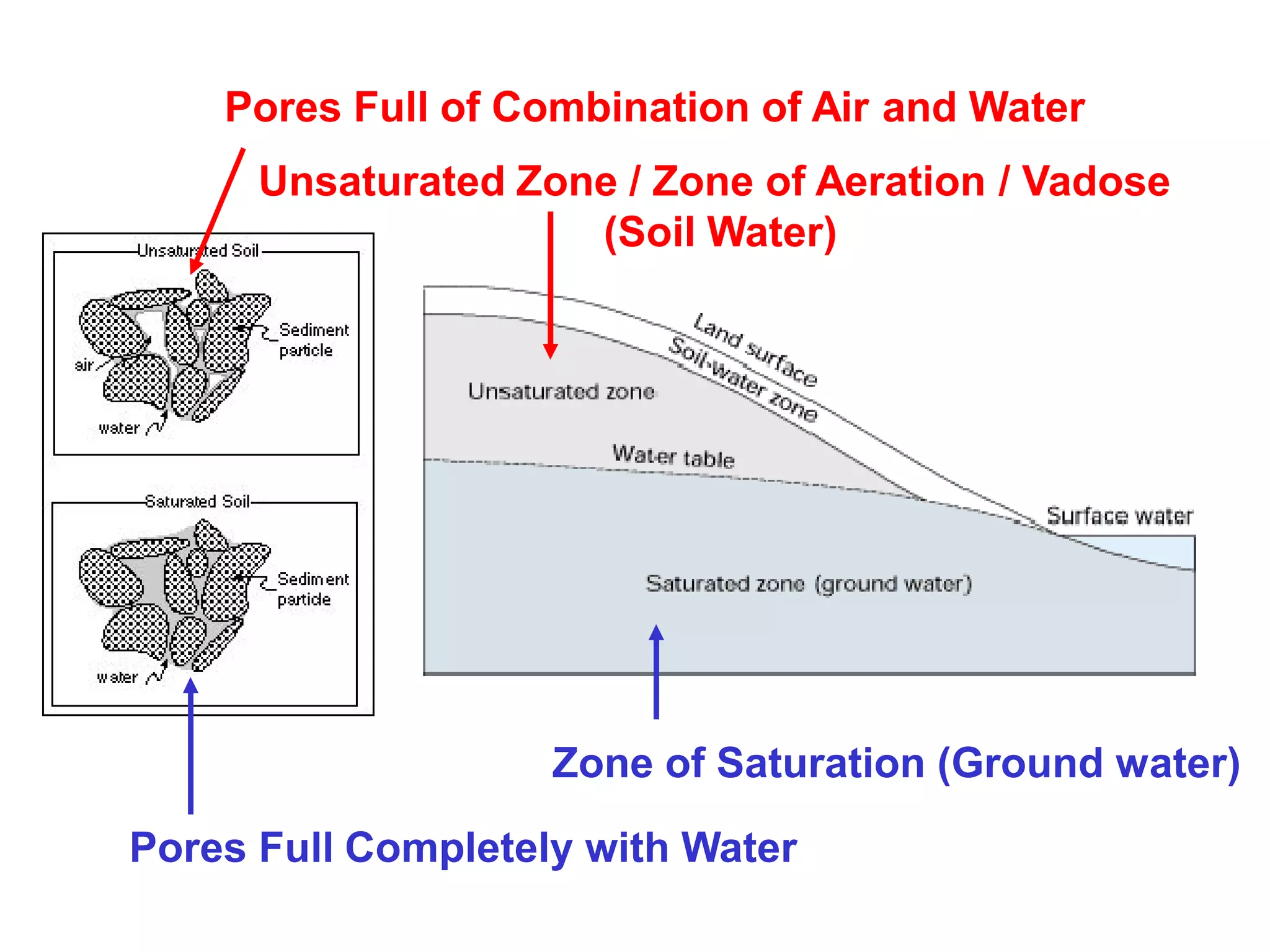
Unsaturated Zone / Zone of Aeration / Vadose
(Soil Water)
Pores Full of Combination of Air and Water
Zone of Saturation (Ground water)
Pores Full Completely with Water
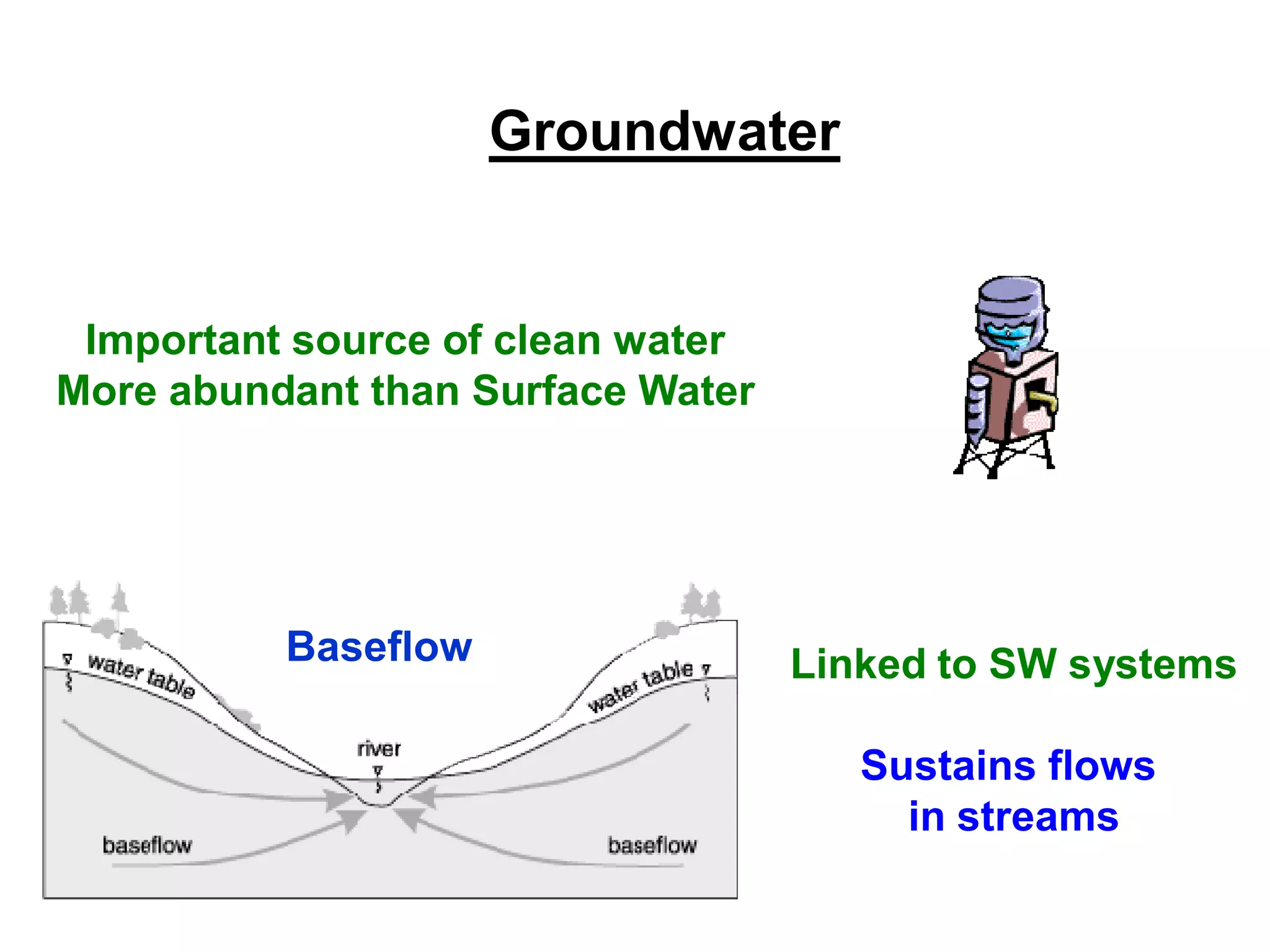
Groundwater
Important source of clean water
More abundant than Surface Water
Linked to SW systems
Sustains flows
in streams
Baseflow
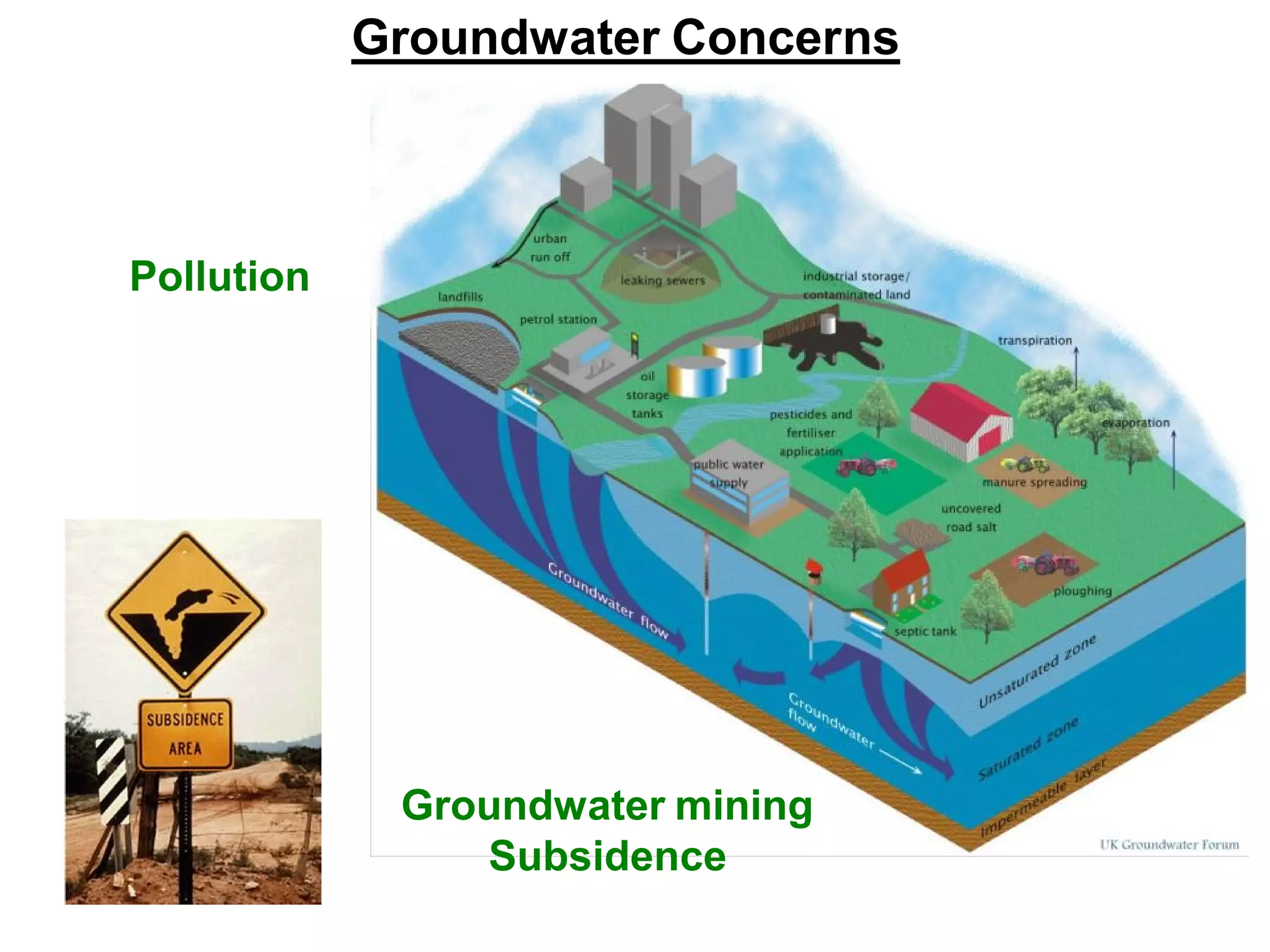
Pollution
Groundwater Concerns
Groundwater mining
Subsidence
Problems with groundwater
Ø Groundwater overdraft / mining / subsidence
Ø Waterlogging
Ø Seawater intrusion
Ø Groundwater pollution
Why Groundwater Modelling is needed?
Groundwater
• An important component of water resource systems.
• Extracted from aquifers through pumping wells and
supplied for domestic use, industry and agriculture.
• With increased withdrawal of groundwater, the quality
of groundwater has been continuously deteriorating.
• Water can be injected into aquifers for storage and/or
quality control purposes.
Management of a groundwater system, means
making such decisions as:
• The total volume that may be withdrawn annually from the aquifer.
• The location of pumping and artificial recharge wells, and their
rates.
• Decisions related to groundwater quality.
Groundwater contamination by:
Ø Hazardous industrial wastes
Ø Leachate from landfills
Ø Agricultural activities such as the use of fertilizers and pesticides
v MANAGEMENT means making decisions to achieve goals without
violating specified constraints.
v Good management requires information on the response of the
managed system to the proposed activities.
v This information enables the decision-maker, to compare alternative
actions and to ensure that constraints are not violated.
v Any planning of mitigation or control measures, once contamination
has been detected in the saturated or unsaturated zones, requires
the prediction of the path and the fate of the contaminants, in
response to the planned activities.
v Any monitoring or observation network must be based on the
anticipated behavior of the system.
v A tool is needed that will provide this information.
v The tool for understanding the system and its behavior
and for predicting this response is the model.
v Usually, the model takes the form of a set of
mathematical equations, involving one or more partial
differential equations. We refer to such model as a
mathematical model.
v The preferred method of solution of the mathematical
model of a given problem is the analytical solution.
v The advantage of the analytical solution is that the
same solution can be applied to various numerical
values of model coefficients and parameters.
v Unfortunately, for most practical problems, because of
the heterogeneity of the considered domain, the
irregular shape of its boundaries, and the non-analytic
form of the various functions, solving the mathematical
models analytically is not possible.
v Instead, we transform the mathematical model into a
numerical one, solving it by means of computer
programs.
ALL GROUNDWATER HYDROLOGY WORK IS MODELING
A Model is a representation of a system.
Modeling begins when one formulates a concept of a
hydrologic system, continues with application of, for
example, Darcy's Law or the Theis equation to the
problem, and may culminate in a complex numerical
simulation.
What is a Model?
• A model is anything that represents an approximation of a
field situation
• Models include:
– Mathematical models
• Numerical
• Analytical
– Physical models
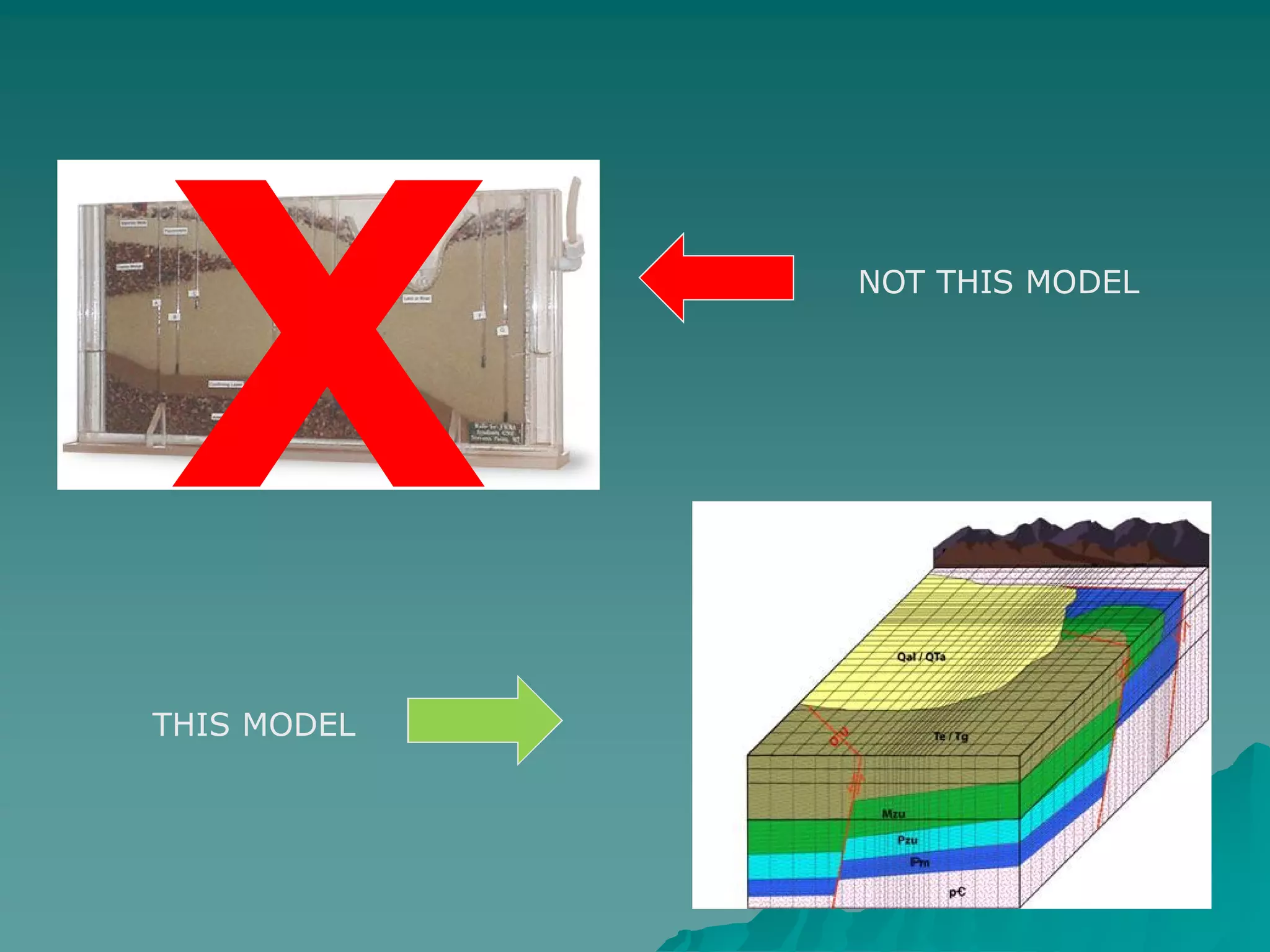
• Sand tank
• A model is a simplified version of a real system and the
phenomena that take place within it
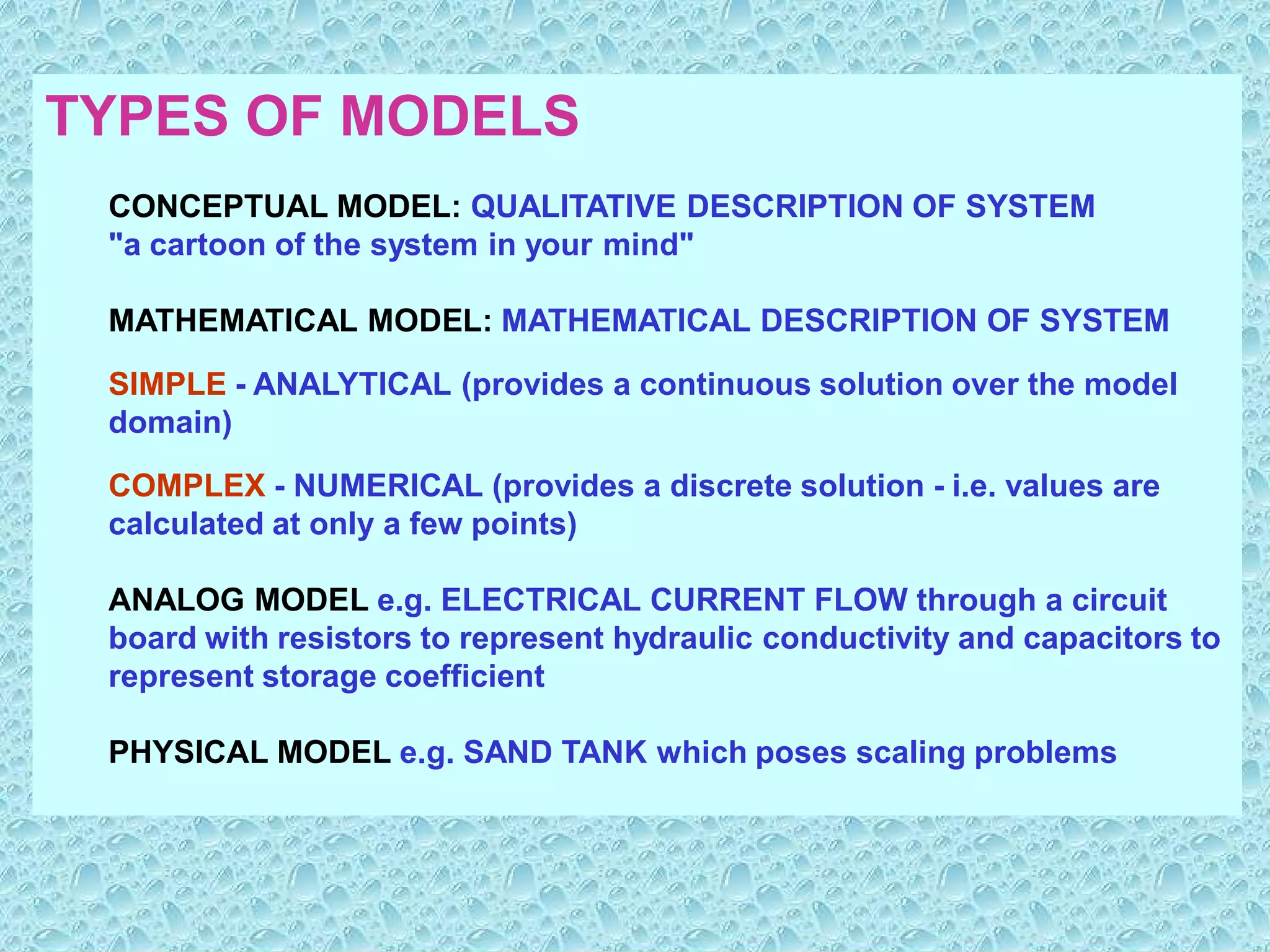
TYPES OF MODELS
CONCEPTUAL MODEL: QUALITATIVE DESCRIPTION OF SYSTEM
"a cartoon of the system in your mind"
MATHEMATICAL MODEL: MATHEMATICAL DESCRIPTION OF SYSTEM
SIMPLE - ANALYTICAL (provides a continuous solution over the model
domain)
COMPLEX - NUMERICAL (provides a discrete solution - i.e. values are
calculated at only a few points)
ANALOG MODEL e.g. ELECTRICAL CURRENT FLOW through a circuit
board with resistors to represent hydraulic conductivity and capacitors to
represent storage coefficient
PHYSICAL MODEL e.g. SAND TANK which poses scaling problems
NOT THIS MODEL
THIS MODEL
Although groundwater flow models can't be as detailed or as
complex as the real system, models are useful in at least four
ways:
• Models integrate and assure consistency among aquifer
properties, recharge, discharge, and groundwater levels.
• Models can be used to estimate flows and aquifer characteristics
for which direct measurements are not available.
• Models can be used to simulate response of the aquifer under
hypothetical conditions.
• Models can identify sensitive areas where additional hydrologic
information could improve understanding.
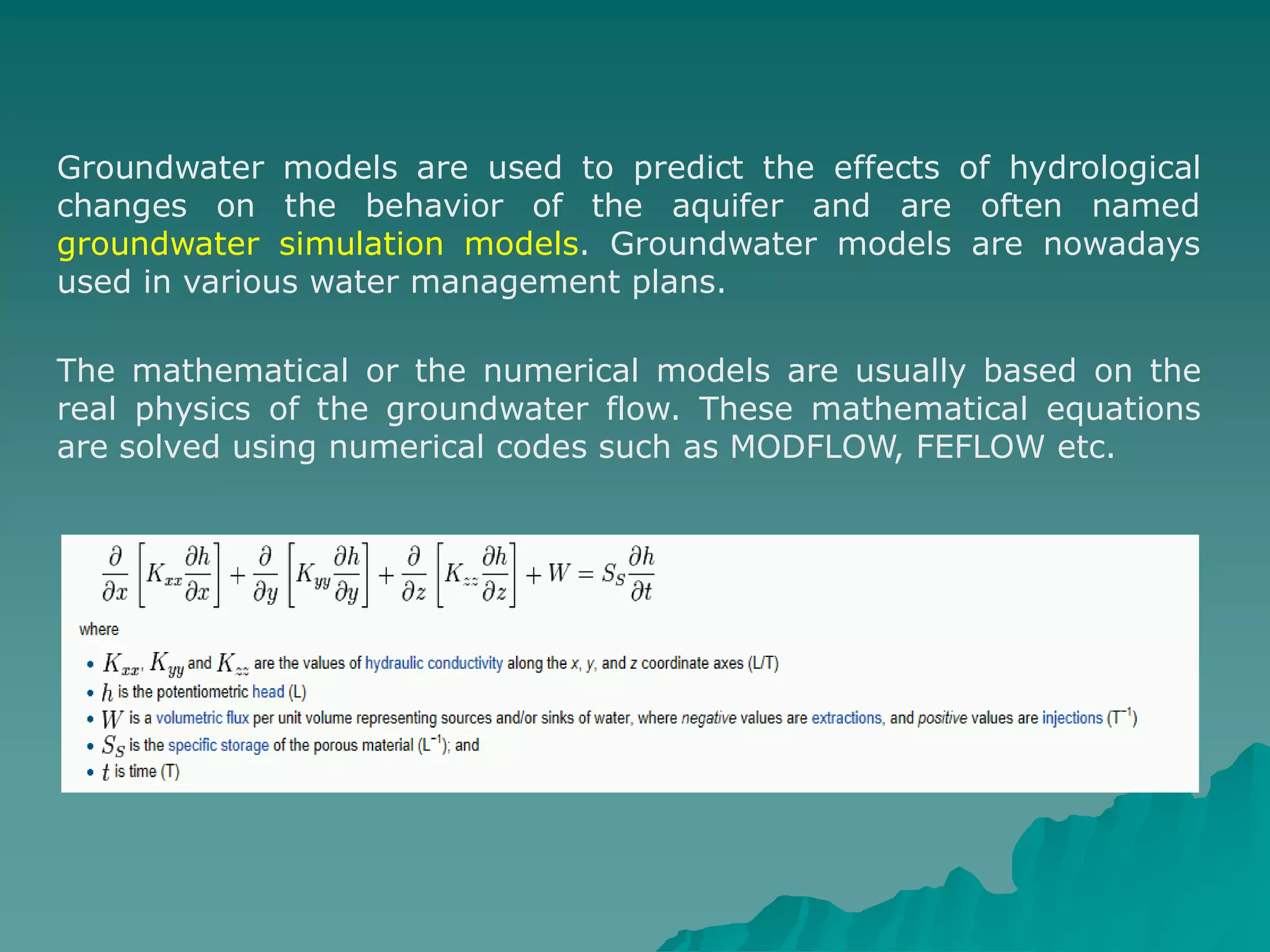
Groundwater models are used to predict the effects of hydrological
changes on the behavior of the aquifer and are often named
groundwater simulation models. Groundwater models are nowadays
used in various water management plans.
The mathematical or the numerical models are usually based on the
real physics of the groundwater flow. These mathematical equations
are solved using numerical codes such as MODFLOW, FEFLOW etc.
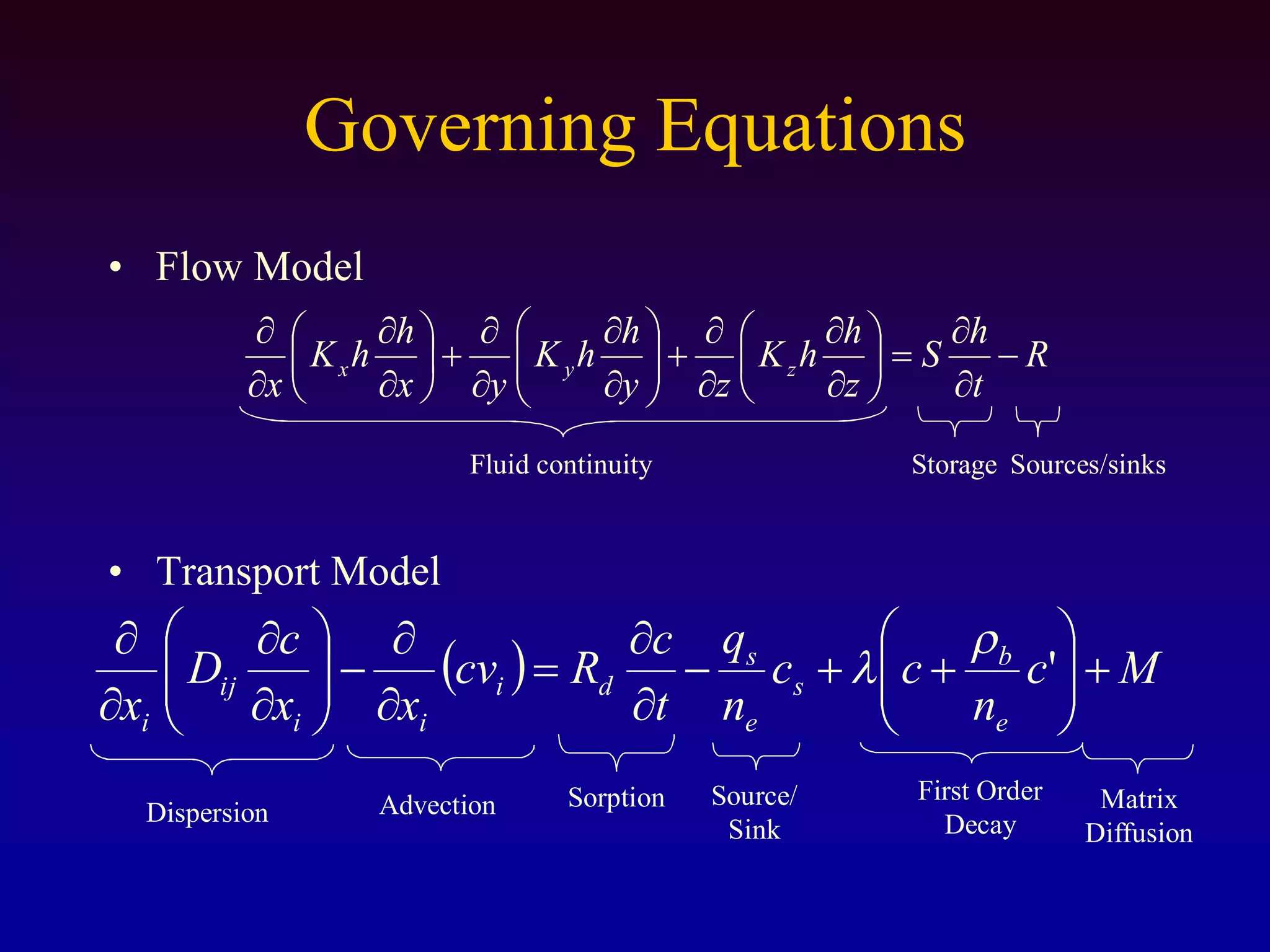
Governing Equations
• Flow Model
• Transport Model
R
t
h
S
z
h
hK
zy
h
hK
yx
h
hK
x
zyx -
¶
¶
=÷
ø
ö
ç
è
æ
¶
¶
¶
¶
+÷÷
ø
ö
çç
è
æ
¶
¶
¶
¶
+÷
ø
ö
ç
è
æ
¶
¶
¶
¶
( ) Mc
n
cc
n
q
t
c
Rcv
xx
c
D
x e
b
s
e
s
di
ii
ij
i
+÷÷
ø
ö
çç
è
æ
++-
¶
¶
=
¶
¶
-÷÷
ø
ö
çç
è
æ
¶
¶
¶
¶
'
r
l
Dispersion Advection Sorption Source/
Sink
First Order
Decay
Matrix
Diffusion
Fluid continuity Storage Sources/sinks
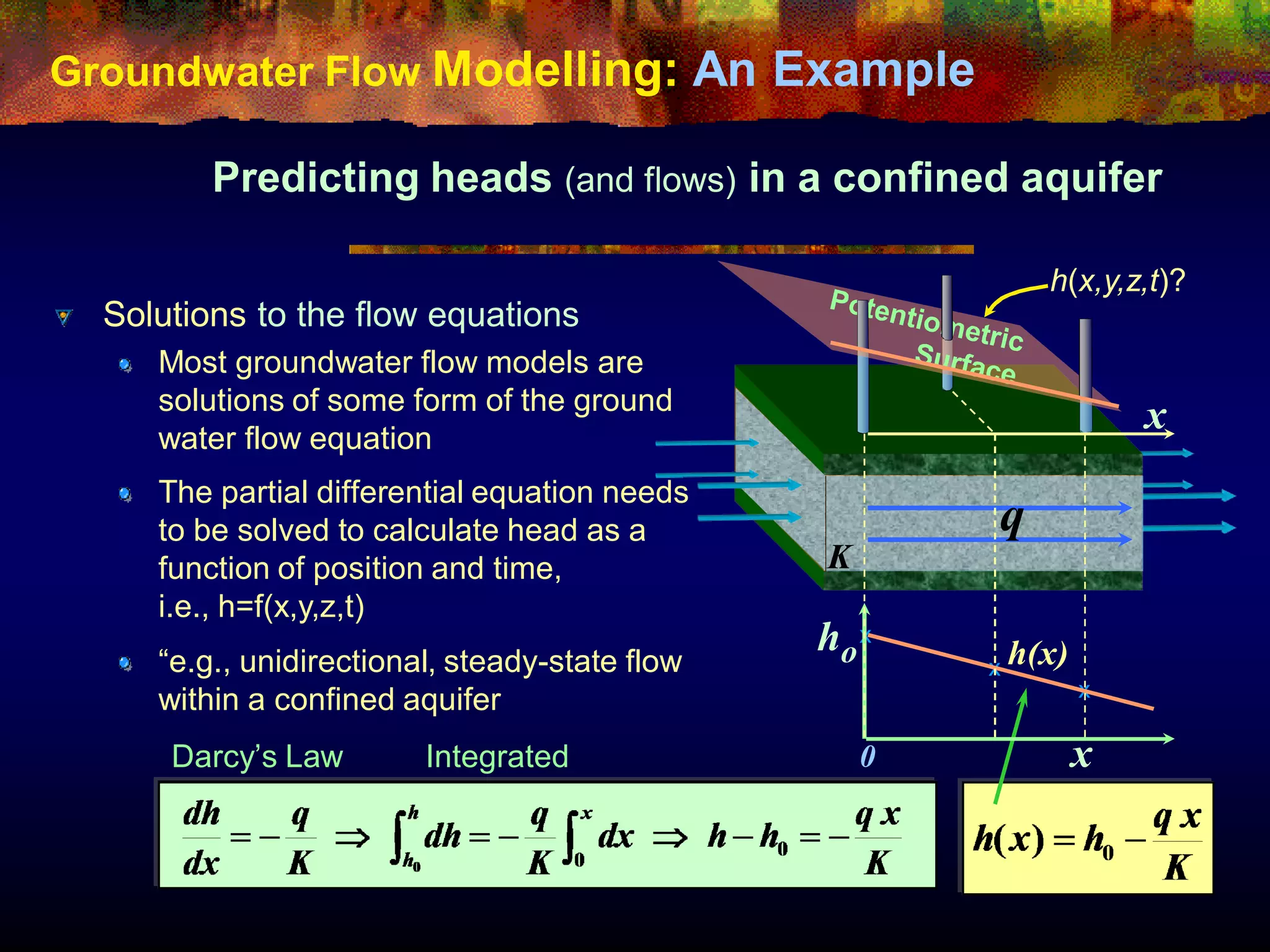
Groundwater Flow Modelling: An Example
Predicting heads (and flows) in a confined aquifer
Solutions to the flow equations
Most groundwater flow models are
solutions of some form of the ground
water flow equation
x
x
x
ho
x0
h(x)
x
K
q
“e.g., unidirectional, steady-state flow
within a confined aquifer
The partial differential equation needs
to be solved to calculate head as a
function of position and time,
i.e., h=f(x,y,z,t)
h(x,y,z,t)?
Darcy’s Law Integrated
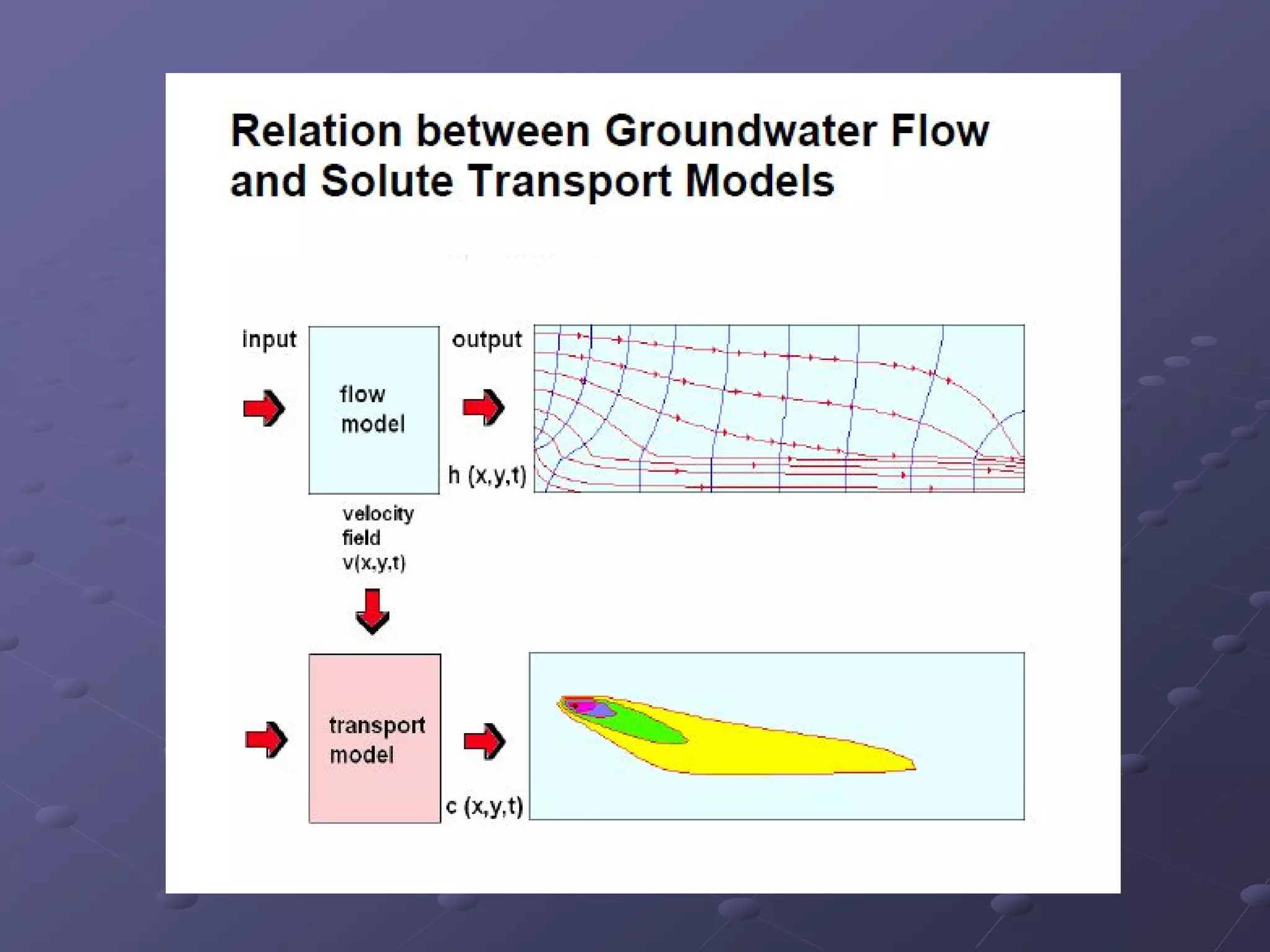
Processes we might want to model
• Groundwater flow
- calculate both heads and flow
• Solute transport – requires information
on flow (velocities)
- calculate concentrations
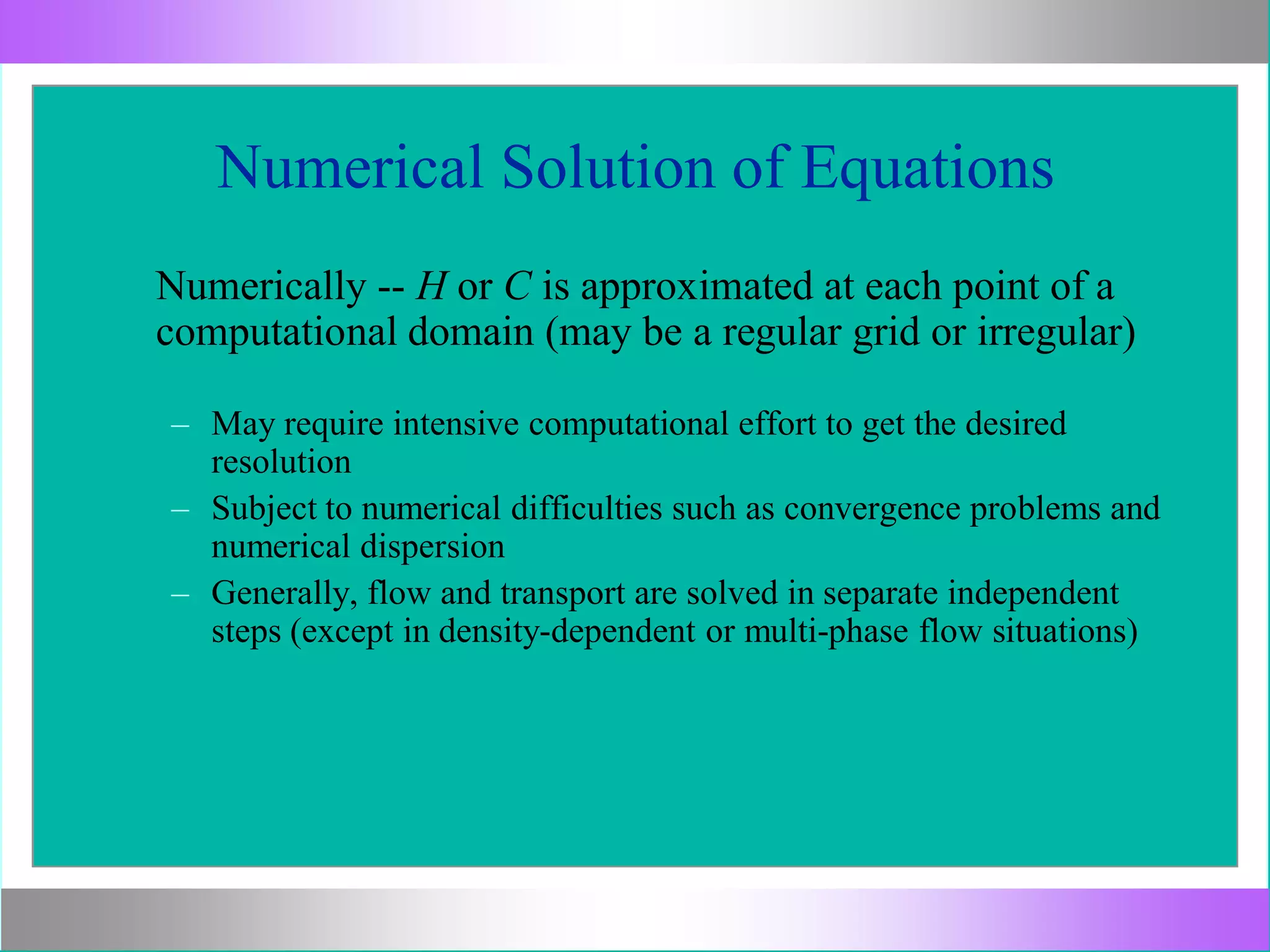
Numerical Solution of Equations
Numerically -- H or C is approximated at each point of a
computational domain (may be a regular grid or irregular)
– May require intensive computational effort to get the desired
resolution
– Subject to numerical difficulties such as convergence problems and
numerical dispersion
– Generally, flow and transport are solved in separate independent
steps (except in density-dependent or multi-phase flow situations)
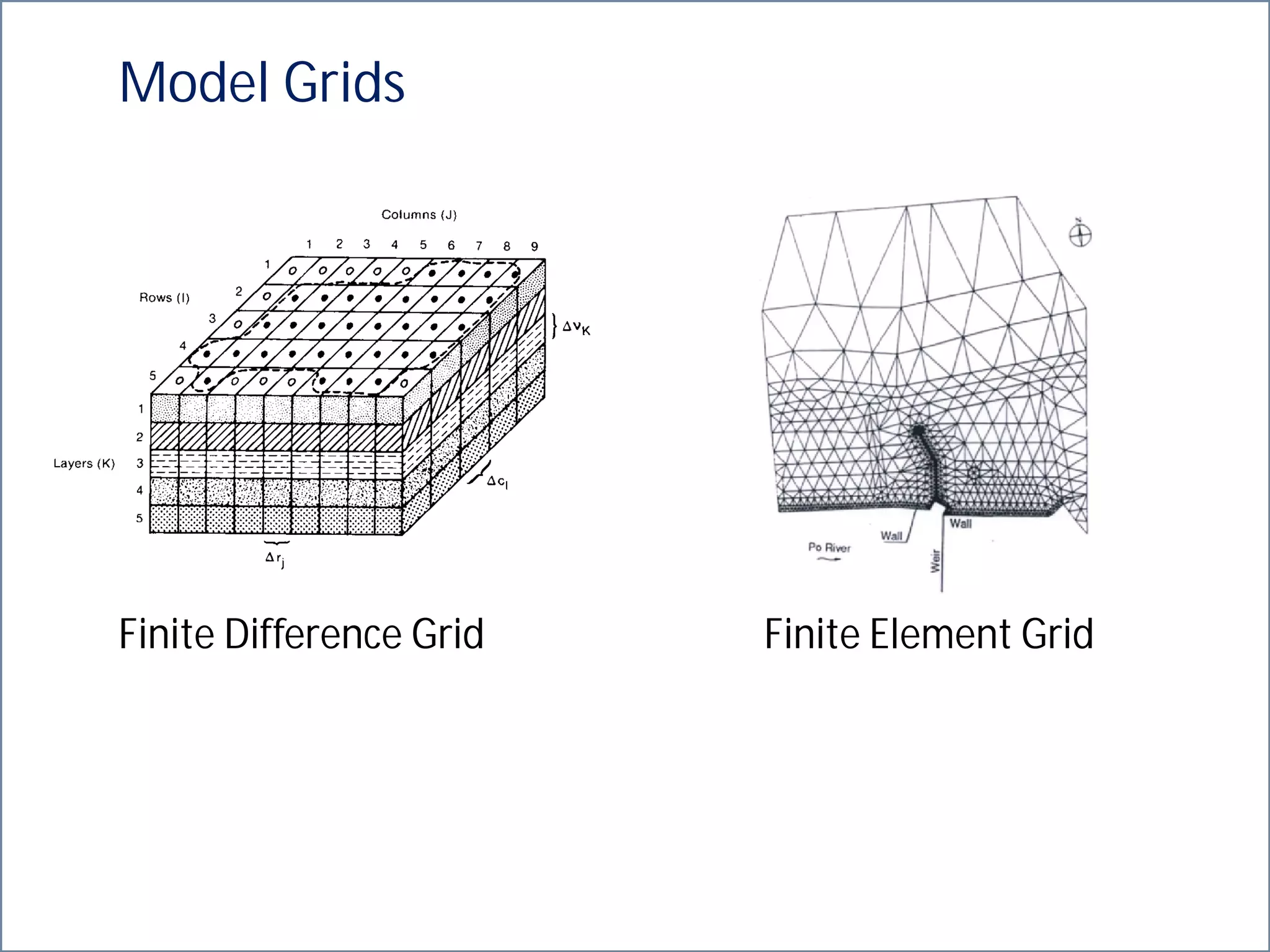
Model Grids
Finite Element GridFinite Difference Grid
(K.J. Halford, 1991)
Calibration,Validation, and Sensitivity
Analysis
– Calibration is the process of making the model match real-
world data. Involves making several model runs, varying
parameters until the ‘best fit’ is achieved.
– Validation is the process of confirming the validity of your
calibration by using the model to fit an independent set of data.
– Sensitivity Analysis is the process of changing parameters to
see the effects on the model results. The most sensitive parameters
need to be checked for accuracy to ensure the best model.
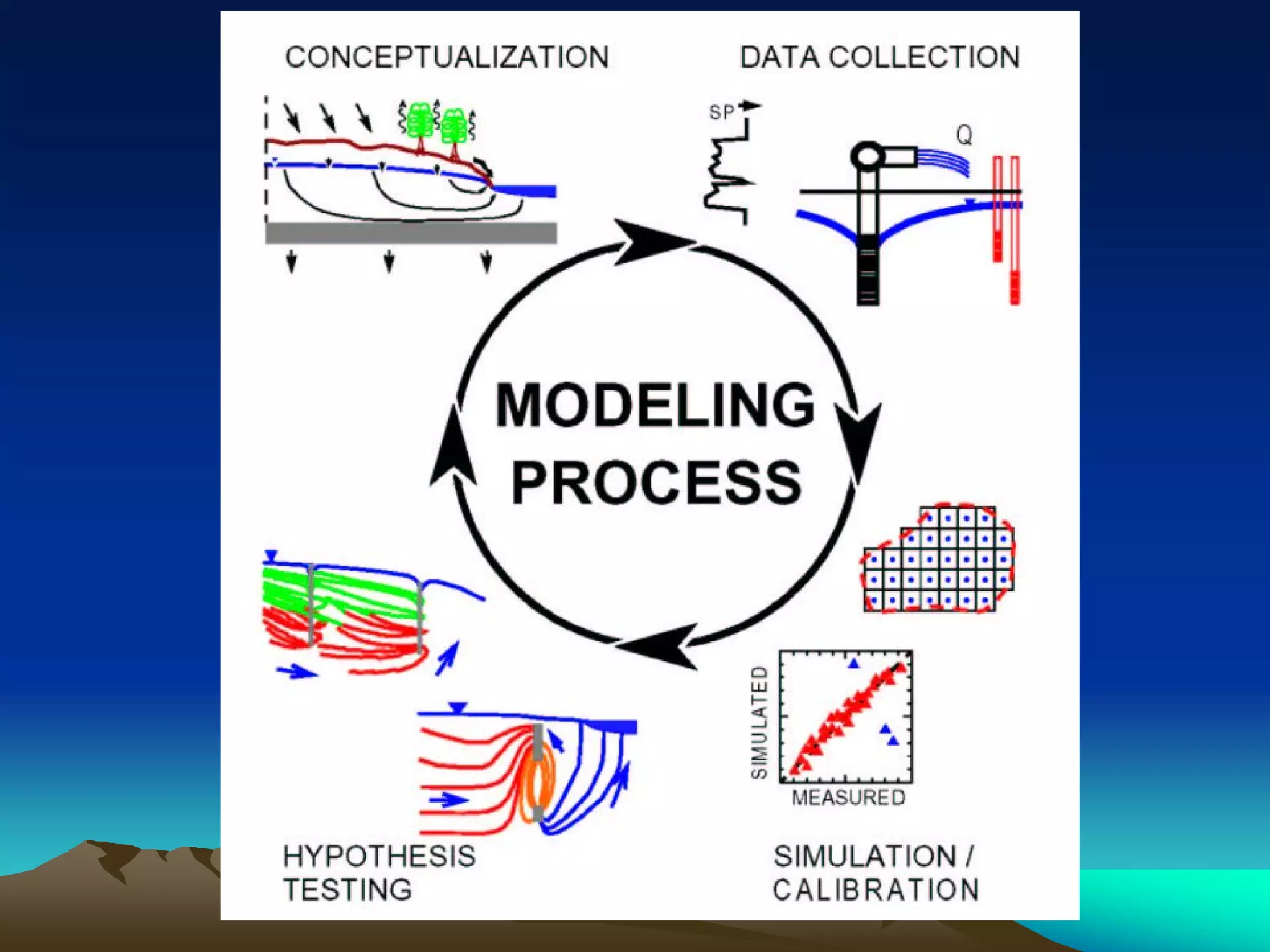
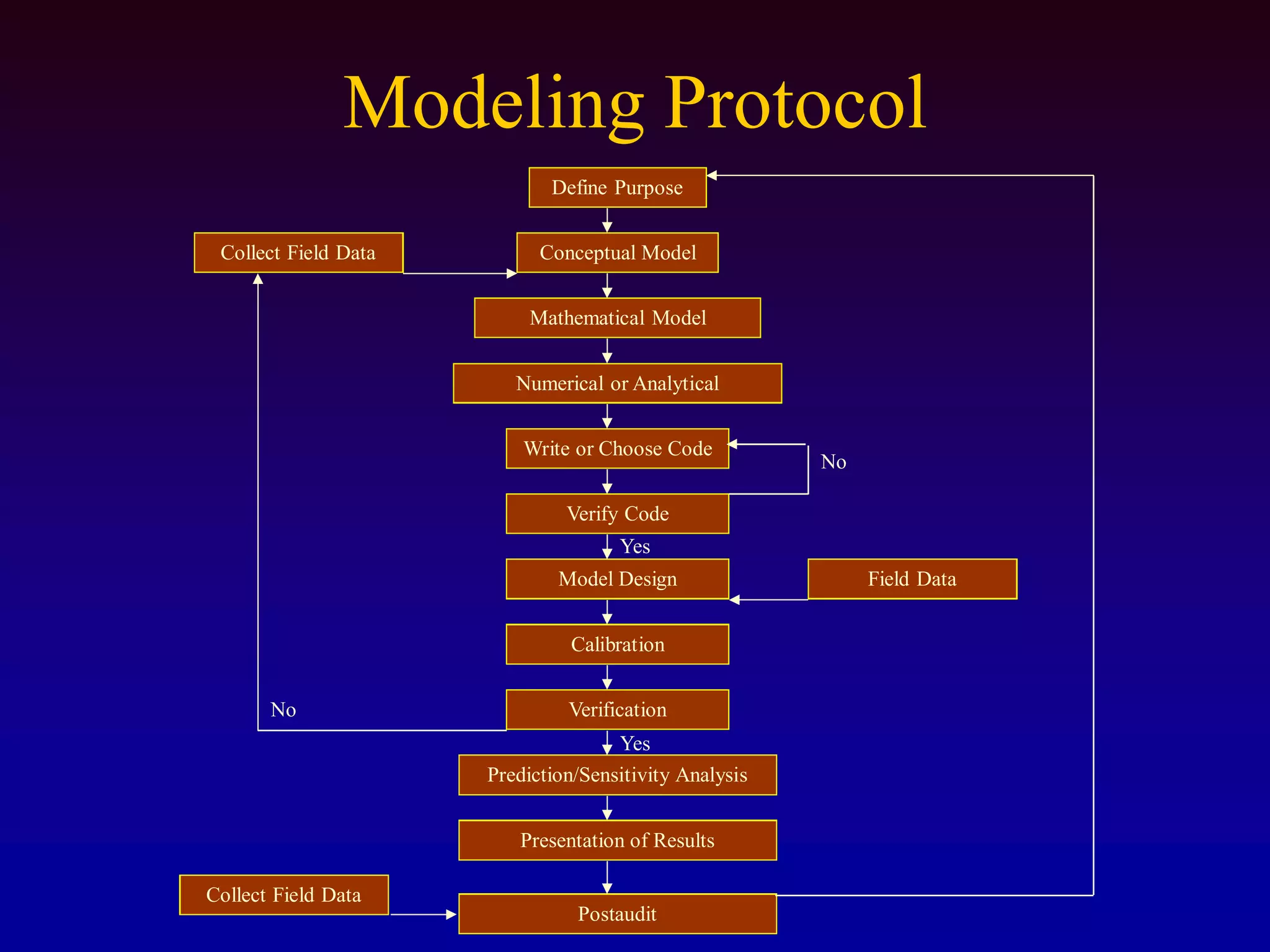
Modeling Protocol
Define Purpose
Write or Choose Code
Collect Field Data Conceptual Model
Mathematical Model
Numerical or Analytical
Verify Code
Model Design
Calibration
Prediction/Sensitivity Analysis
Verification
Presentation of Results
Postaudit
No
Yes
Field Data
Yes
No
Collect Field Data
Data Requirements for
Groundwater Modelling
Ø The success of any groundwater study, to a large measure, depends
upon the availability and accuracy of measured/recorded data required
for that study.
Ø Therefore, identifying the data needs and collection/monitoring of
required data form an integral part of any groundwater exercise.
Ø The first phase of any groundwater study consists of collecting all
existing geological and hydrological data on the groundwater basin in
question.
Ø Any groundwater balance or numerical model requires a set of
quantitative hydrogeological data that fall into two categories:
* Data that define the physical framework of the groundwater basin
* Data that describe its hydrological framework
Defining Data Requirements
Ø General Data Needs
Ø Physical Framework and Hydrological Framework
Ø Hydrological Data Inputs and Operational Data Inputs
Ø Input Data for Flow Models and Transport Models
Model Output for Flow Models and Transport Models
One, Two or Three – Dimensional Models
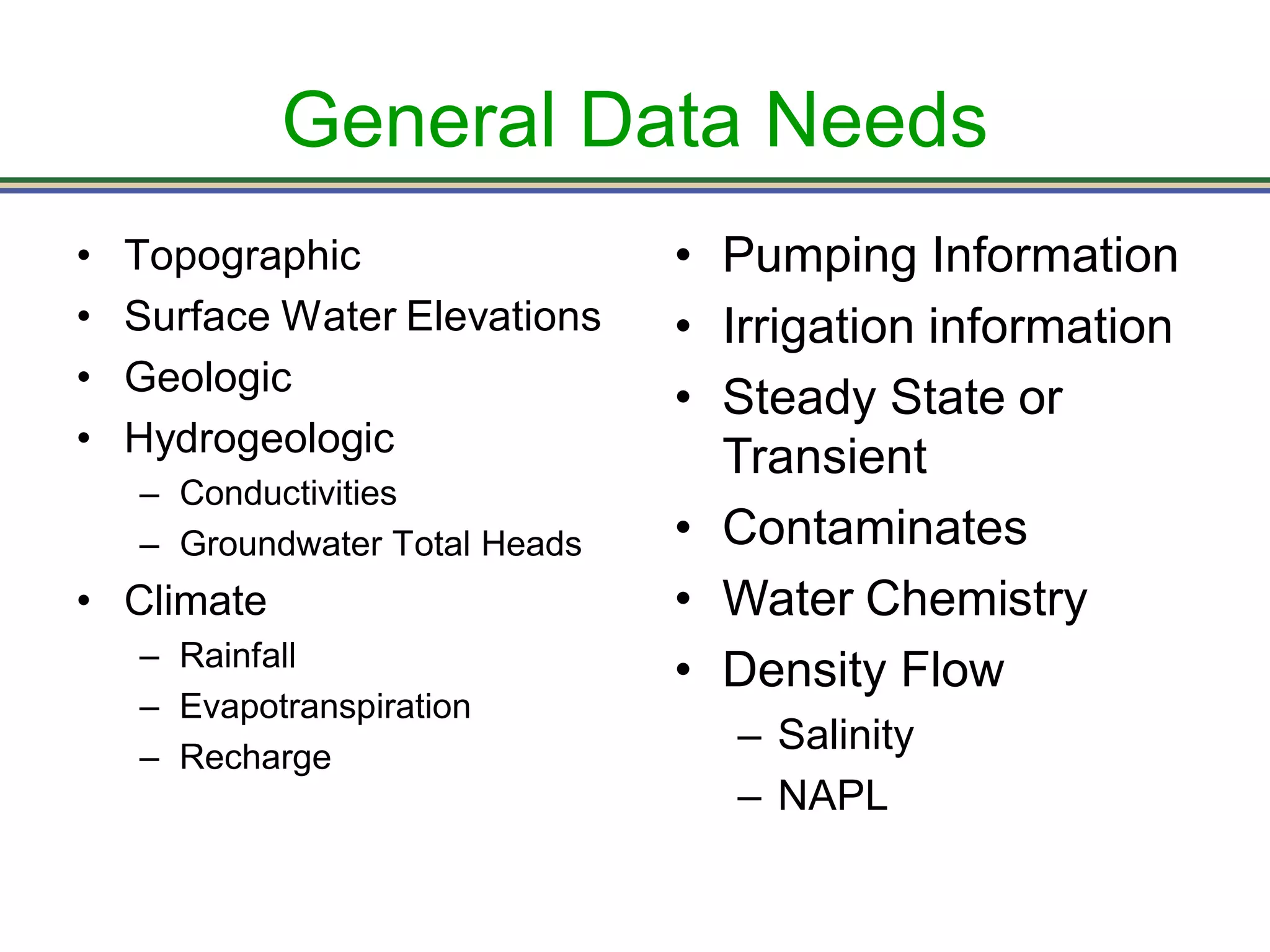
General Data Needs
• Topographic
• Surface Water Elevations
• Geologic
• Hydrogeologic
– Conductivities
– Groundwater Total Heads
• Climate
– Rainfall
– Evapotranspiration
– Recharge
• Pumping Information
• Irrigation information
• Steady State or
Transient
• Contaminates
• Water Chemistry
• Density Flow
– Salinity
– NAPL
Physical Framework
1. Topography
2. Geology
3. Types of aquifers
4. Aquifer thickness and lateral extent
5. Aquifer boundaries
6. Lithological variations within the aquifer
7. Aquifer characteristics
Hydrological Framework
1. Water table elevation
2. Type and extent of recharge areas
3. Rate of recharge
4. Type and extent of discharge areas
5. Rate of discharge
The data required for a groundwater flow modelling study under
physical framework are:
§ Geologic map and cross section or fence diagram showing the
areal and vertical extent and boundaries of the system.
§ Topographic map at a suitable scale showing all surface water
bodies and divides. Details of surface drainage system, springs,
wetlands and swamps should also be available on map.
§ Land use maps showing agricultural areas.
§ Contour maps showing the elevation of the base of the aquifers
and confining beds.
§ Isopach maps showing the thickness of aquifers and confining
beds.
These data are used for defining the geometry of the groundwater
domain under investigation, including the thickness and areal extent
of each hydrostratigraphic unit.
Under the hydrogeologic framework, the data requirements for a
groundwater flow modelling study are:
§ Water table and potentiometric maps for all aquifers.
§ Hydrographs of groundwater head and surface water levels.
§ Maps and cross-sections showing the hydraulic conductivity and/or
transmissivity distribution.
§ Maps and cross-sections showing the storage properties of the
aquifers and confining beds.
§ Spatial and temporal distribution of rates of evaporation,
groundwater recharge, groundwater pumping etc.
Data inputs needed for the model:
• Hydrological data inputs
• Operational data inputs
• Initial and Boundary conditions
• Hydraulic parameters
Hydrological Data Inputs
• Rainfall
• Surface water infiltration
• Evaporation
• Evapotranspiration
These inputs may vary in both time and
space. Some of this data is measured by
climatological services (weather stations).
Operational Data Inputs - Water
Management Data:
• Irrigation
• Drainage
• Pumping from wells
• Water table information
• Retention or infiltration basins
These inputs vary in quantity and quality.
Boundary Conditions (in detail later)
• Levels of the water table
• Piezometric heads
• Hydraulic head along the boundaries of
the model (the head conditions)
• Groundwater inflows and outflows along
the boundaries of the model (the flow
conditions).
Initial Conditions
The initial conditions refer to initial values
of elements that may increase or decrease
in the course of the time inside the model
domain.
Hydraulic Parameters
• Geometry and distances in the domain to
be modelled (geology, size of model)
• Topography
• Horizontal/vertical hydraulic conductivity
of rock layers
• Aquifer transmissivity
• Aquifer porosity and storage coefficient
• Capillarity of the unsaturated zone
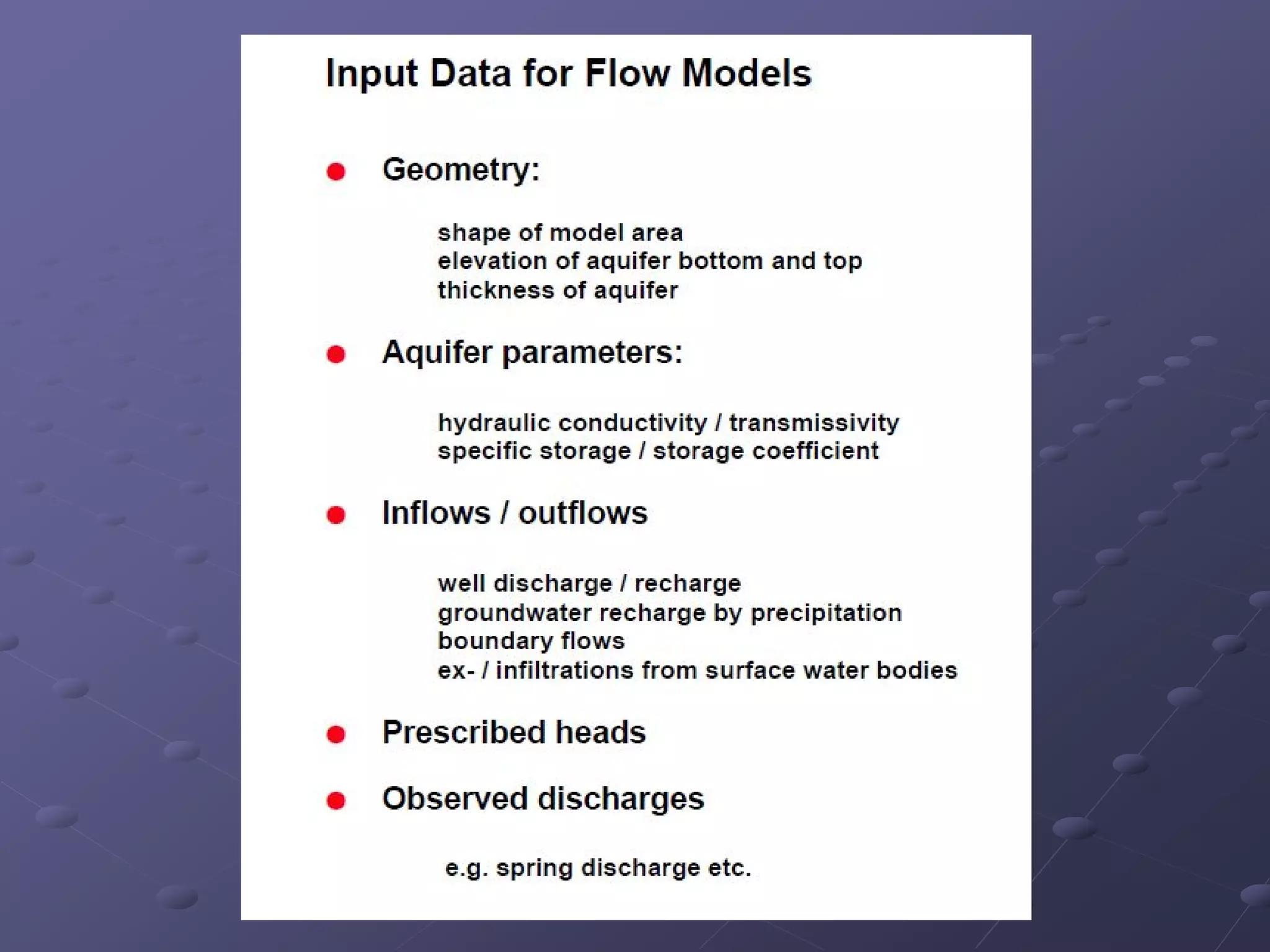
Model Input Data (Flow)
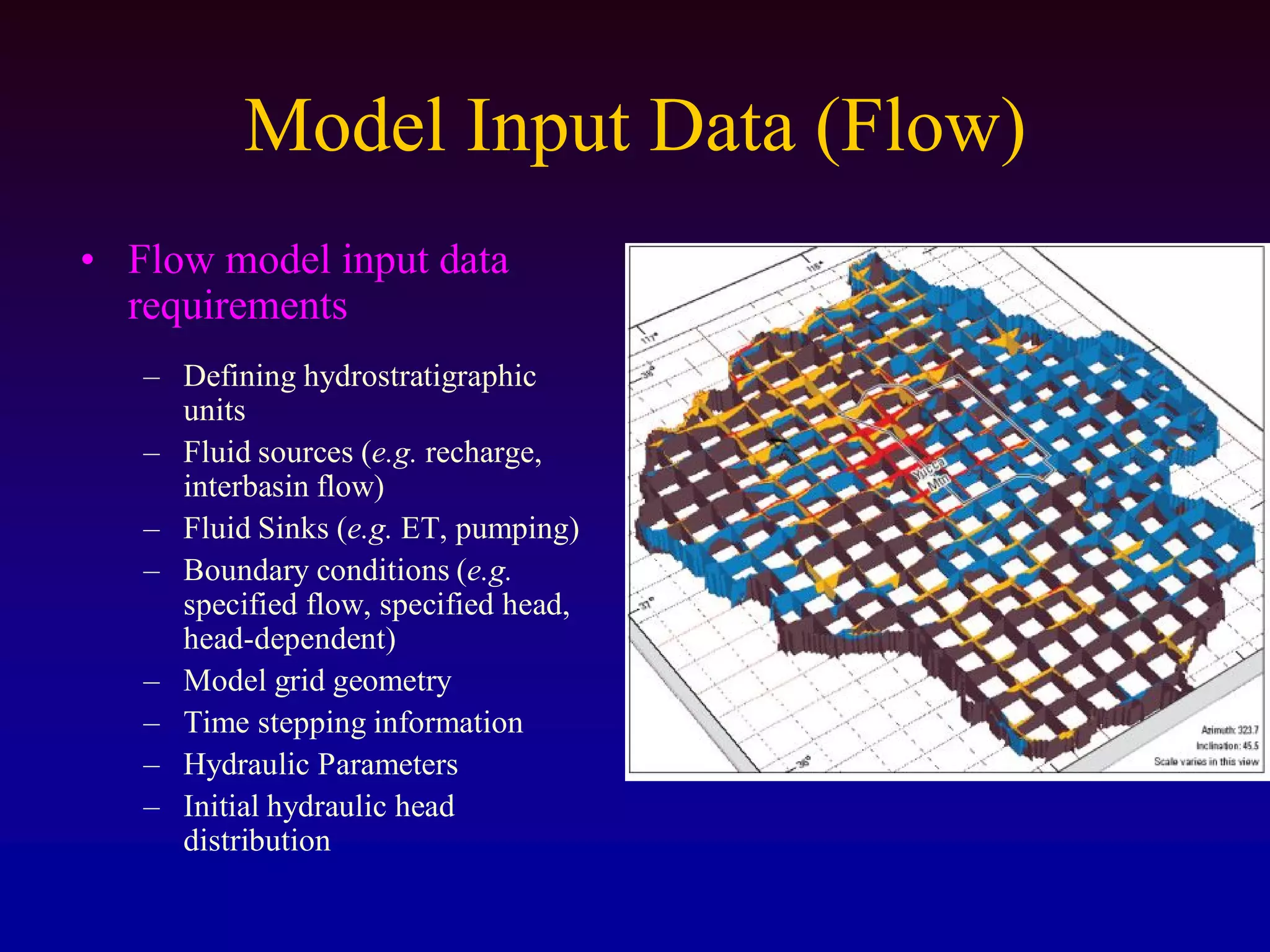
• Flow model input data
requirements
– Defining hydrostratigraphic
units
– Fluid sources (e.g. recharge,
interbasin flow)
– Fluid Sinks (e.g. ET, pumping)
– Boundary conditions (e.g.
specified flow, specified head,
head-dependent)
– Model grid geometry
– Time stepping information
– Hydraulic Parameters
– Initial hydraulic head
distribution
Model Output Data (Flow)
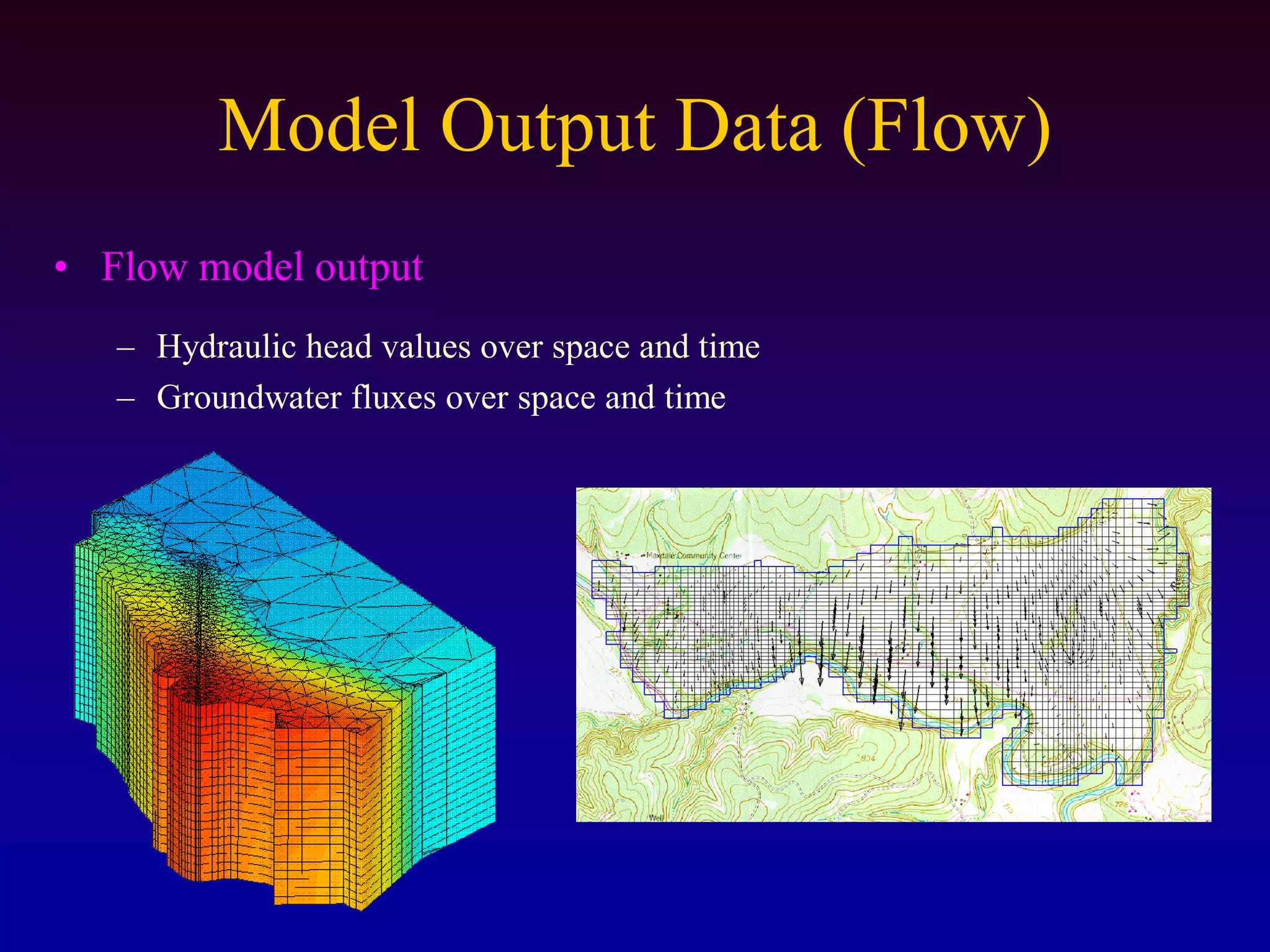
• Flow model output
– Hydraulic head values over space and time
– Groundwater fluxes over space and time
Model Input Data (Transport)
• Transport model input requirements
– Fluid velocities
– Initial distribution of contaminants
– Sources and sinks for contaminants
– Boundary conditions
– Dispersion coefficients
– Effective porosity
– Decay and/or reaction coefficients
– Contaminant loading functions
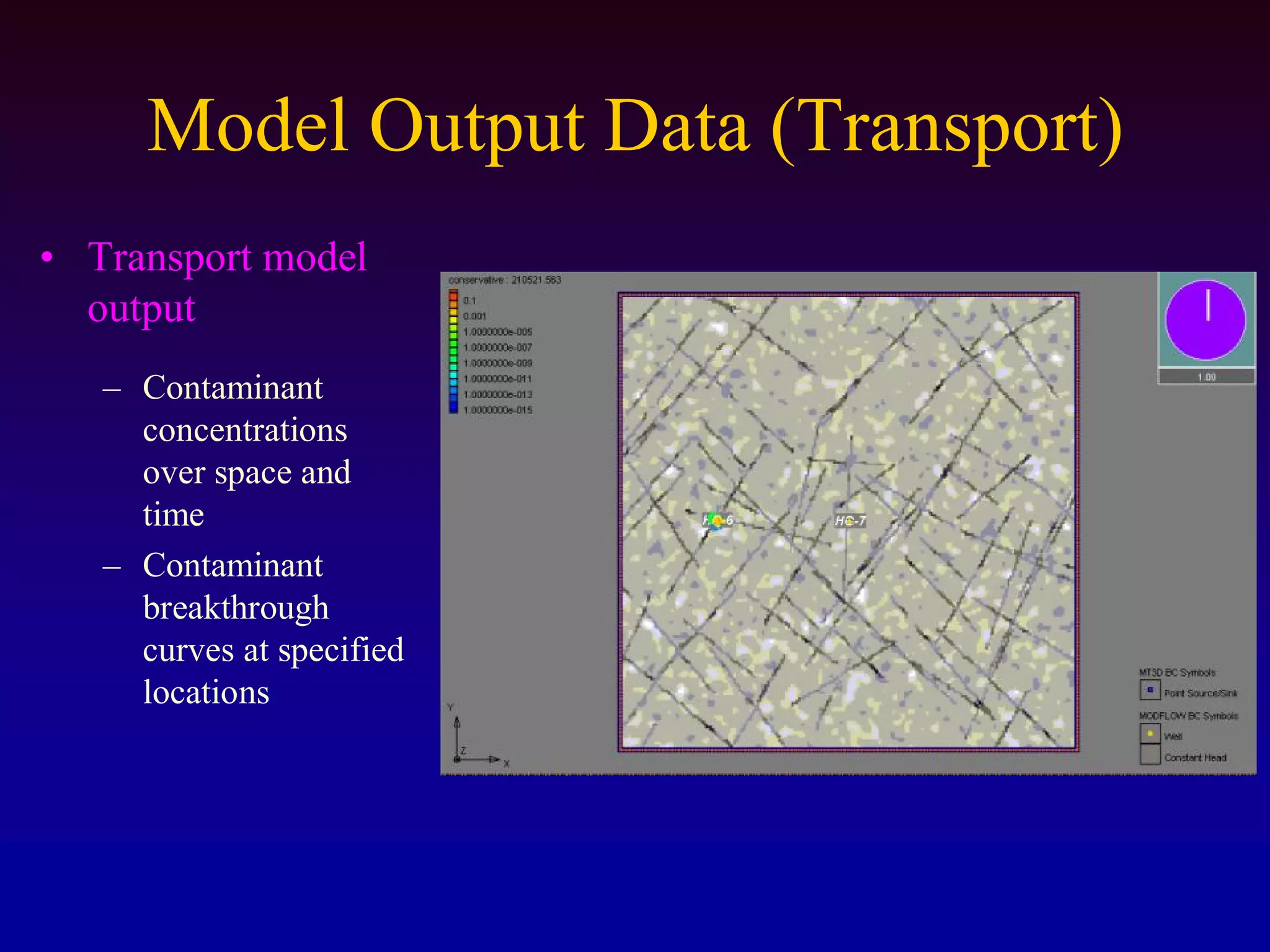
Model Output Data (Transport)
• Transport model
output
– Contaminant
concentrations
over space and
time
– Contaminant
breakthrough
curves at specified
locations
Dimensions
Groundwater models can be one-dimensional,
two-dimensional, and three-dimensional.
One-dimensional models can be used for the
vertical flow in a system of parallel horizontal
layers.
Two-dimensional models apply to a vertical
plane while it is assumed that the
groundwater conditions repeat themselves in
other parallel vertical planes.
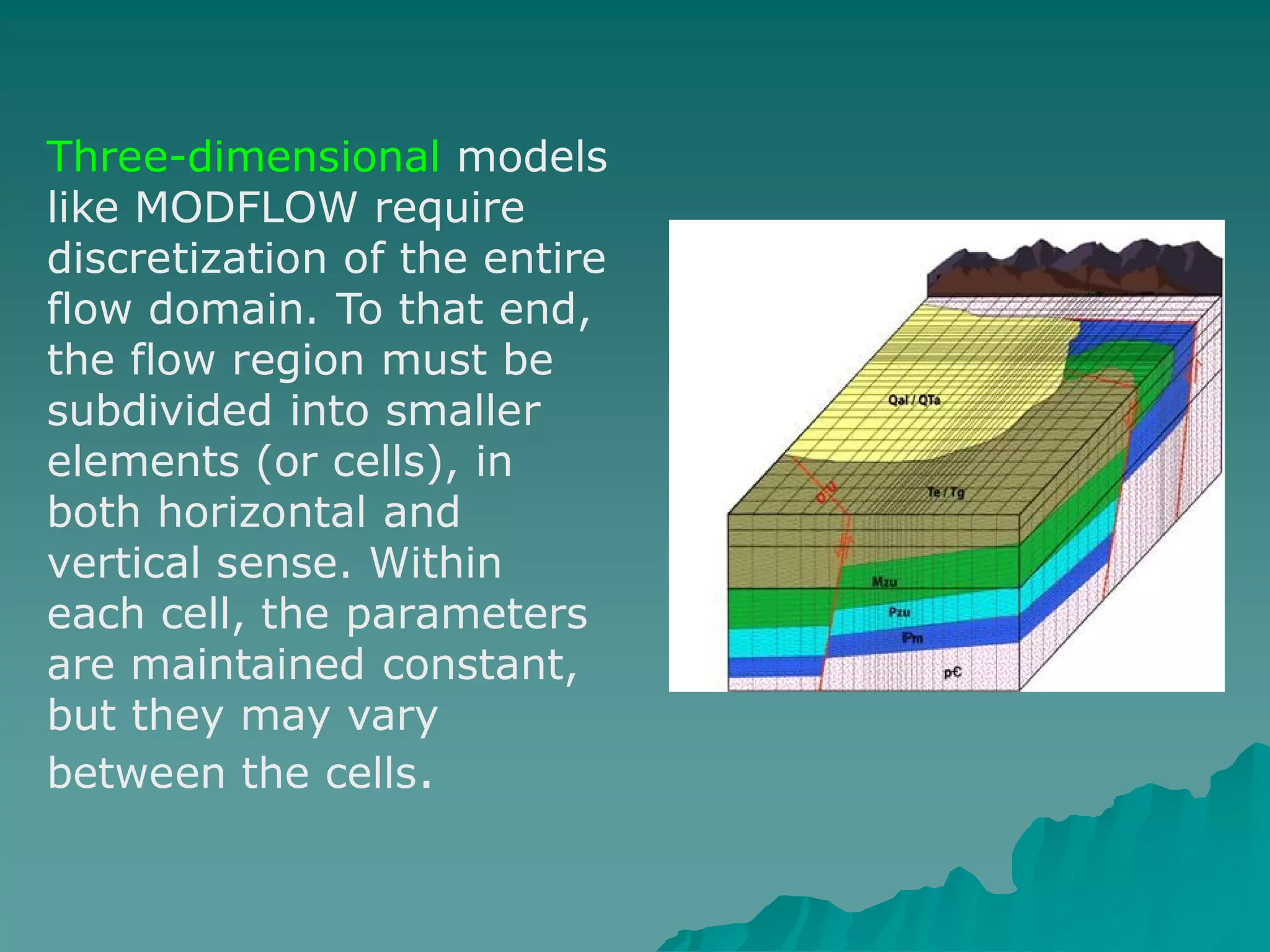
Three-dimensional models
like MODFLOW require
discretization of the entire
flow domain. To that end,
the flow region must be
subdivided into smaller
elements (or cells), in
both horizontal and
vertical sense. Within
each cell, the parameters
are maintained constant,
but they may vary
between the cells.
All these model inputs require a lot of data.
Data can be very manpower-intensive (READ
EXPENSIVE!)
Do we spend the time and money now to get
better management of our water resources?
OR
Do we wait until we are compelled to do so?
Boundary Conditions
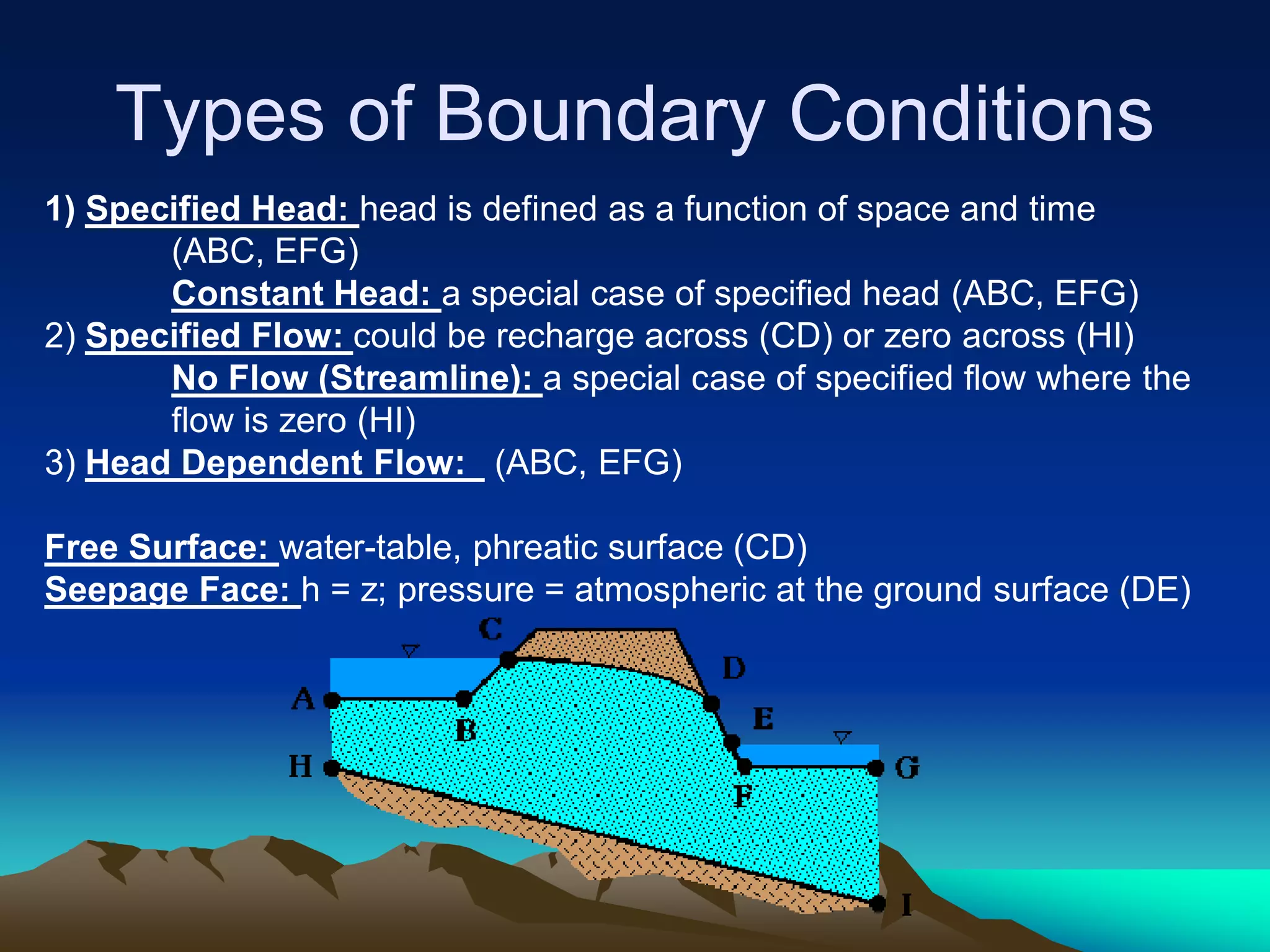
Types of Boundary ConditionsTypes of Boundary Conditions
1) Specified Head: head is defined as a function of space and time
(ABC, EFG)
Constant Head: a special case of specified head (ABC, EFG)
2) Specified Flow: could be recharge across (CD) or zero across (HI)
No Flow (Streamline): a special case of specified flow where the
flow is zero (HI)
3) Head Dependent Flow: (ABC, EFG)
Free Surface: water-table, phreatic surface (CD)
Seepage Face: h = z; pressure = atmospheric at the ground surface (DE)
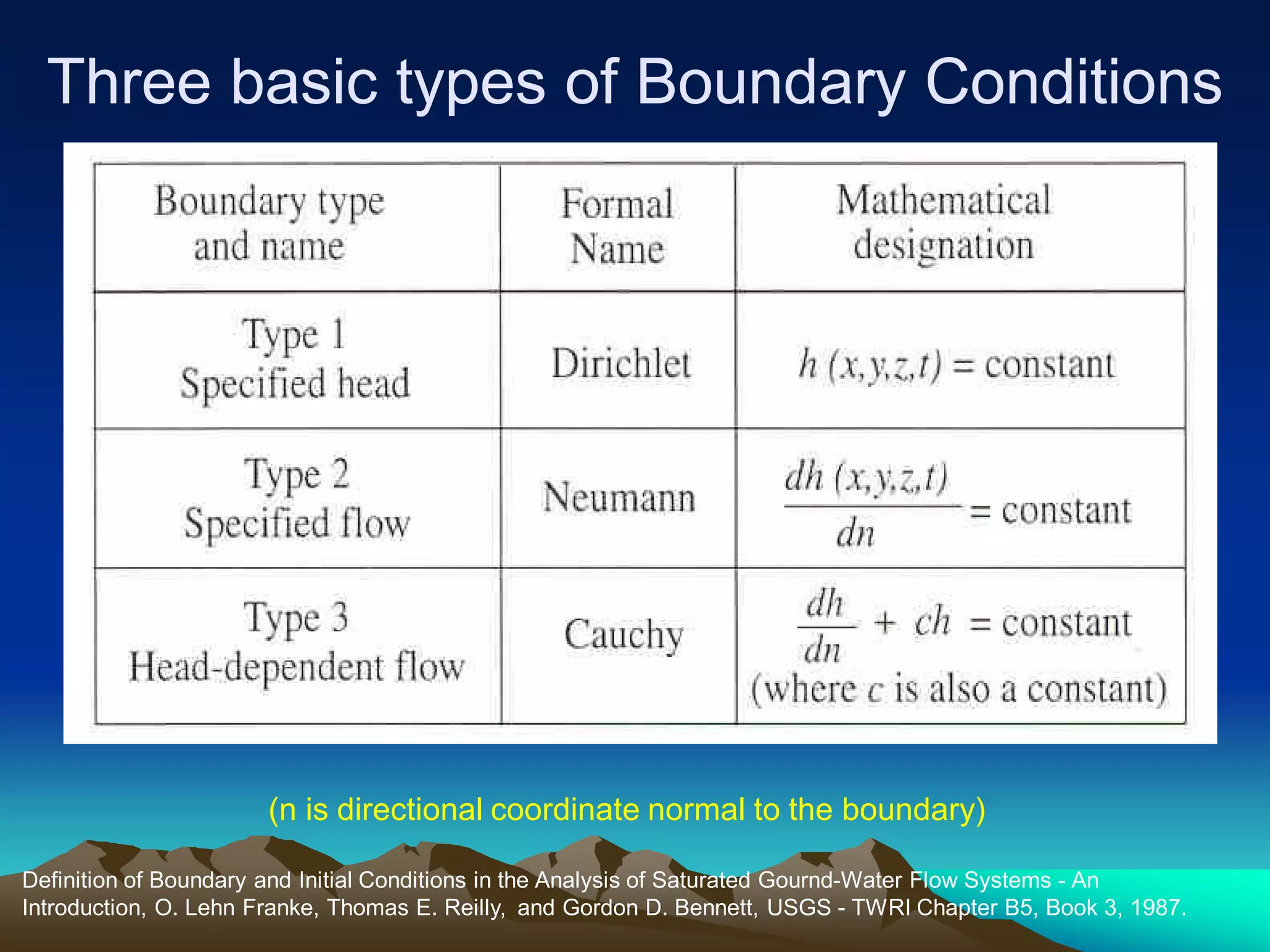
Three basic types of Boundary ConditionsThree basic types of Boundary Conditions
(n is directional coordinate normal to the boundary)
Definition of Boundary and Initial Conditions in the Analysis of Saturated Gournd-Water Flow Systems - An
Introduction, O. Lehn Franke, Thomas E. Reilly, and Gordon D. Bennett, USGS - TWRI Chapter B5, Book 3, 1987.
DIRICHLETDIRICHLET
Constant Head &Constant Head &
Specified Head BoundariesSpecified Head Boundaries
Specified Head:
Head (H) is defined as a function of time and
space.
Constant Head:
Head (H) is constant at a given location.
Implications:
Supply Inexhaustible
NEUMANNNEUMANN
No Flow andNo Flow and
Specified Flow BoundariesSpecified Flow Boundaries
Specified Flow:
Discharge (Q) varies with space and time.
No Flow:
Discharge (Q) equals 0 across boundary.
Implications: H will be calculated as the value required to
produce a gradient to yield that flow, given a specified
hydraulic conductivity (K). The resulting head may be above
the ground surface in an unconfined aquifer, or below the base
of the aquifer where there is a pumping well; neither of these
cases are desirable.
CAUCHYCAUCHY
Head Dependent FlowHead Dependent Flow
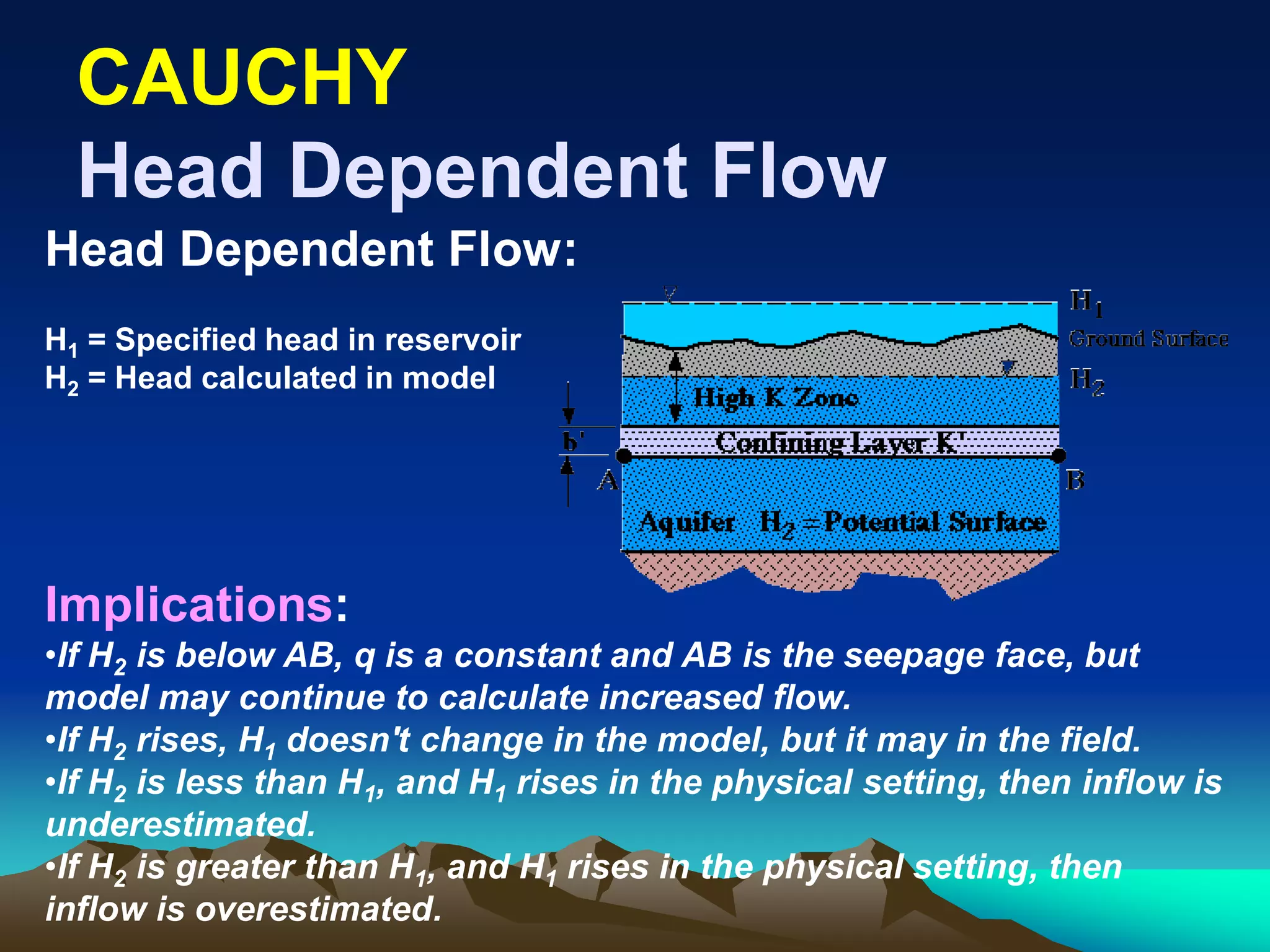
Head Dependent Flow:
H1 = Specified head in reservoir
H2 = Head calculated in model
Implications:
•If H2 is below AB, q is a constant and AB is the seepage face, but
model may continue to calculate increased flow.
•If H2 rises, H1 doesn't change in the model, but it may in the field.
•If H2 is less than H1, and H1 rises in the physical setting, then inflow is
underestimated.
•If H2 is greater than H1, and H1 rises in the physical setting, then
inflow is overestimated.
Free SurfaceFree Surface
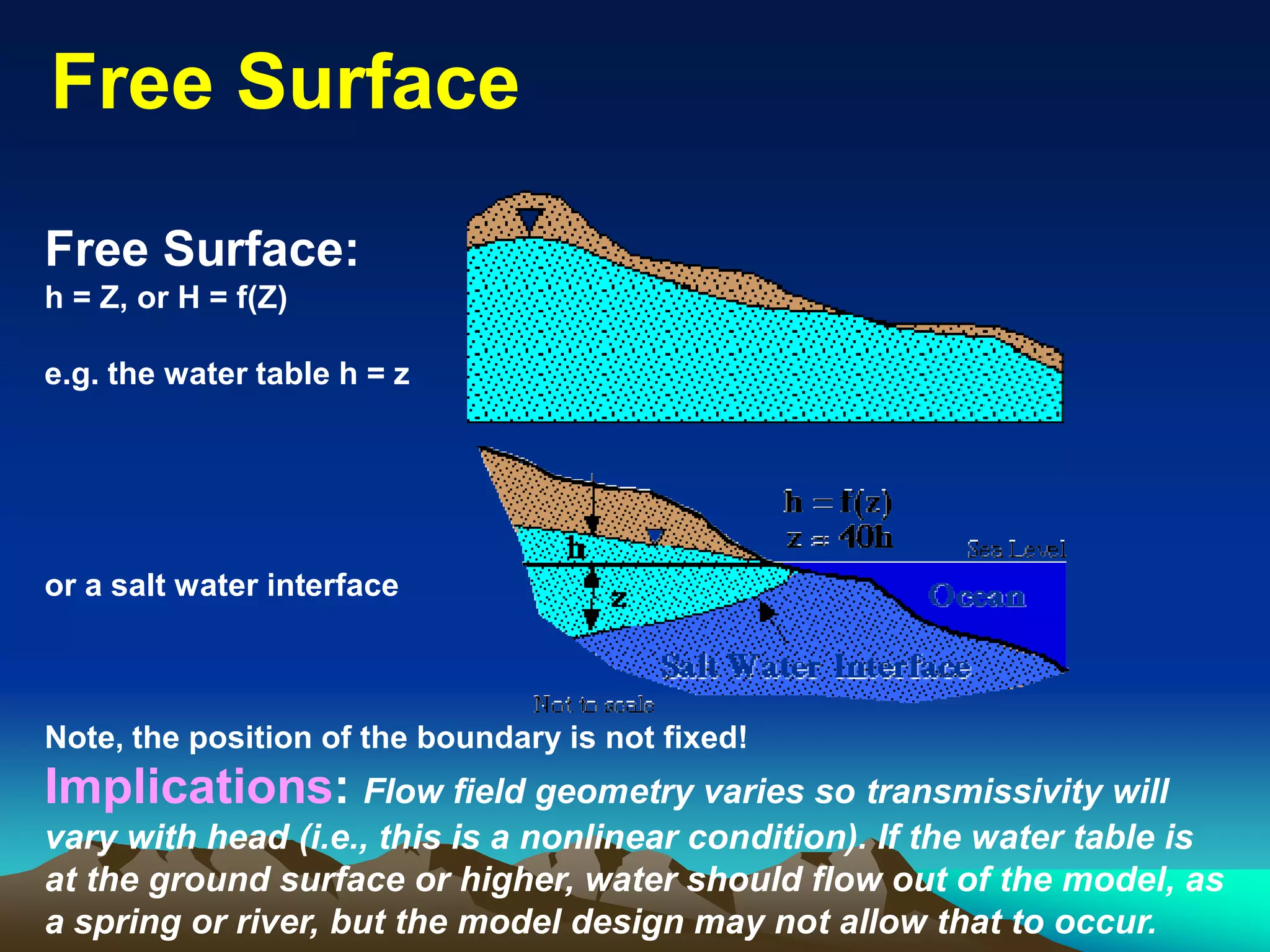
Free Surface:
h = Z, or H = f(Z)
e.g. the water table h = z
or a salt water interface
Note, the position of the boundary is not fixed!
Implications: Flow field geometry varies so transmissivity will
vary with head (i.e., this is a nonlinear condition). If the water table is
at the ground surface or higher, water should flow out of the model, as
a spring or river, but the model design may not allow that to occur.
Seepage SurfaceSeepage Surface
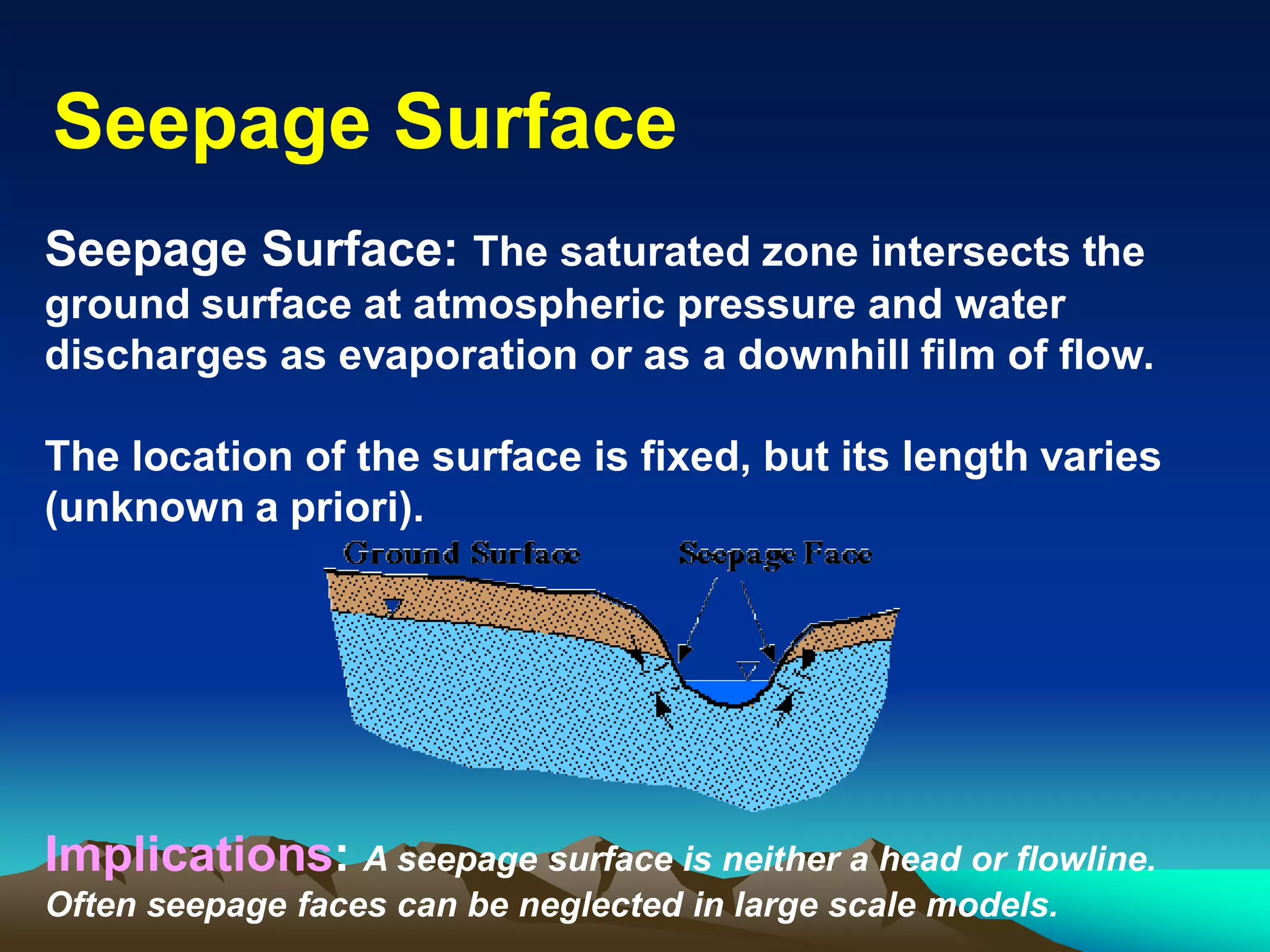
Seepage Surface: The saturated zone intersects the
ground surface at atmospheric pressure and water
discharges as evaporation or as a downhill film of flow.
The location of the surface is fixed, but its length varies
(unknown a priori).
Implications: A seepage surface is neither a head or flowline.
Often seepage faces can be neglected in large scale models.
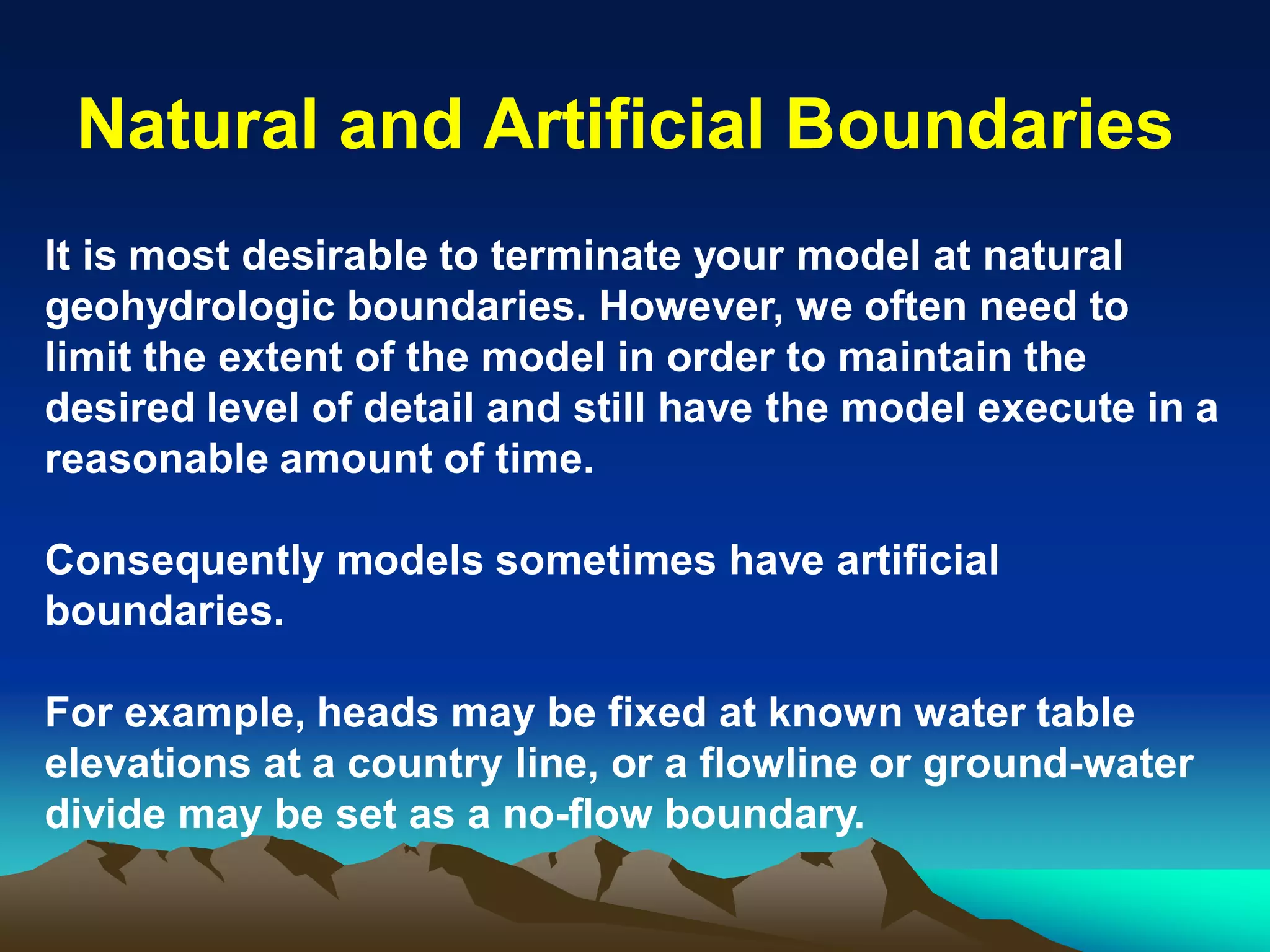
Natural and Artificial BoundariesNatural and Artificial Boundaries
It is most desirable to terminate your model at natural
geohydrologic boundaries. However, we often need to
limit the extent of the model in order to maintain the
desired level of detail and still have the model execute in a
reasonable amount of time.
Consequently models sometimes have artificial
boundaries.
For example, heads may be fixed at known water table
elevations at a country line, or a flowline or ground-water
divide may be set as a no-flow boundary.
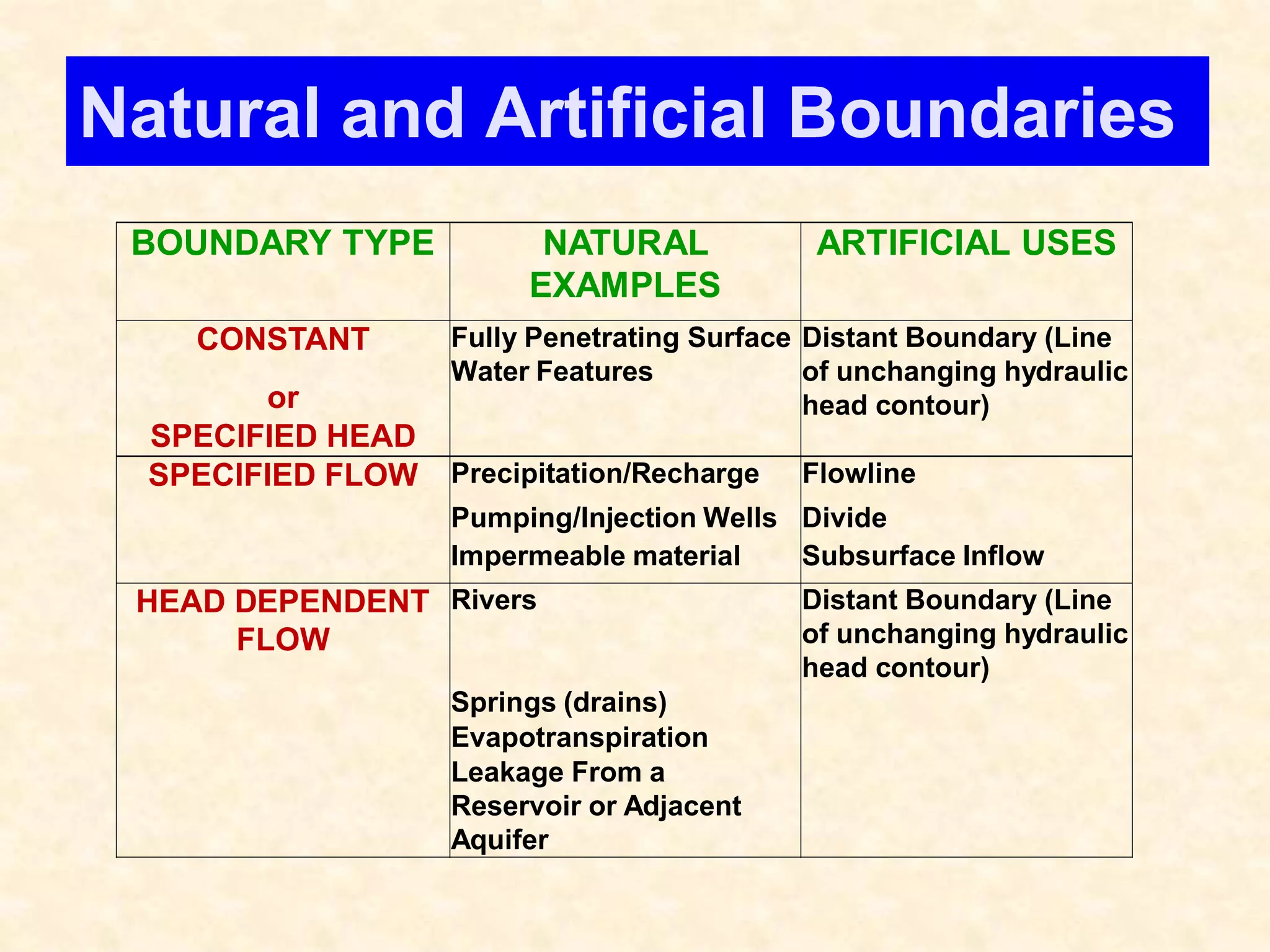
Natural and Artificial BoundariesNatural and Artificial Boundaries
BOUNDARY TYPE NATURAL
EXAMPLES
ARTIFICIAL USES
CONSTANT Fully Penetrating Surface
Water Features
Distant Boundary (Line
of unchanging hydraulic
head contour)or
SPECIFIED HEAD
SPECIFIED FLOW Precipitation/Recharge Flowline
Pumping/Injection Wells Divide
Impermeable material Subsurface Inflow
HEAD DEPENDENT
FLOW
Rivers Distant Boundary (Line
of unchanging hydraulic
head contour)
Springs (drains)
Evapotranspiration
Leakage From a
Reservoir or Adjacent
Aquifer
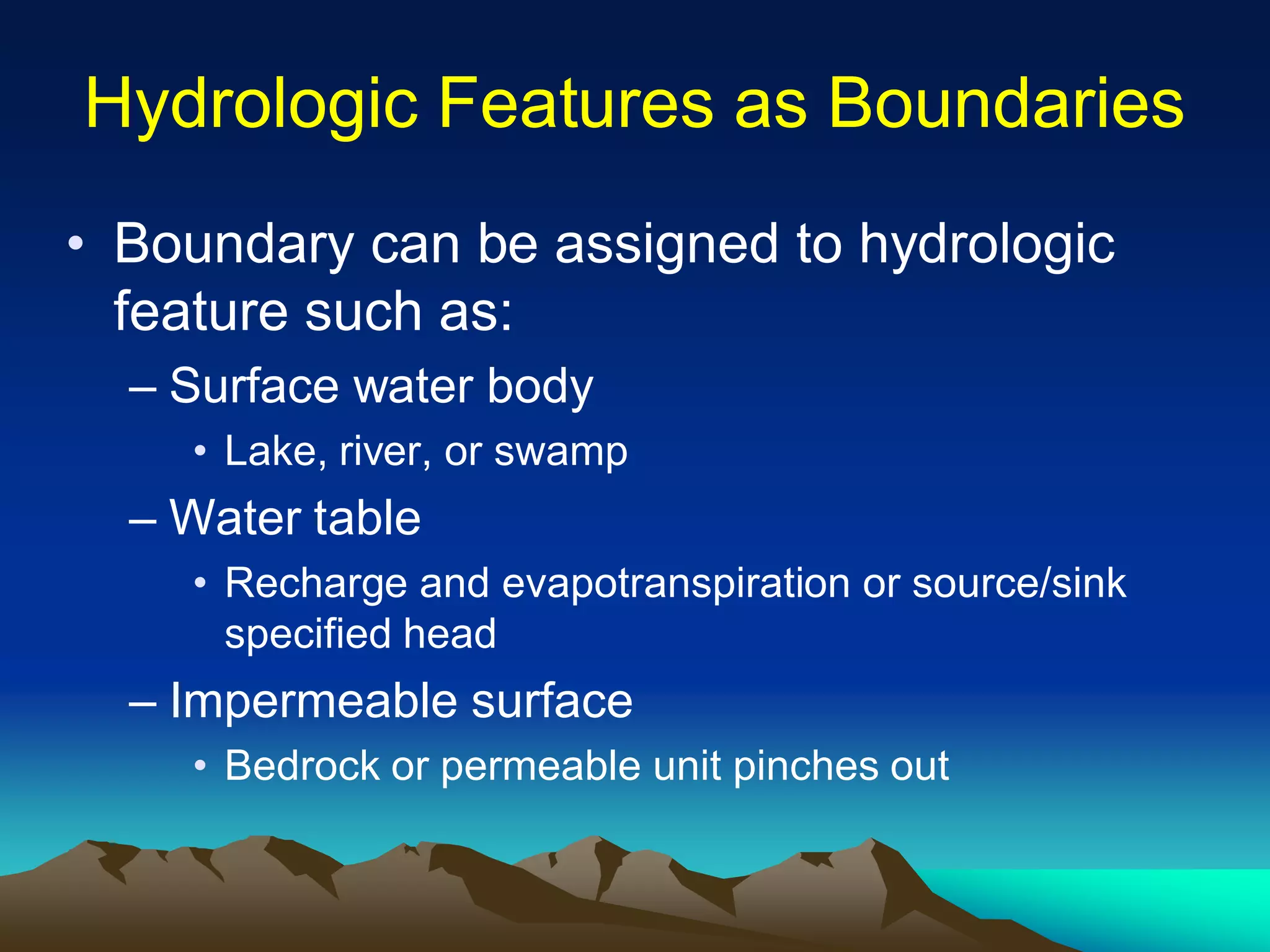
Hydrologic Features as BoundariesHydrologic Features as Boundaries
• Boundary can be assigned to hydrologic
feature such as:
– Surface water body
• Lake, river, or swamp
– Water table
• Recharge and evapotranspiration or source/sink
specified head
– Impermeable surface
• Bedrock or permeable unit pinches out
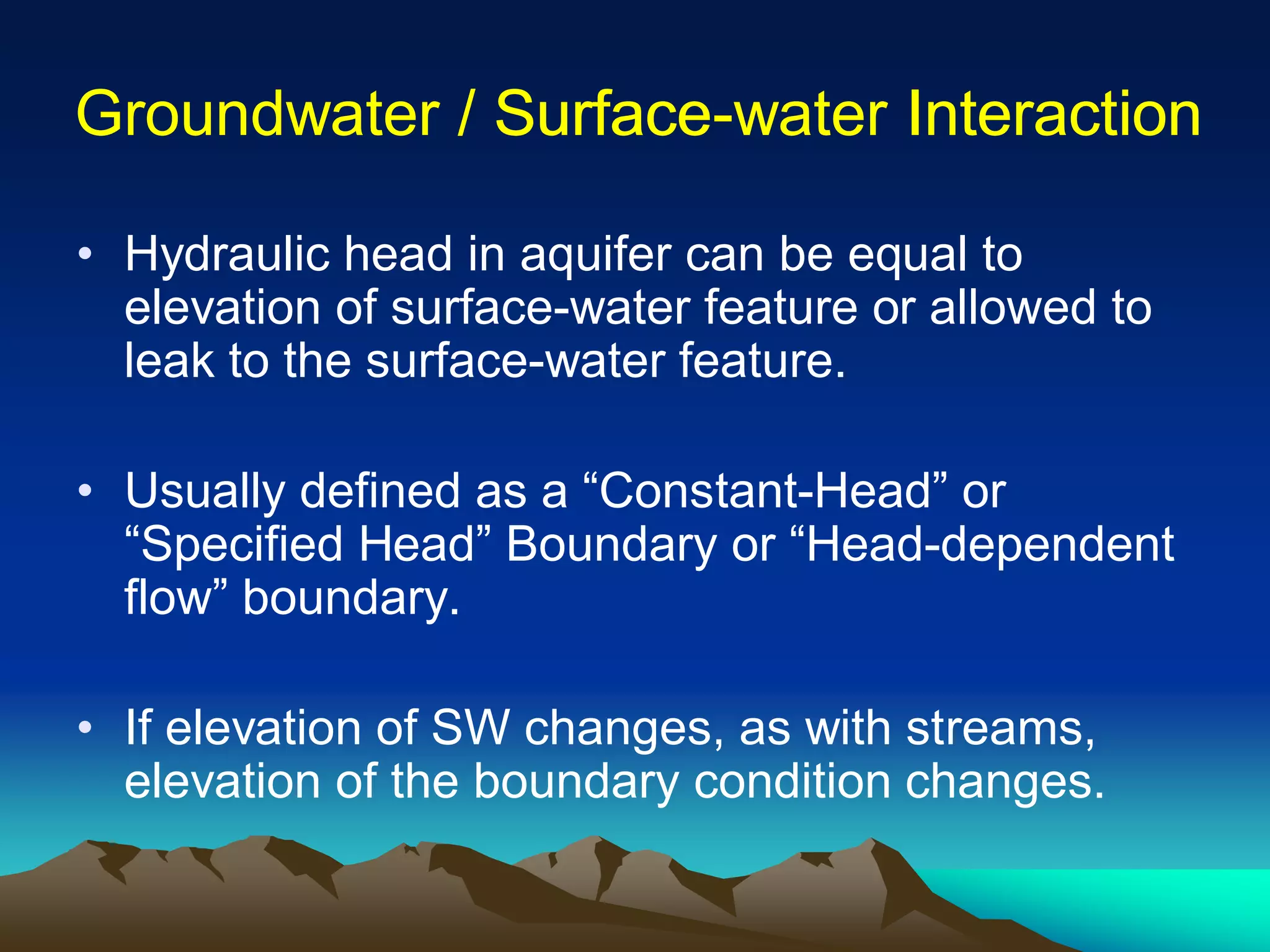
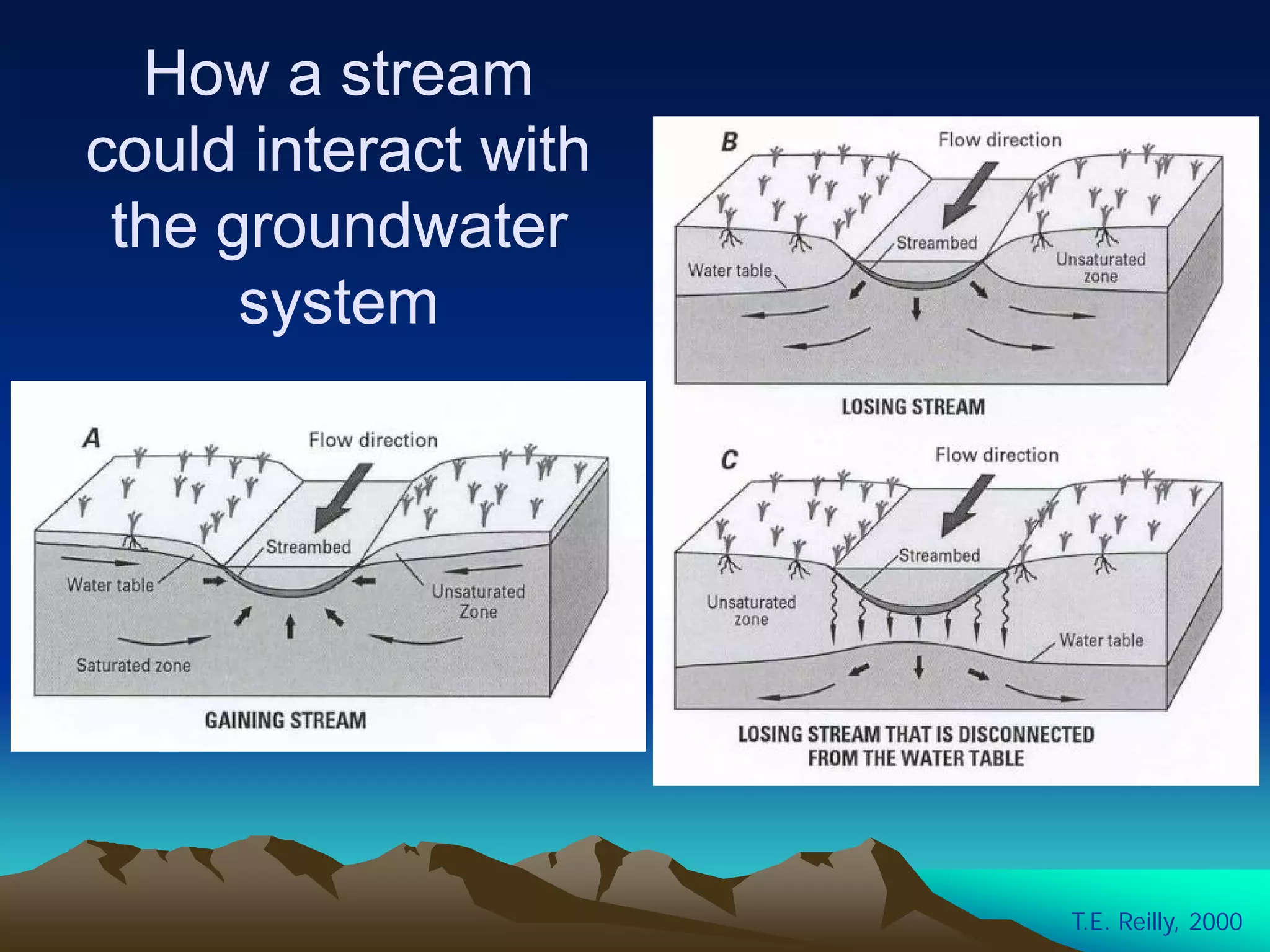
Groundwater / SurfaceGroundwater / Surface--water Interactionwater Interaction
• Hydraulic head in aquifer can be equal to
elevation of surface-water feature or allowed to
leak to the surface-water feature.
• Usually defined as a “Constant-Head” or
“Specified Head” Boundary or “Head-dependent
flow” boundary.
• If elevation of SW changes, as with streams,
elevation of the boundary condition changes.
How a streamHow a stream
could interact withcould interact with
the groundwaterthe groundwater
systemsystem
T.E. Reilly, 2000
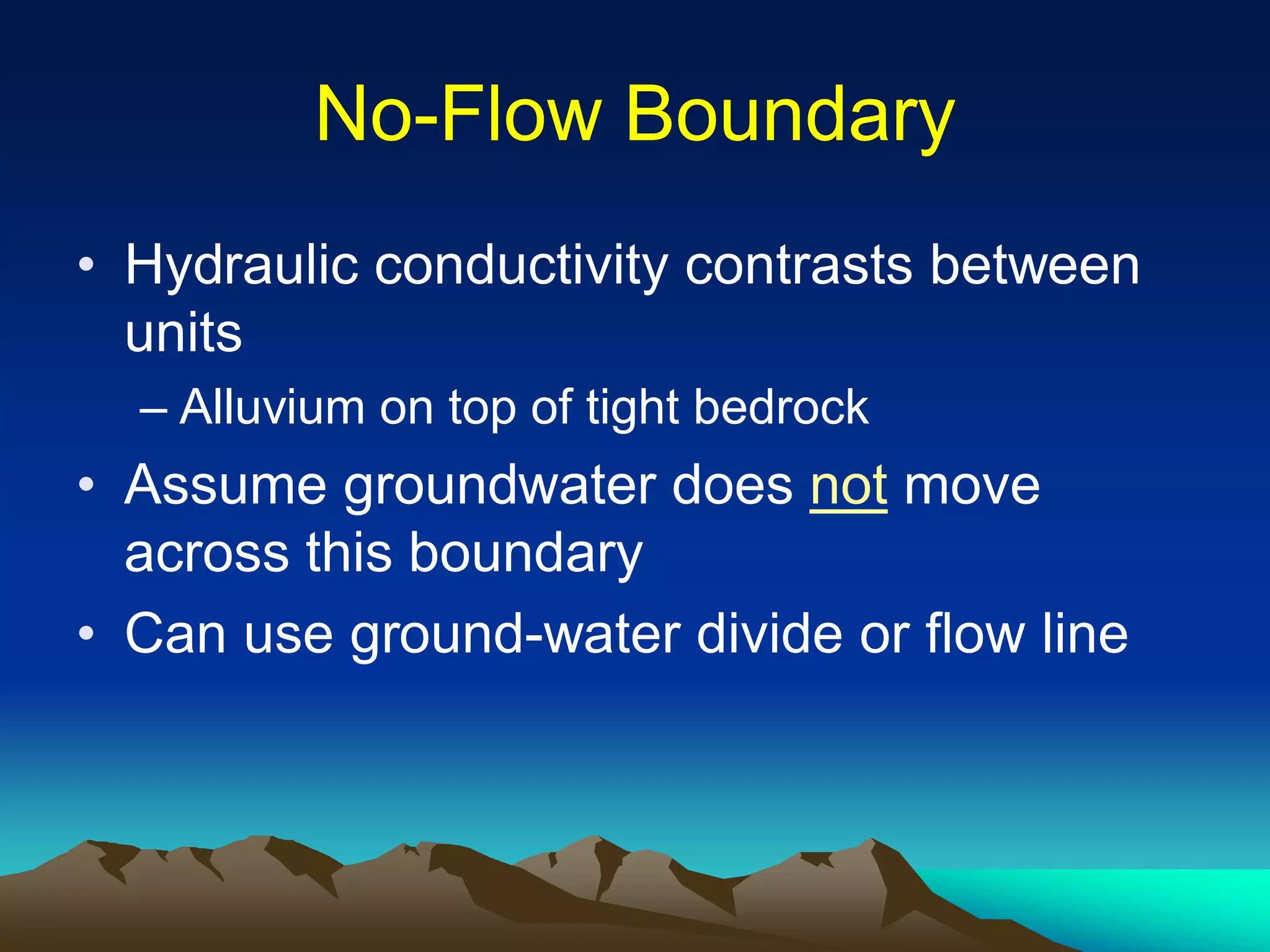
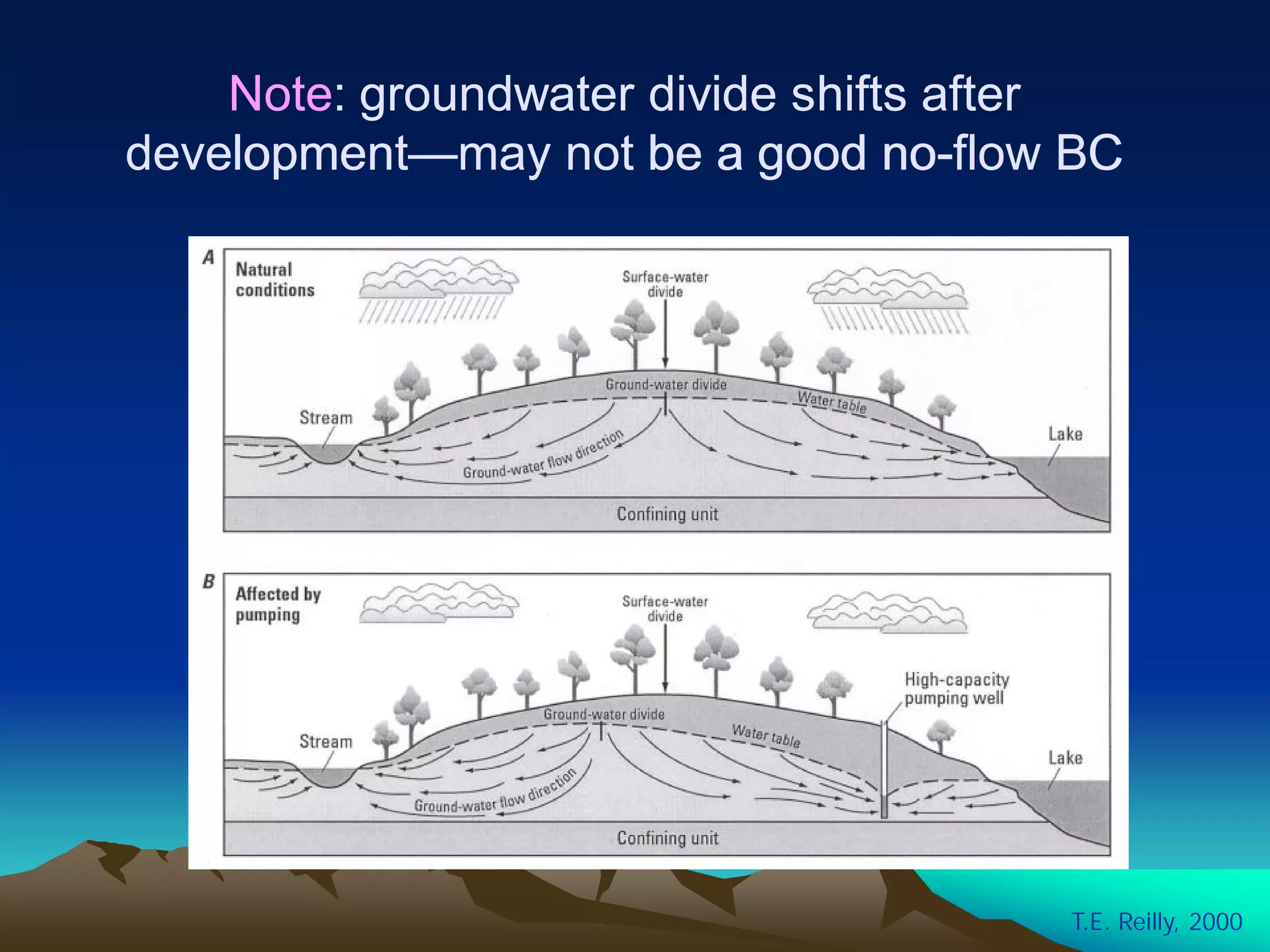
NoNo--Flow BoundaryFlow Boundary
• Hydraulic conductivity contrasts between
units
– Alluvium on top of tight bedrock
• Assume groundwater does not move
across this boundary
• Can use ground-water divide or flow line
NoteNote: groundwater divide shifts after: groundwater divide shifts after
developmentdevelopment——may not be a good nomay not be a good no--flow BCflow BC
T.E. Reilly, 2000
Water Table or “Flow” BoundaryWater Table or “Flow” Boundary
• Intermittent areal recharge on water-table
– Moves through unsaturated zone
– Volume of water per unit area per unit of time entering
the groundwater system is specified
– May vary with time and space
• Evapotranspiration occurs when plants remove
water from the water-table
– May be head-dependent (if water-table too far below
land surface, ET is unlikely)
– Volume of water per unit area per unit of time leaving
the GW system as a function of depth to water is
specified
– May vary in space and time
WellsWells -- an internal boundaryan internal boundary
condition at a pointcondition at a point -- thought of asthought of as
a stress to the systema stress to the system
• A well is a specified flow rate at a point
– Can be pumping or injecting water
– Withdrawals or injection may vary in space
and time
Practical ConsiderationsPractical Considerations
• Boundary conditions must be assigned to every
point on the boundary surface.
• Modeled boundary conditions are usually
greatly simplified compared to actual
conditions.
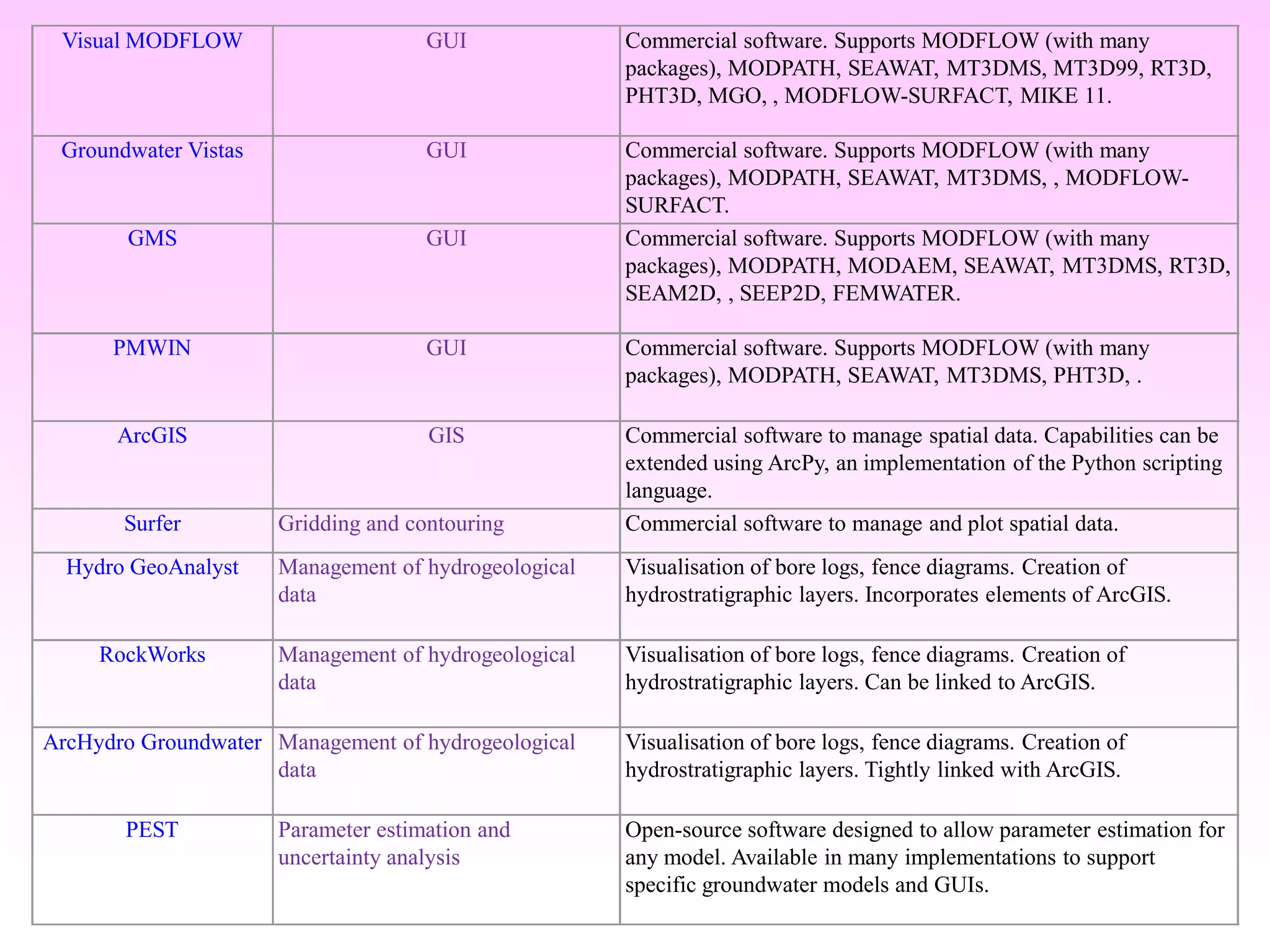
Groundwater Modelling Software
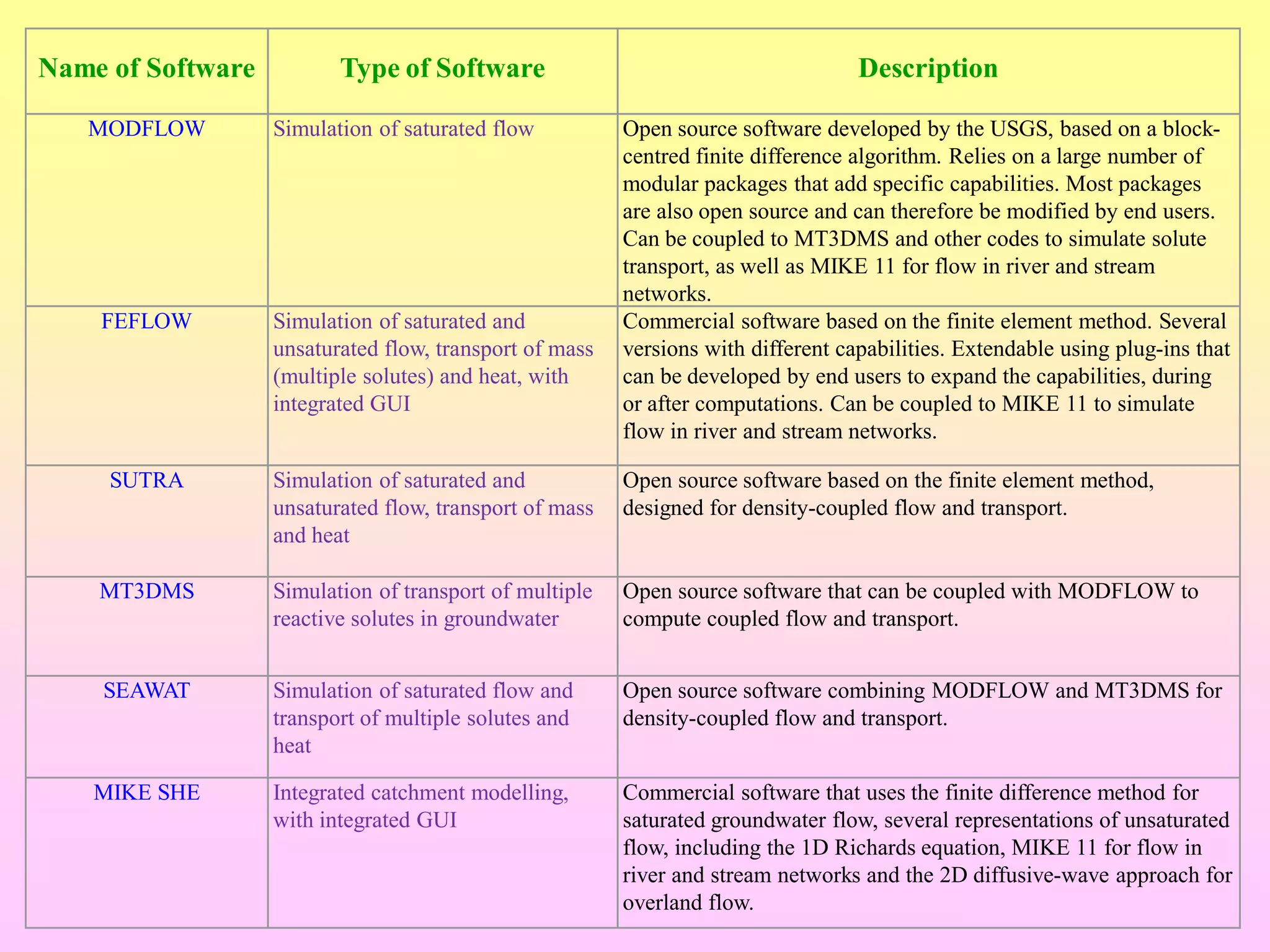
Name of Software Type of Software Description
MODFLOW Simulation of saturated flow Open source software developed by the USGS, based on a block-
centred finite difference algorithm. Relies on a large number of
modular packages that add specific capabilities. Most packages
are also open source and can therefore be modified by end users.
Can be coupled to MT3DMS and other codes to simulate solute
transport, as well as MIKE 11 for flow in river and stream
networks.
FEFLOW Simulation of saturated and
unsaturated flow, transport of mass
(multiple solutes) and heat, with
integrated GUI
Commercial software based on the finite element method. Several
versions with different capabilities. Extendable using plug-ins that
can be developed by end users to expand the capabilities, during
or after computations. Can be coupled to MIKE 11 to simulate
flow in river and stream networks.
SUTRA Simulation of saturated and
unsaturated flow, transport of mass
and heat
Open source software based on the finite element method,
designed for density-coupled flow and transport.
MT3DMS Simulation of transport of multiple
reactive solutes in groundwater
Open source software that can be coupled with MODFLOW to
compute coupled flow and transport.
SEAWAT Simulation of saturated flow and
transport of multiple solutes and
heat
Open source software combining MODFLOW and MT3DMS for
density-coupled flow and transport.
MIKE SHE Integrated catchment modelling,
with integrated GUI
Commercial software that uses the finite difference method for
saturated groundwater flow, several representations of unsaturated
flow, including the 1D Richards equation, MIKE 11 for flow in
river and stream networks and the 2D diffusive-wave approach for
overland flow.
Visual MODFLOW GUI Commercial software. Supports MODFLOW (with many
packages), MODPATH, SEAWAT, MT3DMS, MT3D99, RT3D,
PHT3D, MGO, , MODFLOW-SURFACT, MIKE 11.
Groundwater Vistas GUI Commercial software. Supports MODFLOW (with many
packages), MODPATH, SEAWAT, MT3DMS, , MODFLOW-
SURFACT.
GMS GUI Commercial software. Supports MODFLOW (with many
packages), MODPATH, MODAEM, SEAWAT, MT3DMS, RT3D,
SEAM2D, , SEEP2D, FEMWATER.
PMWIN GUI Commercial software. Supports MODFLOW (with many
packages), MODPATH, SEAWAT, MT3DMS, PHT3D, .
ArcGIS GIS Commercial software to manage spatial data. Capabilities can be
extended using ArcPy, an implementation of the Python scripting
language.
Surfer Gridding and contouring Commercial software to manage and plot spatial data.
Hydro GeoAnalyst Management of hydrogeological
data
Visualisation of bore logs, fence diagrams. Creation of
hydrostratigraphic layers. Incorporates elements of ArcGIS.
RockWorks Management of hydrogeological
data
Visualisation of bore logs, fence diagrams. Creation of
hydrostratigraphic layers. Can be linked to ArcGIS.
ArcHydro Groundwater Management of hydrogeological
data
Visualisation of bore logs, fence diagrams. Creation of
hydrostratigraphic layers. Tightly linked with ArcGIS.
PEST Parameter estimation and
uncertainty analysis
Open-source software designed to allow parameter estimation for
any model. Available in many implementations to support
specific groundwater models and GUIs.
Difference between MODFLOW and MIKE SHE
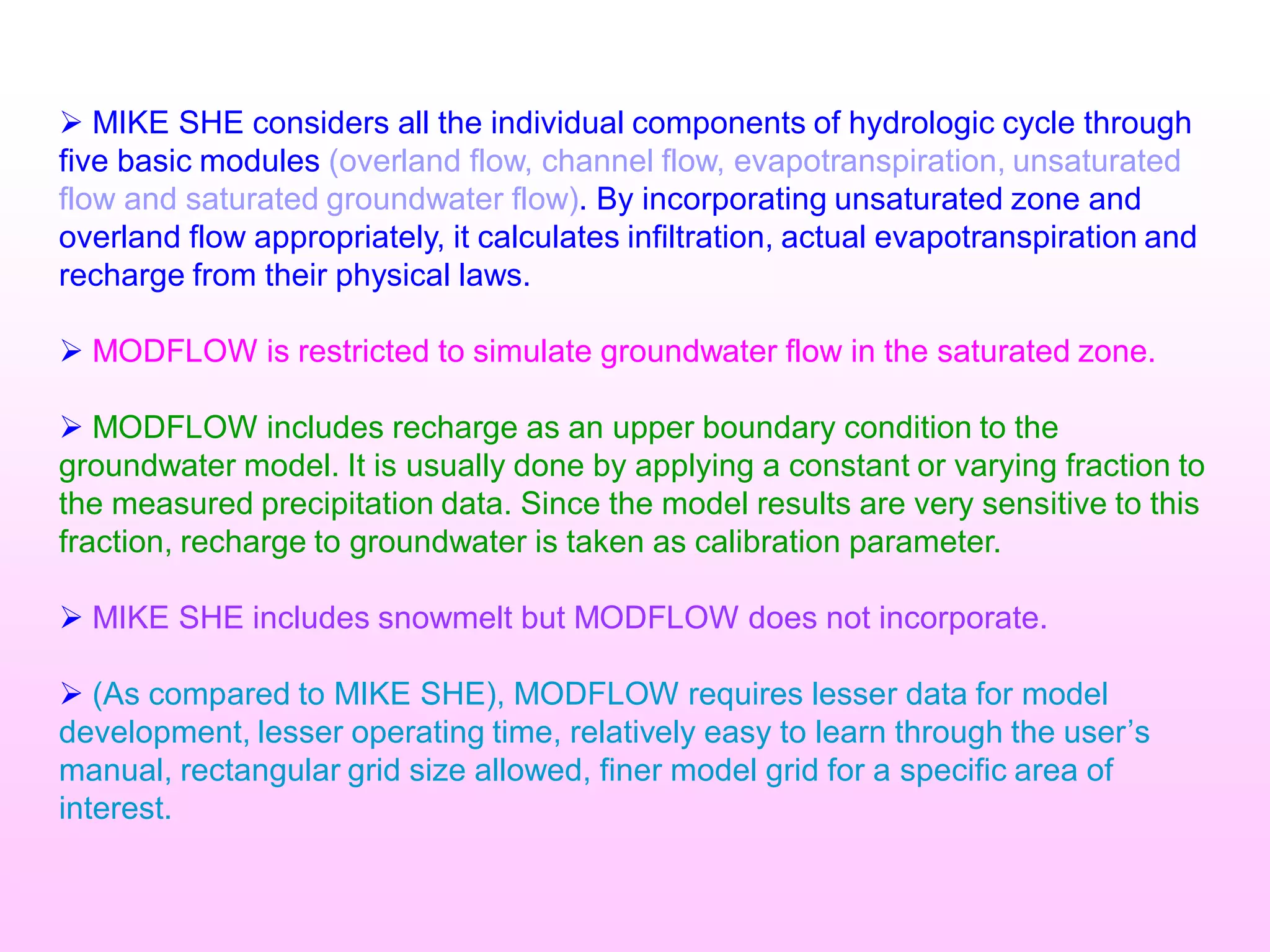
Ø MIKE SHE considers all the individual components of hydrologic cycle through
five basic modules (overland flow, channel flow, evapotranspiration, unsaturated
flow and saturated groundwater flow). By incorporating unsaturated zone and
overland flow appropriately, it calculates infiltration, actual evapotranspiration and
recharge from their physical laws.
Ø MODFLOW is restricted to simulate groundwater flow in the saturated zone.
Ø MODFLOW includes recharge as an upper boundary condition to the
groundwater model. It is usually done by applying a constant or varying fraction to
the measured precipitation data. Since the model results are very sensitive to this
fraction, recharge to groundwater is taken as calibration parameter.
Ø MIKE SHE includes snowmelt but MODFLOW does not incorporate.
Ø (As compared to MIKE SHE), MODFLOW requires lesser data for model
development, lesser operating time, relatively easy to learn through the user’s
manual, rectangular grid size allowed, finer model grid for a specific area of
interest.
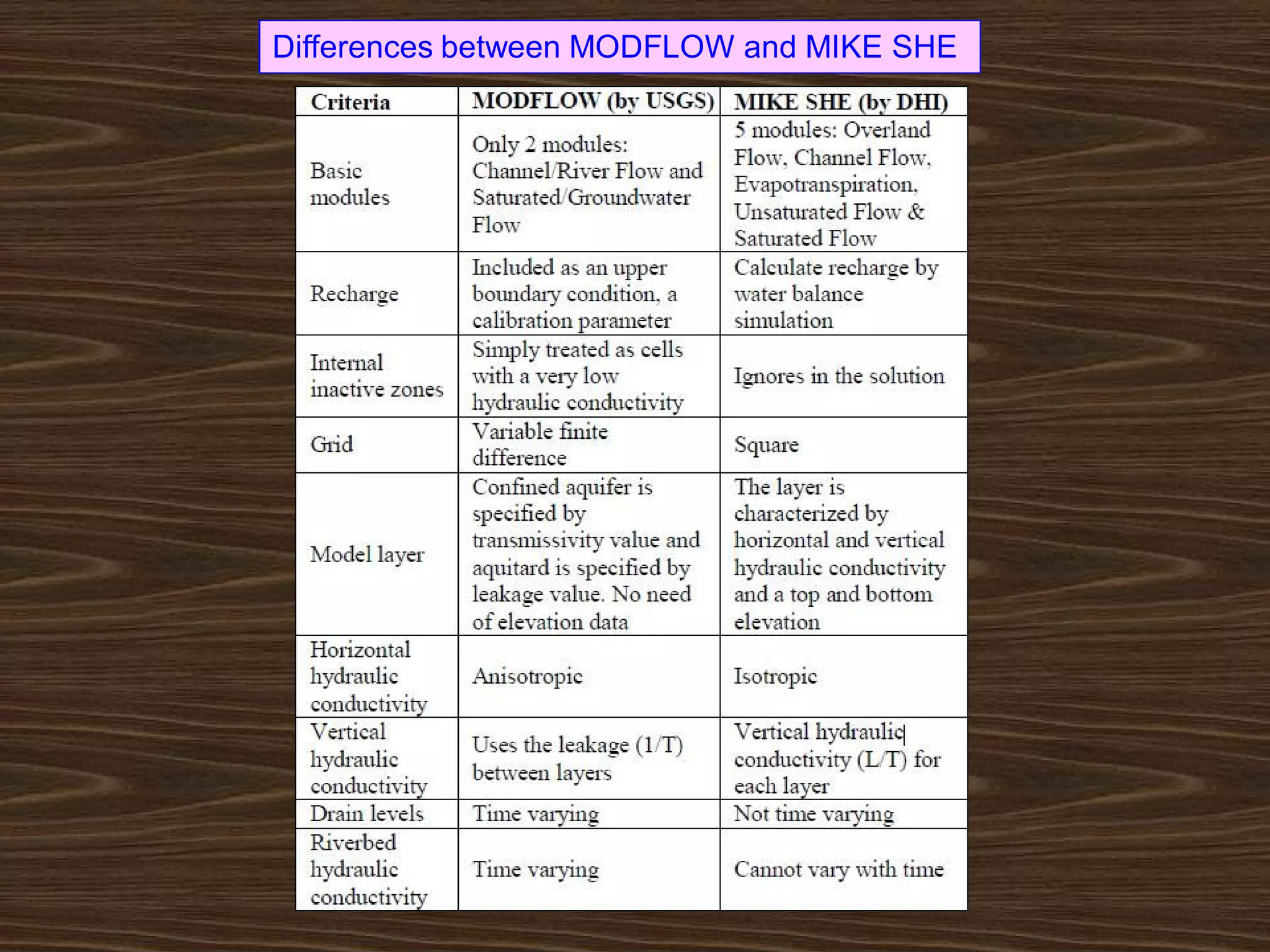
Differences between MODFLOW and MIKE SHE
MODFLOW MIKE SHE
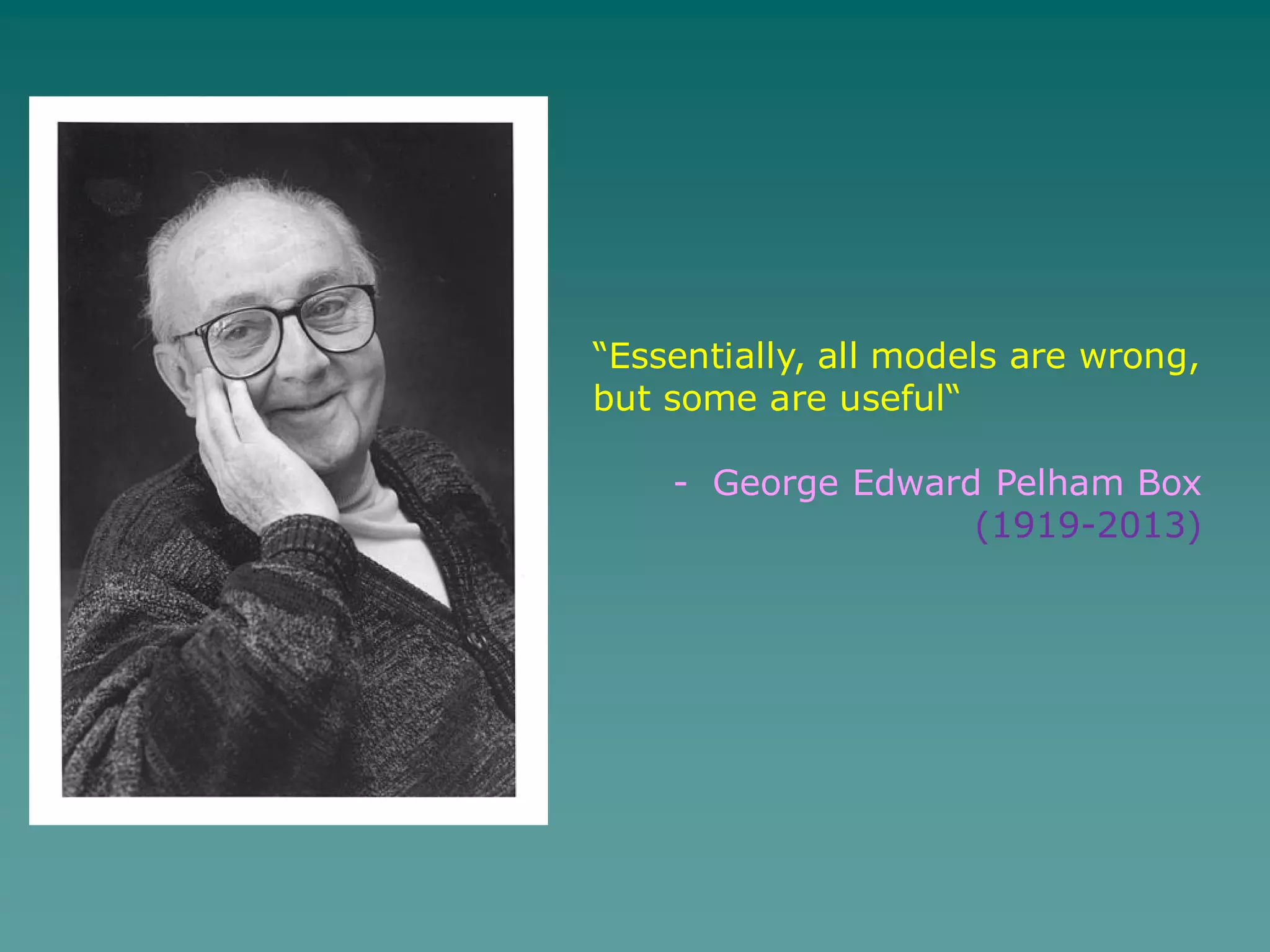
“Essentially, all models are wrong,
but some are useful“
- George Edward Pelham Box
(1919-2013)
Online Discussion Groups
This list aims to provide a forum for discussion of scientific research in all aspects
of Hydrology including hydrologic design, surface water analysis and modelling,
flood studies, drought studies, watershed development, groundwater assessment
and modelling, conjunctive use, drainage, mountain hydrology, environmental
hydrology, lake hydrology, nuclear hydrology, urban hydrology, forest hydrology,
hydrological investigations, remote sensing and GIS applications etc. Exchange of
ideas and experiences regarding use and application of hydrological softwares
are also welcome.
Members : 1985
Founded : Jan 15, 2002
https://groups.yahoo.com/neo/groups/hydforum/info
Post Message : hydforum@yahoogroups.com
Subscribe : hydforum-subscribe@yahoogroups.com
Unsubscribe : hydforum-unsubscribe@yahoogroups.com
List Owner : hydforum-owner@yahoogroups.com
•Members :1985•Founded :Jan 15, 2002•Founded :Jan 15, 2002
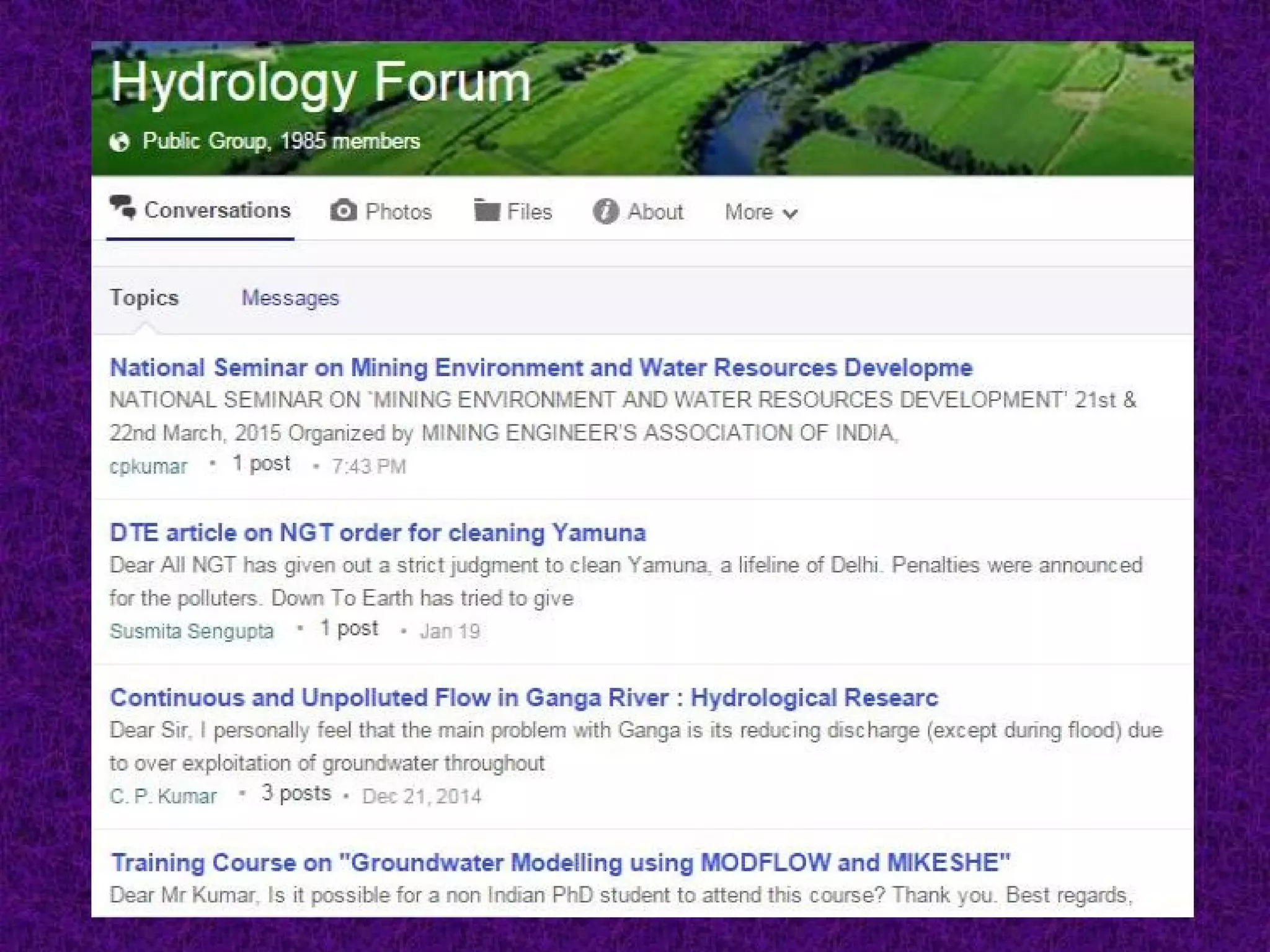
Hydrology Forum
This mailing list aims to provide a forum for discussion of scientific research in
modelling of hydrologic systems including * Rainfall-Runoff Modelling * Overland
Flow Modelling * Unsaturated Flow Modelling * Groundwater Flow Modelling *
Solute Transport Modelling * Sea Water Intrusion Modelling * Water Quality
Modelling * Other relevant aspects of Hydrology and Water Resources
Development and Management. It intends to provide a forum for technical
discussions; announcement of new public domain and commercial softwares; calls
for abstracts and papers; conference and workshop announcements; and
summaries of research results, recent publications, and case studies. Exchange of
ideas and experiences regarding use and application of hydrological softwares are
also welcome.
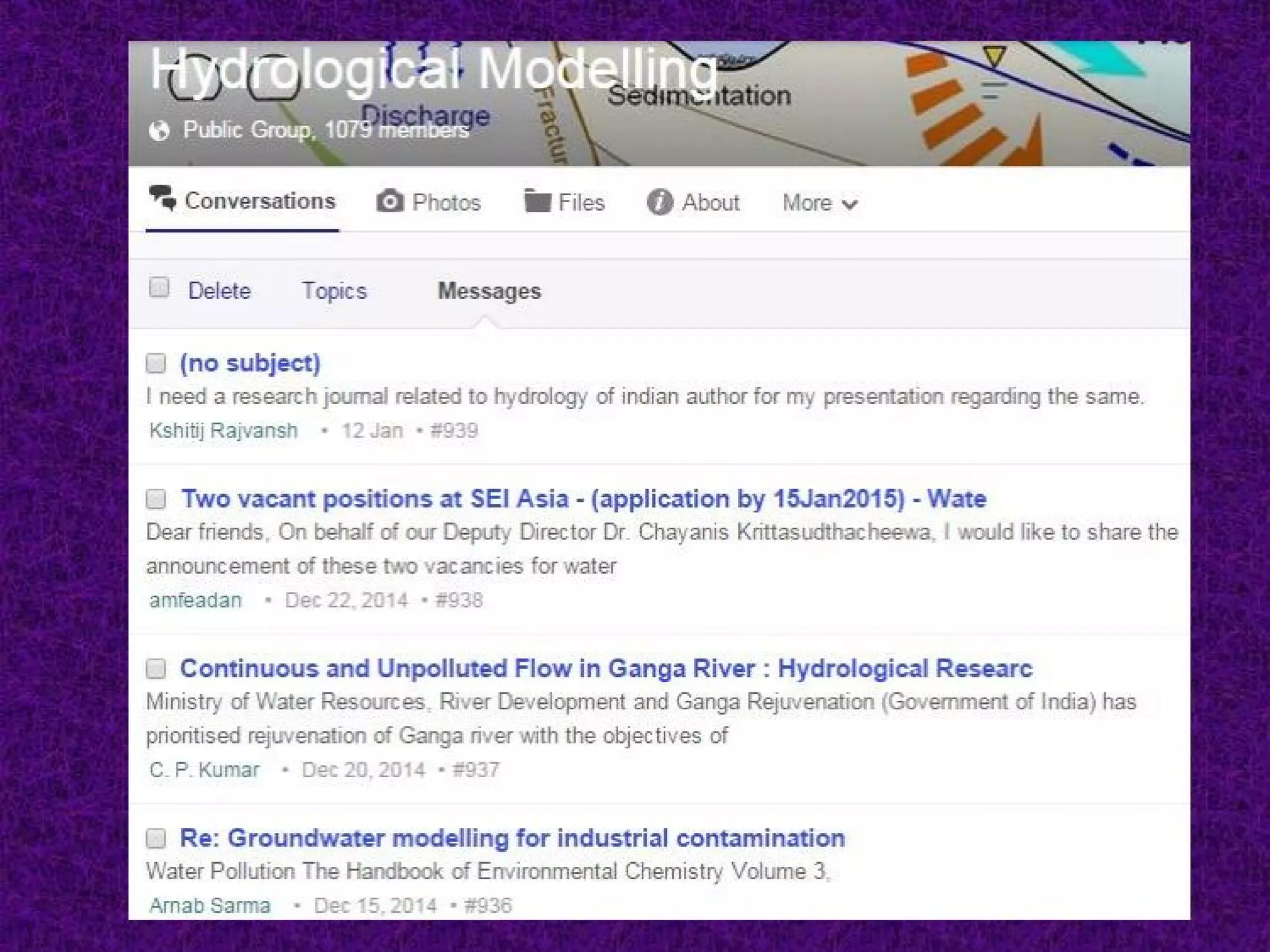
Members : 1079
Founded : Oct 28, 2003
https://in.groups.yahoo.com/neo/groups/hydrologymodel/info
Post Message : hydrologymodel@yahoogroups.co.in
Subscribe : hydrologymodel-subscribe@yahoogroups.co.in
Unsubscribe : hydrologymodel-unsubscribe@yahoogroups.co.in
List Owner : hydrologymodel-owner@yahoogroups.co.in
•Members :1985•Founded :Jan 15, 2002•Founded :Jan 15, 2002
Hydrological Modelling
The "Ground Water Modelling" group is a forum for the communication of all
aspects of ground water modelling including technical discussions;
announcement of new public domain and commercial softwares; calls for
abstracts and papers; conference and workshop announcements; and
summaries of research results, recent publications, and case studies.
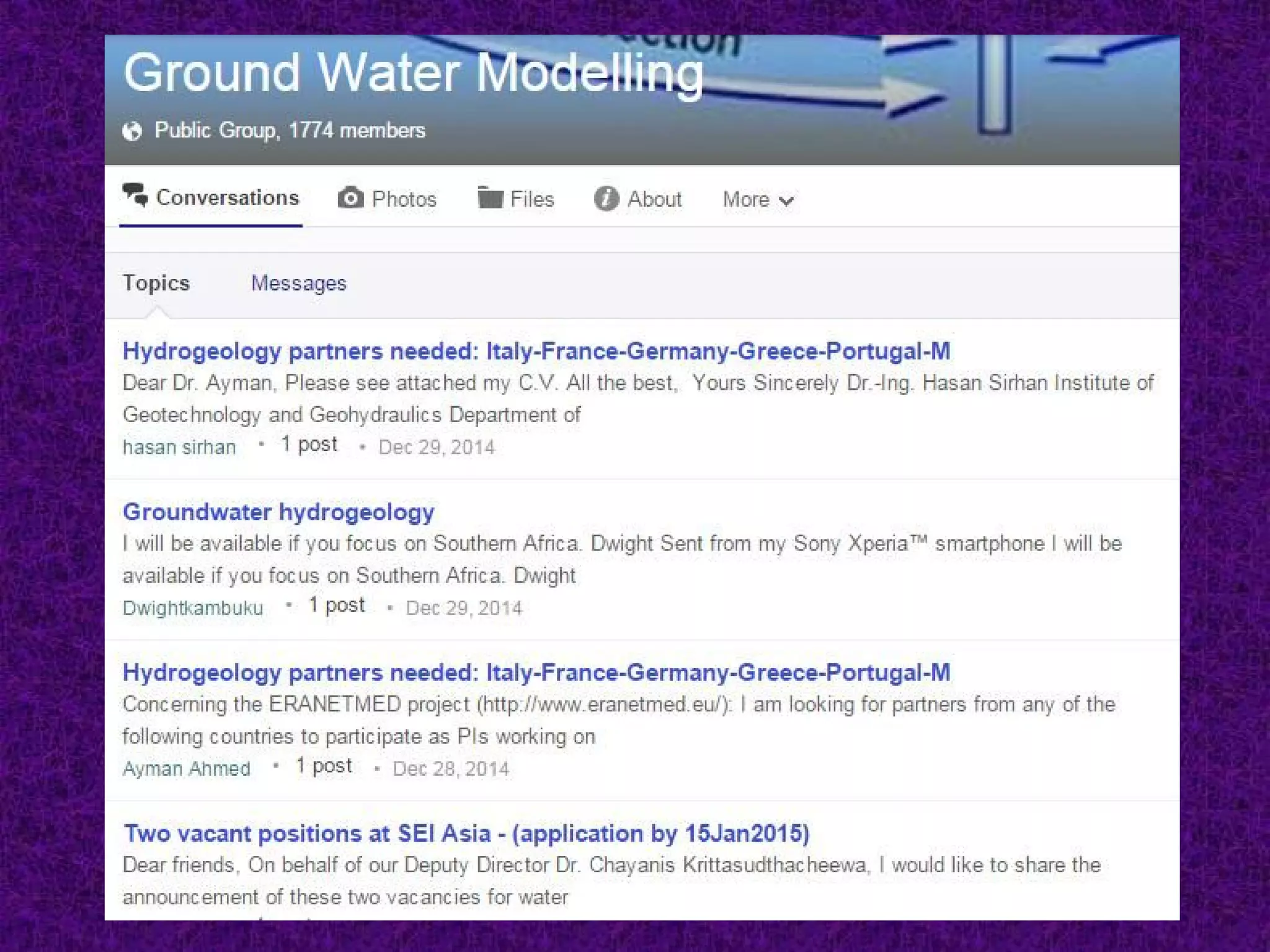
Members : 1774
Founded : Sep 12, 2001
https://groups.yahoo.com/neo/groups/gwmodel/info
Post Message : gwmodel@yahoogroups.com
Subscribe : gwmodel-subscribe@yahoogroups.com
Unsubscribe : gwmodel-unsubscribe@yahoogroups.com
List Owner : gwmodel-owner@yahoogroups.com
•Members :1985•Founded :Jan 15, 2002•Founded :Jan 15, 2002
Ground Water Modelling
A forum for exchange of ideas and experiences regarding use and
application of MODFLOW - a modular three-dimensional finite-difference
ground-water flow model.
Members : 624
Founded : Dec 8, 2004
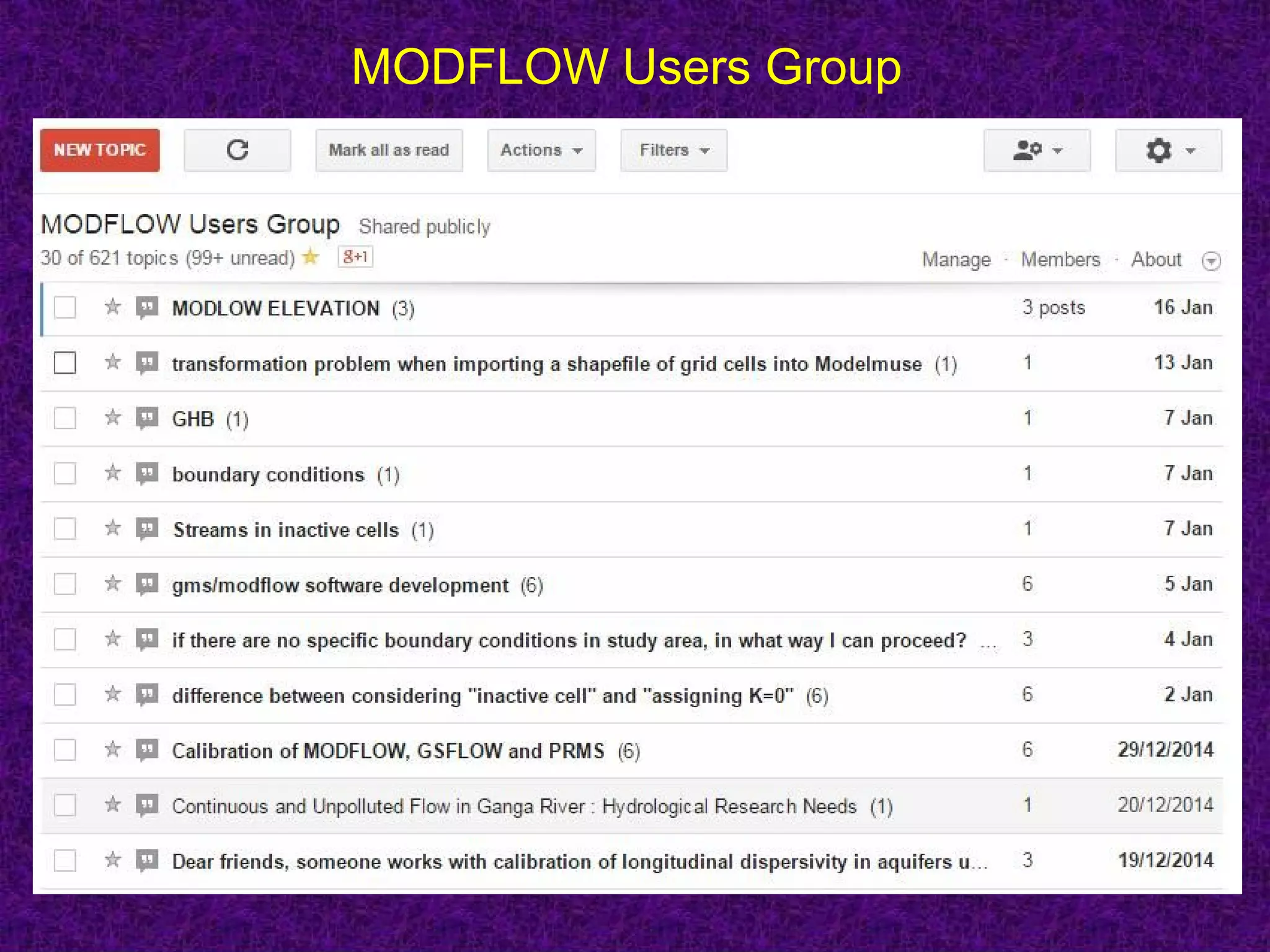
http://groups.google.com/group/modflow/
Group email: modflow@googlegroups.com
Owner email: modflow-owner@googlegroups.com
Subscribe online at the group page.
•Members :1985•Founded :Jan 15, 2002•Founded :Jan 15, 2002
MODFLOW Users Group
MODFLOW Users Group
Thank You !!!

Data Requirements for Groundwater Modelling

  • 1.
    Data Requirements forGroundwater Modelling National Institute of HydrologyNational Institute of Hydrology RoorkeeRoorkee –– 247667 (India)247667 (India) C. P. Kumar Scientist ‘F’ All Lecture Notes and Powerpoint Presentations can be accessed at http://www.angelfire.com/nh/cpkumar/publication/ Google Search: Publications of C. P. Kumar
  • 2.
    Presentation OutlinePresentation Outline Groundwaterin Hydrologic Cycle Why Groundwater Modelling is needed? Data Requirements for Groundwater Modelling Boundary Conditions Groundwater Modelling Software Difference between MODFLOW and MIKE SHE Online Discussion Groups
  • 3.
  • 5.
    Types of TerrestrialWaterTypes of Terrestrial Water Ground waterGround water SoilSoil MoistureMoisture Surface Water
  • 6.
    Unsaturated Zone /Zone of Aeration / Vadose (Soil Water) Pores Full of Combination of Air and Water Zone of Saturation (Ground water) Pores Full Completely with Water
  • 7.
    Groundwater Important source ofclean water More abundant than Surface Water Linked to SW systems Sustains flows in streams Baseflow
  • 8.
  • 9.
    Problems with groundwater ØGroundwater overdraft / mining / subsidence Ø Waterlogging Ø Seawater intrusion Ø Groundwater pollution
  • 10.
  • 11.
    Groundwater • An importantcomponent of water resource systems. • Extracted from aquifers through pumping wells and supplied for domestic use, industry and agriculture. • With increased withdrawal of groundwater, the quality of groundwater has been continuously deteriorating. • Water can be injected into aquifers for storage and/or quality control purposes.
  • 12.
    Management of agroundwater system, means making such decisions as: • The total volume that may be withdrawn annually from the aquifer. • The location of pumping and artificial recharge wells, and their rates. • Decisions related to groundwater quality. Groundwater contamination by: Ø Hazardous industrial wastes Ø Leachate from landfills Ø Agricultural activities such as the use of fertilizers and pesticides
  • 13.
    v MANAGEMENT meansmaking decisions to achieve goals without violating specified constraints. v Good management requires information on the response of the managed system to the proposed activities. v This information enables the decision-maker, to compare alternative actions and to ensure that constraints are not violated. v Any planning of mitigation or control measures, once contamination has been detected in the saturated or unsaturated zones, requires the prediction of the path and the fate of the contaminants, in response to the planned activities. v Any monitoring or observation network must be based on the anticipated behavior of the system.
  • 14.
    v A toolis needed that will provide this information. v The tool for understanding the system and its behavior and for predicting this response is the model. v Usually, the model takes the form of a set of mathematical equations, involving one or more partial differential equations. We refer to such model as a mathematical model. v The preferred method of solution of the mathematical model of a given problem is the analytical solution.
  • 15.
    v The advantageof the analytical solution is that the same solution can be applied to various numerical values of model coefficients and parameters. v Unfortunately, for most practical problems, because of the heterogeneity of the considered domain, the irregular shape of its boundaries, and the non-analytic form of the various functions, solving the mathematical models analytically is not possible. v Instead, we transform the mathematical model into a numerical one, solving it by means of computer programs.
  • 16.
    ALL GROUNDWATER HYDROLOGYWORK IS MODELING A Model is a representation of a system. Modeling begins when one formulates a concept of a hydrologic system, continues with application of, for example, Darcy's Law or the Theis equation to the problem, and may culminate in a complex numerical simulation.
  • 17.
    What is aModel? • A model is anything that represents an approximation of a field situation • Models include: – Mathematical models • Numerical • Analytical – Physical models • Sand tank • A model is a simplified version of a real system and the phenomena that take place within it
  • 18.
    TYPES OF MODELS CONCEPTUALMODEL: QUALITATIVE DESCRIPTION OF SYSTEM "a cartoon of the system in your mind" MATHEMATICAL MODEL: MATHEMATICAL DESCRIPTION OF SYSTEM SIMPLE - ANALYTICAL (provides a continuous solution over the model domain) COMPLEX - NUMERICAL (provides a discrete solution - i.e. values are calculated at only a few points) ANALOG MODEL e.g. ELECTRICAL CURRENT FLOW through a circuit board with resistors to represent hydraulic conductivity and capacitors to represent storage coefficient PHYSICAL MODEL e.g. SAND TANK which poses scaling problems
  • 19.
  • 20.
    Although groundwater flowmodels can't be as detailed or as complex as the real system, models are useful in at least four ways: • Models integrate and assure consistency among aquifer properties, recharge, discharge, and groundwater levels. • Models can be used to estimate flows and aquifer characteristics for which direct measurements are not available. • Models can be used to simulate response of the aquifer under hypothetical conditions. • Models can identify sensitive areas where additional hydrologic information could improve understanding.
  • 21.
    Groundwater models areused to predict the effects of hydrological changes on the behavior of the aquifer and are often named groundwater simulation models. Groundwater models are nowadays used in various water management plans. The mathematical or the numerical models are usually based on the real physics of the groundwater flow. These mathematical equations are solved using numerical codes such as MODFLOW, FEFLOW etc.
  • 22.
    Governing Equations • FlowModel • Transport Model R t h S z h hK zy h hK yx h hK x zyx - ¶ ¶ =÷ ø ö ç è æ ¶ ¶ ¶ ¶ +÷÷ ø ö çç è æ ¶ ¶ ¶ ¶ +÷ ø ö ç è æ ¶ ¶ ¶ ¶ ( ) Mc n cc n q t c Rcv xx c D x e b s e s di ii ij i +÷÷ ø ö çç è æ ++- ¶ ¶ = ¶ ¶ -÷÷ ø ö çç è æ ¶ ¶ ¶ ¶ ' r l Dispersion Advection Sorption Source/ Sink First Order Decay Matrix Diffusion Fluid continuity Storage Sources/sinks
  • 23.
    Groundwater Flow Modelling:An Example Predicting heads (and flows) in a confined aquifer Solutions to the flow equations Most groundwater flow models are solutions of some form of the ground water flow equation x x x ho x0 h(x) x K q “e.g., unidirectional, steady-state flow within a confined aquifer The partial differential equation needs to be solved to calculate head as a function of position and time, i.e., h=f(x,y,z,t) h(x,y,z,t)? Darcy’s Law Integrated
  • 24.
    Processes we mightwant to model • Groundwater flow - calculate both heads and flow • Solute transport – requires information on flow (velocities) - calculate concentrations
  • 26.
    Numerical Solution ofEquations Numerically -- H or C is approximated at each point of a computational domain (may be a regular grid or irregular) – May require intensive computational effort to get the desired resolution – Subject to numerical difficulties such as convergence problems and numerical dispersion – Generally, flow and transport are solved in separate independent steps (except in density-dependent or multi-phase flow situations)
  • 27.
    Model Grids Finite ElementGridFinite Difference Grid
  • 28.
  • 29.
    Calibration,Validation, and Sensitivity Analysis –Calibration is the process of making the model match real- world data. Involves making several model runs, varying parameters until the ‘best fit’ is achieved. – Validation is the process of confirming the validity of your calibration by using the model to fit an independent set of data. – Sensitivity Analysis is the process of changing parameters to see the effects on the model results. The most sensitive parameters need to be checked for accuracy to ensure the best model.
  • 30.
    Modeling Protocol Define Purpose Writeor Choose Code Collect Field Data Conceptual Model Mathematical Model Numerical or Analytical Verify Code Model Design Calibration Prediction/Sensitivity Analysis Verification Presentation of Results Postaudit No Yes Field Data Yes No Collect Field Data
  • 31.
  • 32.
    Ø The successof any groundwater study, to a large measure, depends upon the availability and accuracy of measured/recorded data required for that study. Ø Therefore, identifying the data needs and collection/monitoring of required data form an integral part of any groundwater exercise. Ø The first phase of any groundwater study consists of collecting all existing geological and hydrological data on the groundwater basin in question. Ø Any groundwater balance or numerical model requires a set of quantitative hydrogeological data that fall into two categories: * Data that define the physical framework of the groundwater basin * Data that describe its hydrological framework
  • 33.
    Defining Data Requirements ØGeneral Data Needs Ø Physical Framework and Hydrological Framework Ø Hydrological Data Inputs and Operational Data Inputs Ø Input Data for Flow Models and Transport Models Model Output for Flow Models and Transport Models One, Two or Three – Dimensional Models
  • 34.
    General Data Needs •Topographic • Surface Water Elevations • Geologic • Hydrogeologic – Conductivities – Groundwater Total Heads • Climate – Rainfall – Evapotranspiration – Recharge • Pumping Information • Irrigation information • Steady State or Transient • Contaminates • Water Chemistry • Density Flow – Salinity – NAPL
  • 35.
    Physical Framework 1. Topography 2.Geology 3. Types of aquifers 4. Aquifer thickness and lateral extent 5. Aquifer boundaries 6. Lithological variations within the aquifer 7. Aquifer characteristics
  • 36.
    Hydrological Framework 1. Watertable elevation 2. Type and extent of recharge areas 3. Rate of recharge 4. Type and extent of discharge areas 5. Rate of discharge
  • 37.
    The data requiredfor a groundwater flow modelling study under physical framework are: § Geologic map and cross section or fence diagram showing the areal and vertical extent and boundaries of the system. § Topographic map at a suitable scale showing all surface water bodies and divides. Details of surface drainage system, springs, wetlands and swamps should also be available on map. § Land use maps showing agricultural areas. § Contour maps showing the elevation of the base of the aquifers and confining beds. § Isopach maps showing the thickness of aquifers and confining beds. These data are used for defining the geometry of the groundwater domain under investigation, including the thickness and areal extent of each hydrostratigraphic unit.
  • 38.
    Under the hydrogeologicframework, the data requirements for a groundwater flow modelling study are: § Water table and potentiometric maps for all aquifers. § Hydrographs of groundwater head and surface water levels. § Maps and cross-sections showing the hydraulic conductivity and/or transmissivity distribution. § Maps and cross-sections showing the storage properties of the aquifers and confining beds. § Spatial and temporal distribution of rates of evaporation, groundwater recharge, groundwater pumping etc.
  • 39.
    Data inputs neededfor the model: • Hydrological data inputs • Operational data inputs • Initial and Boundary conditions • Hydraulic parameters
  • 40.
    Hydrological Data Inputs •Rainfall • Surface water infiltration • Evaporation • Evapotranspiration These inputs may vary in both time and space. Some of this data is measured by climatological services (weather stations).
  • 41.
    Operational Data Inputs- Water Management Data: • Irrigation • Drainage • Pumping from wells • Water table information • Retention or infiltration basins These inputs vary in quantity and quality.
  • 42.
    Boundary Conditions (indetail later) • Levels of the water table • Piezometric heads • Hydraulic head along the boundaries of the model (the head conditions) • Groundwater inflows and outflows along the boundaries of the model (the flow conditions).
  • 43.
    Initial Conditions The initialconditions refer to initial values of elements that may increase or decrease in the course of the time inside the model domain.
  • 44.
    Hydraulic Parameters • Geometryand distances in the domain to be modelled (geology, size of model) • Topography • Horizontal/vertical hydraulic conductivity of rock layers • Aquifer transmissivity • Aquifer porosity and storage coefficient • Capillarity of the unsaturated zone
  • 47.
    Model Input Data(Flow) • Flow model input data requirements – Defining hydrostratigraphic units – Fluid sources (e.g. recharge, interbasin flow) – Fluid Sinks (e.g. ET, pumping) – Boundary conditions (e.g. specified flow, specified head, head-dependent) – Model grid geometry – Time stepping information – Hydraulic Parameters – Initial hydraulic head distribution
  • 48.
    Model Output Data(Flow) • Flow model output – Hydraulic head values over space and time – Groundwater fluxes over space and time
  • 49.
    Model Input Data(Transport) • Transport model input requirements – Fluid velocities – Initial distribution of contaminants – Sources and sinks for contaminants – Boundary conditions – Dispersion coefficients – Effective porosity – Decay and/or reaction coefficients – Contaminant loading functions
  • 50.
    Model Output Data(Transport) • Transport model output – Contaminant concentrations over space and time – Contaminant breakthrough curves at specified locations
  • 51.
    Dimensions Groundwater models canbe one-dimensional, two-dimensional, and three-dimensional. One-dimensional models can be used for the vertical flow in a system of parallel horizontal layers. Two-dimensional models apply to a vertical plane while it is assumed that the groundwater conditions repeat themselves in other parallel vertical planes.
  • 52.
    Three-dimensional models like MODFLOWrequire discretization of the entire flow domain. To that end, the flow region must be subdivided into smaller elements (or cells), in both horizontal and vertical sense. Within each cell, the parameters are maintained constant, but they may vary between the cells.
  • 53.
    All these modelinputs require a lot of data. Data can be very manpower-intensive (READ EXPENSIVE!) Do we spend the time and money now to get better management of our water resources? OR Do we wait until we are compelled to do so?
  • 54.
  • 55.
    Types of BoundaryConditionsTypes of Boundary Conditions 1) Specified Head: head is defined as a function of space and time (ABC, EFG) Constant Head: a special case of specified head (ABC, EFG) 2) Specified Flow: could be recharge across (CD) or zero across (HI) No Flow (Streamline): a special case of specified flow where the flow is zero (HI) 3) Head Dependent Flow: (ABC, EFG) Free Surface: water-table, phreatic surface (CD) Seepage Face: h = z; pressure = atmospheric at the ground surface (DE)
  • 56.
    Three basic typesof Boundary ConditionsThree basic types of Boundary Conditions (n is directional coordinate normal to the boundary) Definition of Boundary and Initial Conditions in the Analysis of Saturated Gournd-Water Flow Systems - An Introduction, O. Lehn Franke, Thomas E. Reilly, and Gordon D. Bennett, USGS - TWRI Chapter B5, Book 3, 1987.
  • 57.
    DIRICHLETDIRICHLET Constant Head &ConstantHead & Specified Head BoundariesSpecified Head Boundaries Specified Head: Head (H) is defined as a function of time and space. Constant Head: Head (H) is constant at a given location. Implications: Supply Inexhaustible
  • 58.
    NEUMANNNEUMANN No Flow andNoFlow and Specified Flow BoundariesSpecified Flow Boundaries Specified Flow: Discharge (Q) varies with space and time. No Flow: Discharge (Q) equals 0 across boundary. Implications: H will be calculated as the value required to produce a gradient to yield that flow, given a specified hydraulic conductivity (K). The resulting head may be above the ground surface in an unconfined aquifer, or below the base of the aquifer where there is a pumping well; neither of these cases are desirable.
  • 59.
    CAUCHYCAUCHY Head Dependent FlowHeadDependent Flow Head Dependent Flow: H1 = Specified head in reservoir H2 = Head calculated in model Implications: •If H2 is below AB, q is a constant and AB is the seepage face, but model may continue to calculate increased flow. •If H2 rises, H1 doesn't change in the model, but it may in the field. •If H2 is less than H1, and H1 rises in the physical setting, then inflow is underestimated. •If H2 is greater than H1, and H1 rises in the physical setting, then inflow is overestimated.
  • 60.
    Free SurfaceFree Surface FreeSurface: h = Z, or H = f(Z) e.g. the water table h = z or a salt water interface Note, the position of the boundary is not fixed! Implications: Flow field geometry varies so transmissivity will vary with head (i.e., this is a nonlinear condition). If the water table is at the ground surface or higher, water should flow out of the model, as a spring or river, but the model design may not allow that to occur.
  • 61.
    Seepage SurfaceSeepage Surface SeepageSurface: The saturated zone intersects the ground surface at atmospheric pressure and water discharges as evaporation or as a downhill film of flow. The location of the surface is fixed, but its length varies (unknown a priori). Implications: A seepage surface is neither a head or flowline. Often seepage faces can be neglected in large scale models.
  • 62.
    Natural and ArtificialBoundariesNatural and Artificial Boundaries It is most desirable to terminate your model at natural geohydrologic boundaries. However, we often need to limit the extent of the model in order to maintain the desired level of detail and still have the model execute in a reasonable amount of time. Consequently models sometimes have artificial boundaries. For example, heads may be fixed at known water table elevations at a country line, or a flowline or ground-water divide may be set as a no-flow boundary.
  • 63.
    Natural and ArtificialBoundariesNatural and Artificial Boundaries BOUNDARY TYPE NATURAL EXAMPLES ARTIFICIAL USES CONSTANT Fully Penetrating Surface Water Features Distant Boundary (Line of unchanging hydraulic head contour)or SPECIFIED HEAD SPECIFIED FLOW Precipitation/Recharge Flowline Pumping/Injection Wells Divide Impermeable material Subsurface Inflow HEAD DEPENDENT FLOW Rivers Distant Boundary (Line of unchanging hydraulic head contour) Springs (drains) Evapotranspiration Leakage From a Reservoir or Adjacent Aquifer
  • 64.
    Hydrologic Features asBoundariesHydrologic Features as Boundaries • Boundary can be assigned to hydrologic feature such as: – Surface water body • Lake, river, or swamp – Water table • Recharge and evapotranspiration or source/sink specified head – Impermeable surface • Bedrock or permeable unit pinches out
  • 65.
    Groundwater / SurfaceGroundwater/ Surface--water Interactionwater Interaction • Hydraulic head in aquifer can be equal to elevation of surface-water feature or allowed to leak to the surface-water feature. • Usually defined as a “Constant-Head” or “Specified Head” Boundary or “Head-dependent flow” boundary. • If elevation of SW changes, as with streams, elevation of the boundary condition changes.
  • 66.
    How a streamHowa stream could interact withcould interact with the groundwaterthe groundwater systemsystem T.E. Reilly, 2000
  • 67.
    NoNo--Flow BoundaryFlow Boundary •Hydraulic conductivity contrasts between units – Alluvium on top of tight bedrock • Assume groundwater does not move across this boundary • Can use ground-water divide or flow line
  • 68.
    NoteNote: groundwater divideshifts after: groundwater divide shifts after developmentdevelopment——may not be a good nomay not be a good no--flow BCflow BC T.E. Reilly, 2000
  • 69.
    Water Table or“Flow” BoundaryWater Table or “Flow” Boundary • Intermittent areal recharge on water-table – Moves through unsaturated zone – Volume of water per unit area per unit of time entering the groundwater system is specified – May vary with time and space • Evapotranspiration occurs when plants remove water from the water-table – May be head-dependent (if water-table too far below land surface, ET is unlikely) – Volume of water per unit area per unit of time leaving the GW system as a function of depth to water is specified – May vary in space and time
  • 70.
    WellsWells -- aninternal boundaryan internal boundary condition at a pointcondition at a point -- thought of asthought of as a stress to the systema stress to the system • A well is a specified flow rate at a point – Can be pumping or injecting water – Withdrawals or injection may vary in space and time
  • 71.
    Practical ConsiderationsPractical Considerations •Boundary conditions must be assigned to every point on the boundary surface. • Modeled boundary conditions are usually greatly simplified compared to actual conditions.
  • 72.
  • 73.
    Name of SoftwareType of Software Description MODFLOW Simulation of saturated flow Open source software developed by the USGS, based on a block- centred finite difference algorithm. Relies on a large number of modular packages that add specific capabilities. Most packages are also open source and can therefore be modified by end users. Can be coupled to MT3DMS and other codes to simulate solute transport, as well as MIKE 11 for flow in river and stream networks. FEFLOW Simulation of saturated and unsaturated flow, transport of mass (multiple solutes) and heat, with integrated GUI Commercial software based on the finite element method. Several versions with different capabilities. Extendable using plug-ins that can be developed by end users to expand the capabilities, during or after computations. Can be coupled to MIKE 11 to simulate flow in river and stream networks. SUTRA Simulation of saturated and unsaturated flow, transport of mass and heat Open source software based on the finite element method, designed for density-coupled flow and transport. MT3DMS Simulation of transport of multiple reactive solutes in groundwater Open source software that can be coupled with MODFLOW to compute coupled flow and transport. SEAWAT Simulation of saturated flow and transport of multiple solutes and heat Open source software combining MODFLOW and MT3DMS for density-coupled flow and transport. MIKE SHE Integrated catchment modelling, with integrated GUI Commercial software that uses the finite difference method for saturated groundwater flow, several representations of unsaturated flow, including the 1D Richards equation, MIKE 11 for flow in river and stream networks and the 2D diffusive-wave approach for overland flow.
  • 74.
    Visual MODFLOW GUICommercial software. Supports MODFLOW (with many packages), MODPATH, SEAWAT, MT3DMS, MT3D99, RT3D, PHT3D, MGO, , MODFLOW-SURFACT, MIKE 11. Groundwater Vistas GUI Commercial software. Supports MODFLOW (with many packages), MODPATH, SEAWAT, MT3DMS, , MODFLOW- SURFACT. GMS GUI Commercial software. Supports MODFLOW (with many packages), MODPATH, MODAEM, SEAWAT, MT3DMS, RT3D, SEAM2D, , SEEP2D, FEMWATER. PMWIN GUI Commercial software. Supports MODFLOW (with many packages), MODPATH, SEAWAT, MT3DMS, PHT3D, . ArcGIS GIS Commercial software to manage spatial data. Capabilities can be extended using ArcPy, an implementation of the Python scripting language. Surfer Gridding and contouring Commercial software to manage and plot spatial data. Hydro GeoAnalyst Management of hydrogeological data Visualisation of bore logs, fence diagrams. Creation of hydrostratigraphic layers. Incorporates elements of ArcGIS. RockWorks Management of hydrogeological data Visualisation of bore logs, fence diagrams. Creation of hydrostratigraphic layers. Can be linked to ArcGIS. ArcHydro Groundwater Management of hydrogeological data Visualisation of bore logs, fence diagrams. Creation of hydrostratigraphic layers. Tightly linked with ArcGIS. PEST Parameter estimation and uncertainty analysis Open-source software designed to allow parameter estimation for any model. Available in many implementations to support specific groundwater models and GUIs.
  • 75.
  • 76.
    Ø MIKE SHEconsiders all the individual components of hydrologic cycle through five basic modules (overland flow, channel flow, evapotranspiration, unsaturated flow and saturated groundwater flow). By incorporating unsaturated zone and overland flow appropriately, it calculates infiltration, actual evapotranspiration and recharge from their physical laws. Ø MODFLOW is restricted to simulate groundwater flow in the saturated zone. Ø MODFLOW includes recharge as an upper boundary condition to the groundwater model. It is usually done by applying a constant or varying fraction to the measured precipitation data. Since the model results are very sensitive to this fraction, recharge to groundwater is taken as calibration parameter. Ø MIKE SHE includes snowmelt but MODFLOW does not incorporate. Ø (As compared to MIKE SHE), MODFLOW requires lesser data for model development, lesser operating time, relatively easy to learn through the user’s manual, rectangular grid size allowed, finer model grid for a specific area of interest.
  • 77.
  • 78.
  • 79.
    “Essentially, all modelsare wrong, but some are useful“ - George Edward Pelham Box (1919-2013)
  • 80.
  • 81.
    This list aimsto provide a forum for discussion of scientific research in all aspects of Hydrology including hydrologic design, surface water analysis and modelling, flood studies, drought studies, watershed development, groundwater assessment and modelling, conjunctive use, drainage, mountain hydrology, environmental hydrology, lake hydrology, nuclear hydrology, urban hydrology, forest hydrology, hydrological investigations, remote sensing and GIS applications etc. Exchange of ideas and experiences regarding use and application of hydrological softwares are also welcome. Members : 1985 Founded : Jan 15, 2002 https://groups.yahoo.com/neo/groups/hydforum/info Post Message : hydforum@yahoogroups.com Subscribe : hydforum-subscribe@yahoogroups.com Unsubscribe : hydforum-unsubscribe@yahoogroups.com List Owner : hydforum-owner@yahoogroups.com •Members :1985•Founded :Jan 15, 2002•Founded :Jan 15, 2002 Hydrology Forum
  • 83.
    This mailing listaims to provide a forum for discussion of scientific research in modelling of hydrologic systems including * Rainfall-Runoff Modelling * Overland Flow Modelling * Unsaturated Flow Modelling * Groundwater Flow Modelling * Solute Transport Modelling * Sea Water Intrusion Modelling * Water Quality Modelling * Other relevant aspects of Hydrology and Water Resources Development and Management. It intends to provide a forum for technical discussions; announcement of new public domain and commercial softwares; calls for abstracts and papers; conference and workshop announcements; and summaries of research results, recent publications, and case studies. Exchange of ideas and experiences regarding use and application of hydrological softwares are also welcome. Members : 1079 Founded : Oct 28, 2003 https://in.groups.yahoo.com/neo/groups/hydrologymodel/info Post Message : hydrologymodel@yahoogroups.co.in Subscribe : hydrologymodel-subscribe@yahoogroups.co.in Unsubscribe : hydrologymodel-unsubscribe@yahoogroups.co.in List Owner : hydrologymodel-owner@yahoogroups.co.in •Members :1985•Founded :Jan 15, 2002•Founded :Jan 15, 2002 Hydrological Modelling
  • 85.
    The "Ground WaterModelling" group is a forum for the communication of all aspects of ground water modelling including technical discussions; announcement of new public domain and commercial softwares; calls for abstracts and papers; conference and workshop announcements; and summaries of research results, recent publications, and case studies. Members : 1774 Founded : Sep 12, 2001 https://groups.yahoo.com/neo/groups/gwmodel/info Post Message : gwmodel@yahoogroups.com Subscribe : gwmodel-subscribe@yahoogroups.com Unsubscribe : gwmodel-unsubscribe@yahoogroups.com List Owner : gwmodel-owner@yahoogroups.com •Members :1985•Founded :Jan 15, 2002•Founded :Jan 15, 2002 Ground Water Modelling
  • 87.
    A forum forexchange of ideas and experiences regarding use and application of MODFLOW - a modular three-dimensional finite-difference ground-water flow model. Members : 624 Founded : Dec 8, 2004 http://groups.google.com/group/modflow/ Group email: modflow@googlegroups.com Owner email: modflow-owner@googlegroups.com Subscribe online at the group page. •Members :1985•Founded :Jan 15, 2002•Founded :Jan 15, 2002 MODFLOW Users Group
  • 88.
  • 89.