WATER RESOURES ENGINEERING -I
Presented By
Srikanth Samudrala
Department of CIVIL ENGINEERING
KAMALA INSTITUTE OF TECHNOLOGY AND SCINCE, SINGAPUR
 Precipitation – Surface runoff= Total loss
 Run off
 Total loss= Interception + Transpiration
+Infiltration +Depression storage
+Watershed leakage + Evaporation
 Run off measured by
 Centimeters of water over a catchment
 Total water in cubic meter
 Run off classified into three types
i. Surface runoff
ii. Sub-surface runoff
iii. Base flow
1. Precipitation characteristics
2. Shape and size of the catchment
3. Topography
4. Geological characteristics
5. Meteorological characteristics
6. Character of the catchment surface
7. Storage characteristics
1) By linear or exponential regression
2) By empirical equation and tables
3) By infiltration method
4) By unit hydrograph
5) By rational method
a. Straight line regression between P and R
R=aP+b
a & b are the constants representing abstractions.
𝑎 =
𝑁 𝞢𝑃. 𝑅 − (𝞢𝑃)(𝞢𝑅)
𝑁 𝞢𝑃2 − (𝞢𝑃)2
b=
𝞢𝑅−𝑎𝞢𝑃
𝞢𝑁
b. Exponential regression between P and R
R=β𝑃 𝑚
β and m are the constants
log 𝑒 𝑅 = mlog 𝑒 𝑃 + log 𝑒 β
a. Runoff coefficient
b. Strange’s table and curves
c. Inglis’s formula
d. Lacey’s formula
e. Khosla’s formula
f. ICAR formula
 Evaporation is defined as the process of a
liquid changing into a gas
1. Nature of evaporating surface
2. Area of water surface
3. Depth of water in water body
4. Humidity
5. Wind velocity
6. Temperature of air
7. Atmospheric pressure
8. Quality of water
1. Measurements using evaporation pans
2. Use of empirical equations
3. Water budget method
4. Energy budget method
 E = u ( es-ea )
E= Evaporation loss (mm/day)
u: function of wind speed,
u=a+vb
a, b are constants
ea : current vapor pressure of the air above
es : saturation vapor pressure at the water surface
temperature
 Types:
◦ Livingstone atmometer
◦ Piche Atmometer
 Pan evaporation is a measurement that combines or
integrates the effects of several climate elements:
temperature, humidity, rain fall, drought dispersion, solar
radiation, and wind
 ISI Standard Pan
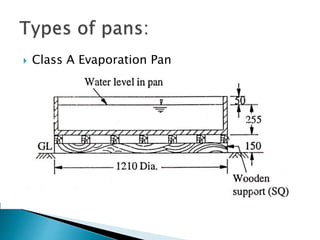
◦ Specified by IS:5973 and known as the modified
Class A Pan
◦ A pan of diameter 1220mm and depth 255mm
◦ The pan is made of copper sheet 0.9mm thick,
tinned inside and painted white outside
◦ The pan is placed on a square wooden platform of
width 1225mm and height 100mm above ground
level to allow free air circulation below the pan
◦ A fixed point gauge indicates the level of water
 Class A Evaporation Pan
 A square pan of 900mm sides and 450mm
deep
 Supported by drum floats in the middle of a
raft of size 4.25m x 4.87m, it is set afloat in
a lake with a view to simulate the
characteristics of a large body of water
 Water level in the pan is maintained at the
same level as that in the lake, leaving a rim of
75mm
 Lake evaporation =pan coefficient*pan
evaporation
◦ pan coefficient =
Lake evaporation
pan evaporation
Sl. No. Types of Pan Average Value Range
1 Class A Land Pan 0.70 0.60 – 0.80
2 ISI Pan (Modified Class A) 0.80 0.65 – 1.10
3 Colorado Sunken Pan 0.78 0.75 – 0.86
4 USGS Floating Pan 0.80 0.70 – 0.82
 WMO recommends the following values of
minimum density of evaporimeters
◦ Arid Zones – 1 station for every 30,000 sq.km
◦ Humid Temperate Zones – 1 station for every
50,000 sq.km
◦ Cold regions – 1 station for every 1,00,000 sq.km
(1) Meyer’s Formula
The wind velocity assumed to the 1/7 power law
𝑉ℎ = 𝐶ℎ(
1
7
)
𝑉ℎ1
𝑉ℎ2
=
ℎ1
ℎ2
(
1
7
)
Surface runoff -
Subsurface
runoff
Inflow-
Outflow-
Evaporation- E
surface losses
Precipitation -
P
 Hn = Ha + He + Hg + Hs + Hi
Where, Hn = net heat energy received by the water surface
= Hc (1- r) - Hb
Hc (1 – r) = incoming solar radiation into a surface of reflection coefficient
(albedo) r
Hb = back radiation (long wave) from water body
Ha = sensible heat transfer from water surface to air
He = heat energy used up in evaporation = ρ L E
where ρ = density of water
L = latent heat of evaporation and
E = evaporation in mm
Hg = heat flux into the ground
Hs = heat stored in water body
Hi = net heat conducted out of the system by water flow (advected energy)
 The sensible heat term Ha can be estimated
by using Bowen’s ratio by the following
expression
The process by which water vapour escapes
from the living plant , principally through the
leaves and enters the atmosphere
Air enters and water exit through Stomata
 a) Temperature;
 b) Solar Radiation;
 c) Wind;
 d) Soil Moisture;
 e) Plant type
 Use of empirical equations
 WBM
 EBM
 By field experiments
Potometer
Lysimeter
 combination of evaporation and transpiration =
consumptive use = Evapotranspiration (ET)
 The process by which water is evaporated from
wet surface and transpired from plants, i.e.
sum of evaporation and transpiration.
Potential Evapotranspiration (PET)
 The evapotranspiration (ET) that would occur if
there was an adequate soil-moisture supply at
all time.
Evapotranspiration
𝑐 𝑢 = 𝑘. 𝑓
The downward movement of water from soil surface, into
the soil mass through the pores of the soil.
1. Condition of entry surface
2. Permeable characteristics of soil
3. Moisture conditions in soil
4. Temperature
5. Intensity and duration of rainfall
6. Movement of man and animals
7. Human activities
8. Quality of water
9. Presence of ground water table
10. Size and characteristics of soil particles
11. Catchment parameters
Infiltration by Horton’s method
  kt
cc effff 
 0
 Single tube(ring) infiltrometer
 Double tube(ring) infiltrometer
Single Ring Double Ring
1. Average infiltration rate or W-index
Run off coefficient ‘k’
water resources engineering

water resources engineering

  • 1.
    WATER RESOURES ENGINEERING-I Presented By Srikanth Samudrala Department of CIVIL ENGINEERING KAMALA INSTITUTE OF TECHNOLOGY AND SCINCE, SINGAPUR
  • 2.
     Precipitation –Surface runoff= Total loss  Run off  Total loss= Interception + Transpiration +Infiltration +Depression storage +Watershed leakage + Evaporation
  • 3.
     Run offmeasured by  Centimeters of water over a catchment  Total water in cubic meter  Run off classified into three types i. Surface runoff ii. Sub-surface runoff iii. Base flow
  • 5.
    1. Precipitation characteristics 2.Shape and size of the catchment 3. Topography 4. Geological characteristics 5. Meteorological characteristics 6. Character of the catchment surface 7. Storage characteristics
  • 6.
    1) By linearor exponential regression 2) By empirical equation and tables 3) By infiltration method 4) By unit hydrograph 5) By rational method
  • 7.
    a. Straight lineregression between P and R R=aP+b a & b are the constants representing abstractions. 𝑎 = 𝑁 𝞢𝑃. 𝑅 − (𝞢𝑃)(𝞢𝑅) 𝑁 𝞢𝑃2 − (𝞢𝑃)2 b= 𝞢𝑅−𝑎𝞢𝑃 𝞢𝑁 b. Exponential regression between P and R R=β𝑃 𝑚 β and m are the constants log 𝑒 𝑅 = mlog 𝑒 𝑃 + log 𝑒 β
  • 8.
    a. Runoff coefficient b.Strange’s table and curves c. Inglis’s formula
  • 9.
    d. Lacey’s formula e.Khosla’s formula f. ICAR formula
  • 10.
     Evaporation isdefined as the process of a liquid changing into a gas
  • 12.
    1. Nature ofevaporating surface 2. Area of water surface 3. Depth of water in water body 4. Humidity 5. Wind velocity 6. Temperature of air 7. Atmospheric pressure 8. Quality of water
  • 14.
    1. Measurements usingevaporation pans 2. Use of empirical equations 3. Water budget method 4. Energy budget method
  • 15.
     E =u ( es-ea ) E= Evaporation loss (mm/day) u: function of wind speed, u=a+vb a, b are constants ea : current vapor pressure of the air above es : saturation vapor pressure at the water surface temperature
  • 16.
     Types: ◦ Livingstoneatmometer ◦ Piche Atmometer
  • 17.
     Pan evaporationis a measurement that combines or integrates the effects of several climate elements: temperature, humidity, rain fall, drought dispersion, solar radiation, and wind
  • 18.
     ISI StandardPan ◦ Specified by IS:5973 and known as the modified Class A Pan ◦ A pan of diameter 1220mm and depth 255mm ◦ The pan is made of copper sheet 0.9mm thick, tinned inside and painted white outside ◦ The pan is placed on a square wooden platform of width 1225mm and height 100mm above ground level to allow free air circulation below the pan ◦ A fixed point gauge indicates the level of water
  • 20.
     Class AEvaporation Pan
  • 22.
     A squarepan of 900mm sides and 450mm deep  Supported by drum floats in the middle of a raft of size 4.25m x 4.87m, it is set afloat in a lake with a view to simulate the characteristics of a large body of water  Water level in the pan is maintained at the same level as that in the lake, leaving a rim of 75mm
  • 24.
     Lake evaporation=pan coefficient*pan evaporation ◦ pan coefficient = Lake evaporation pan evaporation Sl. No. Types of Pan Average Value Range 1 Class A Land Pan 0.70 0.60 – 0.80 2 ISI Pan (Modified Class A) 0.80 0.65 – 1.10 3 Colorado Sunken Pan 0.78 0.75 – 0.86 4 USGS Floating Pan 0.80 0.70 – 0.82
  • 25.
     WMO recommendsthe following values of minimum density of evaporimeters ◦ Arid Zones – 1 station for every 30,000 sq.km ◦ Humid Temperate Zones – 1 station for every 50,000 sq.km ◦ Cold regions – 1 station for every 1,00,000 sq.km
  • 26.
  • 27.
    The wind velocityassumed to the 1/7 power law 𝑉ℎ = 𝐶ℎ( 1 7 ) 𝑉ℎ1 𝑉ℎ2 = ℎ1 ℎ2 ( 1 7 )
  • 29.
  • 30.
     Hn =Ha + He + Hg + Hs + Hi Where, Hn = net heat energy received by the water surface = Hc (1- r) - Hb Hc (1 – r) = incoming solar radiation into a surface of reflection coefficient (albedo) r Hb = back radiation (long wave) from water body Ha = sensible heat transfer from water surface to air He = heat energy used up in evaporation = ρ L E where ρ = density of water L = latent heat of evaporation and E = evaporation in mm Hg = heat flux into the ground Hs = heat stored in water body Hi = net heat conducted out of the system by water flow (advected energy)
  • 31.
     The sensibleheat term Ha can be estimated by using Bowen’s ratio by the following expression
  • 33.
    The process bywhich water vapour escapes from the living plant , principally through the leaves and enters the atmosphere Air enters and water exit through Stomata
  • 34.
     a) Temperature; b) Solar Radiation;  c) Wind;  d) Soil Moisture;  e) Plant type
  • 35.
     Use ofempirical equations  WBM  EBM  By field experiments Potometer Lysimeter
  • 36.
     combination ofevaporation and transpiration = consumptive use = Evapotranspiration (ET)  The process by which water is evaporated from wet surface and transpired from plants, i.e. sum of evaporation and transpiration. Potential Evapotranspiration (PET)  The evapotranspiration (ET) that would occur if there was an adequate soil-moisture supply at all time. Evapotranspiration
  • 37.
    𝑐 𝑢 =𝑘. 𝑓
  • 45.
    The downward movementof water from soil surface, into the soil mass through the pores of the soil.
  • 46.
    1. Condition ofentry surface 2. Permeable characteristics of soil 3. Moisture conditions in soil 4. Temperature 5. Intensity and duration of rainfall 6. Movement of man and animals 7. Human activities 8. Quality of water 9. Presence of ground water table 10. Size and characteristics of soil particles 11. Catchment parameters
  • 48.
  • 50.
      kt cceffff   0
  • 51.
     Single tube(ring)infiltrometer  Double tube(ring) infiltrometer
  • 52.
  • 53.
    1. Average infiltrationrate or W-index Run off coefficient ‘k’