RISK MANAGEMENT
Presented By:
Kinza Razzaq (BSIT-13-F072)
Risk management
• Risk management is concerned with identifying risks and drawing up
plans to minimise their effect on a project.
• A risk is a probability that some adverse circumstance will occur
• Project risks affect schedule or resources;
• Product risks affect the quality or performance of the software being
developed;
• Business risks affect the organising, developing or procuring the software.
2Risk Management
What is Risk Management?
• Risk is an uncertain event that may
have a positive or negative impact on
the project.
• Risk Management is the process of
identifying and migrating risk.
Risk Management 3
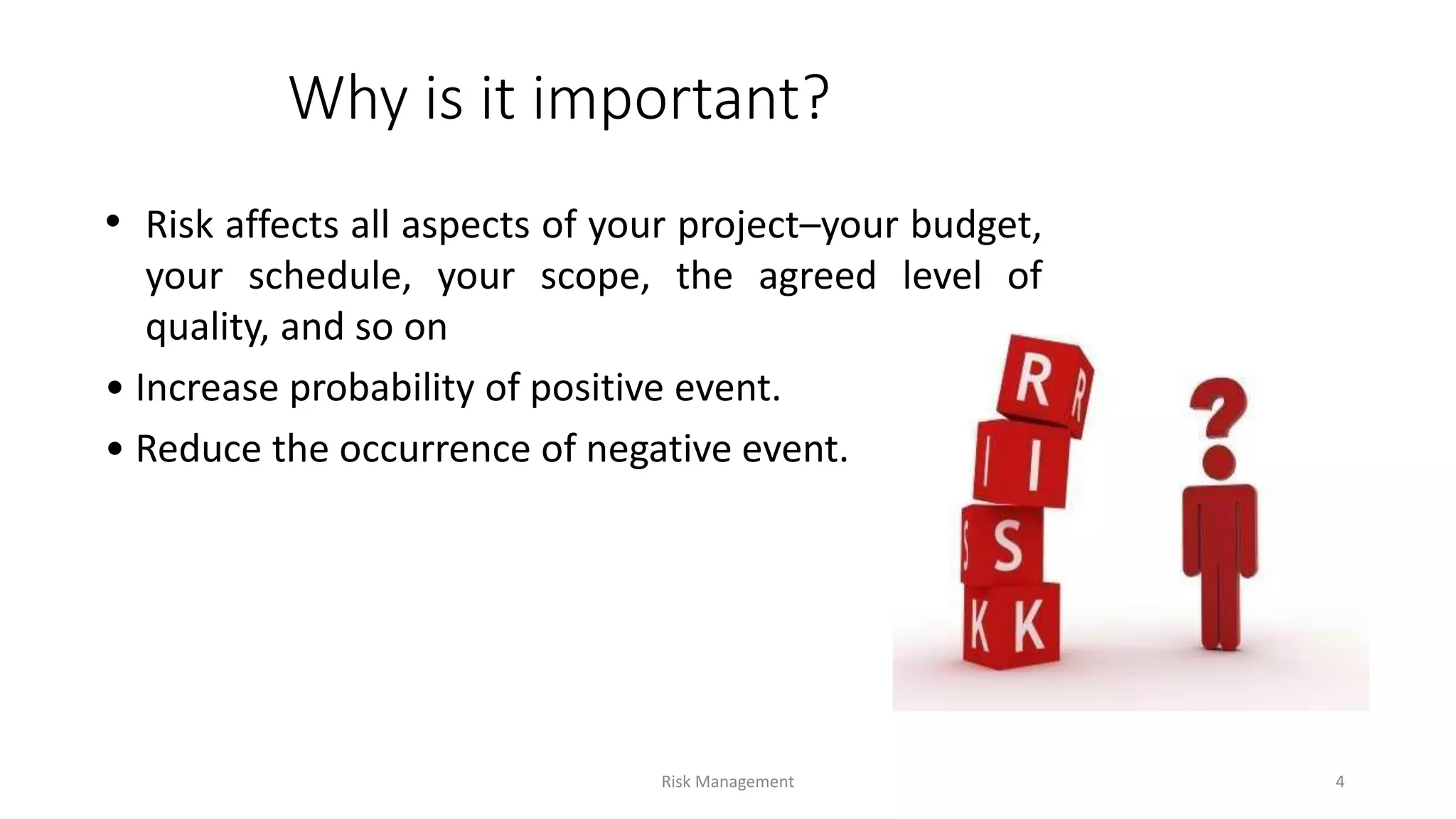
Why is it important?
• Risk affects all aspects of your project–your budget,
your schedule, your scope, the agreed level of
quality, and so on
• Increase probability of positive event.
• Reduce the occurrence of negative event.
Risk Management 4
Examples of common project, product, and
business risks
Risk Affects Description
Staff turnover Project Experienced staff will leave the project before it is
finished.
Management change Project There will be a change of organizational
management with different priorities.
Hardware unavailability Project Hardware that is essential for the project will not
be delivered on schedule.
Requirements change Project and product There will be a larger number of changes to the
requirements than anticipated.
Specification delays Project and product Specifications of essential interfaces are not
available on schedule.
Size underestimate Project and product The size of the system has been underestimated.
CASE tool
underperformance
Product CASE tools, which support the project, do not
perform as anticipated.
Technology change Business The underlying technology on which the system
is built is superseded by new technology.
Product competition Business A competitive product is marketed before the
system is completed.
5Risk Management
The risk management process
• Risk identification
• Identify project, product and business risks;
• Risk analysis
• Assess the likelihood and consequences of these risks;
• Risk planning
• Draw up plans to avoid or minimise the effects of the risk;
• Risk monitoring
• Monitor the risks throughout the project;
6Risk Management
The risk management process
7Risk Management
Risk identification
• May be a team activities or based on the individual project manager’s
experience.
• A checklist of common risks may be used to identify risks in a project
• Technology risks.
• People risks.
• Organisational risks.
• Requirements risks.
• Estimation risks.
8Risk Management
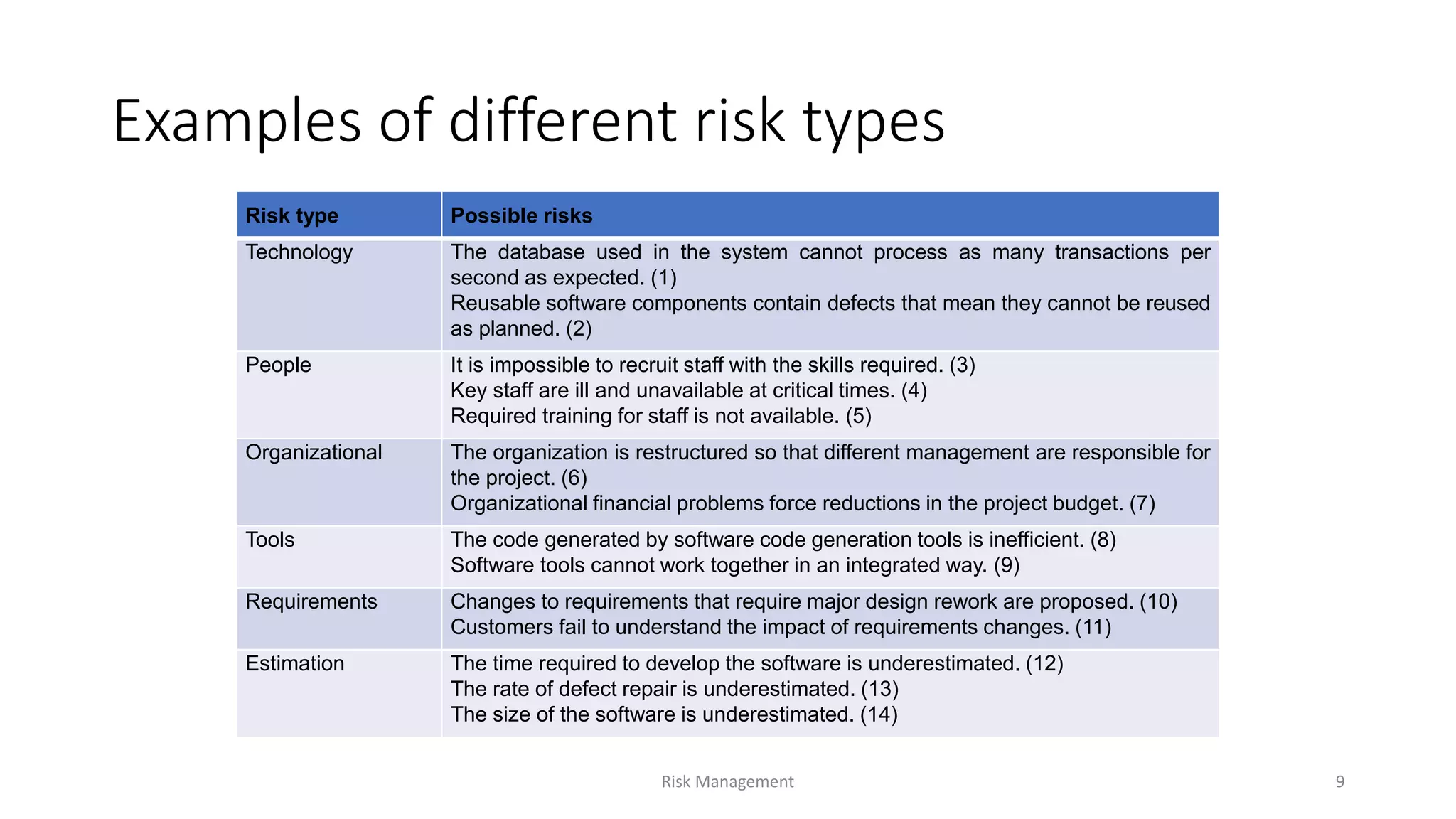
Examples of different risk types
Risk type Possible risks
Technology The database used in the system cannot process as many transactions per
second as expected. (1)
Reusable software components contain defects that mean they cannot be reused
as planned. (2)
People It is impossible to recruit staff with the skills required. (3)
Key staff are ill and unavailable at critical times. (4)
Required training for staff is not available. (5)
Organizational The organization is restructured so that different management are responsible for
the project. (6)
Organizational financial problems force reductions in the project budget. (7)
Tools The code generated by software code generation tools is inefficient. (8)
Software tools cannot work together in an integrated way. (9)
Requirements Changes to requirements that require major design rework are proposed. (10)
Customers fail to understand the impact of requirements changes. (11)
Estimation The time required to develop the software is underestimated. (12)
The rate of defect repair is underestimated. (13)
The size of the software is underestimated. (14)
9Risk Management
Risk analysis
• Assess probability and seriousness of each risk.
• Probability may be very low, low, moderate, high or very high.
• Risk consequences might be catastrophic, serious, tolerable or
insignificant.
10Risk Management
Risk types and examples
Risk Probability Effects
Organizational financial problems force reductions in the
project budget (7).
Low Catastrophic
It is impossible to recruit staff with the skills required for the
project (3).
High Catastrophic
Key staff are ill at critical times in the project (4). Moderate Serious
Faults in reusable software components have to be repaired
before these components are reused. (2).
Moderate Serious
Changes to requirements that require major design rework
are proposed (10).
Moderate Serious
The organization is restructured so that different
management are responsible for the project (6).
High Serious
The database used in the system cannot process as many
transactions per second as expected (1).
Moderate Serious
11Risk Management
Risk Probability Effects
The time required to develop the software is
underestimated (12).
High Serious
Software tools cannot be integrated (9). High Tolerable
Customers fail to understand the impact of requirements
changes (11).
Moderate Tolerable
Required training for staff is not available (5). Moderate Tolerable
The rate of defect repair is underestimated (13). Moderate Tolerable
The size of the software is underestimated (14). High Tolerable
Code generated by code generation tools is inefficient (8). Moderate Insignificant
Risk types and examples
12Risk Management
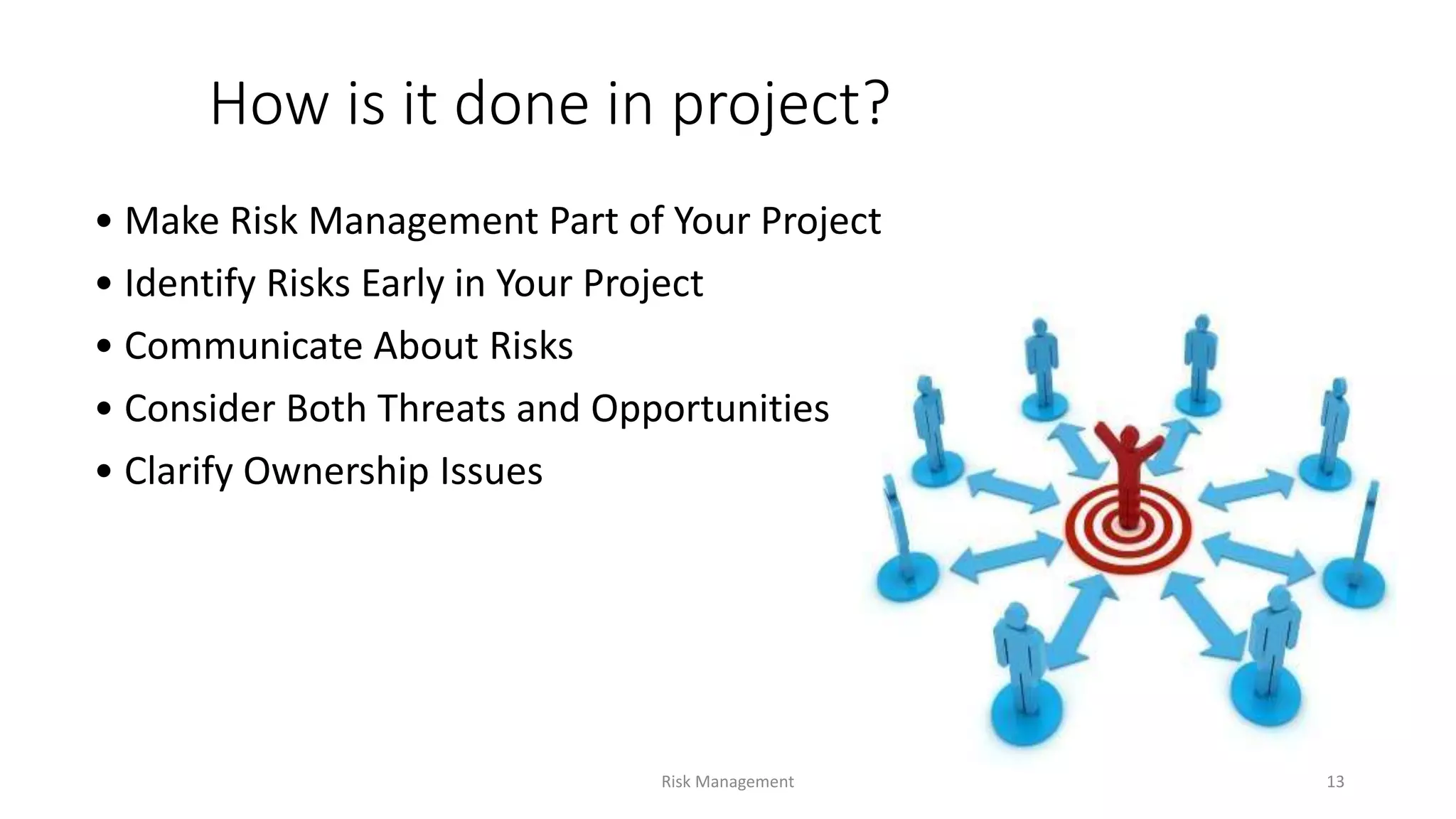
How is it done in project?
• Make Risk Management Part of Your Project
• Identify Risks Early in Your Project
• Communicate About Risks
• Consider Both Threats and Opportunities
• Clarify Ownership Issues
Risk Management 13
How is It done in project?
• Prioritise Risks
• Analyse Risks
• Plan and Implement Risk Responses
• Register Project Risks
• Track Risks and Associated Tasks
Risk Management 14
Strategies to help manage risk
Risk Strategy
Organizational financial
problems
Prepare a briefing document for senior management
showing how the project is making a very important
contribution to the goals of the business and presenting
reasons why cuts to the project budget would not be cost-
effective.
Recruitment problems Alert customer to potential difficulties and the possibility of
delays; investigate buying-in components.
Staff illness Reorganize team so that there is more overlap of work and
people therefore understand each other’s jobs.
Defective components Replace potentially defective components with bought-in
components of known reliability.
Requirements changes Derive traceability information to assess requirements
change impact; maximize information hiding in the design.
15Risk Management
Strategies to help manage risk
Risk Strategy
Organizational
restructuring
Prepare a briefing document for senior management
showing how the project is making a very important
contribution to the goals of the business.
Database
performance
Investigate the possibility of buying a higher-performance
database.
Underestimated
development time
Investigate buying-in components; investigate use of a
program generator.
16Risk Management
Risk monitoring
• Assess each identified risks regularly to decide whether or not it is
becoming less or more probable.
• Also assess whether the effects of the risk have changed.
• Each key risk should be discussed at management progress meetings.
17Risk Management
What are the benefits?
• Effective use of resources
• Promoting continuous improvement
• Fewer shocks and failures
• Strategic business planning
• Raised awareness of significant risks.
Risk Management 18
What are the benefits?
• Quick grasp of new opportunities
• Enhancing communication
• Reassuring stakeholders
• Focus on internal audit programme
• Recognition of responsibility and
accountability.
Risk Management 19
Risk indicators
Risk type Potential indicators
Technology Late delivery of hardware or support software; many reported
technology problems.
People Poor staff morale; poor relationships amongst team members; high staff
turnover.
Organizational Organizational gossip; lack of action by senior management.
Tools Reluctance by team members to use tools; complaints about CASE
tools; demands for higher-powered workstations.
Requirements Many requirements change requests; customer complaints.
Estimation Failure to meet agreed schedule; failure to clear reported defects.
20Risk Management
How does Primavera help?
• Keep track of issues
• Maintain threshold
• Health of project
• Track overall project progress to identify any deviation
Risk Management 21
Key points
• Good project management is essential if software engineering projects are to be developed on
schedule and within budget.
• Software management is distinct from other engineering management. Software is intangible.
Projects may be novel or innovative with no body of experience to guide their management.
Software processes are not as mature as traditional engineering processes.
• Risk management is now recognized as one of the most important project management tasks.
• Risk management involves identifying and assessing project risks to establish the probability that
they will occur and the consequences for the project if that risk does arise. You should make plans
to avoid, manage or deal with likely risks if or when they arise.
Risk Management 22
Risk Management 23

Risk Management

  • 1.
  • 2.
    Risk management • Riskmanagement is concerned with identifying risks and drawing up plans to minimise their effect on a project. • A risk is a probability that some adverse circumstance will occur • Project risks affect schedule or resources; • Product risks affect the quality or performance of the software being developed; • Business risks affect the organising, developing or procuring the software. 2Risk Management
  • 3.
    What is RiskManagement? • Risk is an uncertain event that may have a positive or negative impact on the project. • Risk Management is the process of identifying and migrating risk. Risk Management 3
  • 4.
    Why is itimportant? • Risk affects all aspects of your project–your budget, your schedule, your scope, the agreed level of quality, and so on • Increase probability of positive event. • Reduce the occurrence of negative event. Risk Management 4
  • 5.
    Examples of commonproject, product, and business risks Risk Affects Description Staff turnover Project Experienced staff will leave the project before it is finished. Management change Project There will be a change of organizational management with different priorities. Hardware unavailability Project Hardware that is essential for the project will not be delivered on schedule. Requirements change Project and product There will be a larger number of changes to the requirements than anticipated. Specification delays Project and product Specifications of essential interfaces are not available on schedule. Size underestimate Project and product The size of the system has been underestimated. CASE tool underperformance Product CASE tools, which support the project, do not perform as anticipated. Technology change Business The underlying technology on which the system is built is superseded by new technology. Product competition Business A competitive product is marketed before the system is completed. 5Risk Management
  • 6.
    The risk managementprocess • Risk identification • Identify project, product and business risks; • Risk analysis • Assess the likelihood and consequences of these risks; • Risk planning • Draw up plans to avoid or minimise the effects of the risk; • Risk monitoring • Monitor the risks throughout the project; 6Risk Management
  • 7.
    The risk managementprocess 7Risk Management
  • 8.
    Risk identification • Maybe a team activities or based on the individual project manager’s experience. • A checklist of common risks may be used to identify risks in a project • Technology risks. • People risks. • Organisational risks. • Requirements risks. • Estimation risks. 8Risk Management
  • 9.
    Examples of differentrisk types Risk type Possible risks Technology The database used in the system cannot process as many transactions per second as expected. (1) Reusable software components contain defects that mean they cannot be reused as planned. (2) People It is impossible to recruit staff with the skills required. (3) Key staff are ill and unavailable at critical times. (4) Required training for staff is not available. (5) Organizational The organization is restructured so that different management are responsible for the project. (6) Organizational financial problems force reductions in the project budget. (7) Tools The code generated by software code generation tools is inefficient. (8) Software tools cannot work together in an integrated way. (9) Requirements Changes to requirements that require major design rework are proposed. (10) Customers fail to understand the impact of requirements changes. (11) Estimation The time required to develop the software is underestimated. (12) The rate of defect repair is underestimated. (13) The size of the software is underestimated. (14) 9Risk Management
  • 10.
    Risk analysis • Assessprobability and seriousness of each risk. • Probability may be very low, low, moderate, high or very high. • Risk consequences might be catastrophic, serious, tolerable or insignificant. 10Risk Management
  • 11.
    Risk types andexamples Risk Probability Effects Organizational financial problems force reductions in the project budget (7). Low Catastrophic It is impossible to recruit staff with the skills required for the project (3). High Catastrophic Key staff are ill at critical times in the project (4). Moderate Serious Faults in reusable software components have to be repaired before these components are reused. (2). Moderate Serious Changes to requirements that require major design rework are proposed (10). Moderate Serious The organization is restructured so that different management are responsible for the project (6). High Serious The database used in the system cannot process as many transactions per second as expected (1). Moderate Serious 11Risk Management
  • 12.
    Risk Probability Effects Thetime required to develop the software is underestimated (12). High Serious Software tools cannot be integrated (9). High Tolerable Customers fail to understand the impact of requirements changes (11). Moderate Tolerable Required training for staff is not available (5). Moderate Tolerable The rate of defect repair is underestimated (13). Moderate Tolerable The size of the software is underestimated (14). High Tolerable Code generated by code generation tools is inefficient (8). Moderate Insignificant Risk types and examples 12Risk Management
  • 13.
    How is itdone in project? • Make Risk Management Part of Your Project • Identify Risks Early in Your Project • Communicate About Risks • Consider Both Threats and Opportunities • Clarify Ownership Issues Risk Management 13
  • 14.
    How is Itdone in project? • Prioritise Risks • Analyse Risks • Plan and Implement Risk Responses • Register Project Risks • Track Risks and Associated Tasks Risk Management 14
  • 15.
    Strategies to helpmanage risk Risk Strategy Organizational financial problems Prepare a briefing document for senior management showing how the project is making a very important contribution to the goals of the business and presenting reasons why cuts to the project budget would not be cost- effective. Recruitment problems Alert customer to potential difficulties and the possibility of delays; investigate buying-in components. Staff illness Reorganize team so that there is more overlap of work and people therefore understand each other’s jobs. Defective components Replace potentially defective components with bought-in components of known reliability. Requirements changes Derive traceability information to assess requirements change impact; maximize information hiding in the design. 15Risk Management
  • 16.
    Strategies to helpmanage risk Risk Strategy Organizational restructuring Prepare a briefing document for senior management showing how the project is making a very important contribution to the goals of the business. Database performance Investigate the possibility of buying a higher-performance database. Underestimated development time Investigate buying-in components; investigate use of a program generator. 16Risk Management
  • 17.
    Risk monitoring • Assesseach identified risks regularly to decide whether or not it is becoming less or more probable. • Also assess whether the effects of the risk have changed. • Each key risk should be discussed at management progress meetings. 17Risk Management
  • 18.
    What are thebenefits? • Effective use of resources • Promoting continuous improvement • Fewer shocks and failures • Strategic business planning • Raised awareness of significant risks. Risk Management 18
  • 19.
    What are thebenefits? • Quick grasp of new opportunities • Enhancing communication • Reassuring stakeholders • Focus on internal audit programme • Recognition of responsibility and accountability. Risk Management 19
  • 20.
    Risk indicators Risk typePotential indicators Technology Late delivery of hardware or support software; many reported technology problems. People Poor staff morale; poor relationships amongst team members; high staff turnover. Organizational Organizational gossip; lack of action by senior management. Tools Reluctance by team members to use tools; complaints about CASE tools; demands for higher-powered workstations. Requirements Many requirements change requests; customer complaints. Estimation Failure to meet agreed schedule; failure to clear reported defects. 20Risk Management
  • 21.
    How does Primaverahelp? • Keep track of issues • Maintain threshold • Health of project • Track overall project progress to identify any deviation Risk Management 21
  • 22.
    Key points • Goodproject management is essential if software engineering projects are to be developed on schedule and within budget. • Software management is distinct from other engineering management. Software is intangible. Projects may be novel or innovative with no body of experience to guide their management. Software processes are not as mature as traditional engineering processes. • Risk management is now recognized as one of the most important project management tasks. • Risk management involves identifying and assessing project risks to establish the probability that they will occur and the consequences for the project if that risk does arise. You should make plans to avoid, manage or deal with likely risks if or when they arise. Risk Management 22
  • 23.