1
Construction Planning & Management
Text Book 1:Dr. B.C. Punmia, K.K.
Khandelwal
Akhil Shetty
Asst. Professor
Department of Civil Engineering
2
Project Management
 A project is composed of jobs, activities, functions or
tasks that are related one to the other in some manner.
 All of these should be completed in order to complete
the project.
 Every project has one specific purpose. It starts at
some specific moment and it is finished when its
objectives have been fulfilled.
3
Characteristics of a Project
 A unique, one-time effort
 Requires the completion of a large number of
interrelated activities
 Resources, such as time and/or money, are limited
 Typically has its own management structure
4
Objectives of Project
 The Project should be completed with a minimum of
elapsed time.
 It should use available manpower and the other
recourses as sparingly as possible, without delay.
 It should be completed with a minimum of capital
investment, without delay.
5
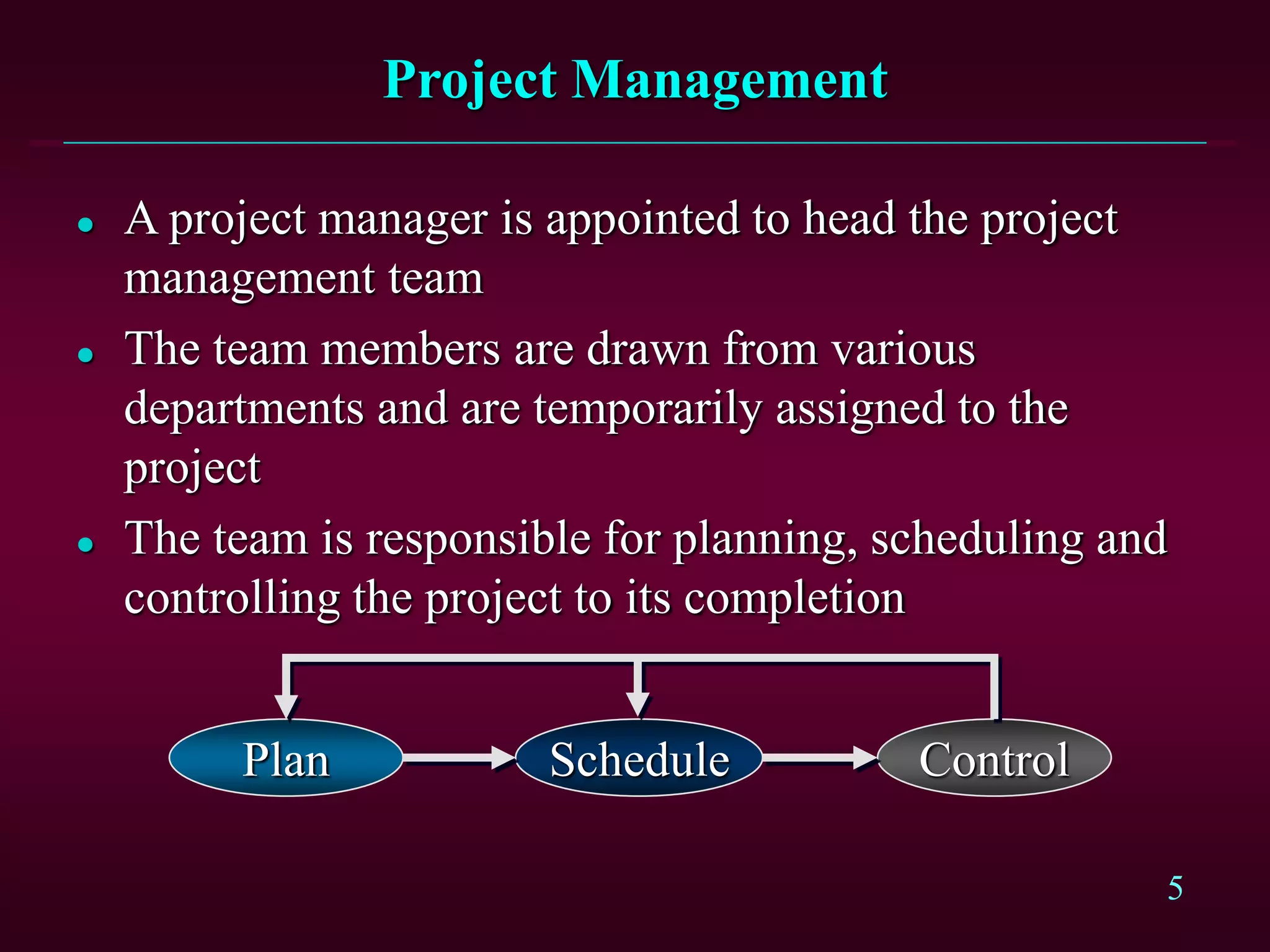
Project Management
 A project manager is appointed to head the project
management team
 The team members are drawn from various
departments and are temporarily assigned to the
project
 The team is responsible for planning, scheduling and
controlling the project to its completion
Plan Schedule Control
6
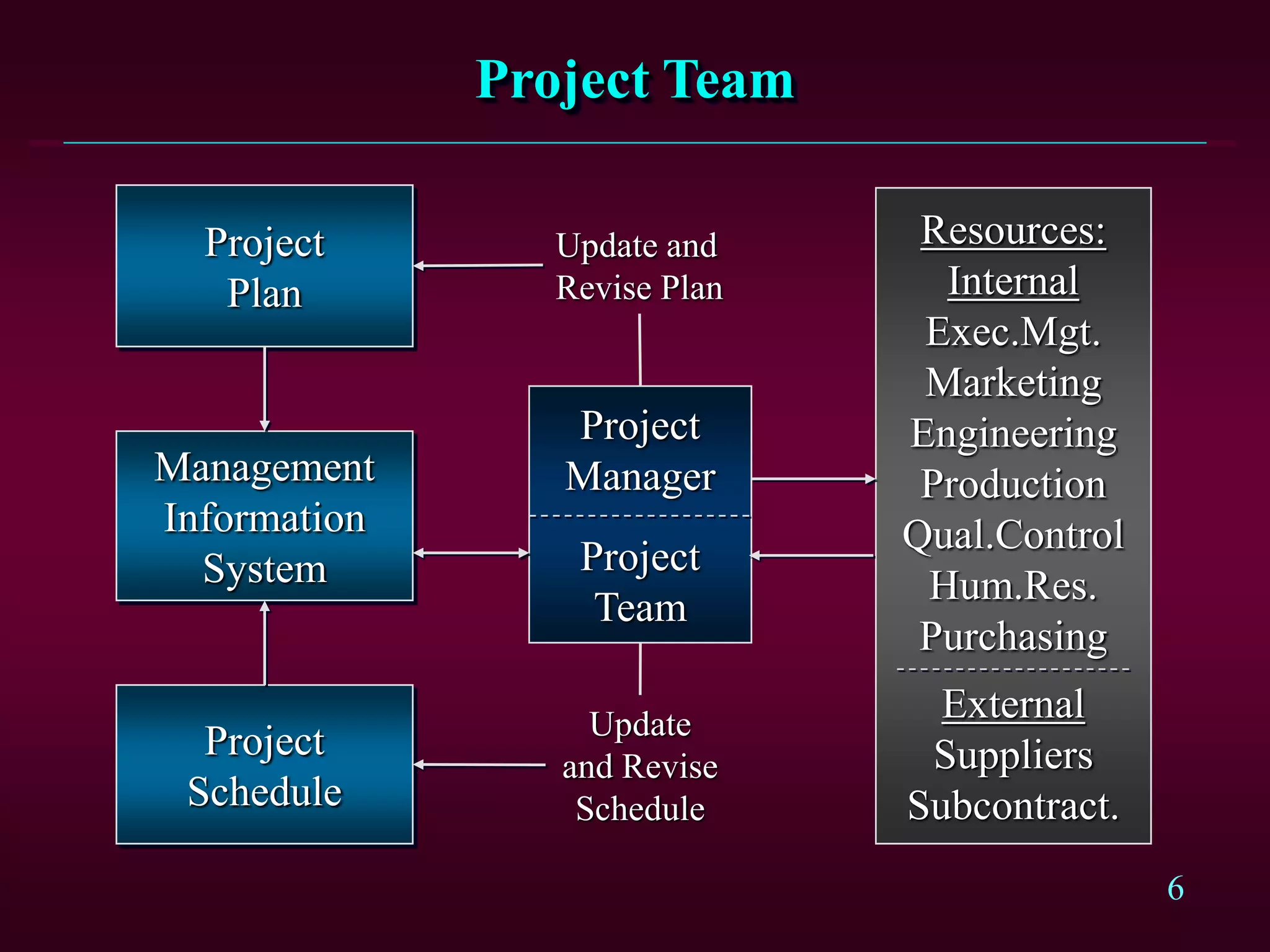
Project Team
Project
Plan
Management
Information
System
Project
Schedule
Project
Manager
Project
Team
Resources:
Internal
Exec.Mgt.
Marketing
Engineering
Production
Qual.Control
Hum.Res.
Purchasing
External
Suppliers
Subcontract.
Update
and Revise
Schedule
Update and
Revise Plan
7
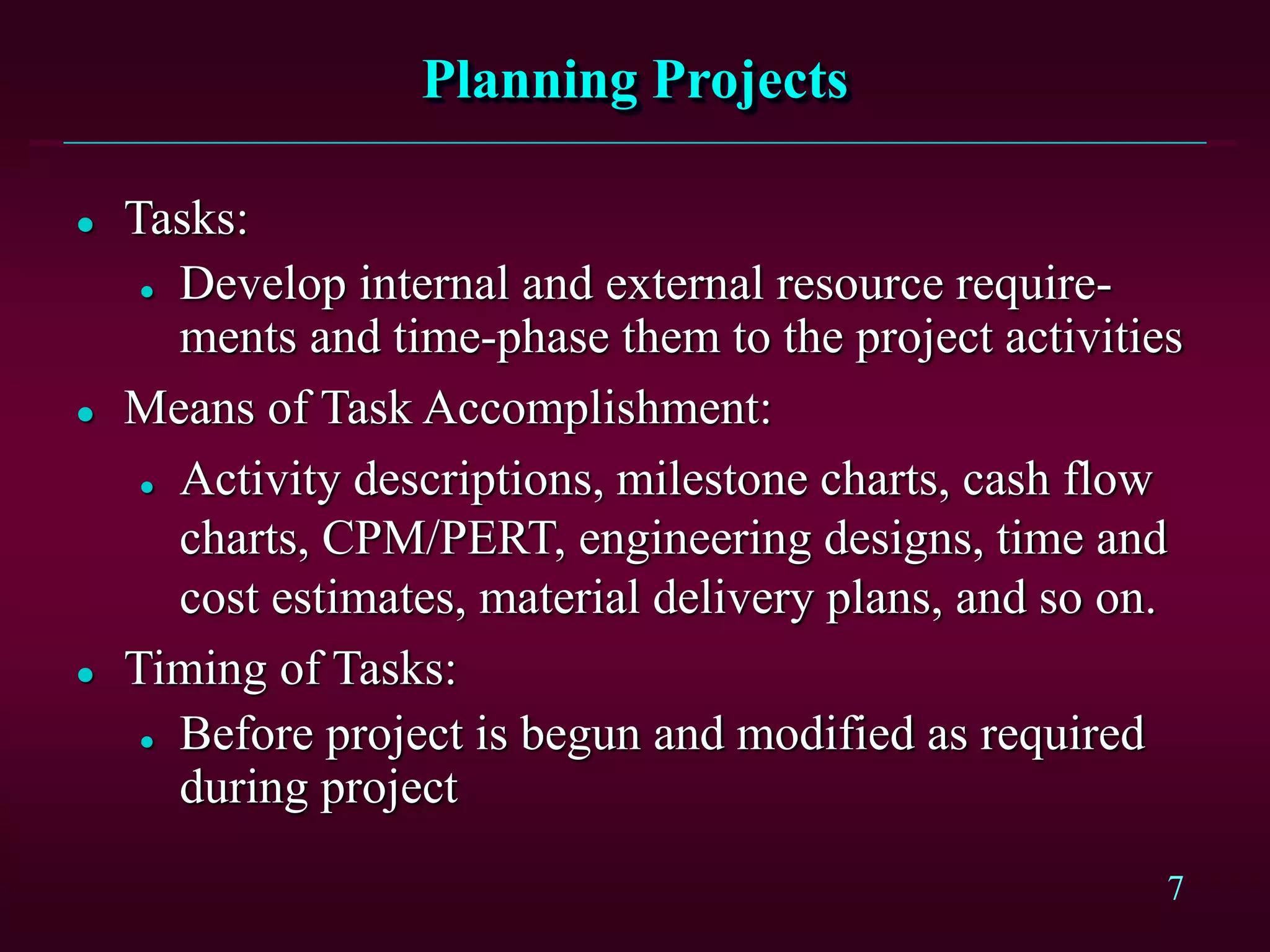
Planning Projects
 Tasks:
 Develop internal and external resource require-
ments and time-phase them to the project activities
 Means of Task Accomplishment:
 Activity descriptions, milestone charts, cash flow
charts, CPM/PERT, engineering designs, time and
cost estimates, material delivery plans, and so on.
 Timing of Tasks:
 Before project is begun and modified as required
during project
8
Planning is important because….
 It provides direction.
 It provides unifying framework.
 It helps to reveal future opportunities and threats.
 It provides performance standards.
In Planning phase, plan is made and strategies are set,
taking into account the company’s policies, procedures
and rules.
9
Plan
 It is the statement of intent, i.e, what is to be done.
 What has to be done to resources to achieve the
intent.
 Plans are detailed methods, formulated before hand
for doing or making something.
 Plan list the goals(targets) and define the means of
achieving them.
 These listed goals are called Events and means of
achieving these goals are known as operations or
Activities.
10
Strategies
 Strategy is one important type of plan.
 It specifies the central concept or purpose of the
enterprise as well as the means by which it intends to
carry the purpose.
11
Policies, procedures and rules.
 Policies: It sets broad guidelines for an enterprise.
 Procedure: it specifies, how to proceed in some
situation.
 Rule: It is even more specific guide for action.
12
Steps in project planning
1. Define
2. Establish
3. Develop
4. Evaluate
5. Determinate
6. Test
7. Choose
8. Decide
13
Resources
 Material resources (including financial resources)
 Equipment resources
 Space resources
 Manpower resources
 Time resources
14
Scheduling
 Scheduling is the allocation of resources.
 These resources are time, space, equipment and effort
applied to material.
 It is the mechanical process of assigning the starting
and completion dates to each part (or activity) of the
work in such a manner that the whole work proceed
in logical sequence and in an orderly and systematic
manner.
15
Steps in Project Scheduling Phase
 Calculate
 Assign
 Give
 Allocate
16
Controlling
 Controlling consists of reviewing the difference
between the schedule and actual performance once
the project has begun.
 Project control is the formal mechanism established
to determine deviations from the basic plan, to
determine the precise effect of these deviations on the
plan.
 To replan and reschedule to compensate for the
deviations.
17
Steps in Control Process
1. Establish
2. Measure
3. Identity
4. Suggest and Select
18
Scheduling and Control Charts
 Horizontal Bar Charts
 A version of the Gantt chart
 Used to plan and schedule activities
 As the project progresses, the status of activities is
plotted on the chart, compared to the plan, and, if
necessary, corrective action is taken
 … more
19
Scheduling and Control Charts
 Horizontal Bar Charts (continued)
 Advantages
 Easy to understand
 Easy to modify and update
 Low costq
 Disadvantages
 Cumbersome for large project
 Must be keep up to date
 Does not indicate the relationships among the
activities
20
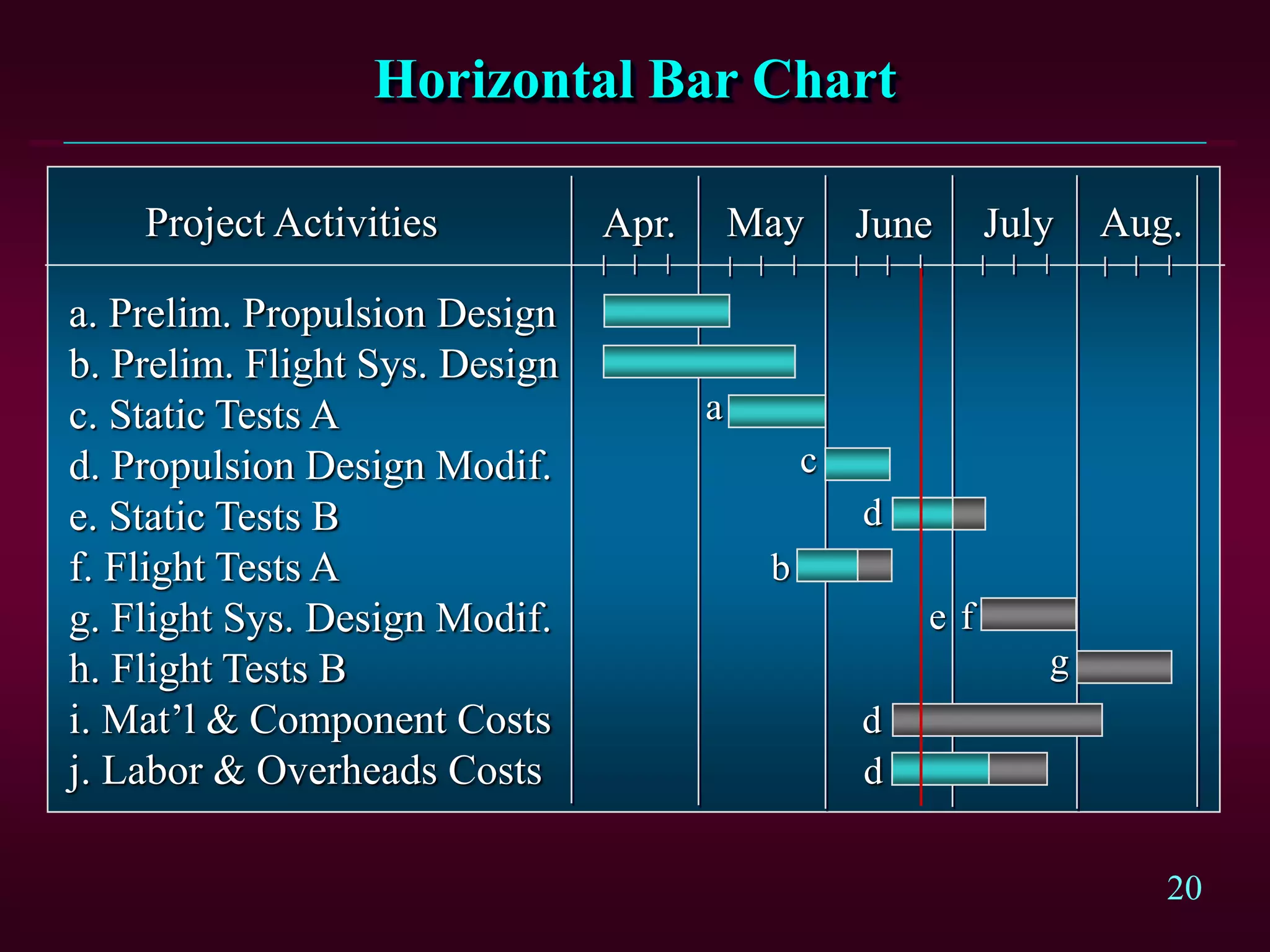
Horizontal Bar Chart
a. Prelim. Propulsion Design
b. Prelim. Flight Sys. Design
c. Static Tests A
d. Propulsion Design Modif.
e. Static Tests B
f. Flight Tests A
g. Flight Sys. Design Modif.
h. Flight Tests B
i. Mat’l & Component Costs
j. Labor & Overheads Costs
Apr. May June July Aug.
a
c
d
b
e f
g
d
d
Project Activities
21
Network Methods
 Network diagram is an outcome of the improvements
in the bar charts.
 This technique is based on the basic characteristics of
all projects, that all work must be done in well
defined steps.
 This technique exploits the characteristics by
representing the steps of the project objective
graphically in the form of a network or arrow
diagram
22
PERT
 Program Evaluation and Review Technique
 The PERT system uses a network diagram consisting
of events which must be established to reach project
objectives.
 An event is that particular instant of time at which
some specific part of a plan is to be achieved.
 PERT uses event oriented network diagrams in which
successive events are joined by arrows.
 PERT is preferred for projects which are non
repetitive in nature (Management cannot be guided by
past experience)
23
CPM
 Critical Path Method
 In CPM networks, the whole projects consist of a
number of clearly recognizable jobs or operations,
called activities.
 Activities are usually operations which take time to
carry out (on which resources are expended)
 Junction between activity is know as Event.
 CPM networks are activity oriented diagrams in
which each activity is represented by an arrow.
 The sequence in which the activities are performed is
the sequence of arrows.
24
Differences between PERT and CPM
CPM PERT
CPM uses activity oriented network. PERT uses event oriented Network.
Durations of activity may be estimated
with a fair degree of accuracy.
Estimate of time for activities are not
so accurate and definite.
It is used extensively in construction
projects.
It is used mostly in research and
development projects, particularly
projects of non-repetitive nature.
Deterministic concept is used. Probabilistic model concept is used.
CPM can control both time and cost
when planning.
PERT is basically a tool for planning.
25
CPM PERT
In CPM, cost optimization is
given prime importance. The
time for the completion of the
project depends upon cost
optimization. The cost is not
directly proportioned to time.
Thus, cost is the controlling
factor.
In PERT, it is assumed that cost
varies directly with time.
Attention is therefore given to
minimize the time so that
minimum cost results. Thus in
PERT, time is the controlling
factor.

Introduction Construction Planning and Management

  • 1.
    1 Construction Planning &Management Text Book 1:Dr. B.C. Punmia, K.K. Khandelwal Akhil Shetty Asst. Professor Department of Civil Engineering
  • 2.
    2 Project Management  Aproject is composed of jobs, activities, functions or tasks that are related one to the other in some manner.  All of these should be completed in order to complete the project.  Every project has one specific purpose. It starts at some specific moment and it is finished when its objectives have been fulfilled.
  • 3.
    3 Characteristics of aProject  A unique, one-time effort  Requires the completion of a large number of interrelated activities  Resources, such as time and/or money, are limited  Typically has its own management structure
  • 4.
    4 Objectives of Project The Project should be completed with a minimum of elapsed time.  It should use available manpower and the other recourses as sparingly as possible, without delay.  It should be completed with a minimum of capital investment, without delay.
  • 5.
    5 Project Management  Aproject manager is appointed to head the project management team  The team members are drawn from various departments and are temporarily assigned to the project  The team is responsible for planning, scheduling and controlling the project to its completion Plan Schedule Control
  • 6.
  • 7.
    7 Planning Projects  Tasks: Develop internal and external resource require- ments and time-phase them to the project activities  Means of Task Accomplishment:  Activity descriptions, milestone charts, cash flow charts, CPM/PERT, engineering designs, time and cost estimates, material delivery plans, and so on.  Timing of Tasks:  Before project is begun and modified as required during project
  • 8.
    8 Planning is importantbecause….  It provides direction.  It provides unifying framework.  It helps to reveal future opportunities and threats.  It provides performance standards. In Planning phase, plan is made and strategies are set, taking into account the company’s policies, procedures and rules.
  • 9.
    9 Plan  It isthe statement of intent, i.e, what is to be done.  What has to be done to resources to achieve the intent.  Plans are detailed methods, formulated before hand for doing or making something.  Plan list the goals(targets) and define the means of achieving them.  These listed goals are called Events and means of achieving these goals are known as operations or Activities.
  • 10.
    10 Strategies  Strategy isone important type of plan.  It specifies the central concept or purpose of the enterprise as well as the means by which it intends to carry the purpose.
  • 11.
    11 Policies, procedures andrules.  Policies: It sets broad guidelines for an enterprise.  Procedure: it specifies, how to proceed in some situation.  Rule: It is even more specific guide for action.
  • 12.
    12 Steps in projectplanning 1. Define 2. Establish 3. Develop 4. Evaluate 5. Determinate 6. Test 7. Choose 8. Decide
  • 13.
    13 Resources  Material resources(including financial resources)  Equipment resources  Space resources  Manpower resources  Time resources
  • 14.
    14 Scheduling  Scheduling isthe allocation of resources.  These resources are time, space, equipment and effort applied to material.  It is the mechanical process of assigning the starting and completion dates to each part (or activity) of the work in such a manner that the whole work proceed in logical sequence and in an orderly and systematic manner.
  • 15.
    15 Steps in ProjectScheduling Phase  Calculate  Assign  Give  Allocate
  • 16.
    16 Controlling  Controlling consistsof reviewing the difference between the schedule and actual performance once the project has begun.  Project control is the formal mechanism established to determine deviations from the basic plan, to determine the precise effect of these deviations on the plan.  To replan and reschedule to compensate for the deviations.
  • 17.
    17 Steps in ControlProcess 1. Establish 2. Measure 3. Identity 4. Suggest and Select
  • 18.
    18 Scheduling and ControlCharts  Horizontal Bar Charts  A version of the Gantt chart  Used to plan and schedule activities  As the project progresses, the status of activities is plotted on the chart, compared to the plan, and, if necessary, corrective action is taken  … more
  • 19.
    19 Scheduling and ControlCharts  Horizontal Bar Charts (continued)  Advantages  Easy to understand  Easy to modify and update  Low costq  Disadvantages  Cumbersome for large project  Must be keep up to date  Does not indicate the relationships among the activities
  • 20.
    20 Horizontal Bar Chart a.Prelim. Propulsion Design b. Prelim. Flight Sys. Design c. Static Tests A d. Propulsion Design Modif. e. Static Tests B f. Flight Tests A g. Flight Sys. Design Modif. h. Flight Tests B i. Mat’l & Component Costs j. Labor & Overheads Costs Apr. May June July Aug. a c d b e f g d d Project Activities
  • 21.
    21 Network Methods  Networkdiagram is an outcome of the improvements in the bar charts.  This technique is based on the basic characteristics of all projects, that all work must be done in well defined steps.  This technique exploits the characteristics by representing the steps of the project objective graphically in the form of a network or arrow diagram
  • 22.
    22 PERT  Program Evaluationand Review Technique  The PERT system uses a network diagram consisting of events which must be established to reach project objectives.  An event is that particular instant of time at which some specific part of a plan is to be achieved.  PERT uses event oriented network diagrams in which successive events are joined by arrows.  PERT is preferred for projects which are non repetitive in nature (Management cannot be guided by past experience)
  • 23.
    23 CPM  Critical PathMethod  In CPM networks, the whole projects consist of a number of clearly recognizable jobs or operations, called activities.  Activities are usually operations which take time to carry out (on which resources are expended)  Junction between activity is know as Event.  CPM networks are activity oriented diagrams in which each activity is represented by an arrow.  The sequence in which the activities are performed is the sequence of arrows.
  • 24.
    24 Differences between PERTand CPM CPM PERT CPM uses activity oriented network. PERT uses event oriented Network. Durations of activity may be estimated with a fair degree of accuracy. Estimate of time for activities are not so accurate and definite. It is used extensively in construction projects. It is used mostly in research and development projects, particularly projects of non-repetitive nature. Deterministic concept is used. Probabilistic model concept is used. CPM can control both time and cost when planning. PERT is basically a tool for planning.
  • 25.
    25 CPM PERT In CPM,cost optimization is given prime importance. The time for the completion of the project depends upon cost optimization. The cost is not directly proportioned to time. Thus, cost is the controlling factor. In PERT, it is assumed that cost varies directly with time. Attention is therefore given to minimize the time so that minimum cost results. Thus in PERT, time is the controlling factor.