Project Management and
Implementation
Bill Burson
Session 1: Participant Mobility
But first – what are we doing?
 Investigating key issues relevant to Erasmus+ projects
 Asking questions which help us to identify the
challenges and barriers to good practice
 Finding and sharing practical solutions within the group
 Passing the learning from today out more widely to
Erasmus+ beneficiaries
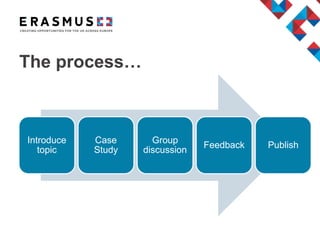
The process…
Introduce
topic
Case
Study
Group
discussion
Feedback Publish
Session One: Participant Mobility
 Why this topic?
 In many sectors, beneficiaries find it difficult to introduce
non-staff mobility in to their projects
 Erasmus+ funding provides a unique opportunity for
people to work and study in another country – we want
this benefit to reach as many people as possible.
 What do we want to achieve?
 To remove the barriers to mobility and to identify best
practice and top tips.
Session 2: Managing International
Partnerships
Session Two: Partnership Management
 Why this topic?
 Projects which perform poorly are often derailed by
breakdowns in the partnership.
 Incomplete projects result in funding being poorly used or
returned
 What do want to achieve?
 To identify the actions, approaches and processes which
facilitate successful partnership working
Project Management and Implementation

Project Management and Implementation

  • 1.
  • 2.
  • 3.
    But first –what are we doing?  Investigating key issues relevant to Erasmus+ projects  Asking questions which help us to identify the challenges and barriers to good practice  Finding and sharing practical solutions within the group  Passing the learning from today out more widely to Erasmus+ beneficiaries
  • 4.
  • 5.
    Session One: ParticipantMobility  Why this topic?  In many sectors, beneficiaries find it difficult to introduce non-staff mobility in to their projects  Erasmus+ funding provides a unique opportunity for people to work and study in another country – we want this benefit to reach as many people as possible.  What do we want to achieve?  To remove the barriers to mobility and to identify best practice and top tips.
  • 7.
    Session 2: ManagingInternational Partnerships
  • 8.
    Session Two: PartnershipManagement  Why this topic?  Projects which perform poorly are often derailed by breakdowns in the partnership.  Incomplete projects result in funding being poorly used or returned  What do want to achieve?  To identify the actions, approaches and processes which facilitate successful partnership working

Editor's Notes

  • #3 SECTION 4 - ECORYS
  • #6 To give you an overview of the Programme: Erasmus+ is the successor to the Lifelong Learning Programme and Youth in Action. Some of you may be familiar with the old Comenius programme which fell under the Lifelong Learning Programme. The Erasmus+ programme began in 2014 and runs for seven years until 2020, so we’re just starting the second year of the programme. As you can see in the diagram it is structured around five different Actions: Key Action 1 – Mobility of individuals Key Action 2 – Co-operation for innovation and the exchange of good practices Key Action 3 – Support for policy reform Jean Monnet - which is about higher education activities around European integration And last but not least Sport for activities relating to grassroots sport. Activities are split between those managed in each participating country and those managed centrally in Brussels: For Centralised Actions you apply to the European Commission and they manage your project. There is more detail about this on our webiste. For Decentralised Actions you apply to UK National Agency and your project is handled in the UK. In the UK the decentralised activities - Key Actions 1, 2 and 3 - are run by the British Council and Ecorys UK in partnership as the National Agency.
  • #7 To give you an overview of the Programme: Erasmus+ is the successor to the Lifelong Learning Programme and Youth in Action. Some of you may be familiar with the old Comenius programme which fell under the Lifelong Learning Programme. The Erasmus+ programme began in 2014 and runs for seven years until 2020, so we’re just starting the second year of the programme. As you can see in the diagram it is structured around five different Actions: Key Action 1 – Mobility of individuals Key Action 2 – Co-operation for innovation and the exchange of good practices Key Action 3 – Support for policy reform Jean Monnet - which is about higher education activities around European integration And last but not least Sport for activities relating to grassroots sport. Activities are split between those managed in each participating country and those managed centrally in Brussels: For Centralised Actions you apply to the European Commission and they manage your project. There is more detail about this on our webiste. For Decentralised Actions you apply to UK National Agency and your project is handled in the UK. In the UK the decentralised activities - Key Actions 1, 2 and 3 - are run by the British Council and Ecorys UK in partnership as the National Agency.
  • #9 To give you an overview of the Programme: Erasmus+ is the successor to the Lifelong Learning Programme and Youth in Action. Some of you may be familiar with the old Comenius programme which fell under the Lifelong Learning Programme. The Erasmus+ programme began in 2014 and runs for seven years until 2020, so we’re just starting the second year of the programme. As you can see in the diagram it is structured around five different Actions: Key Action 1 – Mobility of individuals Key Action 2 – Co-operation for innovation and the exchange of good practices Key Action 3 – Support for policy reform Jean Monnet - which is about higher education activities around European integration And last but not least Sport for activities relating to grassroots sport. Activities are split between those managed in each participating country and those managed centrally in Brussels: For Centralised Actions you apply to the European Commission and they manage your project. There is more detail about this on our webiste. For Decentralised Actions you apply to UK National Agency and your project is handled in the UK. In the UK the decentralised activities - Key Actions 1, 2 and 3 - are run by the British Council and Ecorys UK in partnership as the National Agency.
  • #10 To give you an overview of the Programme: Erasmus+ is the successor to the Lifelong Learning Programme and Youth in Action. Some of you may be familiar with the old Comenius programme which fell under the Lifelong Learning Programme. The Erasmus+ programme began in 2014 and runs for seven years until 2020, so we’re just starting the second year of the programme. As you can see in the diagram it is structured around five different Actions: Key Action 1 – Mobility of individuals Key Action 2 – Co-operation for innovation and the exchange of good practices Key Action 3 – Support for policy reform Jean Monnet - which is about higher education activities around European integration And last but not least Sport for activities relating to grassroots sport. Activities are split between those managed in each participating country and those managed centrally in Brussels: For Centralised Actions you apply to the European Commission and they manage your project. There is more detail about this on our webiste. For Decentralised Actions you apply to UK National Agency and your project is handled in the UK. In the UK the decentralised activities - Key Actions 1, 2 and 3 - are run by the British Council and Ecorys UK in partnership as the National Agency.
  • #11 To give you an overview of the Programme: Erasmus+ is the successor to the Lifelong Learning Programme and Youth in Action. Some of you may be familiar with the old Comenius programme which fell under the Lifelong Learning Programme. The Erasmus+ programme began in 2014 and runs for seven years until 2020, so we’re just starting the second year of the programme. As you can see in the diagram it is structured around five different Actions: Key Action 1 – Mobility of individuals Key Action 2 – Co-operation for innovation and the exchange of good practices Key Action 3 – Support for policy reform Jean Monnet - which is about higher education activities around European integration And last but not least Sport for activities relating to grassroots sport. Activities are split between those managed in each participating country and those managed centrally in Brussels: For Centralised Actions you apply to the European Commission and they manage your project. There is more detail about this on our webiste. For Decentralised Actions you apply to UK National Agency and your project is handled in the UK. In the UK the decentralised activities - Key Actions 1, 2 and 3 - are run by the British Council and Ecorys UK in partnership as the National Agency.