

Key Action 2 & 3:
Improve practice
and policy
Improve practice
Three types of decentralised project
Key
Action 1
Key
Action 2
Key
Action 3
Key Action 2: Partnerships
Just over 27% of UK budget
allocated; all fields can apply
What can you do?
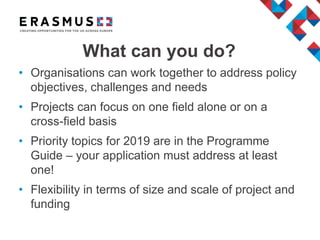
• Organisations can work together to address policy
objectives, challenges and needs
• Projects can focus on one field alone or on a
cross-field basis
• Priority topics for 2019 are in the Programme
Guide – your application must address at least
one!
• Flexibility in terms of size and scale of project and
funding
What can you do?
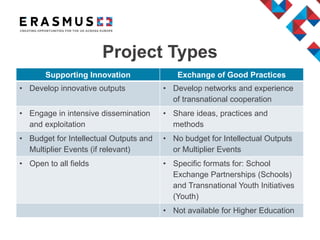
Supporting Innovation Exchange of Good Practices
• Develop innovative outputs • Develop networks and experience
of transnational cooperation
• Engage in intensive dissemination
and exploitation
• Share ideas, practices and
methods
• Budget for Intellectual Outputs and
Multiplier Events (if relevant)
• No budget for Intellectual Outputs
or Multiplier Events
• Open to all fields • Specific formats for: School
Exchange Partnerships (Schools)
and Transnational Youth Initiatives
(Youth)
• Not available for Higher Education
Project Types
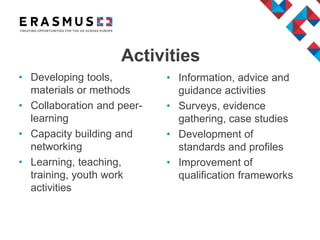
Activities
• Developing tools,
materials or methods
• Collaboration and peer-
learning
• Capacity building and
networking
• Learning, teaching,
training, youth work
activities
• Information, advice and
guidance activities
• Surveys, evidence
gathering, case studies
• Development of
standards and profiles
• Improvement of
qualification frameworks
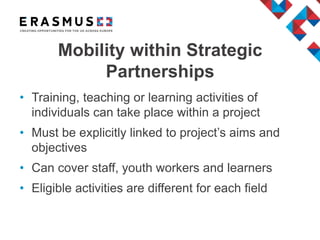
• Training, teaching or learning activities of
individuals can take place within a project
• Must be explicitly linked to project’s aims and
objectives
• Can cover staff, youth workers and learners
• Eligible activities are different for each field
Mobility within Strategic
Partnerships
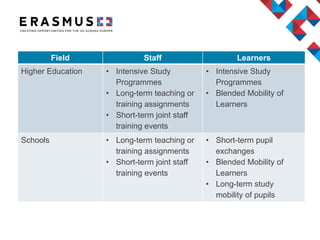
Field Staff Learners
Higher Education • Intensive Study
Programmes
• Long-term teaching or
training assignments
• Short-term joint staff
training events
• Intensive Study
Programmes
• Blended Mobility of
Learners
Schools • Long-term teaching or
training assignments
• Short-term joint staff
training events
• Short-term pupil
exchanges
• Blended Mobility of
Learners
• Long-term study
mobility of pupils
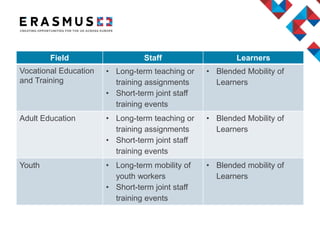
Field Staff Learners
Vocational Education
and Training
• Long-term teaching or
training assignments
• Short-term joint staff
training events
• Blended Mobility of
Learners
Adult Education • Long-term teaching or
training assignments
• Short-term joint staff
training events
• Blended Mobility of
Learners
Youth • Long-term mobility of
youth workers
• Short-term joint staff
training events
• Blended mobility of
Learners
How does it work?
• Organisations need to be part of a partnership of
organisations from different countries
• Minimum size is 2 or 3 partners in total
depending on the field
• One organisation applies for funding in their
country on behalf of the whole partnership
How does it work?
• Eligible project durations vary between fields
• With the exception of School Exchange
Partnerships, funding is up to a maximum of
€12,500 per month
• Different rules for School Exchange
Partnerships
• Each project assembles its budget from a ‘menu’
of cost items
How does it work?
Eligibility
• Check the eligibility criteria relating to:
• Participating organisations/applicant
• Eligible activity types
• Venues of activities
• Duration of the project
• Teaching, training and learning activities (if
applicable)
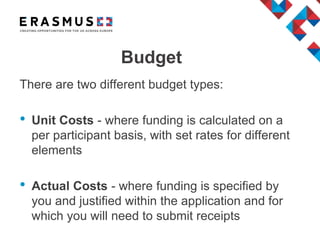
There are two different budget types:
• Unit Costs - where funding is calculated on a
per participant basis, with set rates for different
elements
• Actual Costs - where funding is specified by
you and justified within the application and for
which you will need to submit receipts
Budget
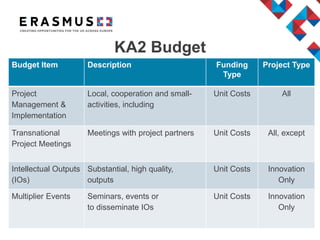
KA2 Budget
Budget Item Description Funding
Type
Project Type
Project
Management &
Implementation
Local, cooperation and small-
activities, including
Unit Costs All
Transnational
Project Meetings
Meetings with project partners Unit Costs All, except
Intellectual Outputs
(IOs)
Substantial, high quality,
outputs
Unit Costs Innovation
Only
Multiplier Events Seminars, events or
to disseminate IOs
Unit Costs Innovation
Only
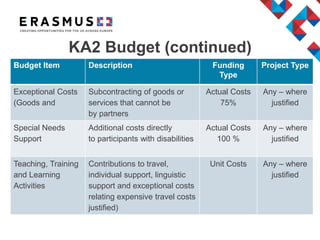
KA2 Budget (continued)
Budget Item Description Funding
Type
Project Type
Exceptional Costs
(Goods and
Subcontracting of goods or
services that cannot be
by partners
Actual Costs
75%
Any – where
justified
Special Needs
Support
Additional costs directly
to participants with disabilities
Actual Costs
100 %
Any – where
justified
Teaching, Training
and Learning
Activities
Contributions to travel,
individual support, linguistic
support and exceptional costs
relating expensive travel costs
justified)
Unit Costs Any – where
justified
Improve policy
Improve policy
Three types of decentralised project
Key
Action 1
Key
Action 2
Key
Action 3
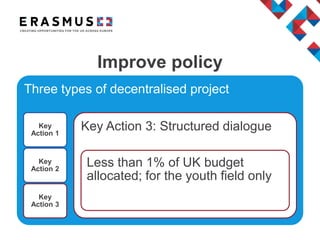
Key Action 3: Structured dialogue
Less than 1% of UK budget
allocated; for the youth field only
• Organisations can bring young people and
decision-makers together to improve youth
policy
• Activities aimed at promoting the active
participation of young people in democratic life
and enabling young people to make their voices
heard
What can you do?
• Meetings, events, seminars, debates and
discussions
• Meetings and seminars linked to official EU
Presidency Youth Conferences
• Events and debates linked to the European
Youth Week; and
• Consultation, including online opinions polls and
surveys
Activities
• Organisations can apply for funding for national
or transnational meetings
• Young people must be involved in all stages of
the project
• Emphasis on non-formal learning principles and
practices
How does it work?
Eligibility
Eligible organisation types:
• Public body at local or regional level
• Non-profit organisation, association and NGOs
• European Youth NGO
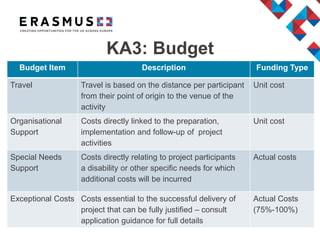
KA3: Budget
Budget Item Description Funding Type
Travel Travel is based on the distance per participant
from their point of origin to the venue of the
activity
Unit cost
Organisational
Support
Costs directly linked to the preparation,
implementation and follow-up of project
activities
Unit cost
Special Needs
Support
Costs directly relating to project participants
a disability or other specific needs for which
additional costs will be incurred
Actual costs
Exceptional Costs Costs essential to the successful delivery of
project that can be fully justified – consult
application guidance for full details
Actual Costs
(75%-100%)
Tips for a quality application
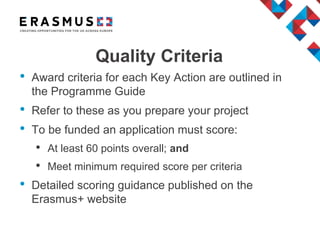
Quality Criteria
• Award criteria for each Key Action are outlined in
the Programme Guide
• Refer to these as you prepare your project
• To be funded an application must score:
• At least 60 points overall; and
• Meet minimum required score per criteria
• Detailed scoring guidance published on the
Erasmus+ website
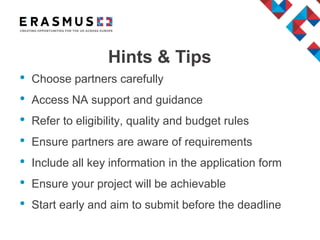
Hints & Tips
• Choose partners carefully
• Access NA support and guidance
• Refer to eligibility, quality and budget rules
• Ensure partners are aware of requirements
• Include all key information in the application form
• Ensure your project will be achievable
• Start early and aim to submit before the deadline
• Register on the Participant Portal via EU Login
(formerly ECAS) to obtain a unique reference
code (PIC)
• Refer to NA Guidance for Applicants as you
complete your application
• Contact our Helpline for support
• Complete and submit before the deadline!
How to Apply
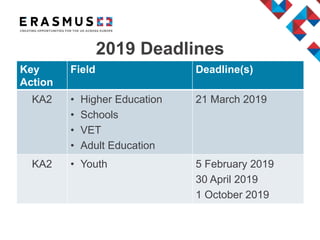
2019 Deadlines
Key
Action
Field Deadline(s)
KA2 • Higher Education
• Schools
• VET
• Adult Education
21 March 2019
KA2 • Youth 5 February 2019
30 April 2019
1 October 2019
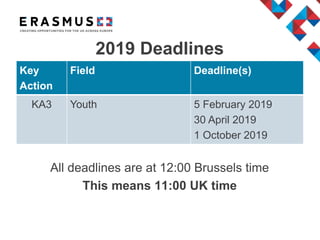
2019 Deadlines
Key
Action
Field Deadline(s)
KA3 Youth 5 February 2019
30 April 2019
1 October 2019
All deadlines are at 12:00 Brussels time
This means 11:00 UK time
Contact Us
For general enquiries you can contact either the
British Council or Ecorys UK as follows:
British Council
T: 0161 957 7755
erasmusplus.enquiries@britishcouncil.org
Ecorys UK
T: 0121 212 8947
erasmusplus@ecorys.com
Erasmus+ is the European Union programme for education, training, youth and sport.
The Erasmus+ UK National Agency is a partnership between the British Council and Ecorys UK.
Website: www.erasmusplus.org.uk
@erasmusplusuk
ukerasmusplus
erasmusplusuk

Applying for Key Action 2&3 in 2019

  • 1.
    Key Action 2& 3: Improve practice and policy
  • 2.
    Improve practice Three typesof decentralised project Key Action 1 Key Action 2 Key Action 3 Key Action 2: Partnerships Just over 27% of UK budget allocated; all fields can apply
  • 3.
  • 4.
    • Organisations canwork together to address policy objectives, challenges and needs • Projects can focus on one field alone or on a cross-field basis • Priority topics for 2019 are in the Programme Guide – your application must address at least one! • Flexibility in terms of size and scale of project and funding What can you do?
  • 5.
    Supporting Innovation Exchangeof Good Practices • Develop innovative outputs • Develop networks and experience of transnational cooperation • Engage in intensive dissemination and exploitation • Share ideas, practices and methods • Budget for Intellectual Outputs and Multiplier Events (if relevant) • No budget for Intellectual Outputs or Multiplier Events • Open to all fields • Specific formats for: School Exchange Partnerships (Schools) and Transnational Youth Initiatives (Youth) • Not available for Higher Education Project Types
  • 6.
    Activities • Developing tools, materialsor methods • Collaboration and peer- learning • Capacity building and networking • Learning, teaching, training, youth work activities • Information, advice and guidance activities • Surveys, evidence gathering, case studies • Development of standards and profiles • Improvement of qualification frameworks
  • 7.
    • Training, teachingor learning activities of individuals can take place within a project • Must be explicitly linked to project’s aims and objectives • Can cover staff, youth workers and learners • Eligible activities are different for each field Mobility within Strategic Partnerships
  • 8.
    Field Staff Learners HigherEducation • Intensive Study Programmes • Long-term teaching or training assignments • Short-term joint staff training events • Intensive Study Programmes • Blended Mobility of Learners Schools • Long-term teaching or training assignments • Short-term joint staff training events • Short-term pupil exchanges • Blended Mobility of Learners • Long-term study mobility of pupils
  • 9.
    Field Staff Learners VocationalEducation and Training • Long-term teaching or training assignments • Short-term joint staff training events • Blended Mobility of Learners Adult Education • Long-term teaching or training assignments • Short-term joint staff training events • Blended Mobility of Learners Youth • Long-term mobility of youth workers • Short-term joint staff training events • Blended mobility of Learners
  • 10.
  • 11.
    • Organisations needto be part of a partnership of organisations from different countries • Minimum size is 2 or 3 partners in total depending on the field • One organisation applies for funding in their country on behalf of the whole partnership How does it work?
  • 12.
    • Eligible projectdurations vary between fields • With the exception of School Exchange Partnerships, funding is up to a maximum of €12,500 per month • Different rules for School Exchange Partnerships • Each project assembles its budget from a ‘menu’ of cost items How does it work?
  • 13.
    Eligibility • Check theeligibility criteria relating to: • Participating organisations/applicant • Eligible activity types • Venues of activities • Duration of the project • Teaching, training and learning activities (if applicable)
  • 14.
    There are twodifferent budget types: • Unit Costs - where funding is calculated on a per participant basis, with set rates for different elements • Actual Costs - where funding is specified by you and justified within the application and for which you will need to submit receipts Budget
  • 15.
    KA2 Budget Budget ItemDescription Funding Type Project Type Project Management & Implementation Local, cooperation and small- activities, including Unit Costs All Transnational Project Meetings Meetings with project partners Unit Costs All, except Intellectual Outputs (IOs) Substantial, high quality, outputs Unit Costs Innovation Only Multiplier Events Seminars, events or to disseminate IOs Unit Costs Innovation Only
  • 16.
    KA2 Budget (continued) BudgetItem Description Funding Type Project Type Exceptional Costs (Goods and Subcontracting of goods or services that cannot be by partners Actual Costs 75% Any – where justified Special Needs Support Additional costs directly to participants with disabilities Actual Costs 100 % Any – where justified Teaching, Training and Learning Activities Contributions to travel, individual support, linguistic support and exceptional costs relating expensive travel costs justified) Unit Costs Any – where justified
  • 17.
  • 18.
    Improve policy Three typesof decentralised project Key Action 1 Key Action 2 Key Action 3 Key Action 3: Structured dialogue Less than 1% of UK budget allocated; for the youth field only
  • 19.
    • Organisations canbring young people and decision-makers together to improve youth policy • Activities aimed at promoting the active participation of young people in democratic life and enabling young people to make their voices heard What can you do?
  • 20.
    • Meetings, events,seminars, debates and discussions • Meetings and seminars linked to official EU Presidency Youth Conferences • Events and debates linked to the European Youth Week; and • Consultation, including online opinions polls and surveys Activities
  • 21.
    • Organisations canapply for funding for national or transnational meetings • Young people must be involved in all stages of the project • Emphasis on non-formal learning principles and practices How does it work?
  • 22.
    Eligibility Eligible organisation types: •Public body at local or regional level • Non-profit organisation, association and NGOs • European Youth NGO
  • 23.
    KA3: Budget Budget ItemDescription Funding Type Travel Travel is based on the distance per participant from their point of origin to the venue of the activity Unit cost Organisational Support Costs directly linked to the preparation, implementation and follow-up of project activities Unit cost Special Needs Support Costs directly relating to project participants a disability or other specific needs for which additional costs will be incurred Actual costs Exceptional Costs Costs essential to the successful delivery of project that can be fully justified – consult application guidance for full details Actual Costs (75%-100%)
  • 24.
    Tips for aquality application
  • 25.
    Quality Criteria • Awardcriteria for each Key Action are outlined in the Programme Guide • Refer to these as you prepare your project • To be funded an application must score: • At least 60 points overall; and • Meet minimum required score per criteria • Detailed scoring guidance published on the Erasmus+ website
  • 26.
    Hints & Tips •Choose partners carefully • Access NA support and guidance • Refer to eligibility, quality and budget rules • Ensure partners are aware of requirements • Include all key information in the application form • Ensure your project will be achievable • Start early and aim to submit before the deadline
  • 27.
    • Register onthe Participant Portal via EU Login (formerly ECAS) to obtain a unique reference code (PIC) • Refer to NA Guidance for Applicants as you complete your application • Contact our Helpline for support • Complete and submit before the deadline! How to Apply
  • 28.
    2019 Deadlines Key Action Field Deadline(s) KA2• Higher Education • Schools • VET • Adult Education 21 March 2019 KA2 • Youth 5 February 2019 30 April 2019 1 October 2019
  • 29.
    2019 Deadlines Key Action Field Deadline(s) KA3Youth 5 February 2019 30 April 2019 1 October 2019 All deadlines are at 12:00 Brussels time This means 11:00 UK time
  • 30.
    Contact Us For generalenquiries you can contact either the British Council or Ecorys UK as follows: British Council T: 0161 957 7755 erasmusplus.enquiries@britishcouncil.org Ecorys UK T: 0121 212 8947 erasmusplus@ecorys.com
  • 31.
    Erasmus+ is theEuropean Union programme for education, training, youth and sport. The Erasmus+ UK National Agency is a partnership between the British Council and Ecorys UK. Website: www.erasmusplus.org.uk @erasmusplusuk ukerasmusplus erasmusplusuk

Editor's Notes

  • #2 Introductions… explain how the presentation will be split between the two presenters. Within this session we are going to be talking about Key Action 2 Strategic Partnerships and Key Action 3 Support for Policy Reform. The aim of this session is to give you an overview of the different activities available under these Key Actions and an introduction to the programme rules and requirements you need to be aware of in order to submit a high quality application. We will start the session by talking about Key Action 2 Strategic Partnerships. Show of hands – who has applied for KA2 before?
  • #3 Strategic Partnerships are decentralised Key Action 2 projects, which you apply to the UK National Agency for funding for. In 2018 around 27% of the UK budget was allocated to this type of project, so Strategic Partnerships do represent a substantial part of the programme. Organisations from all sectors of education, training and youth can apply for this type of project, although it’s important to note that the rules do differ between sectors.
  • #5 Strategic partnerships bring together organisations from different countries to work together on solving a common problem or addressing a common need. Organisations can choose either to work with partners from the same field of education, training or youth or with partners from different fields, as long as all partners have relevant interests, skills and experience to contribute towards developing a high quality project. Strategic Partnerships must demonstrate a clear link between project objectives and the policy priorities outlined in Part B of the Programme Guide. In order to be funded, projects must address at least one horizontal priority and/or one field specific priority relevant to the field their application is submitted under. KA2 projects are also flexible in terms of their size and scale and there are different project types and formats available. The starting point is to identify your project objective, make sure it’s relevant to policy priorities, then find the right project type and partners to achieve it. For projects addressing a horizontal priority and/or involving partners from different fields, it’s important to submit your application under the field which is most relevant to your project objectives and most likely to be impacted.
  • #6 As mentioned, Strategic Partnerships are flexible and there are two different project types you can choose from: Strategic Partnerships Supporting Innovation: As the name suggests, this project type has a strong focus on innovation. This type of project is expected to develop innovative outputs and/or engage in intensive dissemination and exploitation activities. To support this, it is possible to request additional budget to develop substantial, high quality, Intellectual Outputs and, where relevant, to fund Multiplier Events to disseminate them. This project type is available for all fields of Education, Training and Youth. Strategic Partnerships supporting Exchange of Good Practices: This project type aims to support organisations to share ideas and ways of working, and to develop their experience of transnational cooperation. Exchange of Practices projects should still aim to deliver new outcomes and may produce tangible outputs but these are expected to be proportionate to the size and experience of the partnership. There is no budget available for Intellectual Outputs or Multiplier Events. This type of project is a good entry point for smaller organisations or organisations with less experience of transnational partnership working. This type of project is not available for the field of Higher Education but is available for other fields. It is important to note that there are some specific project formats which fall under Exchange of Practices projects: School Exchange Partnerships: Only for schools. These projects can use mobility opportunities for pupils and staff to develop as organisations and increase their ability to work in international projects. Transnational Youth Initiatives: These Strategic Partnerships in the field of youth aim to foster social commitment and entrepreneurial spirit of young people. A Youth Initiative is initiated, set up and carried out by young people themselves and project proposals are implemented by informal groups of young people.
  • #7 This slide provides some examples of the types of activities and outputs that can be developed in Strategic Partnerships projects. This is not an exhaustive list and the types of activity will depend on the type of project you select and the field you are working in. More detailed information on activities which may be relevant to specific fields and project types is included in the Programme Guide (Part B and Annex I, Strategic Partnerships).
  • #8 The mobility of learners and staff is also possible in KA2 Strategic Partnerships, both those Supporting Innovation and Exchange of Practices. Within Strategic Partnerships these are called Teaching, Training and Learning activities. Teaching, training and learning activities within KA2 are intended to support the aims and objectives of the project and to promote collaboration. Therefore, they must be shown to be relevant and necessary in order to achieve the project objectives. Not all Strategic Partnerships will involve Teaching, Training and Learning activities. Mobility activities in Key Action 2 projects enable organisations to: Get learners involved in the project through study programmes, blended mobility, project work, long term pupil mobility and youth initiatives; and/or Involve staff through teaching/training events and exchanges, and youth worker placements. There are specific eligibility requirements for each field and mobility type, so it’s important to ensure you refer to the criteria in the Programme Guide.
  • #9 These tables give an overview of the different types of Teaching, Training and Learning activities which are available for each field. It’s important to note that there are some differences regarding eligible activities between fields. Each type of TTL activity also has specific eligibility rules regarding the duration of the activity and the individuals who are eligible to participate. It is therefore very important to refer to the eligibility criteria for each type of activity in Part B of the Programme Guide as you complete your application, to ensure you meet these requirements.
  • #10 Cont.. From previous slide.
  • #12 All Strategic Partnerships must involve organisations from different countries and all partners must be identified at application stage. For most fields, projects must involve at least 3 partners from 3 different Programme countries. However, Strategic Partnerships involving schools and youth organisations can have a minimum of 2 partners from 2 different Programme countries. School Exchange Partnerships can have a maximum of 6 partners from different countries; for other types of project there is no maximum (although the funding is capped at equivalent for 10 partners). The Applicant organisation applies to their National Agency on behalf of the whole partnership (N.B. For School Exchange Partnerships, if approved, individual participating schools sign grant agreements with their respective NA; for other KA2 projects, the coordinator applies for and manages the funding on behalf of the partnership). The applicant must be an organisation participating in the project and must be based in a Programme Country. For most KA2, the participation of partners from Partner Countries may be allowed but must be strongly justified in terms of added value for the project It is very important to check Part B of the Programme Guide for the specific rules and requirements that apply to each field, as these do differ. ---- Programme countries Member States of the European Union (EU) and Non EU Programme Countries: former Yugoslav Republic of Macedonia Iceland Liechtenstein Norway Turkey PARTNER COUNTRIES Other countries as stated in Part B of the Programme guide.
  • #13 Project durations vary between fields: Partnerships in the field of higher education: between 24 and 36 months; Partnerships in the field of VET, school education and adult education: between 12 and 36 months; Partnerships in the youth field: between 6 and 36 months. For most Strategic Partnerships, funding is up to a maximum of €12,500 per month depending on the duration of the project School Exchange Partnerships funding is capped at of €16,500 per year and per school in the project. The budget for KA2 projects is made up of a ‘menu’ of cost items. Each project will need to work out their budget based on the types of activities they plan to deliver in order to achieve their objectives. The budget should be built around the project and not the other way around! The majority of budget headings are based on unit costs and maxima do apply to some budget items, so it’s important to refer to the detailed guidance in Part B of the Programme Guide.
  • #14 As mentioned in previous slides, there are a number of eligibility criteria you need to be aware of when preparing to submit your application. These do vary between the Key Actions and fields, so it is very important to check them carefully. We have touched on a number of these in the previous slides but they are all set out in Part B of the Programme Guide, under the relevant Key Action. Further guidance will also be provided in the NA’s Guidance for Applicants.
  • #15 Financial support varies by field and participant type. There are two different ‘funding types’: Unit Costs - where funding is calculated on a per participant basis, with set rates for different elements Actual Costs - where funding is specified by you and justified within the application and for which you will need to submit receipts
  • #16 For KA2 Strategic Partnership the project grant is a contribution to the costs of delivering the project and may not cover all costs. The grant is made up a ‘menu’ of budget items, some of which are calculated on the basis of unit costs and some based on an estimate of likely actual costs. Not all budget items will be applicable for every project and the project budget needs to be built around the planned activities, not the other way around. Some budget items are only available for Supporting Innovation projects (IOs and MEs) and some can only be approved where they are adequately justified in the application (E.g. Exceptional Costs, and Special Needs Support). All projects will have requested funding under Project management and implementation. This budget is a lump sum grant to support the costs of managing/being involved in the project, smaller scale activities such as project websites and all dissemination costs. This also covers funding for the implementation of Transnational Youth Initiatives and School Exchange Partnerships. PMI is calculated based on the number of partners and duration of the project. Most projects will also have requested funding under Transnational Project Meetings to support the participating countries in meeting up to discuss the project and plan project activities; however this budget item is not available for School Exchange Partnership projects. This grant is calculated on the basis of a unit cost per participant to cover travel and subsistence, with a different unit cost for short and long distance travel. Supporting Innovation projects may request additional budget items such as Intellectual Outputs funding which is a contribution the staff time associated with tangible deliverables which must be substantial in quality and quantity, with potential for wider dissemination and exploitation. The idea behind these outputs is that they should be freely accessible even after the project’s termination. Examples of tangible outputs include curricula, pedagogical materials, open education resources, IT tools, studies and peer-learning methods. Multiplier Event funding is only available to Supporting Innovation projects which plan to develop Intellectual Outputs. This funding supports the dissemination of the Intellectual Outputs produced by the project beyond the immediate project partners and beneficiaries.
  • #17 The three budget headings shown here are available for either types of Strategic Partnership, where required and justified within the application. Exceptional Costs and Special Needs support budget items are calculated on the basis of a % of the estimated actual costs. In both cases the need for the costs must be fully explained and justified within the application. Where insufficient justification is provided, the requested costs may not be approved. As mentioned, it is also possible for projects to include Training, Teaching and Learning activities where these are embedded within broader project objectives and will support the achievement of these. Where these activities are planned and justified, funding is available to co-finance travel, individual support (subsistence), linguistic support, and exceptional costs relating to expensive travel costs for participants. Exceptional costs for expensive travel must be justified. There are a number of specific rules and criteria which apply to each budget item, so it is very important to refer to the detailed budget guidance in Part B of the Programme Guide as you complete your application.
  • #19 Key Action 3 which concerns youth structured dialogue. Less than 1% of the UK budget was allocated to this Key Action in 2018 so it’s quite a small action and it does have a very specific topic and target groups. This Key Action is only available for the youth field.
  • #20 As stated in the slide, the principal aim of Key Action 3 is to engage young people in the democratic process as well as to provide a platform for their concerns, interests and opinions to heard by decision makers. Note This Key Action is unique in that mobility and transnational partnerships are not essential – that is to say, UK organisations can make an application for funding for a project working only within the UK.
  • #21 *Run through list* The list above gives a sample of the types of activity that organisations might include as part of their Key Action 3 project. Whatever you elect to do within your project it should be relevant to the young people with which you work. Irrespective of the activity, young people should lead the activities in all stages of the project from preparation to follow-up.
  • #22 Projects run for between three and 24 months As with all the other types of Erasmus+ activity, there is a competitive application process – details of application deadlines to follow. As highlighted elsewhere, The Erasmus+ grant is intended as a contribution to your project costs and may not cover the total cost of your project. The maximum grant awarded for a Structured Dialogue project is €50,000. Funding supports Travel Organisational Support Exceptional Costs Special Needs Support As mentioned, while the application will most-likely be submitted by a representative of the youth organisation, it should be made clear that the area of focus, project design and associated activities are determined by the young people involved in the project. The final point regarding “non-formal learning principals and practices” is to illustrate that this type of project cannot be used to support activities taking part within a formal education setting (e.g. to support a school debate team). Projects should be rooted in non-formal learning both in terms the organisations that apply, the participants involved and the delivery of activity.
  • #23 The organisation types listed on the slide are all eligible to make applications for KA3 funding. The UK National Agency is working to ensure maximum access to the Erasmus+ programme, and charities with an unincorporated status, such as registered trusts and associations, that are registered with the Charity Commission are now eligible to apply. We strongly recommend that all applicants – irrespective of the sector in which they operate - get in touch directly with their National Agency if they are unsure whether they are eligible to make an application.
  • #24 There are four budget types available through Key Action three as listed in the slide. Travel is based on fixed unit costs and is calculated using the European Commissions distance calculator tool. The further the distance travelled, the higher the unit cost provided. This funding is based on travel to a destination outside the UK Organisational support is also based on fixed unit costs and is calculated per participant. It will be automatically populated based on the country of destination and duration of the stay Special needs support is calculated on an actual cost basis and will be assessed on a case-by-case basis. The individual situation should be described and any particular needs and extra costs should be detailed in the application form Exceptional costs are calculated on an actual cost basis. Depending on the type of exceptional cost you can request up to 75, 80 or 100% of eligible costs. We strongly recommend reviewing the guidance available on the Erasmus+ website before making an application for exceptional costs but to give some guidance the funding rules state that these costs are specifically to support the following: Costs connected to (online) consultations and opinion polls of young people in so far as necessary for the participation in this Action Costs linked to dissemination and exploitation of results; Costs to support the participation of young people with fewer opportunities on equal terms as others; Visa and visa-related costs, residence permits, vaccinations; Costs for providing a financial guarantee Additional costs directly related to participants with fewer opportunities
  • #26 Each application will be assessed against the European Commission’s published award criteria for the Key Action/field you are applying under. The award criteria and scoring guidance are included in Part B of the Programme Guide and these give you a good indication of the elements you need to consider when planning your project in order to improve your chances of being successful. You should refer to the award criteria throughout the process of planning your project and completing your application form, not only at the end! It is important to remember that if you application is successful you will be expected to deliver the project as outlined in the approved application, so you need to design the project to meet the award criteria and to be achievable in practice. The quality award criteria cover aspects such as: The relevance and evidence of need for your project The extent to which it is innovative and/or complementary The quality and coherence of the project design and plans for implementation, including the suitability of the budget Value for money The quality of the partnership Plans for dissemination and sustainability * This is not an exhaustive list! The application process is competitive and only high scoring projects will be funded; therefore important to refer to the scoring requirements for the Key Action/field you are applying under. For KA2 and KA3 projects you must score 60 points or above overall and at least half of the available points for each individual award criterion in order to have a chance of being funded. In addition, the detailed quality assessment criteria used by assessors is published on the Erasmus+ website once it’s released by the EC, so it’s a good idea to look out for this.
  • #27 These are some hints and tips to help you develop a good quality application. Firstly, choose your partners carefully – you may be working closely with them for up to three years and a strong and reliable partnership is the foundation of any successful project. Exploit your networks and seek recommendations from organisations you may have worked with in the past. If you are looking for new partners, you are encouraged to use platforms such as EPALE (Adult Ed) or eTwinning (Schools) or have a look at the organisations involved in previous projects on the Erasmus+ Project Results Platform. Access NA support – after the Call is released, the NA produces detailed guidance for applicants and application support webinars. Keep an eye on our website or sign up for our newsletter for information about these. Refer to the eligibility, quality and budget rules – we have mentioned this several times already because it is really important! You need to refer to these from the early planning stages of your project and throughout the application process. They are explained in more detail in the NA Guidance for Applicants. If you still have queries, contact us on our Helpline for advice. Make sure partners are aware of the requirements – involve your partners in the planning and design of your project to ensure they are clear about their involvement and fully committed. Make sure they understand the rules and requirements which apply to them. For example, make sure they have a PIC number, as this will be needed in order to complete the application. Include all the key information in the application form – it seems obvious but make sure you answer the questions in the application form fully and provide as much relevant detail as possible. Cross-refer with the quality criteria to ensure these are being addressed. Don’t assume that anything is obvious – make it clear. Avoid errors or inconsistencies and make sure the application form itself includes all the key information about your project. Make sure your project is realistic and achievable – remember that if you are successful you will be expected to deliver the project as outlined in the approved application, so you must make sure your plans are realistic and achievable bearing in mind the make up and capacity of your partnership. Think about quality over – or at least, as well as - quantity. Finally, start your planning as early as possible and aim to submit your application in good time before the deadline. Allow time for final proof-reading and to deal with any unexpected technical glitches.
  • #28 Both you and your partners will need to obtain a PIC number in order to complete the application. If you have been involved in the programme before, check whether your organisation already has a PIC number before registering again. Each organisation should only have one PIC. Make sure you refer to the NA Guidance for Applicants – it includes both technical and qualitative guidance to help you complete and submit your application. If you have queries or would like to discuss a project idea, contact the Erasmus+ Helpline for support. And a final reminder to submit your application before the deadline – there is no flexibility and late applications will unfortunately be ineligible. Applications need to be submitted electronically using the online form. Some actions may have the web based application and others an eform.
  • #30 For Key Action 2, the deadline is expected to be in March and for all Youth applications the deadlines are expected to be February, April and October – please carefully check the Programme Guide (once released) for the deadline for the Key Action and field you are applying under. We expect that applications will need to be submitted online by 12:00 Brussels time, which is 11:00 UK time on the day of the deadline.
  • #31 Contact the BC for queries relating to: Higher Education Schools Youth KA2/3 Contact Ecorys for queries relating to: VET Adult Education KA1 youth