







10 PROJECT GOALS
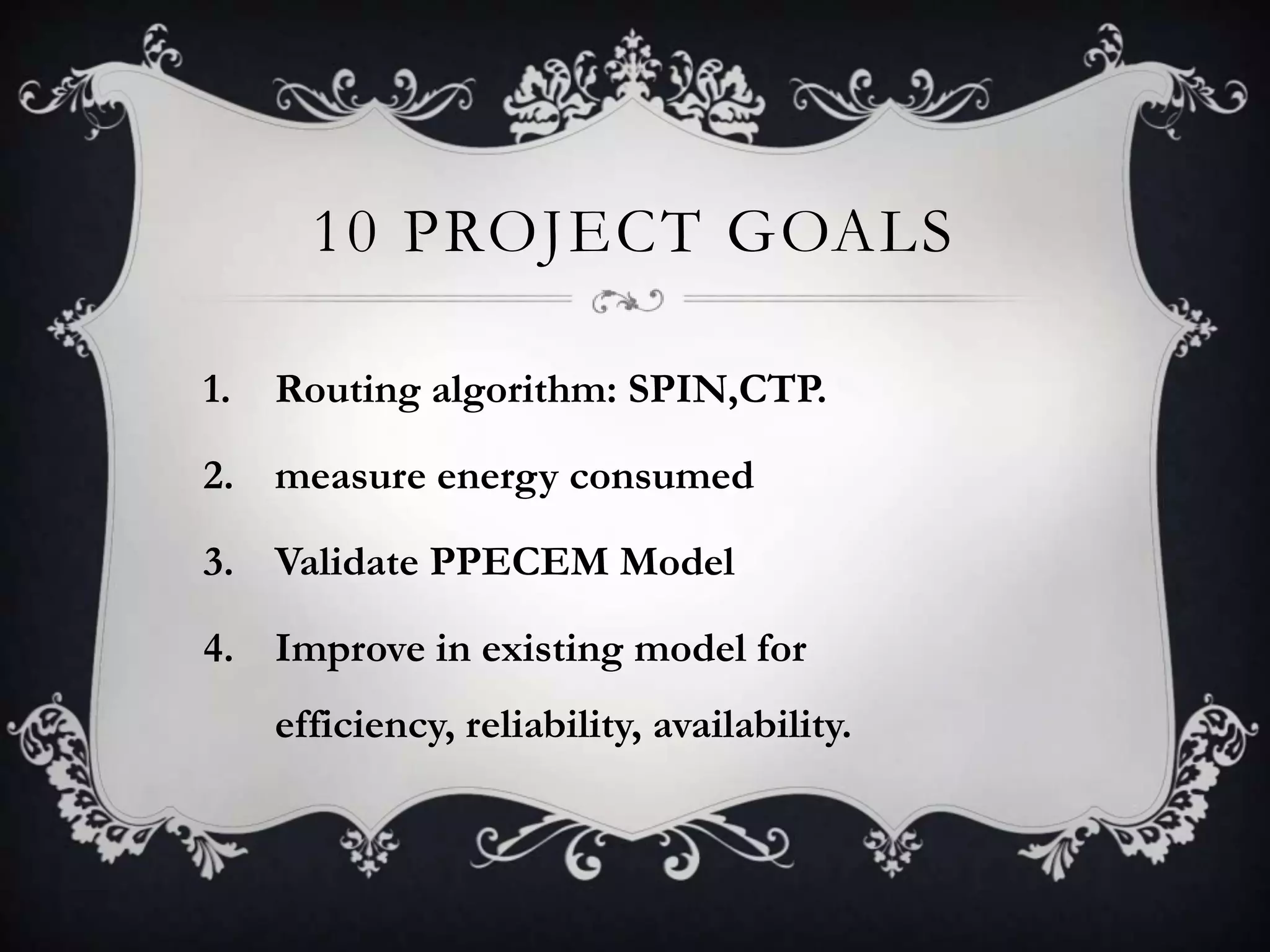
1.

Routing algorithm: SPIN,CTP.

2. measure energy consumed

3. Validate PPECEM Model
4. Improve in existing model for
efficiency, reliability, availability.
10 PROJECT GOALS
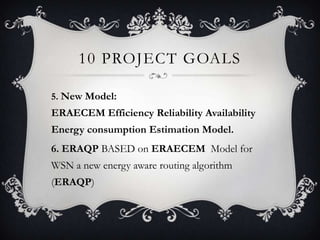
5. New Model:

ERAECEM Efficiency Reliability Availability
Energy consumption Estimation Model.
6. ERAQP BASED on ERAECEM Model for
WSN a new energy aware routing algorithm
(ERAQP)
10 PROJECT GOALS
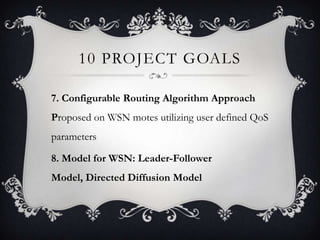
7. Configurable Routing Algorithm Approach
Proposed on WSN motes utilizing user defined QoS

parameters
8. Model for WSN: Leader-Follower
Model, Directed Diffusion Model
10 PROJECT GOALS
9. Fuzzy routing Algorithm
10. Fuzzy Information Neural Network

representation of Wireless Sensor Network.
MOTIVATION
1.1 SPIN
1.2 CTP
 Collection tree protocol
2 ENERGY MEASUREMENT
 Agilent 33522B Waveform Generator was used to measure the
Current and voltage graph .
 The Graph measurement were then converted to numerical power

Power= Voltage X current = V X I.
The Power consumed during motes routing on SPIN and CTP then
taken into is added up to give power consumption and values are
applied to PPECEM.
1.3 WSN SECURITY
3.1COST OF SECURITY
 Cost of security In WSN can only be estimated by looking at extra
burden of secure algorithm and security of Energy Consumption as
the Energy is key driver or critical resource in design of WSN. As

design is completely dominated by size of battery supplying power to
mote.
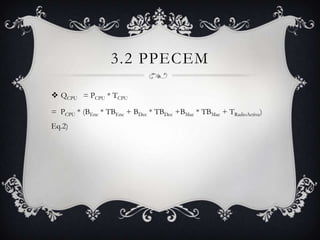
3.2 PPECEM
 QCPU = PCPU * TCPU
= PCPU * (BEnc * TBEnc + BDec * TBDec +BMac * TBMac + TRadioActive)
Eq.2)
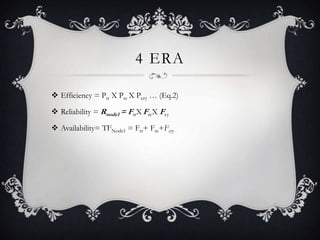
4 ERA
 Efficiency = Ptr X Prc X Pcry … (Eq.2)
 Reliability = Rnode1 = FtrX FrcX Fcy
 Availability= TFNode1 = Ftr+ Frc+Fcry
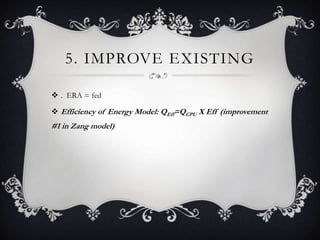
5. IMPROVE EXISTING
 . ERA = fed
 Efficiency of Energy Model: QEff=QCPU X Eff (improvement

#1 in Zang model)
ERAECEM
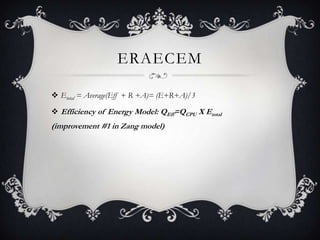
 Etotal = Average(Eff + R +A)= (E+R+A)/3
 Efficiency of Energy Model: QEff=QCPU X Etotal

(improvement #1 in Zang model)
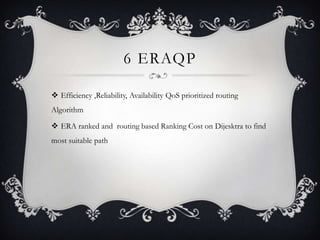
6 ERAQP
 Efficiency ,Reliability, Availability QoS prioritized routing
Algorithm
 ERA ranked and routing based Ranking Cost on Dijesktra to find

most suitable path
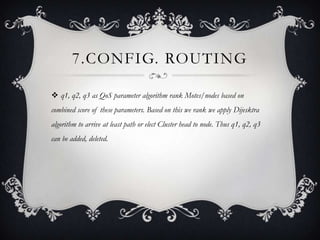
7.CONFIG. ROUTING
 q1, q2, q3 as QoS parameter algorithm rank Motes/nodes based on
combined score of these parameters. Based on this we rank we apply Dijesktra
algorithm to arrive at least path or elect Cluster head to node. Thus q1, q2, q3

can be added, deleted.
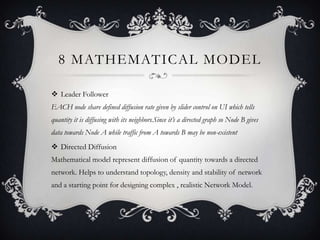
8 MATHEMATICAL MODEL
 Leader Follower
EACH node share defined diffusion rate given by slider control on UI which tells
quantity it is diffusing with its neighbors.Since it’s a directed graph so Node B gives
data towards Node A while traffic from A towards B may be non-existent
 Directed Diffusion
Mathematical model represent diffusion of quantity towards a directed
network. Helps to understand topology, density and stability of network
and a starting point for designing complex , realistic Network Model.
9 FUZZY ROUTING
 Fuzzy set A {MoteA, p(A))
 Where, p(A) is probability Of Data Usage Or Percentage Load in Fraction
Compared With Global Load
10 FUZZY TOPOLOGY
 Based on this Utilization p(A) nodes can be ranked in ascending order to find
most data dwarfed node at the top. Then We can apply Dijkstra's algorithm on
the network to find best route based on weight on each node represented by Rank.

Mathematical Modelling of Wireless sensor Network and new energy Aware Routing

  • 1.
    10 PROJECT GOALS 1. Routingalgorithm: SPIN,CTP. 2. measure energy consumed 3. Validate PPECEM Model 4. Improve in existing model for efficiency, reliability, availability.
  • 2.
    10 PROJECT GOALS 5.New Model: ERAECEM Efficiency Reliability Availability Energy consumption Estimation Model. 6. ERAQP BASED on ERAECEM Model for WSN a new energy aware routing algorithm (ERAQP)
  • 3.
    10 PROJECT GOALS 7.Configurable Routing Algorithm Approach Proposed on WSN motes utilizing user defined QoS parameters 8. Model for WSN: Leader-Follower Model, Directed Diffusion Model
  • 4.
    10 PROJECT GOALS 9.Fuzzy routing Algorithm 10. Fuzzy Information Neural Network representation of Wireless Sensor Network.
  • 5.
  • 6.
  • 7.
  • 8.
    2 ENERGY MEASUREMENT Agilent 33522B Waveform Generator was used to measure the Current and voltage graph .  The Graph measurement were then converted to numerical power Power= Voltage X current = V X I. The Power consumed during motes routing on SPIN and CTP then taken into is added up to give power consumption and values are applied to PPECEM.
  • 9.
  • 10.
    3.1COST OF SECURITY Cost of security In WSN can only be estimated by looking at extra burden of secure algorithm and security of Energy Consumption as the Energy is key driver or critical resource in design of WSN. As design is completely dominated by size of battery supplying power to mote.
  • 11.
    3.2 PPECEM  QCPU= PCPU * TCPU = PCPU * (BEnc * TBEnc + BDec * TBDec +BMac * TBMac + TRadioActive) Eq.2)
  • 12.
    4 ERA  Efficiency= Ptr X Prc X Pcry … (Eq.2)  Reliability = Rnode1 = FtrX FrcX Fcy  Availability= TFNode1 = Ftr+ Frc+Fcry
  • 13.
    5. IMPROVE EXISTING . ERA = fed  Efficiency of Energy Model: QEff=QCPU X Eff (improvement #1 in Zang model)
  • 14.
    ERAECEM  Etotal =Average(Eff + R +A)= (E+R+A)/3  Efficiency of Energy Model: QEff=QCPU X Etotal (improvement #1 in Zang model)
  • 15.
    6 ERAQP  Efficiency,Reliability, Availability QoS prioritized routing Algorithm  ERA ranked and routing based Ranking Cost on Dijesktra to find most suitable path
  • 16.
    7.CONFIG. ROUTING  q1,q2, q3 as QoS parameter algorithm rank Motes/nodes based on combined score of these parameters. Based on this we rank we apply Dijesktra algorithm to arrive at least path or elect Cluster head to node. Thus q1, q2, q3 can be added, deleted.
  • 17.
    8 MATHEMATICAL MODEL Leader Follower EACH node share defined diffusion rate given by slider control on UI which tells quantity it is diffusing with its neighbors.Since it’s a directed graph so Node B gives data towards Node A while traffic from A towards B may be non-existent  Directed Diffusion Mathematical model represent diffusion of quantity towards a directed network. Helps to understand topology, density and stability of network and a starting point for designing complex , realistic Network Model.
  • 18.
    9 FUZZY ROUTING Fuzzy set A {MoteA, p(A))  Where, p(A) is probability Of Data Usage Or Percentage Load in Fraction Compared With Global Load
  • 19.
    10 FUZZY TOPOLOGY Based on this Utilization p(A) nodes can be ranked in ascending order to find most data dwarfed node at the top. Then We can apply Dijkstra's algorithm on the network to find best route based on weight on each node represented by Rank.