Project Formulation
 Project is a specific task, with well defined objectives, which require certain time, and
resources for its implementation, which can be reasonably planned and appraised in
advance and also can be evaluated as an independent work unit and with defined
budget.
 Those around a project, who may affect or be affected by a project, Opportunities
and relationships to build upon in implementing a project to help make it a success,
Who should be encouraged to participate in a project.
 Three main components:-
a. Stakeholder analysis b. Problem analysis c. Objective/Strategies analysis
Any Individual, community, group or organization or Institution with an interest in the
outputs/outcomes of a project. Either as a result of being affected by it positively or
negatively or by being able to influence project activities.
 What is a project? A project is a complex of non-routine activities that must
be completed with a set amount of resources and within a set time interval.
It is carried out in an organized manner with a clearly pre-defined need ,
start point and end-point. A project follows a hierarchy of assumptions and
objectives: Inputs Activities Proposals Outputs Goals
Characteristics of Project
 Objectives-Every project has aimed to achieve certain objective. Once the
objective is achieved the project is said to be completed .
 Life cycle- stages of Life cycle are as follows:
a. conception b. Design c. Implementation d. Commissioning
 Definite time limit
 Uniqueness
 Change
 Optimality
 Control mechanism
Classification of projects
 Phases in project cycle
1. Identification
2. Formulation
3. Appraisal
4. Implementation
5. Monitoring
6. Evaluation
Project Idea Generation
 Project Formulation
• Identification of Project Ideas
• Project Formulation
Source of Project Idea
 Our own needs
 Trade and professional journals, project profiles
 Trade fairs and exhibitions
 Success stories of friends and relatives, prospective customers
 Research organizations, utilization of waste materials, study of govt policies,
development of Nation.
 Items reserved for small scale units
 Screening of project ideas
Factors of Project Idea generation
 Cost of the Project : material cost, labour cost, facory overhead cost etc
 Profitability : project yielding higher returns
 Marketing Facilities : Potential demand, nature of competition, sales and
distribution system, consumption trends etc.
 Availability of Inputs : the resources and inputs required for the project
must be reasonably assured.
 Compatibility with the Entrepreneur : the idea suits with the interest,
personality and resources of the Entrepreneur
Project Formulation
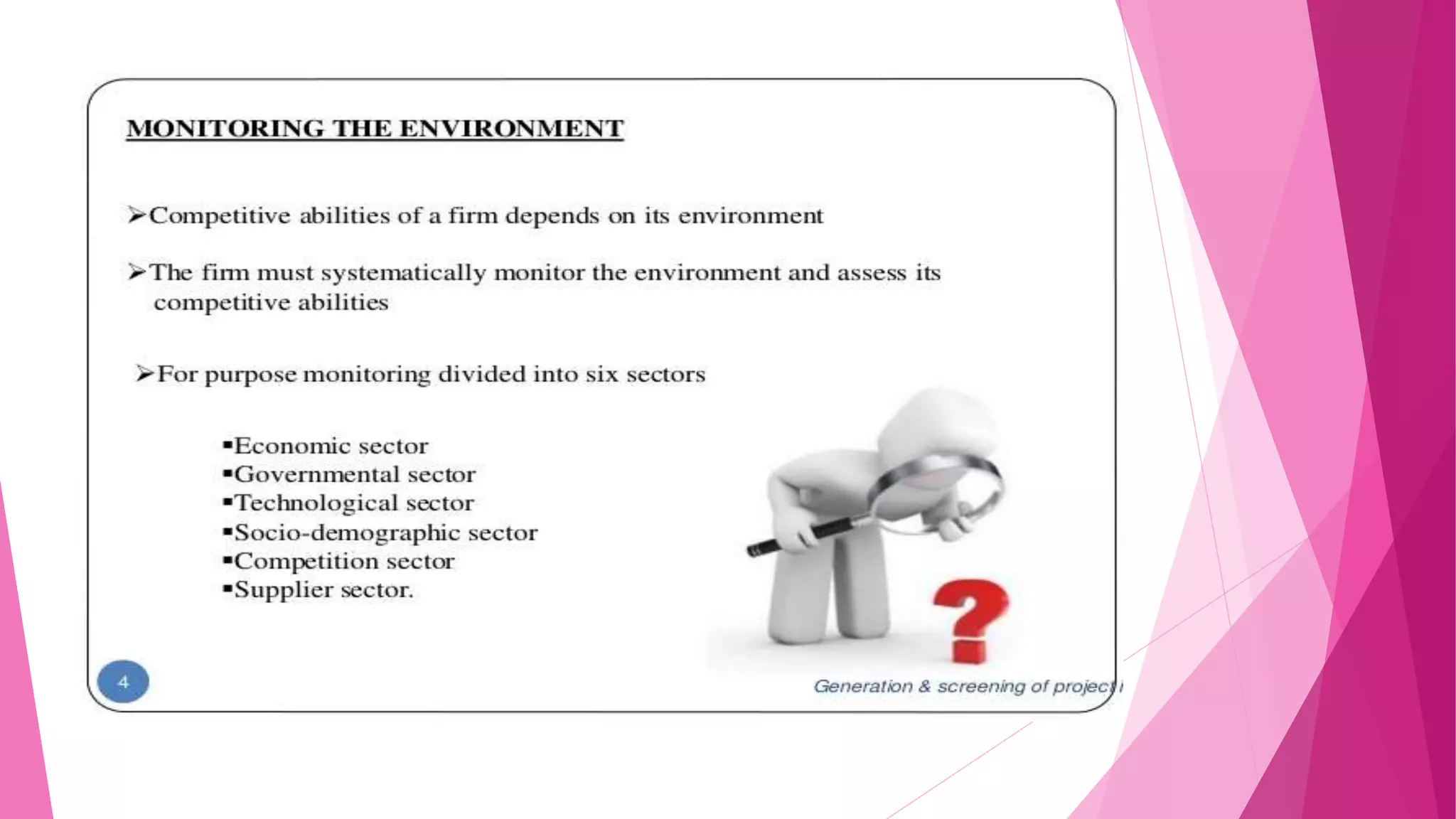
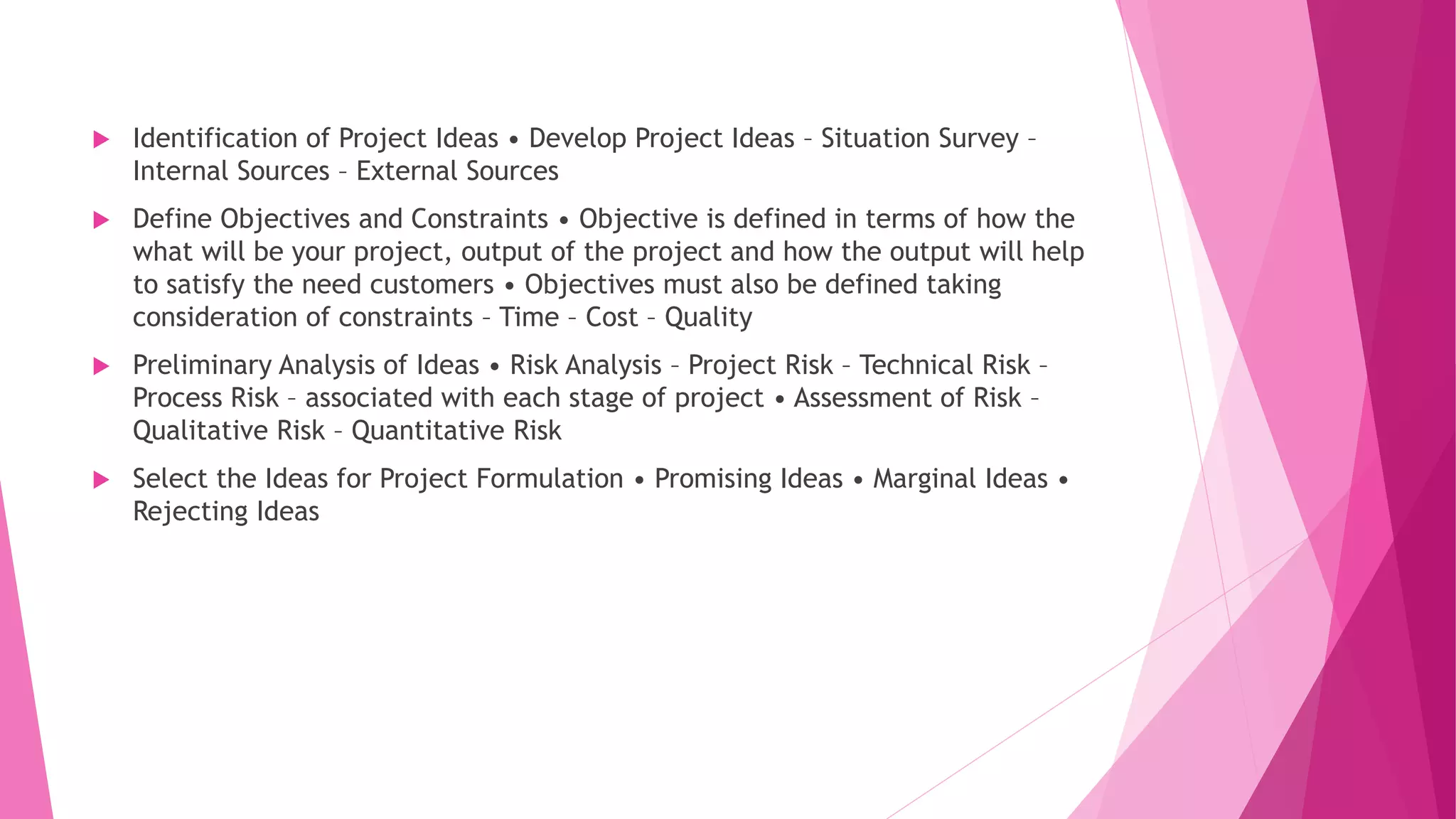
 Identification of Project Ideas • Develop Project Ideas – Situation Survey –
Internal Sources – External Sources
 Define Objectives and Constraints • Objective is defined in terms of how the
what will be your project, output of the project and how the output will help
to satisfy the need customers • Objectives must also be defined taking
consideration of constraints – Time – Cost – Quality
 Preliminary Analysis of Ideas • Risk Analysis – Project Risk – Technical Risk –
Process Risk – associated with each stage of project • Assessment of Risk –
Qualitative Risk – Quantitative Risk
 Select the Ideas for Project Formulation • Promising Ideas • Marginal Ideas •
Rejecting Ideas
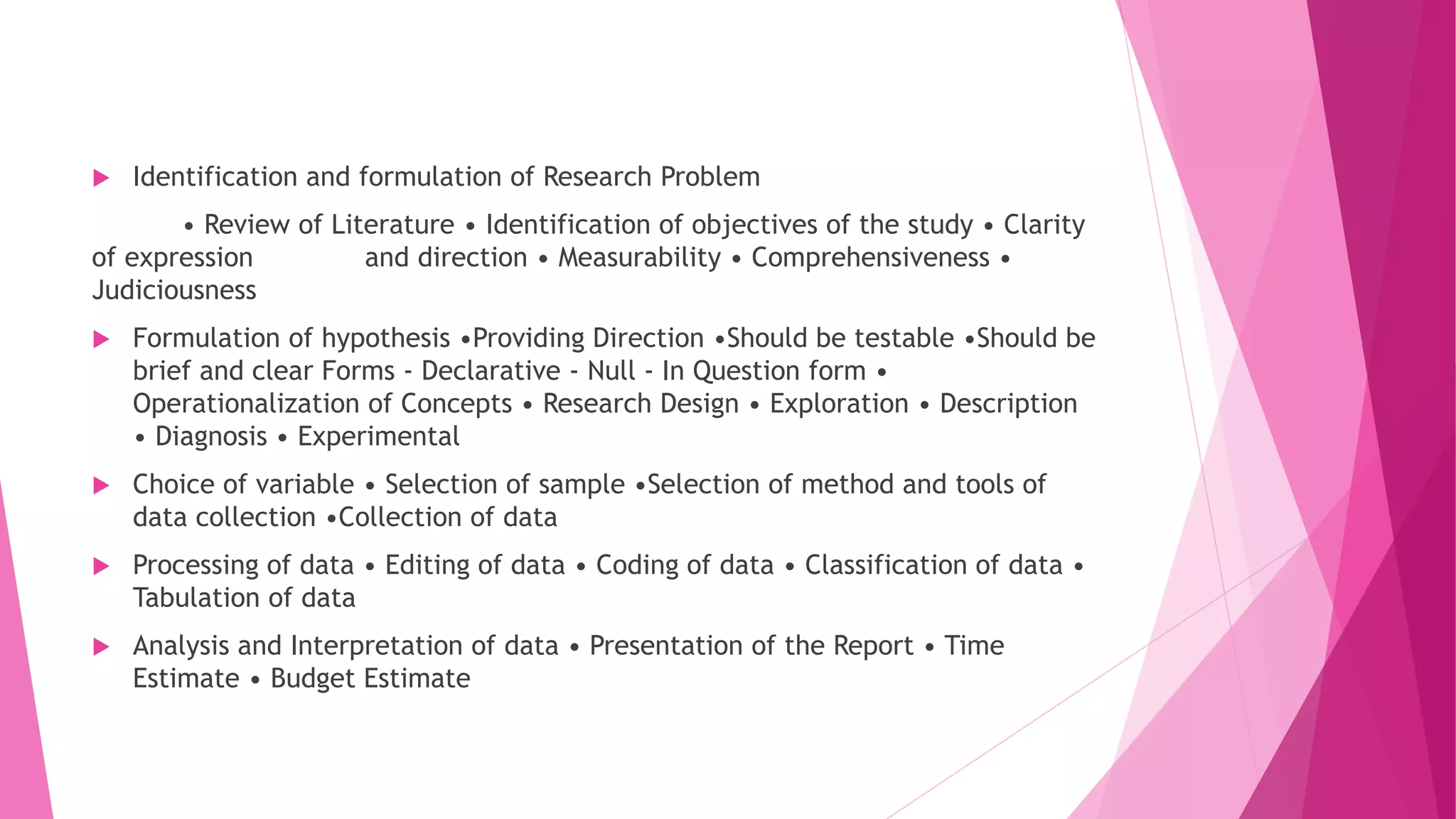
 Identification and formulation of Research Problem
• Review of Literature • Identification of objectives of the study • Clarity
of expression and direction • Measurability • Comprehensiveness •
Judiciousness
 Formulation of hypothesis •Providing Direction •Should be testable •Should be
brief and clear Forms - Declarative - Null - In Question form •
Operationalization of Concepts • Research Design • Exploration • Description
• Diagnosis • Experimental
 Choice of variable • Selection of sample •Selection of method and tools of
data collection •Collection of data
 Processing of data • Editing of data • Coding of data • Classification of data •
Tabulation of data
 Analysis and Interpretation of data • Presentation of the Report • Time
Estimate • Budget Estimate
 Project Formulation • Statement of Work – Need for the project – Scope of the
project – Objective and output of the project – Budget – Time
 Prefeasibility Study • Technical Analysis • Financial Analysis • Economic Analysis •
Marketing Analysis • Management Analysis • Environmental Analysis
 Preliminary Design • Technical Aspects – Engineering Design for example •
Preliminary Project Schedule and Implementation Plan • Estimated Project Cost
 Proposal Development • Project Objective and Output • Project Activities •
Project Implementation - implementation strategy, organization and party
involved • Project Schedule • Project Monitoring and Evaluation
 Project Planning • Understand the project objective • Identify the key project
stages • Work Breakdown Structure • Determine the logical sequence of activities
• Determine time and resource allocation – Capital Cost – Working capital cost •
Allocate the responsibility of each activity • Finalize the project plan
 Content of Project Plan • Overview • Objective • General Approach • Contractual
Approach • Schedule • Resources • Human Resources • Evaluation Method •
Potential Problem
 Feasibility Analysis • Technical Analysis • Economic Analysis • Marketing Analysis •
Managerial Analysis – Institutional Relationship – Project Organization – Project
Management – Stakeholder Analysis • Environmental Analysis – Environmental
Impact – EIA • Financial Analysis
Elements of Project Formulation
 Feasibility Analysis
 Techno Economic Analysis
 Estimation of Demand Or Market Potential
 Selection of Technology
 Project Design and Network Analysis
 Input Analysis
 Financial Analysis
 Social Cost benefit Analysis
 Pre-Investment Appraisal

Project Formulation

  • 1.
    Project Formulation  Projectis a specific task, with well defined objectives, which require certain time, and resources for its implementation, which can be reasonably planned and appraised in advance and also can be evaluated as an independent work unit and with defined budget.  Those around a project, who may affect or be affected by a project, Opportunities and relationships to build upon in implementing a project to help make it a success, Who should be encouraged to participate in a project.  Three main components:- a. Stakeholder analysis b. Problem analysis c. Objective/Strategies analysis Any Individual, community, group or organization or Institution with an interest in the outputs/outcomes of a project. Either as a result of being affected by it positively or negatively or by being able to influence project activities.
  • 2.
     What isa project? A project is a complex of non-routine activities that must be completed with a set amount of resources and within a set time interval. It is carried out in an organized manner with a clearly pre-defined need , start point and end-point. A project follows a hierarchy of assumptions and objectives: Inputs Activities Proposals Outputs Goals
  • 3.
    Characteristics of Project Objectives-Every project has aimed to achieve certain objective. Once the objective is achieved the project is said to be completed .  Life cycle- stages of Life cycle are as follows: a. conception b. Design c. Implementation d. Commissioning  Definite time limit  Uniqueness  Change  Optimality  Control mechanism
  • 4.
    Classification of projects Phases in project cycle 1. Identification 2. Formulation 3. Appraisal 4. Implementation 5. Monitoring 6. Evaluation
  • 5.
    Project Idea Generation Project Formulation • Identification of Project Ideas • Project Formulation
  • 6.
    Source of ProjectIdea  Our own needs  Trade and professional journals, project profiles  Trade fairs and exhibitions  Success stories of friends and relatives, prospective customers  Research organizations, utilization of waste materials, study of govt policies, development of Nation.  Items reserved for small scale units  Screening of project ideas
  • 7.
    Factors of ProjectIdea generation  Cost of the Project : material cost, labour cost, facory overhead cost etc  Profitability : project yielding higher returns  Marketing Facilities : Potential demand, nature of competition, sales and distribution system, consumption trends etc.  Availability of Inputs : the resources and inputs required for the project must be reasonably assured.  Compatibility with the Entrepreneur : the idea suits with the interest, personality and resources of the Entrepreneur
  • 10.
  • 11.
     Identification ofProject Ideas • Develop Project Ideas – Situation Survey – Internal Sources – External Sources  Define Objectives and Constraints • Objective is defined in terms of how the what will be your project, output of the project and how the output will help to satisfy the need customers • Objectives must also be defined taking consideration of constraints – Time – Cost – Quality  Preliminary Analysis of Ideas • Risk Analysis – Project Risk – Technical Risk – Process Risk – associated with each stage of project • Assessment of Risk – Qualitative Risk – Quantitative Risk  Select the Ideas for Project Formulation • Promising Ideas • Marginal Ideas • Rejecting Ideas
  • 12.
     Identification andformulation of Research Problem • Review of Literature • Identification of objectives of the study • Clarity of expression and direction • Measurability • Comprehensiveness • Judiciousness  Formulation of hypothesis •Providing Direction •Should be testable •Should be brief and clear Forms - Declarative - Null - In Question form • Operationalization of Concepts • Research Design • Exploration • Description • Diagnosis • Experimental  Choice of variable • Selection of sample •Selection of method and tools of data collection •Collection of data  Processing of data • Editing of data • Coding of data • Classification of data • Tabulation of data  Analysis and Interpretation of data • Presentation of the Report • Time Estimate • Budget Estimate
  • 13.
     Project Formulation• Statement of Work – Need for the project – Scope of the project – Objective and output of the project – Budget – Time  Prefeasibility Study • Technical Analysis • Financial Analysis • Economic Analysis • Marketing Analysis • Management Analysis • Environmental Analysis  Preliminary Design • Technical Aspects – Engineering Design for example • Preliminary Project Schedule and Implementation Plan • Estimated Project Cost  Proposal Development • Project Objective and Output • Project Activities • Project Implementation - implementation strategy, organization and party involved • Project Schedule • Project Monitoring and Evaluation  Project Planning • Understand the project objective • Identify the key project stages • Work Breakdown Structure • Determine the logical sequence of activities • Determine time and resource allocation – Capital Cost – Working capital cost • Allocate the responsibility of each activity • Finalize the project plan  Content of Project Plan • Overview • Objective • General Approach • Contractual Approach • Schedule • Resources • Human Resources • Evaluation Method • Potential Problem  Feasibility Analysis • Technical Analysis • Economic Analysis • Marketing Analysis • Managerial Analysis – Institutional Relationship – Project Organization – Project Management – Stakeholder Analysis • Environmental Analysis – Environmental Impact – EIA • Financial Analysis
  • 14.
    Elements of ProjectFormulation  Feasibility Analysis  Techno Economic Analysis  Estimation of Demand Or Market Potential  Selection of Technology  Project Design and Network Analysis  Input Analysis  Financial Analysis  Social Cost benefit Analysis  Pre-Investment Appraisal