PROJECT IDENTIFICATION
Christopher R. Abne
Projects are described as the “cutting edge of
development” or as “building blocks of
development.”
by Ernesto Franco
PROJECT MANAGEMENT DEFINITATION
“PROJECT MANAGEMENT” is:
 the application of knowledge, skills, tools
and techniques to project activities in order
to meet stakeholders’ need and
expectation.
 refers to the series of methods and tools that
are used to plan and implement a changer or
project from its inception to its completion.
PROJECT IDENTIFICATION DEFINITATION
“PROJECT IDENTIFICATION” is:
 a process to assess each project idea and select
the project with the highest priority.
 concerned with collection, compilation and
analysis of economic data for the eventual
purpose of locating possible opportunities for
investment.
Some tools used in project identification:
 Situational and Environmental Analysis
 SWOT Analysis
 Problem and Opportunity Studies
 Resource Analysis
SITUATIONAL AND
ENVIRONMENTAL
ANALYSIS
SITUATION ANALYSIS
If we talk about “Situation Analysis’’ we also talk
about “market audits’’.
Basically “ Situation analysis’’ is same meaning
with “ market audits’’
SITUATION ANALYSIS
An audit is the means by which a company can:
(a)understand how it relates to the environment in
which it operates.
(b) identify its own strengths and weaknesses as
they relate to external opportunities and threats.
Thus, it is a way of helping management to select a
position in that environment based on known
factors.
SITUATION ANALYSIS
A market analysis will be made up of a range of
factors relevant to the particular situation under
review, but would normally include the following
areas:
i. Actual and potential market size
ii.Trends
iii.Costumer
iv.Costumer segment
v. Distribution channel
ENVIRONMENTAL ANALYSIS
Environmental analysis refers to the monitoring,
evaluating and disseminating of information from the
external environment with the objective of identifying
threats and opportunities and assessing their impact
given the company’s internal strengths and
weaknesses.
According to Business Environment: Managing in a Strategic Context,
An environment is defined as: “anything outside an organization
which may affect an organization’s present or future
activities. Thus, the environment is situational – it is
unique to each organization” (Kew and Stredwick 2005).
ENVIRONMENTAL VARIABLES
A. Industry Environment

Customers

Suppliers

Labor unions

Creditors

Competitors

Government

Community
B. Organizational Environment
– Macro Environment

Demographic

Social

Economic

Technological

Political/Legal
ENVIRONMENTAL VARIABLES
This includes those elements or groups in
the immediate environment of a company that
directly affect the corporation and in turn are
affected by it.
INDUSTRY/TASK /OPERATING
ENVIRONMENT
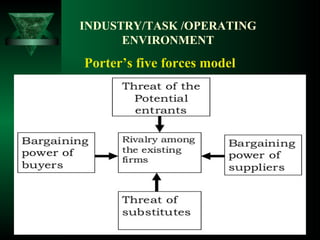
According to Michael Porter the nature and the degree of
competition in an industry hinge on five forces that drive
competition in the industry.
INDUSTRY/TASK /OPERATING
ENVIRONMENT
Porter’s five forces model
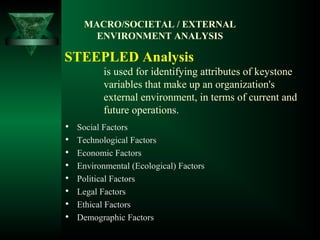
STEEPLED Analysis
is used for identifying attributes of keystone
variables that make up an organization's
external environment, in terms of current and
future operations.

Social Factors

Technological Factors

Economic Factors

Environmental (Ecological) Factors

Political Factors

Legal Factors

Ethical Factors

Demographic Factors
MACRO/SOCIETAL / EXTERNAL
ENVIRONMENT ANALYSIS
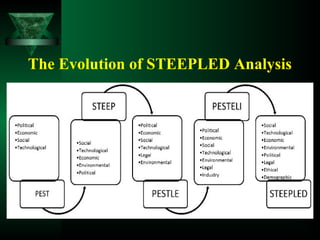
The Evolution of STEEPLED Analysis
SWOT ANALYSIS
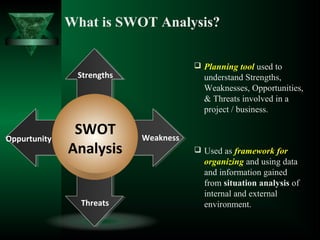
 Planning tool used to
understand Strengths,
Weaknesses, Opportunities,
& Threats involved in a
project / business.
 Used as framework for
organizing and using data
and information gained
from situation analysis of
internal and external
environment.
What is SWOT Analysis?
Threats
Strengths
WeaknessOppurtunity
SWOT
Analysis
Strengths

What advantages (for example, skills, education or personal
industry connections) do they have that others don’t have?

What makes company standout from its competitors?

What positive aspects does the company enjoy in the current
environment ?
A strength can be a competitive advantage like…
- Superior product quality
- Lowest price
- Best expertise
- Location
Weaknesses

Which areas are causing concerns?

Which issues can be avoided?

Company’s reputation among its customers.
A weakness can be a disadvantage such as…
- A tired brand
- Inferior location
- High overheads
- A lack of R&D
Opportunities

How can the company be more innovative ?
 Which are the new markets or consumers that can be tapped ?

Which area has the company not ventured ?

What are the upcoming trends that are catching up in the
market ?
An opportunity can be…
- A regulatory or tax change
- A high-profile event (marketing opportunity)
- An untapped market
- A gap left by a failed competitor
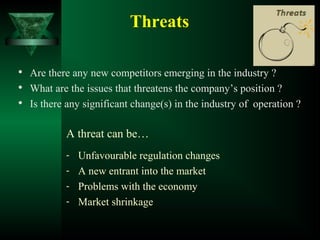
Threats

Are there any new competitors emerging in the industry ?

What are the issues that threatens the company’s position ?

Is there any significant change(s) in the industry of operation ?
A threat can be…
- Unfavourable regulation changes
- A new entrant into the market
- Problems with the economy
- Market shrinkage
Creative Use of SWOTs

How can we Use each Strength?

How can we Stop each Weakness?

How can we use each Opportunity?

How can we Defend against each Threat?
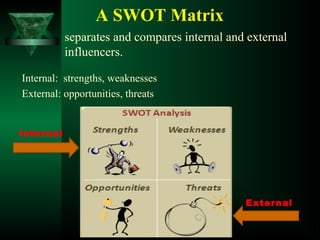
A SWOT Matrix
separates and compares internal and external
influencers.
Internal: strengths, weaknesses
External: opportunities, threats
Internal
s
External
s
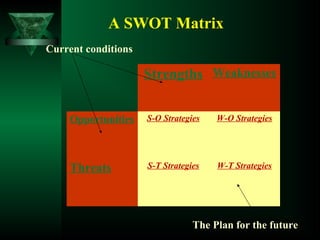
Strengths Weaknesses
Opportunities S-O Strategies W-O Strategies
Threats S-T Strategies W-T Strategies
A SWOT Matrix
Current conditions
The Plan for the future
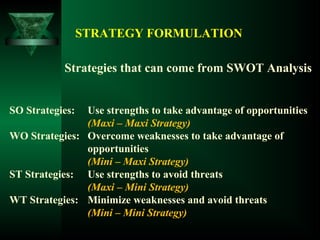
STRATEGY FORMULATION
Strategies that can come from SWOT Analysis
SO Strategies:
WO Strategies:
ST Strategies:
WT Strategies:
Use strengths to take advantage of opportunities
(Maxi – Maxi Strategy)
Overcome weaknesses to take advantage of
opportunities
(Mini – Maxi Strategy)
Use strengths to avoid threats
(Maxi – Mini Strategy)
Minimize weaknesses and avoid threats
(Mini – Mini Strategy)
PROBLEM AND
OPPORTUNITY
STUDIES
Opportunity – favourable position or
a range for advancement
Opportunity Identification – identify the
technologies that could be successfully turned into
commercial products.
Opportunity Study
Generate Ideas
Answer the question:
“What can be brought to the market?”
“How can it be brought to the market?”
Scan & Understand the needs & wants of people
Identifying Opportunities &
Threats in the Environment

Socio-Cultural

Technological & Technical

Economic

Natural

Political

Peace & Order

Population Trends

Government Program

Global Environment
SOCIO-CULTURAL
Opportunity
People have develop
the habit of eating
in fast- food
restaurants. Many
of these
establishments
serve ham &
bacon and other
processed meat.
Threats
People have develop
the habit of eating
in fast- food
restaurants. Many
of these
establishments
serve ham &
bacon and other
processed meat.
TECHNOLOGICAL & TECHNICAL
Opportunity
The new technology
can cure ham in
three days
Threats
ECONOMIC
Opportunity Threats
The purchasing power
of population has
lowered because of
the peso
devaluation and
high cost of oil, thus
reducing the
number of people
who buy ham and
bacon.
NATURAL
Opportunity Threats
Hoof and mouth
disease can
threaten the
supply of raw
materials.
POLITICAL
Opportunity Threats
Political instability
can affect the
economy.
PEACE & ORDER
Opportunity
In general, there is
peace and order
in the place of
business.
Threats
POPULATION TRENDS
Opportunity
The population is
increasing. More
people mean
more consumers
who need food.
Threats
GOVERNMENT PROGRAM
Opportunity
The government is
providing assistance
to MSMEs. The
company may be
able to avail of this
assistance in the
form of financing,
technical &
marketing.
Threats
GLOBAL ENVIRONMENT
Opportunity
If there is a shortage
of local pork, it is
possible to import
raw materials
from other
countries.
Threats
RESOURCE
ANALYSIS
Resource Analysis
 where strengths and weaknesses are
identified, indicates what the firm is capable
of doing at the start of the business.
 views the firm as a collection of resources
comprised of tangible and intangible assets
as well as core capabilities.
 the strengths identify distinctive
competencies of the company which can
work to its advantage.
The Resource
Base View
(RBS) theory
integrates the
components of
internal scrutiny
with external
competitive
analysis by
placing them
through the
value, rareness,
inimitability,
and organization
framework, thus
determining
their competitive
value.
The RBV theory defines four broad
categories of resources as potential
sources of competitive advantage:
tangible assets
intangible assets
capabilities, and
core competencies.

Tangible Assets
Physical factors that directly aid in the
delivery of customer value. Can usually
be found on financial statements.

Intangible Assets
Factors of production that cannot be seen
or touched that contribute to the delivery
of customer value. Examples include
brand names, customer goodwill,
corporate reputation, and copyrights.

Organizational Capabilities
Processes and activities that transform
tangible and intangible assets into goods
and services.

Core competencies
Human skill and talent, collective
organizational capacity, and learning that
allow a company to transform their
tangible and intangible assets into
competitively superior customer value.

Project identification

  • 1.
  • 2.
    Projects are describedas the “cutting edge of development” or as “building blocks of development.” by Ernesto Franco
  • 3.
    PROJECT MANAGEMENT DEFINITATION “PROJECTMANAGEMENT” is:  the application of knowledge, skills, tools and techniques to project activities in order to meet stakeholders’ need and expectation.  refers to the series of methods and tools that are used to plan and implement a changer or project from its inception to its completion.
  • 4.
    PROJECT IDENTIFICATION DEFINITATION “PROJECTIDENTIFICATION” is:  a process to assess each project idea and select the project with the highest priority.  concerned with collection, compilation and analysis of economic data for the eventual purpose of locating possible opportunities for investment.
  • 5.
    Some tools usedin project identification:  Situational and Environmental Analysis  SWOT Analysis  Problem and Opportunity Studies  Resource Analysis
  • 6.
  • 7.
    SITUATION ANALYSIS If wetalk about “Situation Analysis’’ we also talk about “market audits’’. Basically “ Situation analysis’’ is same meaning with “ market audits’’
  • 8.
    SITUATION ANALYSIS An auditis the means by which a company can: (a)understand how it relates to the environment in which it operates. (b) identify its own strengths and weaknesses as they relate to external opportunities and threats. Thus, it is a way of helping management to select a position in that environment based on known factors.
  • 9.
    SITUATION ANALYSIS A marketanalysis will be made up of a range of factors relevant to the particular situation under review, but would normally include the following areas: i. Actual and potential market size ii.Trends iii.Costumer iv.Costumer segment v. Distribution channel
  • 10.
    ENVIRONMENTAL ANALYSIS Environmental analysisrefers to the monitoring, evaluating and disseminating of information from the external environment with the objective of identifying threats and opportunities and assessing their impact given the company’s internal strengths and weaknesses. According to Business Environment: Managing in a Strategic Context, An environment is defined as: “anything outside an organization which may affect an organization’s present or future activities. Thus, the environment is situational – it is unique to each organization” (Kew and Stredwick 2005).
  • 11.
    ENVIRONMENTAL VARIABLES A. IndustryEnvironment  Customers  Suppliers  Labor unions  Creditors  Competitors  Government  Community
  • 12.
    B. Organizational Environment –Macro Environment  Demographic  Social  Economic  Technological  Political/Legal ENVIRONMENTAL VARIABLES
  • 13.
    This includes thoseelements or groups in the immediate environment of a company that directly affect the corporation and in turn are affected by it. INDUSTRY/TASK /OPERATING ENVIRONMENT According to Michael Porter the nature and the degree of competition in an industry hinge on five forces that drive competition in the industry.
  • 14.
  • 15.
    STEEPLED Analysis is usedfor identifying attributes of keystone variables that make up an organization's external environment, in terms of current and future operations.  Social Factors  Technological Factors  Economic Factors  Environmental (Ecological) Factors  Political Factors  Legal Factors  Ethical Factors  Demographic Factors MACRO/SOCIETAL / EXTERNAL ENVIRONMENT ANALYSIS
  • 16.
    The Evolution ofSTEEPLED Analysis
  • 17.
  • 18.
     Planning toolused to understand Strengths, Weaknesses, Opportunities, & Threats involved in a project / business.  Used as framework for organizing and using data and information gained from situation analysis of internal and external environment. What is SWOT Analysis? Threats Strengths WeaknessOppurtunity SWOT Analysis
  • 19.
    Strengths  What advantages (forexample, skills, education or personal industry connections) do they have that others don’t have?  What makes company standout from its competitors?  What positive aspects does the company enjoy in the current environment ? A strength can be a competitive advantage like… - Superior product quality - Lowest price - Best expertise - Location
  • 20.
    Weaknesses  Which areas arecausing concerns?  Which issues can be avoided?  Company’s reputation among its customers. A weakness can be a disadvantage such as… - A tired brand - Inferior location - High overheads - A lack of R&D
  • 21.
    Opportunities  How can thecompany be more innovative ?  Which are the new markets or consumers that can be tapped ?  Which area has the company not ventured ?  What are the upcoming trends that are catching up in the market ? An opportunity can be… - A regulatory or tax change - A high-profile event (marketing opportunity) - An untapped market - A gap left by a failed competitor
  • 22.
    Threats  Are there anynew competitors emerging in the industry ?  What are the issues that threatens the company’s position ?  Is there any significant change(s) in the industry of operation ? A threat can be… - Unfavourable regulation changes - A new entrant into the market - Problems with the economy - Market shrinkage
  • 23.
    Creative Use ofSWOTs  How can we Use each Strength?  How can we Stop each Weakness?  How can we use each Opportunity?  How can we Defend against each Threat?
  • 24.
    A SWOT Matrix separatesand compares internal and external influencers. Internal: strengths, weaknesses External: opportunities, threats Internal s External s
  • 25.
    Strengths Weaknesses Opportunities S-OStrategies W-O Strategies Threats S-T Strategies W-T Strategies A SWOT Matrix Current conditions The Plan for the future
  • 26.
    STRATEGY FORMULATION Strategies thatcan come from SWOT Analysis SO Strategies: WO Strategies: ST Strategies: WT Strategies: Use strengths to take advantage of opportunities (Maxi – Maxi Strategy) Overcome weaknesses to take advantage of opportunities (Mini – Maxi Strategy) Use strengths to avoid threats (Maxi – Mini Strategy) Minimize weaknesses and avoid threats (Mini – Mini Strategy)
  • 27.
  • 28.
    Opportunity – favourableposition or a range for advancement Opportunity Identification – identify the technologies that could be successfully turned into commercial products.
  • 29.
    Opportunity Study Generate Ideas Answerthe question: “What can be brought to the market?” “How can it be brought to the market?” Scan & Understand the needs & wants of people
  • 30.
    Identifying Opportunities & Threatsin the Environment  Socio-Cultural  Technological & Technical  Economic  Natural  Political  Peace & Order  Population Trends  Government Program  Global Environment
  • 31.
    SOCIO-CULTURAL Opportunity People have develop thehabit of eating in fast- food restaurants. Many of these establishments serve ham & bacon and other processed meat. Threats People have develop the habit of eating in fast- food restaurants. Many of these establishments serve ham & bacon and other processed meat.
  • 32.
    TECHNOLOGICAL & TECHNICAL Opportunity Thenew technology can cure ham in three days Threats
  • 33.
    ECONOMIC Opportunity Threats The purchasingpower of population has lowered because of the peso devaluation and high cost of oil, thus reducing the number of people who buy ham and bacon.
  • 34.
    NATURAL Opportunity Threats Hoof andmouth disease can threaten the supply of raw materials.
  • 35.
  • 36.
    PEACE & ORDER Opportunity Ingeneral, there is peace and order in the place of business. Threats
  • 37.
    POPULATION TRENDS Opportunity The populationis increasing. More people mean more consumers who need food. Threats
  • 38.
    GOVERNMENT PROGRAM Opportunity The governmentis providing assistance to MSMEs. The company may be able to avail of this assistance in the form of financing, technical & marketing. Threats
  • 39.
    GLOBAL ENVIRONMENT Opportunity If thereis a shortage of local pork, it is possible to import raw materials from other countries. Threats
  • 40.
  • 41.
    Resource Analysis  wherestrengths and weaknesses are identified, indicates what the firm is capable of doing at the start of the business.  views the firm as a collection of resources comprised of tangible and intangible assets as well as core capabilities.  the strengths identify distinctive competencies of the company which can work to its advantage.
  • 42.
    The Resource Base View (RBS)theory integrates the components of internal scrutiny with external competitive analysis by placing them through the value, rareness, inimitability, and organization framework, thus determining their competitive value. The RBV theory defines four broad categories of resources as potential sources of competitive advantage: tangible assets intangible assets capabilities, and core competencies.
  • 43.
     Tangible Assets Physical factorsthat directly aid in the delivery of customer value. Can usually be found on financial statements.  Intangible Assets Factors of production that cannot be seen or touched that contribute to the delivery of customer value. Examples include brand names, customer goodwill, corporate reputation, and copyrights.
  • 44.
     Organizational Capabilities Processes andactivities that transform tangible and intangible assets into goods and services.  Core competencies Human skill and talent, collective organizational capacity, and learning that allow a company to transform their tangible and intangible assets into competitively superior customer value.