Project Formulation
• Identification o Project Ideas
• Project Formulation
Identification of Project Ideas
• Develop Project Ideas
– Situation Survey
– Internal Sources
– External Sources
Define Objectives and Constraints
• Objective is defined in terms of how the what
will be your project, output of the project and
how the output will help to satisfy the need
customers
• Objectives must also be defined taking
consideration of constraints
– Time
– Cost
– Quality
Preliminary Analysis of Ideas
• Risk Analysis
– Project Risk – Technical Risk
– Process Risk – associated with each stage of
project
• Assessment of Risk
– Qualitative Risk
– Quantitative Risk
Select the Ideas for Project
Formulation
• Promising Ideas
• Marginal Ideas
• Rejecting Ideas
Project Formulation
• Statement of Work
– Need for the project
– Scope of the project
– Objective and output of the project
– Budget
– Time
Prefeasibility Study
• Technical Analysis
• Financial Analysis
• Economic Analysis
• Marketing Analysis
• Management Analysis
• Environmental Analysis
Preliminary Design
• Technical Aspects – Engineering Design for
example
• Preliminary Project Schedule and
Implementation Plan
• Estimated Project Cost
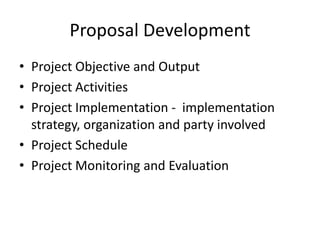
Proposal Development
• Project Objective and Output
• Project Activities
• Project Implementation - implementation
strategy, organization and party involved
• Project Schedule
• Project Monitoring and Evaluation
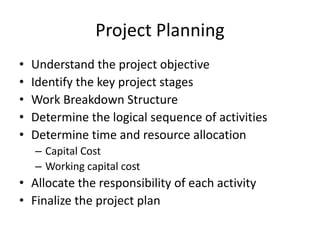
Project Planning
• Understand the project objective
• Identify the key project stages
• Work Breakdown Structure
• Determine the logical sequence of activities
• Determine time and resource allocation
– Capital Cost
– Working capital cost
• Allocate the responsibility of each activity
• Finalize the project plan
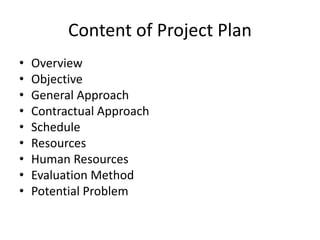
Content of Project Plan
• Overview
• Objective
• General Approach
• Contractual Approach
• Schedule
• Resources
• Human Resources
• Evaluation Method
• Potential Problem
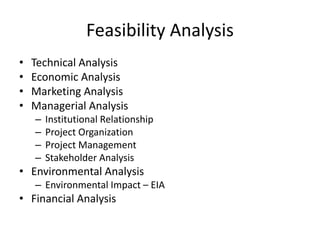
Feasibility Analysis
• Technical Analysis
• Economic Analysis
• Marketing Analysis
• Managerial Analysis
– Institutional Relationship
– Project Organization
– Project Management
– Stakeholder Analysis
• Environmental Analysis
– Environmental Impact – EIA
• Financial Analysis

Project formulation

  • 1.
    Project Formulation • Identificationo Project Ideas • Project Formulation
  • 2.
    Identification of ProjectIdeas • Develop Project Ideas – Situation Survey – Internal Sources – External Sources
  • 3.
    Define Objectives andConstraints • Objective is defined in terms of how the what will be your project, output of the project and how the output will help to satisfy the need customers • Objectives must also be defined taking consideration of constraints – Time – Cost – Quality
  • 4.
    Preliminary Analysis ofIdeas • Risk Analysis – Project Risk – Technical Risk – Process Risk – associated with each stage of project • Assessment of Risk – Qualitative Risk – Quantitative Risk
  • 5.
    Select the Ideasfor Project Formulation • Promising Ideas • Marginal Ideas • Rejecting Ideas
  • 6.
    Project Formulation • Statementof Work – Need for the project – Scope of the project – Objective and output of the project – Budget – Time
  • 7.
    Prefeasibility Study • TechnicalAnalysis • Financial Analysis • Economic Analysis • Marketing Analysis • Management Analysis • Environmental Analysis
  • 8.
    Preliminary Design • TechnicalAspects – Engineering Design for example • Preliminary Project Schedule and Implementation Plan • Estimated Project Cost
  • 9.
    Proposal Development • ProjectObjective and Output • Project Activities • Project Implementation - implementation strategy, organization and party involved • Project Schedule • Project Monitoring and Evaluation
  • 10.
    Project Planning • Understandthe project objective • Identify the key project stages • Work Breakdown Structure • Determine the logical sequence of activities • Determine time and resource allocation – Capital Cost – Working capital cost • Allocate the responsibility of each activity • Finalize the project plan
  • 11.
    Content of ProjectPlan • Overview • Objective • General Approach • Contractual Approach • Schedule • Resources • Human Resources • Evaluation Method • Potential Problem
  • 12.
    Feasibility Analysis • TechnicalAnalysis • Economic Analysis • Marketing Analysis • Managerial Analysis – Institutional Relationship – Project Organization – Project Management – Stakeholder Analysis • Environmental Analysis – Environmental Impact – EIA • Financial Analysis