UNIT - II
PROJECT CYCLE
2.1. Meaning and Definition of Project Cycle
2.2. World Bank Project Cycle
2.3. UNIDO Project Cycle
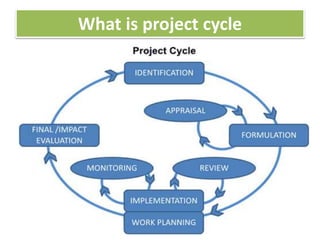
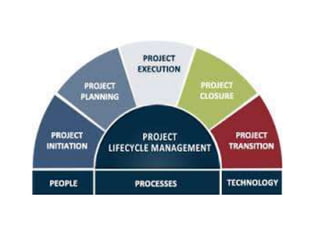
What is project cycle
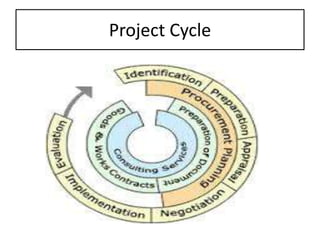
Project Cycle
Meaning of Project Cycle
 Before any project is actually realized it goes
through various planning phases.
 Therefore, the different phases through which
a project passes constitutes what is often
called “the project cycle”.
 The main features of this process are
information gathering, analysis and decision-
making
Meaning of Project Cycle (cont…)
 project cycle the primary preoccupation of the
analyst is to consider alternatives, evaluate
them, and to make decisions as to which of
them should be advanced to the next stage.
 The project cycle means the various stages of
information gathering and decision-making,
which take place between a project’s
inception and completion.
Type of Project Models
There are various models that deal with the
project cycle. However, here we give more
emphasis on the Basic Models
 The Baum’s cycle
 DEPSA’s
 UNIDO project cycle.
Various stages of Baum Cycle
• The first basic model of a project cycle is that
of Baum (1970), which has been adopted by
the World Bank and initially recognized four
main stages, namely.
• Identification
• Preparation
• Appraisal and Selection
• Implementation
Phases and stages of Baum Cycle
It has distinct phases and stages :
Meaning of Project Identification
• Fixing Priority is called Product identification
( giving more priority for the specific aspects )
• It deals with elimination process
Phases and stages of Baum Cycle
At a later stage (in 1978) the author has
added an additional stage called “Evaluation”
which usually closes the cycle as it gives rise to
the identification of new projects.
Thus making the stages 5 in number.
Baum Cycle – Stage 1
Project Identification
Meaning : Project identification is nothing but “ to
find potential projects “
Stages of Project Identification
(A). Conceptual Stage – Generation of Project Ideas
(B). Screening Stage – unviable ideas are eliminated
(C). Identification Stage - Viable Projects will be selected
(D). Pre feasibility Stage – Pre feasibility studies should
be taken place
Baum Cycle – Stage 2
Project Preparation
Project preparation (project formulation) covers
the establishment of technical, economic and
financial feasibility. Decisions have to be made
on the scope of the project, location and site,
soil and hydrological requirements, project size
(farm or factory size) etc.
Project formulation
 The purpose of project formulation is to make investment
decisions.
 It enables the decision makers to decide whether we go
ahead with that or not.
 It involves the identification of investment options by the
enterprise.
 The purpose is to bring project sponsoring authorities
support.
 It requires forecasting , choosing of goals , details , feasibility
studies , Arranging funds, distribution of work as well as funds
, execution and evaluation of funds.
Baum Cycle – Stage 3
Project Analysis
After a project has been prepared, it is generally
appropriate for a critical review or an
independent appraisal to be conducted.
This provides an opportunity to re-examine
every aspect of the project plan to assess
whether the proposal is appropriate and sound
before large sums are committed.
Project Analysis
Appraisals should cover at least seven aspects of
a project, each of which must have been given
special consideration during the project
preparation phase, that are :
Technical , Financial , Commercial , incentive
( things are going in such a way or not ? , who's
participation is required ) , Economic ,
Managerial and Organisational.
Baum Cycle – Stage 4
Project Implementation
The objective of any effort in project planning and analysis
clearly is to have a project that can be implemented to the
benefit of the society.
Thus, implementation is perhaps the most important part of
the project cycle.This stage includes :
 whether funds are actually disbursed to get the project
started and keep running.
 Whether the project is carried out in the way and within
the period that was planned.
 Problems frequently occur when the economic and
financial environment at implementation differs from the
situation expected during appraisal.
Baum Cycle – Stage 5
Project Evaluation
 Meaning of Project Evaluation is to look back
over what took place, to compare actual progress with
the plans, and to judge whether the decisions and
actions taken were responsible and useful.
 It is a most important managerial tool in ongoing
projects and may take place at several times in
the life of a project.
DEPSA’s Project Cycle – Three Phases
• There are various ways in which the project cycle
may be viewed and portrayed depending on the
purpose, emphasis and detail required to
illustrate.
• According to the Guidelines to project planning in
Ethiopia (1990) of Development Project Studies
Authority (DEPSA), the project cycle comprises
three major phases.
• Pre – investment
• Investment and
• Operation
DEPSA’s Project Cycle – six stages
• Each of these three phases may be divided into
stages. The Guidelines has divided the Project
cycle into six stages :
• Identification
• Preparation
• Appraisal/decision
• Implementation
• Operation
• Ex-post evaluation
UNIDO – Project Cycle
It is comprising three distinct phases :
• The pre – investment
• The investment and
• The operational phases
Each of these three phases is divided into stages,
some of which constitute important consultancy,
engineering and industrial activities.
According to the UNIDO Manual, the pre – investment
phase comprises several stages:
• Identification of investment opportunities (opportunity
studies).
• Analysis of project alternatives and preliminary project
selection as well as project preparation (pre – feasibility, and
feasibility studies) and
• Project appraisal and investment decision (appraisal repot)
Functional Studies
Functional studies are also a part of the project
preparation stage and are usually conducted
separately, for later incorporation in a
pre – feasibility study or feasibility study as
appropriate.
UNIDO Project Cycle : Phase 1 - Pre –
investment phase
It is a central point of attention, because the
success or failure of an industrial project
ultimately depends on the marketing, technical,
financial and economic findings and their
interpretation, especially in the feasibility study.
(A). Opportunity study
Opportunity Studies : The identification of
investment opportunities is the starting – point
in a series of investment – related activities,
when potential investors (private or public) are
interested in obtaining information on newly
identified viable investment opportunities.
(A).Opportunity stydy ( contiu..)
The main instrument used to quantify the
parameters, information and data required to
develop a project idea into a proposal is the
opportunity study, which should analyses :
• Natural resources
• The existing agriculture (basis for agro industry)
• Future demand for consumer goods.
• Imports substitution and export possibilities
• Environmental impact
• Expansions of existing capacity
• Manufacturing sectors (successful in other countries)
• Diversification
(A). Opportunity study ( Contin…..)
• General opportunity studies ( Sector approach )
designed to identify opportunities based on the
utilization of natural, agricultural or industrial.
• Specific project opportunity studies (enterprise
approach)
It may be defined as the transformation of a
project idea into a broad investment proposition.
(B). Pre – Feasibility studies
A pre – feasibility study should be viewed as an
intermediate stage between a project
opportunity study and a detailed feasibility
study
Formulation of Project idea in Pre Feasibility
Study
Before assigning larger funds for such a study, a
further assessment of the project idea might be
made in a pre-feasibility study. This is to see if:
• All possible project alternatives are examined
• The project concept justifies detailed study
• All aspects are critical and need in – depth
investigation
• The project idea is viable and attractive or not
(C). Support or Functional Studies
It cover aspects of an investment project, and are required as
prerequisites for, or in support of, pre – feasibility and
feasibility studies, particularly large – scale investment
proposals.
• This includes:
• Market studies of products
• Raw material and factory supply studies
• Laboratory and pilot plant tests
• Location studies
• Environmental impact assessment
• Economics of scale studies
• Equipment selection studies
(D). Feasibility Studies
 It should provide all necessary data required for decision
making
 The commercial, technical, financial, economic and
environment prerequisites for an investment project should
be defined and critically examined on the basis of alternative
solutions already reviewed in the pre – feasibility study.
 It should clearly examine the results of the effort on the
basis of possible marketing strategies , possible market share
 Corresponding Production Capacities , Plant Location ,
Existing Raw Material , Appropriate technology and
Mechanical Equipment's should also be determined
Environment Impact Assessment
 Final part of the feasibility study includes : Scope of
Investment , New working Capital , Production and Marketing
Cost , Sales revenue , Return on Capital.
(E). Appraisal Report
After Feasibility studies, the various parties will
carry out their own appraisal of the investment
project in accordance with their individual
objectives and evaluation of expected risks, costs
and gain.
The techniques applied to appraise projects in
line with these criteria center around technical,
commercial, market, managerial, organizational,
financial and possibly also economic aspects.
UNIDO : Phase 2 – Investment / implementation
Phase
The investment phase can be divided into the following
stages:
• Establishing the legal, financial and organizational,
including proposing, evaluation of bids and negotiations.
• Technology acquisition and transfer.
• Detailed engineering design and contract, including
tendering, evaluation of bids and negotiations.
• Acquisition of land, construction work and installation.
• Pre – production marketing, including the securing of
suppliers and setting up the administration of the firm.
• Recruitment and training of personnel.
• Plant commissioning and start – up.
UNIDO : Phase 3 – Operational Phase
It is connected with Problem identification
Short term problems :
• Production techniques
• Operation of equipment
• Inadequate labor productivity
• Lack of qualified staff and labor.
Long term problems :
• Production and marketing costs
• Sales revenues.
Steps or phases of Project Life cycles
1. Pre investment phase
Investment opportunities , Investment Analysis,
Feasibility study , decision making
2. Implementation Phase
Project design , Drawings and Blue Prints , Step by step
approach
3. Operation Phase
 It begins , commissioned and ends with Projects , Long
time consumption will be there
 It ensures smooth and un interrupted operation
 Project monitoring and Evaluation
Steps or phases of Project Life cycles
1.Concept phase – Introduction stage
2. Definition phase – Introduction stage
3. Planning and organising phase – Growth
4. Implementation phase – Maturity
5.Clean up phase – Declain
It helps a project manager to ascertain the
health of any project at any point of time.
THANK YOU
END OF UNIT - II

MBA UNIT 2.pptx

  • 1.
    UNIT - II PROJECTCYCLE 2.1. Meaning and Definition of Project Cycle 2.2. World Bank Project Cycle 2.3. UNIDO Project Cycle
  • 2.
  • 3.
  • 5.
    Meaning of ProjectCycle  Before any project is actually realized it goes through various planning phases.  Therefore, the different phases through which a project passes constitutes what is often called “the project cycle”.  The main features of this process are information gathering, analysis and decision- making
  • 6.
    Meaning of ProjectCycle (cont…)  project cycle the primary preoccupation of the analyst is to consider alternatives, evaluate them, and to make decisions as to which of them should be advanced to the next stage.  The project cycle means the various stages of information gathering and decision-making, which take place between a project’s inception and completion.
  • 7.
    Type of ProjectModels There are various models that deal with the project cycle. However, here we give more emphasis on the Basic Models  The Baum’s cycle  DEPSA’s  UNIDO project cycle.
  • 8.
    Various stages ofBaum Cycle • The first basic model of a project cycle is that of Baum (1970), which has been adopted by the World Bank and initially recognized four main stages, namely. • Identification • Preparation • Appraisal and Selection • Implementation
  • 9.
    Phases and stagesof Baum Cycle It has distinct phases and stages : Meaning of Project Identification • Fixing Priority is called Product identification ( giving more priority for the specific aspects ) • It deals with elimination process
  • 10.
    Phases and stagesof Baum Cycle At a later stage (in 1978) the author has added an additional stage called “Evaluation” which usually closes the cycle as it gives rise to the identification of new projects. Thus making the stages 5 in number.
  • 11.
    Baum Cycle –Stage 1 Project Identification Meaning : Project identification is nothing but “ to find potential projects “ Stages of Project Identification (A). Conceptual Stage – Generation of Project Ideas (B). Screening Stage – unviable ideas are eliminated (C). Identification Stage - Viable Projects will be selected (D). Pre feasibility Stage – Pre feasibility studies should be taken place
  • 12.
    Baum Cycle –Stage 2 Project Preparation Project preparation (project formulation) covers the establishment of technical, economic and financial feasibility. Decisions have to be made on the scope of the project, location and site, soil and hydrological requirements, project size (farm or factory size) etc.
  • 13.
    Project formulation  Thepurpose of project formulation is to make investment decisions.  It enables the decision makers to decide whether we go ahead with that or not.  It involves the identification of investment options by the enterprise.  The purpose is to bring project sponsoring authorities support.  It requires forecasting , choosing of goals , details , feasibility studies , Arranging funds, distribution of work as well as funds , execution and evaluation of funds.
  • 14.
    Baum Cycle –Stage 3 Project Analysis After a project has been prepared, it is generally appropriate for a critical review or an independent appraisal to be conducted. This provides an opportunity to re-examine every aspect of the project plan to assess whether the proposal is appropriate and sound before large sums are committed.
  • 15.
    Project Analysis Appraisals shouldcover at least seven aspects of a project, each of which must have been given special consideration during the project preparation phase, that are : Technical , Financial , Commercial , incentive ( things are going in such a way or not ? , who's participation is required ) , Economic , Managerial and Organisational.
  • 16.
    Baum Cycle –Stage 4 Project Implementation The objective of any effort in project planning and analysis clearly is to have a project that can be implemented to the benefit of the society. Thus, implementation is perhaps the most important part of the project cycle.This stage includes :  whether funds are actually disbursed to get the project started and keep running.  Whether the project is carried out in the way and within the period that was planned.  Problems frequently occur when the economic and financial environment at implementation differs from the situation expected during appraisal.
  • 17.
    Baum Cycle –Stage 5 Project Evaluation  Meaning of Project Evaluation is to look back over what took place, to compare actual progress with the plans, and to judge whether the decisions and actions taken were responsible and useful.  It is a most important managerial tool in ongoing projects and may take place at several times in the life of a project.
  • 18.
    DEPSA’s Project Cycle– Three Phases • There are various ways in which the project cycle may be viewed and portrayed depending on the purpose, emphasis and detail required to illustrate. • According to the Guidelines to project planning in Ethiopia (1990) of Development Project Studies Authority (DEPSA), the project cycle comprises three major phases. • Pre – investment • Investment and • Operation
  • 19.
    DEPSA’s Project Cycle– six stages • Each of these three phases may be divided into stages. The Guidelines has divided the Project cycle into six stages : • Identification • Preparation • Appraisal/decision • Implementation • Operation • Ex-post evaluation
  • 20.
    UNIDO – ProjectCycle It is comprising three distinct phases : • The pre – investment • The investment and • The operational phases Each of these three phases is divided into stages, some of which constitute important consultancy, engineering and industrial activities.
  • 21.
    According to theUNIDO Manual, the pre – investment phase comprises several stages: • Identification of investment opportunities (opportunity studies). • Analysis of project alternatives and preliminary project selection as well as project preparation (pre – feasibility, and feasibility studies) and • Project appraisal and investment decision (appraisal repot)
  • 22.
    Functional Studies Functional studiesare also a part of the project preparation stage and are usually conducted separately, for later incorporation in a pre – feasibility study or feasibility study as appropriate.
  • 23.
    UNIDO Project Cycle: Phase 1 - Pre – investment phase It is a central point of attention, because the success or failure of an industrial project ultimately depends on the marketing, technical, financial and economic findings and their interpretation, especially in the feasibility study.
  • 24.
    (A). Opportunity study OpportunityStudies : The identification of investment opportunities is the starting – point in a series of investment – related activities, when potential investors (private or public) are interested in obtaining information on newly identified viable investment opportunities.
  • 25.
    (A).Opportunity stydy (contiu..) The main instrument used to quantify the parameters, information and data required to develop a project idea into a proposal is the opportunity study, which should analyses : • Natural resources • The existing agriculture (basis for agro industry) • Future demand for consumer goods. • Imports substitution and export possibilities • Environmental impact • Expansions of existing capacity • Manufacturing sectors (successful in other countries) • Diversification
  • 26.
    (A). Opportunity study( Contin…..) • General opportunity studies ( Sector approach ) designed to identify opportunities based on the utilization of natural, agricultural or industrial. • Specific project opportunity studies (enterprise approach) It may be defined as the transformation of a project idea into a broad investment proposition.
  • 27.
    (B). Pre –Feasibility studies A pre – feasibility study should be viewed as an intermediate stage between a project opportunity study and a detailed feasibility study
  • 28.
    Formulation of Projectidea in Pre Feasibility Study Before assigning larger funds for such a study, a further assessment of the project idea might be made in a pre-feasibility study. This is to see if: • All possible project alternatives are examined • The project concept justifies detailed study • All aspects are critical and need in – depth investigation • The project idea is viable and attractive or not
  • 29.
    (C). Support orFunctional Studies It cover aspects of an investment project, and are required as prerequisites for, or in support of, pre – feasibility and feasibility studies, particularly large – scale investment proposals. • This includes: • Market studies of products • Raw material and factory supply studies • Laboratory and pilot plant tests • Location studies • Environmental impact assessment • Economics of scale studies • Equipment selection studies
  • 30.
    (D). Feasibility Studies It should provide all necessary data required for decision making  The commercial, technical, financial, economic and environment prerequisites for an investment project should be defined and critically examined on the basis of alternative solutions already reviewed in the pre – feasibility study.  It should clearly examine the results of the effort on the basis of possible marketing strategies , possible market share  Corresponding Production Capacities , Plant Location , Existing Raw Material , Appropriate technology and Mechanical Equipment's should also be determined Environment Impact Assessment  Final part of the feasibility study includes : Scope of Investment , New working Capital , Production and Marketing Cost , Sales revenue , Return on Capital.
  • 31.
    (E). Appraisal Report AfterFeasibility studies, the various parties will carry out their own appraisal of the investment project in accordance with their individual objectives and evaluation of expected risks, costs and gain. The techniques applied to appraise projects in line with these criteria center around technical, commercial, market, managerial, organizational, financial and possibly also economic aspects.
  • 32.
    UNIDO : Phase2 – Investment / implementation Phase The investment phase can be divided into the following stages: • Establishing the legal, financial and organizational, including proposing, evaluation of bids and negotiations. • Technology acquisition and transfer. • Detailed engineering design and contract, including tendering, evaluation of bids and negotiations. • Acquisition of land, construction work and installation. • Pre – production marketing, including the securing of suppliers and setting up the administration of the firm. • Recruitment and training of personnel. • Plant commissioning and start – up.
  • 33.
    UNIDO : Phase3 – Operational Phase It is connected with Problem identification Short term problems : • Production techniques • Operation of equipment • Inadequate labor productivity • Lack of qualified staff and labor. Long term problems : • Production and marketing costs • Sales revenues.
  • 34.
    Steps or phasesof Project Life cycles 1. Pre investment phase Investment opportunities , Investment Analysis, Feasibility study , decision making 2. Implementation Phase Project design , Drawings and Blue Prints , Step by step approach 3. Operation Phase  It begins , commissioned and ends with Projects , Long time consumption will be there  It ensures smooth and un interrupted operation  Project monitoring and Evaluation
  • 35.
    Steps or phasesof Project Life cycles 1.Concept phase – Introduction stage 2. Definition phase – Introduction stage 3. Planning and organising phase – Growth 4. Implementation phase – Maturity 5.Clean up phase – Declain It helps a project manager to ascertain the health of any project at any point of time.
  • 36.