Competitiveness, Strategy
Productivity,
By: M. B. Cabrera, PIE
Engineering Program
Holy Angel University
Competitiveness
 How effectively an organization meets the wants and
needs of consumers relative to others that offer similar
goods or services.
Marketing influence
competitiveness
 Identifying consumer wants and/or needs
 Pricing
 Advertising and promotion
Operations Major Influences
on Competitiveness
 Product and service design
 Cost of an organization output
 Location
 Quality
 Quick response
 Flexibility
 Inventory Management
 Supply Chain Management
 Service as value-value
 Management and workers
Why Some Organizations Fail?
 Putting too much emphasis on short-term
financial performance.
 Failing to take advantage of the strength and
opportunities, and or failing to recognize
competitive threats
 Neglecting Operations Strategy
 Placing too much emphasis on product and
service design and not enough on process
design and improvement..
 Neglecting investments in capital and human
resources.
 Failing to establish good internal
communications and cooperation among
different functional areas.
 Failing to consider customer wants and needs.
Strategies
 Plan for achieving organizational goals.
 These can be a long term, intermediate, or short term.
Mission and Goals
 Mission
 The reason for the existence of an organizations.
 Goals
 Provide details and scope of the mission
Tactics
 The methods and actions taken to accomplish
strategies.
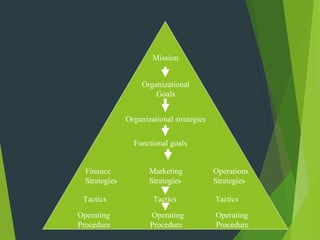
Mission
Organizational
Goals
Organizational strategies
Functional goals
Finance Marketing Operations
Strategies Strategies Strategies
Tactics Tactics Tactics
Operating Operating Operating
Procedure Procedure Procedure
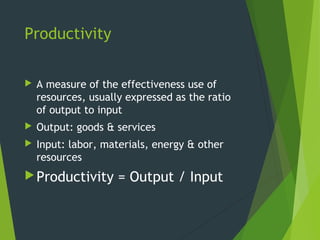
Productivity
 A measure of the effectiveness use of
resources, usually expressed as the ratio
of output to input
 Output: goods & services
 Input: labor, materials, energy & other
resources
Productivity = Output / Input
Productivity
 Can be computed for:
 A single operation
 A department
 An organization
 An entire country
 Can be based on:
 Single input (partial productivity)
 More than 1 input (multifactor
productivity)
 All inputs (total productivity)
Purpose of Productivity
Measurement
 Used to track performance over
time.
 Used to judge the performance of
the entire industry or the country as
a whole.
 Serve as scoreboards of effective
use of resources
Factors that affect
Productivity
Methods
Capital
Quality
Technology
Management
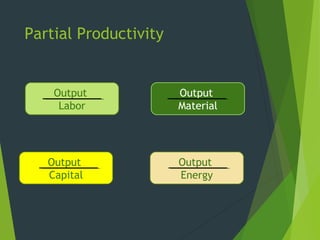
Partial Productivity
Output
Labor
Output
Energy
Output
Capital
Output
Material
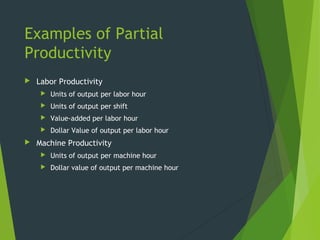
Examples of Partial
Productivity
 Labor Productivity
 Units of output per labor hour
 Units of output per shift
 Value-added per labor hour
 Dollar Value of output per labor hour
 Machine Productivity
 Units of output per machine hour
 Dollar value of output per machine hour
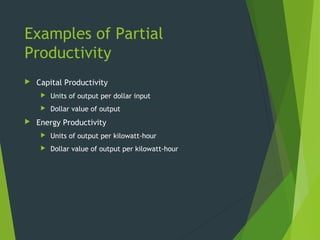
Examples of Partial
Productivity
 Capital Productivity
 Units of output per dollar input
 Dollar value of output
 Energy Productivity
 Units of output per kilowatt-hour
 Dollar value of output per kilowatt-hour
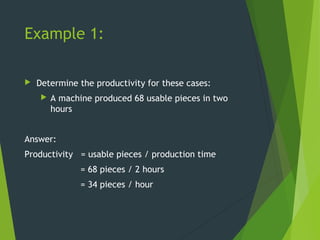
Example 1:
 Determine the productivity for these cases:
 A machine produced 68 usable pieces in two
hours
Answer:
Productivity = usable pieces / production time
= 68 pieces / 2 hours
= 34 pieces / hour
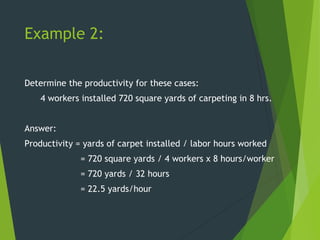
Example 2:
Determine the productivity for these cases:
4 workers installed 720 square yards of carpeting in 8 hrs.
Answer:
Productivity = yards of carpet installed / labor hours worked
= 720 square yards / 4 workers x 8 hours/worker
= 720 yards / 32 hours
= 22.5 yards/hour
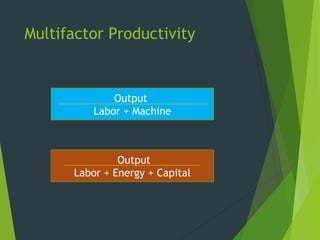
Multifactor Productivity
Output
Labor + Machine
Output
Labor + Energy + Capital
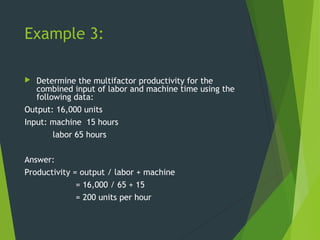
Example 3:
 Determine the multifactor productivity for the
combined input of labor and machine time using the
following data:
Output: 16,000 units
Input: machine 15 hours
labor 65 hours
Answer:
Productivity = output / labor + machine
= 16,000 / 65 + 15
= 200 units per hour
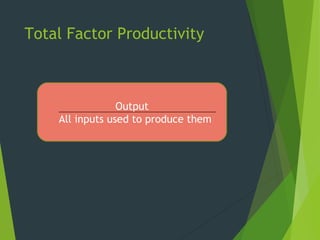
Total Factor Productivity
Output
All inputs used to produce them
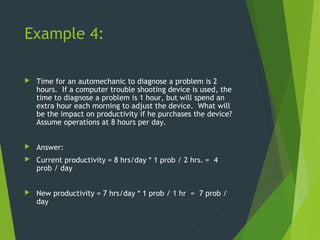
Example 4:
 Time for an automechanic to diagnose a problem is 2
hours. If a computer trouble shooting device is used, the
time to diagnose a problem is 1 hour, but will spend an
extra hour each morning to adjust the device. What will
be the impact on productivity if he purchases the device?
Assume operations at 8 hours per day.
 Answer:
 Current productivity = 8 hrs/day * 1 prob / 2 hrs. = 4
prob / day
 New productivity = 7 hrs/day * 1 prob / 1 hr = 7 prob /
day
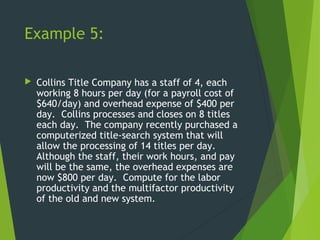
Example 5:
 Collins Title Company has a staff of 4, each
working 8 hours per day (for a payroll cost of
$640/day) and overhead expense of $400 per
day. Collins processes and closes on 8 titles
each day. The company recently purchased a
computerized title-search system that will
allow the processing of 14 titles per day.
Although the staff, their work hours, and pay
will be the same, the overhead expenses are
now $800 per day. Compute for the labor
productivity and the multifactor productivity
of the old and new system.
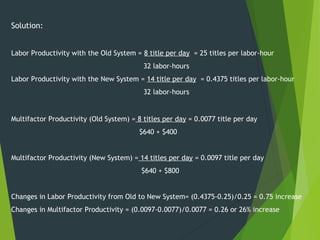
Solution:
Labor Productivity with the Old System = 8 title per day = 25 titles per labor-hour
32 labor-hours
Labor Productivity with the New System = 14 title per day = 0.4375 titles per labor-hour
32 labor-hours
Multifactor Productivity (Old System) = 8 titles per day = 0.0077 title per day
$640 + $400
Multifactor Productivity (New System) = 14 titles per day = 0.0097 title per day
$640 + $800
Changes in Labor Productivity from Old to New System= (0.4375-0.25)/0.25 = 0.75 increase
Changes in Multifactor Productivity = (0.0097-0.0077)/0.0077 = 0.26 or 26% increase
Example 6:
 Joanna is currently working a total of 12 hours per day to
produce 240 “Tommy” dolls. She thinks that by changing
the paint used for the facial features and fingernails, she
can increase her rate to 360 dolls per day. Viewing this
from a total factor productivity perspective, what is her
productivity at present and with a new paint?
 Total material cost for each doll is approximately $3.50.
She invests $20 in the necessary tools per day and energy
costs are assumed to be only $4.00 per day. She assumes
that she should be making $10 per hour for her time. How
would productivity change if using the new paint raised
Joanna’s material costs $0.50 per doll?
 By what amount could the material cost increase without
reducing productivity?
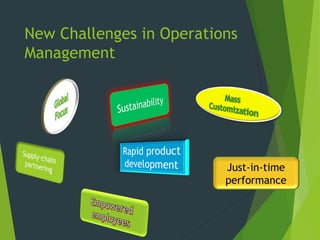
New Challenges in Operations
Management
Just-in-time
performance
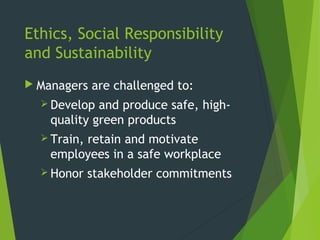
Ethics, Social Responsibility
and Sustainability
 Managers are challenged to:
 Develop and produce safe, high-
quality green products
 Train, retain and motivate
employees in a safe workplace
 Honor stakeholder commitments
Seatwork:
1. Lori Cook produces “Final Exam Care Packages” for
resale by her sorority. She is currently working a total
of 5 hours per day to produce 100 care packages.
a) What is Lori’s productivity?
b) Lori think that by redesigning the package, she can
increase her total productivity 133 care packages per day.
What will be her new productivity?
c) What will be the percentage increase in productivity if
Lori make the change?
Seatwork:
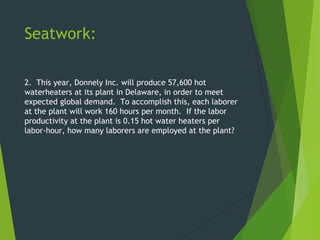
2. This year, Donnely Inc. will produce 57,600 hot
waterheaters at its plant in Delaware, in order to meet
expected global demand. To accomplish this, each laborer
at the plant will work 160 hours per month. If the labor
productivity at the plant is 0.15 hot water heaters per
labor-hour, how many laborers are employed at the plant?
Seatwork:
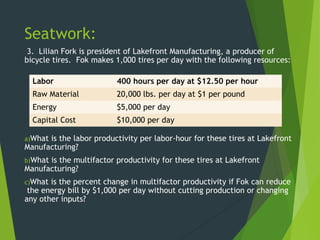
3. Lilian Fork is president of Lakefront Manufacturing, a producer of
bicycle tires. Fok makes 1,000 tires per day with the following resources:
a)What is the labor productivity per labor-hour for these tires at Lakefront
Manufacturing?
b)What is the multifactor productivity for these tires at Lakefront
Manufacturing?
c)What is the percent change in multifactor productivity if Fok can reduce
the energy bill by $1,000 per day without cutting production or changing
any other inputs?
Labor 400 hours per day at $12.50 per hour
Raw Material 20,000 lbs. per day at $1 per pound
Energy $5,000 per day
Capital Cost $10,000 per day

Productivity,competitiveness,strategy

  • 1.
    Competitiveness, Strategy Productivity, By: M.B. Cabrera, PIE Engineering Program Holy Angel University
  • 2.
    Competitiveness  How effectivelyan organization meets the wants and needs of consumers relative to others that offer similar goods or services.
  • 3.
    Marketing influence competitiveness  Identifyingconsumer wants and/or needs  Pricing  Advertising and promotion
  • 4.
    Operations Major Influences onCompetitiveness  Product and service design  Cost of an organization output  Location  Quality  Quick response  Flexibility  Inventory Management  Supply Chain Management  Service as value-value  Management and workers
  • 5.
    Why Some OrganizationsFail?  Putting too much emphasis on short-term financial performance.  Failing to take advantage of the strength and opportunities, and or failing to recognize competitive threats  Neglecting Operations Strategy  Placing too much emphasis on product and service design and not enough on process design and improvement..  Neglecting investments in capital and human resources.  Failing to establish good internal communications and cooperation among different functional areas.  Failing to consider customer wants and needs.
  • 6.
    Strategies  Plan forachieving organizational goals.  These can be a long term, intermediate, or short term.
  • 7.
    Mission and Goals Mission  The reason for the existence of an organizations.  Goals  Provide details and scope of the mission
  • 8.
    Tactics  The methodsand actions taken to accomplish strategies.
  • 9.
    Mission Organizational Goals Organizational strategies Functional goals FinanceMarketing Operations Strategies Strategies Strategies Tactics Tactics Tactics Operating Operating Operating Procedure Procedure Procedure
  • 10.
    Productivity  A measureof the effectiveness use of resources, usually expressed as the ratio of output to input  Output: goods & services  Input: labor, materials, energy & other resources Productivity = Output / Input
  • 11.
    Productivity  Can becomputed for:  A single operation  A department  An organization  An entire country  Can be based on:  Single input (partial productivity)  More than 1 input (multifactor productivity)  All inputs (total productivity)
  • 12.
    Purpose of Productivity Measurement Used to track performance over time.  Used to judge the performance of the entire industry or the country as a whole.  Serve as scoreboards of effective use of resources
  • 13.
  • 14.
  • 15.
    Examples of Partial Productivity Labor Productivity  Units of output per labor hour  Units of output per shift  Value-added per labor hour  Dollar Value of output per labor hour  Machine Productivity  Units of output per machine hour  Dollar value of output per machine hour
  • 16.
    Examples of Partial Productivity Capital Productivity  Units of output per dollar input  Dollar value of output  Energy Productivity  Units of output per kilowatt-hour  Dollar value of output per kilowatt-hour
  • 17.
    Example 1:  Determinethe productivity for these cases:  A machine produced 68 usable pieces in two hours Answer: Productivity = usable pieces / production time = 68 pieces / 2 hours = 34 pieces / hour
  • 18.
    Example 2: Determine theproductivity for these cases: 4 workers installed 720 square yards of carpeting in 8 hrs. Answer: Productivity = yards of carpet installed / labor hours worked = 720 square yards / 4 workers x 8 hours/worker = 720 yards / 32 hours = 22.5 yards/hour
  • 19.
    Multifactor Productivity Output Labor +Machine Output Labor + Energy + Capital
  • 20.
    Example 3:  Determinethe multifactor productivity for the combined input of labor and machine time using the following data: Output: 16,000 units Input: machine 15 hours labor 65 hours Answer: Productivity = output / labor + machine = 16,000 / 65 + 15 = 200 units per hour
  • 21.
    Total Factor Productivity Output Allinputs used to produce them
  • 22.
    Example 4:  Timefor an automechanic to diagnose a problem is 2 hours. If a computer trouble shooting device is used, the time to diagnose a problem is 1 hour, but will spend an extra hour each morning to adjust the device. What will be the impact on productivity if he purchases the device? Assume operations at 8 hours per day.  Answer:  Current productivity = 8 hrs/day * 1 prob / 2 hrs. = 4 prob / day  New productivity = 7 hrs/day * 1 prob / 1 hr = 7 prob / day
  • 23.
    Example 5:  CollinsTitle Company has a staff of 4, each working 8 hours per day (for a payroll cost of $640/day) and overhead expense of $400 per day. Collins processes and closes on 8 titles each day. The company recently purchased a computerized title-search system that will allow the processing of 14 titles per day. Although the staff, their work hours, and pay will be the same, the overhead expenses are now $800 per day. Compute for the labor productivity and the multifactor productivity of the old and new system.
  • 24.
    Solution: Labor Productivity withthe Old System = 8 title per day = 25 titles per labor-hour 32 labor-hours Labor Productivity with the New System = 14 title per day = 0.4375 titles per labor-hour 32 labor-hours Multifactor Productivity (Old System) = 8 titles per day = 0.0077 title per day $640 + $400 Multifactor Productivity (New System) = 14 titles per day = 0.0097 title per day $640 + $800 Changes in Labor Productivity from Old to New System= (0.4375-0.25)/0.25 = 0.75 increase Changes in Multifactor Productivity = (0.0097-0.0077)/0.0077 = 0.26 or 26% increase
  • 25.
    Example 6:  Joannais currently working a total of 12 hours per day to produce 240 “Tommy” dolls. She thinks that by changing the paint used for the facial features and fingernails, she can increase her rate to 360 dolls per day. Viewing this from a total factor productivity perspective, what is her productivity at present and with a new paint?  Total material cost for each doll is approximately $3.50. She invests $20 in the necessary tools per day and energy costs are assumed to be only $4.00 per day. She assumes that she should be making $10 per hour for her time. How would productivity change if using the new paint raised Joanna’s material costs $0.50 per doll?  By what amount could the material cost increase without reducing productivity?
  • 26.
    New Challenges inOperations Management Just-in-time performance
  • 27.
    Ethics, Social Responsibility andSustainability  Managers are challenged to:  Develop and produce safe, high- quality green products  Train, retain and motivate employees in a safe workplace  Honor stakeholder commitments
  • 28.
    Seatwork: 1. Lori Cookproduces “Final Exam Care Packages” for resale by her sorority. She is currently working a total of 5 hours per day to produce 100 care packages. a) What is Lori’s productivity? b) Lori think that by redesigning the package, she can increase her total productivity 133 care packages per day. What will be her new productivity? c) What will be the percentage increase in productivity if Lori make the change?
  • 29.
    Seatwork: 2. This year,Donnely Inc. will produce 57,600 hot waterheaters at its plant in Delaware, in order to meet expected global demand. To accomplish this, each laborer at the plant will work 160 hours per month. If the labor productivity at the plant is 0.15 hot water heaters per labor-hour, how many laborers are employed at the plant?
  • 30.
    Seatwork: 3. Lilian Forkis president of Lakefront Manufacturing, a producer of bicycle tires. Fok makes 1,000 tires per day with the following resources: a)What is the labor productivity per labor-hour for these tires at Lakefront Manufacturing? b)What is the multifactor productivity for these tires at Lakefront Manufacturing? c)What is the percent change in multifactor productivity if Fok can reduce the energy bill by $1,000 per day without cutting production or changing any other inputs? Labor 400 hours per day at $12.50 per hour Raw Material 20,000 lbs. per day at $1 per pound Energy $5,000 per day Capital Cost $10,000 per day