Quality Management
Quality Management
Definition:
The Project
Management Institute
defines Quality as
Conformance to
requirements.
Grade is the Ranking we
give products that have
the same functional use,
but different
characteristics.
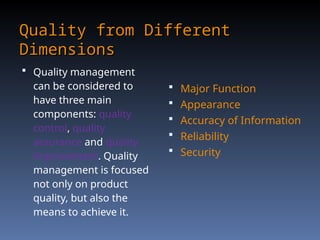
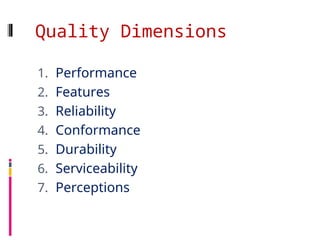
Quality from Different
Qualityfrom Different
Dimensions
Dimensions
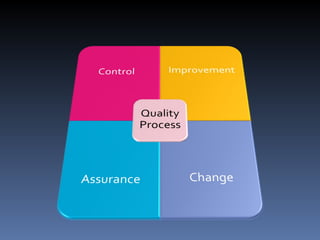
Quality management
can be considered to
have three main
components: quality
control, quality
assurance and quality
improvement. Quality
management is focused
not only on product
quality, but also the
means to achieve it.
Major Function
Appearance
Accuracy of Information
Reliability
Security
6.
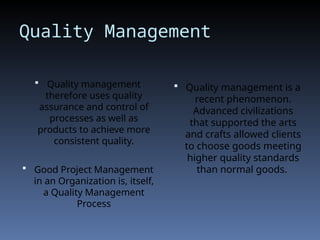
Quality Management
Qualitymanagement
therefore uses quality
assurance and control of
processes as well as
products to achieve more
consistent quality.
Good Project Management
in an Organization is, itself,
a Quality Management
Process
Quality management is a
recent phenomenon.
Advanced civilizations
that supported the arts
and crafts allowed clients
to choose goods meeting
higher quality standards
than normal goods.
7.
Quality Management
Quality Management
In societies where art
and craft (and
craftsmanship) were
valued, one of the
responsibilities of a
master craftsman (and
similarly for artists) was
to lead their studio, train
and supervise the work
of their craftsmen and
apprentices
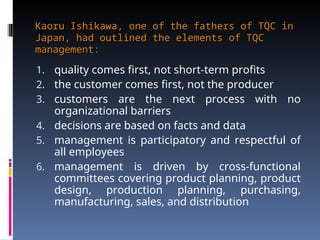
Kaoru Ishikawa, oneof the fathers of TQC in
Kaoru Ishikawa, one of the fathers of TQC in
Japan, had outlined the elements of TQC
Japan, had outlined the elements of TQC
management:
management:
1. quality comes first, not short-term profits
2. the customer comes first, not the producer
3. customers are the next process with no
organizational barriers
4. decisions are based on facts and data
5. management is participatory and respectful of
all employees
6. management is driven by cross-functional
committees covering product planning, product
design, production planning, purchasing,
manufacturing, sales, and distribution
13.
TQM Evolution
TQM Evolution
The origination of TQM and its philosophical
approaches should be attributed to the Japanese
approach towards quality improvement after the
Second World War.
TQM has been widely used as a management
initiative to improve quality in the firm. TQM is a
continuous process that aims at quality
improvement in all processes and activities in the
firm. The ultimate goal of TQM is to establish a
management system and organizational culture
that ensures customer satisfaction and
continuous improvement
TQM
TQM
Total QualityManagement (TQM) is a
management approach which seeks to
establish zero defects in any part of an
organization, and which uses teams,
worker empowerment and creative
problem solving to accomplish this
aggressive goal.
17.
TQM Philosophy
TQM Philosophy
It views organizations as
a collection of processes.
It maintains that
organizations must strive
to continuously improve
these processes by
incorporating the
knowledge and
experiences of workers..
TQM is a management
philosophy which seeks
to integrate all
organizational functions
(marketing, finance,
design, engineering,
production, customer
service …) to focus on
meeting customer needs
and organizational
objectives.
Quality Movements
Quality Movements
The Quality movement in
business and organization
has occurred in three
major phases. It began
with the idea of the
production line in the
1920’s at Ford Motor
Company, and with the
idea that each item
produced is the same as
every other item..
In the 1970’s, the concept of
continuous improvement
took the quality movement to
a next step. Current ideas
about quality have moved to
the idea that what is required
in a fast changing world is
the capacity to respond to
change. It is not simply
continuous improvement
that is required, but rather
breakthroughs in how people
think and solve problems.
Deming Philosophy
Deming Philosophy
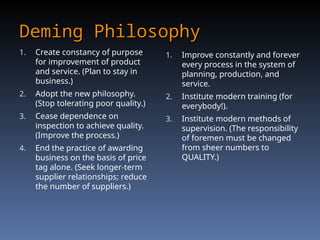
1.Create constancy of purpose
for improvement of product
and service. (Plan to stay in
business.)
2. Adopt the new philosophy.
(Stop tolerating poor quality.)
3. Cease dependence on
inspection to achieve quality.
(Improve the process.)
4. End the practice of awarding
business on the basis of price
tag alone. (Seek longer-term
supplier relationships; reduce
the number of suppliers.)
1. Improve constantly and forever
every process in the system of
planning, production, and
service.
2. Institute modern training (for
everybody!).
3. Institute modern methods of
supervision. (The responsibility
of foremen must be changed
from sheer numbers to
QUALITY.)
24.
Deming Philosophy
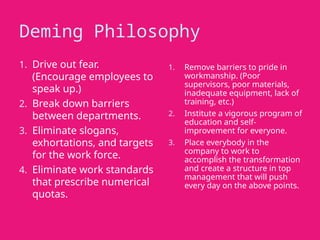
1. Driveout fear.
(Encourage employees to
speak up.)
2. Break down barriers
between departments.
3. Eliminate slogans,
exhortations, and targets
for the work force.
4. Eliminate work standards
that prescribe numerical
quotas.
1. Remove barriers to pride in
workmanship. (Poor
supervisors, poor materials,
inadequate equipment, lack of
training, etc.)
2. Institute a vigorous program of
education and self-
improvement for everyone.
3. Place everybody in the
company to work to
accomplish the transformation
and create a structure in top
management that will push
every day on the above points.
TQM
TQM
Total QualityManagement (TQM) is a
management approach which seeks to
establish zero defects in any part of an
organization, and which uses teams,
worker empowerment and creative
problem solving to accomplish this
aggressive goal.
27.
TQM
TQM
TQM is amanagement philosophy which
seeks to integrate all organizational
functions (marketing, finance, design,
engineering, production, customer
service …) to focus on meeting
customer needs and organizational
objectives.
28.
Definition:
Definition:
As defined bythe International
Organization for Standardization (ISO):
"TQM is a management approach for an
organization, centered on quality, based on the
participation of all its members and aiming at
long-term success through customer satisfaction,
and benefits to all members of the organization
and to society."
29.
Definition
Definition
When used togetheras a phrase, the
three words in this expression have the
following meanings:
Total: Involving the entire organization, supply chain,
and/or product life cycle
Quality: With its usual definitions, with all its complexities
Management: The system of managing with steps like Plan,
Organize, Control, Lead, Staff, provisioning and organizing
citation needed].
30.
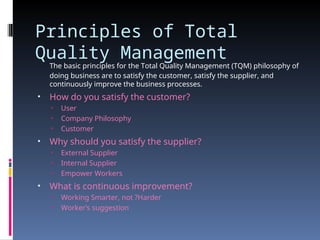
Principles of Total
QualityManagement
The basic principles for the Total Quality Management (TQM) philosophy of
doing business are to satisfy the customer, satisfy the supplier, and
continuously improve the business processes.
• How do you satisfy the customer?
• User
• Company Philosophy
• Customer
• Why should you satisfy the supplier?
• External Supplier
• Internal Supplier
• Empower Workers
• What is continuous improvement?
• Working Smarter, not ?Harder
• Worker’s suggestion
31.
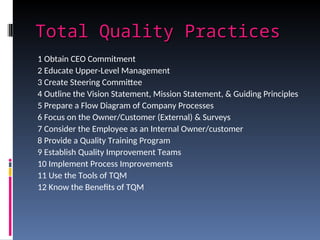
Total Quality Practices
TotalQuality Practices
1 Obtain CEO Commitment
2 Educate Upper-Level Management
3 Create Steering Committee
4 Outline the Vision Statement, Mission Statement, & Guiding Principles
5 Prepare a Flow Diagram of Company Processes
6 Focus on the Owner/Customer (External) & Surveys
7 Consider the Employee as an Internal Owner/customer
8 Provide a Quality Training Program
9 Establish Quality Improvement Teams
10 Implement Process Improvements
11 Use the Tools of TQM
12 Know the Benefits of TQM
32.
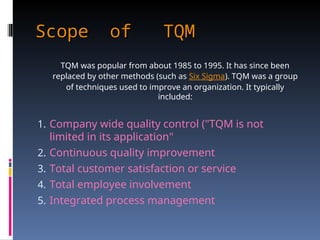
Scope of TQM
Scopeof TQM
TQM was popular from about 1985 to 1995. It has since been
replaced by other methods (such as Six Sigma). TQM was a group
of techniques used to improve an organization. It typically
included:
1. Company wide quality control ("TQM is not
limited in its application"
2. Continuous quality improvement
3. Total customer satisfaction or service
4. Total employee involvement
5. Integrated process management
33.
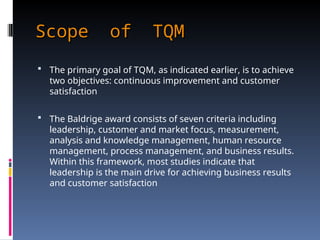
Scope of TQM
Scopeof TQM
The primary goal of TQM, as indicated earlier, is to achieve
two objectives: continuous improvement and customer
satisfaction
The Baldrige award consists of seven criteria including
leadership, customer and market focus, measurement,
analysis and knowledge management, human resource
management, process management, and business results.
Within this framework, most studies indicate that
leadership is the main drive for achieving business results
and customer satisfaction
Empowerment
Empowerment
The concept ofempowerment is based upon the belief that
employees needs the organization as much as the
organization needs them and that leaders understand that
employees are the most valuable asset in the firm
1. Quality starts with people
2. Participative Management
3. We are all in it together
4. Empower from the bottom up
5. Employees; the most important asset of an organization
6. Treat Your employees the way you want your customers to
be treated.
36.
Cost of Quality
Cost of Quality ("COQ") is a measurement used for
assessing the waste or losses from some defined process
(eg. machine, production line, plant, department, company,
etc.).
Recognizing the power and universal applicability of Cost of
Quality ("COQ"), PQA has developed numerous
proprietary Cost of Quality ("COQ") systems for ensuring
the effectiveness of Cost of Quality ("COQ")
implementations.
37.
Cost of Quality
Costof Quality
The Cost of Quality ("COQ") measurement can track
changes over time for one particular process, or be used as
a benchmark for comparison of two or more different
processes (eg. two machines, different production lines,
sister plants, two competitor companies, etc.).
Usually, Cost of Quality ("COQ") is measured in currency (eg.
$), requiring all losses and wastes to be converted to their
liquidated cost equivalent (ie. man-hrs lost or spent are
converted to $ by multiplying by the hourly rate, $/hr).
38.
Synonyms & RelatedTerms
Synonyms & Related Terms
1. CNQ (Cost of Non-Quality)
2. ROQ (Return on Quality, a proprietary system for
Cost of Quality ("COQ"), developed by PQA) Losses
3. Non-Value Added
4. Waste Measurement
5. Muda (Japanese for waste)
![Definition
Definition
When used together as a phrase, the
three words in this expression have the
following meanings:
Total: Involving the entire organization, supply chain,
and/or product life cycle
Quality: With its usual definitions, with all its complexities
Management: The system of managing with steps like Plan,
Organize, Control, Lead, Staff, provisioning and organizing
citation needed].](https://image.slidesharecdn.com/qualityprojectmanagement-250415154138-47da5ada/85/Introduction-to-Quality-Project-Management-ppt-29-320.jpg)