Spirit Proprietary 1
7 QC TOOLS
The term “7 QC tools for QC” is name after the 7 tools of the famous
warrior , Benkai. Benkai owned 7 weapons, which he used to win all his
battles. Similarly, from my own experience, you will find that you will able to
solve 95% of the problems around you if you wisely use the 7 tools of QC.”
ISHIKAWA KAORU, Professor Emeritus, University of Tokyo.
7 Quality Tools
Spirit Proprietary 2
Page 2
Introduction
In 1950, the Japanese Union of Scientists and Engineers (JUSE) invited
legendary quality guru W. Edwards Deming to go to Japan and train hundreds of
Japanese engineers, managers and scholars in statistical process control.
Deming also delivered a series of lectures to Japanese business managers on the
subject, and during his lectures, he would emphasize the importance of what he
called the "basic tool" that were available to use in quality control.
One of the members of the JUSE was Kaoru Ishikawa, at the time an associate
professor at the University of Tokyo. Ishikawa had a desire to 'democratise
quality': that is to say, he wanted to make quality control comprehensible to all
workers, and inspired by Deming’s lectures, he formalised the Seven Basic Tools
of Quality Control.
Ishikawa believed that 90% of a company’s problems could be improved using
these seven tools, and that –- with the exception of Control Charts -- they could
easily be taught to any member of the organisation. This ease-of-use combined
with their graphical nature makes statistical analysis easier for all.
Spirit Proprietary 3
The Basic Seven (B7)
Tools of Quality
A PowerPoint Training Presentation
"As much as 95% of quality related problems in the factory can be
solved with seven fundamental quantitative tools." - Kaoru
Ishikawa
Spirit Proprietary 4
What are the Basic Seven Tools of
Quality?
 1 – Fishbone/Ishikawa Diagrams
 2 - Histograms
 3 - Pareto Analysis
 4 - Flowcharts
 5 - Scatter Plots
 6 - Run Charts
 7 - Control Charts
Spirit Proprietary 5
Where did the Basic Seven come
from?
Kaoru Ishikawa
 Known for “Democratizing Statistics”
 The Basic Seven Tools made statistical analysis less
complicated for the average person
 Good Visual Aids make statistical and quality control
more comprehendible.
Spirit Proprietary 6
The Basic Seven (B7)
Tools of Quality
1] Fishbone Diagrams
 No statistics involved
 Maps out a process/problem
 Makes improvement easier
 Looks like a “Fish Skeleton”
Spirit Proprietary 7
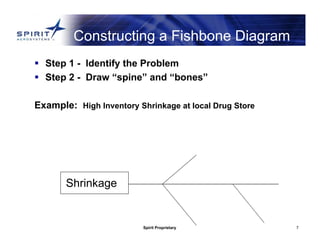
Constructing a Fishbone Diagram
 Step 1 - Identify the Problem
 Step 2 - Draw “spine” and “bones”
Example: High Inventory Shrinkage at local Drug Store
Shrinkage
Spirit Proprietary 8
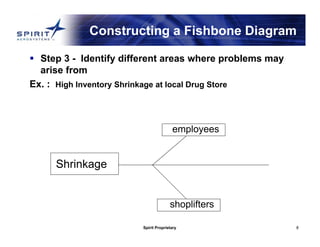
Constructing a Fishbone Diagram
 Step 3 - Identify different areas where problems may
arise from
Ex. : High Inventory Shrinkage at local Drug Store
Shrinkage
employees
shoplifters
Spirit Proprietary 9
Constructing a Fishbone Diagram
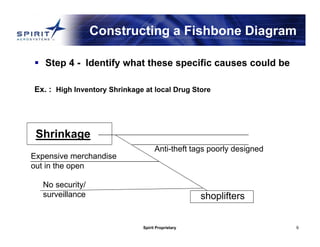
 Step 4 - Identify what these specific causes could be
Ex. : High Inventory Shrinkage at local Drug Store
Shrinkage
shoplifters
Anti-theft tags poorly designed
Expensive merchandise
out in the open
No security/
surveillance
Spirit Proprietary 10
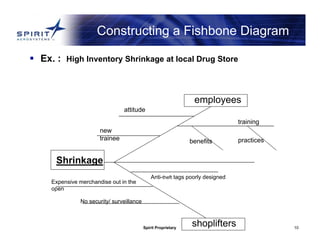
Constructing a Fishbone Diagram
 Ex. : High Inventory Shrinkage at local Drug Store
Shrinkage
shoplifters
Anti-theft tags poorly designed
Expensive merchandise out in the
open
No security/ surveillance
employees
attitude
new
trainee
training
benefits practices
Spirit Proprietary 11
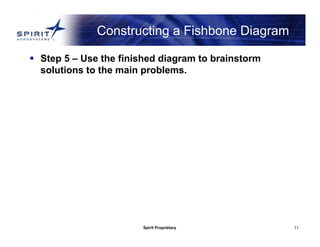
Constructing a Fishbone Diagram
 Step 5 – Use the finished diagram to brainstorm
solutions to the main problems.
Spirit Proprietary 12
The Basic Seven (B7)
Tools of Quality
2] Histograms
 Bar chart
 Used to graphically represent groups of data
Spirit Proprietary 13
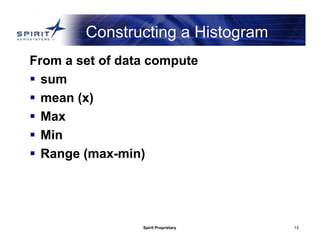
Constructing a Histogram
From a set of data compute
 sum
 mean (x)
 Max
 Min
 Range (max-min)
Spirit Proprietary 14
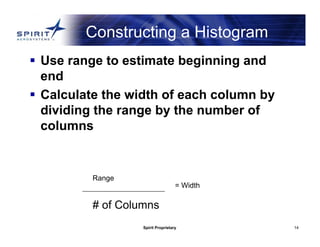
Constructing a Histogram
 Use range to estimate beginning and
end
 Calculate the width of each column by
dividing the range by the number of
columns
Range
# of Columns
= Width
Spirit Proprietary 15
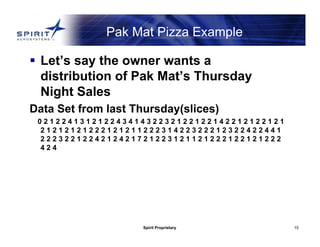
Pak Mat Pizza Example
 Let’s say the owner wants a
distribution of Pak Mat’s Thursday
Night Sales
Data Set from last Thursday(slices)
0 2 1 2 2 4 1 3 1 2 1 2 2 4 3 4 1 4 3 2 2 3 2 1 2 2 1 2 2 1 4 2 2 1 2 1 2 2 1 2 1
2 1 2 1 2 1 2 1 2 2 2 1 2 1 2 1 1 2 2 2 3 1 4 2 2 3 2 2 2 1 2 3 2 2 4 2 2 4 4 1
2 2 2 3 2 2 1 2 2 4 2 1 2 4 2 1 7 2 1 2 2 3 1 2 1 1 2 1 2 2 2 1 2 2 1 2 1 2 2 2
4 2 4
Spirit Proprietary 16
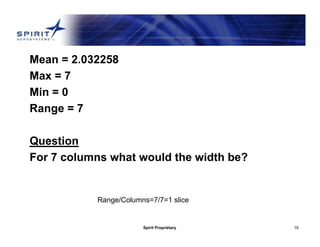
Acme Pizza ExampleMean = 2.032258
Max = 7
Min = 0
Range = 7
Question
For 7 columns what would the width be?
Range/Columns=7/7=1 slice
Spirit Proprietary 17
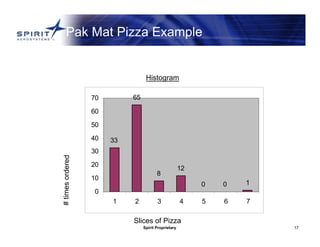
Pak Mat Pizza Example
33
65
8
12
0 0 1
0
10
20
30
40
50
60
70
1 2 3 4 5 6 7
Slices of Pizza
Histogram
Spirit Proprietary 18
Constructing a Histogram
How is this helpful to Pak Mat?
 2 slices of pizza most common order placed
 Distribution of sales useful for forecasting
next Thursday’s late night demand
If you were an Pak Mat manager how could
you apply this information?
Spirit Proprietary 19
The Basic Seven (B7)
Tools of Quality
3] Pareto Analysis
 Very similar to Histograms
 Use of the 80/20 rule
 Use of percentages to show importance
Spirit Proprietary 20
Pak Mat Pizza (part 2)
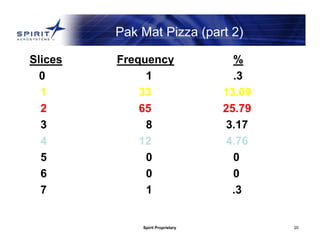
Slices Frequency %
0 1 .3
1 33 13.09
2 65 25.79
3 8 3.17
4 12 4.76
5 0 0
6 0 0
7 1 .3
Spirit Proprietary 21
Pak Mat Pizza (part 2)
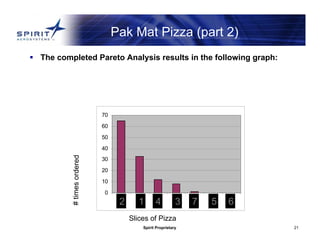
 The completed Pareto Analysis results in the following graph:
0
10
20
30
40
50
60
70
1 2 3 4 5 6 7
Slices of Pizza
2 1 4 3 7 5 6
Spirit Proprietary 22
Pak Mat Pizza (part 2)
Critical Thinking
 How does the Pareto Analysis differ
from the Histogram?
 How can this be a useful tool to the Pak
Mat boss?
Spirit Proprietary 23
The Basic Seven (B7)
Tools of Quality
4] Flowcharts
 A graphical picture of a PROCESS
Process Decision
The process flow
Spirit Proprietary 24
Flowcharts
Don’t Forget to:
 Define symbols before beginning
 Stay consistent
 Check that process is accurate
Spirit Proprietary 25
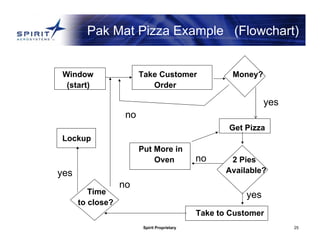
Pak Mat Pizza Example (Flowchart)
Window Take Customer Money?
(start) Order
Get Pizza
Lockup
Put More in
Oven 2 Pies
Available?
Time
to close?
Take to Customer
no
yes
no
yes
no
yes
Spirit Proprietary 26
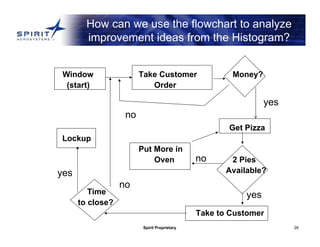
How can we use the flowchart to analyze
improvement ideas from the Histogram?
Window Take Customer Money?
(start) Order
Get Pizza
Lockup
Put More in
Oven 2 Pies
Available?
Time
to close?
Take to Customer
no
yes
no
yes
no
yes
Spirit Proprietary 27
Want some practice?
Make a flowchart for:
 Taking a shower
 Cooking dinner
 Driving a car
 Having a party
 Creating a Flowchart
Any other processes you can think of?
Spirit Proprietary 28
The Basic Seven (B7)
Tools of Quality
5] Scatter Plots
 2 Dimensional X/Y plots
 Used to show relationship between
independent(x) and dependent(y)
variables
Spirit Proprietary 29
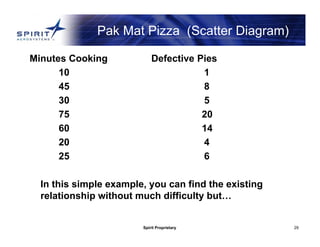
Pak Mat Pizza (Scatter Diagram)
Minutes Cooking Defective Pies
10 1
45 8
30 5
75 20
60 14
20 4
25 6
In this simple example, you can find the existing
relationship without much difficulty but…
Spirit Proprietary 30
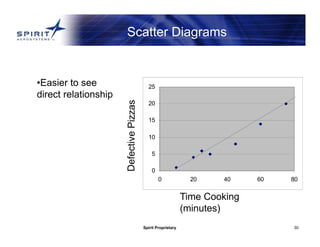
Scatter Diagrams
0
5
10
15
20
25
0 20 40 60 80
•Easier to see
direct relationship
Time Cooking
(minutes)
Spirit Proprietary 31
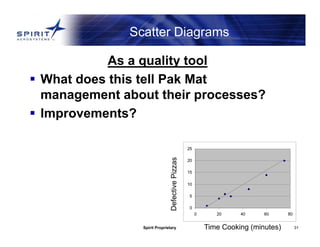
Scatter Diagrams
As a quality tool
 What does this tell Pak Mat
management about their processes?
 Improvements?
0
5
10
15
20
25
0 20 40 60 80
Time Cooking (minutes)
Spirit Proprietary 32
The Basic Seven (B7)
Tools of Quality
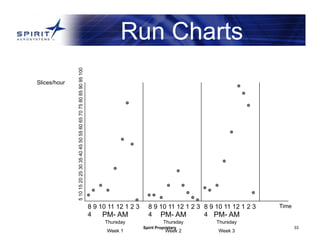
6] Run charts
 Time-based (x-axis)
 Cyclical
 Look for patterns
Spirit Proprietary 33
Run Charts
8 9 10 11 12 1 2 3
4
8 9 10 11 12 1 2 3
4
8 9 10 11 12 1 2 3
4PM- AM PM- AM PM- AM
Thursday
Week 1
Thursday
Week 2
Thursday
Week 3
Slices/hour
Time
Spirit Proprietary 34
The Basic Seven (B7)
Tools of Quality
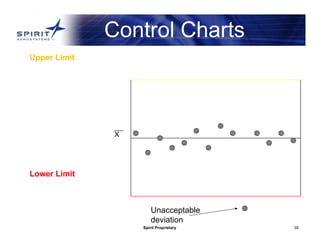
7] Control Charts
 Deviation from Mean
 Upper and Lower Spec’s
 Range
Spirit Proprietary 35
Control Charts
Upper Limit
Lower Limit
Unacceptable
deviation
X
Spirit Proprietary 36
Control Charts
Pak Mat Pizza Management wants to get in on the control chart action
•Average Diameter = 16 inches
•Upper Limit = 17 inches
•Lower Limit = 15 inches
Spirit Proprietary 37
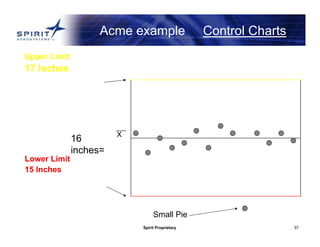
Acme example Control Charts
Upper Limit
17 inches
Lower Limit
15 Inches
Small Pie
X
16
inches=
Spirit Proprietary 38
Pak Mat example #50
Control Charts
•Pies within specifications were acceptable
•One abnormally small pie is “uncommon”
•Should be examined for quality control
Spirit Proprietary 39
Summary
 Basic Seven Tools of Quality
 Measuring data
 Quality Analysis
 “Democratized statistics”
Spirit Proprietary 40
Bibliography
 Foster, Thomas. Managing Quality. An Integrative Approach.
Upper Saddle River : Prentice Hall, 2001.
 Stevenson, William. “Supercharging Your Pareto Analysis.”
Quality Progress October 2000: 51-55.
 “Dr Kaoru Ishikawa.” Internet
“http://www.dti.gov.uk/mbp/bpgt/m9ja00001/m9j
a0000110.html.” 16 February 2001.
 “Chemical and Process Engineering.” Internet.
“http://lorien.ncl.ac.uk/ming/spc/spc8.htm.” 17 February 2001.

7 qc tool presentation material

  • 1.
    Spirit Proprietary 1 7QC TOOLS The term “7 QC tools for QC” is name after the 7 tools of the famous warrior , Benkai. Benkai owned 7 weapons, which he used to win all his battles. Similarly, from my own experience, you will find that you will able to solve 95% of the problems around you if you wisely use the 7 tools of QC.” ISHIKAWA KAORU, Professor Emeritus, University of Tokyo. 7 Quality Tools
  • 2.
    Spirit Proprietary 2 Page 2 Introduction In1950, the Japanese Union of Scientists and Engineers (JUSE) invited legendary quality guru W. Edwards Deming to go to Japan and train hundreds of Japanese engineers, managers and scholars in statistical process control. Deming also delivered a series of lectures to Japanese business managers on the subject, and during his lectures, he would emphasize the importance of what he called the "basic tool" that were available to use in quality control. One of the members of the JUSE was Kaoru Ishikawa, at the time an associate professor at the University of Tokyo. Ishikawa had a desire to 'democratise quality': that is to say, he wanted to make quality control comprehensible to all workers, and inspired by Deming’s lectures, he formalised the Seven Basic Tools of Quality Control. Ishikawa believed that 90% of a company’s problems could be improved using these seven tools, and that –- with the exception of Control Charts -- they could easily be taught to any member of the organisation. This ease-of-use combined with their graphical nature makes statistical analysis easier for all.
  • 3.
    Spirit Proprietary 3 TheBasic Seven (B7) Tools of Quality A PowerPoint Training Presentation "As much as 95% of quality related problems in the factory can be solved with seven fundamental quantitative tools." - Kaoru Ishikawa
  • 4.
    Spirit Proprietary 4 Whatare the Basic Seven Tools of Quality?  1 – Fishbone/Ishikawa Diagrams  2 - Histograms  3 - Pareto Analysis  4 - Flowcharts  5 - Scatter Plots  6 - Run Charts  7 - Control Charts
  • 5.
    Spirit Proprietary 5 Wheredid the Basic Seven come from? Kaoru Ishikawa  Known for “Democratizing Statistics”  The Basic Seven Tools made statistical analysis less complicated for the average person  Good Visual Aids make statistical and quality control more comprehendible.
  • 6.
    Spirit Proprietary 6 TheBasic Seven (B7) Tools of Quality 1] Fishbone Diagrams  No statistics involved  Maps out a process/problem  Makes improvement easier  Looks like a “Fish Skeleton”
  • 7.
    Spirit Proprietary 7 Constructinga Fishbone Diagram  Step 1 - Identify the Problem  Step 2 - Draw “spine” and “bones” Example: High Inventory Shrinkage at local Drug Store Shrinkage
  • 8.
    Spirit Proprietary 8 Constructinga Fishbone Diagram  Step 3 - Identify different areas where problems may arise from Ex. : High Inventory Shrinkage at local Drug Store Shrinkage employees shoplifters
  • 9.
    Spirit Proprietary 9 Constructinga Fishbone Diagram  Step 4 - Identify what these specific causes could be Ex. : High Inventory Shrinkage at local Drug Store Shrinkage shoplifters Anti-theft tags poorly designed Expensive merchandise out in the open No security/ surveillance
  • 10.
    Spirit Proprietary 10 Constructinga Fishbone Diagram  Ex. : High Inventory Shrinkage at local Drug Store Shrinkage shoplifters Anti-theft tags poorly designed Expensive merchandise out in the open No security/ surveillance employees attitude new trainee training benefits practices
  • 11.
    Spirit Proprietary 11 Constructinga Fishbone Diagram  Step 5 – Use the finished diagram to brainstorm solutions to the main problems.
  • 12.
    Spirit Proprietary 12 TheBasic Seven (B7) Tools of Quality 2] Histograms  Bar chart  Used to graphically represent groups of data
  • 13.
    Spirit Proprietary 13 Constructinga Histogram From a set of data compute  sum  mean (x)  Max  Min  Range (max-min)
  • 14.
    Spirit Proprietary 14 Constructinga Histogram  Use range to estimate beginning and end  Calculate the width of each column by dividing the range by the number of columns Range # of Columns = Width
  • 15.
    Spirit Proprietary 15 PakMat Pizza Example  Let’s say the owner wants a distribution of Pak Mat’s Thursday Night Sales Data Set from last Thursday(slices) 0 2 1 2 2 4 1 3 1 2 1 2 2 4 3 4 1 4 3 2 2 3 2 1 2 2 1 2 2 1 4 2 2 1 2 1 2 2 1 2 1 2 1 2 1 2 1 2 1 2 2 2 1 2 1 2 1 1 2 2 2 3 1 4 2 2 3 2 2 2 1 2 3 2 2 4 2 2 4 4 1 2 2 2 3 2 2 1 2 2 4 2 1 2 4 2 1 7 2 1 2 2 3 1 2 1 1 2 1 2 2 2 1 2 2 1 2 1 2 2 2 4 2 4
  • 16.
    Spirit Proprietary 16 AcmePizza ExampleMean = 2.032258 Max = 7 Min = 0 Range = 7 Question For 7 columns what would the width be? Range/Columns=7/7=1 slice
  • 17.
    Spirit Proprietary 17 PakMat Pizza Example 33 65 8 12 0 0 1 0 10 20 30 40 50 60 70 1 2 3 4 5 6 7 Slices of Pizza Histogram
  • 18.
    Spirit Proprietary 18 Constructinga Histogram How is this helpful to Pak Mat?  2 slices of pizza most common order placed  Distribution of sales useful for forecasting next Thursday’s late night demand If you were an Pak Mat manager how could you apply this information?
  • 19.
    Spirit Proprietary 19 TheBasic Seven (B7) Tools of Quality 3] Pareto Analysis  Very similar to Histograms  Use of the 80/20 rule  Use of percentages to show importance
  • 20.
    Spirit Proprietary 20 PakMat Pizza (part 2) Slices Frequency % 0 1 .3 1 33 13.09 2 65 25.79 3 8 3.17 4 12 4.76 5 0 0 6 0 0 7 1 .3
  • 21.
    Spirit Proprietary 21 PakMat Pizza (part 2)  The completed Pareto Analysis results in the following graph: 0 10 20 30 40 50 60 70 1 2 3 4 5 6 7 Slices of Pizza 2 1 4 3 7 5 6
  • 22.
    Spirit Proprietary 22 PakMat Pizza (part 2) Critical Thinking  How does the Pareto Analysis differ from the Histogram?  How can this be a useful tool to the Pak Mat boss?
  • 23.
    Spirit Proprietary 23 TheBasic Seven (B7) Tools of Quality 4] Flowcharts  A graphical picture of a PROCESS Process Decision The process flow
  • 24.
    Spirit Proprietary 24 Flowcharts Don’tForget to:  Define symbols before beginning  Stay consistent  Check that process is accurate
  • 25.
    Spirit Proprietary 25 PakMat Pizza Example (Flowchart) Window Take Customer Money? (start) Order Get Pizza Lockup Put More in Oven 2 Pies Available? Time to close? Take to Customer no yes no yes no yes
  • 26.
    Spirit Proprietary 26 Howcan we use the flowchart to analyze improvement ideas from the Histogram? Window Take Customer Money? (start) Order Get Pizza Lockup Put More in Oven 2 Pies Available? Time to close? Take to Customer no yes no yes no yes
  • 27.
    Spirit Proprietary 27 Wantsome practice? Make a flowchart for:  Taking a shower  Cooking dinner  Driving a car  Having a party  Creating a Flowchart Any other processes you can think of?
  • 28.
    Spirit Proprietary 28 TheBasic Seven (B7) Tools of Quality 5] Scatter Plots  2 Dimensional X/Y plots  Used to show relationship between independent(x) and dependent(y) variables
  • 29.
    Spirit Proprietary 29 PakMat Pizza (Scatter Diagram) Minutes Cooking Defective Pies 10 1 45 8 30 5 75 20 60 14 20 4 25 6 In this simple example, you can find the existing relationship without much difficulty but…
  • 30.
    Spirit Proprietary 30 ScatterDiagrams 0 5 10 15 20 25 0 20 40 60 80 •Easier to see direct relationship Time Cooking (minutes)
  • 31.
    Spirit Proprietary 31 ScatterDiagrams As a quality tool  What does this tell Pak Mat management about their processes?  Improvements? 0 5 10 15 20 25 0 20 40 60 80 Time Cooking (minutes)
  • 32.
    Spirit Proprietary 32 TheBasic Seven (B7) Tools of Quality 6] Run charts  Time-based (x-axis)  Cyclical  Look for patterns
  • 33.
    Spirit Proprietary 33 RunCharts 8 9 10 11 12 1 2 3 4 8 9 10 11 12 1 2 3 4 8 9 10 11 12 1 2 3 4PM- AM PM- AM PM- AM Thursday Week 1 Thursday Week 2 Thursday Week 3 Slices/hour Time
  • 34.
    Spirit Proprietary 34 TheBasic Seven (B7) Tools of Quality 7] Control Charts  Deviation from Mean  Upper and Lower Spec’s  Range
  • 35.
    Spirit Proprietary 35 ControlCharts Upper Limit Lower Limit Unacceptable deviation X
  • 36.
    Spirit Proprietary 36 ControlCharts Pak Mat Pizza Management wants to get in on the control chart action •Average Diameter = 16 inches •Upper Limit = 17 inches •Lower Limit = 15 inches
  • 37.
    Spirit Proprietary 37 Acmeexample Control Charts Upper Limit 17 inches Lower Limit 15 Inches Small Pie X 16 inches=
  • 38.
    Spirit Proprietary 38 PakMat example #50 Control Charts •Pies within specifications were acceptable •One abnormally small pie is “uncommon” •Should be examined for quality control
  • 39.
    Spirit Proprietary 39 Summary Basic Seven Tools of Quality  Measuring data  Quality Analysis  “Democratized statistics”
  • 40.
    Spirit Proprietary 40 Bibliography Foster, Thomas. Managing Quality. An Integrative Approach. Upper Saddle River : Prentice Hall, 2001.  Stevenson, William. “Supercharging Your Pareto Analysis.” Quality Progress October 2000: 51-55.  “Dr Kaoru Ishikawa.” Internet “http://www.dti.gov.uk/mbp/bpgt/m9ja00001/m9j a0000110.html.” 16 February 2001.  “Chemical and Process Engineering.” Internet. “http://lorien.ncl.ac.uk/ming/spc/spc8.htm.” 17 February 2001.