BUSINESS ECONOMICS 
UNIT II 
PRODUCTION FUNCTION
PRODUCTION FUNCTION 
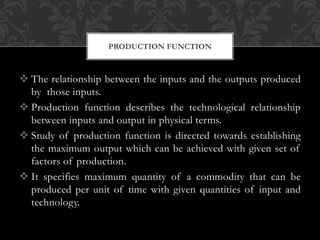
 The relationship between the inputs and the outputs produced 
by those inputs. 
 Production function describes the technological relationship 
between inputs and output in physical terms. 
 Study of production function is directed towards establishing 
the maximum output which can be achieved with given set of 
factors of production. 
 It specifies maximum quantity of a commodity that can be 
produced per unit of time with given quantities of input and 
technology.
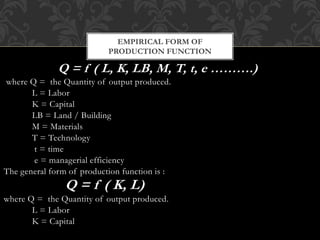
Q = f ( L, K, LB, M, T, t, e ……….) 
where Q = the Quantity of output produced. 
L = Labor 
K = Capital 
LB = Land / Building 
M = Materials 
T = Technology 
t = time 
e = managerial efficiency 
The general form of production function is : 
Q = f ( K, L) 
where Q = the Quantity of output produced. 
L = Labor 
K = Capital 
EMPIRICAL FORM OF 
PRODUCTION FUNCTION
ASSUMPTIONS 
 The factors of production are divisible into viable units. 
 Limited substitution of one factor to other. 
 Constant technology; and 
 Inelastic supply of fixed factors in short run.
IMPORTANT CONCEPTS 
Short run and long run : The reference to time period 
involved in production process is an important concept used in 
production analysis. 
Short run refers to a period of time in which the supply of 
certain inputs is fixed or is inelastic. In short run supply of capital 
is fixed therefore in short run the firm can increase its production 
by increasing only labor. Q = f (L) 
The long run refers to a period of time in which the supply of 
all inputs is elastic, but not enough to permit a change in 
technology. In long run both capital and labor are included. 
Q = f (K, L)
THERE ARE THREE IMPORTANT WAYS TO MEASURE THE 
PRODUCTIVITY OF LABOR 
Total product (TP) 
Average product (AP) 
Marginal product (MP) 
9 / 1 8 / 2 0 1 4 
6
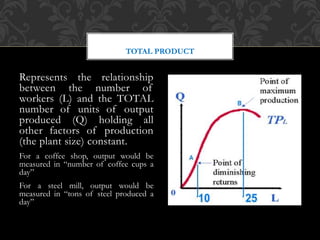
TOTAL PRODUCT FUNCTION 
(TOTAL PRODUCT) 
Represents the relationship 
between the number of 
workers (L) and the TOTAL 
number of units of output 
produced (Q) holding all 
other factors of production 
(the plant size) constant. 
For a coffee shop, output would be 
measured in “number of coffee cups a 
day” 
For a steel mill, output would be 
measured in “tons of steel produced a 
day”
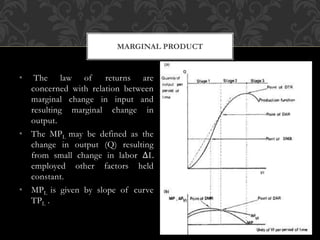
• The law of returns are 
concerned with relation between 
marginal change in input and 
resulting marginal change in 
output. 
• The MPL may be defined as the 
change in output (Q) resulting 
from small change in labor ΔL 
employed other factors held 
constant. 
• MPL is given by slope of curve 
TPL . 
MARGINAL PRODUCT
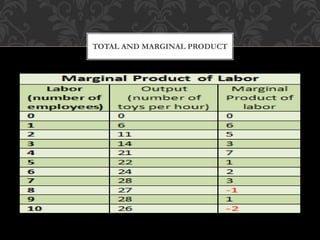
TOTAL AND MARGINAL PRODUCT
LAWS OF PRODUCTION 
Production Function with one variable input : The 
law of variable proportions 
Production function with two variable input : The 
law of returns to scale
PRODUCTION FUNCTION WITH ONE 
VARIABLE INPUT. 
In the short run, production function is explained with one variable 
factor and other factors of productions are held constant. We have 
called this production function as the Law of Variable Proportions or 
the Law of Diminishing returns.

Production function

  • 1.
    BUSINESS ECONOMICS UNITII PRODUCTION FUNCTION
  • 2.
    PRODUCTION FUNCTION The relationship between the inputs and the outputs produced by those inputs.  Production function describes the technological relationship between inputs and output in physical terms.  Study of production function is directed towards establishing the maximum output which can be achieved with given set of factors of production.  It specifies maximum quantity of a commodity that can be produced per unit of time with given quantities of input and technology.
  • 3.
    Q = f( L, K, LB, M, T, t, e ……….) where Q = the Quantity of output produced. L = Labor K = Capital LB = Land / Building M = Materials T = Technology t = time e = managerial efficiency The general form of production function is : Q = f ( K, L) where Q = the Quantity of output produced. L = Labor K = Capital EMPIRICAL FORM OF PRODUCTION FUNCTION
  • 4.
    ASSUMPTIONS  Thefactors of production are divisible into viable units.  Limited substitution of one factor to other.  Constant technology; and  Inelastic supply of fixed factors in short run.
  • 5.
    IMPORTANT CONCEPTS Shortrun and long run : The reference to time period involved in production process is an important concept used in production analysis. Short run refers to a period of time in which the supply of certain inputs is fixed or is inelastic. In short run supply of capital is fixed therefore in short run the firm can increase its production by increasing only labor. Q = f (L) The long run refers to a period of time in which the supply of all inputs is elastic, but not enough to permit a change in technology. In long run both capital and labor are included. Q = f (K, L)
  • 6.
    THERE ARE THREEIMPORTANT WAYS TO MEASURE THE PRODUCTIVITY OF LABOR Total product (TP) Average product (AP) Marginal product (MP) 9 / 1 8 / 2 0 1 4 6
  • 7.
    TOTAL PRODUCT FUNCTION (TOTAL PRODUCT) Represents the relationship between the number of workers (L) and the TOTAL number of units of output produced (Q) holding all other factors of production (the plant size) constant. For a coffee shop, output would be measured in “number of coffee cups a day” For a steel mill, output would be measured in “tons of steel produced a day”
  • 8.
    • The lawof returns are concerned with relation between marginal change in input and resulting marginal change in output. • The MPL may be defined as the change in output (Q) resulting from small change in labor ΔL employed other factors held constant. • MPL is given by slope of curve TPL . MARGINAL PRODUCT
  • 9.
  • 10.
    LAWS OF PRODUCTION Production Function with one variable input : The law of variable proportions Production function with two variable input : The law of returns to scale
  • 11.
    PRODUCTION FUNCTION WITHONE VARIABLE INPUT. In the short run, production function is explained with one variable factor and other factors of productions are held constant. We have called this production function as the Law of Variable Proportions or the Law of Diminishing returns.