According to the Parkinson:
“Production is the organized activity of transformation
resources into finished products in the form of goods and
services”.
Mechanical or chemical steps used to create an object, usually
repeated to create multiple units of the same item. Generally
involves the use of raw materials, machinery and manpower to
create a product.
Production function expresses a functional or technical
relationship between physical inputs and physical outputs
of a firm at any particular time period.
The output is thus a function of inputs
The factors used for production are called “inputs”.
The production we get is called “output”
Definition for Production function:
“The production function is the name given to the
relationship between the rates of productive services and
the rates of output of the product.”
------ Stigler
Definition for Production function:
“Production function is that function which defines the
maximum amount of output that can be produced with a
given set of inputs”.
--- Michael R Baye.
It can be expressed in an allegorical equation:
Where
Q stands for the quantity of output
a, b, c, d…..n are the various inputs.
Production function has to be expressed in a precise
mathematical equation i.e.
It is showing the there is constant relationship
between application of input (x) and the amount of
output(Y).
 )...........,,,( ndcbaQ
bxaY 
Production function is invented by Jnut Wicksell and first tested
by C.W. Cobb and P.H. Douglas in 1928.
This famous statistical production function is known as Cobb-
Dougles production function.
American manufacturing industry.
Cobb-Dougles production function takes the following
mathematical form
Where,
Y= Output
K= Capital
L= Labour
A, α = Positive Constant
)( 1  
 LKAY
Assumptions:
It assumes that output is the function of two factors,
i.e. capital and labour
There are constant returns to scale
All inputs are homogenous
There is perfect competition
There is no change in technology
Criticism:
Cobb-Douglas production function is criticized because it shows
constant returns to scale. But constant returns to scale are not actuality.
Industry is either subject to increasing returns or diminishing returns.
No entrepreneur will like to increase the inputs in order to have
constant returns only. His aim will be to get increasing returns and not
constant returns
PRODUCTION FUNCTION
SHORT RUN
ONE
VARIABLE
TWO
VARIABLE
LONGRUN
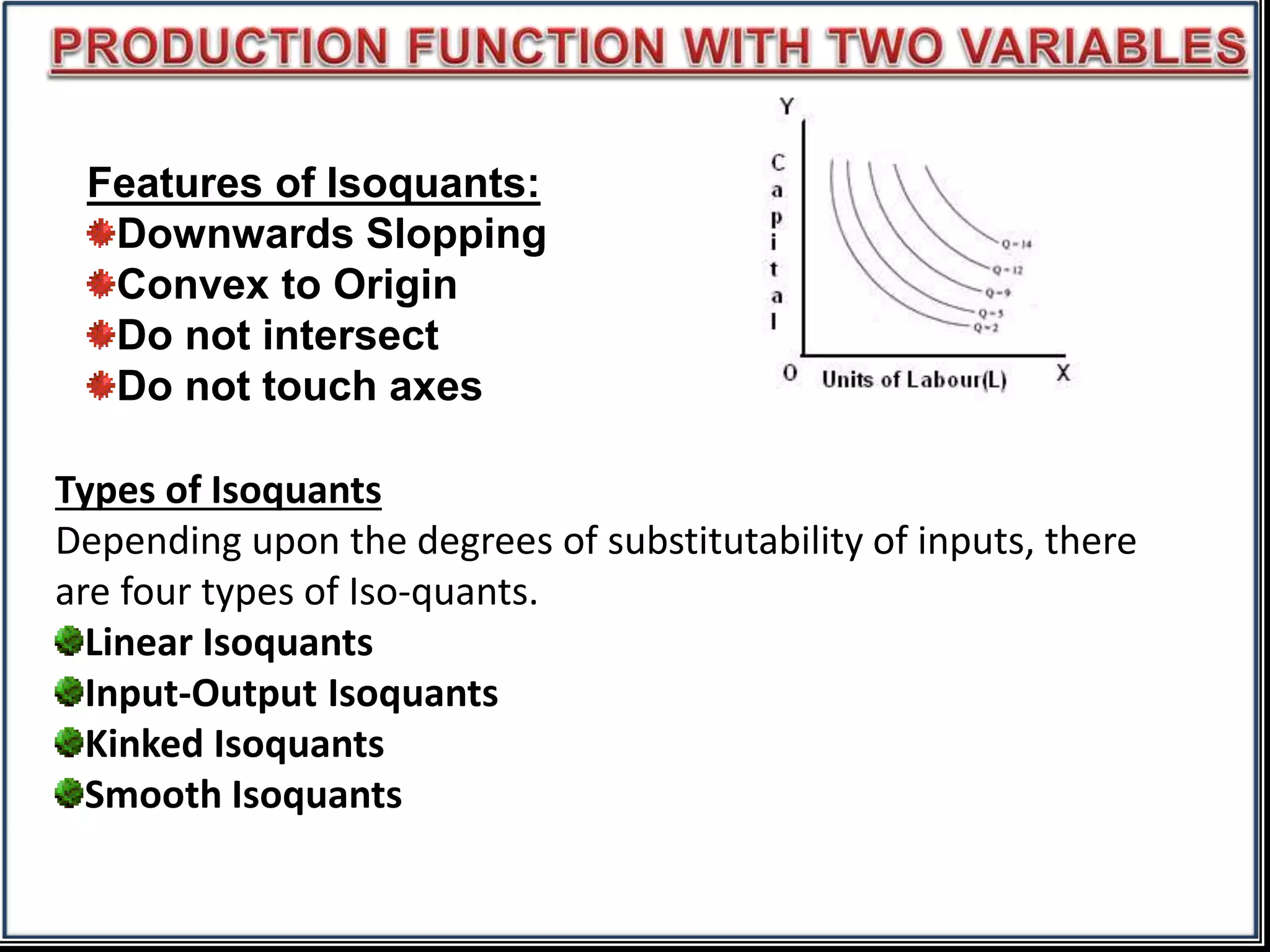
“Iso” means equal
“Quants” means quantity.
It means the quantities throughout a given iso quant
are equal. Isoquants are also called iso product curves.
 ),( KLQ
This function has three variables
Q= output of commodity,
L= Labour and
K=Capital.
Q=2 Q=5 Q=9 Q=12 Q=14
K L K L K L K L K L
1 20 2 20 3 20 4 20 5 20
2 12 3 12 4 12 5 12 6 12
3 8 4 8 5 8 6 8 7 8
4 6 5 6 6 6 7 6 8 6
5 4 6 4 7 4 8 4 9 4
6 3 7 3 8 3 9 3 10 3
Features of Isoquants:
Downwards Slopping
Convex to Origin
Do not intersect
Do not touch axes
Types of Isoquants
Depending upon the degrees of substitutability of inputs, there
are four types of Iso-quants.
Linear Isoquants
Input-Output Isoquants
Kinked Isoquants
Smooth Isoquants
Linear Isoquants:
It represents perfect substitutability
of factors of production.
Input-Output Isoquants
zero substitutability
Kinked Isoquants
If the factors of production show
limited substitutability
Smooth Isoquants
continuous substitutability of
factors of production
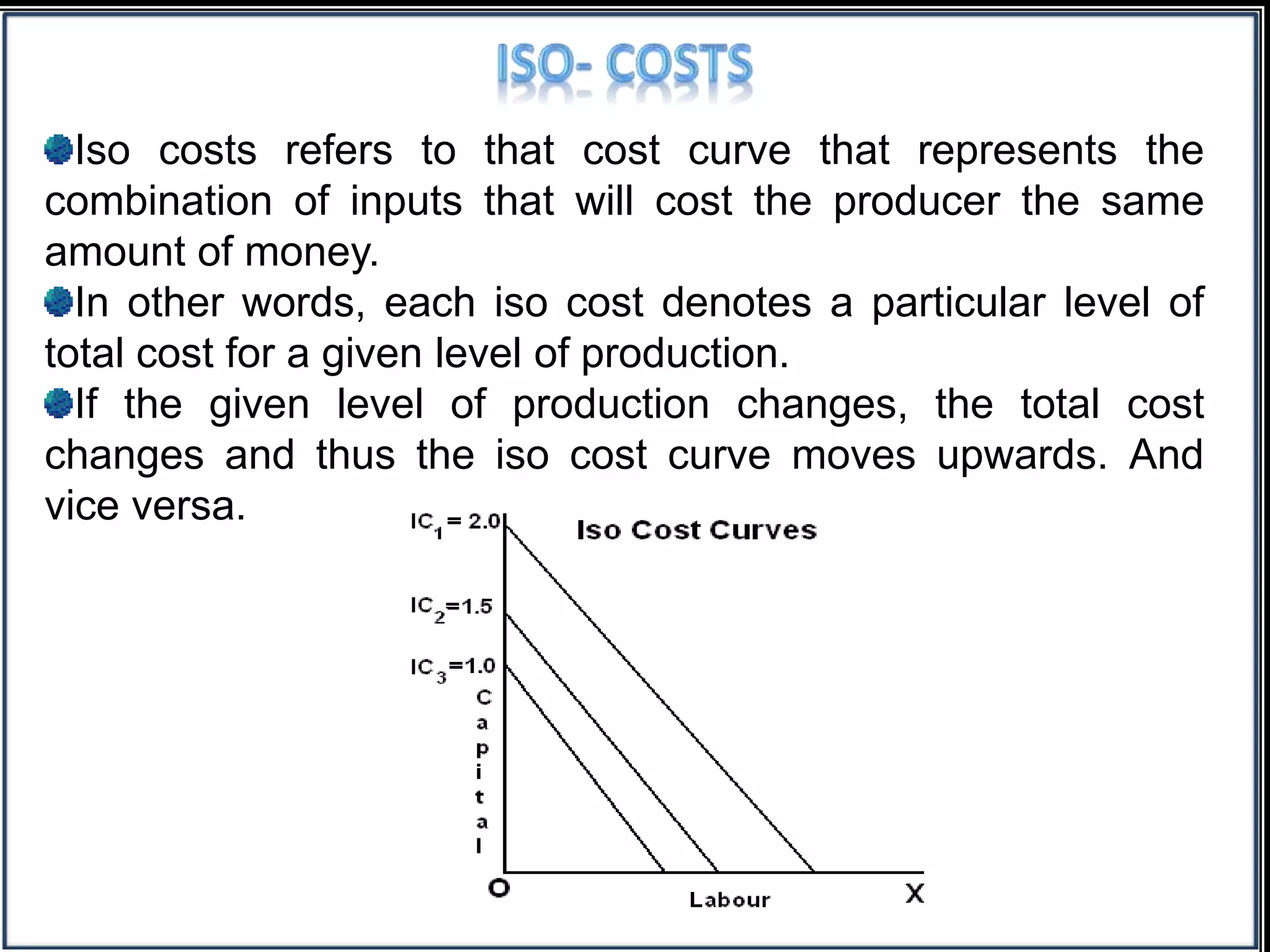
Iso costs refers to that cost curve that represents the
combination of inputs that will cost the producer the same
amount of money.
In other words, each iso cost denotes a particular level of
total cost for a given level of production.
If the given level of production changes, the total cost
changes and thus the iso cost curve moves upwards. And
vice versa.
The marginal rate of technical substitution refers to the
rate at which one input factor is substituted with other
to attain a given level of output
Combina
tions
Inputs Units
MRTS
K L
A 1 20 -
B 2 15 5:1
C 3 11 4:1
D 4 8 3:1
E 5 6 2:1
F 6 5 1:1
The iso costs curve indicates the alternative combinations
of various factors of production which can produce a given
output. Of these, an entrepreneur would like to choose the
combination of input factors, which costs him the least
Combi
nations
Inputs Units Cost
Rs.K(Rs.9) L (Rs.9)
1 3 20 3*9 + 20*6=147
2 4 13 4*9 + 13*6=105
3 5 10 5*9 + 10*6=105
4 6 8 6*9 + 8*6=102
5 7 6 7*9 + 6 * 6=99
6 8 5 8*9 + 5* 6=102
PRODUCTION FUNCTION
SHORT RUN
ONE
VARIABLE
TWO
VARIABLE
LONGRUN
Law of variable proportion/ Law of diminishing
returns/ law of returns
The law of variable proportion explains the input- output relation,
the change in output due to addition of one variable input.
This is a short run phenomenon.
The short run is a period in which at least one input is fixed.
Thus in the short-run, the increase in production is possible only
by increasing the variable inputs
The law also brings diminishing tendency in production is also
known as the law of diminishing returns
Law of variable proportion/ Law of diminishing
returns/ law of returns
Labour TP AP MP Stages
0 0 0 0 Stage
I1 10 10 10
2 22 11 12
3 33 11 11 Stage
II4 40 10 7
5 45 9 5
6 48 8 3
7 48 6.85 0 Stage
III8 45 5.62 –3
Law of variable proportion/ Law of diminishing
returns/ law of returns
Labour TP AP MP Stages
0 0 0 0 Stage
I1 10 10 10
2 22 11 12
3 33 11 11 Stage
II4 40 10 7
5 45 9 5
6 48 8 3
7 48 6.85 0 Stage
III8 45 5.62 –3
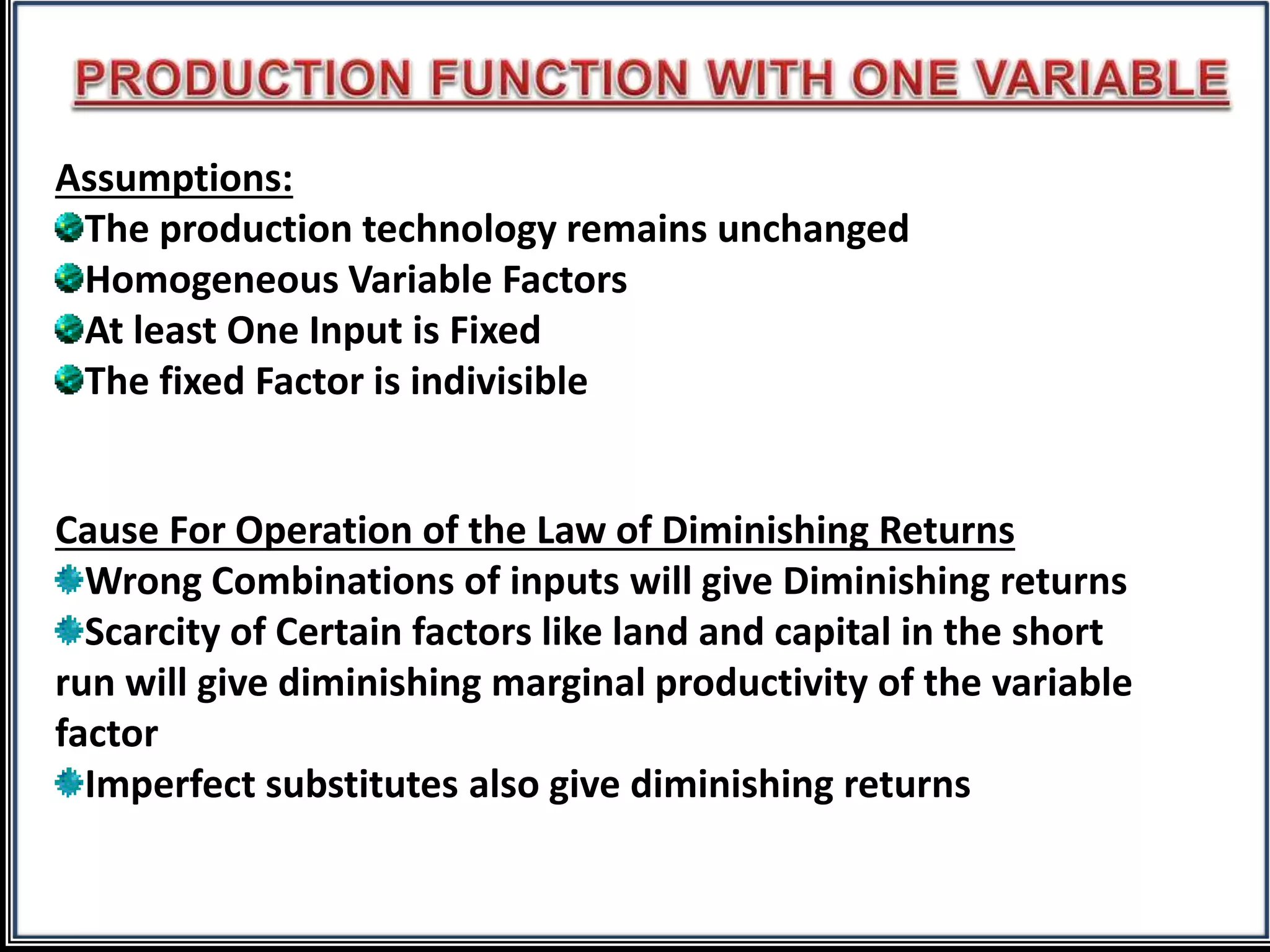
Assumptions:
The production technology remains unchanged
Homogeneous Variable Factors
At least One Input is Fixed
The fixed Factor is indivisible
Cause For Operation of the Law of Diminishing Returns
Wrong Combinations of inputs will give Diminishing returns
Scarcity of Certain factors like land and capital in the short
run will give diminishing marginal productivity of the variable
factor
Imperfect substitutes also give diminishing returns

Managerial Economics Production Analysis ppt by NDP

  • 2.
    According to theParkinson: “Production is the organized activity of transformation resources into finished products in the form of goods and services”. Mechanical or chemical steps used to create an object, usually repeated to create multiple units of the same item. Generally involves the use of raw materials, machinery and manpower to create a product.
  • 4.
    Production function expressesa functional or technical relationship between physical inputs and physical outputs of a firm at any particular time period. The output is thus a function of inputs The factors used for production are called “inputs”. The production we get is called “output” Definition for Production function: “The production function is the name given to the relationship between the rates of productive services and the rates of output of the product.” ------ Stigler
  • 5.
    Definition for Productionfunction: “Production function is that function which defines the maximum amount of output that can be produced with a given set of inputs”. --- Michael R Baye.
  • 6.
    It can beexpressed in an allegorical equation: Where Q stands for the quantity of output a, b, c, d…..n are the various inputs. Production function has to be expressed in a precise mathematical equation i.e. It is showing the there is constant relationship between application of input (x) and the amount of output(Y).  )...........,,,( ndcbaQ bxaY 
  • 9.
    Production function isinvented by Jnut Wicksell and first tested by C.W. Cobb and P.H. Douglas in 1928. This famous statistical production function is known as Cobb- Dougles production function. American manufacturing industry. Cobb-Dougles production function takes the following mathematical form Where, Y= Output K= Capital L= Labour A, α = Positive Constant )( 1    LKAY
  • 10.
    Assumptions: It assumes thatoutput is the function of two factors, i.e. capital and labour There are constant returns to scale All inputs are homogenous There is perfect competition There is no change in technology Criticism: Cobb-Douglas production function is criticized because it shows constant returns to scale. But constant returns to scale are not actuality. Industry is either subject to increasing returns or diminishing returns. No entrepreneur will like to increase the inputs in order to have constant returns only. His aim will be to get increasing returns and not constant returns
  • 11.
  • 12.
    “Iso” means equal “Quants”means quantity. It means the quantities throughout a given iso quant are equal. Isoquants are also called iso product curves.  ),( KLQ This function has three variables Q= output of commodity, L= Labour and K=Capital.
  • 13.
    Q=2 Q=5 Q=9Q=12 Q=14 K L K L K L K L K L 1 20 2 20 3 20 4 20 5 20 2 12 3 12 4 12 5 12 6 12 3 8 4 8 5 8 6 8 7 8 4 6 5 6 6 6 7 6 8 6 5 4 6 4 7 4 8 4 9 4 6 3 7 3 8 3 9 3 10 3
  • 14.
    Features of Isoquants: DownwardsSlopping Convex to Origin Do not intersect Do not touch axes Types of Isoquants Depending upon the degrees of substitutability of inputs, there are four types of Iso-quants. Linear Isoquants Input-Output Isoquants Kinked Isoquants Smooth Isoquants
  • 15.
    Linear Isoquants: It representsperfect substitutability of factors of production. Input-Output Isoquants zero substitutability Kinked Isoquants If the factors of production show limited substitutability Smooth Isoquants continuous substitutability of factors of production
  • 16.
    Iso costs refersto that cost curve that represents the combination of inputs that will cost the producer the same amount of money. In other words, each iso cost denotes a particular level of total cost for a given level of production. If the given level of production changes, the total cost changes and thus the iso cost curve moves upwards. And vice versa.
  • 17.
    The marginal rateof technical substitution refers to the rate at which one input factor is substituted with other to attain a given level of output Combina tions Inputs Units MRTS K L A 1 20 - B 2 15 5:1 C 3 11 4:1 D 4 8 3:1 E 5 6 2:1 F 6 5 1:1
  • 18.
    The iso costscurve indicates the alternative combinations of various factors of production which can produce a given output. Of these, an entrepreneur would like to choose the combination of input factors, which costs him the least Combi nations Inputs Units Cost Rs.K(Rs.9) L (Rs.9) 1 3 20 3*9 + 20*6=147 2 4 13 4*9 + 13*6=105 3 5 10 5*9 + 10*6=105 4 6 8 6*9 + 8*6=102 5 7 6 7*9 + 6 * 6=99 6 8 5 8*9 + 5* 6=102
  • 19.
  • 20.
    Law of variableproportion/ Law of diminishing returns/ law of returns The law of variable proportion explains the input- output relation, the change in output due to addition of one variable input. This is a short run phenomenon. The short run is a period in which at least one input is fixed. Thus in the short-run, the increase in production is possible only by increasing the variable inputs The law also brings diminishing tendency in production is also known as the law of diminishing returns
  • 21.
    Law of variableproportion/ Law of diminishing returns/ law of returns Labour TP AP MP Stages 0 0 0 0 Stage I1 10 10 10 2 22 11 12 3 33 11 11 Stage II4 40 10 7 5 45 9 5 6 48 8 3 7 48 6.85 0 Stage III8 45 5.62 –3
  • 22.
    Law of variableproportion/ Law of diminishing returns/ law of returns Labour TP AP MP Stages 0 0 0 0 Stage I1 10 10 10 2 22 11 12 3 33 11 11 Stage II4 40 10 7 5 45 9 5 6 48 8 3 7 48 6.85 0 Stage III8 45 5.62 –3
  • 23.
    Assumptions: The production technologyremains unchanged Homogeneous Variable Factors At least One Input is Fixed The fixed Factor is indivisible Cause For Operation of the Law of Diminishing Returns Wrong Combinations of inputs will give Diminishing returns Scarcity of Certain factors like land and capital in the short run will give diminishing marginal productivity of the variable factor Imperfect substitutes also give diminishing returns