1
Objectives
•After successful completion of this unit, you will be able
to
•Define production and production function
•Differentiate short run and long run, and fixed and
variable inputs
•Know the concepts of short run production and
efficiency
•Know the concepts of long run production, laws of
returns to scale and how to determine least cost
production process.
THE THEORY OF PRODUCTION
Introduction: Definition and basic concepts
 production means creation of utility for sales.
 production may be defined as the act of
creating those goods/services which have
exchange value for sale (not for personal
consumption).
 Raw materials yield less satisfaction to the
consumer by themselves.
 In order to get utility from raw materials, first
they must be transformed into output.
2
Introduction: Definition and basic concepts
 However, transforming raw materials into
final products require factor inputs such as
land, labor, and capital and entrepreneurial
ability.
 Thus, no production (transforming raw
material into output) can take place without
the use of inputs.
3
Fixed Vs. variable inputs
In economics, inputs can be classified as fixed & variable.
Fixed input
An input for which the level of usage cannot readily be
changed.
In economic sense, a fixed input is one whose supply is
inelastic in the short run.
In technical sense, a fixed input is one that remains fixed
(or constant) for certain level of output.
4
THE THEORY OF PRODUCTION
Variable input
A variable input is one whose supply in the short
run is elastic, example, labour, raw materials, and the
like. Users of such inputs can employ a larger quantity
in the short run.
Technically, a variable input is one that changes
with changes in output.
 In the long run, all inputs are variable.
5
Production Function
A production function is purely technical relation
which connects factor inputs & outputs.
It describes the transformation of factor inputs into
outputs at any particular time period.
6
Q = f( L,K,R,Ld,T,t)
where
Q = output R= Raw Material
L= Labour Ld = Land
K= Capital T = Technology
t = time
For our current analysis, let’s reduce the
inputs to two, capital (K) and labor (L):
Q = f(L, K)
Short-Run and Long-Run Production
In economics, short run refers to that period
of time in which the quantity of at least one
input is fixed.
For example, if it requires a firm one year to
change the quantities of all the inputs, those
time periods below one year are considered
as short run.
In the short run some inputs are fixed and some
variable
7
Short-Run production
 Thus, short run is that time period which is not
sufficient to change the quantities of all inputs,
 so that at least one input remains fixed.
 One thing to be noted here is that short run
periods of different firms have different
duration.
 In the short run we can talk about factor
productivity / law of variable proportion/law of
diminishing returns
8
9
long run production
Long run is that time period (planning horizon)
which is sufficient to change the quantities of all
inputs.
Thus there is no fixed input in the long -run.
in the long run we can talk about returns to
scale
The Production Function
 Production in the short run: Production with
one variable input
 Production with one variable input (while the
others are fixed) is obviously a short run
phenomenon because there is no fixed input in
the long run.
10
Assumption of short run production analysis
In order to simplify the analysis of short run
production, the classical economist assumed the
following:
1. Perfect divisibility of inputs and outputs
 This assumption implies that factor inputs and outputs
are so divisible that one can hire, for example a fraction of
labor, a fraction of manager and we can produce a fraction
of output, such as a fraction of automobile.
2. Limited substitution between inputs
Factor inputs can substitute each other up to a certain
point, beyond which they can not substitute each other
11
3. Constant technology
They assumed that level of technology of production is
constant in the short run.
Suppose a firm that uses two inputs: Capital (which is a
fixed input) and labor (which is variable input).
Given the assumptions of short run production, the firm
can increase output only by increasing the amount of labor it
uses.
Hence, its production function is
Q = f (L) K - being constant
Where Q is the quantity of production (Output)
L is the quantity of labor used, which is variable, and
K is the quantity of capital (which is fixed)
12
Total product, marginal product and average product:
Short-Run Analysis
• Total product: is the total amount of output
that can be produced by efficiently utilizing a
specific combination of labor and capital.
• The total product curve, thus, represents
various levels of output that can be obtained
from efficient utilization of various
combinations of the variable input, and the
fixed input.
• It shows the output produced for different
amounts of the variable input, labor.
13
Marginal Product (MP)
 The marginal product of variable input is the
addition to the total product attributable to
the addition of one unit of the variable input
to the production process, other inputs being
constant (fixed).
 Before deciding whether to hire one more
worker, a manager wants to determine how
much this extra worker (L) will increase
output, (q).
14
The Marginal Product of Labor
• The marginal product of labor is the increase in
output obtained by adding 1 unit of labor but
holding constant the inputs of all other factors
Marginal Product of L:
MPL= Q/L (holding K constant)
= Q/L
Average Product of L:
APL= Q/L (holding K constant)
15
Marginal Utility and Marginal Product
In Consumer Theory, marginal utility was the
slope of the total utility curve
In Production Theory, marginal product is the
slope of the total product curve:
16
Law of Diminishing Returns
Law of diminishing marginal utility: marginal
utility (eventually) declines as the quantity
consumed of a single good increases.
Law of diminishing marginal returns states that
marginal products (eventually) decline as the
quantity used of a single input increases.
Generally the first few inputs are highly productive,
but additional units are less productive).
17
Law of Diminishing Returns (Diminishing Marginal
Product)
18
The law of diminishing returns states that
when more and more units of a variable input
are applied to a given quantity of fixed
inputs, the total output may initially increase
at an increasing rate and then at a constant
rate but it will eventually increases at
diminishing rates.
Assumptions. The law of diminishing returns
is based on the following assumptions: (i) the
state of technology is given (ii) labour is
homogenous and (iii) input prices are given.
Short-Run Analysis of Total,
Average, and Marginal Product
• If MP > AP then AP is
rising
• If MP < AP then AP is
falling
• MP = AP when AP is
maximized
• TP maximized when
MP = 0
19
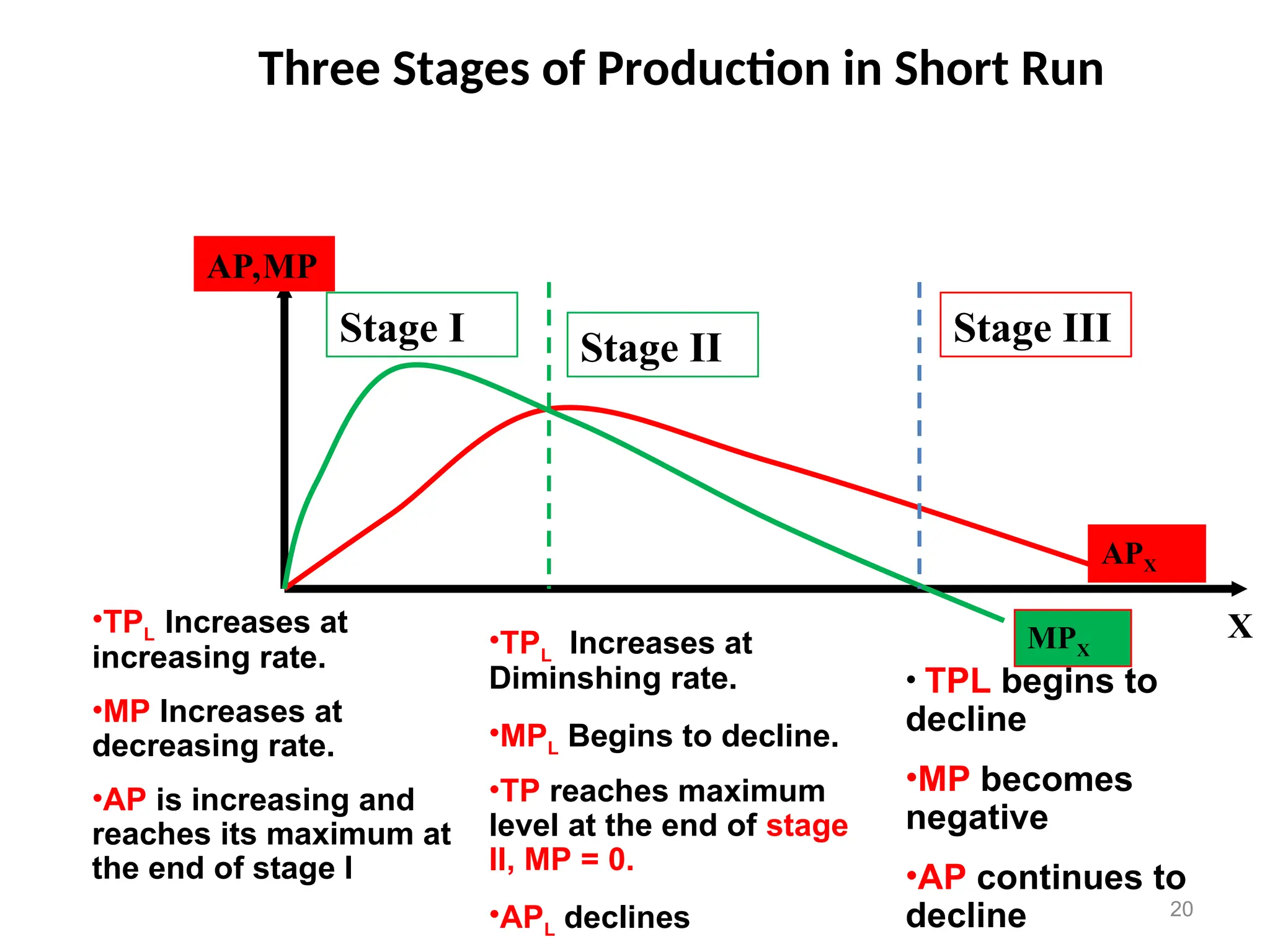
Three Stages of Production in Short Run
20
AP,MP
X
Stage I Stage II Stage III
APX
MPX
•TPL Increases at
increasing rate.
•MP Increases at
decreasing rate.
•AP is increasing and
reaches its maximum at
the end of stage I
•TPL Increases at
Diminshing rate.
•MPL Begins to decline.
•TP reaches maximum
level at the end of stage
II, MP = 0.
•APL declines
• TPL begins to
decline
•MP becomes
negative
•AP continues to
decline
Application of Law of Diminishing Returns:
• It helps in identifying the rational and irrational
stages of operations.
• It gives answers to question –
How much to produce?
What number of workers to apply to a given
fixed inputs so that the output is maximum?
21
Production in the Long-Run
All inputs are now considered to be variable
(both L and K in our case)
How to determine the optimal combination of
inputs?
 To illustrate this case we will use production
isoquants.
 An isoquant is a locus of all technically efficient
methods or all possible combinations of inputs for
22
Properties of Isoquants
Isoquants have a negative slope.
Isoquants are convex to the origin.
Isoquants cannot intersect or be tangent to each
other.
Upper Isoquants represents higher level of
output
23
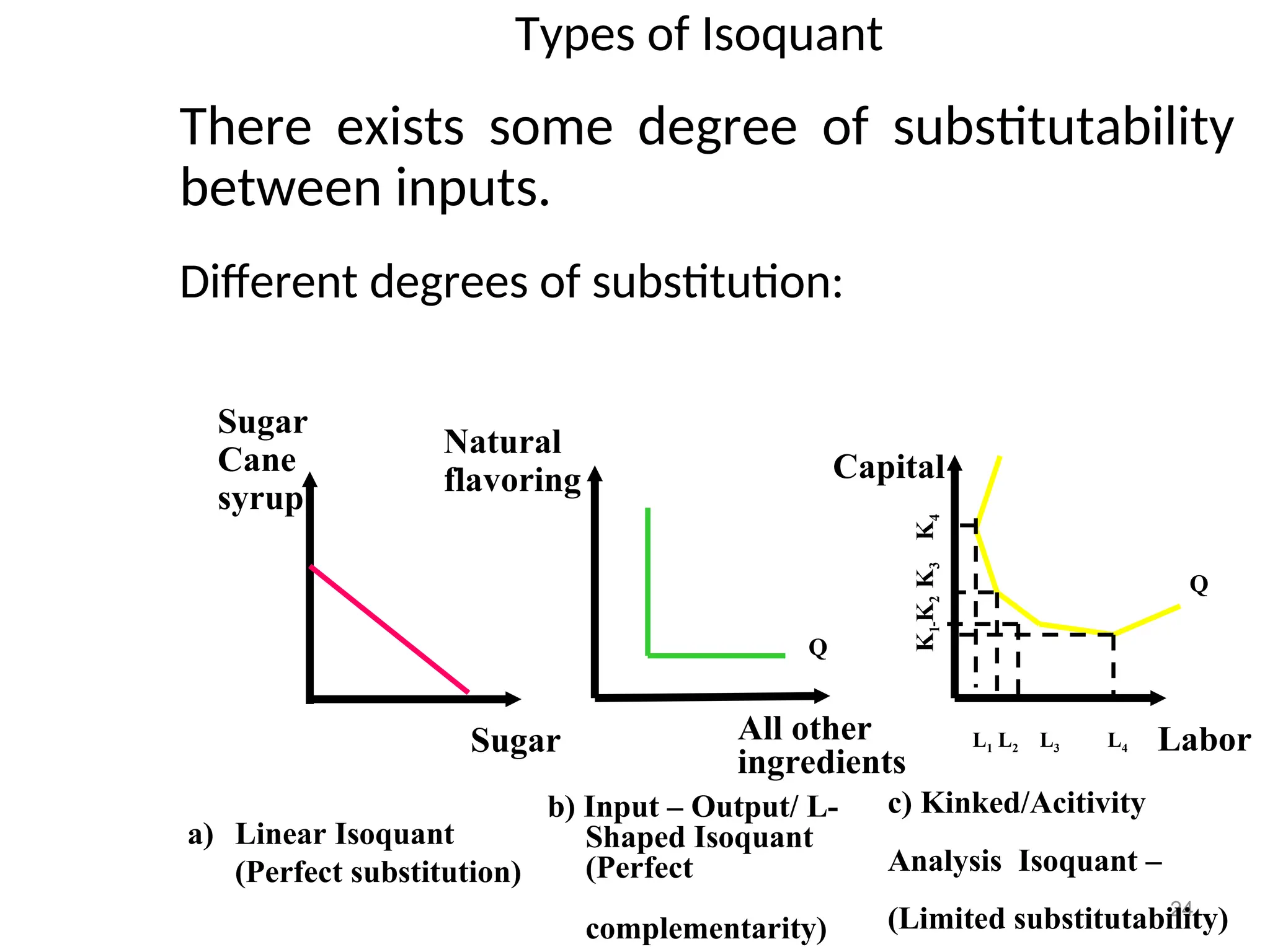
Types of Isoquant
There exists some degree of substitutability
between inputs.
Different degrees of substitution:
24
Sugar
a) Linear Isoquant
(Perfect substitution)
b) Input – Output/ L-
Shaped Isoquant
(Perfect
complementarity)
All other
ingredients
Natural
flavoring
Q
Q
Capital
Labor
L1 L2 L3 L4
K
1
K
2
K
3
K
4
Sugar
Cane
syrup
c) Kinked/Acitivity
Analysis Isoquant –
(Limited substitutability)
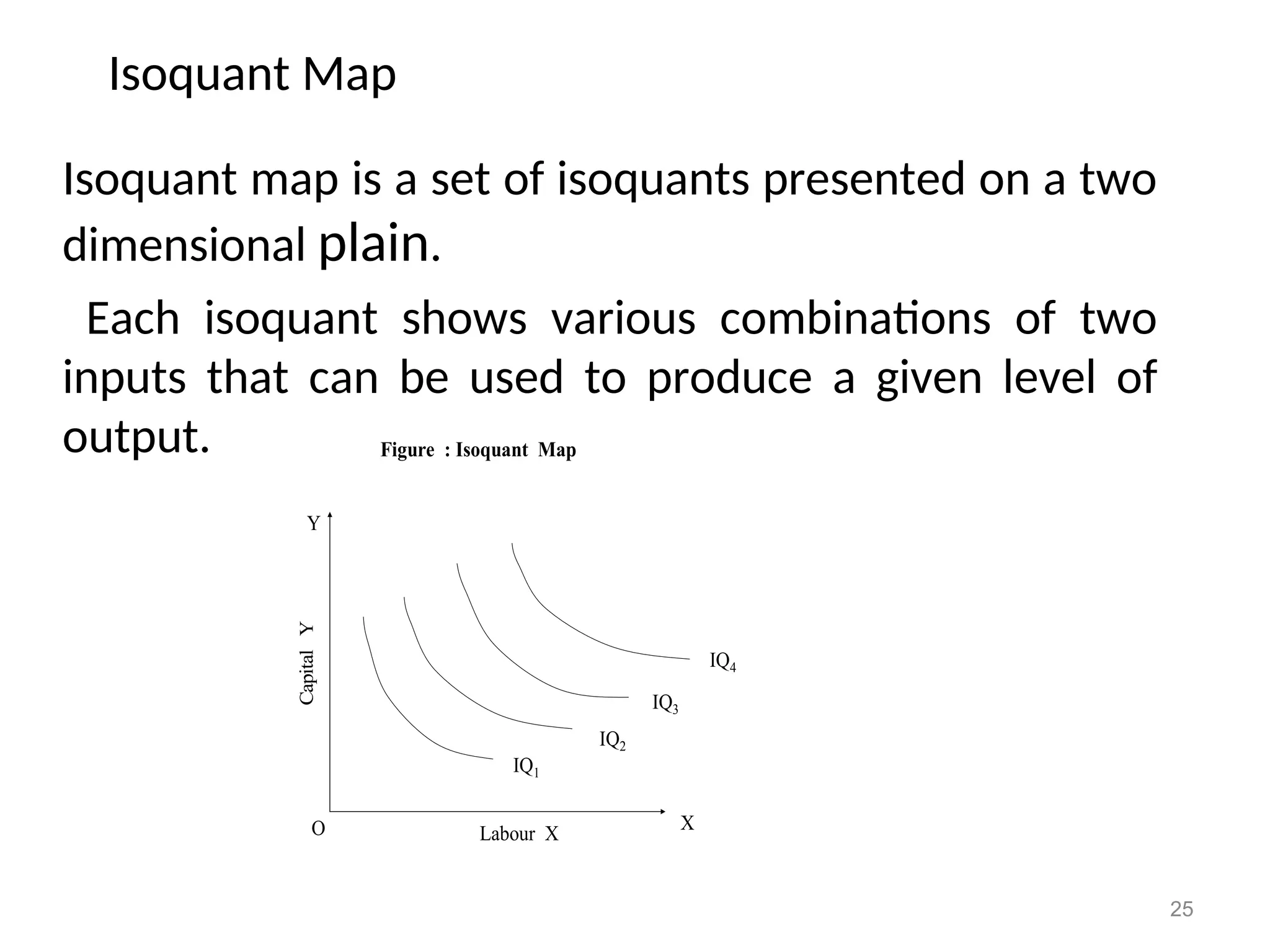
Isoquant Map
Isoquant map is a set of isoquants presented on a two
dimensional plain.
Each isoquant shows various combinations of two
inputs that can be used to produce a given level of
output.
25
Figure : Isoquant Map
Labour X
Capital
Y
Y
O X
IQ4
IQ3
IQ2
IQ1
Marginal rate of technical substitution
(labor for capital): measures the
amount of K the firm the firm could give
up in exchange for an additional L, in
order to just be able to produce the same
output as before.
26
The marginal rate of technical substitution
The marginal rate of technical substitution,
MRTSL,K tells us:
The amount capital can be decreased for
every increase in labour, holding output
constant OR
The amount capital must be increased for
every decrease in labour, holding output
constant
27
Marginal rate of technical
substitution
-as we move down the isoquant, the slope
decreases, decreasing the MRTSL,K
-this is diminishing marginal rate of technical
substitution
as you focus more on one input, the other input
becomes more productive
Marginal products and the MRTS (MRTS-
Slope of Isoquant)are related:
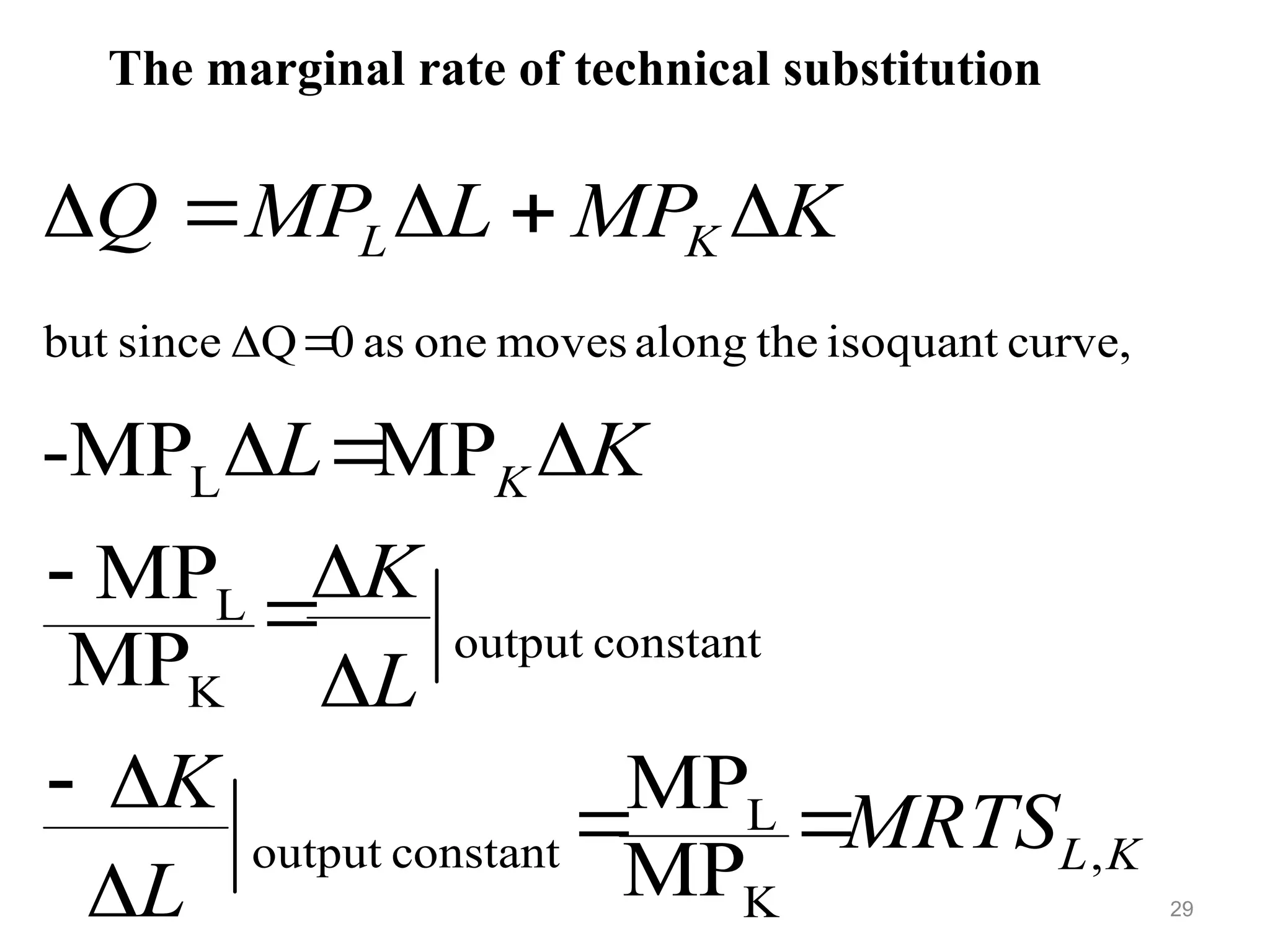
MPL/MPK = -K/L = MRTSL,K
28
The marginal rate of technical substitution
29
K
L
K
K
L
MRTS
L
K
L
K
K
L
K
MP
L
MP
Q
,
K
L
constant
output
constant
output
K
L
L
curve,
isoquant
the
along
moves
one
as
0
Q
since
but
MP
MP
MP
MP
MP
MP
-



















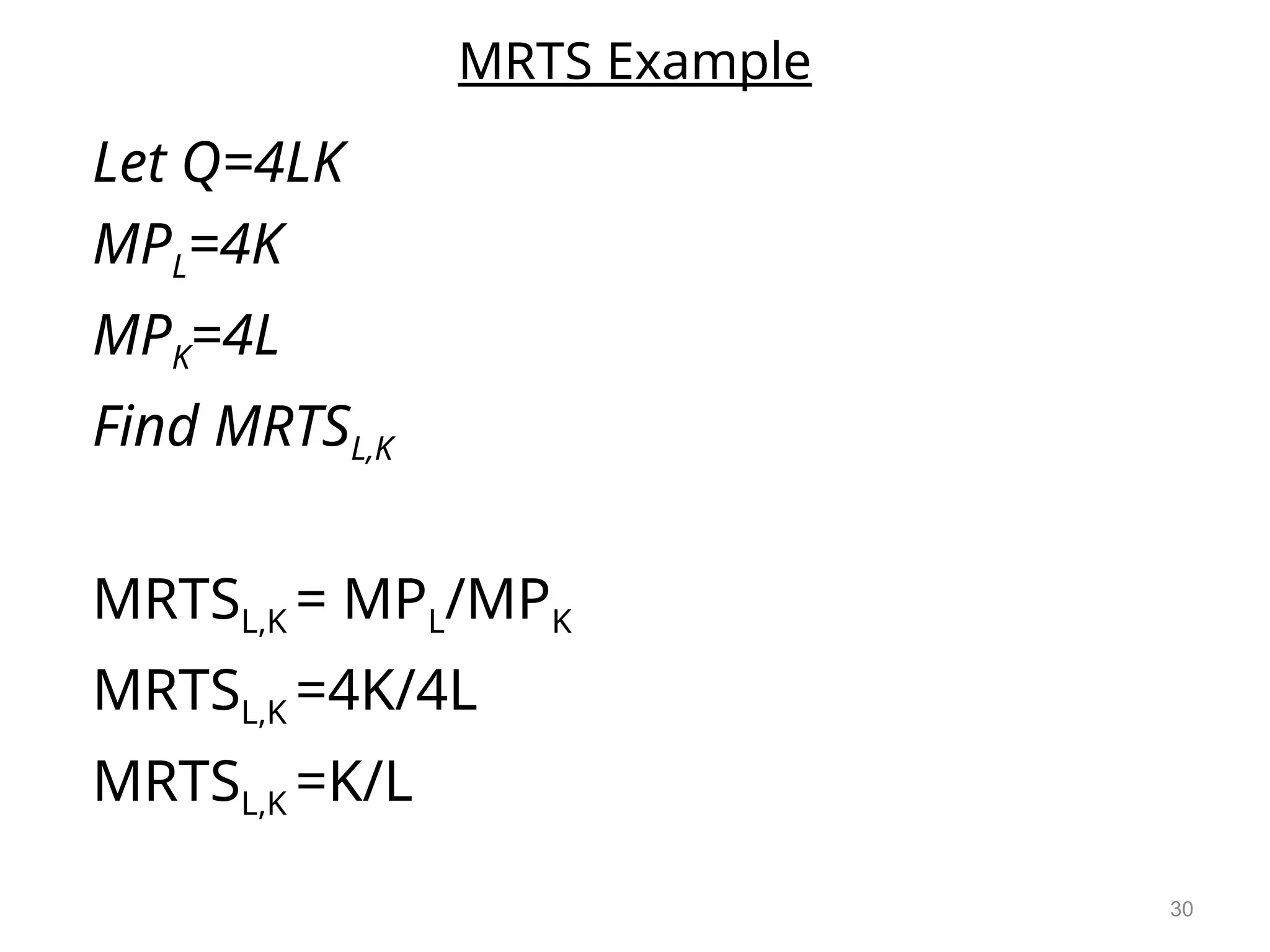
MRTS Example
Let Q=4LK
MPL=4K
MPK=4L
Find MRTSL,K
MRTSL,K = MPL/MPK
MRTSL,K =4K/4L
MRTSL,K =K/L
30
How much will output increase when ALL inputs
increase by a particular amount?
RTS = [%Q] / [%(all inputs)]
1% increase in inputs => more than 1% increase in
output, increasing returns to scale.
1% increase in inputs => 1% increase in output
constant returns to scale.
1% increase in inputs => a less than 1% increase in
output, decreasing returns to scale.
31
Laws of Returns to Scale
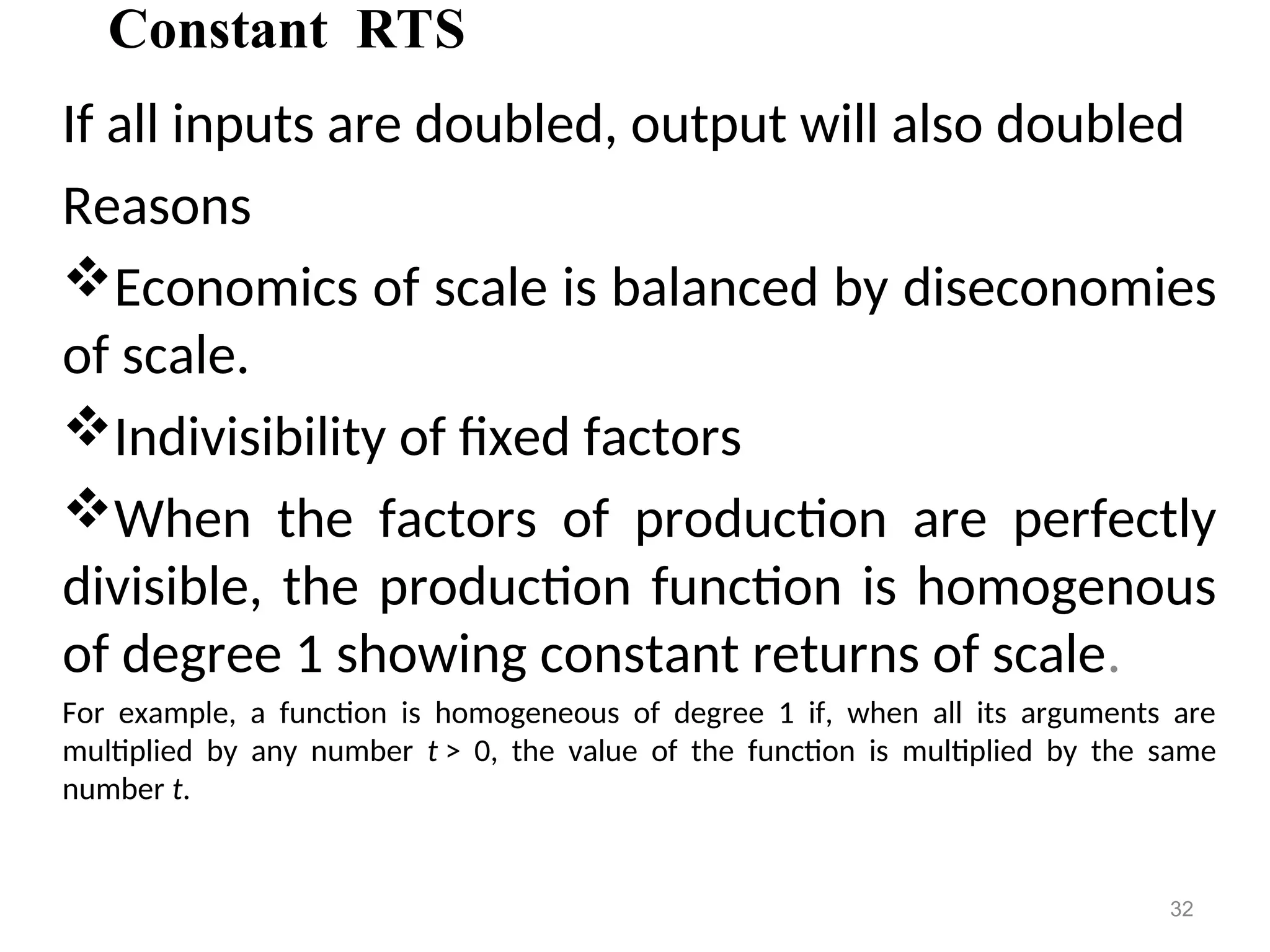
Constant RTS
If all inputs are doubled, output will also doubled
Reasons
Economics of scale is balanced by diseconomies
of scale.
Indivisibility of fixed factors
When the factors of production are perfectly
divisible, the production function is homogenous
of degree 1 showing constant returns of scale.
For example, a function is homogeneous of degree 1 if, when all its arguments are
multiplied by any number t > 0, the value of the function is multiplied by the same
number t.
32
The slope of an isoquant: marginal rate of technical
substitution (MRTS)
 The slope of an isoquant (-K/L) indicates how
the quantity of one input can be traded off
against the quantity of the other, while output is
held constant.
 The absolute value of the slope of an isoquant
is called marginal rate of technical substitution
(MRTS).
 The MRTS shows the amount by which the
quantity of one input can be reduced when one
extra unit of another input is used, so that
output remains constant. 33
 MRTS of labor for capital, denoted as MRTS L, K
shows the amount by which the input of capital
can be reduced when one extra unit of labor is
used, so that output remains constant.
34
Elasticity of substitution
 It represents how easily firms can substitute
capital for labour and expresses the percentage
change in the capital-labour ratio due to a one
percent change in the price ratio of these
inputs.
 A better measure of the ease of factor
substitution is provided by the elasticity of
substitution, δ. The elasticity of substitution is
defined as
35
 The elasticity of substitution is a pure number
independent of the units of measurement of K
and L,
 since the numerator and the denominator are
measured in the same units and be canceled.
36
Factor intensity
 A process of production can be labor intensive
or capital intensive or neutral process.
 A process of production is called labor intensive
if it uses many labors and relatively few capitals.
 If it uses many capitals and relatively few labor
it is called capital intensive technology.
 On the other hand, if the process uses equal
proportion of both it is called neutral
technology.
37
 The factor intensity of any process is measured
by the slope of the line through the origin
representing the particular process.
 Thus, the factor intensity is the capital-labor
ratio.
 The higher the capital-labor ratio is the higher
the capital intensity but the lower the capital-
labor ratio is the higher labor intensity of the
process.
38
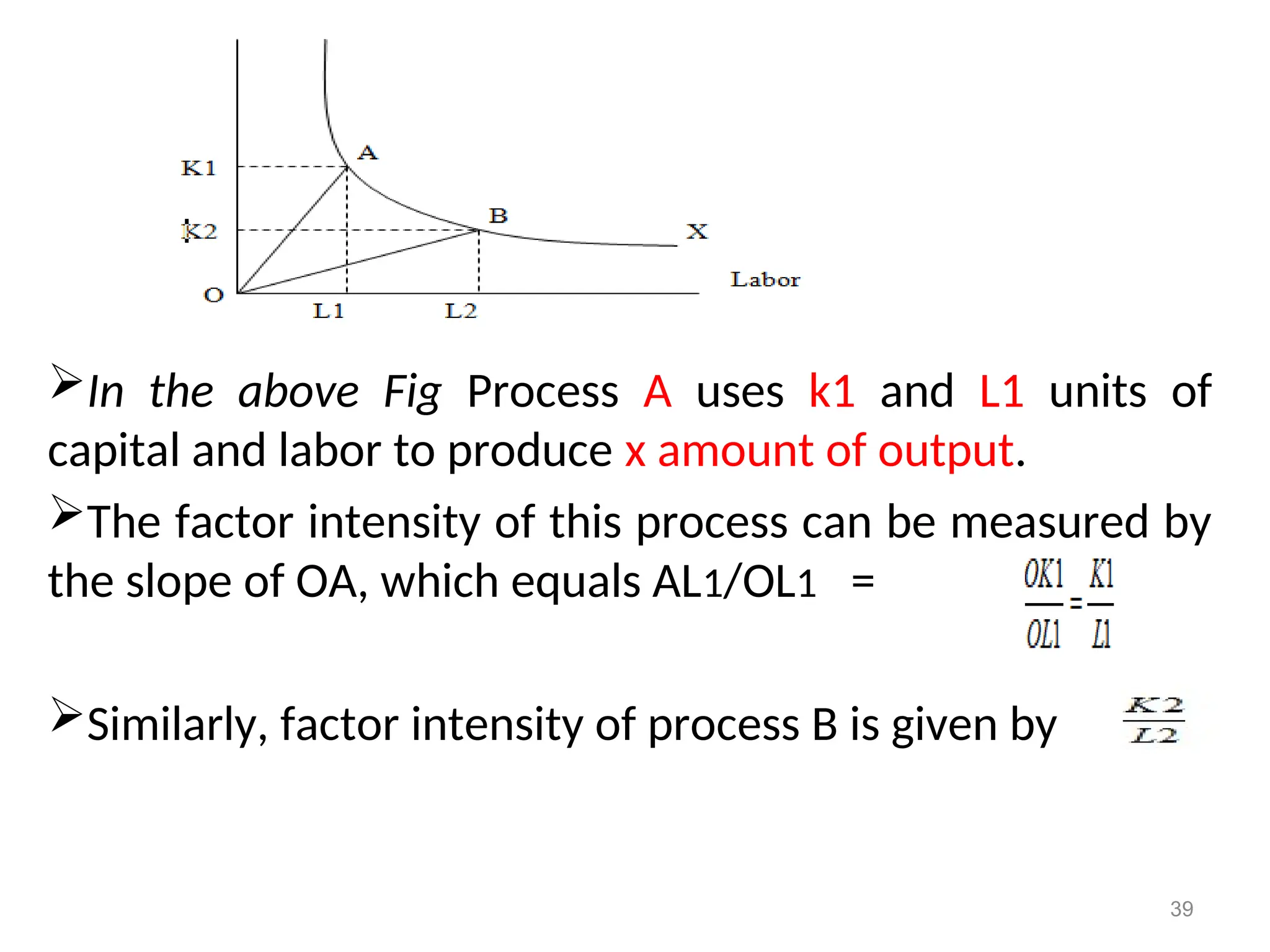
In the above Fig Process A uses k1 and L1 units of
capital and labor to produce x amount of output.
The factor intensity of this process can be measured by
the slope of OA, which equals AL1/OL1 =
Similarly, factor intensity of process B is given by
39
 Since process A is more capital intensive
than process B or B is more labor intensive than
A.
 The upper part of the isoquant includes more
capital intensive processes and the lower part,
labor intensive techniques.
40
The long run law of production: The law of returns
to scale
 In the short run output may be increased by
using more of the variable factor, while capital
(and possibly other factors as well) are kept
constant.
 The expansion of output with one factor (at
least) constant is described by the law of
variable proportion or the law of (eventually)
diminishing returns of the variable factor.
41
 The laws of production describe the technically
possible ways of increasing the level of
production.
 Output may increase in various ways.
 In the long run output can be increased by
changing all factors of production.
 This long run analysis of production is called Law
of returns to scale.
 Now let’s have a deep examination of law of
returns to scale.
42
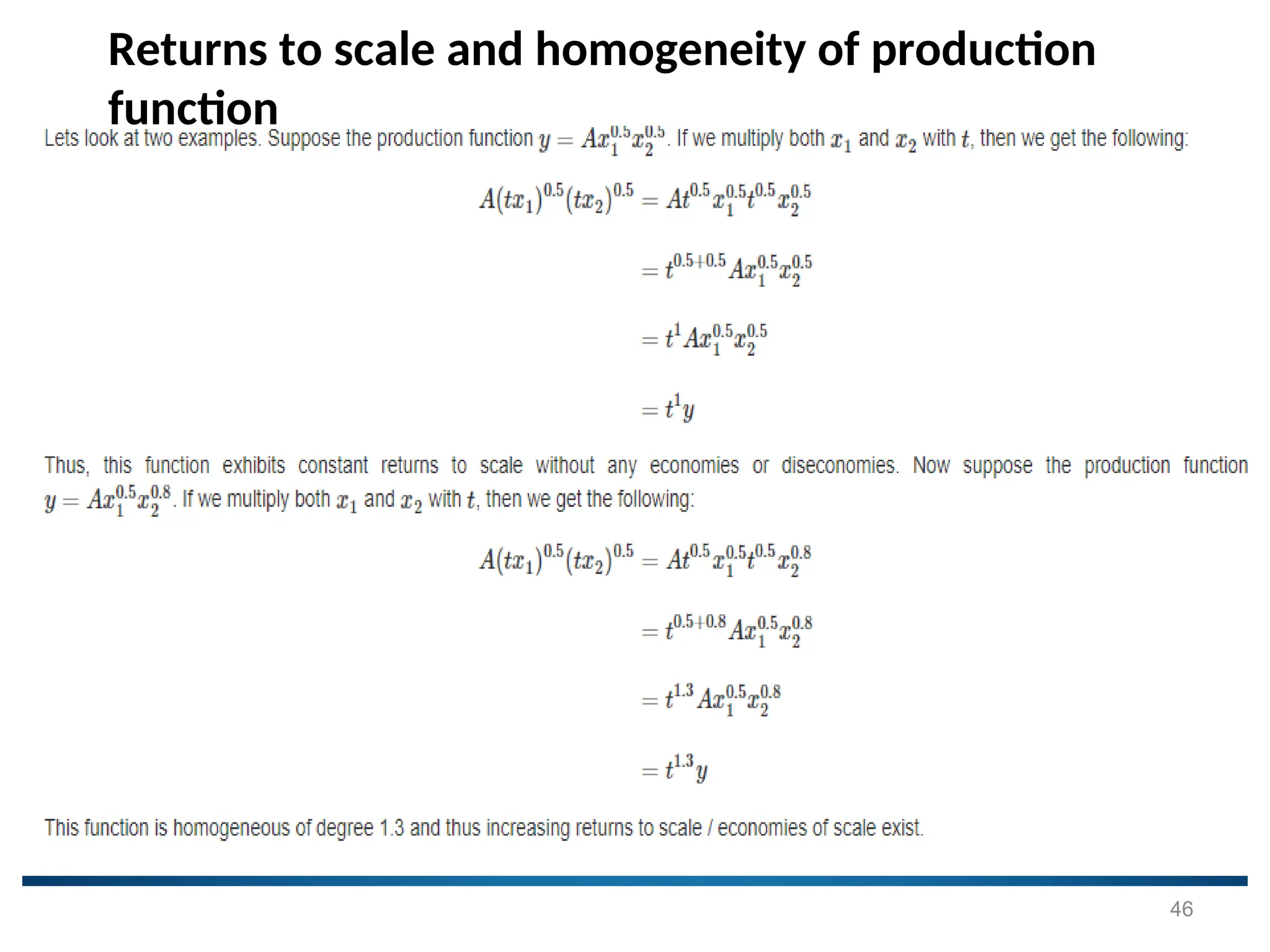
Returns to scale and homogeneity of production
function
 Suppose we increase both factors of the function
 X0=f (L, K) by the same proportion‘t’, and we get the
new level of output X = f (tL, tK)
 If t can be factored out then the new level of output X*
can be expressed as a function of t (to any power V)
and the initial level of output, and the production
function is said to be homogeneous.
X* = t f (LK) or X* = t X0
 If t can not be factored out, the production
function is non-homogeneous.
43
 Thus, a homogeneous function is a function
such that if each of the input is multiplied by t,
then t can be completely factored out of the
function.
 The power V of t is called degree of
homogeneity of the function and is measure of
returns to scale.
44
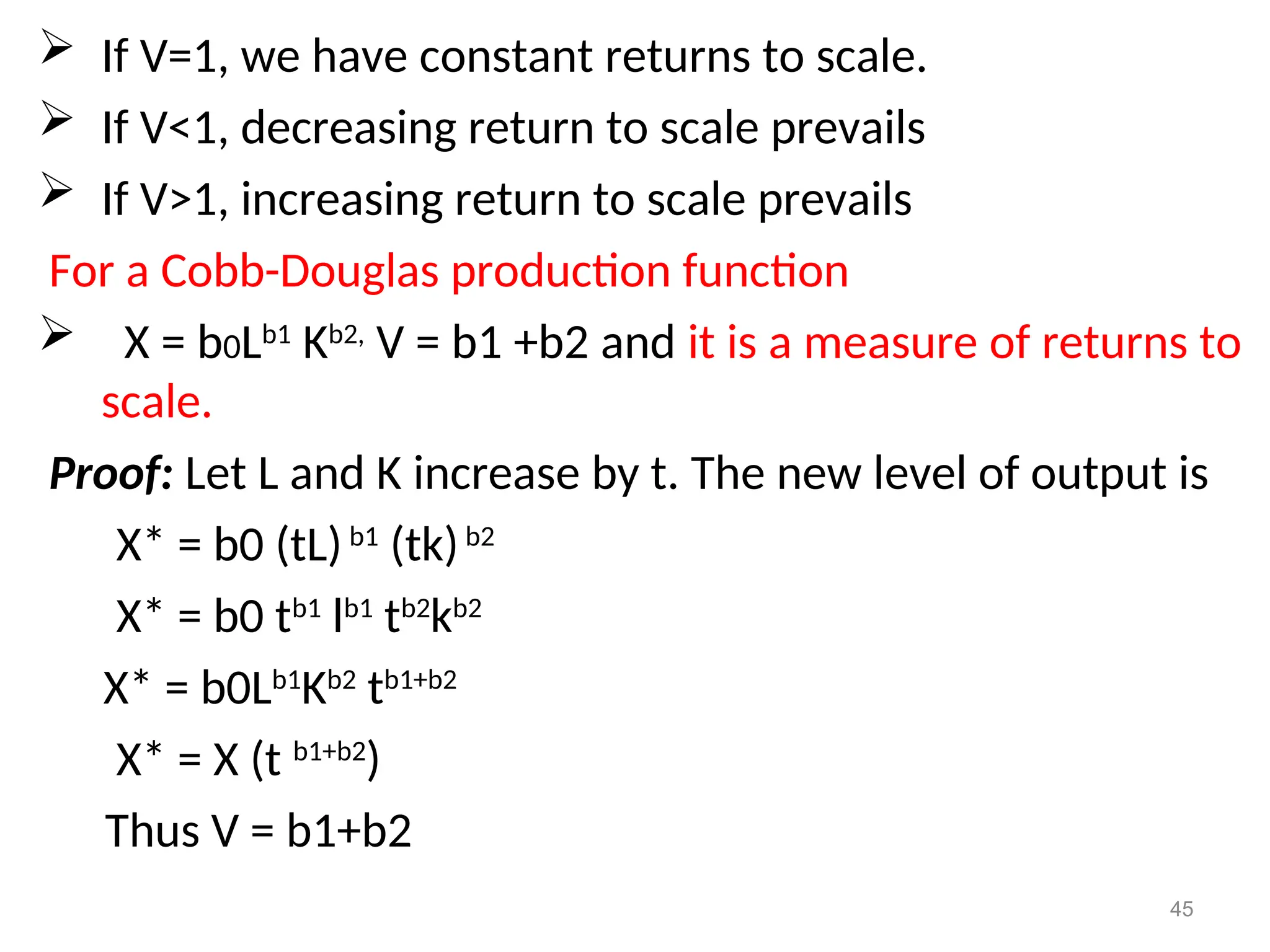
 If V=1, we have constant returns to scale.
 If V<1, decreasing return to scale prevails
 If V>1, increasing return to scale prevails
For a Cobb-Douglas production function
 X = b0Lb1
Kb2,
V = b1 +b2 and it is a measure of returns to
scale.
Proof: Let L and K increase by t. The new level of output is
X* = b0 (tL)b1
(tk)b2
X* = b0 tb1
lb1
tb2
kb2
X* = b0Lb1
Kb2
tb1+b2
X* = X (t b1+b2
)
Thus V = b1+b2
45
Returns to scale and homogeneity of production
function
46
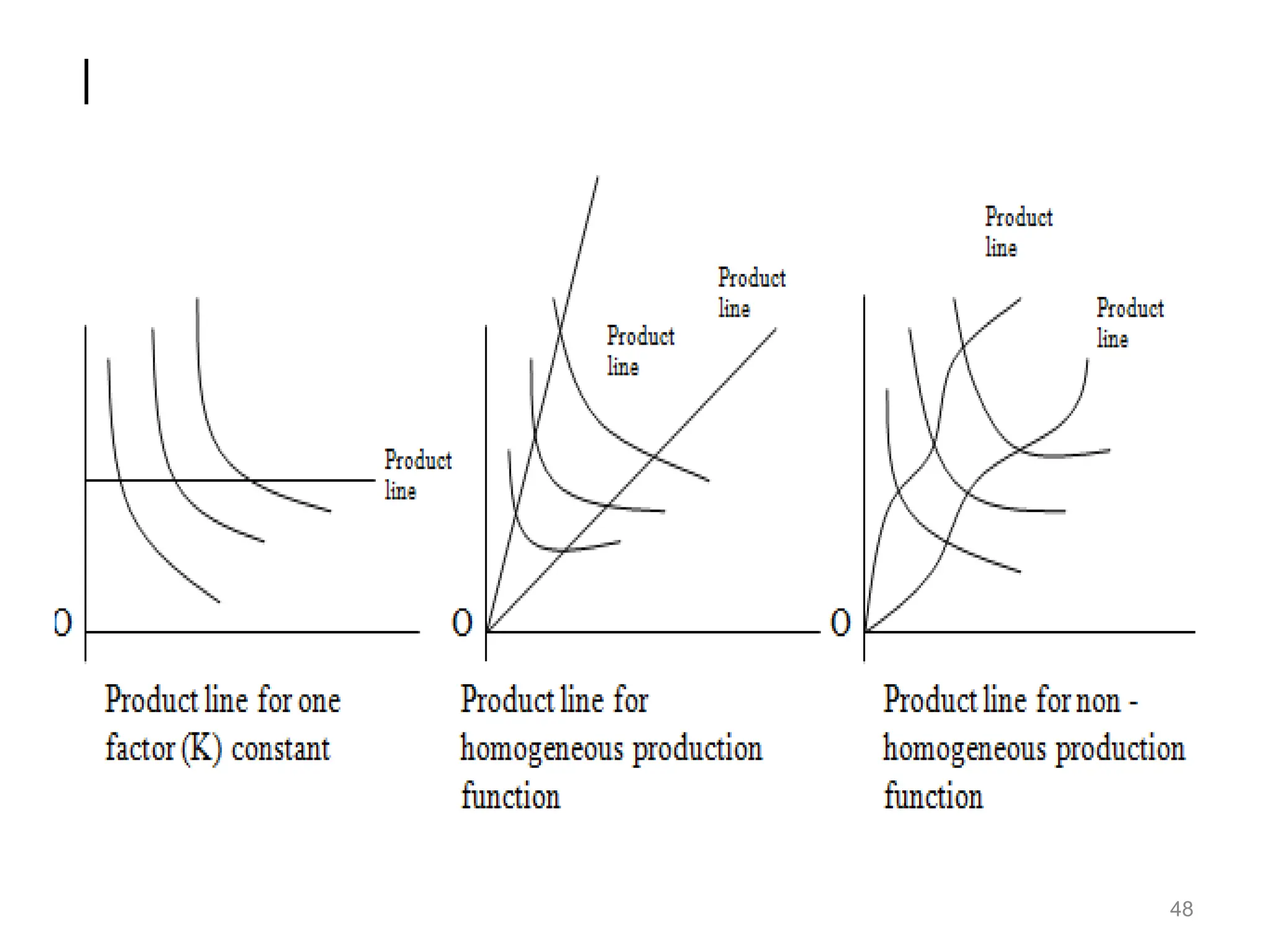
Product Lines
 A product line shows the (physical) movement
from one isoquant to another as we change
the employment of both factors and a single
factor,
 The product line (curve) passes through the
origin if all factors are variable.
 If only one factor is variable (the other being
constant) the product line is a straight line
parallel to the axis of the variable factor.
 For such product lines the K/L ratio diminishes
along the product line
47
48
 A product line along which the MRTS of factors is
constant is called an isocline.
 So an isocline is the locus of points of different
isoquants at which MRTS of factors is constant.
 If the production function is homogeneous the isoclines
are straight lines through the origin.
 Along any one isocline the K/L ratio is also constant (as
is the MRTS of the factors).
 But K/L ratio and the MRTS are different for different
isoclines.
 If the production is non homogeneous the isocline will
not be straight line, but their shape will be twiddle.
 The K/L ratio changes along each isocline and on
different isoclines. 49
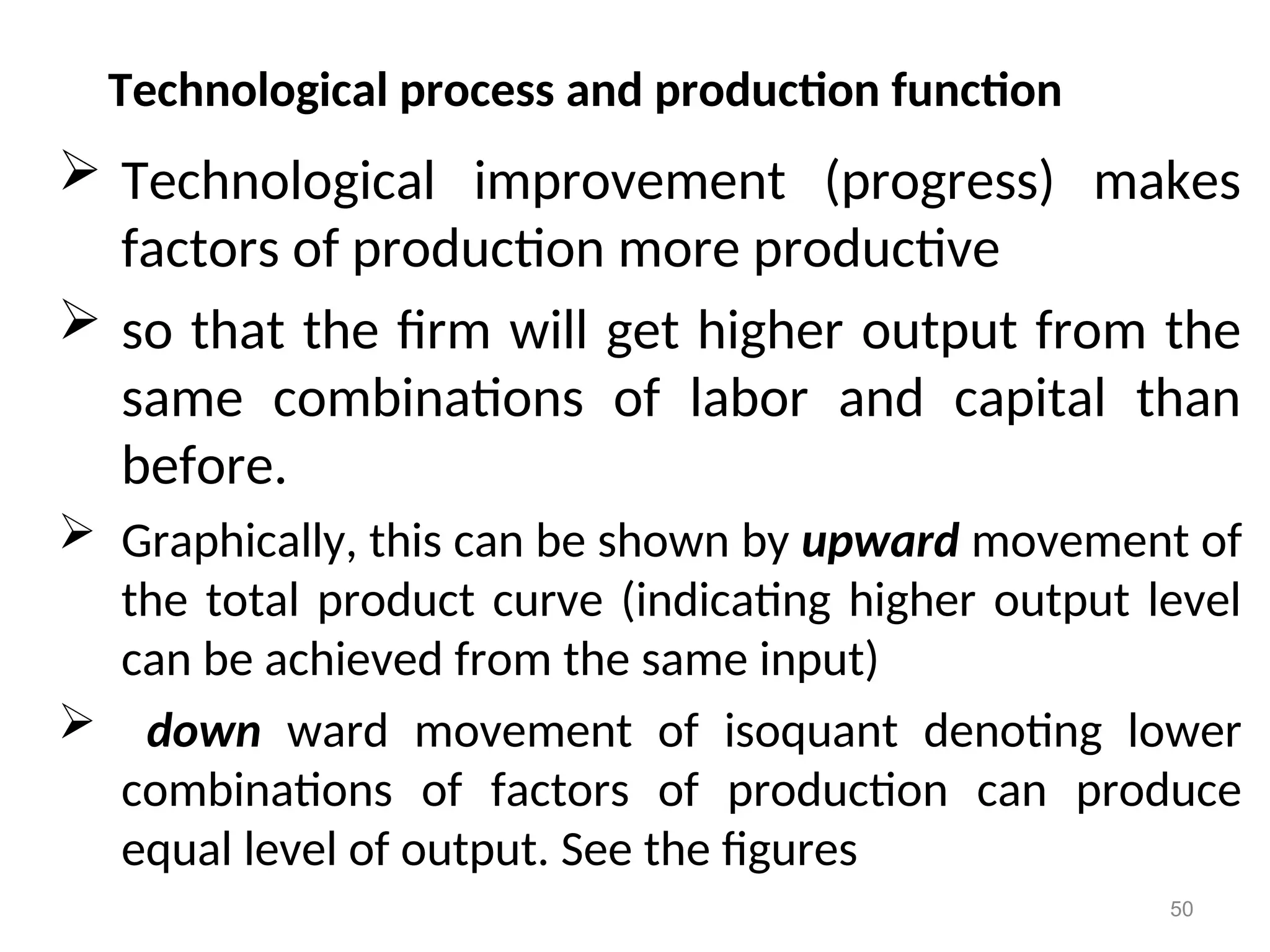
Technological process and production function
 Technological improvement (progress) makes
factors of production more productive
 so that the firm will get higher output from the
same combinations of labor and capital than
before.
 Graphically, this can be shown by upward movement of
the total product curve (indicating higher output level
can be achieved from the same input)
 down ward movement of isoquant denoting lower
combinations of factors of production can produce
equal level of output. See the figures
50
51
Equilibrium of the firm: Choice of optimal
combination of factors of production
 though different combinations of labor and capital on a
given isoquant yield the same level of output,
 the cost of these different combinations of labor and
capital could differ because the prices of the inputs can
differ.
 Thus, isoquant shows only technically efficient
combinations of inputs, not economically efficient
combinations.
 Technical efficiency takes in to account the physical
quantity of inputs
52
 whereas economic efficiency goes beyond
technical efficiency and seeks to find the least
cost (in monetary terms) combination of inputs
among the various technically efficient
combinations.
 Hence, technical efficiency is a necessary
condition, but not a sufficient condition for
economic efficiency.
 To determine the economically efficient input
combinations we need to have the prices of
inputs.
53
To determine the economically efficient input
combination, the following simplifying assumptions hold
true:
Assumptions
1. The goal of the firm is maximization of profit where
Where -Profit, R-revenue and C-is cost outlay.
2. The price of the product is given and it is equal to .
3. The prices of inputs are given (constant).
Price of a unit of labor is and that of capital is .
54
 we need to know the isocost line, because optimal
input is defined by the tangency of the isoquant and
isocost line.
Isocost line
 Isocost lines have most of the same
properties as that of budget lines,
 an isocost line is the locus points denoting all
combination of factors that a firm can purchase
with a given monetary outlay, given prices of
factors.
55
 Suppose the firm has amount of cost out lay
(budget) and prices of labor and capital are and
respectively.
 The equation of the firm’s isocost line is given
as:
are quantities of capital and labor respectively.
56
 Given the cost outlay , the maximum
amounts of capital and labor that the firm can
purchase are equal to and respectively.
 The straight line that connects these points is
the iso-cost line.
See the following figure:
57
Under we will discuss the two situations
separately.
Case1: Maximization of output subject to cost
constraint
 Suppose a firm having a fixed cost out lay (money
budget) which is shown by its iso-cost line.
Here, the firm is in equilibrium when it produces the
maximum possible out put, given the cost outlay and
prices of input.
 The equilibrium point (economically efficient
combination) is graphically defined by the tangency of the
firm’s iso-cost line (showing the budget constraint) with
the highest possible isoquant.
58
 At this point, the slope of the iso cost line is
equal to the slope of the isoquant .
 The condition of equilibrium under this case
is, thus:
 This is the first order (necessary) condition.
 The second order (sufficient) condition is that
isoquant must be convex to the origin.
See the following figure:
59
Fig: 3.19 the optimal combination of inputs is
defined by the tangency of the iso-cost line (AB) and the
highest possible isoquant , at point E.
 At this point the slope of iso-cost line is equal to
the
slope of isoquant.
The second order condition is also satisfied by the
convexity of the isoquant.
60
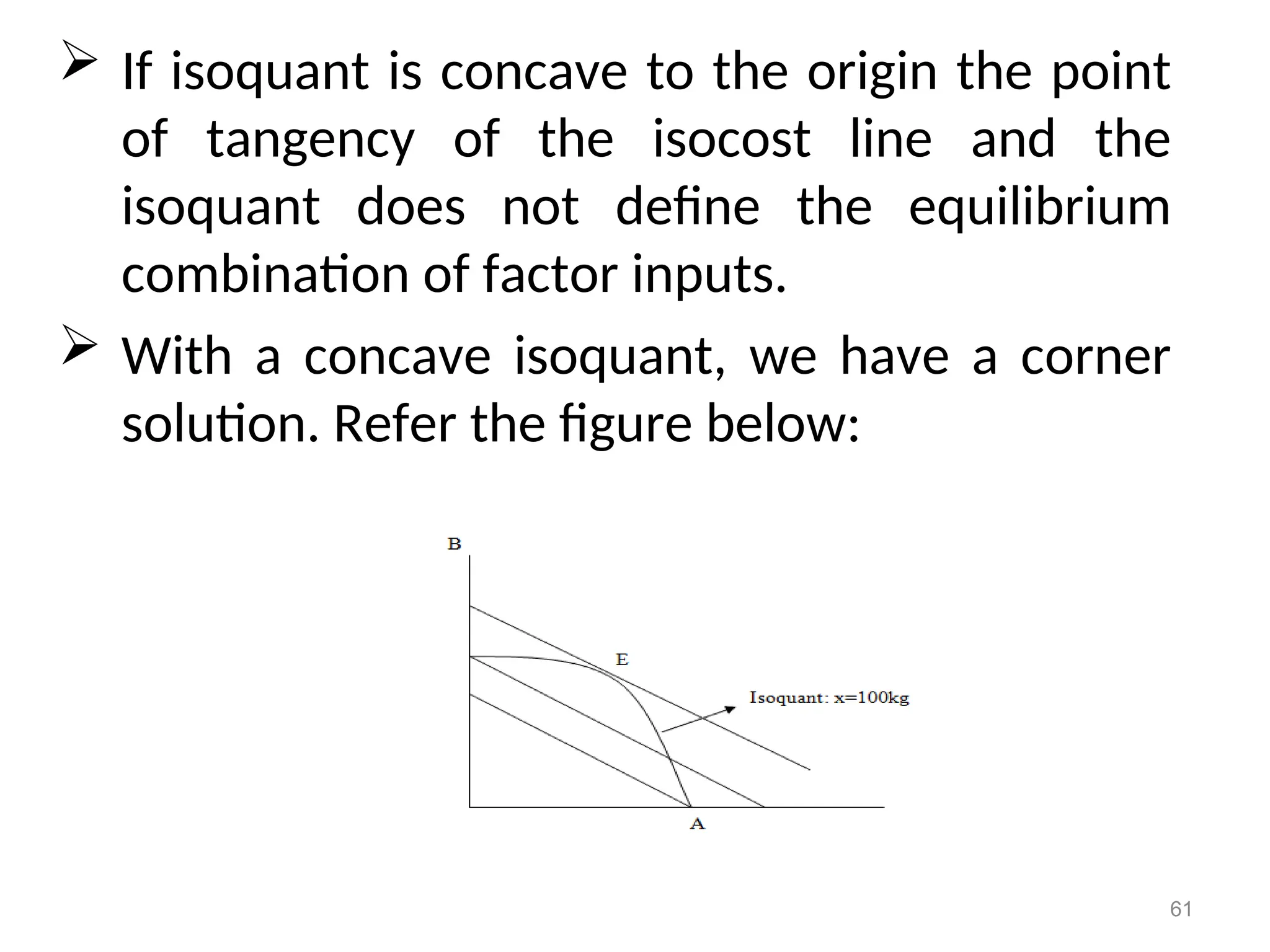
 If isoquant is concave to the origin the point
of tangency of the isocost line and the
isoquant does not define the equilibrium
combination of factor inputs.
 With a concave isoquant, we have a corner
solution. Refer the figure below:
61
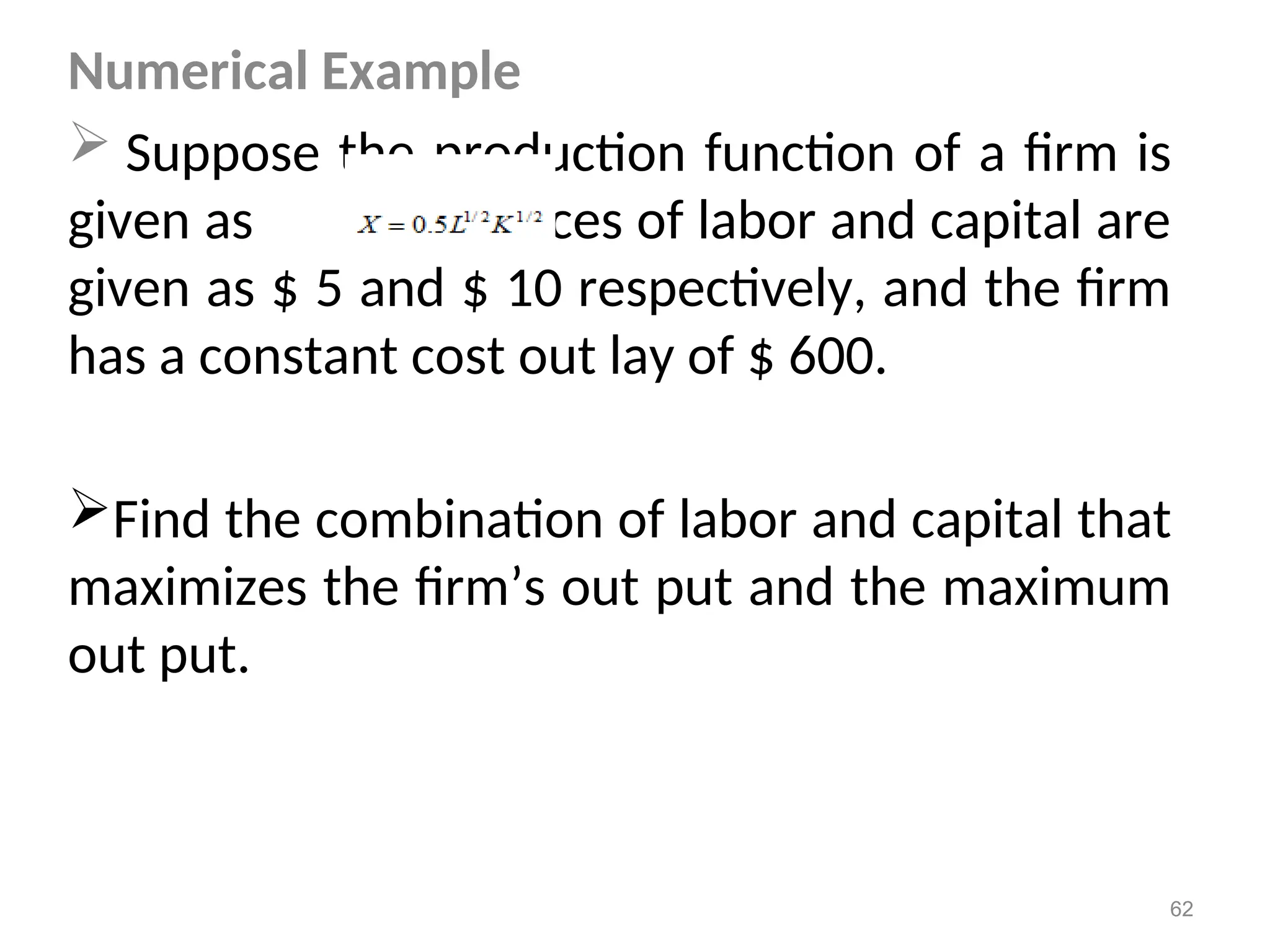
Numerical Example
 Suppose the production function of a firm is
given as prices of labor and capital are
given as $ 5 and $ 10 respectively, and the firm
has a constant cost out lay of $ 600.
Find the combination of labor and capital that
maximizes the firm’s out put and the maximum
out put.
62
Case -2: Minimization of cost for a given level of
output
 In this case, consider an entrepreneur (a firm) who
wants to produce a given output (for example a bridge
or a building )with minimum cost
 Higher isocost lines denote higher production costs.
 The production costs of a desired level of output will
therefore be minimized when the isoquant line is
tangent to the lowest possible isocost line
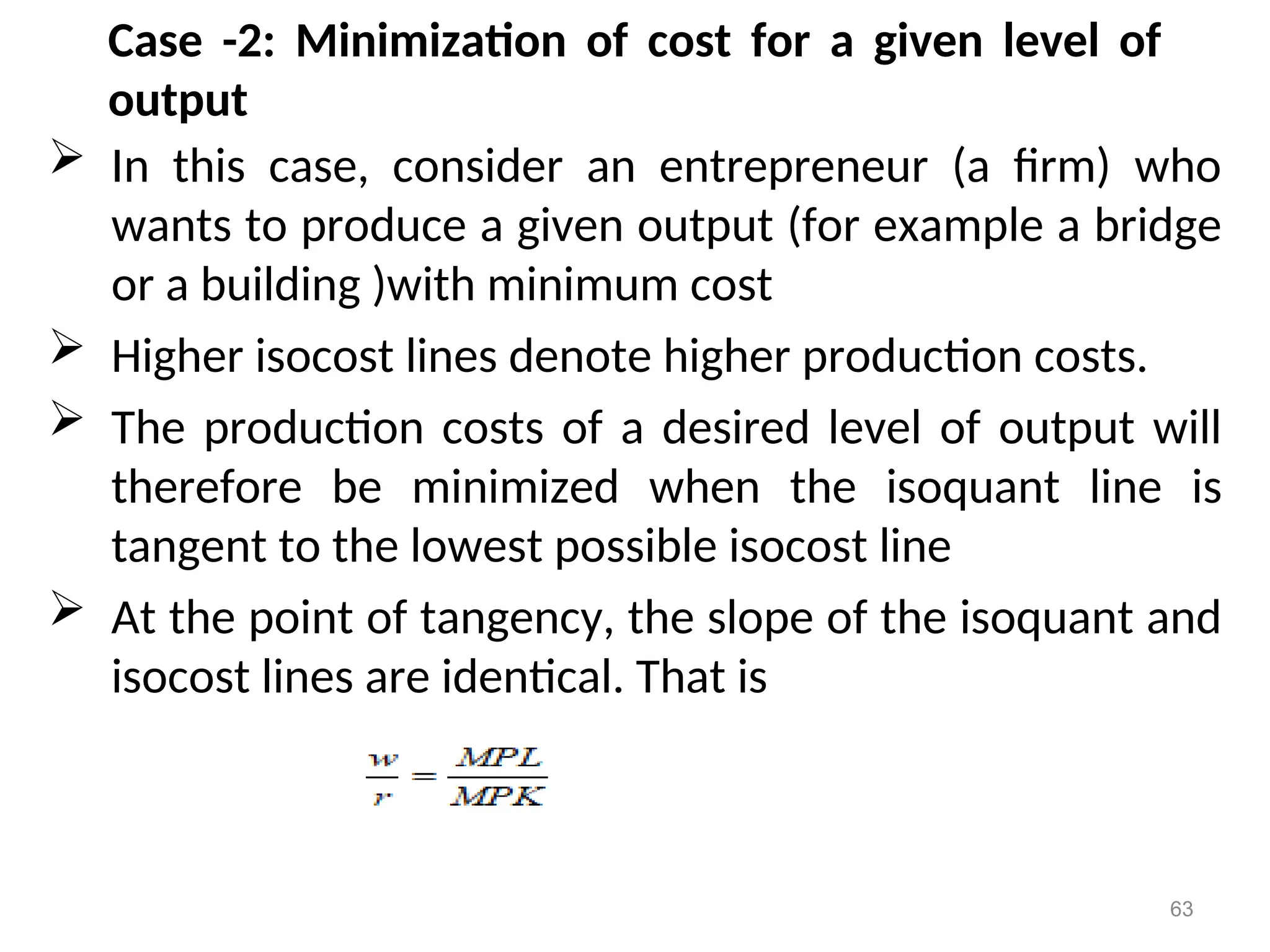
 At the point of tangency, the slope of the isoquant and
isocost lines are identical. That is
63
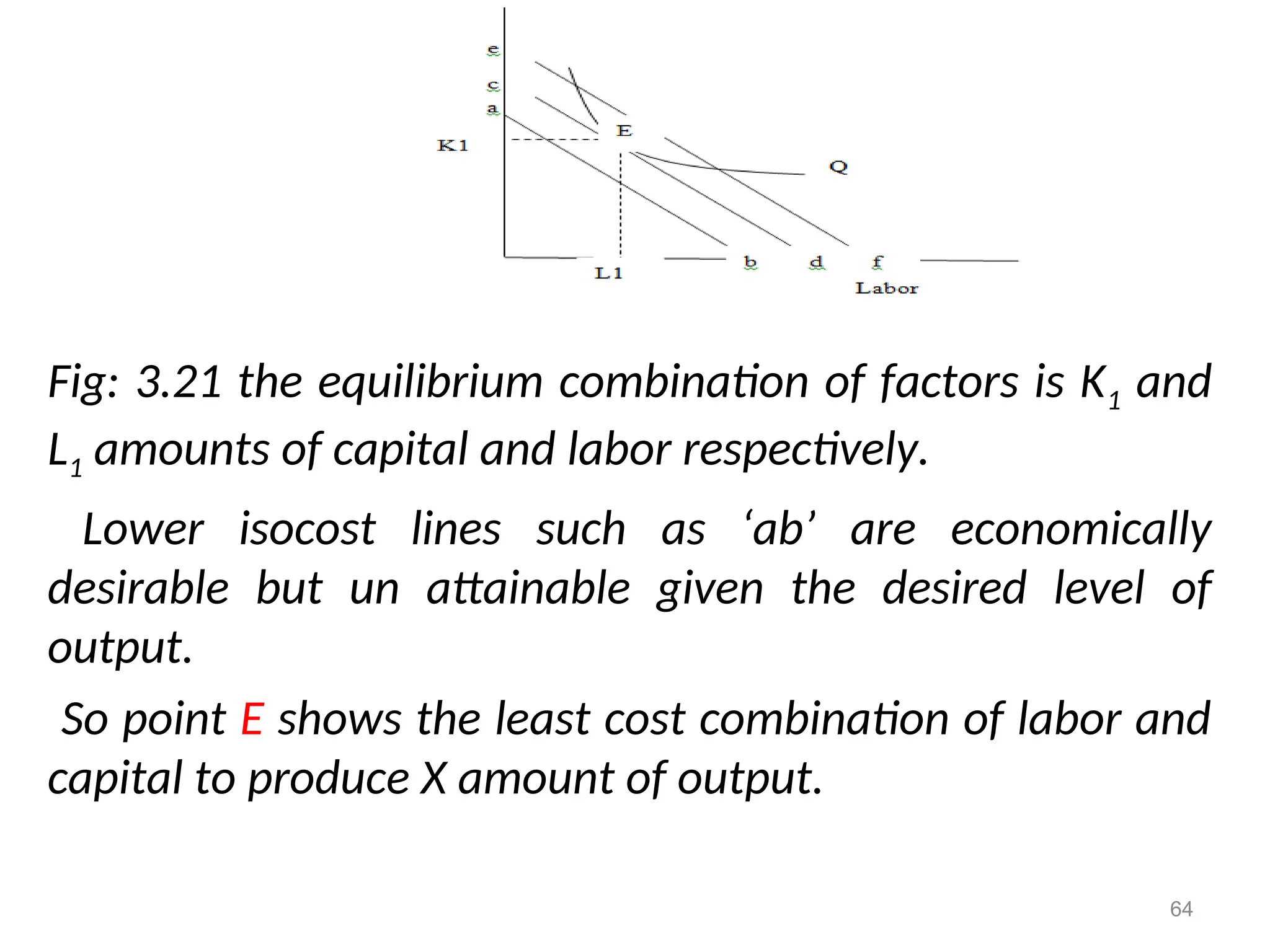
Fig: 3.21 the equilibrium combination of factors is K1 and
L1 amounts of capital and labor respectively.
Lower isocost lines such as ‘ab’ are economically
desirable but un attainable given the desired level of
output.
So point E shows the least cost combination of labor and
capital to produce X amount of output.
64
 Now let us see the mathematical derivation
of the equilibrium condition.
 As mentioned earlier, we minimize the cost
of producing a given level of output.
Thus, the problem can be stated as:
65
Cost minimization with varying out put levels
and the derivation of long run total cost curve
 in the previous chapter we saw how a cost
minimizing firm selects a combination of
inputs to produce a given level of out put.
 Now we extend this analysis to see how the
firm’s costs depend on its out put level.
 To do best with, refer to the following figure
:
66
In the above figure, the firm is assumed to have
increasing returns to scale up to point A
constant returns to scale between points A and B
decreasing returns to scale beyond point B
67
 The curve passing through the points of tangency
between the firm’s iso cost lines and its isoquants is
called expansion path.
 The expansion path denotes least cost combination of
labor and capital required to produce different levels of
out put.
 To produce 10 units of out put, the firm uses 2K and 3L,
to produce 20 units, the firm uses 3K and 5L, to
produce 30 units it uses 3.5K and 6L, and so on.
 Hence, as out put expands at a constant amount, the
units of labor and capital increases at a decreasing rate
up to point A.
 That is, total cost of production increases at a
decreasing rate up to point A. 68
 From point A to B, combination of labor and capital
increase at a constant rate as out put increases at a
constant rate.
 Hence, the long run total cost increases at a constant
rate up to point B.
69

CHapter production theory of mco eco .ppt

  • 1.
    1 Objectives •After successful completionof this unit, you will be able to •Define production and production function •Differentiate short run and long run, and fixed and variable inputs •Know the concepts of short run production and efficiency •Know the concepts of long run production, laws of returns to scale and how to determine least cost production process. THE THEORY OF PRODUCTION
  • 2.
    Introduction: Definition andbasic concepts  production means creation of utility for sales.  production may be defined as the act of creating those goods/services which have exchange value for sale (not for personal consumption).  Raw materials yield less satisfaction to the consumer by themselves.  In order to get utility from raw materials, first they must be transformed into output. 2
  • 3.
    Introduction: Definition andbasic concepts  However, transforming raw materials into final products require factor inputs such as land, labor, and capital and entrepreneurial ability.  Thus, no production (transforming raw material into output) can take place without the use of inputs. 3
  • 4.
    Fixed Vs. variableinputs In economics, inputs can be classified as fixed & variable. Fixed input An input for which the level of usage cannot readily be changed. In economic sense, a fixed input is one whose supply is inelastic in the short run. In technical sense, a fixed input is one that remains fixed (or constant) for certain level of output. 4
  • 5.
    THE THEORY OFPRODUCTION Variable input A variable input is one whose supply in the short run is elastic, example, labour, raw materials, and the like. Users of such inputs can employ a larger quantity in the short run. Technically, a variable input is one that changes with changes in output.  In the long run, all inputs are variable. 5
  • 6.
    Production Function A productionfunction is purely technical relation which connects factor inputs & outputs. It describes the transformation of factor inputs into outputs at any particular time period. 6 Q = f( L,K,R,Ld,T,t) where Q = output R= Raw Material L= Labour Ld = Land K= Capital T = Technology t = time For our current analysis, let’s reduce the inputs to two, capital (K) and labor (L): Q = f(L, K)
  • 7.
    Short-Run and Long-RunProduction In economics, short run refers to that period of time in which the quantity of at least one input is fixed. For example, if it requires a firm one year to change the quantities of all the inputs, those time periods below one year are considered as short run. In the short run some inputs are fixed and some variable 7
  • 8.
    Short-Run production  Thus,short run is that time period which is not sufficient to change the quantities of all inputs,  so that at least one input remains fixed.  One thing to be noted here is that short run periods of different firms have different duration.  In the short run we can talk about factor productivity / law of variable proportion/law of diminishing returns 8
  • 9.
    9 long run production Longrun is that time period (planning horizon) which is sufficient to change the quantities of all inputs. Thus there is no fixed input in the long -run. in the long run we can talk about returns to scale
  • 10.
    The Production Function Production in the short run: Production with one variable input  Production with one variable input (while the others are fixed) is obviously a short run phenomenon because there is no fixed input in the long run. 10
  • 11.
    Assumption of shortrun production analysis In order to simplify the analysis of short run production, the classical economist assumed the following: 1. Perfect divisibility of inputs and outputs  This assumption implies that factor inputs and outputs are so divisible that one can hire, for example a fraction of labor, a fraction of manager and we can produce a fraction of output, such as a fraction of automobile. 2. Limited substitution between inputs Factor inputs can substitute each other up to a certain point, beyond which they can not substitute each other 11
  • 12.
    3. Constant technology Theyassumed that level of technology of production is constant in the short run. Suppose a firm that uses two inputs: Capital (which is a fixed input) and labor (which is variable input). Given the assumptions of short run production, the firm can increase output only by increasing the amount of labor it uses. Hence, its production function is Q = f (L) K - being constant Where Q is the quantity of production (Output) L is the quantity of labor used, which is variable, and K is the quantity of capital (which is fixed) 12
  • 13.
    Total product, marginalproduct and average product: Short-Run Analysis • Total product: is the total amount of output that can be produced by efficiently utilizing a specific combination of labor and capital. • The total product curve, thus, represents various levels of output that can be obtained from efficient utilization of various combinations of the variable input, and the fixed input. • It shows the output produced for different amounts of the variable input, labor. 13
  • 14.
    Marginal Product (MP) The marginal product of variable input is the addition to the total product attributable to the addition of one unit of the variable input to the production process, other inputs being constant (fixed).  Before deciding whether to hire one more worker, a manager wants to determine how much this extra worker (L) will increase output, (q). 14
  • 15.
    The Marginal Productof Labor • The marginal product of labor is the increase in output obtained by adding 1 unit of labor but holding constant the inputs of all other factors Marginal Product of L: MPL= Q/L (holding K constant) = Q/L Average Product of L: APL= Q/L (holding K constant) 15
  • 16.
    Marginal Utility andMarginal Product In Consumer Theory, marginal utility was the slope of the total utility curve In Production Theory, marginal product is the slope of the total product curve: 16
  • 17.
    Law of DiminishingReturns Law of diminishing marginal utility: marginal utility (eventually) declines as the quantity consumed of a single good increases. Law of diminishing marginal returns states that marginal products (eventually) decline as the quantity used of a single input increases. Generally the first few inputs are highly productive, but additional units are less productive). 17
  • 18.
    Law of DiminishingReturns (Diminishing Marginal Product) 18 The law of diminishing returns states that when more and more units of a variable input are applied to a given quantity of fixed inputs, the total output may initially increase at an increasing rate and then at a constant rate but it will eventually increases at diminishing rates. Assumptions. The law of diminishing returns is based on the following assumptions: (i) the state of technology is given (ii) labour is homogenous and (iii) input prices are given.
  • 19.
    Short-Run Analysis ofTotal, Average, and Marginal Product • If MP > AP then AP is rising • If MP < AP then AP is falling • MP = AP when AP is maximized • TP maximized when MP = 0 19
  • 20.
    Three Stages ofProduction in Short Run 20 AP,MP X Stage I Stage II Stage III APX MPX •TPL Increases at increasing rate. •MP Increases at decreasing rate. •AP is increasing and reaches its maximum at the end of stage I •TPL Increases at Diminshing rate. •MPL Begins to decline. •TP reaches maximum level at the end of stage II, MP = 0. •APL declines • TPL begins to decline •MP becomes negative •AP continues to decline
  • 21.
    Application of Lawof Diminishing Returns: • It helps in identifying the rational and irrational stages of operations. • It gives answers to question – How much to produce? What number of workers to apply to a given fixed inputs so that the output is maximum? 21
  • 22.
    Production in theLong-Run All inputs are now considered to be variable (both L and K in our case) How to determine the optimal combination of inputs?  To illustrate this case we will use production isoquants.  An isoquant is a locus of all technically efficient methods or all possible combinations of inputs for 22
  • 23.
    Properties of Isoquants Isoquantshave a negative slope. Isoquants are convex to the origin. Isoquants cannot intersect or be tangent to each other. Upper Isoquants represents higher level of output 23
  • 24.
    Types of Isoquant Thereexists some degree of substitutability between inputs. Different degrees of substitution: 24 Sugar a) Linear Isoquant (Perfect substitution) b) Input – Output/ L- Shaped Isoquant (Perfect complementarity) All other ingredients Natural flavoring Q Q Capital Labor L1 L2 L3 L4 K 1 K 2 K 3 K 4 Sugar Cane syrup c) Kinked/Acitivity Analysis Isoquant – (Limited substitutability)
  • 25.
    Isoquant Map Isoquant mapis a set of isoquants presented on a two dimensional plain. Each isoquant shows various combinations of two inputs that can be used to produce a given level of output. 25 Figure : Isoquant Map Labour X Capital Y Y O X IQ4 IQ3 IQ2 IQ1
  • 26.
    Marginal rate oftechnical substitution (labor for capital): measures the amount of K the firm the firm could give up in exchange for an additional L, in order to just be able to produce the same output as before. 26
  • 27.
    The marginal rateof technical substitution The marginal rate of technical substitution, MRTSL,K tells us: The amount capital can be decreased for every increase in labour, holding output constant OR The amount capital must be increased for every decrease in labour, holding output constant 27
  • 28.
    Marginal rate oftechnical substitution -as we move down the isoquant, the slope decreases, decreasing the MRTSL,K -this is diminishing marginal rate of technical substitution as you focus more on one input, the other input becomes more productive Marginal products and the MRTS (MRTS- Slope of Isoquant)are related: MPL/MPK = -K/L = MRTSL,K 28
  • 29.
    The marginal rateof technical substitution 29 K L K K L MRTS L K L K K L K MP L MP Q , K L constant output constant output K L L curve, isoquant the along moves one as 0 Q since but MP MP MP MP MP MP -                   
  • 30.
    MRTS Example Let Q=4LK MPL=4K MPK=4L FindMRTSL,K MRTSL,K = MPL/MPK MRTSL,K =4K/4L MRTSL,K =K/L 30
  • 31.
    How much willoutput increase when ALL inputs increase by a particular amount? RTS = [%Q] / [%(all inputs)] 1% increase in inputs => more than 1% increase in output, increasing returns to scale. 1% increase in inputs => 1% increase in output constant returns to scale. 1% increase in inputs => a less than 1% increase in output, decreasing returns to scale. 31 Laws of Returns to Scale
  • 32.
    Constant RTS If allinputs are doubled, output will also doubled Reasons Economics of scale is balanced by diseconomies of scale. Indivisibility of fixed factors When the factors of production are perfectly divisible, the production function is homogenous of degree 1 showing constant returns of scale. For example, a function is homogeneous of degree 1 if, when all its arguments are multiplied by any number t > 0, the value of the function is multiplied by the same number t. 32
  • 33.
    The slope ofan isoquant: marginal rate of technical substitution (MRTS)  The slope of an isoquant (-K/L) indicates how the quantity of one input can be traded off against the quantity of the other, while output is held constant.  The absolute value of the slope of an isoquant is called marginal rate of technical substitution (MRTS).  The MRTS shows the amount by which the quantity of one input can be reduced when one extra unit of another input is used, so that output remains constant. 33
  • 34.
     MRTS oflabor for capital, denoted as MRTS L, K shows the amount by which the input of capital can be reduced when one extra unit of labor is used, so that output remains constant. 34
  • 35.
    Elasticity of substitution It represents how easily firms can substitute capital for labour and expresses the percentage change in the capital-labour ratio due to a one percent change in the price ratio of these inputs.  A better measure of the ease of factor substitution is provided by the elasticity of substitution, δ. The elasticity of substitution is defined as 35
  • 36.
     The elasticityof substitution is a pure number independent of the units of measurement of K and L,  since the numerator and the denominator are measured in the same units and be canceled. 36
  • 37.
    Factor intensity  Aprocess of production can be labor intensive or capital intensive or neutral process.  A process of production is called labor intensive if it uses many labors and relatively few capitals.  If it uses many capitals and relatively few labor it is called capital intensive technology.  On the other hand, if the process uses equal proportion of both it is called neutral technology. 37
  • 38.
     The factorintensity of any process is measured by the slope of the line through the origin representing the particular process.  Thus, the factor intensity is the capital-labor ratio.  The higher the capital-labor ratio is the higher the capital intensity but the lower the capital- labor ratio is the higher labor intensity of the process. 38
  • 39.
    In the aboveFig Process A uses k1 and L1 units of capital and labor to produce x amount of output. The factor intensity of this process can be measured by the slope of OA, which equals AL1/OL1 = Similarly, factor intensity of process B is given by 39
  • 40.
     Since processA is more capital intensive than process B or B is more labor intensive than A.  The upper part of the isoquant includes more capital intensive processes and the lower part, labor intensive techniques. 40
  • 41.
    The long runlaw of production: The law of returns to scale  In the short run output may be increased by using more of the variable factor, while capital (and possibly other factors as well) are kept constant.  The expansion of output with one factor (at least) constant is described by the law of variable proportion or the law of (eventually) diminishing returns of the variable factor. 41
  • 42.
     The lawsof production describe the technically possible ways of increasing the level of production.  Output may increase in various ways.  In the long run output can be increased by changing all factors of production.  This long run analysis of production is called Law of returns to scale.  Now let’s have a deep examination of law of returns to scale. 42
  • 43.
    Returns to scaleand homogeneity of production function  Suppose we increase both factors of the function  X0=f (L, K) by the same proportion‘t’, and we get the new level of output X = f (tL, tK)  If t can be factored out then the new level of output X* can be expressed as a function of t (to any power V) and the initial level of output, and the production function is said to be homogeneous. X* = t f (LK) or X* = t X0  If t can not be factored out, the production function is non-homogeneous. 43
  • 44.
     Thus, ahomogeneous function is a function such that if each of the input is multiplied by t, then t can be completely factored out of the function.  The power V of t is called degree of homogeneity of the function and is measure of returns to scale. 44
  • 45.
     If V=1,we have constant returns to scale.  If V<1, decreasing return to scale prevails  If V>1, increasing return to scale prevails For a Cobb-Douglas production function  X = b0Lb1 Kb2, V = b1 +b2 and it is a measure of returns to scale. Proof: Let L and K increase by t. The new level of output is X* = b0 (tL)b1 (tk)b2 X* = b0 tb1 lb1 tb2 kb2 X* = b0Lb1 Kb2 tb1+b2 X* = X (t b1+b2 ) Thus V = b1+b2 45
  • 46.
    Returns to scaleand homogeneity of production function 46
  • 47.
    Product Lines  Aproduct line shows the (physical) movement from one isoquant to another as we change the employment of both factors and a single factor,  The product line (curve) passes through the origin if all factors are variable.  If only one factor is variable (the other being constant) the product line is a straight line parallel to the axis of the variable factor.  For such product lines the K/L ratio diminishes along the product line 47
  • 48.
  • 49.
     A productline along which the MRTS of factors is constant is called an isocline.  So an isocline is the locus of points of different isoquants at which MRTS of factors is constant.  If the production function is homogeneous the isoclines are straight lines through the origin.  Along any one isocline the K/L ratio is also constant (as is the MRTS of the factors).  But K/L ratio and the MRTS are different for different isoclines.  If the production is non homogeneous the isocline will not be straight line, but their shape will be twiddle.  The K/L ratio changes along each isocline and on different isoclines. 49
  • 50.
    Technological process andproduction function  Technological improvement (progress) makes factors of production more productive  so that the firm will get higher output from the same combinations of labor and capital than before.  Graphically, this can be shown by upward movement of the total product curve (indicating higher output level can be achieved from the same input)  down ward movement of isoquant denoting lower combinations of factors of production can produce equal level of output. See the figures 50
  • 51.
  • 52.
    Equilibrium of thefirm: Choice of optimal combination of factors of production  though different combinations of labor and capital on a given isoquant yield the same level of output,  the cost of these different combinations of labor and capital could differ because the prices of the inputs can differ.  Thus, isoquant shows only technically efficient combinations of inputs, not economically efficient combinations.  Technical efficiency takes in to account the physical quantity of inputs 52
  • 53.
     whereas economicefficiency goes beyond technical efficiency and seeks to find the least cost (in monetary terms) combination of inputs among the various technically efficient combinations.  Hence, technical efficiency is a necessary condition, but not a sufficient condition for economic efficiency.  To determine the economically efficient input combinations we need to have the prices of inputs. 53
  • 54.
    To determine theeconomically efficient input combination, the following simplifying assumptions hold true: Assumptions 1. The goal of the firm is maximization of profit where Where -Profit, R-revenue and C-is cost outlay. 2. The price of the product is given and it is equal to . 3. The prices of inputs are given (constant). Price of a unit of labor is and that of capital is . 54
  • 55.
     we needto know the isocost line, because optimal input is defined by the tangency of the isoquant and isocost line. Isocost line  Isocost lines have most of the same properties as that of budget lines,  an isocost line is the locus points denoting all combination of factors that a firm can purchase with a given monetary outlay, given prices of factors. 55
  • 56.
     Suppose thefirm has amount of cost out lay (budget) and prices of labor and capital are and respectively.  The equation of the firm’s isocost line is given as: are quantities of capital and labor respectively. 56
  • 57.
     Given thecost outlay , the maximum amounts of capital and labor that the firm can purchase are equal to and respectively.  The straight line that connects these points is the iso-cost line. See the following figure: 57
  • 58.
    Under we willdiscuss the two situations separately. Case1: Maximization of output subject to cost constraint  Suppose a firm having a fixed cost out lay (money budget) which is shown by its iso-cost line. Here, the firm is in equilibrium when it produces the maximum possible out put, given the cost outlay and prices of input.  The equilibrium point (economically efficient combination) is graphically defined by the tangency of the firm’s iso-cost line (showing the budget constraint) with the highest possible isoquant. 58
  • 59.
     At thispoint, the slope of the iso cost line is equal to the slope of the isoquant .  The condition of equilibrium under this case is, thus:  This is the first order (necessary) condition.  The second order (sufficient) condition is that isoquant must be convex to the origin. See the following figure: 59
  • 60.
    Fig: 3.19 theoptimal combination of inputs is defined by the tangency of the iso-cost line (AB) and the highest possible isoquant , at point E.  At this point the slope of iso-cost line is equal to the slope of isoquant. The second order condition is also satisfied by the convexity of the isoquant. 60
  • 61.
     If isoquantis concave to the origin the point of tangency of the isocost line and the isoquant does not define the equilibrium combination of factor inputs.  With a concave isoquant, we have a corner solution. Refer the figure below: 61
  • 62.
    Numerical Example  Supposethe production function of a firm is given as prices of labor and capital are given as $ 5 and $ 10 respectively, and the firm has a constant cost out lay of $ 600. Find the combination of labor and capital that maximizes the firm’s out put and the maximum out put. 62
  • 63.
    Case -2: Minimizationof cost for a given level of output  In this case, consider an entrepreneur (a firm) who wants to produce a given output (for example a bridge or a building )with minimum cost  Higher isocost lines denote higher production costs.  The production costs of a desired level of output will therefore be minimized when the isoquant line is tangent to the lowest possible isocost line  At the point of tangency, the slope of the isoquant and isocost lines are identical. That is 63
  • 64.
    Fig: 3.21 theequilibrium combination of factors is K1 and L1 amounts of capital and labor respectively. Lower isocost lines such as ‘ab’ are economically desirable but un attainable given the desired level of output. So point E shows the least cost combination of labor and capital to produce X amount of output. 64
  • 65.
     Now letus see the mathematical derivation of the equilibrium condition.  As mentioned earlier, we minimize the cost of producing a given level of output. Thus, the problem can be stated as: 65
  • 66.
    Cost minimization withvarying out put levels and the derivation of long run total cost curve  in the previous chapter we saw how a cost minimizing firm selects a combination of inputs to produce a given level of out put.  Now we extend this analysis to see how the firm’s costs depend on its out put level.  To do best with, refer to the following figure : 66
  • 67.
    In the abovefigure, the firm is assumed to have increasing returns to scale up to point A constant returns to scale between points A and B decreasing returns to scale beyond point B 67
  • 68.
     The curvepassing through the points of tangency between the firm’s iso cost lines and its isoquants is called expansion path.  The expansion path denotes least cost combination of labor and capital required to produce different levels of out put.  To produce 10 units of out put, the firm uses 2K and 3L, to produce 20 units, the firm uses 3K and 5L, to produce 30 units it uses 3.5K and 6L, and so on.  Hence, as out put expands at a constant amount, the units of labor and capital increases at a decreasing rate up to point A.  That is, total cost of production increases at a decreasing rate up to point A. 68
  • 69.
     From pointA to B, combination of labor and capital increase at a constant rate as out put increases at a constant rate.  Hence, the long run total cost increases at a constant rate up to point B. 69