Accounting for PartnershipAccounting for Partnership
Basics of PartnershipBasics of Partnership
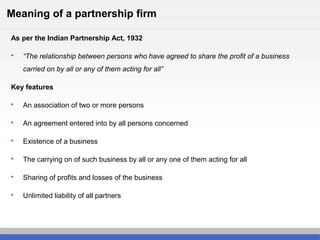
Meaning of a partnership firm
As per the Indian Partnership Act, 1932
 “The relationship between persons who have agreed to share the profit of a business
carried on by all or any of them acting for all”
Key features
 An association of two or more persons
 An agreement entered into by all persons concerned
 Existence of a business
 The carrying on of such business by all or any one of them acting for all
 Sharing of profits and losses of the business
 Unlimited liability of all partners
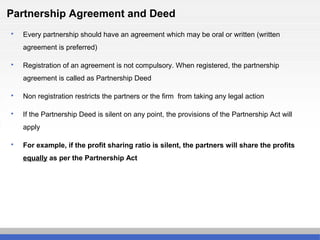
Partnership Agreement and Deed
 Every partnership should have an agreement which may be oral or written (written
agreement is preferred)
 Registration of an agreement is not compulsory. When registered, the partnership
agreement is called as Partnership Deed
 Non registration restricts the partners or the firm from taking any legal action
 If the Partnership Deed is silent on any point, the provisions of the Partnership Act will
apply
 For example, if the profit sharing ratio is silent, the partners will share the profits
equally as per the Partnership Act
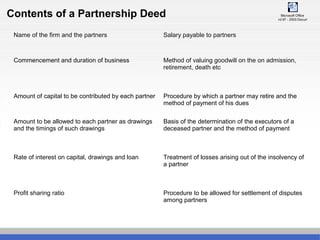
Contents of a Partnership Deed
Name of the firm and the partners Salary payable to partners
Commencement and duration of business Method of valuing goodwill on the on admission,
retirement, death etc
Amount of capital to be contributed by each partner Procedure by which a partner may retire and the
method of payment of his dues
Amount to be allowed to each partner as drawings
and the timings of such drawings
Basis of the determination of the executors of a
deceased partner and the method of payment
Rate of interest on capital, drawings and loan Treatment of losses arising out of the insolvency of
a partner
Profit sharing ratio Procedure to be allowed for settlement of disputes
among partners
Microsoft Office
Word 97 - 2003 Document
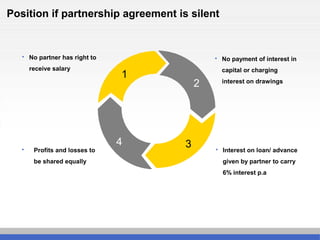
Position if partnership agreement is silent
2
 No partner has right to
receive salary
 No payment of interest in
capital or charging
interest on drawings
 Interest on loan/ advance
given by partner to carry
6% interest p.a
 Profits and losses to
be shared equally
2
34
1
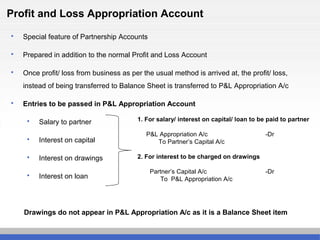
Profit and Loss Appropriation Account
 Special feature of Partnership Accounts
 Prepared in addition to the normal Profit and Loss Account
 Once profit/ loss from business as per the usual method is arrived at, the profit/ loss,
instead of being transferred to Balance Sheet is transferred to P&L Appropriation A/c
 Entries to be passed in P&L Appropriation Account
 Salary to partner
 Interest on capital
 Interest on drawings
 Interest on loan
Drawings do not appear in P&L Appropriation A/c as it is a Balance Sheet item
1. For salary/ interest on capital/ loan to be paid to partner
P&L Appropriation A/c -Dr
To Partner’s Capital A/c
2. For interest to be charged on drawings
Partner’s Capital A/c -Dr
To P&L Appropriation A/c
Problem 1
A and B start business on 1st January, 2009, with capitals of Rs. 30,000 and Rs.
20,000. According to the Partnership Deed, B is entitled to a salary of Rs. 500 per
month and interest is to be allowed on capitals at 6% per annum. The remaining
profits are to be distributed amongst the partners in the ratio of 5:3. During 2009
the firm earned a profit, before charging salary to B and interest on capital
amounting to Rs. 25,000. During the year A withdrew Rs. 8,000 and B withdrew
Rs. 10,000 for domestic purposes. Rate of interest on drawings is 5%
Prepare the Profit and Loss Appropriation Account and Capital Accounts of
Partners. Assume calendar year.
Problem 2
Ram, Rahim and Karim are partners in a firm. They have no agreement in
respect of profit- sharing ratio, interest on capital, interest on loan advanced by
partners and remuneration payable to partners. In the matter of distribution of
profits they have put forward the following claims:
1.Ram, who has contributed maximum capital demands interest on capital at 10%
p.a. and share of profit in the capital ratio
2.Rahim has devoted full time for running the business and demands salary at the
rate of Rs. 500 p.m.
3.Karim demands interest on loan of Rs. 2,000 advanced by him at the market
rate of interest which is 12% p.a.
Valuation of GoodwillValuation of Goodwill
Which will you choose?
Bangalore-Mysore cost
Mercedes Benz – Rs 200
Ordinary – Rs 100
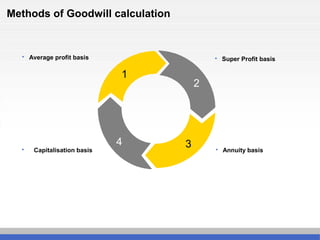
Methods of Goodwill calculation
2
 Average profit basis  Super Profit basis
 Annuity basis Capitalisation basis
2
34
1
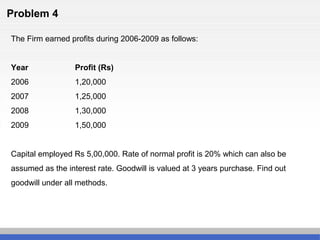
Problem 4
The Firm earned profits during 2006-2009 as follows:
Year Profit (Rs)
2006 1,20,000
2007 1,25,000
2008 1,30,000
2009 1,50,000
Capital employed Rs 5,00,000. Rate of normal profit is 20% which can also be
assumed as the interest rate. Goodwill is valued at 3 years purchase. Find out
goodwill under all methods.
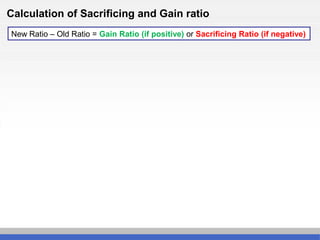
Calculation of Sacrificing and Gain ratio
New Ratio – Old Ratio = Gain Ratio (if positive) or Sacrificing Ratio (if negative)
Admission of a partnerAdmission of a partner
Admission- Basics
 When a new partner is admitted, the firm is said to be reconstituted
 A new balance sheet must be drawn up on the date of admission
 Entry for appreciation or depreciation of assets should be passed
 Unrecorded asset or liability should be brought into books
 Goodwill, if any, must be valued and reserves must be shared
 For the purposes of the admission of a new partner, ‘Revaluation A/c’ is drawn up
 Profit/ loss from Revalution A/c must be shared between old partners in their old
profit sharing ratio
The same approach is also applicable for Retirement and Death
 The following will be entries which would be passed during admission
 New partners share of goodwill credited to sacrificing partners in sacrificing ratio
 Share of revaluation profits or losses
 Share of Reserve
 Capital brought in by new partner
Revaluation Account
 Opened specially during reconstitution of a firm (admission, death, retirement)
 Contains amounts on account of bringing the balance sheet of the firm up-to date
 Also known as ‘Profit and Loss Adjustment A/c’
Journal Entries
1. Revaluation A/c -Dr
To Assets A/c (decrease in assets)
To Liabilities A/c (increase in liability)
2. Asset A/c -Dr (increase in asset)
Liability A/c -Dr (decrease in liability)
To Revaluation A/c
3. Revaluation A/c -Dr (in case of profit on revaluation)
To Old Partners Capital A/c
(in old profit sharing ratio)
4. Old Partners Capital A/c -Dr (in case of loss on revaluation)
To Revaluation A/c
(in old profit sharing ratio)
Problems
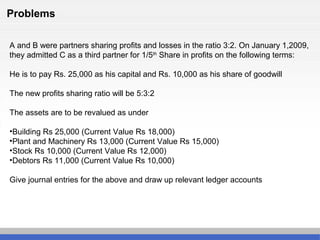
A and B were partners sharing profits and losses in the ratio 3:2. On January 1,2009,
they admitted C as a third partner for 1/5th
Share in profits on the following terms:
He is to pay Rs. 25,000 as his capital and Rs. 10,000 as his share of goodwill
The new profits sharing ratio will be 5:3:2
The assets are to be revalued as under
•Building Rs 25,000 (Current Value Rs 18,000)
•Plant and Machinery Rs 13,000 (Current Value Rs 15,000)
•Stock Rs 10,000 (Current Value Rs 12,000)
•Debtors Rs 11,000 (Current Value Rs 10,000)
Give journal entries for the above and draw up relevant ledger accounts
Problems
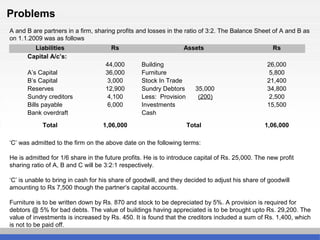
A and B are partners in a firm, sharing profits and losses in the ratio of 3:2. The Balance Sheet of A and B as
on 1.1.2009 was as follows
‘C’ was admitted to the firm on the above date on the following terms:
He is admitted for 1/6 share in the future profits. He is to introduce capital of Rs. 25,000. The new profit
sharing ratio of A, B and C will be 3:2:1 respectively.
‘C’ is unable to bring in cash for his share of goodwill, and they decided to adjust his share of goodwill
amounting to Rs 7,500 though the partner’s capital accounts.
Furniture is to be written down by Rs. 870 and stock to be depreciated by 5%. A provision is required for
debtors @ 5% for bad debts. The value of buildings having appreciated is to be brought upto Rs. 29,200. The
value of investments is increased by Rs. 450. It is found that the creditors included a sum of Rs. 1,400, which
is not to be paid off.
Liabilities Rs Assets Rs
Capital A/c’s:
A’s Capital
B’s Capital
Reserves
Sundry creditors
Bills payable
Bank overdraft
44,000
36,000
3,000
12,900
4,100
6,000
Building
Furniture
Stock In Trade
Sundry Debtors 35,000
Less: Provision (200)
Investments
Cash
26,000
5,800
21,400
34,800
2,500
15,500
Total 1,06,000 Total 1,06,000
Retirement- Basics (same as admission)
 When a partner retires, the firm is said to be reconstituted
 A new balance sheet must be drawn up on the date of retirement
 Entry for appreciation or depreciation of assets should be passed
 Unrecorded asset or liability should be brought into books
 Goodwill, if any, must be valued and reserves must be shared
 For the purposes of the retirement of a partner, ‘Revaluation A/c’ is drawn up
 Profit/ loss from Revalution A/c must be shared between old partners in their old
profit sharing ratio
 A retiring partner will get the following on retirement:
 His share of goodwill borne by continuing partners in gain ratio
 Share of revaluation profits
 Share of Reserve
 Capital balance
Revaluation Account (same as admission)
 Opened specially during reconstitution of a firm
 Contains amounts on account of bringing the balance sheet of the firm up-to date
 Also known as ‘Profit and Loss Adjustment A/c’
Journal Entries
1. Revaluation A/c -Dr
To Assets A/c (decrease in assets)
To Liabilities A/c (increase in liability)
2. Asset A/c -Dr (increase in asset)
Liability A/c -Dr (decrease in liability)
To Revaluation A/c
3. Revaluation A/c -Dr (in case of profit on revaluation)
To Old Partners Capital A/c
(in old profit sharing ratio)
4. Old Partners Capital A/c -Dr (in case of loss on revaluation)
To Revaluation A/c
(in old profit sharing ratio)
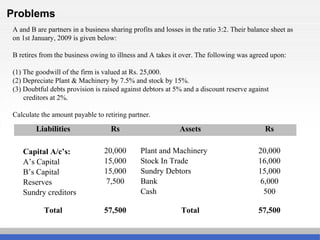
Problems
Liabilities Rs Assets Rs
Capital A/c’s:
A’s Capital
B’s Capital
Reserves
Sundry creditors
20,000
15,000
15,000
7,500
Plant and Machinery
Stock In Trade
Sundry Debtors
Bank
Cash
20,000
16,000
15,000
6,000
500
Total 57,500 Total 57,500
A and B are partners in a business sharing profits and losses in the ratio 3:2. Their balance sheet as
on 1st January, 2009 is given below:
B retires from the business owing to illness and A takes it over. The following was agreed upon:
(1) The goodwill of the firm is valued at Rs. 25,000.
(2) Depreciate Plant & Machinery by 7.5% and stock by 15%.
(3) Doubtful debts provision is raised against debtors at 5% and a discount reserve against
creditors at 2%.
Calculate the amount payable to retiring partner.

Partnership accounts

  • 1.
  • 2.
  • 3.
    Meaning of apartnership firm As per the Indian Partnership Act, 1932  “The relationship between persons who have agreed to share the profit of a business carried on by all or any of them acting for all” Key features  An association of two or more persons  An agreement entered into by all persons concerned  Existence of a business  The carrying on of such business by all or any one of them acting for all  Sharing of profits and losses of the business  Unlimited liability of all partners
  • 4.
    Partnership Agreement andDeed  Every partnership should have an agreement which may be oral or written (written agreement is preferred)  Registration of an agreement is not compulsory. When registered, the partnership agreement is called as Partnership Deed  Non registration restricts the partners or the firm from taking any legal action  If the Partnership Deed is silent on any point, the provisions of the Partnership Act will apply  For example, if the profit sharing ratio is silent, the partners will share the profits equally as per the Partnership Act
  • 5.
    Contents of aPartnership Deed Name of the firm and the partners Salary payable to partners Commencement and duration of business Method of valuing goodwill on the on admission, retirement, death etc Amount of capital to be contributed by each partner Procedure by which a partner may retire and the method of payment of his dues Amount to be allowed to each partner as drawings and the timings of such drawings Basis of the determination of the executors of a deceased partner and the method of payment Rate of interest on capital, drawings and loan Treatment of losses arising out of the insolvency of a partner Profit sharing ratio Procedure to be allowed for settlement of disputes among partners Microsoft Office Word 97 - 2003 Document
  • 6.
    Position if partnershipagreement is silent 2  No partner has right to receive salary  No payment of interest in capital or charging interest on drawings  Interest on loan/ advance given by partner to carry 6% interest p.a  Profits and losses to be shared equally 2 34 1
  • 7.
    Profit and LossAppropriation Account  Special feature of Partnership Accounts  Prepared in addition to the normal Profit and Loss Account  Once profit/ loss from business as per the usual method is arrived at, the profit/ loss, instead of being transferred to Balance Sheet is transferred to P&L Appropriation A/c  Entries to be passed in P&L Appropriation Account  Salary to partner  Interest on capital  Interest on drawings  Interest on loan Drawings do not appear in P&L Appropriation A/c as it is a Balance Sheet item 1. For salary/ interest on capital/ loan to be paid to partner P&L Appropriation A/c -Dr To Partner’s Capital A/c 2. For interest to be charged on drawings Partner’s Capital A/c -Dr To P&L Appropriation A/c
  • 8.
    Problem 1 A andB start business on 1st January, 2009, with capitals of Rs. 30,000 and Rs. 20,000. According to the Partnership Deed, B is entitled to a salary of Rs. 500 per month and interest is to be allowed on capitals at 6% per annum. The remaining profits are to be distributed amongst the partners in the ratio of 5:3. During 2009 the firm earned a profit, before charging salary to B and interest on capital amounting to Rs. 25,000. During the year A withdrew Rs. 8,000 and B withdrew Rs. 10,000 for domestic purposes. Rate of interest on drawings is 5% Prepare the Profit and Loss Appropriation Account and Capital Accounts of Partners. Assume calendar year.
  • 9.
    Problem 2 Ram, Rahimand Karim are partners in a firm. They have no agreement in respect of profit- sharing ratio, interest on capital, interest on loan advanced by partners and remuneration payable to partners. In the matter of distribution of profits they have put forward the following claims: 1.Ram, who has contributed maximum capital demands interest on capital at 10% p.a. and share of profit in the capital ratio 2.Rahim has devoted full time for running the business and demands salary at the rate of Rs. 500 p.m. 3.Karim demands interest on loan of Rs. 2,000 advanced by him at the market rate of interest which is 12% p.a.
  • 10.
  • 11.
    Which will youchoose? Bangalore-Mysore cost Mercedes Benz – Rs 200 Ordinary – Rs 100
  • 12.
    Methods of Goodwillcalculation 2  Average profit basis  Super Profit basis  Annuity basis Capitalisation basis 2 34 1
  • 13.
    Problem 4 The Firmearned profits during 2006-2009 as follows: Year Profit (Rs) 2006 1,20,000 2007 1,25,000 2008 1,30,000 2009 1,50,000 Capital employed Rs 5,00,000. Rate of normal profit is 20% which can also be assumed as the interest rate. Goodwill is valued at 3 years purchase. Find out goodwill under all methods.
  • 14.
    Calculation of Sacrificingand Gain ratio New Ratio – Old Ratio = Gain Ratio (if positive) or Sacrificing Ratio (if negative)
  • 15.
    Admission of apartnerAdmission of a partner
  • 16.
    Admission- Basics  Whena new partner is admitted, the firm is said to be reconstituted  A new balance sheet must be drawn up on the date of admission  Entry for appreciation or depreciation of assets should be passed  Unrecorded asset or liability should be brought into books  Goodwill, if any, must be valued and reserves must be shared  For the purposes of the admission of a new partner, ‘Revaluation A/c’ is drawn up  Profit/ loss from Revalution A/c must be shared between old partners in their old profit sharing ratio The same approach is also applicable for Retirement and Death  The following will be entries which would be passed during admission  New partners share of goodwill credited to sacrificing partners in sacrificing ratio  Share of revaluation profits or losses  Share of Reserve  Capital brought in by new partner
  • 17.
    Revaluation Account  Openedspecially during reconstitution of a firm (admission, death, retirement)  Contains amounts on account of bringing the balance sheet of the firm up-to date  Also known as ‘Profit and Loss Adjustment A/c’ Journal Entries 1. Revaluation A/c -Dr To Assets A/c (decrease in assets) To Liabilities A/c (increase in liability) 2. Asset A/c -Dr (increase in asset) Liability A/c -Dr (decrease in liability) To Revaluation A/c 3. Revaluation A/c -Dr (in case of profit on revaluation) To Old Partners Capital A/c (in old profit sharing ratio) 4. Old Partners Capital A/c -Dr (in case of loss on revaluation) To Revaluation A/c (in old profit sharing ratio)
  • 18.
    Problems A and Bwere partners sharing profits and losses in the ratio 3:2. On January 1,2009, they admitted C as a third partner for 1/5th Share in profits on the following terms: He is to pay Rs. 25,000 as his capital and Rs. 10,000 as his share of goodwill The new profits sharing ratio will be 5:3:2 The assets are to be revalued as under •Building Rs 25,000 (Current Value Rs 18,000) •Plant and Machinery Rs 13,000 (Current Value Rs 15,000) •Stock Rs 10,000 (Current Value Rs 12,000) •Debtors Rs 11,000 (Current Value Rs 10,000) Give journal entries for the above and draw up relevant ledger accounts
  • 19.
    Problems A and Bare partners in a firm, sharing profits and losses in the ratio of 3:2. The Balance Sheet of A and B as on 1.1.2009 was as follows ‘C’ was admitted to the firm on the above date on the following terms: He is admitted for 1/6 share in the future profits. He is to introduce capital of Rs. 25,000. The new profit sharing ratio of A, B and C will be 3:2:1 respectively. ‘C’ is unable to bring in cash for his share of goodwill, and they decided to adjust his share of goodwill amounting to Rs 7,500 though the partner’s capital accounts. Furniture is to be written down by Rs. 870 and stock to be depreciated by 5%. A provision is required for debtors @ 5% for bad debts. The value of buildings having appreciated is to be brought upto Rs. 29,200. The value of investments is increased by Rs. 450. It is found that the creditors included a sum of Rs. 1,400, which is not to be paid off. Liabilities Rs Assets Rs Capital A/c’s: A’s Capital B’s Capital Reserves Sundry creditors Bills payable Bank overdraft 44,000 36,000 3,000 12,900 4,100 6,000 Building Furniture Stock In Trade Sundry Debtors 35,000 Less: Provision (200) Investments Cash 26,000 5,800 21,400 34,800 2,500 15,500 Total 1,06,000 Total 1,06,000
  • 20.
    Retirement- Basics (sameas admission)  When a partner retires, the firm is said to be reconstituted  A new balance sheet must be drawn up on the date of retirement  Entry for appreciation or depreciation of assets should be passed  Unrecorded asset or liability should be brought into books  Goodwill, if any, must be valued and reserves must be shared  For the purposes of the retirement of a partner, ‘Revaluation A/c’ is drawn up  Profit/ loss from Revalution A/c must be shared between old partners in their old profit sharing ratio  A retiring partner will get the following on retirement:  His share of goodwill borne by continuing partners in gain ratio  Share of revaluation profits  Share of Reserve  Capital balance
  • 21.
    Revaluation Account (sameas admission)  Opened specially during reconstitution of a firm  Contains amounts on account of bringing the balance sheet of the firm up-to date  Also known as ‘Profit and Loss Adjustment A/c’ Journal Entries 1. Revaluation A/c -Dr To Assets A/c (decrease in assets) To Liabilities A/c (increase in liability) 2. Asset A/c -Dr (increase in asset) Liability A/c -Dr (decrease in liability) To Revaluation A/c 3. Revaluation A/c -Dr (in case of profit on revaluation) To Old Partners Capital A/c (in old profit sharing ratio) 4. Old Partners Capital A/c -Dr (in case of loss on revaluation) To Revaluation A/c (in old profit sharing ratio)
  • 22.
    Problems Liabilities Rs AssetsRs Capital A/c’s: A’s Capital B’s Capital Reserves Sundry creditors 20,000 15,000 15,000 7,500 Plant and Machinery Stock In Trade Sundry Debtors Bank Cash 20,000 16,000 15,000 6,000 500 Total 57,500 Total 57,500 A and B are partners in a business sharing profits and losses in the ratio 3:2. Their balance sheet as on 1st January, 2009 is given below: B retires from the business owing to illness and A takes it over. The following was agreed upon: (1) The goodwill of the firm is valued at Rs. 25,000. (2) Depreciate Plant & Machinery by 7.5% and stock by 15%. (3) Doubtful debts provision is raised against debtors at 5% and a discount reserve against creditors at 2%. Calculate the amount payable to retiring partner.

Editor's Notes

  • #4 Madras HC judgment where it was held that subsequent use of loan is also relevant for determining its deductibility
  • #5 Madras HC judgment where it was held that subsequent use of loan is also relevant for determining its deductibility
  • #6 Madras HC judgment where it was held that subsequent use of loan is also relevant for determining its deductibility
  • #7 Madras HC judgment where it was held that subsequent use of loan is also relevant for determining its deductibility
  • #8 Madras HC judgment where it was held that subsequent use of loan is also relevant for determining its deductibility
  • #9 Madras HC judgment where it was held that subsequent use of loan is also relevant for determining its deductibility
  • #10 Madras HC judgment where it was held that subsequent use of loan is also relevant for determining its deductibility
  • #12 Madras HC judgment where it was held that subsequent use of loan is also relevant for determining its deductibility
  • #13 Madras HC judgment where it was held that subsequent use of loan is also relevant for determining its deductibility
  • #14 Madras HC judgment where it was held that subsequent use of loan is also relevant for determining its deductibility
  • #15 Madras HC judgment where it was held that subsequent use of loan is also relevant for determining its deductibility
  • #17 Madras HC judgment where it was held that subsequent use of loan is also relevant for determining its deductibility
  • #18 Madras HC judgment where it was held that subsequent use of loan is also relevant for determining its deductibility
  • #19 Madras HC judgment where it was held that subsequent use of loan is also relevant for determining its deductibility
  • #20 Madras HC judgment where it was held that subsequent use of loan is also relevant for determining its deductibility
  • #21 Madras HC judgment where it was held that subsequent use of loan is also relevant for determining its deductibility
  • #22 Madras HC judgment where it was held that subsequent use of loan is also relevant for determining its deductibility
  • #23 Madras HC judgment where it was held that subsequent use of loan is also relevant for determining its deductibility