Role of Govt. in environmental
protection
24-1 The Role of Government in the
Transition to More Sustainable
Societies
• Concept 24-1 A government can help to
protect environmental and public interests and
help to encourage more environmentally
sustainable economic development through its
policies.
Government Can Serve Environmental
and Other Public Interests (1)
• Balance between government intervention
and free enterprise
• Is the government the best mechanism to deal
with
– Full-cost pricing
– Market failures
– The tragedy of the commons
Government Can Serve Environmental
and Other Public Interests (2)
• Policies and politics
• Environmental policy
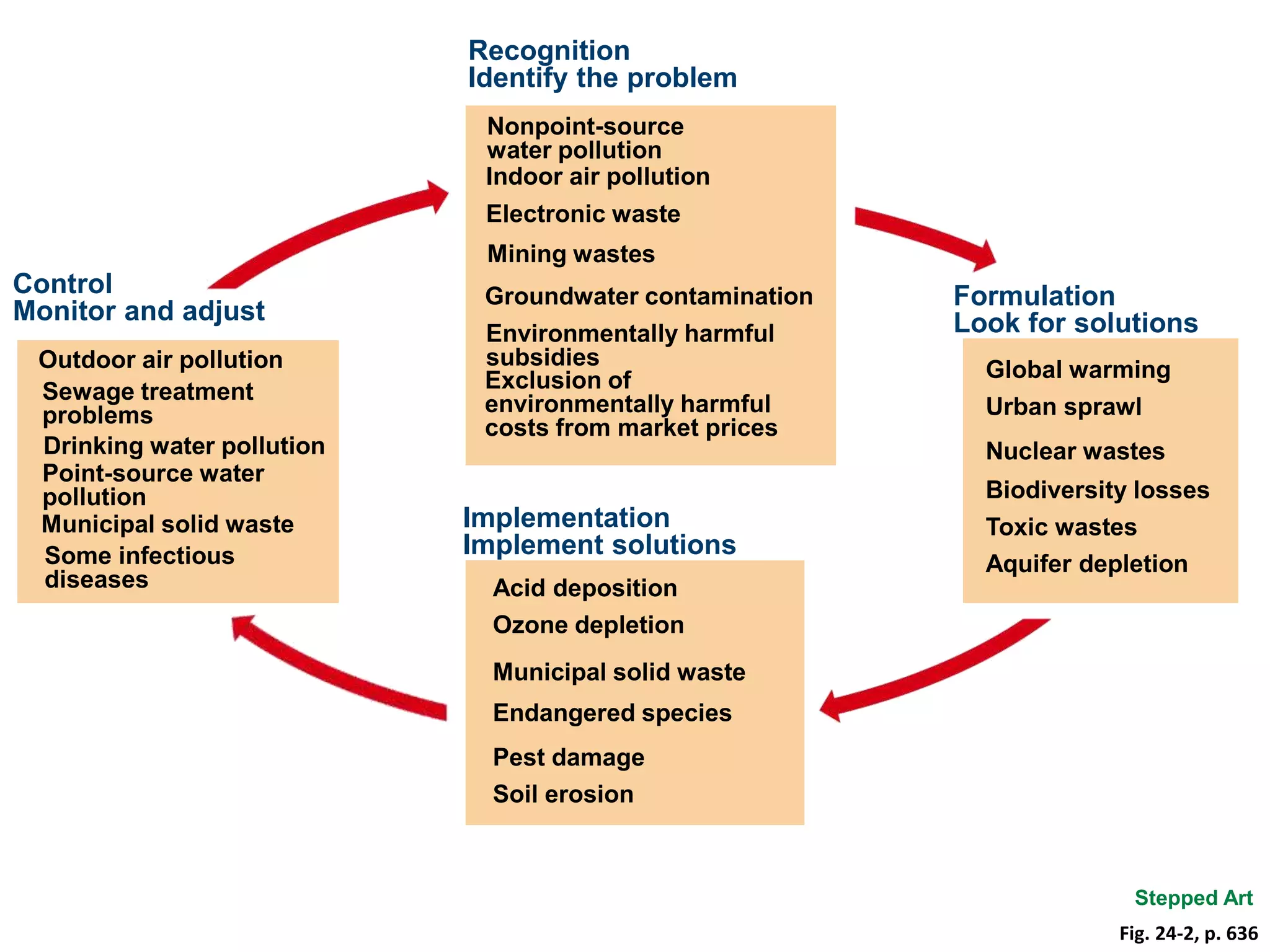
• Policy life cycle: 4 stages
– Recognition
– Formulation
– Implementation
– Control
Fig. 24-2, p. 636
Recognition
Identify the problem
Nonpoint-source
water pollution
Indoor air pollution
Electronic waste
Mining wastes
Groundwater contamination
Environmentally harmful
subsidies
Exclusion of
environmentally harmful
costs from market prices
Control
Monitor and adjust
Outdoor air pollution
Sewage treatment
problems
Drinking water pollution
Point-source water
pollution
Some infectious
diseases
Municipal solid waste
Stepped Art
Implementation
Implement solutions
Acid deposition
Ozone depletion
Municipal solid waste
Endangered species
Pest damage
Soil erosion
Formulation
Look for solutions
Global warming
Urban sprawl
Nuclear wastes
Biodiversity losses
Toxic wastes
Aquifer depletion
Democracy Does Not Always Allow
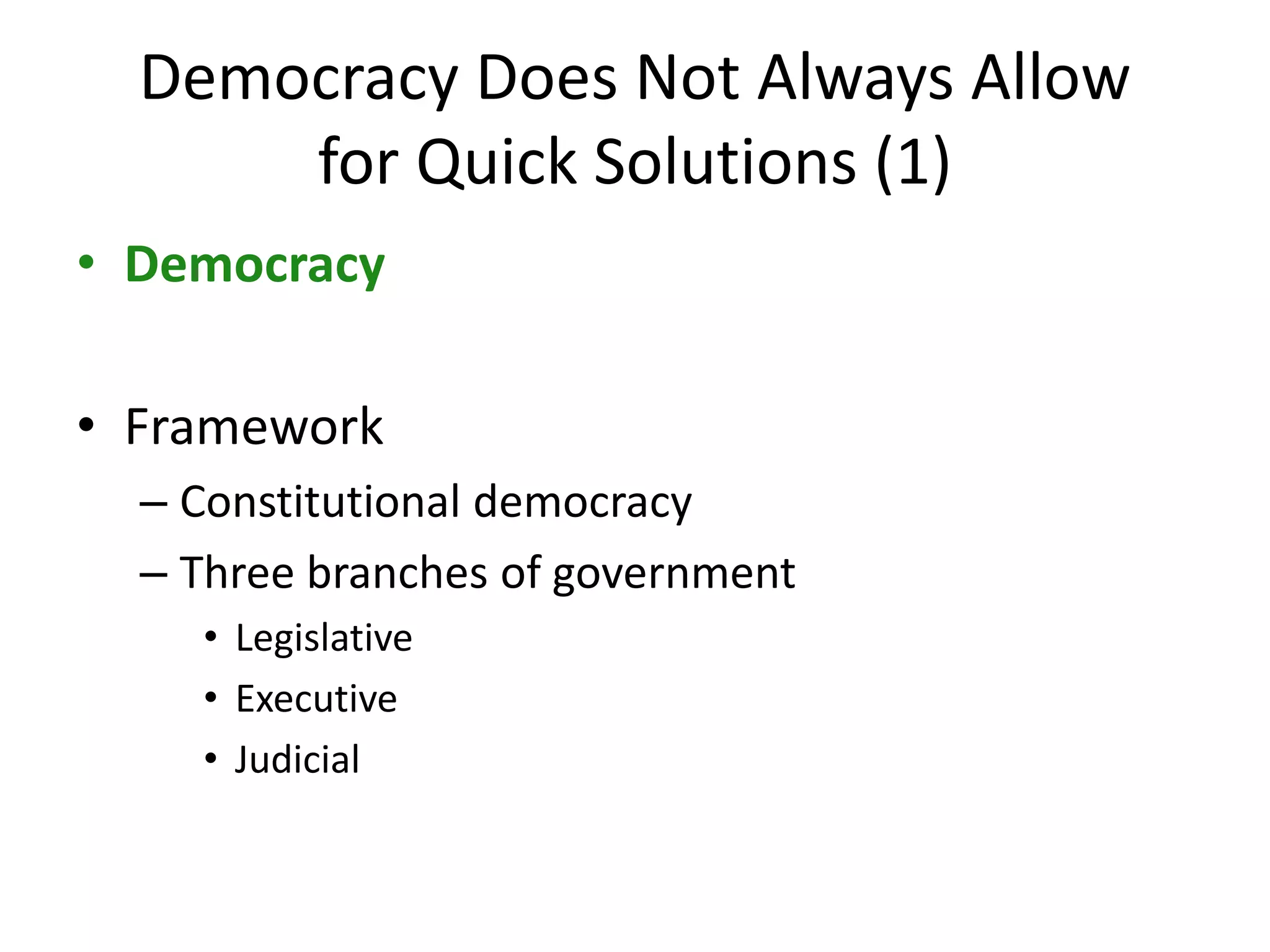
for Quick Solutions (1)
• Democracy
• Framework
– Constitutional democracy
– Three branches of government
• Legislative
• Executive
• Judicial
Democracy Does Not Always Allow
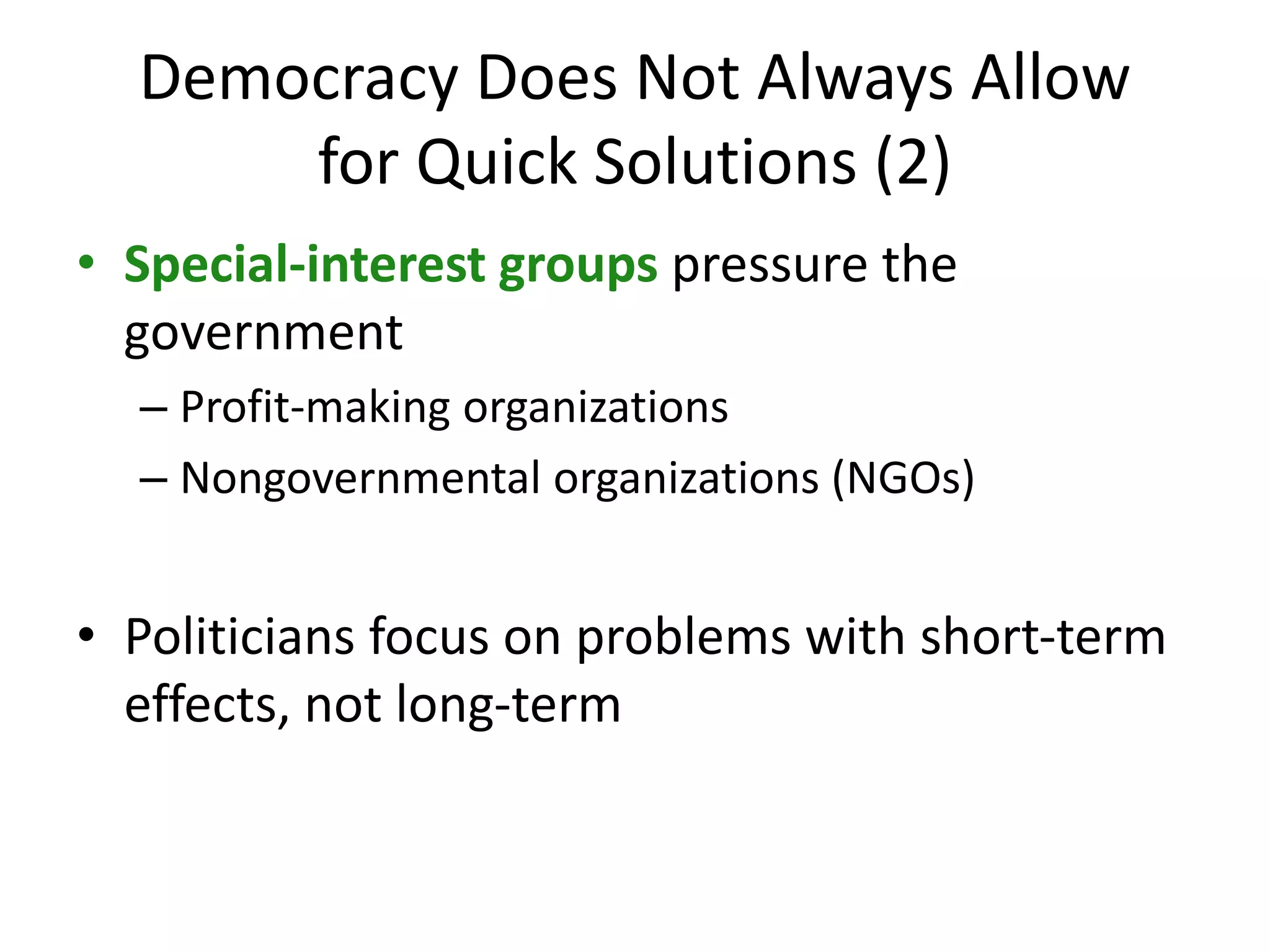
for Quick Solutions (2)
• Special-interest groups pressure the
government
– Profit-making organizations
– Nongovernmental organizations (NGOs)
• Politicians focus on problems with short-term
effects, not long-term
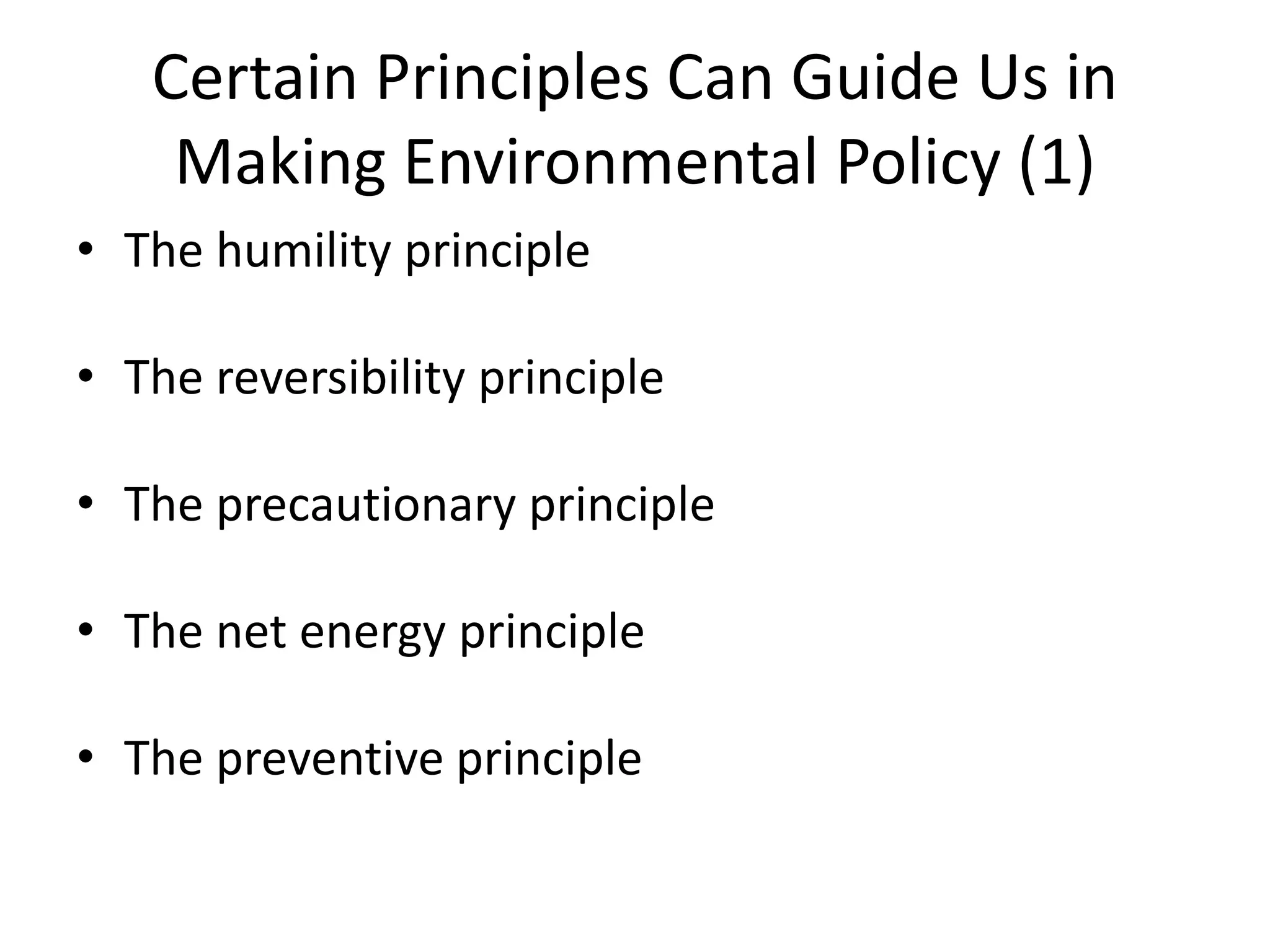
Certain Principles Can Guide Us in
Making Environmental Policy (1)
• The humility principle
• The reversibility principle
• The precautionary principle
• The net energy principle
• The preventive principle
Certain Principles Can Guide Us in
Making Environmental Policy (2)
• The polluter-pays principle
• The public access and participation principle
• The human rights principle
• The environmental justice principle
• How will these principles be implemented?
24-2 How Is Environmental Policy
Made? (1)
• Concept 24-2A Policy making involves law
making, program funding, rule writing, and
enforcement of rules by agencies—a complex
process that is affected at each stage by
political processes.
24-2 How Is Environmental Policy
Made? (2)
• Concept 24-2B Individuals can work with each
other to become part of political processes
that influence how environmental policies are
made and whether or not they succeed.
(Individuals matter.)
How Democratic Government Works:
The U.S. Model
• Three branches
– Legislative branch
– Executive branch
– Judicial branch
• Develop and implement policy
– Laws, regulation, and funding
– Lobbying
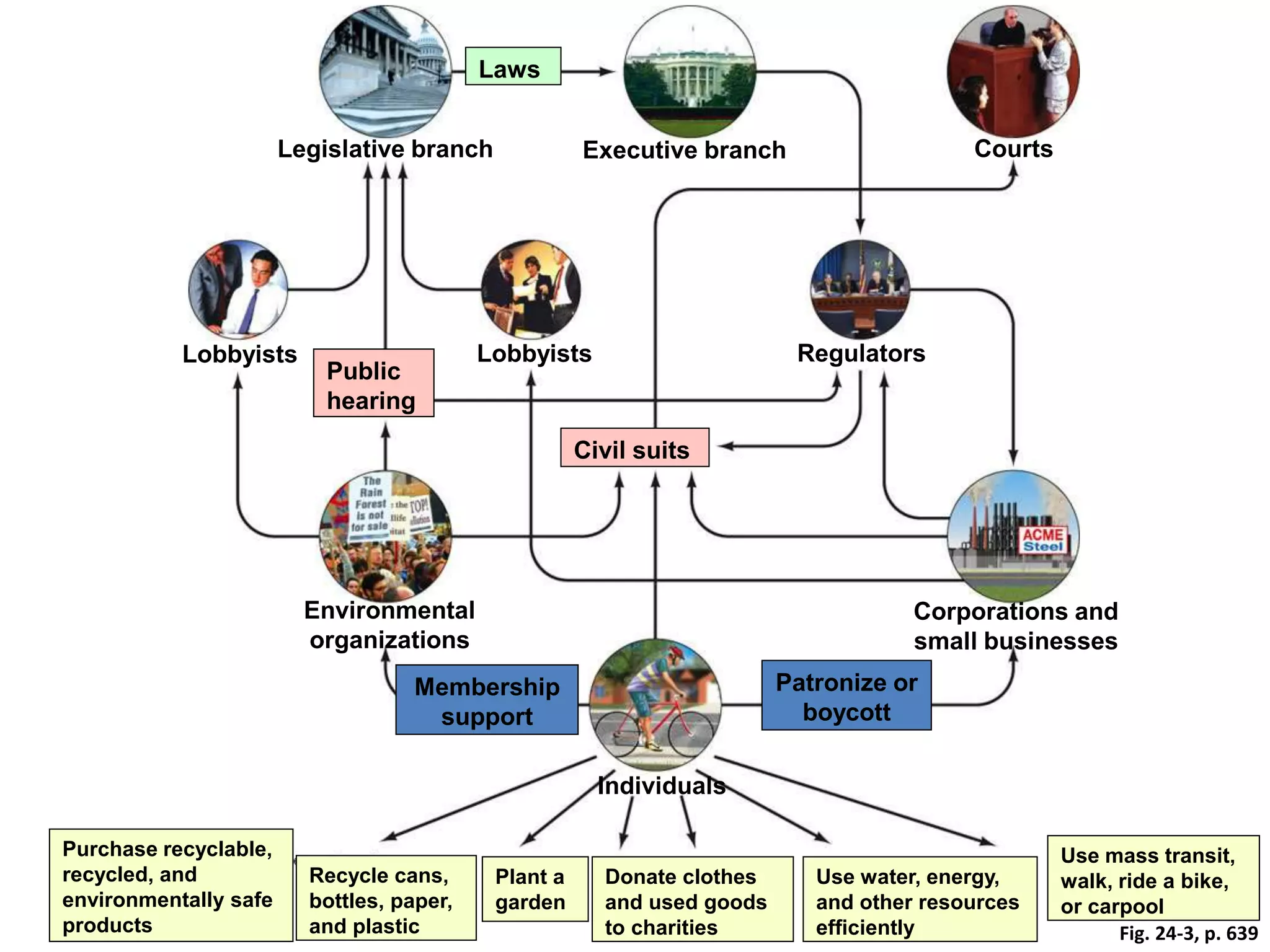
Fig. 24-3, p. 639
Laws
Legislative branch Executive branch Courts
Lobbyists Lobbyists Regulators
Public
hearing
Civil suits
Environmental
organizations
Corporations and
small businesses
Membership
support
Patronize or
boycott
Individuals
Purchase recyclable,
recycled, and
environmentally safe
products
Recycle cans,
bottles, paper,
and plastic
Plant a
garden
Donate clothes
and used goods
to charities
Use water, energy,
and other resources
efficiently
Use mass transit,
walk, ride a bike,
or carpool
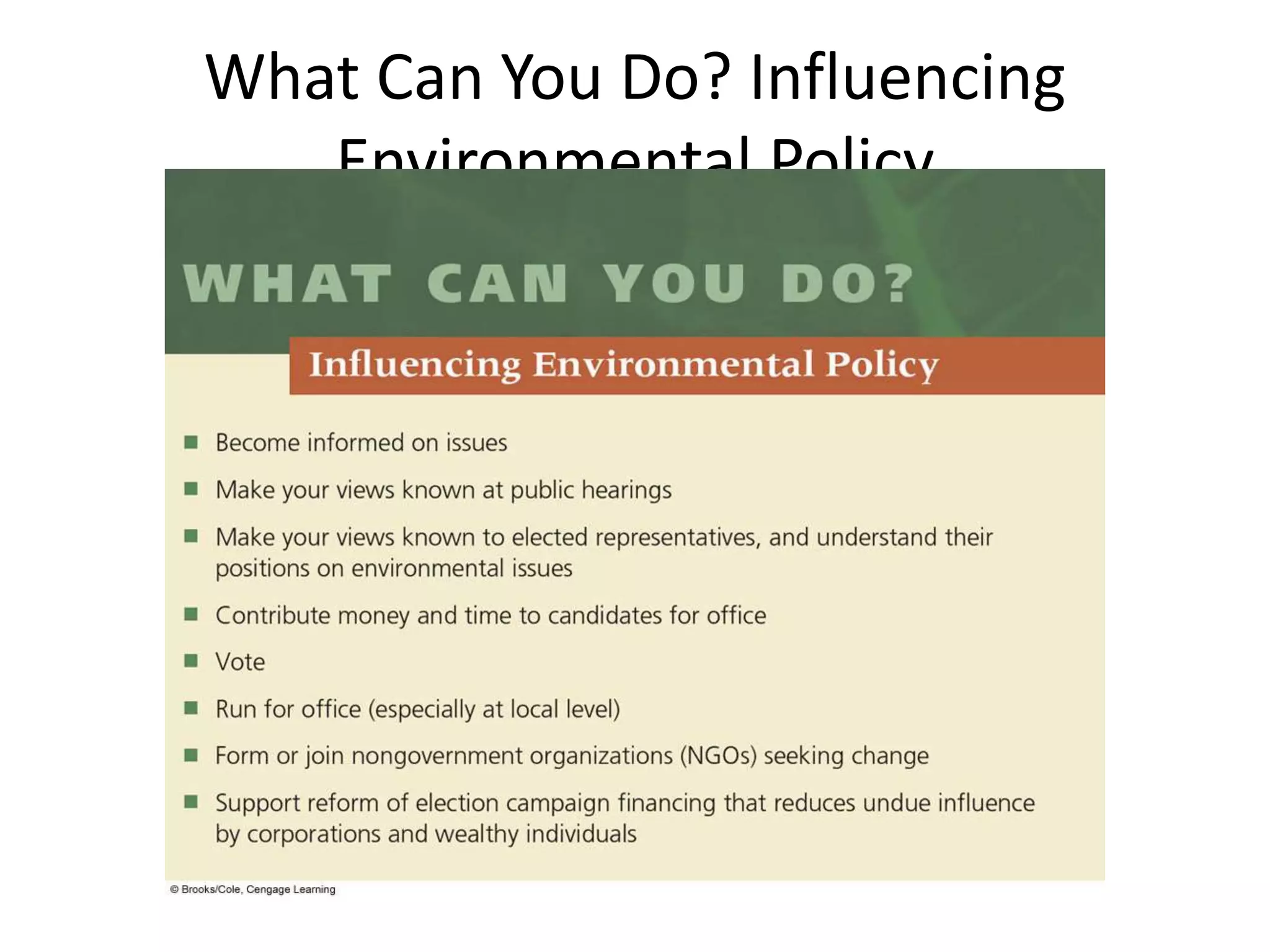
What Can You Do? Influencing
Environmental Policy
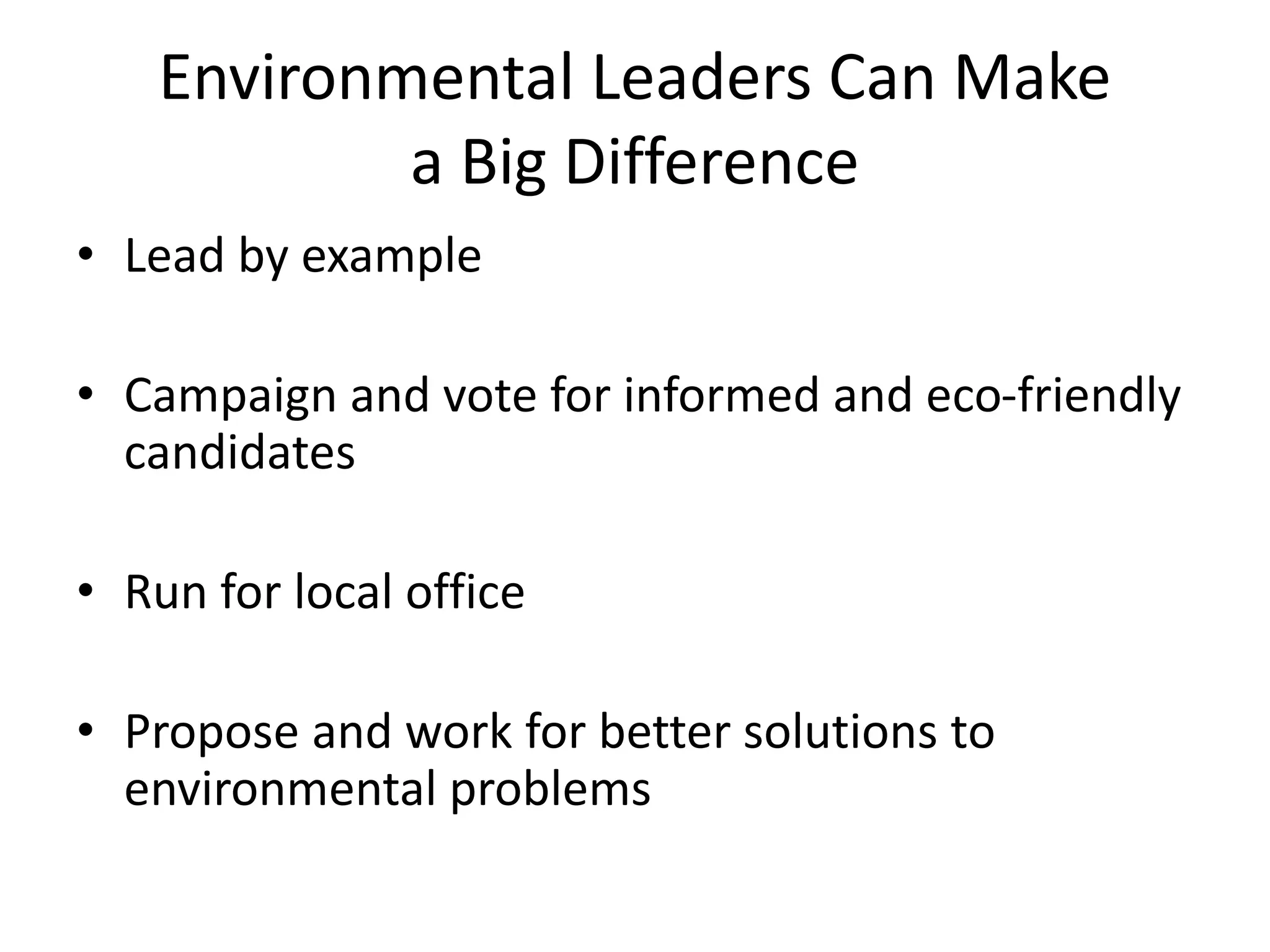
Environmental Leaders Can Make
a Big Difference
• Lead by example
• Campaign and vote for informed and eco-friendly
candidates
• Run for local office
• Propose and work for better solutions to
environmental problems
24-3 What Is the Role of Environmental
Law in Dealing with Environmental
Problems?
• Concept 24-3 Environmental laws and
regulations can be used to control pollution,
set safety standards, encourage resource
conservation, and protect species and
ecosystems.
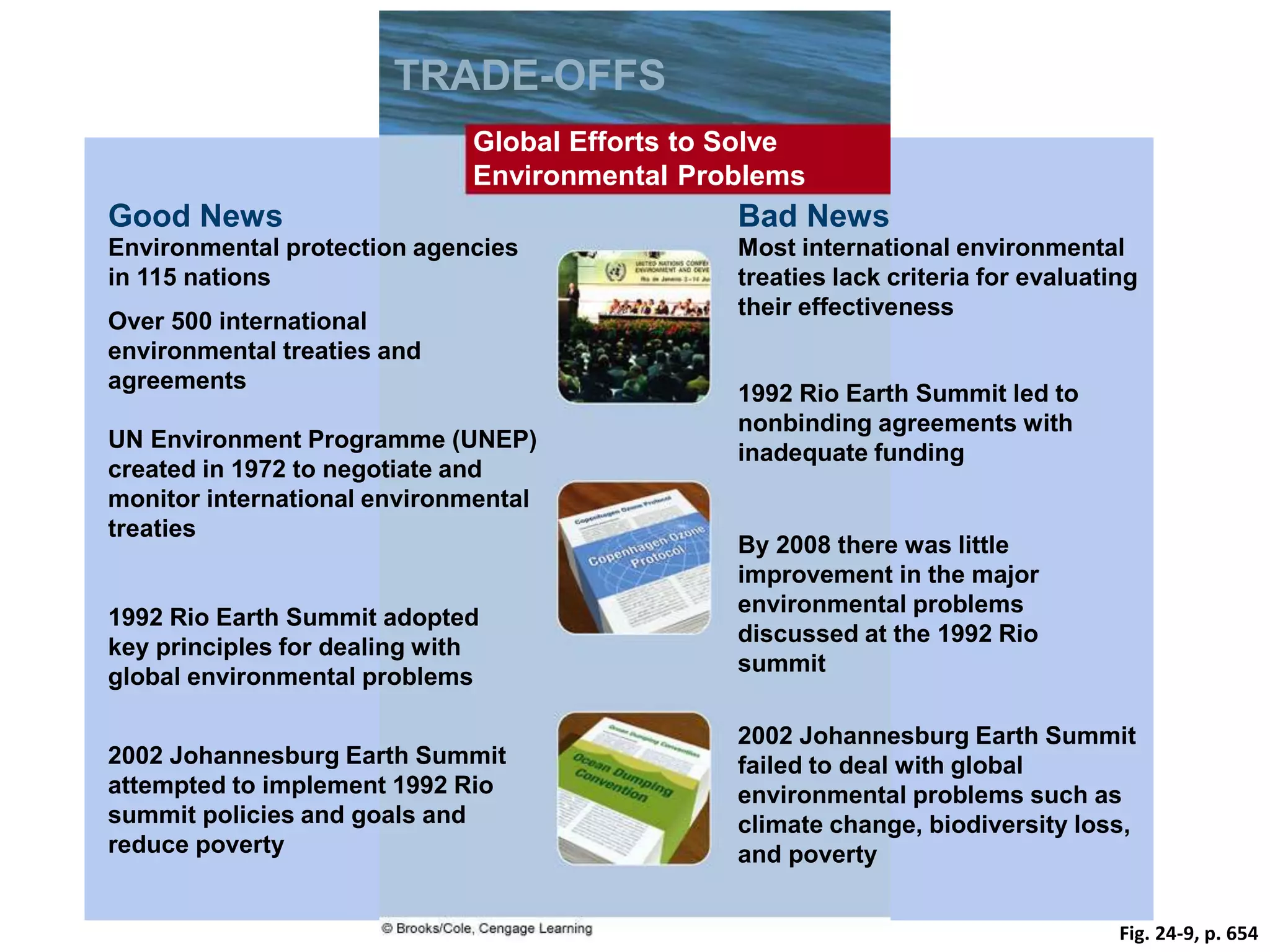
Fig. 24-9, p. 654
TRADE-OFFS
Global Efforts to Solve
Environmental Problems
Good News Bad News
Environmental protection agencies
in 115 nations
Most international environmental
treaties lack criteria for evaluating
their effectiveness
Over 500 international
environmental treaties and
agreements
1992 Rio Earth Summit led to
nonbinding agreements with
inadequate funding
UN Environment Programme (UNEP)
created in 1972 to negotiate and
monitor international environmental
treaties
By 2008 there was little
improvement in the major
environmental problems
discussed at the 1992 Rio
summit
1992 Rio Earth Summit adopted
key principles for dealing with
global environmental problems
2002 Johannesburg Earth Summit
failed to deal with global
environmental problems such as
climate change, biodiversity loss,
and poverty
2002 Johannesburg Earth Summit
attempted to implement 1992 Rio
summit policies and goals and
reduce poverty
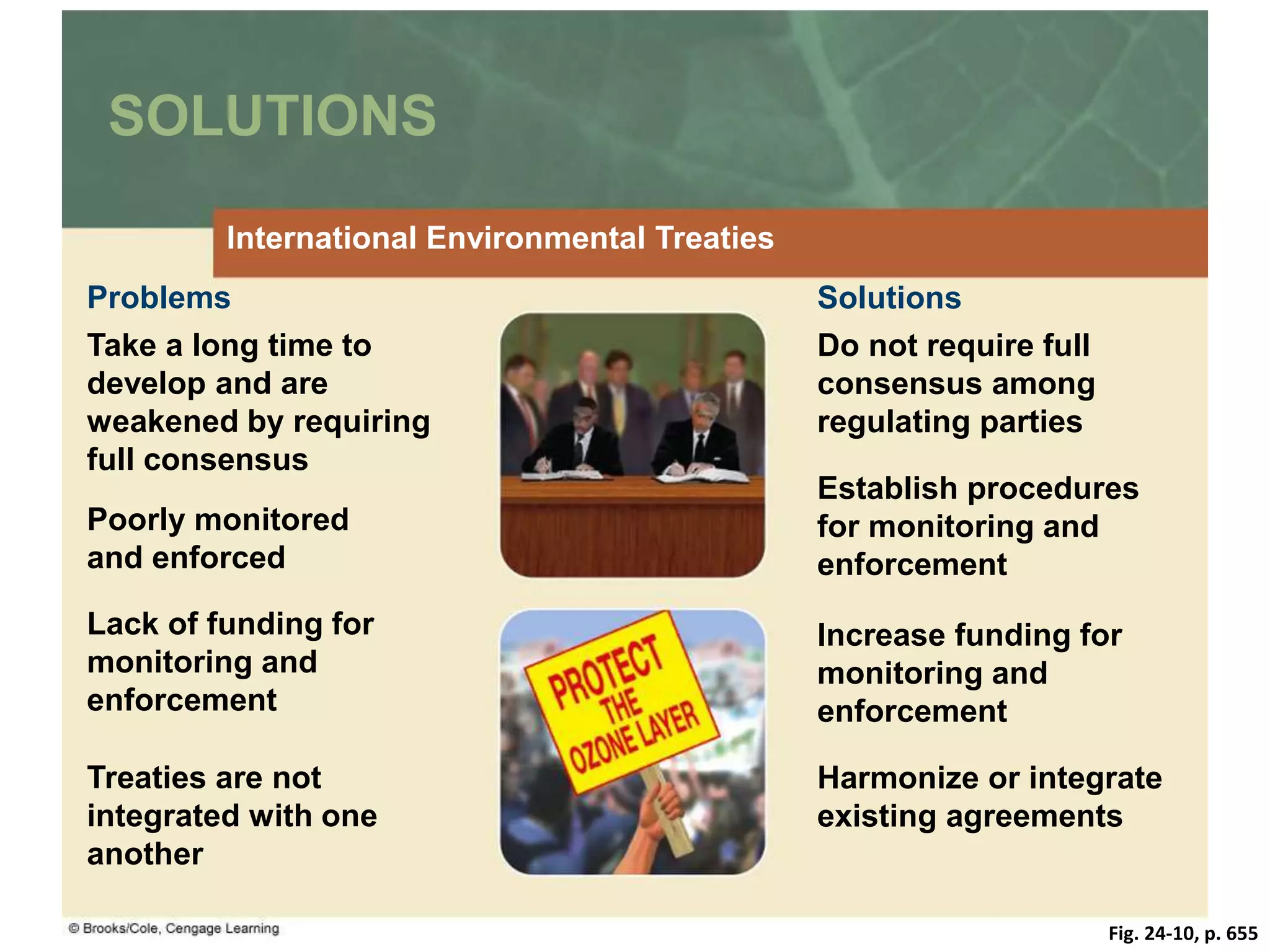
Fig. 24-10, p. 655
SOLUTIONS
International Environmental Treaties
Problems Solutions
Take a long time to
develop and are
weakened by requiring
full consensus
Do not require full
consensus among
regulating parties
Poorly monitored
and enforced
Establish procedures
for monitoring and
enforcement
Lack of funding for
monitoring and
enforcement
Increase funding for
monitoring and
enforcement
Treaties are not
integrated with one
another
Harmonize or integrate
existing agreements
Corporations Can Play a Key Role in
Moving Toward Environmental
Sustainability
• Eco-efficiency
• World Business Council for Sustainable
Development
24-6 Implementing More Sustainable
and Just Environmental Policies
• Concept 24-6 Making the transition to more
sustainable societies will require that nations
implement green plans and that people and
nations cooperate, agree on principles, and
make the political commitment to achieve this
transition.
Green Planning Can Be a National
Priority
• The Netherlands focused on four themes
– Implement life-cycle management
– Improve energy efficiency
– Invent more environmentally sustainable technologies
– Public education
• Is the plan in the Netherlands working?
• EPI rank for the Netherlands is 55/149 countries
We Can Shift to More Environmentally
Sustainable Societies
• Emphasize preventing or minimizing
environmental problems
• Use market-place solutions
• Win-win solutions or trade-offs to environmental
problems or injustices
• Be honest and objective
Role of govt in environment

Role of govt in environment

  • 1.
    Role of Govt.in environmental protection
  • 2.
    24-1 The Roleof Government in the Transition to More Sustainable Societies • Concept 24-1 A government can help to protect environmental and public interests and help to encourage more environmentally sustainable economic development through its policies.
  • 3.
    Government Can ServeEnvironmental and Other Public Interests (1) • Balance between government intervention and free enterprise • Is the government the best mechanism to deal with – Full-cost pricing – Market failures – The tragedy of the commons
  • 4.
    Government Can ServeEnvironmental and Other Public Interests (2) • Policies and politics • Environmental policy • Policy life cycle: 4 stages – Recognition – Formulation – Implementation – Control
  • 5.
    Fig. 24-2, p.636 Recognition Identify the problem Nonpoint-source water pollution Indoor air pollution Electronic waste Mining wastes Groundwater contamination Environmentally harmful subsidies Exclusion of environmentally harmful costs from market prices Control Monitor and adjust Outdoor air pollution Sewage treatment problems Drinking water pollution Point-source water pollution Some infectious diseases Municipal solid waste Stepped Art Implementation Implement solutions Acid deposition Ozone depletion Municipal solid waste Endangered species Pest damage Soil erosion Formulation Look for solutions Global warming Urban sprawl Nuclear wastes Biodiversity losses Toxic wastes Aquifer depletion
  • 6.
    Democracy Does NotAlways Allow for Quick Solutions (1) • Democracy • Framework – Constitutional democracy – Three branches of government • Legislative • Executive • Judicial
  • 7.
    Democracy Does NotAlways Allow for Quick Solutions (2) • Special-interest groups pressure the government – Profit-making organizations – Nongovernmental organizations (NGOs) • Politicians focus on problems with short-term effects, not long-term
  • 8.
    Certain Principles CanGuide Us in Making Environmental Policy (1) • The humility principle • The reversibility principle • The precautionary principle • The net energy principle • The preventive principle
  • 9.
    Certain Principles CanGuide Us in Making Environmental Policy (2) • The polluter-pays principle • The public access and participation principle • The human rights principle • The environmental justice principle • How will these principles be implemented?
  • 10.
    24-2 How IsEnvironmental Policy Made? (1) • Concept 24-2A Policy making involves law making, program funding, rule writing, and enforcement of rules by agencies—a complex process that is affected at each stage by political processes.
  • 11.
    24-2 How IsEnvironmental Policy Made? (2) • Concept 24-2B Individuals can work with each other to become part of political processes that influence how environmental policies are made and whether or not they succeed. (Individuals matter.)
  • 12.
    How Democratic GovernmentWorks: The U.S. Model • Three branches – Legislative branch – Executive branch – Judicial branch • Develop and implement policy – Laws, regulation, and funding – Lobbying
  • 13.
    Fig. 24-3, p.639 Laws Legislative branch Executive branch Courts Lobbyists Lobbyists Regulators Public hearing Civil suits Environmental organizations Corporations and small businesses Membership support Patronize or boycott Individuals Purchase recyclable, recycled, and environmentally safe products Recycle cans, bottles, paper, and plastic Plant a garden Donate clothes and used goods to charities Use water, energy, and other resources efficiently Use mass transit, walk, ride a bike, or carpool
  • 14.
    What Can YouDo? Influencing Environmental Policy
  • 15.
    Environmental Leaders CanMake a Big Difference • Lead by example • Campaign and vote for informed and eco-friendly candidates • Run for local office • Propose and work for better solutions to environmental problems
  • 16.
    24-3 What Isthe Role of Environmental Law in Dealing with Environmental Problems? • Concept 24-3 Environmental laws and regulations can be used to control pollution, set safety standards, encourage resource conservation, and protect species and ecosystems.
  • 17.
    Fig. 24-9, p.654 TRADE-OFFS Global Efforts to Solve Environmental Problems Good News Bad News Environmental protection agencies in 115 nations Most international environmental treaties lack criteria for evaluating their effectiveness Over 500 international environmental treaties and agreements 1992 Rio Earth Summit led to nonbinding agreements with inadequate funding UN Environment Programme (UNEP) created in 1972 to negotiate and monitor international environmental treaties By 2008 there was little improvement in the major environmental problems discussed at the 1992 Rio summit 1992 Rio Earth Summit adopted key principles for dealing with global environmental problems 2002 Johannesburg Earth Summit failed to deal with global environmental problems such as climate change, biodiversity loss, and poverty 2002 Johannesburg Earth Summit attempted to implement 1992 Rio summit policies and goals and reduce poverty
  • 18.
    Fig. 24-10, p.655 SOLUTIONS International Environmental Treaties Problems Solutions Take a long time to develop and are weakened by requiring full consensus Do not require full consensus among regulating parties Poorly monitored and enforced Establish procedures for monitoring and enforcement Lack of funding for monitoring and enforcement Increase funding for monitoring and enforcement Treaties are not integrated with one another Harmonize or integrate existing agreements
  • 19.
    Corporations Can Playa Key Role in Moving Toward Environmental Sustainability • Eco-efficiency • World Business Council for Sustainable Development
  • 20.
    24-6 Implementing MoreSustainable and Just Environmental Policies • Concept 24-6 Making the transition to more sustainable societies will require that nations implement green plans and that people and nations cooperate, agree on principles, and make the political commitment to achieve this transition.
  • 21.
    Green Planning CanBe a National Priority • The Netherlands focused on four themes – Implement life-cycle management – Improve energy efficiency – Invent more environmentally sustainable technologies – Public education • Is the plan in the Netherlands working? • EPI rank for the Netherlands is 55/149 countries
  • 22.
    We Can Shiftto More Environmentally Sustainable Societies • Emphasize preventing or minimizing environmental problems • Use market-place solutions • Win-win solutions or trade-offs to environmental problems or injustices • Be honest and objective

Editor's Notes

  • #6 Figure 24.2 The policy life cycle, including positions of some major environmental problems within the cycle in most developed countries.
  • #14 Figure 24.3 Greatly simplified overview of how individuals, corporations, and environmental organizations interact with each other and with the legislative, executive, and judicial branches of the U.S. government. The bottom of this diagram also shows some ways in which individuals can bring about environmental change through their own lifestyles. (See the website for this book for details on contacting elected representatives.)
  • #18 Figure 24.9 Good and bad news about international efforts to deal with global environmental problems. Question: What single piece of good news and what single piece of bad news do you think are the most important?
  • #19 Figure 24.10 Global outlook: major problems with global environmental treaties and agreements and solutions to these problems. Question: Which problem and which solution do you think are the most important?