MARKET STRUCTURES
Prepared by: Sajan N Thomas
What are markets?
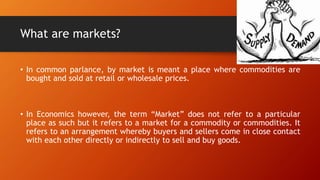
• In common parlance, by market is meant a place where commodities are
bought and sold at retail or wholesale prices.
• In Economics however, the term “Market” does not refer to a particular
place as such but it refers to a market for a commodity or commodities. It
refers to an arrangement whereby buyers and sellers come in close contact
with each other directly or indirectly to sell and buy goods.
Markets
What is ‘market structure’
• Market structure is the characteristics of a market.
• We focus on those characteristics which affect the nature of
competition and pricing
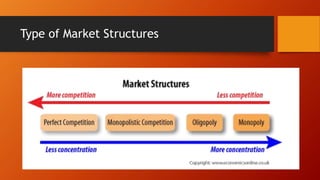
Type of Market Structures
Alternative Market Structures
• The four market structures
• perfect competition
• monopoly
• monopolistic competition
• oligopoly
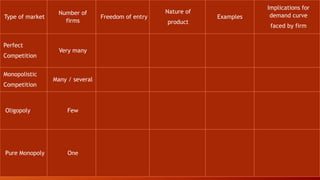
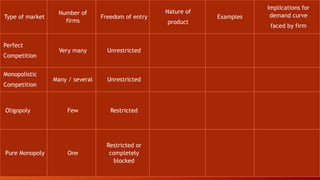
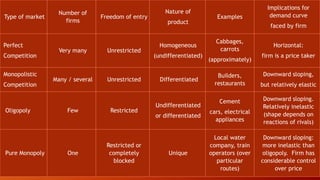
Type of market
Number of
firms
Freedom of entry
Nature of
product
Examples
Implications for
demand curve
faced by firm
Perfect
Competition
Very many Unrestricted
Homogeneous
(undifferentiated)
Cabbages,
carrots
(approximately)
Horizontal:
firm is a price taker
Monopolistic
Competition
Many / several Unrestricted Differentiated
Builders,
restaurants
Downward sloping,
but relatively elastic
Oligopoly Few Restricted
Undifferentiated
or differentiated
Cement
cars, electrical
appliances
Downward sloping.
Relatively inelastic
(shape depends on
reactions of rivals)
Pure Monopoly One
Restricted or
completely
blocked
Unique
Local water
company, train
operators (over
particular
routes)
Downward sloping:
more inelastic than
oligopoly. Firm has
considerable control
over price
Type of market
Number of
firms
Freedom of entry
Nature of
product
Examples
Implications for
demand curve
faced by firm
Perfect
Competition
Very many Unrestricted
Homogeneous
(undifferentiated)
Cabbages,
carrots
(approximately)
Horizontal:
firm is a price taker
Monopolistic
Competition
Many / several Unrestricted Differentiated
Builders,
restaurants
Downward sloping,
but relatively elastic
Oligopoly Few Restricted
Undifferentiated
or differentiated
Cement
cars, electrical
appliances
Downward sloping.
Relatively inelastic
(shape depends on
reactions of rivals)
Pure Monopoly One
Restricted or
completely
blocked
Unique
Local water
company, train
operators (over
particular
routes)
Downward sloping:
more inelastic than
oligopoly. Firm has
considerable control
over price
Type of market
Number of
firms
Freedom of entry
Nature of
product
Examples
Implications for
demand curve
faced by firm
Perfect
Competition
Very many Unrestricted
Homogeneous
(undifferentiated)
Cabbages,
carrots
(approximately)
Horizontal:
firm is a price taker
Monopolistic
Competition
Many / several Unrestricted Differentiated
Builders,
restaurants
Downward sloping,
but relatively elastic
Oligopoly Few Restricted
Undifferentiated
or differentiated
Cement
cars, electrical
appliances
Downward sloping.
Relatively inelastic
(shape depends on
reactions of rivals)
Pure Monopoly One
Restricted or
completely
blocked
Unique
Local water
company, train
operators (over
particular
routes)
Downward sloping:
more inelastic than
oligopoly. Firm has
considerable control
over price
Type of market
Number of
firms
Freedom of entry
Nature of
product
Examples
Implications for
demand curve
faced by firm
Perfect
Competition
Very many Unrestricted
Homogeneous
(undifferentiated)
Cabbages,
carrots
(approximately)
Horizontal:
firm is a price taker
Monopolistic
Competition
Many / several Unrestricted Differentiated
Builders,
restaurants
Downward sloping,
but relatively elastic
Oligopoly Few Restricted
Undifferentiated
or differentiated
Cement
cars, electrical
appliances
Downward sloping.
Relatively inelastic
(shape depends on
reactions of rivals)
Pure Monopoly One
Restricted or
completely
blocked
Unique
Local water
company, train
operators (over
particular
routes)
Downward sloping:
more inelastic than
oligopoly. Firm has
considerable control
over price
Type of market
Number of
firms
Freedom of entry
Nature of
product
Examples
Implications for
demand curve
faced by firm
Perfect
Competition
Very many Unrestricted
Homogeneous
(undifferentiated)
Cabbages,
carrots
(approximately)
Horizontal:
firm is a price taker
Monopolistic
Competition
Many / several Unrestricted Differentiated
Builders,
restaurants
Downward sloping,
but relatively elastic
Oligopoly Few Restricted
Undifferentiated
or differentiated
Cement
cars, electrical
appliances
Downward sloping.
Relatively inelastic
(shape depends on
reactions of rivals)
Pure Monopoly One
Restricted or
completely
blocked
Unique
Local water
company, train
operators (over
particular
routes)
Downward sloping:
more inelastic than
oligopoly. Firm has
considerable control
over price
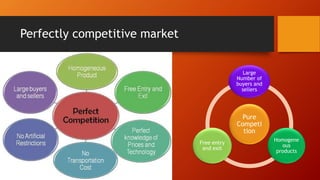
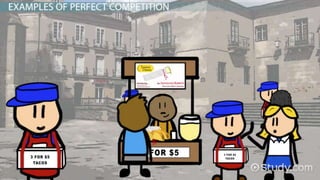
Perfectly competitive market
Pure
Competi
tion
Large
Number of
buyers and
sellers
Homogene
ous
products
Free entry
and exit
REVENUE AND COST CURVES UNDER
PERFECT COMPETITION
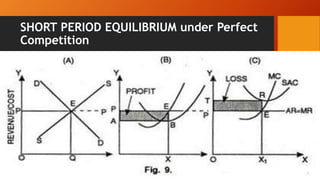
SHORT PERIOD EQUILIBRIUM under Perfect
Competition
LONG PERIOD EQUILIBRIUM under Perfect
Competition
IMPERFECT COMPETITION
MONOPOLY
• Literally monopoly means one seller.
• ‘Mono’ means one and ‘poly’ means seller.
• One firm is the sole producer or seller of a product which has no close substitutes.
• Thus monopoly is negation of competition.
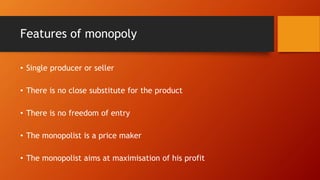
Features of monopoly
• Single producer or seller
• There is no close substitute for the product
• There is no freedom of entry
• The monopolist is a price maker
• The monopolist aims at maximisation of his profit
Indian railway – a monopoly
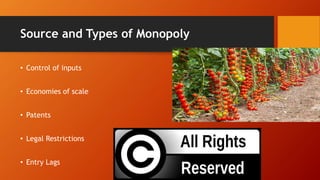
Source and Types of Monopoly
• Control of inputs
• Economies of scale
• Patents
• Legal Restrictions
• Entry Lags
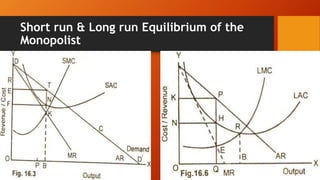
Short run & Long run Equilibrium of the
Monopolist
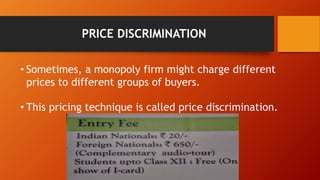
PRICE DISCRIMINATION
• Sometimes, a monopoly firm might charge different
prices to different groups of buyers.
• This pricing technique is called price discrimination.
Degrees of Price Discrimination
Prof. A C Pigou has distinguished between three forms of price discrimination,
namely;
• First degree price discrimination (different price to each of its customers)
• Second degree price discrimination (discriminate according to quantities consumed)
• Third degree price discrimination (different prices to each sub market)
Price
discrimination
of the first
degree
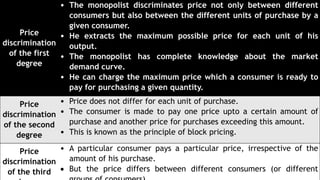
• The monopolist discriminates price not only between different
consumers but also between the different units of purchase by a
given consumer.
• He extracts the maximum possible price for each unit of his
output.
• The monopolist has complete knowledge about the market
demand curve.
• He can charge the maximum price which a consumer is ready to
pay for purchasing a given quantity.
Price
discrimination
of the second
degree
• Price does not differ for each unit of purchase.
• The consumer is made to pay one price upto a certain amount of
purchase and another price for purchases exceeding this amount.
• This is known as the principle of block pricing.
Price
discrimination
of the third
• A particular consumer pays a particular price, irrespective of the
amount of his purchase.
 But the price differs between different consumers (or different
Monopolistic Competition
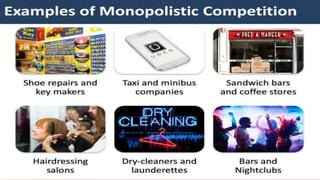
• It is that form of market in which there are large numbers of sellers selling
differentiated products which are similar in nature but not homogenous.
• Eg., the different brands of soap - these are closely related goods with a
little difference in odour, size and shape.
• It is a combination of perfect competition and monopoly
Features of monopolistic competition
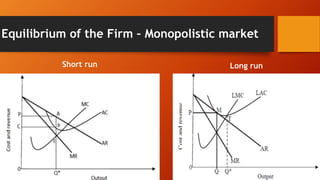
Equilibrium of the Firm – Monopolistic market
Short run Long run
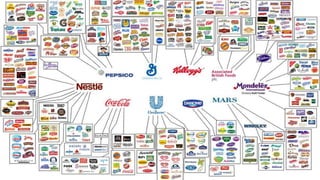
OLIGOPOLY
Meaning
• Oligopoly is a market situation in which there are few firms
producing either differential goods or closely differential goods.
The number of firms is so small that every seller is affected by the
activities of the others.
Features of oligopoly
COLLUSIVE OLIGOPOLY
• There exists usually some form of understanding among the
oligopolists in a particular industry.
• This understanding or agreement among the oligopolists may be
either tacit or formal.
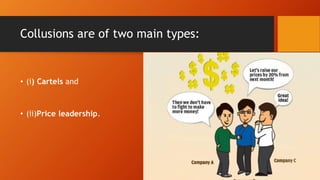
Collusions are of two main types:
• (i) Cartels and
• (ii)Price leadership.
THE KINKED DEMAND THEORY OF
OLIGOPOLY
• It has been observed that many oligopolistic industries exhibit an appreciable degree of price
rigidity or stability.
• That is, in many oligopolistic industries prices remain sticky or inflexible, and there is no
tendency on the part of the oligopolists to change price of the commodity by them even if
the economic conditions undergo a change.
• The most popular explanation is the so-called kinked demand curve hypothesis.
KINKED DEMAND CURVE
DUOPOLY
Meaning pf duopoly
• It is a specific type of oligopoly where only two producers exist in
one market. In reality, this definition is generally used where only
two firms have dominant control over a market.
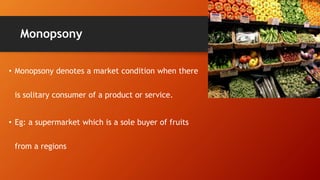
Monopsony
• Monopsony denotes a market condition when there
is solitary consumer of a product or service.
• Eg: a supermarket which is a sole buyer of fruits
from a regions
Bilateral Monopoly
• Bilateral monopoly denotes a market condition in which a solitary
manufacturer of merchandise faces a solitary purchaser of that
commodity
Duopsony
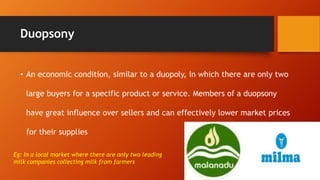
• An economic condition, similar to a duopoly, in which there are only two
large buyers for a specific product or service. Members of a duopsony
have great influence over sellers and can effectively lower market prices
for their supplies
Eg: In a local market where there are only two leading
milk companies collecting milk from farmers
Oligopsony
• An oligopsony is a market form in which the number of buyers is
small while the number of sellers in theory could be large.
• This typically happens in a market for inputs where numerous
suppliers are competing to sell their product to a small number of
(often large and powerful) buyers.
• It contrasts with an oligopoly, where there are many buyers but few
sellers.
Example of oligopsony

Market structures perfect & imperfect competitions

  • 1.
  • 2.
    What are markets? •In common parlance, by market is meant a place where commodities are bought and sold at retail or wholesale prices. • In Economics however, the term “Market” does not refer to a particular place as such but it refers to a market for a commodity or commodities. It refers to an arrangement whereby buyers and sellers come in close contact with each other directly or indirectly to sell and buy goods.
  • 3.
  • 4.
    What is ‘marketstructure’ • Market structure is the characteristics of a market. • We focus on those characteristics which affect the nature of competition and pricing
  • 5.
    Type of MarketStructures
  • 6.
    Alternative Market Structures •The four market structures • perfect competition • monopoly • monopolistic competition • oligopoly
  • 7.
    Type of market Numberof firms Freedom of entry Nature of product Examples Implications for demand curve faced by firm Perfect Competition Very many Unrestricted Homogeneous (undifferentiated) Cabbages, carrots (approximately) Horizontal: firm is a price taker Monopolistic Competition Many / several Unrestricted Differentiated Builders, restaurants Downward sloping, but relatively elastic Oligopoly Few Restricted Undifferentiated or differentiated Cement cars, electrical appliances Downward sloping. Relatively inelastic (shape depends on reactions of rivals) Pure Monopoly One Restricted or completely blocked Unique Local water company, train operators (over particular routes) Downward sloping: more inelastic than oligopoly. Firm has considerable control over price
  • 8.
    Type of market Numberof firms Freedom of entry Nature of product Examples Implications for demand curve faced by firm Perfect Competition Very many Unrestricted Homogeneous (undifferentiated) Cabbages, carrots (approximately) Horizontal: firm is a price taker Monopolistic Competition Many / several Unrestricted Differentiated Builders, restaurants Downward sloping, but relatively elastic Oligopoly Few Restricted Undifferentiated or differentiated Cement cars, electrical appliances Downward sloping. Relatively inelastic (shape depends on reactions of rivals) Pure Monopoly One Restricted or completely blocked Unique Local water company, train operators (over particular routes) Downward sloping: more inelastic than oligopoly. Firm has considerable control over price
  • 9.
    Type of market Numberof firms Freedom of entry Nature of product Examples Implications for demand curve faced by firm Perfect Competition Very many Unrestricted Homogeneous (undifferentiated) Cabbages, carrots (approximately) Horizontal: firm is a price taker Monopolistic Competition Many / several Unrestricted Differentiated Builders, restaurants Downward sloping, but relatively elastic Oligopoly Few Restricted Undifferentiated or differentiated Cement cars, electrical appliances Downward sloping. Relatively inelastic (shape depends on reactions of rivals) Pure Monopoly One Restricted or completely blocked Unique Local water company, train operators (over particular routes) Downward sloping: more inelastic than oligopoly. Firm has considerable control over price
  • 10.
    Type of market Numberof firms Freedom of entry Nature of product Examples Implications for demand curve faced by firm Perfect Competition Very many Unrestricted Homogeneous (undifferentiated) Cabbages, carrots (approximately) Horizontal: firm is a price taker Monopolistic Competition Many / several Unrestricted Differentiated Builders, restaurants Downward sloping, but relatively elastic Oligopoly Few Restricted Undifferentiated or differentiated Cement cars, electrical appliances Downward sloping. Relatively inelastic (shape depends on reactions of rivals) Pure Monopoly One Restricted or completely blocked Unique Local water company, train operators (over particular routes) Downward sloping: more inelastic than oligopoly. Firm has considerable control over price
  • 11.
    Type of market Numberof firms Freedom of entry Nature of product Examples Implications for demand curve faced by firm Perfect Competition Very many Unrestricted Homogeneous (undifferentiated) Cabbages, carrots (approximately) Horizontal: firm is a price taker Monopolistic Competition Many / several Unrestricted Differentiated Builders, restaurants Downward sloping, but relatively elastic Oligopoly Few Restricted Undifferentiated or differentiated Cement cars, electrical appliances Downward sloping. Relatively inelastic (shape depends on reactions of rivals) Pure Monopoly One Restricted or completely blocked Unique Local water company, train operators (over particular routes) Downward sloping: more inelastic than oligopoly. Firm has considerable control over price
  • 12.
    Perfectly competitive market Pure Competi tion Large Numberof buyers and sellers Homogene ous products Free entry and exit
  • 14.
    REVENUE AND COSTCURVES UNDER PERFECT COMPETITION
  • 15.
    SHORT PERIOD EQUILIBRIUMunder Perfect Competition
  • 16.
    LONG PERIOD EQUILIBRIUMunder Perfect Competition
  • 17.
  • 18.
    MONOPOLY • Literally monopolymeans one seller. • ‘Mono’ means one and ‘poly’ means seller. • One firm is the sole producer or seller of a product which has no close substitutes. • Thus monopoly is negation of competition.
  • 19.
    Features of monopoly •Single producer or seller • There is no close substitute for the product • There is no freedom of entry • The monopolist is a price maker • The monopolist aims at maximisation of his profit
  • 21.
  • 22.
    Source and Typesof Monopoly • Control of inputs • Economies of scale • Patents • Legal Restrictions • Entry Lags
  • 23.
    Short run &Long run Equilibrium of the Monopolist
  • 24.
    PRICE DISCRIMINATION • Sometimes,a monopoly firm might charge different prices to different groups of buyers. • This pricing technique is called price discrimination.
  • 25.
    Degrees of PriceDiscrimination Prof. A C Pigou has distinguished between three forms of price discrimination, namely; • First degree price discrimination (different price to each of its customers) • Second degree price discrimination (discriminate according to quantities consumed) • Third degree price discrimination (different prices to each sub market)
  • 26.
    Price discrimination of the first degree •The monopolist discriminates price not only between different consumers but also between the different units of purchase by a given consumer. • He extracts the maximum possible price for each unit of his output. • The monopolist has complete knowledge about the market demand curve. • He can charge the maximum price which a consumer is ready to pay for purchasing a given quantity. Price discrimination of the second degree • Price does not differ for each unit of purchase. • The consumer is made to pay one price upto a certain amount of purchase and another price for purchases exceeding this amount. • This is known as the principle of block pricing. Price discrimination of the third • A particular consumer pays a particular price, irrespective of the amount of his purchase.  But the price differs between different consumers (or different
  • 27.
    Monopolistic Competition • Itis that form of market in which there are large numbers of sellers selling differentiated products which are similar in nature but not homogenous. • Eg., the different brands of soap - these are closely related goods with a little difference in odour, size and shape. • It is a combination of perfect competition and monopoly
  • 29.
  • 31.
    Equilibrium of theFirm – Monopolistic market Short run Long run
  • 32.
  • 33.
    Meaning • Oligopoly isa market situation in which there are few firms producing either differential goods or closely differential goods. The number of firms is so small that every seller is affected by the activities of the others.
  • 36.
  • 37.
    COLLUSIVE OLIGOPOLY • Thereexists usually some form of understanding among the oligopolists in a particular industry. • This understanding or agreement among the oligopolists may be either tacit or formal.
  • 38.
    Collusions are oftwo main types: • (i) Cartels and • (ii)Price leadership.
  • 39.
    THE KINKED DEMANDTHEORY OF OLIGOPOLY • It has been observed that many oligopolistic industries exhibit an appreciable degree of price rigidity or stability. • That is, in many oligopolistic industries prices remain sticky or inflexible, and there is no tendency on the part of the oligopolists to change price of the commodity by them even if the economic conditions undergo a change. • The most popular explanation is the so-called kinked demand curve hypothesis.
  • 40.
  • 41.
  • 42.
    Meaning pf duopoly •It is a specific type of oligopoly where only two producers exist in one market. In reality, this definition is generally used where only two firms have dominant control over a market.
  • 43.
    Monopsony • Monopsony denotesa market condition when there is solitary consumer of a product or service. • Eg: a supermarket which is a sole buyer of fruits from a regions
  • 44.
    Bilateral Monopoly • Bilateralmonopoly denotes a market condition in which a solitary manufacturer of merchandise faces a solitary purchaser of that commodity
  • 45.
    Duopsony • An economiccondition, similar to a duopoly, in which there are only two large buyers for a specific product or service. Members of a duopsony have great influence over sellers and can effectively lower market prices for their supplies Eg: In a local market where there are only two leading milk companies collecting milk from farmers
  • 46.
    Oligopsony • An oligopsonyis a market form in which the number of buyers is small while the number of sellers in theory could be large. • This typically happens in a market for inputs where numerous suppliers are competing to sell their product to a small number of (often large and powerful) buyers. • It contrasts with an oligopoly, where there are many buyers but few sellers.
  • 47.