Product Life Cycle
Its concept
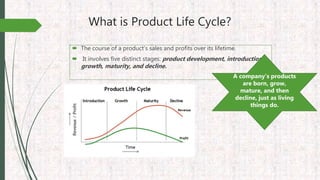
What is Product Life Cycle?
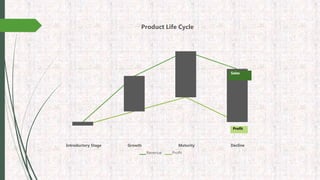
 The course of a product’s sales and profits over its lifetime.
 It involves five distinct stages: product development, introduction,
growth, maturity, and decline.
A company’s products
are born, grow,
mature, and then
decline, just as living
things do.
Stages of PLC
The PLC has five distinct stages:
 1. Product development begins when the company finds and develops a new-
product idea.
 2. Introduction is a period of slow sales growth as the product is introduced in the
market.
 3. Growth is a period of rapid market acceptance and increasing profits.
 4. Maturity is a period of slowdown in sales growth because the product has
achieved acceptance by most potential buyers.
 5. Decline is the period when sales fall off and profits drop.
Some products die quickly; others
stay in the mature stage for a
long, long time.
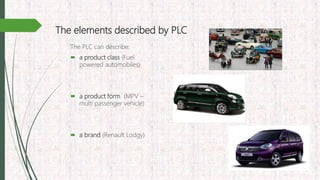
The elements described by PLC
The PLC can describe:
 a product class (Fuel
powered automobiles)
 a product form (MPV –
multi passenger vehicle)
 a brand (Renault Lodgy)
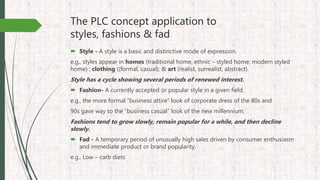
The PLC concept application to
styles, fashions & fad
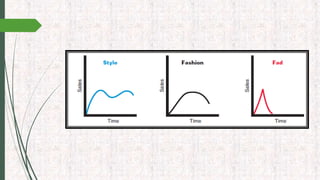
 Style - A style is a basic and distinctive mode of expression.
e.g., styles appear in homes (traditional home, ethnic – styled home, modern styled
home) ; clothing ((formal, casual); & art (realist, surrealist, abstract).
Style has a cycle showing several periods of renewed interest.
 Fashion- A currently accepted or popular style in a given field.
e.g., the more formal “business attire” look of corporate dress of the 80s and
90s gave way to the “business casual” look of the new millennium.
Fashions tend to grow slowly, remain popular for a while, and then decline
slowly.
 Fad - A temporary period of unusually high sales driven by consumer enthusiasm
and immediate product or brand popularity.
e.g., Low – carb diets
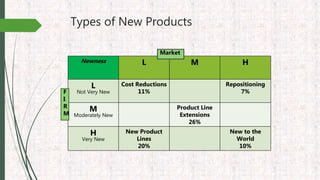
Types of New Products
Newness L M H
L
Not Very New
Cost Reductions
11%
Repositioning
7%
M
Moderately New
Product Line
Extensions
26%
H
Very New
New Product
Lines
20%
New to the
World
10%
Market
F
I
R
M
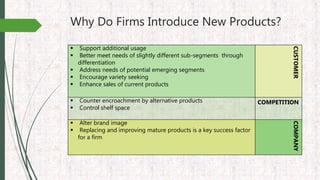
Why Do Firms Introduce New Products?
 Support additional usage
 Better meet needs of slightly different sub-segments through
differentiation
 Address needs of potential emerging segments
 Encourage variety seeking
 Enhance sales of current products
CUSTOMER
 Counter encroachment by alternative products
 Control shelf space
COMPETITION
 Alter brand image
 Replacing and improving mature products is a key success factor
for a firm
COMPANY
Introductory Stage Growth Maturity Decline
Product Life Cycle
Revenue Profit
Sales
Profit
Ti…
Innovators
Early Adopters
Early Majority
Late Majority
Laggards
No.ofAdopters
Technology Adoption Cycle
Introductory Phase
 Introduction stage
 The PLC stage in which a new product is first distributed and made available for
purchase.
 Introduction takes time, and sales growth is apt to be slow.
 Profits are negative or low because of the low sales and high distribution and
promotion expenses.
 Much money is needed to attract distributors and build their inventories.
 These firms focus their selling on those buyers who are the most ready to buy.
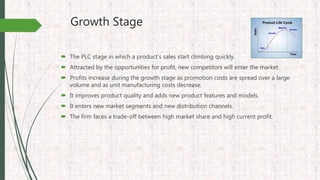
Growth Stage
 The PLC stage in which a product’s sales start climbing quickly.
 Attracted by the opportunities for profit, new competitors will enter the market.
 Profits increase during the growth stage as promotion costs are spread over a large
volume and as unit manufacturing costs decrease.
 It improves product quality and adds new product features and models.
 It enters new market segments and new distribution channels.
 The firm faces a trade-off between high market share and high current profit.
Maturity stage
 The PLC stage in which a product’s sales growth slows or levels off.
 This maturity stage normally lasts longer than the previous stages, and it poses
strong challenges to marketing management.
 Competitors begin marking down prices, increasing their advertising and sales
promotions, and upping their product development budgets to find better versions
of the product.
 The company can try modifying the marketing mix—improving sales by changing
one or more marketing mix elements.
Decline Stage
 The PLC stage in which a product’s sales decline.
 Sales may plunge to zero, or they may drop to a low level where they continue for
many years. This is the decline stage.
 As sales and profits decline, some firms withdraw from the market.
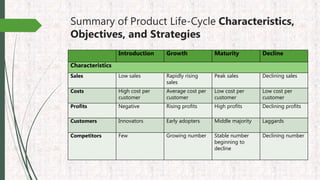
Summary of Product Life-Cycle Characteristics,
Objectives, and Strategies
Introduction Growth Maturity Decline
Characteristics
Sales Low sales Rapidly rising
sales
Peak sales Declining sales
Costs High cost per
customer
Average cost per
customer
Low cost per
customer
Low cost per
customer
Profits Negative Rising profits High profits Declining profits
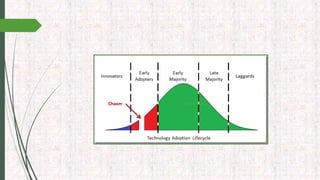
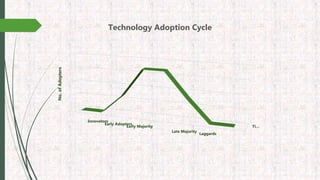
Customers Innovators Early adopters Middle majority Laggards
Competitors Few Growing number Stable number
beginning to
decline
Declining number
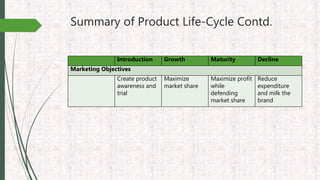
Summary of Product Life-Cycle Contd.
Introduction Growth Maturity Decline
Marketing Objectives
Create product
awareness and
trial
Maximize
market share
Maximize profit
while
defending
market share
Reduce
expenditure
and milk the
brand
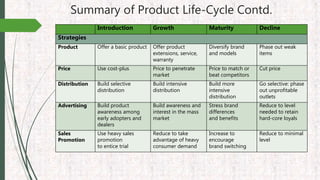
Summary of Product Life-Cycle Contd.
Introduction Growth Maturity Decline
Strategies
Product Offer a basic product Offer product
extensions, service,
warranty
Diversify brand
and models
Phase out weak
items
Price Use cost-plus Price to penetrate
market
Price to match or
beat competitors
Cut price
Distribution Build selective
distribution
Build intensive
distribution
Build more
intensive
distribution
Go selective: phase
out unprofitable
outlets
Advertising Build product
awareness among
early adopters and
dealers
Build awareness and
interest in the mass
market
Stress brand
differences
and benefits
Reduce to level
needed to retain
hard-core loyals
Sales
Promotion
Use heavy sales
promotion
to entice trial
Reduce to take
advantage of heavy
consumer demand
Increase to
encourage
brand switching
Reduce to minimal
level

Plc

  • 1.
  • 2.
    What is ProductLife Cycle?  The course of a product’s sales and profits over its lifetime.  It involves five distinct stages: product development, introduction, growth, maturity, and decline. A company’s products are born, grow, mature, and then decline, just as living things do.
  • 3.
    Stages of PLC ThePLC has five distinct stages:  1. Product development begins when the company finds and develops a new- product idea.  2. Introduction is a period of slow sales growth as the product is introduced in the market.  3. Growth is a period of rapid market acceptance and increasing profits.  4. Maturity is a period of slowdown in sales growth because the product has achieved acceptance by most potential buyers.  5. Decline is the period when sales fall off and profits drop. Some products die quickly; others stay in the mature stage for a long, long time.
  • 4.
    The elements describedby PLC The PLC can describe:  a product class (Fuel powered automobiles)  a product form (MPV – multi passenger vehicle)  a brand (Renault Lodgy)
  • 5.
    The PLC conceptapplication to styles, fashions & fad  Style - A style is a basic and distinctive mode of expression. e.g., styles appear in homes (traditional home, ethnic – styled home, modern styled home) ; clothing ((formal, casual); & art (realist, surrealist, abstract). Style has a cycle showing several periods of renewed interest.  Fashion- A currently accepted or popular style in a given field. e.g., the more formal “business attire” look of corporate dress of the 80s and 90s gave way to the “business casual” look of the new millennium. Fashions tend to grow slowly, remain popular for a while, and then decline slowly.  Fad - A temporary period of unusually high sales driven by consumer enthusiasm and immediate product or brand popularity. e.g., Low – carb diets
  • 7.
    Types of NewProducts Newness L M H L Not Very New Cost Reductions 11% Repositioning 7% M Moderately New Product Line Extensions 26% H Very New New Product Lines 20% New to the World 10% Market F I R M
  • 8.
    Why Do FirmsIntroduce New Products?  Support additional usage  Better meet needs of slightly different sub-segments through differentiation  Address needs of potential emerging segments  Encourage variety seeking  Enhance sales of current products CUSTOMER  Counter encroachment by alternative products  Control shelf space COMPETITION  Alter brand image  Replacing and improving mature products is a key success factor for a firm COMPANY
  • 9.
    Introductory Stage GrowthMaturity Decline Product Life Cycle Revenue Profit Sales Profit
  • 11.
    Ti… Innovators Early Adopters Early Majority LateMajority Laggards No.ofAdopters Technology Adoption Cycle
  • 12.
    Introductory Phase  Introductionstage  The PLC stage in which a new product is first distributed and made available for purchase.  Introduction takes time, and sales growth is apt to be slow.  Profits are negative or low because of the low sales and high distribution and promotion expenses.  Much money is needed to attract distributors and build their inventories.  These firms focus their selling on those buyers who are the most ready to buy.
  • 13.
    Growth Stage  ThePLC stage in which a product’s sales start climbing quickly.  Attracted by the opportunities for profit, new competitors will enter the market.  Profits increase during the growth stage as promotion costs are spread over a large volume and as unit manufacturing costs decrease.  It improves product quality and adds new product features and models.  It enters new market segments and new distribution channels.  The firm faces a trade-off between high market share and high current profit.
  • 14.
    Maturity stage  ThePLC stage in which a product’s sales growth slows or levels off.  This maturity stage normally lasts longer than the previous stages, and it poses strong challenges to marketing management.  Competitors begin marking down prices, increasing their advertising and sales promotions, and upping their product development budgets to find better versions of the product.  The company can try modifying the marketing mix—improving sales by changing one or more marketing mix elements.
  • 15.
    Decline Stage  ThePLC stage in which a product’s sales decline.  Sales may plunge to zero, or they may drop to a low level where they continue for many years. This is the decline stage.  As sales and profits decline, some firms withdraw from the market.
  • 16.
    Summary of ProductLife-Cycle Characteristics, Objectives, and Strategies Introduction Growth Maturity Decline Characteristics Sales Low sales Rapidly rising sales Peak sales Declining sales Costs High cost per customer Average cost per customer Low cost per customer Low cost per customer Profits Negative Rising profits High profits Declining profits Customers Innovators Early adopters Middle majority Laggards Competitors Few Growing number Stable number beginning to decline Declining number
  • 17.
    Summary of ProductLife-Cycle Contd. Introduction Growth Maturity Decline Marketing Objectives Create product awareness and trial Maximize market share Maximize profit while defending market share Reduce expenditure and milk the brand
  • 18.
    Summary of ProductLife-Cycle Contd. Introduction Growth Maturity Decline Strategies Product Offer a basic product Offer product extensions, service, warranty Diversify brand and models Phase out weak items Price Use cost-plus Price to penetrate market Price to match or beat competitors Cut price Distribution Build selective distribution Build intensive distribution Build more intensive distribution Go selective: phase out unprofitable outlets Advertising Build product awareness among early adopters and dealers Build awareness and interest in the mass market Stress brand differences and benefits Reduce to level needed to retain hard-core loyals Sales Promotion Use heavy sales promotion to entice trial Reduce to take advantage of heavy consumer demand Increase to encourage brand switching Reduce to minimal level