Product life cycle
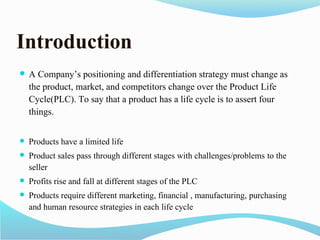
 A Company’s positioning and differentiation strategy must change as
the product, market, and competitors change over the Product Life
Cycle(PLC). To say that a product has a life cycle is to assert four
things.
 Products have a limited life
 Product sales pass through different stages with challenges/problems to the
seller
 Profits rise and fall at different stages of the PLC
 Products require different marketing, financial , manufacturing, purchasing
and human resource strategies in each life cycle
Introduction
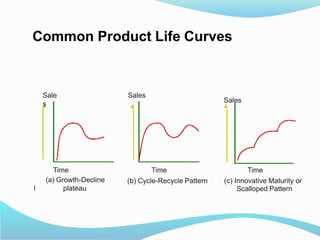
Common Product Life Curves
Sale
s
Sales
Sales
l
Time
(a) Growth-Decline
plateau
Time
(b) Cycle-Recycle Pattern
Time
(c) Innovative Maturity or
Scalloped Pattern
Introduction Stage
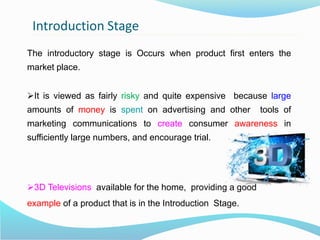
The introductory stage is Occurs when product first enters the
market place.
It is viewed as fairly risky and quite expensive because large
amounts of money is spent on advertising and other tools of
marketing communications to create consumer awareness in
sufficiently large numbers, and encourage trial.
3D Televisions available for the home, providing a good
example of a product that is in the Introduction Stage.
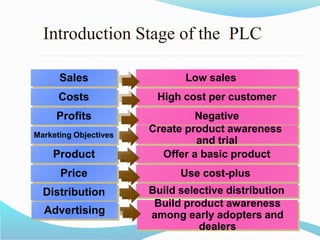
Introduction Stage of the PLC
Sales
Costs
Profits
Marketing Objectives
Product
Price
Low sales
High cost per customer
Negative
Create product awareness
and trial
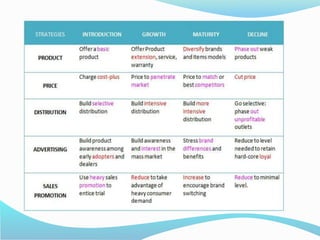
Offer a basic product
Use cost-plus
Distribution Build selective distribution
Advertising
Build product awareness
among early adopters and
dealers
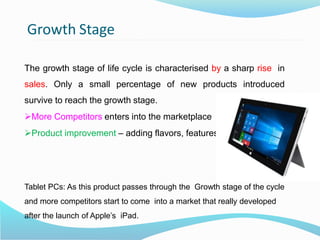
Growth Stage
The growth stage of life cycle is characterised by a sharp rise in
sales. Only a small percentage of new products introduced
survive to reach the growth stage.
More Competitors enters into the marketplace
Product improvement – adding flavors, features.
Tablet PCs: As this product passes through the Growth stage of the cycle
and more competitors start to come into a market that really developed
after the launch of Apple’s iPad.
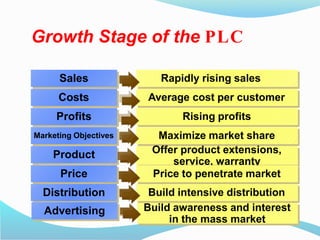
Growth Stage of the PLC
Sales
Costs
Profits
Marketing Objectives
Product
Price
Rapidly rising sales
Average cost per customer
Rising profits
Maximize market share
Offer product extensions,
service, warranty
Price to penetrate market
Distribution Build intensive distribution
Advertising Build awareness and interest
in the mass market
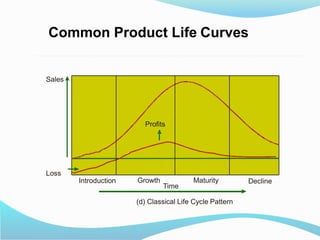
Introduction DeclineGrowth Maturity
Time
(d) Classical Life Cycle Pattern
Sales
Profits
Loss
Common Product Life Curves
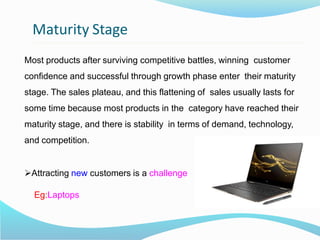
Maturity Stage
Most products after surviving competitive battles, winning customer
confidence and successful through growth phase enter their maturity
stage. The sales plateau, and this flattening of sales usually lasts for
some time because most products in the category have reached their
maturity stage, and there is stability in terms of demand, technology,
and competition.
Attracting new customers is a challenge
Eg:Laptops
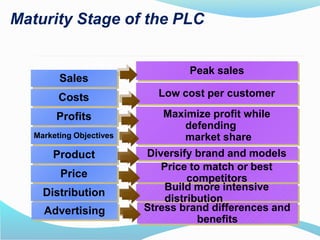
Maturity Stage of the PLC
Sales
Costs
Profits
Marketing Objectives
Product
Price
Peak sales
Low cost per customer
High profitsMaximize profit while
defending
market share
Diversify brand and models
Price to match or best
competitors
Distribution
Build more intensive
distribution
Advertising Stress brand differences and
benefits
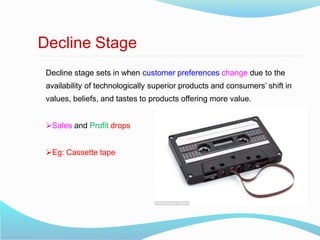
Decline Stage
Decline stage sets in when customer preferences change due to the
availability of technologically superior products and consumers’ shift in
values, beliefs, and tastes to products offering more value.
Sales and Profit drops
Eg: Cassette tape
MARKETING STRATEGIES
Product life cycle

Product life cycle

  • 1.
  • 2.
     A Company’spositioning and differentiation strategy must change as the product, market, and competitors change over the Product Life Cycle(PLC). To say that a product has a life cycle is to assert four things.  Products have a limited life  Product sales pass through different stages with challenges/problems to the seller  Profits rise and fall at different stages of the PLC  Products require different marketing, financial , manufacturing, purchasing and human resource strategies in each life cycle Introduction
  • 3.
    Common Product LifeCurves Sale s Sales Sales l Time (a) Growth-Decline plateau Time (b) Cycle-Recycle Pattern Time (c) Innovative Maturity or Scalloped Pattern
  • 4.
    Introduction Stage The introductorystage is Occurs when product first enters the market place. It is viewed as fairly risky and quite expensive because large amounts of money is spent on advertising and other tools of marketing communications to create consumer awareness in sufficiently large numbers, and encourage trial. 3D Televisions available for the home, providing a good example of a product that is in the Introduction Stage.
  • 5.
    Introduction Stage ofthe PLC Sales Costs Profits Marketing Objectives Product Price Low sales High cost per customer Negative Create product awareness and trial Offer a basic product Use cost-plus Distribution Build selective distribution Advertising Build product awareness among early adopters and dealers
  • 6.
    Growth Stage The growthstage of life cycle is characterised by a sharp rise in sales. Only a small percentage of new products introduced survive to reach the growth stage. More Competitors enters into the marketplace Product improvement – adding flavors, features. Tablet PCs: As this product passes through the Growth stage of the cycle and more competitors start to come into a market that really developed after the launch of Apple’s iPad.
  • 7.
    Growth Stage ofthe PLC Sales Costs Profits Marketing Objectives Product Price Rapidly rising sales Average cost per customer Rising profits Maximize market share Offer product extensions, service, warranty Price to penetrate market Distribution Build intensive distribution Advertising Build awareness and interest in the mass market
  • 8.
    Introduction DeclineGrowth Maturity Time (d)Classical Life Cycle Pattern Sales Profits Loss Common Product Life Curves
  • 9.
    Maturity Stage Most productsafter surviving competitive battles, winning customer confidence and successful through growth phase enter their maturity stage. The sales plateau, and this flattening of sales usually lasts for some time because most products in the category have reached their maturity stage, and there is stability in terms of demand, technology, and competition. Attracting new customers is a challenge Eg:Laptops
  • 10.
    Maturity Stage ofthe PLC Sales Costs Profits Marketing Objectives Product Price Peak sales Low cost per customer High profitsMaximize profit while defending market share Diversify brand and models Price to match or best competitors Distribution Build more intensive distribution Advertising Stress brand differences and benefits
  • 11.
    Decline Stage Decline stagesets in when customer preferences change due to the availability of technologically superior products and consumers’ shift in values, beliefs, and tastes to products offering more value. Sales and Profit drops Eg: Cassette tape
  • 12.