Why a product life cycle?
A company’s positioning and differentiation strategy
must change as the product, market, and competitors
change over the product life cycle(PLC)
When we say that a product has a life cycle we assert four
things:
i. Products have a limited life.
ii. Products sales pass through distinct stages, each
posing different challenges, opportunities and
problems to the seller.
iii. Profits rise and fall at different stages of the product
life cycle.
iv. Products require different marketing, financial,
manufacturing, purchasing, and human resource
strategies in each life – cycle stages.
Product Life Cycle
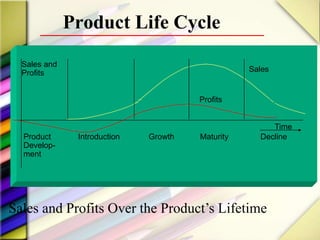
product life cycle is the course of a product’s sales
and profits over time.
product life cycle(PLC) deals with the life of a
product in the market with respect to business or
commercial costs and sales measures.
The five stages of each product lifecycle are product
development, introduction, growth, maturity and
decline.
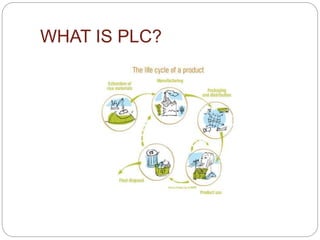
WHAT IS PLC?
Time
Product
Develop-
ment
Introduction
Profits
Sales
Growth Maturity Decline
Sales and
Profits
Sales and Profits Over the Product’s Lifetime
Product Life Cycle
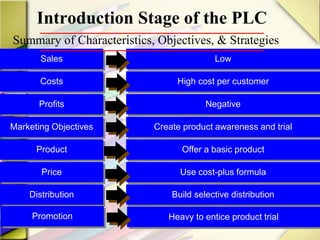
Sales
Costs
Profits
Marketing Objectives
Product
Price
Low
High cost per customer
Negative
Create product awareness and trial
Offer a basic product
Use cost-plus formula
Distribution Build selective distribution
Promotion Heavy to entice product trial
Summary of Characteristics, Objectives, & Strategies
Introduction Stage of the PLC
Sales
Costs
Profits
Marketing Objectives
Product
Price
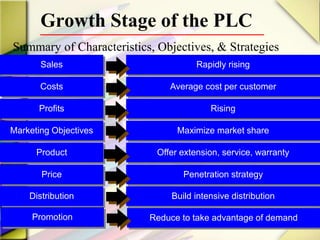
Rapidly rising
Average cost per customer
Rising
Maximize market share
Offer extension, service, warranty
Penetration strategy
Distribution Build intensive distribution
Promotion Reduce to take advantage of demand
Summary of Characteristics, Objectives, & Strategies
Growth Stage of the PLC
Sales
Costs
Profits
Marketing Objectives
Product
Price
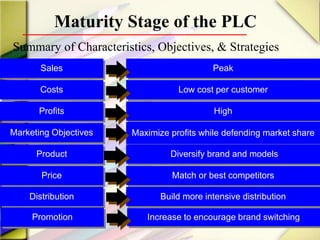
Peak
Low cost per customer
High
Maximize profits while defending market share
Diversify brand and models
Match or best competitors
Distribution Build more intensive distribution
Promotion Increase to encourage brand switching
Summary of Characteristics, Objectives, & Strategies
Maturity Stage of the PLC
Sales
Costs
Profits
Marketing Objectives
Product
Price
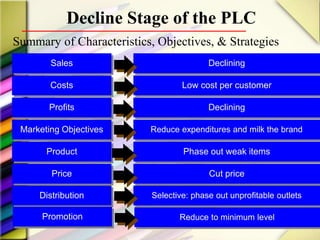
Declining
Low cost per customer
Declining
Reduce expenditures and milk the brand
Phase out weak items
Cut price
Distribution Selective: phase out unprofitable outlets
Promotion Reduce to minimum level
Summary of Characteristics, Objectives, & Strategies
Decline Stage of the PLC
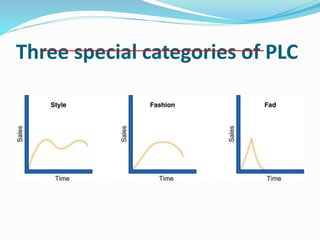
Three special categories of PLC
A Style is a basic and distinctive mode of
expression appearing in a field of human
endeavor. Styles appear in homes, clothing,
art etc.
A Fashion is a currently accepted or popular
style in a given field. Fashion pass through
four stages: Distinctiveness, emulation, mass
fashion, decline.
Fads are fashions that comes quickly into
public view , are adopted with great zeal,
peak early, and decline very fast.
1. Introduction stage is marked with slow
growth in sales and a very little or no
profit
2. sales volume is limited
3. Following are the possible strategies
during the first stage:
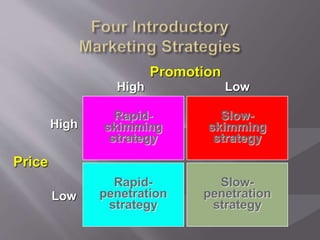
Rapid-
skimming
strategy
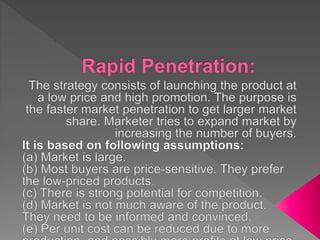
Rapid-
penetration
strategy
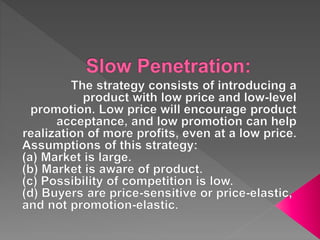
Slow-
penetration
strategy
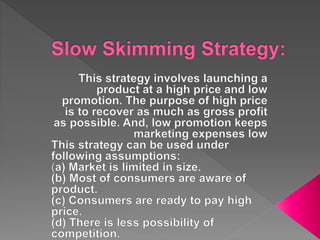
Slow-
skimming
strategy
Price
Low
High
Promotion
High Low
RAPID SKIMMING STRATEGY:
This strategy consists of introducing a new
product at high price and high promotional
expenses. The purpose of high price is to recover
profit per unit as much as possible
This strategy makes a sense in following
assumptions:
(a) Major part of market is not aware of the product.
(b) Customers are ready to pay the asking price.
(c) There possibility of competition and the firm wants to
build up the brand preference.
(d) Market is limited in size.
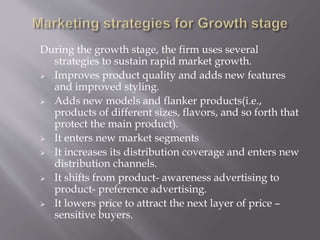
During the growth stage, the firm uses several
strategies to sustain rapid market growth.
 Improves product quality and adds new features
and improved styling.
 Adds new models and flanker products(i.e.,
products of different sizes, flavors, and so forth that
protect the main product).
 It enters new market segments
 It increases its distribution coverage and enters new
distribution channels.
 It shifts from product- awareness advertising to
product- preference advertising.
 It lowers price to attract the next layer of price –
sensitive buyers.
Three potentially useful ways to change the course
for a brand are market, product, and marketing
program modification.
Following possible strategies are followed:
1. To Do Nothing:New strategies are not formulated
2.Market Modification
Sales volume = no. of brand users * usage rate
per user.
Expand the no. of brand users
Convert nonusers
Enter new market segments
Attract competitors’ customers
Increase the usage rate among users
Have consumers use the product on more
occasions.
Have consumers use more of the product on
each occasion
Have consumers use the product in new
ways.
3 Product modification
Trying to stimulate sales by modifying the
product’s characteristics through
CONTINUED..
Quality improvement:
Aims at increasing the product’s functional performance.
Eg: Aashirvaad, Annapoorna, Pillsbury, Naturefresh
Feature improvement
Aims at adding new features, such as size, weight,
materials, additives, and accessories, that expand the
product’s performance, versatility, safety, or
convenience.
Style improvement
Aims at increasing the product’s esthetics appeal.
Eg; New car models, New Coke
 Increase investment
 Resolve uncertainties - stable investment
 Selective niches
 Harvesting
 Divesting
 To establish a system for identifying weak products.
 Some firms’ abandon declining markets earlier than
others.

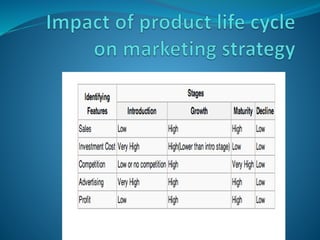
Product life cycle

  • 1.
    Why a productlife cycle? A company’s positioning and differentiation strategy must change as the product, market, and competitors change over the product life cycle(PLC) When we say that a product has a life cycle we assert four things: i. Products have a limited life. ii. Products sales pass through distinct stages, each posing different challenges, opportunities and problems to the seller. iii. Profits rise and fall at different stages of the product life cycle. iv. Products require different marketing, financial, manufacturing, purchasing, and human resource strategies in each life – cycle stages.
  • 2.
    Product Life Cycle productlife cycle is the course of a product’s sales and profits over time. product life cycle(PLC) deals with the life of a product in the market with respect to business or commercial costs and sales measures. The five stages of each product lifecycle are product development, introduction, growth, maturity and decline.
  • 3.
  • 5.
    Time Product Develop- ment Introduction Profits Sales Growth Maturity Decline Salesand Profits Sales and Profits Over the Product’s Lifetime Product Life Cycle
  • 6.
    Sales Costs Profits Marketing Objectives Product Price Low High costper customer Negative Create product awareness and trial Offer a basic product Use cost-plus formula Distribution Build selective distribution Promotion Heavy to entice product trial Summary of Characteristics, Objectives, & Strategies Introduction Stage of the PLC
  • 7.
    Sales Costs Profits Marketing Objectives Product Price Rapidly rising Averagecost per customer Rising Maximize market share Offer extension, service, warranty Penetration strategy Distribution Build intensive distribution Promotion Reduce to take advantage of demand Summary of Characteristics, Objectives, & Strategies Growth Stage of the PLC
  • 8.
    Sales Costs Profits Marketing Objectives Product Price Peak Low costper customer High Maximize profits while defending market share Diversify brand and models Match or best competitors Distribution Build more intensive distribution Promotion Increase to encourage brand switching Summary of Characteristics, Objectives, & Strategies Maturity Stage of the PLC
  • 9.
    Sales Costs Profits Marketing Objectives Product Price Declining Low costper customer Declining Reduce expenditures and milk the brand Phase out weak items Cut price Distribution Selective: phase out unprofitable outlets Promotion Reduce to minimum level Summary of Characteristics, Objectives, & Strategies Decline Stage of the PLC
  • 11.
  • 12.
    A Style isa basic and distinctive mode of expression appearing in a field of human endeavor. Styles appear in homes, clothing, art etc. A Fashion is a currently accepted or popular style in a given field. Fashion pass through four stages: Distinctiveness, emulation, mass fashion, decline. Fads are fashions that comes quickly into public view , are adopted with great zeal, peak early, and decline very fast.
  • 13.
    1. Introduction stageis marked with slow growth in sales and a very little or no profit 2. sales volume is limited 3. Following are the possible strategies during the first stage:
  • 14.
  • 15.
    RAPID SKIMMING STRATEGY: Thisstrategy consists of introducing a new product at high price and high promotional expenses. The purpose of high price is to recover profit per unit as much as possible This strategy makes a sense in following assumptions: (a) Major part of market is not aware of the product. (b) Customers are ready to pay the asking price. (c) There possibility of competition and the firm wants to build up the brand preference. (d) Market is limited in size.
  • 19.
    During the growthstage, the firm uses several strategies to sustain rapid market growth.  Improves product quality and adds new features and improved styling.  Adds new models and flanker products(i.e., products of different sizes, flavors, and so forth that protect the main product).  It enters new market segments  It increases its distribution coverage and enters new distribution channels.  It shifts from product- awareness advertising to product- preference advertising.  It lowers price to attract the next layer of price – sensitive buyers.
  • 20.
    Three potentially usefulways to change the course for a brand are market, product, and marketing program modification. Following possible strategies are followed: 1. To Do Nothing:New strategies are not formulated 2.Market Modification Sales volume = no. of brand users * usage rate per user. Expand the no. of brand users Convert nonusers Enter new market segments Attract competitors’ customers
  • 21.
    Increase the usagerate among users Have consumers use the product on more occasions. Have consumers use more of the product on each occasion Have consumers use the product in new ways. 3 Product modification Trying to stimulate sales by modifying the product’s characteristics through
  • 22.
    CONTINUED.. Quality improvement: Aims atincreasing the product’s functional performance. Eg: Aashirvaad, Annapoorna, Pillsbury, Naturefresh Feature improvement Aims at adding new features, such as size, weight, materials, additives, and accessories, that expand the product’s performance, versatility, safety, or convenience. Style improvement Aims at increasing the product’s esthetics appeal. Eg; New car models, New Coke
  • 23.
     Increase investment Resolve uncertainties - stable investment  Selective niches  Harvesting  Divesting  To establish a system for identifying weak products.  Some firms’ abandon declining markets earlier than others.

Editor's Notes