Individually how many products of
Virgin can you name ?

(Students who attended yesterday
should do best)

You have 3 minutes!!!!
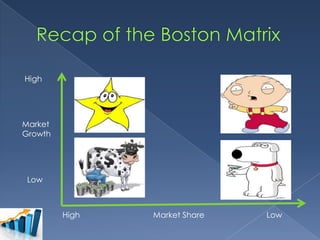
High

Market
Growth

Low

High

Market Share

Low
 Product

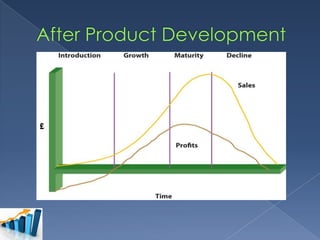
Life Cycle – shows the stages
that products go through from
development to withdrawal
from the market

It refers to their full life span as such.
 Are Sega Megadrives
still around?

£

£
› Each product may have a different life
›
›

›
›

›

cycle
PLC determines revenue earned
Contributes to strategic marketing
planning
May help the firm to identify when
a product needs support, redesign,
reinvigorating, withdrawal, etc.
May help in new product development
planning
May help in forecasting and managing
cash flow
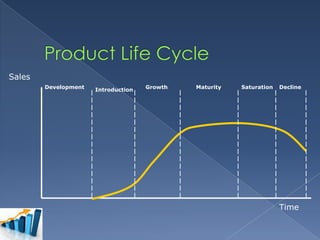
› Development
› Introduction/Launch
› Growth
› Maturity
› Saturation
› Decline
› Withdrawal
› May come from any of the following –
› Market research – identifies gaps in the
›
›

›
›
›

market
Monitoring competitors
Planned research and development
(R&D)
Luck or intuition – stumble across ideas?
Creative thinking – inventions, hunches?
Futures thinking – what will people be
using/wanting/needing 5,10,20 years from
now
› New ideas/possible inventions
› Market analysis – is it wanted? Can it be
produced at a profit? Who is it likely
to be aimed at?
› Product Development and refinement
› Test Marketing – possibly local/regional
› Analysis of test marketing results and
amendment of product/production
process
› Preparations for launch – publicity,
marketing campaign
› Advertising and promotion campaigns
› Target campaign at specific audience?
› Monitor initial sales
› Maximise publicity
› High cost/low sales
› Length of time – type of product
› Increased consumer awareness
› Sales rise
› Revenues increase
› Costs - fixed costs/variable costs, profits
may be made
› Monitor market – competitors reaction?
›
›
›
›
›
›
›
›

Sales reach peak
Cost of supporting the product declines
Ratio of revenue to cost high
Sales growth likely to be low
Market share may be high
Competition likely to be greater
Price elasticity of demand?
Monitor market –
changes/amendments/new strategies?


New entrants likely to mean market is ‘flooded’



Necessity to develop new strategies becomes more
pressing:
› Searching out new markets:

 Linking to changing fashions
 Seeking new or exploiting market segments
 Linking to joint ventures – media/music, etc.
 Developing new uses

› Focus on adapting the product
 Re-packaging or format
 Improving the standard or quality

› Developing the product range
›
›
›
›
›
›

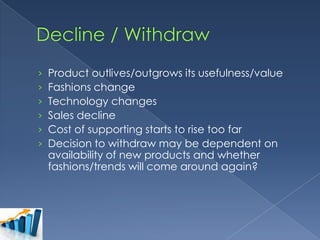
Product outlives/outgrows its usefulness/value
Fashions change
Technology changes
Sales decline
Cost of supporting starts to rise too far
Decision to withdraw may be dependent on
availability of new products and whether
fashions/trends will come around again?
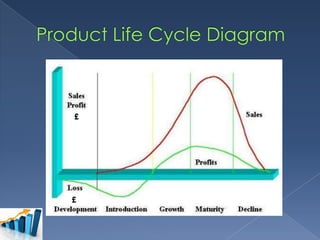
£
Sales
Development

Introduction

Growth

Maturity

Saturation

Decline

Time
Sales

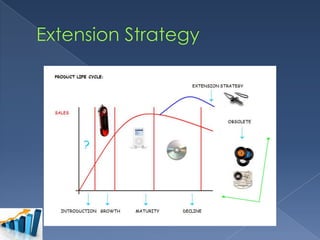
Effects of Extension
Strategies
Time




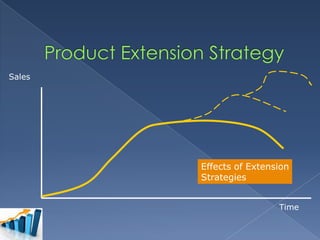
Can be defined as - a medium to long-term
plan for lengthening a products life cycle. It is
likely to be implemented during the Maturity or
early Decline.
Extension Strategies include:
› Redesigning the Product – New and Improved!

› Adding an extra feature – Now with…(colour, quality,

texture…)
› Changing the packaging and advertising to appeal
to a NEW Market Segment.
› Providing a Unique Selling Point (USP) – Cross shaped
MP3 player.
Individually you are required to:
 Produce a Product Life Cycle, illustrating
at which point an Extension Strategy
may be applied to a product.
Remember to include the four stages!
 Identify a product (not already
discussed) at each individual stage of
the Product Life Cycle. Most points for
most original, creative.



In GROUPS you are required to: (on A3 paper
provided)

Determine appropriate Extension Strategies
to lengthen the Products Life Cycle for a
product you identify as a group. Include
appropriate design features that will appeal
to the Target Market i.e. design, colour,
durability, shape.
 As a group, justify why you have chosen
these Extension Strategies? It is important
not to forget who your Target Market is!!!
 Explain the results of your to the remainder
class through a short presentation.


Product life cycle

  • 2.
    Individually how manyproducts of Virgin can you name ? (Students who attended yesterday should do best) You have 3 minutes!!!!
  • 3.
  • 4.
     Product Life Cycle– shows the stages that products go through from development to withdrawal from the market It refers to their full life span as such.  Are Sega Megadrives still around? 
  • 5.
  • 6.
    › Each productmay have a different life › › › › › cycle PLC determines revenue earned Contributes to strategic marketing planning May help the firm to identify when a product needs support, redesign, reinvigorating, withdrawal, etc. May help in new product development planning May help in forecasting and managing cash flow
  • 7.
    › Development › Introduction/Launch ›Growth › Maturity › Saturation › Decline › Withdrawal
  • 8.
    › May comefrom any of the following – › Market research – identifies gaps in the › › › › › market Monitoring competitors Planned research and development (R&D) Luck or intuition – stumble across ideas? Creative thinking – inventions, hunches? Futures thinking – what will people be using/wanting/needing 5,10,20 years from now
  • 9.
    › New ideas/possibleinventions › Market analysis – is it wanted? Can it be produced at a profit? Who is it likely to be aimed at? › Product Development and refinement › Test Marketing – possibly local/regional › Analysis of test marketing results and amendment of product/production process › Preparations for launch – publicity, marketing campaign
  • 10.
    › Advertising andpromotion campaigns › Target campaign at specific audience? › Monitor initial sales › Maximise publicity › High cost/low sales › Length of time – type of product
  • 11.
    › Increased consumerawareness › Sales rise › Revenues increase › Costs - fixed costs/variable costs, profits may be made › Monitor market – competitors reaction?
  • 12.
    › › › › › › › › Sales reach peak Costof supporting the product declines Ratio of revenue to cost high Sales growth likely to be low Market share may be high Competition likely to be greater Price elasticity of demand? Monitor market – changes/amendments/new strategies?
  • 13.
     New entrants likelyto mean market is ‘flooded’  Necessity to develop new strategies becomes more pressing: › Searching out new markets:  Linking to changing fashions  Seeking new or exploiting market segments  Linking to joint ventures – media/music, etc.  Developing new uses › Focus on adapting the product  Re-packaging or format  Improving the standard or quality › Developing the product range
  • 14.
    › › › › › › Product outlives/outgrows itsusefulness/value Fashions change Technology changes Sales decline Cost of supporting starts to rise too far Decision to withdraw may be dependent on availability of new products and whether fashions/trends will come around again?
  • 15.
  • 16.
  • 17.
  • 19.
      Can be definedas - a medium to long-term plan for lengthening a products life cycle. It is likely to be implemented during the Maturity or early Decline. Extension Strategies include: › Redesigning the Product – New and Improved! › Adding an extra feature – Now with…(colour, quality, texture…) › Changing the packaging and advertising to appeal to a NEW Market Segment. › Providing a Unique Selling Point (USP) – Cross shaped MP3 player.
  • 20.
    Individually you arerequired to:  Produce a Product Life Cycle, illustrating at which point an Extension Strategy may be applied to a product. Remember to include the four stages!  Identify a product (not already discussed) at each individual stage of the Product Life Cycle. Most points for most original, creative. 
  • 21.
     In GROUPS youare required to: (on A3 paper provided) Determine appropriate Extension Strategies to lengthen the Products Life Cycle for a product you identify as a group. Include appropriate design features that will appeal to the Target Market i.e. design, colour, durability, shape.  As a group, justify why you have chosen these Extension Strategies? It is important not to forget who your Target Market is!!!  Explain the results of your to the remainder class through a short presentation. 