New-Product Development and  Life-Cycle Strategies Chapter 9
Learning Goals Learn how companies find and develop new-product ideas Understand the steps in the new-product development process Know the stages of the product life cycle Realize how marketing strategies change during the product’s life cycle
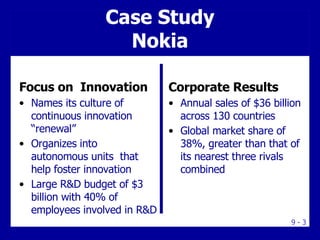
Focus on  Innovation Names its culture of continuous innovation “renewal” Organizes into autonomous units  that help foster innovation Large R&D budget of $3 billion with 40% of employees involved in R&D Corporate Results Annual sales of $36 billion across 130 countries Global market share of 38%, greater than that of its nearest three rivals combined Case Study Nokia
Definition New Product Development Development of original products, product improvements, product modifications, and new brands through the firm’s own R & D efforts. Goal 1:  Learn how companies find & develop new-product ideas
New Product Development Strategy New products can be obtained via acquisition or development. New products suffer from high failure rates. Several reasons account for failure. Goal 1:  Learn how companies find & develop new-product ideas
Stages of the New Product Development Process Stage 1:  Idea Generation Internal idea sources:  R & D External idea sources:  Customers, competitors, distributors, suppliers Goal 2:  Understand steps in the new-product development process
Stages of the New Product Development Process Stage 2:  Idea Screening Product development costs increase substantially in later stages so poor ideas must be dropped Ideas are evaluated against criteria; most are eliminated Goal 2:  Understand steps in the new-product development process
Stages of the New Product Development Process Stage 3:  Concept Development and Testing Concept development creates a detailed version of the idea stated in meaningful consumer terms. Concept testing asks target consumers to evaluate product concepts. Goal 2:  Understand steps in the new-product development process
Stages of the New Product Development Process Stage 4:  Marketing Strategy Development The target market, product positioning, and sales, share, and profit goals for the first few years. Product price, distribution, and marketing budget for the first year. Long-run sales and profit goals and the marketing mix strategy. Goal 2:  Understand steps in the new-product development process
Stages of the New Product Development Process Stage 5: Business Analysis Sales, cost, and profit projections Stage 6: Product Development Prototype development and testing Goal 2:  Understand steps in the new-product development process
Stages of the New Product Development Process Stage 7: Test Marketing Standard test markets Controlled test markets Simulated test markets Stage 8: Commercialization Goal 2:  Understand steps in the new-product development process
Product Life-Cycle Strategies The Product Life Cycle (PLC) has Five Stages Product Development, Introduction, Growth, Maturity, Decline Not all products follow this cycle:  Fads Styles Fashions Goal 3:  Know the stages of the product life cycle process
Product Life-Cycle Strategies The product life cycle concept can be applied to a: Product class (soft drinks) Product form (diet colas) Brand (Diet Dr. Pepper) Using the PLC to forecast brand performance or to develop marketing strategies is problematic Goal 3:  Know the stages of the product life cycle process
Product Life-Cycle Strategies Product development Introduction Growth Maturity Decline Begins when the company develops a new-product idea Sales are zero Investment costs are high Profits are negative PLC Stages  Goal 4:  Realize how marketing strategies change during the product life cycle
Product Life-Cycle Strategies Product development Introduction Growth Maturity Decline Low sales High cost per customer acquired Negative profits Innovators are targeted Little competition PLC Stages  Goal 4:  Realize how marketing strategies change during the product life cycle
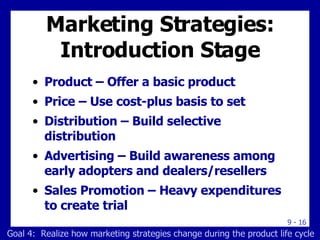
Marketing Strategies: Introduction Stage Product – Offer a basic product Price – Use cost-plus basis to set Distribution – Build selective distribution Advertising – Build awareness among early adopters and dealers/resellers Sales Promotion – Heavy expenditures to create trial Goal 4:  Realize how marketing strategies change during the product life cycle
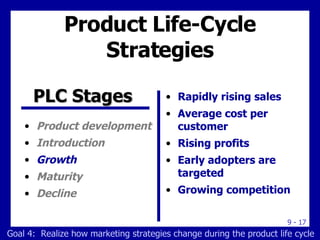
Product Life-Cycle Strategies Product development Introduction Growth Maturity Decline Rapidly rising sales Average cost per customer Rising profits Early adopters are targeted Growing competition PLC Stages  Goal 4:  Realize how marketing strategies change during the product life cycle
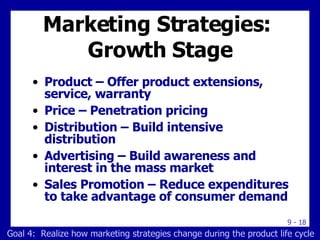
Marketing Strategies:  Growth Stage Product – Offer product extensions, service, warranty Price – Penetration pricing Distribution – Build intensive distribution Advertising – Build awareness and interest in the mass market Sales Promotion – Reduce expenditures to take advantage of consumer demand Goal 4:  Realize how marketing strategies change during the product life cycle
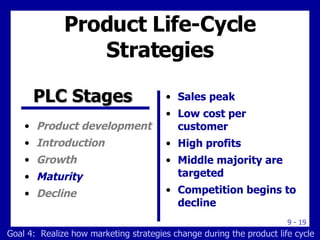
Product Life-Cycle Strategies Product development Introduction Growth Maturity Decline Sales peak Low cost per customer High profits Middle majority are targeted Competition begins to decline PLC Stages  Goal 4:  Realize how marketing strategies change during the product life cycle
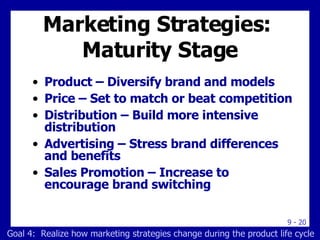
Marketing Strategies:  Maturity Stage Product – Diversify brand and models Price – Set to match or beat competition Distribution – Build more intensive distribution Advertising – Stress brand differences and benefits Sales Promotion – Increase to encourage brand switching Goal 4:  Realize how marketing strategies change during the product life cycle
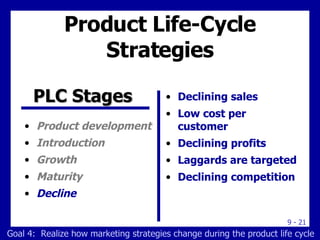
Product Life-Cycle Strategies Product development Introduction Growth Maturity Decline Declining sales Low cost per customer Declining profits Laggards are targeted Declining competition PLC Stages  Goal 4:  Realize how marketing strategies change during the product life cycle
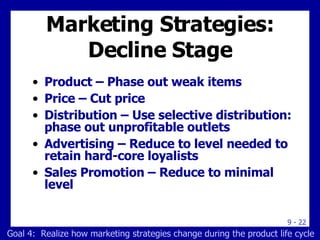
Marketing Strategies: Decline Stage Product – Phase out weak items Price – Cut price Distribution – Use selective distribution: phase out unprofitable outlets Advertising – Reduce to level needed to retain hard-core loyalists Sales Promotion – Reduce to minimal level Goal 4:  Realize how marketing strategies change during the product life cycle

New-Product Development and Life-Cycle Strategies

  • 1.
    New-Product Development and Life-Cycle Strategies Chapter 9
  • 2.
    Learning Goals Learnhow companies find and develop new-product ideas Understand the steps in the new-product development process Know the stages of the product life cycle Realize how marketing strategies change during the product’s life cycle
  • 3.
    Focus on Innovation Names its culture of continuous innovation “renewal” Organizes into autonomous units that help foster innovation Large R&D budget of $3 billion with 40% of employees involved in R&D Corporate Results Annual sales of $36 billion across 130 countries Global market share of 38%, greater than that of its nearest three rivals combined Case Study Nokia
  • 4.
    Definition New ProductDevelopment Development of original products, product improvements, product modifications, and new brands through the firm’s own R & D efforts. Goal 1: Learn how companies find & develop new-product ideas
  • 5.
    New Product DevelopmentStrategy New products can be obtained via acquisition or development. New products suffer from high failure rates. Several reasons account for failure. Goal 1: Learn how companies find & develop new-product ideas
  • 6.
    Stages of theNew Product Development Process Stage 1: Idea Generation Internal idea sources: R & D External idea sources: Customers, competitors, distributors, suppliers Goal 2: Understand steps in the new-product development process
  • 7.
    Stages of theNew Product Development Process Stage 2: Idea Screening Product development costs increase substantially in later stages so poor ideas must be dropped Ideas are evaluated against criteria; most are eliminated Goal 2: Understand steps in the new-product development process
  • 8.
    Stages of theNew Product Development Process Stage 3: Concept Development and Testing Concept development creates a detailed version of the idea stated in meaningful consumer terms. Concept testing asks target consumers to evaluate product concepts. Goal 2: Understand steps in the new-product development process
  • 9.
    Stages of theNew Product Development Process Stage 4: Marketing Strategy Development The target market, product positioning, and sales, share, and profit goals for the first few years. Product price, distribution, and marketing budget for the first year. Long-run sales and profit goals and the marketing mix strategy. Goal 2: Understand steps in the new-product development process
  • 10.
    Stages of theNew Product Development Process Stage 5: Business Analysis Sales, cost, and profit projections Stage 6: Product Development Prototype development and testing Goal 2: Understand steps in the new-product development process
  • 11.
    Stages of theNew Product Development Process Stage 7: Test Marketing Standard test markets Controlled test markets Simulated test markets Stage 8: Commercialization Goal 2: Understand steps in the new-product development process
  • 12.
    Product Life-Cycle StrategiesThe Product Life Cycle (PLC) has Five Stages Product Development, Introduction, Growth, Maturity, Decline Not all products follow this cycle: Fads Styles Fashions Goal 3: Know the stages of the product life cycle process
  • 13.
    Product Life-Cycle StrategiesThe product life cycle concept can be applied to a: Product class (soft drinks) Product form (diet colas) Brand (Diet Dr. Pepper) Using the PLC to forecast brand performance or to develop marketing strategies is problematic Goal 3: Know the stages of the product life cycle process
  • 14.
    Product Life-Cycle StrategiesProduct development Introduction Growth Maturity Decline Begins when the company develops a new-product idea Sales are zero Investment costs are high Profits are negative PLC Stages Goal 4: Realize how marketing strategies change during the product life cycle
  • 15.
    Product Life-Cycle StrategiesProduct development Introduction Growth Maturity Decline Low sales High cost per customer acquired Negative profits Innovators are targeted Little competition PLC Stages Goal 4: Realize how marketing strategies change during the product life cycle
  • 16.
    Marketing Strategies: IntroductionStage Product – Offer a basic product Price – Use cost-plus basis to set Distribution – Build selective distribution Advertising – Build awareness among early adopters and dealers/resellers Sales Promotion – Heavy expenditures to create trial Goal 4: Realize how marketing strategies change during the product life cycle
  • 17.
    Product Life-Cycle StrategiesProduct development Introduction Growth Maturity Decline Rapidly rising sales Average cost per customer Rising profits Early adopters are targeted Growing competition PLC Stages Goal 4: Realize how marketing strategies change during the product life cycle
  • 18.
    Marketing Strategies: Growth Stage Product – Offer product extensions, service, warranty Price – Penetration pricing Distribution – Build intensive distribution Advertising – Build awareness and interest in the mass market Sales Promotion – Reduce expenditures to take advantage of consumer demand Goal 4: Realize how marketing strategies change during the product life cycle
  • 19.
    Product Life-Cycle StrategiesProduct development Introduction Growth Maturity Decline Sales peak Low cost per customer High profits Middle majority are targeted Competition begins to decline PLC Stages Goal 4: Realize how marketing strategies change during the product life cycle
  • 20.
    Marketing Strategies: Maturity Stage Product – Diversify brand and models Price – Set to match or beat competition Distribution – Build more intensive distribution Advertising – Stress brand differences and benefits Sales Promotion – Increase to encourage brand switching Goal 4: Realize how marketing strategies change during the product life cycle
  • 21.
    Product Life-Cycle StrategiesProduct development Introduction Growth Maturity Decline Declining sales Low cost per customer Declining profits Laggards are targeted Declining competition PLC Stages Goal 4: Realize how marketing strategies change during the product life cycle
  • 22.
    Marketing Strategies: DeclineStage Product – Phase out weak items Price – Cut price Distribution – Use selective distribution: phase out unprofitable outlets Advertising – Reduce to level needed to retain hard-core loyalists Sales Promotion – Reduce to minimal level Goal 4: Realize how marketing strategies change during the product life cycle