
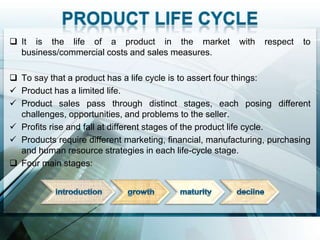

 It is the life of a product in the market              with   respect   to
  business/commercial costs and sales measures.

 To say that a product has a life cycle is to assert four things:
 Product has a limited life.
 Product sales pass through distinct stages, each posing different
  challenges, opportunities, and problems to the seller.
 Profits rise and fall at different stages of the product life cycle.
 Products require different marketing, financial, manufacturing, purchasing
  and human resource strategies in each life-cycle stage.
 Four main stages:
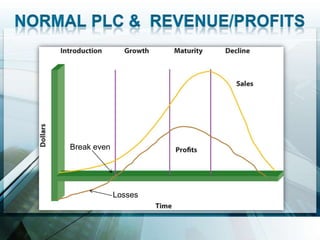
Break even


             Losses
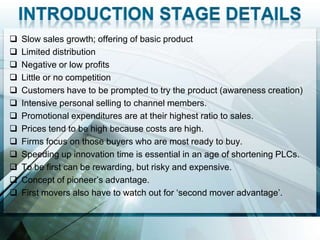
   Slow sales growth; offering of basic product
   Limited distribution
   Negative or low profits
   Little or no competition
   Customers have to be prompted to try the product (awareness creation)
   Intensive personal selling to channel members.
   Promotional expenditures are at their highest ratio to sales.
   Prices tend to be high because costs are high.
   Firms focus on those buyers who are most ready to buy.
   Speeding up innovation time is essential in an age of shortening PLCs.
   To be first can be rewarding, but risky and expensive.
   Concept of pioneer’s advantage.
   First movers also have to watch out for ‘second mover advantage’.
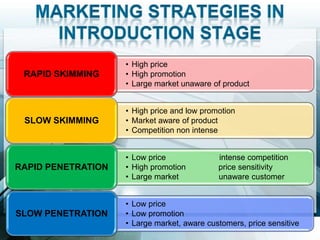
• High price
 RAPID SKIMMING     • High promotion
                    • Large market unaware of product


                    • High price and low promotion
 SLOW SKIMMING      • Market aware of product
                    • Competition non intense


                    • Low price              intense competition
RAPID PENETRATION   • High promotion         price sensitivity
                    • Large market           unaware customer


                    • Low price
SLOW PENETRATION    • Low promotion
                    • Large market, aware customers, price sensitive
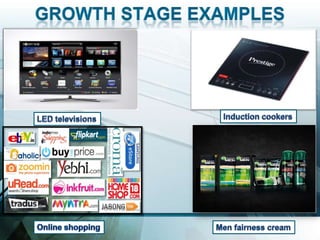
   Rapid climb in sales; brand building
   Purchase by early adopters
   Increase in public awareness; intensive distribution
   Bringing product extensions, warranty and service
   New competitors enter, attracted by the opportunities
   Prices fall slightly or remain as it is, depending on demand increase and
    increased competition.
   Promotional expenditure maintained the same or at slightly increased
    level to meet competition and to educate the market.
   Decline in the promotion-sales ratio
   Increase in profits because of economies of scale and learning effect
    Possibility of a trade-off between high market share and high current
    profit.
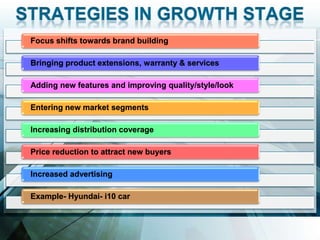
Focus shifts towards brand building

Bringing product extensions, warranty & services

Adding new features and improving quality/style/look

Entering new market segments

Increasing distribution coverage

Price reduction to attract new buyers

Increased advertising

Example- Hyundai- i10 car
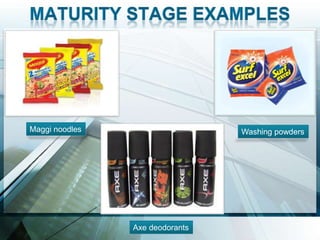
Maggi noodles                    Washing powders


                Axe deodorants
 Sales volume peaks and market saturation is reached at some point
 Costs reduced but prices also tend to drop because of competition
 This stage normally lasts longer than the previous stages and poses big
  challenges to marketing management as profits go down.
 Majority buyers make repeat purchases, laggards join them

 Can be divided into three phases: growth, stable & decaying maturity
 Growth phase- sales growth rates start to decline, no new distribution
  channels to fill, new competitive forces emerge.
 Stable phase- sales flatten on a per capita basis because of market
  saturation, future sales governed by population growth & replacement
  demand.
 Decaying phase- the absolute level of sales start to decline, customers
  begin switching to other products, intensified competition.
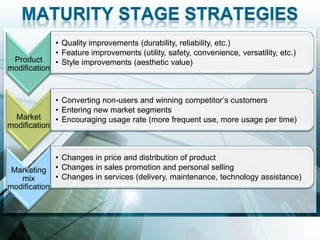
• Quality improvements (durability, reliability, etc.)
               • Feature improvements (utility, safety, convenience, versatility, etc.)
 Product       • Style improvements (aesthetic value)
modification


               • Converting non-users and winning competitor’s customers
               • Entering new market segments
  Market       • Encouraging usage rate (more frequent use, more usage per time)
modification


               • Changes in price and distribution of product
 Marketing     • Changes in sales promotion and personal selling
   mix         • Changes in services (delivery, maintenance, technology assistance)
modification
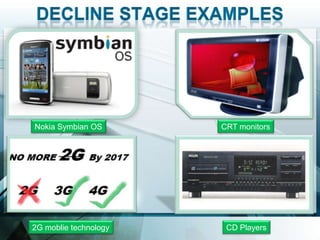
Nokia Symbian OS       CRT monitors


2G moblie technology    CD Players
 Decline in sales because of technological changes, shift in consumer
  tastes, and increased competition
 Laggards and repeat purchases driven sales
 Costs become counter-optimal
 Overcapacity, increased price cutting, reduced promotion & profit erosion
 Most of the product class usually die at this stage
 Withdrawal from market or reduction in number of products offered
 It is also possible to extend the life of the product by various means
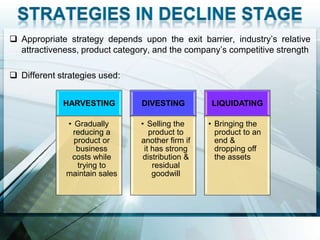
 Appropriate strategy depends upon the exit barrier, industry’s relative
  attractiveness, product category, and the company’s competitive strength

 Different strategies used:


             HARVESTING         DIVESTING         LIQUIDATING

              • Gradually       • Selling the     • Bringing the
                reducing a         product to       product to an
                product or      another firm if     end &
                 business        it has strong      dropping off
               costs while       distribution &     the assets
                 trying to          residual
              maintain sales        goodwill
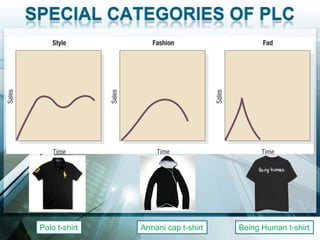
Polo t-shirt   Armani cap t-shirt   Being Human t-shirt
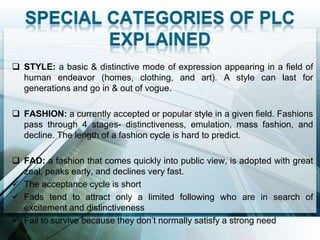
 STYLE: a basic & distinctive mode of expression appearing in a field of
  human endeavor (homes, clothing, and art). A style can last for
  generations and go in & out of vogue.

 FASHION: a currently accepted or popular style in a given field. Fashions
  pass through 4 stages- distinctiveness, emulation, mass fashion, and
  decline. The length of a fashion cycle is hard to predict.

 FAD: a fashion that comes quickly into public view, is adopted with great
  zeal, peaks early, and declines very fast.
 The acceptance cycle is short
 Fads tend to attract only a limited following who are in search of
  excitement and distinctiveness
 Fail to survive because they don’t normally satisfy a strong need
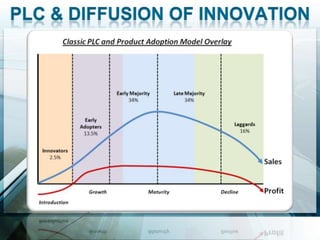
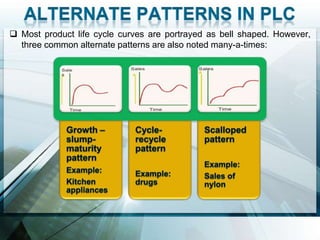
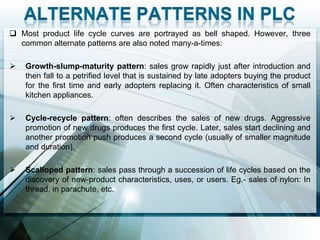
 Most product life cycle curves are portrayed as bell shaped. However,
  three common alternate patterns are also noted many-a-times:
 Most product life cycle curves are portrayed as bell shaped. However, three
  common alternate patterns are also noted many-a-times:

   Growth-slump-maturity pattern: sales grow rapidly just after introduction and
    then fall to a petrified level that is sustained by late adopters buying the product
    for the first time and early adopters replacing it. Often characteristics of small
    kitchen appliances.

   Cycle-recycle pattern: often describes the sales of new drugs. Aggressive
    promotion of new drugs produces the first cycle. Later, sales start declining and
    another promotion push produces a second cycle (usually of smaller magnitude
    and duration).

   Scalloped pattern: sales pass through a succession of life cycles based on the
    discovery of new-product characteristics, uses, or users. Eg.- sales of nylon: In
    thread, in parachute, etc.
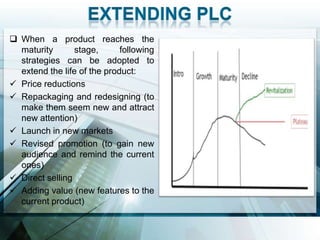
 When a product reaches the
  maturity       stage,      following
  strategies can be adopted to
  extend the life of the product:
 Price reductions
 Repackaging and redesigning (to
  make them seem new and attract
  new attention)
 Launch in new markets
 Revised promotion (to gain new
  audience and remind the current
  ones)
 Direct selling
 Adding value (new features to the
  current product)
There are three levels of PLC:
 Product level (eg. Dell XPS 15 laptop)
 Category level (eg. Desktop, laptop, netbook, tablet PC)
 Brand level (HP, Lenovo, Dell, Acer, Apple, Sony)

 Determines the revenue earned
 Helps the firm in being proactive
 Contributes to strategic marketing planning
 May help the firm to identify when a product needs support, redesign,
  revitalization, withdrawal, etc.
 May help in new product development planning or creating a marketing
  mix for success of a brand/product.
 Product planning
 Maintaining a proper balance of product at different stages of PLC
 Preventing cannibalization
 Pre-planning product launch
 Making investment decisions on products
 Choosing appropriate entry and exit strategy
 Prolonging the profitable phase (by highlighting new uses, adding new
  users, etc.)
 Shortening the product development time
 Customer management
 PLC patterns are too variable in shape and duration to be generalized
 Marketers can seldom tell which stage their product is in.
 For specific products, the duration of each PLC stage is unpredictable.
 A product may appear to be mature when actually it has reached a
  plateau prior to another upsurge.
 The PLC pattern is the self-fulfilling result of marketing strategies and that
  skillful marketing can in fact lead to continued growth.
 Use of PLC may lead to inappropriate actions sometimes.

 Because of these limitations, strict adherence to PLC can lead a
  company to misleading objectives and strategy prescriptions.
product life cycle

product life cycle

  • 2.
     It isthe life of a product in the market with respect to business/commercial costs and sales measures.  To say that a product has a life cycle is to assert four things:  Product has a limited life.  Product sales pass through distinct stages, each posing different challenges, opportunities, and problems to the seller.  Profits rise and fall at different stages of the product life cycle.  Products require different marketing, financial, manufacturing, purchasing and human resource strategies in each life-cycle stage.  Four main stages:
  • 3.
  • 7.
    Slow sales growth; offering of basic product  Limited distribution  Negative or low profits  Little or no competition  Customers have to be prompted to try the product (awareness creation)  Intensive personal selling to channel members.  Promotional expenditures are at their highest ratio to sales.  Prices tend to be high because costs are high.  Firms focus on those buyers who are most ready to buy.  Speeding up innovation time is essential in an age of shortening PLCs.  To be first can be rewarding, but risky and expensive.  Concept of pioneer’s advantage.  First movers also have to watch out for ‘second mover advantage’.
  • 8.
    • High price RAPID SKIMMING • High promotion • Large market unaware of product • High price and low promotion SLOW SKIMMING • Market aware of product • Competition non intense • Low price intense competition RAPID PENETRATION • High promotion price sensitivity • Large market unaware customer • Low price SLOW PENETRATION • Low promotion • Large market, aware customers, price sensitive
  • 10.
    Rapid climb in sales; brand building  Purchase by early adopters  Increase in public awareness; intensive distribution  Bringing product extensions, warranty and service  New competitors enter, attracted by the opportunities  Prices fall slightly or remain as it is, depending on demand increase and increased competition.  Promotional expenditure maintained the same or at slightly increased level to meet competition and to educate the market.  Decline in the promotion-sales ratio  Increase in profits because of economies of scale and learning effect  Possibility of a trade-off between high market share and high current profit.
  • 11.
    Focus shifts towardsbrand building Bringing product extensions, warranty & services Adding new features and improving quality/style/look Entering new market segments Increasing distribution coverage Price reduction to attract new buyers Increased advertising Example- Hyundai- i10 car
  • 12.
    Maggi noodles Washing powders Axe deodorants
  • 13.
     Sales volumepeaks and market saturation is reached at some point  Costs reduced but prices also tend to drop because of competition  This stage normally lasts longer than the previous stages and poses big challenges to marketing management as profits go down.  Majority buyers make repeat purchases, laggards join them  Can be divided into three phases: growth, stable & decaying maturity  Growth phase- sales growth rates start to decline, no new distribution channels to fill, new competitive forces emerge.  Stable phase- sales flatten on a per capita basis because of market saturation, future sales governed by population growth & replacement demand.  Decaying phase- the absolute level of sales start to decline, customers begin switching to other products, intensified competition.
  • 14.
    • Quality improvements(durability, reliability, etc.) • Feature improvements (utility, safety, convenience, versatility, etc.) Product • Style improvements (aesthetic value) modification • Converting non-users and winning competitor’s customers • Entering new market segments Market • Encouraging usage rate (more frequent use, more usage per time) modification • Changes in price and distribution of product Marketing • Changes in sales promotion and personal selling mix • Changes in services (delivery, maintenance, technology assistance) modification
  • 15.
    Nokia Symbian OS CRT monitors 2G moblie technology CD Players
  • 16.
     Decline insales because of technological changes, shift in consumer tastes, and increased competition  Laggards and repeat purchases driven sales  Costs become counter-optimal  Overcapacity, increased price cutting, reduced promotion & profit erosion  Most of the product class usually die at this stage  Withdrawal from market or reduction in number of products offered  It is also possible to extend the life of the product by various means
  • 17.
     Appropriate strategydepends upon the exit barrier, industry’s relative attractiveness, product category, and the company’s competitive strength  Different strategies used: HARVESTING DIVESTING LIQUIDATING • Gradually • Selling the • Bringing the reducing a product to product to an product or another firm if end & business it has strong dropping off costs while distribution & the assets trying to residual maintain sales goodwill
  • 19.
    Polo t-shirt Armani cap t-shirt Being Human t-shirt
  • 20.
     STYLE: abasic & distinctive mode of expression appearing in a field of human endeavor (homes, clothing, and art). A style can last for generations and go in & out of vogue.  FASHION: a currently accepted or popular style in a given field. Fashions pass through 4 stages- distinctiveness, emulation, mass fashion, and decline. The length of a fashion cycle is hard to predict.  FAD: a fashion that comes quickly into public view, is adopted with great zeal, peaks early, and declines very fast.  The acceptance cycle is short  Fads tend to attract only a limited following who are in search of excitement and distinctiveness  Fail to survive because they don’t normally satisfy a strong need
  • 21.
     Most productlife cycle curves are portrayed as bell shaped. However, three common alternate patterns are also noted many-a-times:
  • 22.
     Most productlife cycle curves are portrayed as bell shaped. However, three common alternate patterns are also noted many-a-times:  Growth-slump-maturity pattern: sales grow rapidly just after introduction and then fall to a petrified level that is sustained by late adopters buying the product for the first time and early adopters replacing it. Often characteristics of small kitchen appliances.  Cycle-recycle pattern: often describes the sales of new drugs. Aggressive promotion of new drugs produces the first cycle. Later, sales start declining and another promotion push produces a second cycle (usually of smaller magnitude and duration).  Scalloped pattern: sales pass through a succession of life cycles based on the discovery of new-product characteristics, uses, or users. Eg.- sales of nylon: In thread, in parachute, etc.
  • 23.
     When aproduct reaches the maturity stage, following strategies can be adopted to extend the life of the product:  Price reductions  Repackaging and redesigning (to make them seem new and attract new attention)  Launch in new markets  Revised promotion (to gain new audience and remind the current ones)  Direct selling  Adding value (new features to the current product)
  • 24.
    There are threelevels of PLC:  Product level (eg. Dell XPS 15 laptop)  Category level (eg. Desktop, laptop, netbook, tablet PC)  Brand level (HP, Lenovo, Dell, Acer, Apple, Sony)  Determines the revenue earned  Helps the firm in being proactive  Contributes to strategic marketing planning  May help the firm to identify when a product needs support, redesign, revitalization, withdrawal, etc.  May help in new product development planning or creating a marketing mix for success of a brand/product.
  • 25.
     Product planning Maintaining a proper balance of product at different stages of PLC  Preventing cannibalization  Pre-planning product launch  Making investment decisions on products  Choosing appropriate entry and exit strategy  Prolonging the profitable phase (by highlighting new uses, adding new users, etc.)  Shortening the product development time  Customer management
  • 26.
     PLC patternsare too variable in shape and duration to be generalized  Marketers can seldom tell which stage their product is in.  For specific products, the duration of each PLC stage is unpredictable.  A product may appear to be mature when actually it has reached a plateau prior to another upsurge.  The PLC pattern is the self-fulfilling result of marketing strategies and that skillful marketing can in fact lead to continued growth.  Use of PLC may lead to inappropriate actions sometimes.  Because of these limitations, strict adherence to PLC can lead a company to misleading objectives and strategy prescriptions.