WHY ALL THE COMPANIES ARE
LOOKING TO DEVELOP A
EXISTING PRODUCT OR
INTRODUCING A NEW PRODUCT
?
# “ When the changes outside is better than
 changes inside, the end is near ”.

# To make more profit.

# To expand their market.
NEW PRODUCT DEVELOPMENT

 Definition:

     Development of original products,
 product improvement, product
 modification, inventing new product
 through the firm’s own R&D efforts.
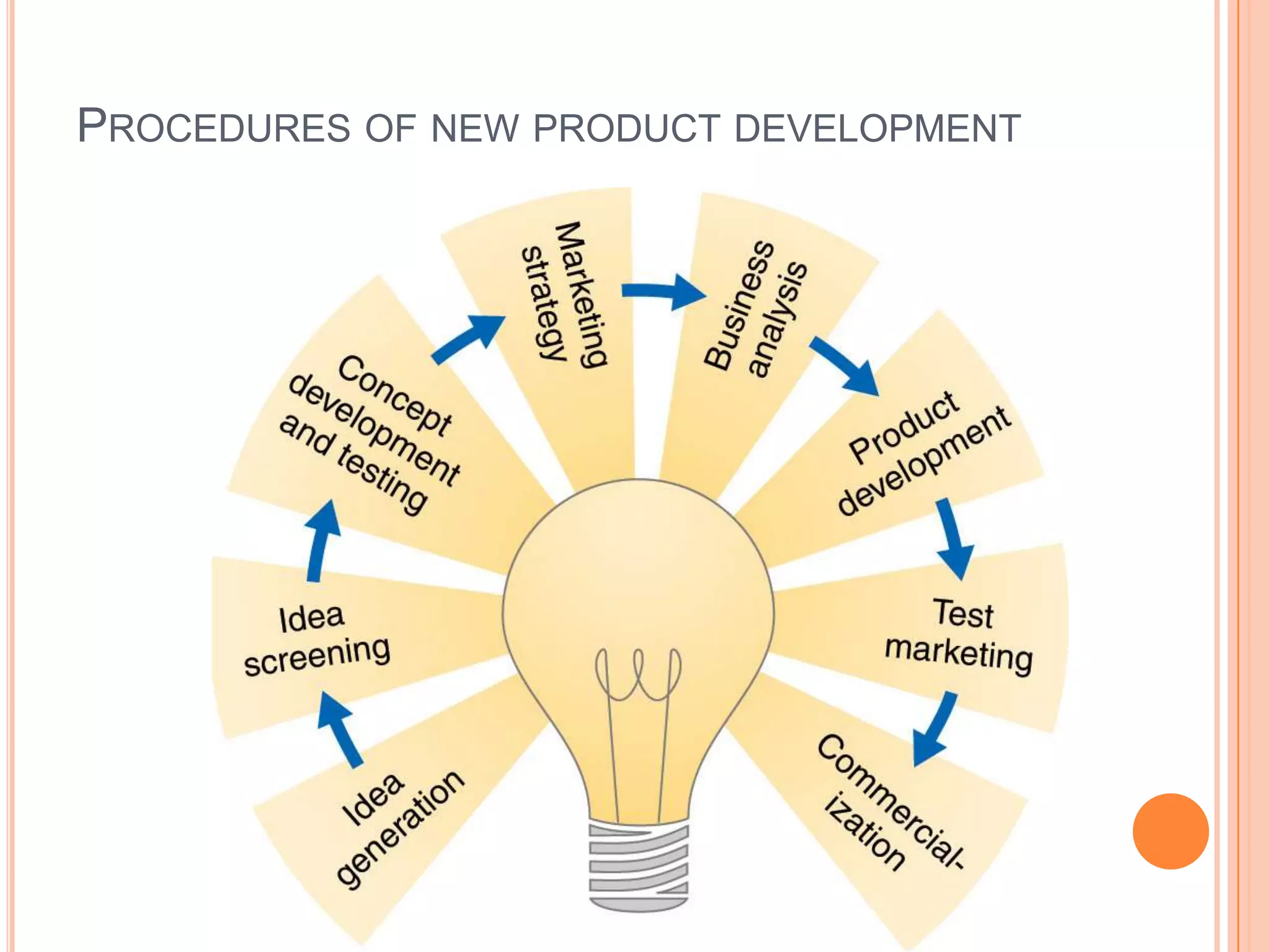
PROCEDURES OF NEW PRODUCT DEVELOPMENT
IDEA GENERATION
   Internal source
         # Research and Development
         # employees

   External source
        # customers
        # competitors
        # suppliers
        # distributers
IDEA SCREENING
Process to spot a good idea and drop poor ones

     # Selecting an idea which is feasible and workable
    to develop.

    # Online blogs may discuss customers
    dissatisfaction with a certain product, which may
    provide ideas to inventors or a new product or
    service.

.
CONCEPT DEVELOPMENT AND TESTING
   It provide full details of the new product’s idea.

   # Will it be practical and feasible?

   # What benefits the product will provide ?

   # How will consumers react to the product?

   # What will it cost to produce it ?

   # Testing the concept by asking a number of
     customers what they think of the idea
MARKET STRATEGY & DEVELOPMENT
  A proposed marketing strategy will be
 written laying out the marketing mix
 strategy of the product, the
 segmentation, targeting and
 positioning strategy sales and profits
 that are expected.
BUSINESS ANALYSIS


     The business analysis stage looks more
 deeply into the Cash flow the product could
 generate, what the cost will be, how much
 market shares the product may achieve and
 the expected life of the product.
PRODUCT DEVELOPMENT


      At this stage the prototype is
 produced. The prototype will clearly
 run through all the desired tests, and
 presented to a selection of people
 made up of the target
 market segment to see if changes
 need to be made.
TEST MARKETING


     Test marketing means testing the
 product within a specific area. The
 product will be launched within a
 particular region so the marketing mix
 strategy can be monitored and if
 needed modified before national
 launch.
COMMERCIALIZATION
There are certain factors that need to be taken into
  account before a product is launched nationally.
  These include:
 timing of the launch,

 how the product will be launched,

 where the product will be launched,

 will there be a national roll out or

 will it be region by region?
CONT…
 Finallythe commercialisation stage involves
 careful planning to maximise product
 success, a poor launch will affect product
 sales and could even affect the reputation
 and image of the new product.
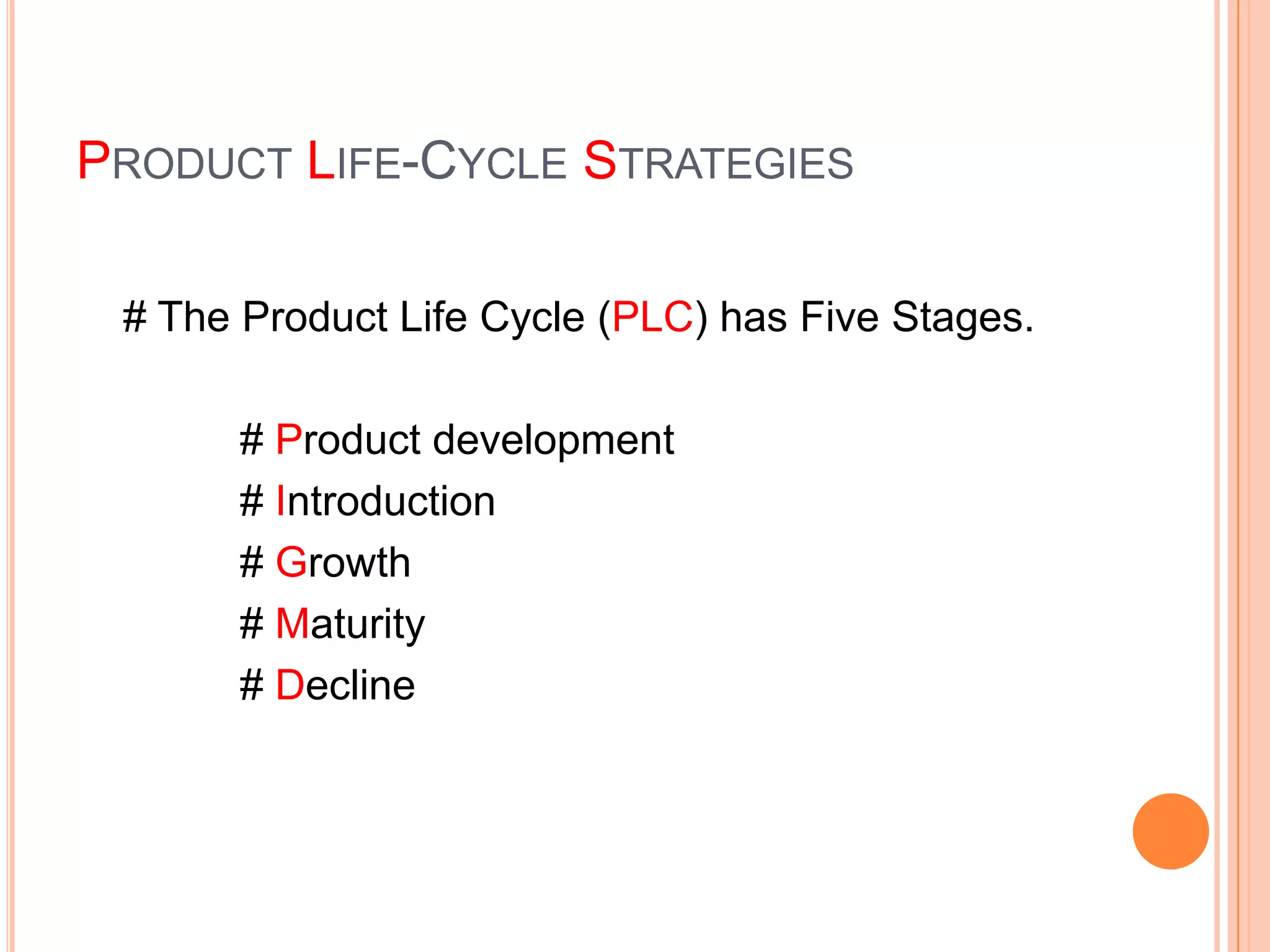
PRODUCT LIFE-CYCLE STRATEGIES

 # The Product Life Cycle (PLC) has Five Stages.

       # Product development
       # Introduction
       # Growth
       # Maturity
       # Decline
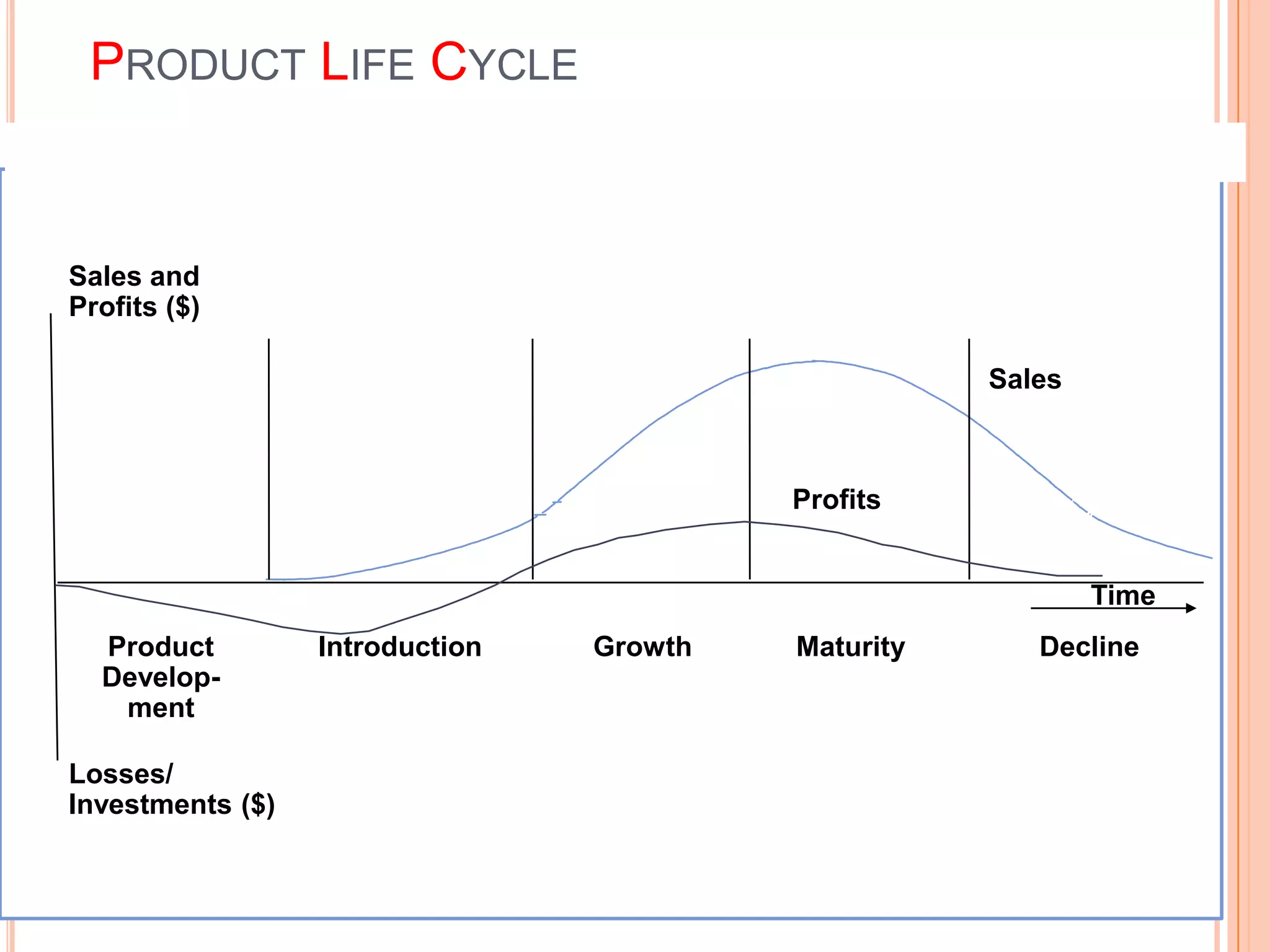
PRODUCT LIFE CYCLE


Sales and
Profits ($)

                                                     Sales


                                          Profits


                                                             Time
  Product         Introduction   Growth   Maturity      Decline
  Develop-
   ment

Losses/
Investments ($)
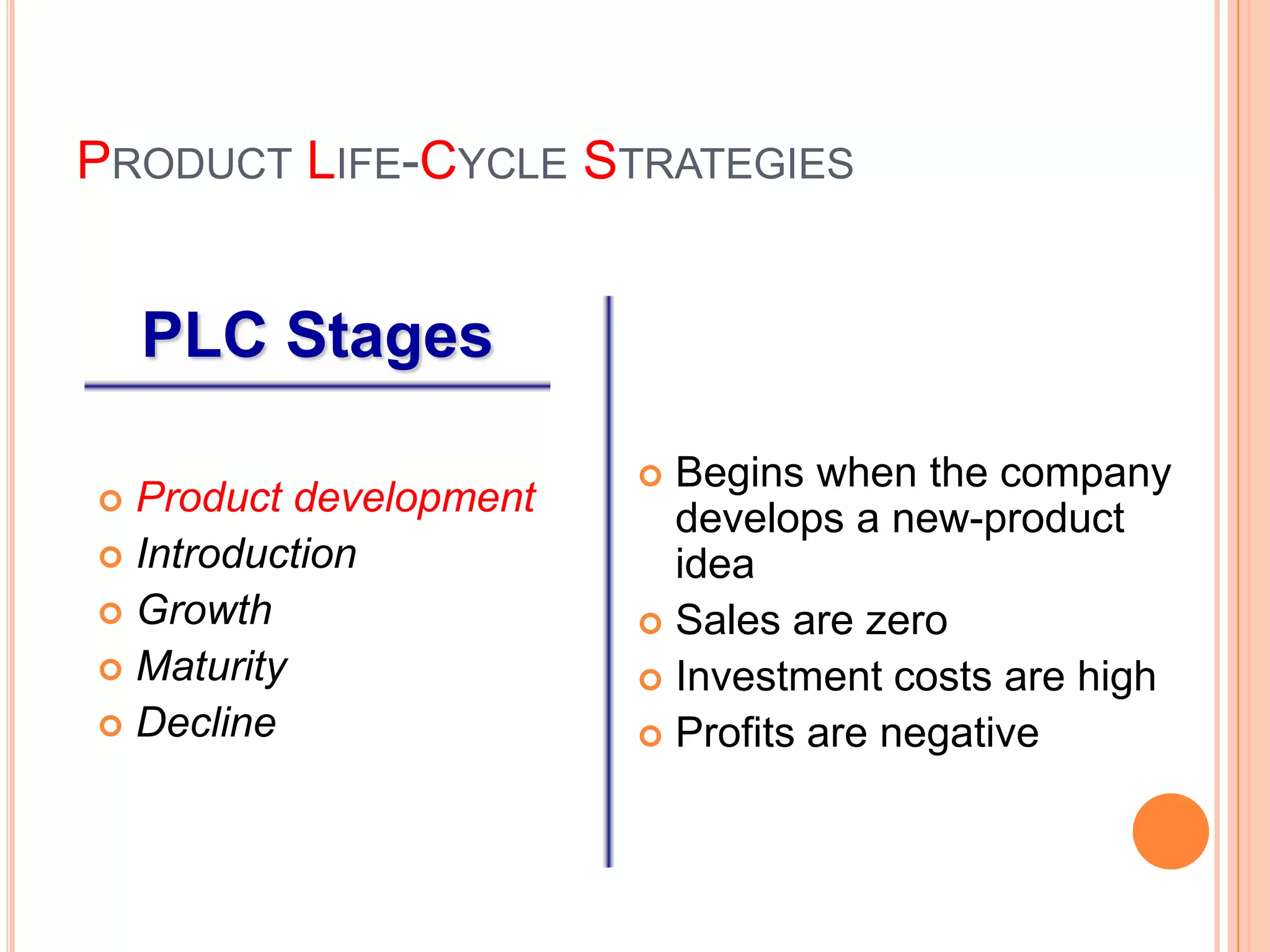
PRODUCT LIFE-CYCLE STRATEGIES


    PLC Stages

                         Begins when the company
 Product development     develops a new-product
 Introduction            idea
 Growth                 Sales are zero
 Maturity               Investment costs are high
 Decline                Profits are negative
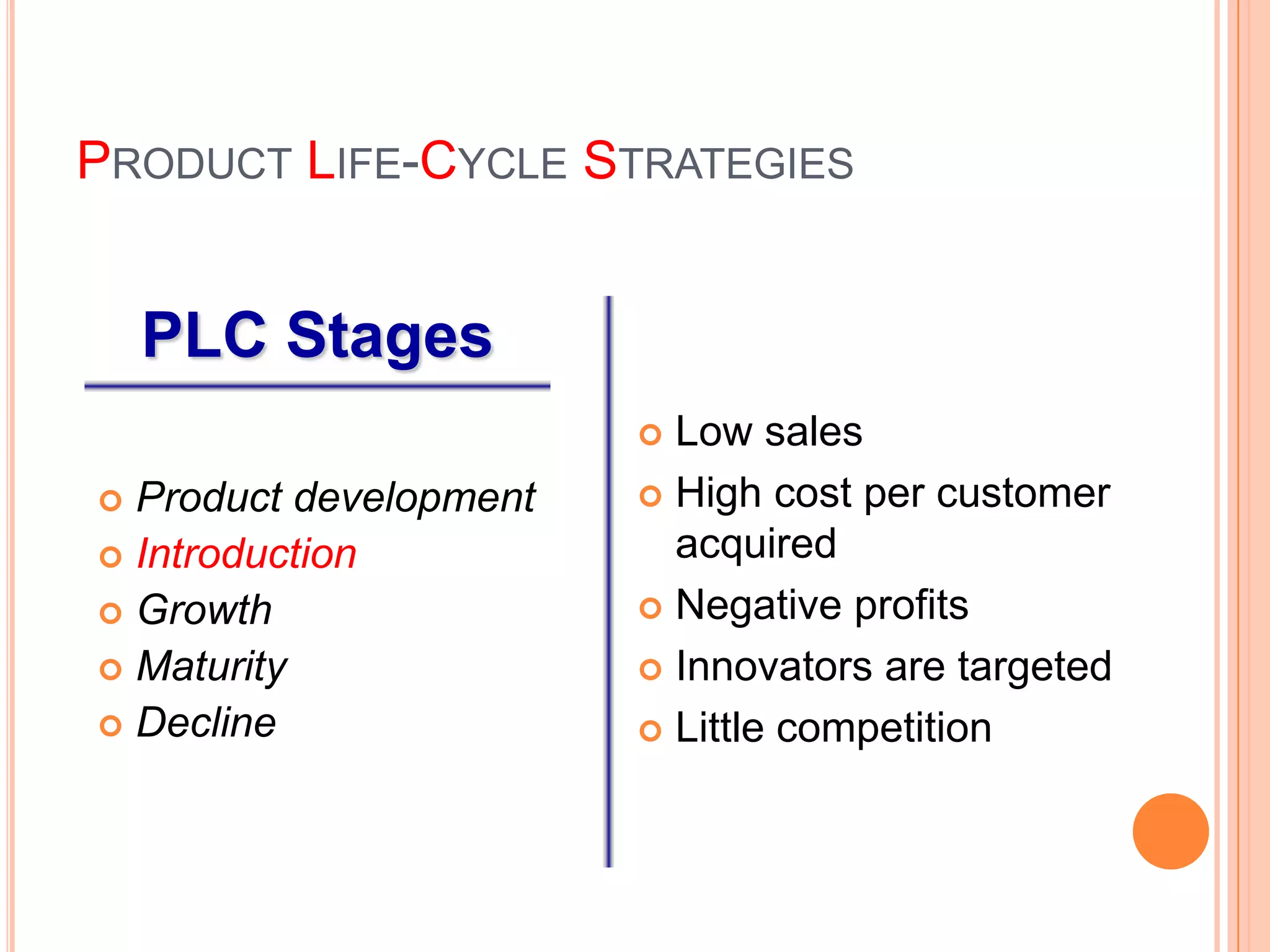
PRODUCT LIFE-CYCLE STRATEGIES


    PLC Stages
                         Low sales
 Product development    High cost per customer

 Introduction            acquired
 Growth                 Negative profits

 Maturity               Innovators are targeted
 Decline                Little competition
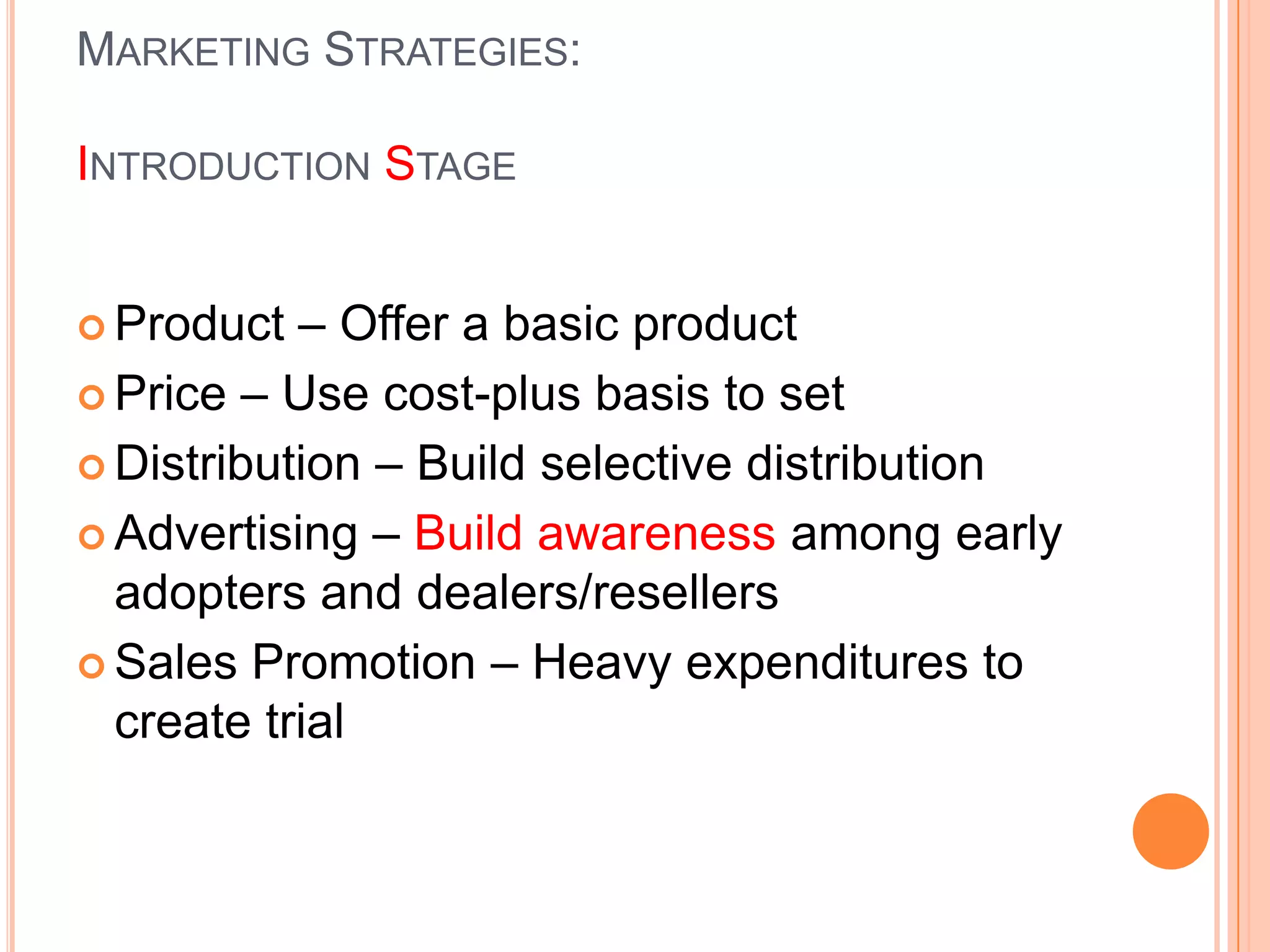
MARKETING STRATEGIES:

INTRODUCTION STAGE


 Product  – Offer a basic product
 Price – Use cost-plus basis to set

 Distribution – Build selective distribution

 Advertising – Build awareness among early
  adopters and dealers/resellers
 Sales Promotion – Heavy expenditures to
  create trial
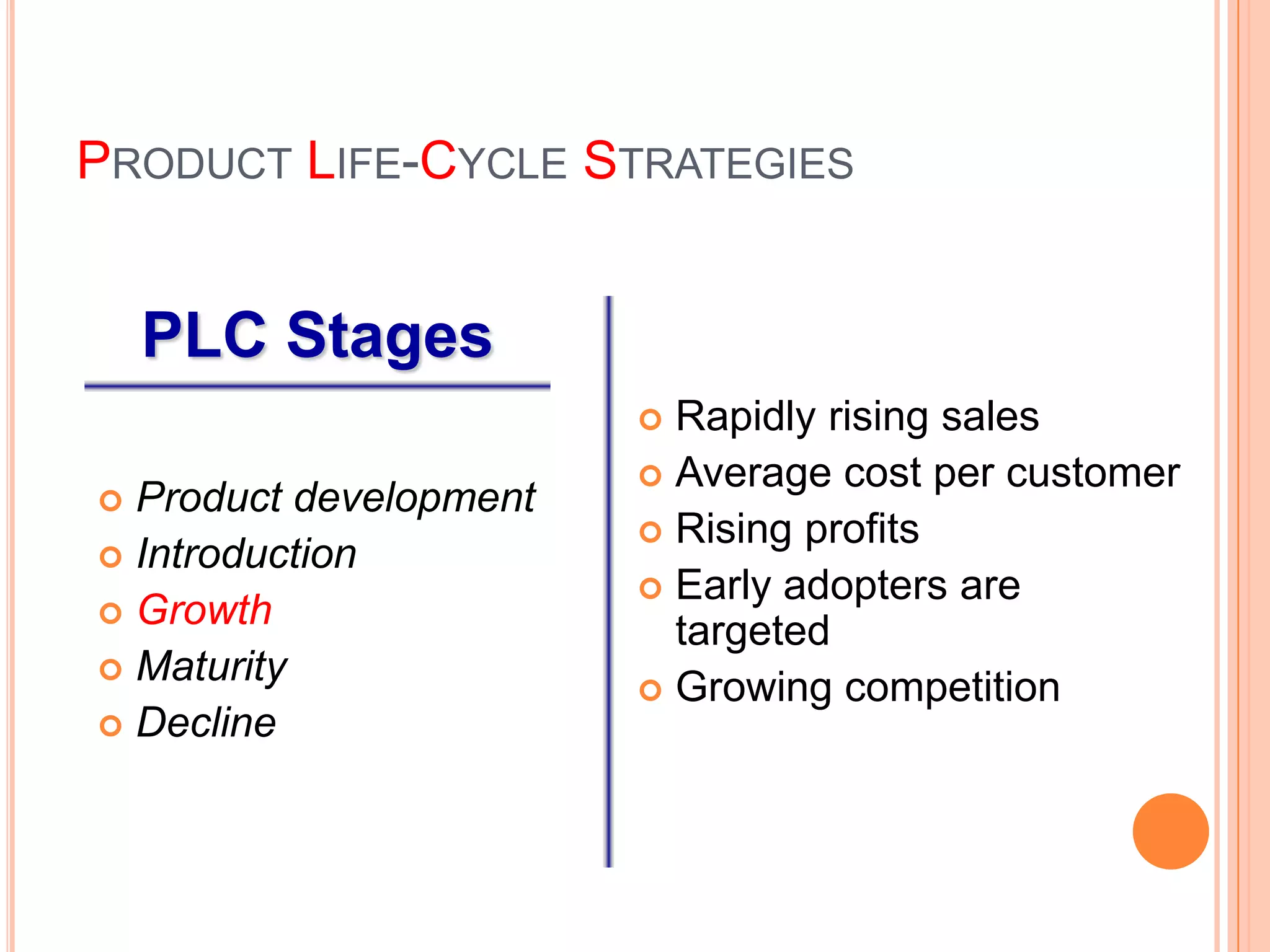
PRODUCT LIFE-CYCLE STRATEGIES


    PLC Stages
                         Rapidly rising sales
                         Average cost per customer
 Product development
                         Rising profits
 Introduction
                         Early adopters are
 Growth
                          targeted
 Maturity
                         Growing competition
 Decline
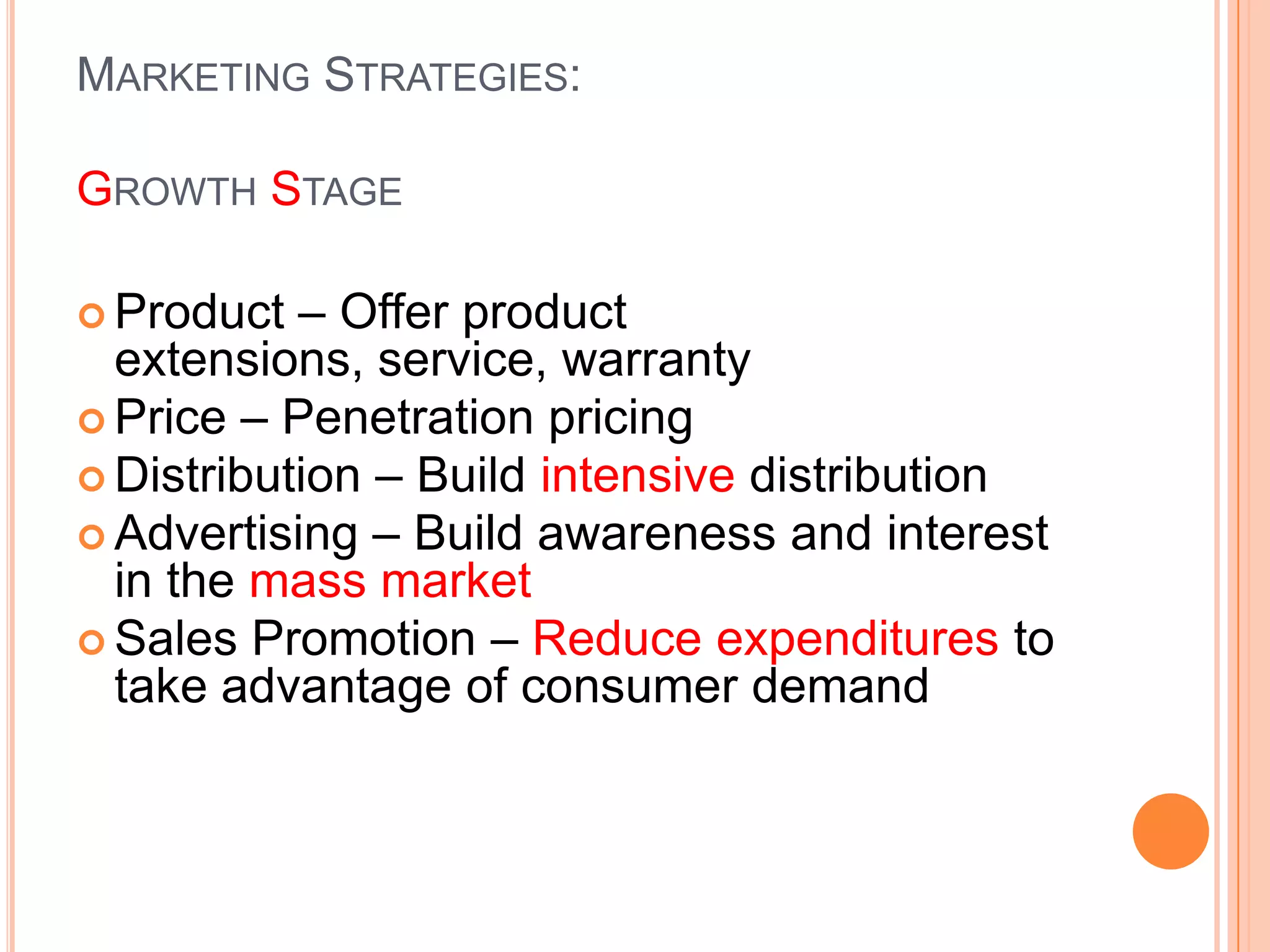
MARKETING STRATEGIES:

GROWTH STAGE

 Product  – Offer product
  extensions, service, warranty
 Price – Penetration pricing
 Distribution – Build intensive distribution
 Advertising – Build awareness and interest
  in the mass market
 Sales Promotion – Reduce expenditures to
  take advantage of consumer demand
PRODUCT LIFE-CYCLE STRATEGIES


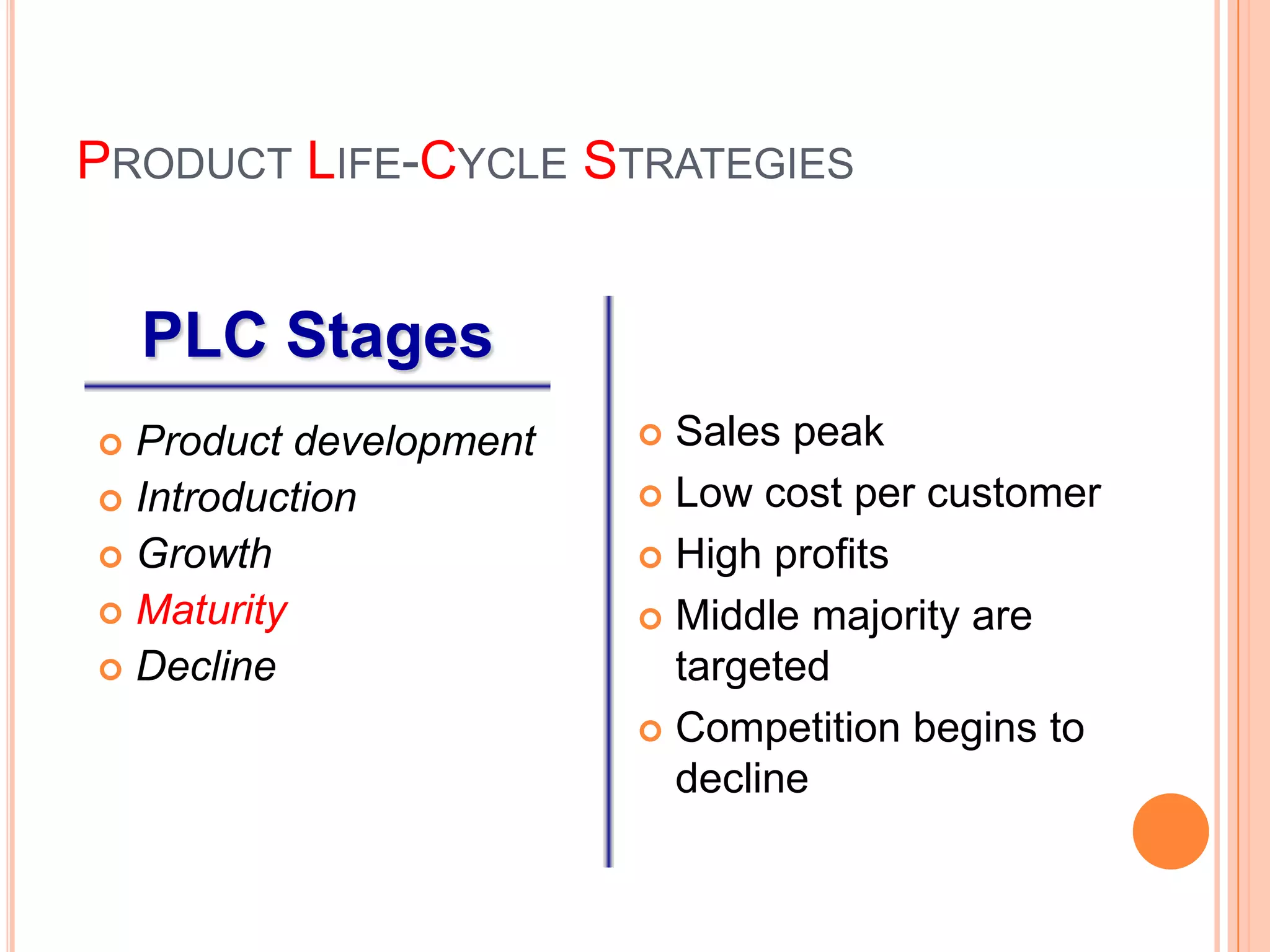
    PLC Stages
 Product development    Sales peak
 Introduction           Low cost per customer

 Growth                 High profits
 Maturity               Middle majority are
 Decline                 targeted
                         Competition begins to
                          decline
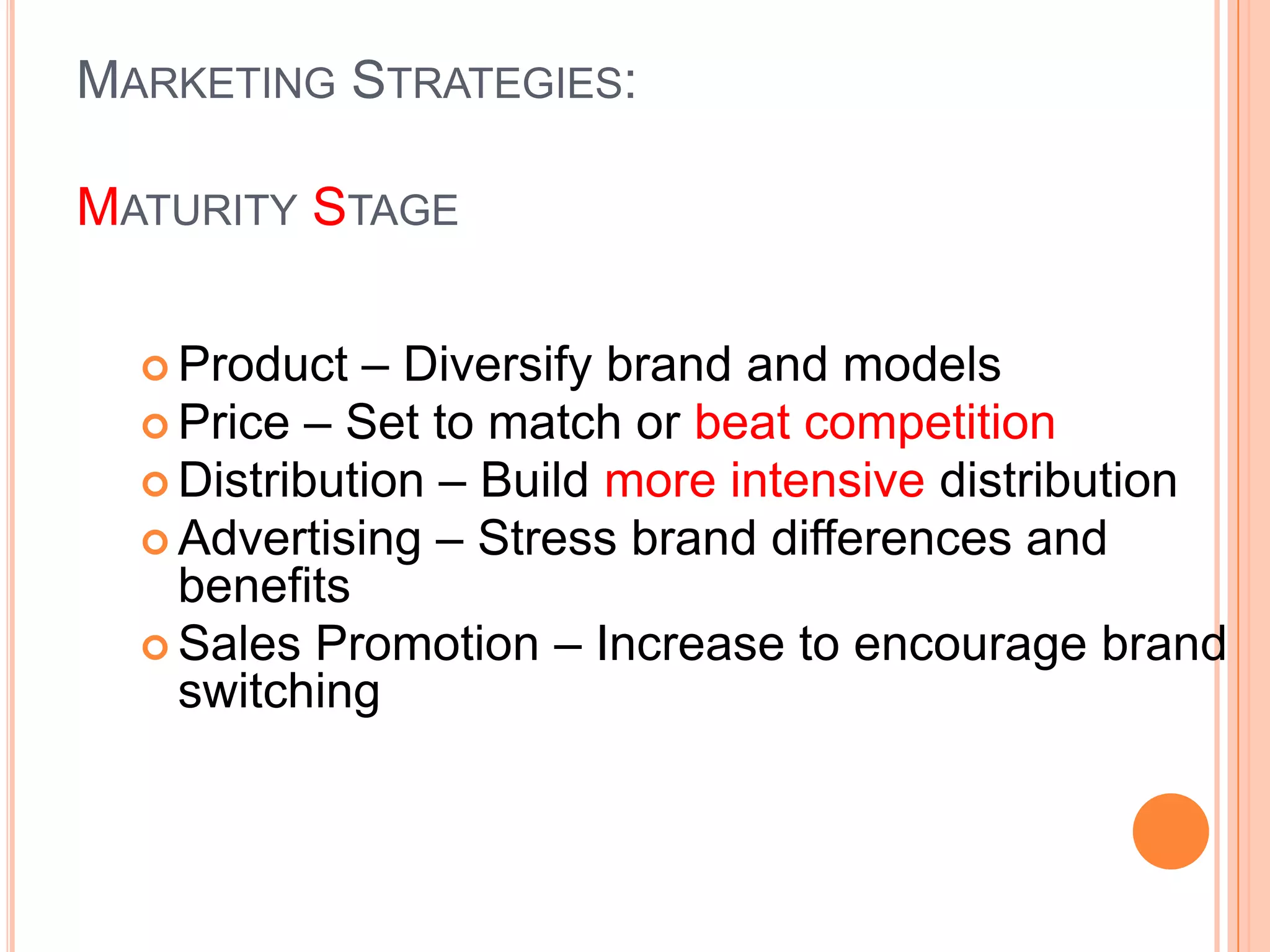
MARKETING STRATEGIES:

MATURITY STAGE

   Product  – Diversify brand and models
   Price – Set to match or beat competition
   Distribution – Build more intensive distribution
   Advertising – Stress brand differences and
    benefits
   Sales Promotion – Increase to encourage brand
    switching
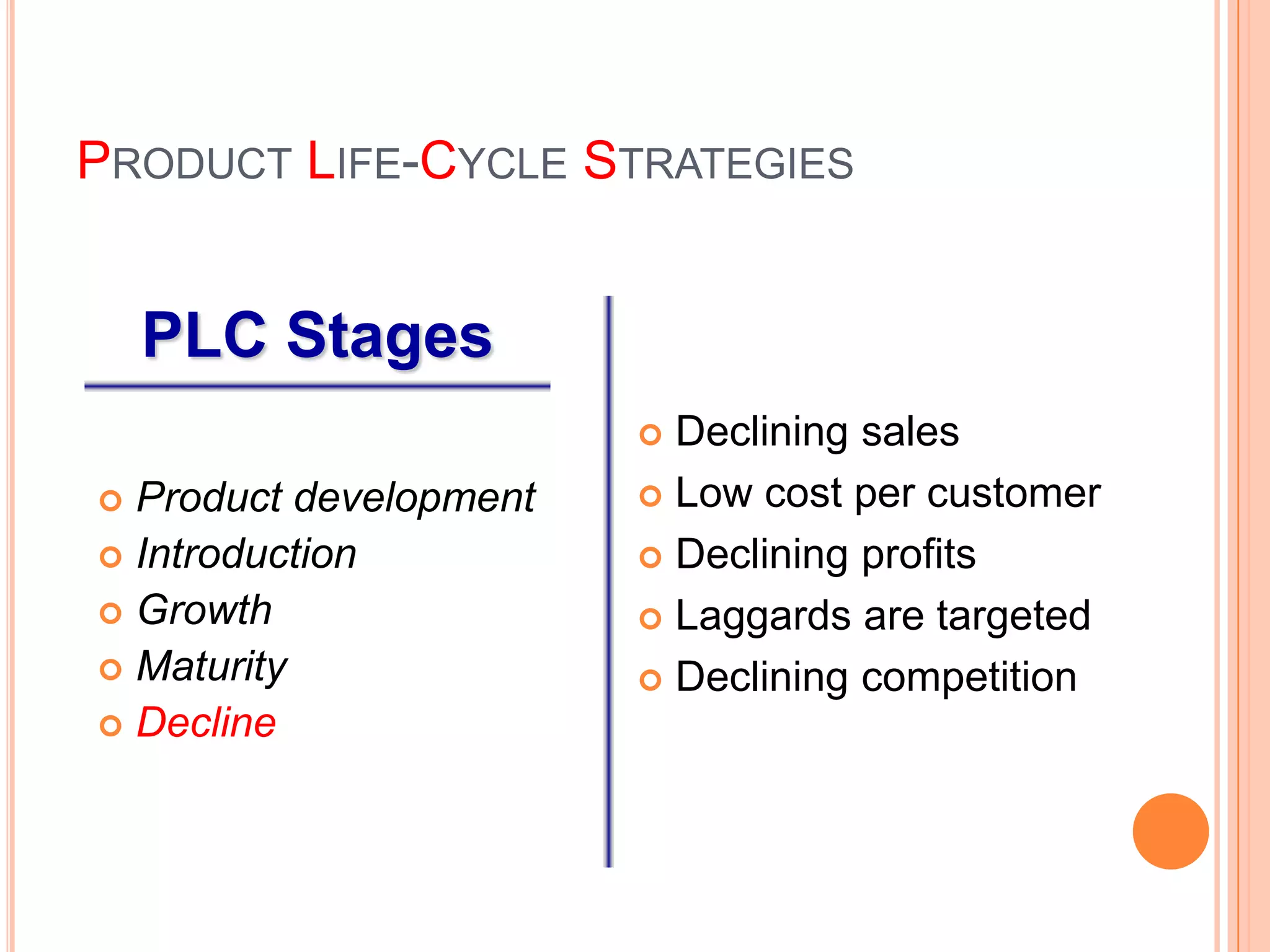
PRODUCT LIFE-CYCLE STRATEGIES


    PLC Stages
                         Declining sales
 Product development    Low cost per customer

 Introduction           Declining profits
 Growth                 Laggards are targeted
 Maturity               Declining competition
 Decline
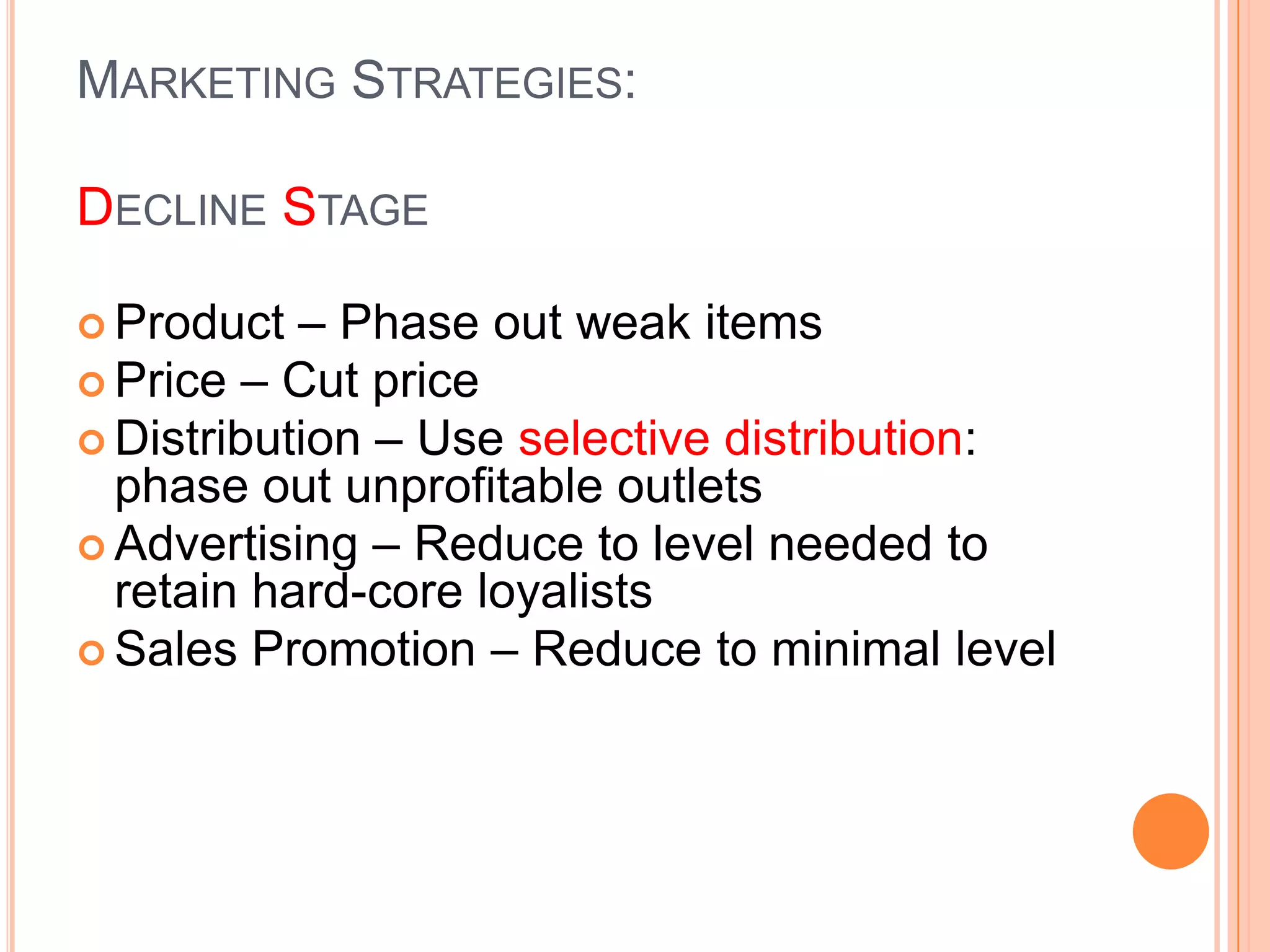
MARKETING STRATEGIES:

DECLINE STAGE

 Product  – Phase out weak items
 Price – Cut price
 Distribution – Use selective distribution:
  phase out unprofitable outlets
 Advertising – Reduce to level needed to
  retain hard-core loyalists
 Sales Promotion – Reduce to minimal level
OPERATIONS OF NEW PRODUCT
DEVELOPMENT

 New Product Lines: They allow the business to
  enter a completely new market segment.
 Additions to existing Product Lines: These are
  new items to the business, but they fit within an
  existing product line that the business already
  produces. They may represent a fairly new product
  to the market.
 Repositioning: These are new applications for
  existing products. They involve the retargeting of
  an old product to a new market segment.
CONT…
 Improvements and Revisions to Existing
Products: These “not so new” products are
replacements of existing product lines. These
“new and improved” product lines are
incremental innovations .
 Cost Reductions: designed to replace existing
  product lines while providing similar benefits and
  performance but at significantly lower costs to the
  business.
Thank you
   

new product development,plc,operations in npd

  • 1.
    WHY ALL THECOMPANIES ARE LOOKING TO DEVELOP A EXISTING PRODUCT OR INTRODUCING A NEW PRODUCT ?
  • 2.
    # “ Whenthe changes outside is better than changes inside, the end is near ”. # To make more profit. # To expand their market.
  • 3.
    NEW PRODUCT DEVELOPMENT Definition: Development of original products, product improvement, product modification, inventing new product through the firm’s own R&D efforts.
  • 4.
    PROCEDURES OF NEWPRODUCT DEVELOPMENT
  • 5.
    IDEA GENERATION  Internal source # Research and Development # employees  External source # customers # competitors # suppliers # distributers
  • 6.
    IDEA SCREENING Process tospot a good idea and drop poor ones # Selecting an idea which is feasible and workable to develop. # Online blogs may discuss customers dissatisfaction with a certain product, which may provide ideas to inventors or a new product or service. .
  • 7.
    CONCEPT DEVELOPMENT ANDTESTING It provide full details of the new product’s idea. # Will it be practical and feasible? # What benefits the product will provide ? # How will consumers react to the product? # What will it cost to produce it ? # Testing the concept by asking a number of customers what they think of the idea
  • 8.
    MARKET STRATEGY &DEVELOPMENT A proposed marketing strategy will be written laying out the marketing mix strategy of the product, the segmentation, targeting and positioning strategy sales and profits that are expected.
  • 9.
    BUSINESS ANALYSIS The business analysis stage looks more deeply into the Cash flow the product could generate, what the cost will be, how much market shares the product may achieve and the expected life of the product.
  • 10.
    PRODUCT DEVELOPMENT At this stage the prototype is produced. The prototype will clearly run through all the desired tests, and presented to a selection of people made up of the target market segment to see if changes need to be made.
  • 11.
    TEST MARKETING Test marketing means testing the product within a specific area. The product will be launched within a particular region so the marketing mix strategy can be monitored and if needed modified before national launch.
  • 12.
    COMMERCIALIZATION There are certainfactors that need to be taken into account before a product is launched nationally. These include:  timing of the launch,  how the product will be launched,  where the product will be launched,  will there be a national roll out or  will it be region by region?
  • 13.
    CONT…  Finallythe commercialisationstage involves careful planning to maximise product success, a poor launch will affect product sales and could even affect the reputation and image of the new product.
  • 14.
    PRODUCT LIFE-CYCLE STRATEGIES # The Product Life Cycle (PLC) has Five Stages. # Product development # Introduction # Growth # Maturity # Decline
  • 15.
    PRODUCT LIFE CYCLE Salesand Profits ($) Sales Profits Time Product Introduction Growth Maturity Decline Develop- ment Losses/ Investments ($)
  • 16.
    PRODUCT LIFE-CYCLE STRATEGIES PLC Stages  Begins when the company  Product development develops a new-product  Introduction idea  Growth  Sales are zero  Maturity  Investment costs are high  Decline  Profits are negative
  • 17.
    PRODUCT LIFE-CYCLE STRATEGIES PLC Stages  Low sales  Product development  High cost per customer  Introduction acquired  Growth  Negative profits  Maturity  Innovators are targeted  Decline  Little competition
  • 18.
    MARKETING STRATEGIES: INTRODUCTION STAGE Product – Offer a basic product  Price – Use cost-plus basis to set  Distribution – Build selective distribution  Advertising – Build awareness among early adopters and dealers/resellers  Sales Promotion – Heavy expenditures to create trial
  • 19.
    PRODUCT LIFE-CYCLE STRATEGIES PLC Stages  Rapidly rising sales  Average cost per customer  Product development  Rising profits  Introduction  Early adopters are  Growth targeted  Maturity  Growing competition  Decline
  • 20.
    MARKETING STRATEGIES: GROWTH STAGE Product – Offer product extensions, service, warranty  Price – Penetration pricing  Distribution – Build intensive distribution  Advertising – Build awareness and interest in the mass market  Sales Promotion – Reduce expenditures to take advantage of consumer demand
  • 21.
    PRODUCT LIFE-CYCLE STRATEGIES PLC Stages  Product development  Sales peak  Introduction  Low cost per customer  Growth  High profits  Maturity  Middle majority are  Decline targeted  Competition begins to decline
  • 22.
    MARKETING STRATEGIES: MATURITY STAGE  Product – Diversify brand and models  Price – Set to match or beat competition  Distribution – Build more intensive distribution  Advertising – Stress brand differences and benefits  Sales Promotion – Increase to encourage brand switching
  • 23.
    PRODUCT LIFE-CYCLE STRATEGIES PLC Stages  Declining sales  Product development  Low cost per customer  Introduction  Declining profits  Growth  Laggards are targeted  Maturity  Declining competition  Decline
  • 24.
    MARKETING STRATEGIES: DECLINE STAGE Product – Phase out weak items  Price – Cut price  Distribution – Use selective distribution: phase out unprofitable outlets  Advertising – Reduce to level needed to retain hard-core loyalists  Sales Promotion – Reduce to minimal level
  • 25.
    OPERATIONS OF NEWPRODUCT DEVELOPMENT  New Product Lines: They allow the business to enter a completely new market segment.  Additions to existing Product Lines: These are new items to the business, but they fit within an existing product line that the business already produces. They may represent a fairly new product to the market.  Repositioning: These are new applications for existing products. They involve the retargeting of an old product to a new market segment.
  • 26.
    CONT…  Improvements andRevisions to Existing Products: These “not so new” products are replacements of existing product lines. These “new and improved” product lines are incremental innovations .  Cost Reductions: designed to replace existing product lines while providing similar benefits and performance but at significantly lower costs to the business.
  • 27.