PRODUCT LIFE CYCLE
CONTENTS
Introduction
Concept
Stages
- Introduction
- Growth
- Maturity
- Decline
PLC Graph
Examples
Conclusion
INTRODUCTION
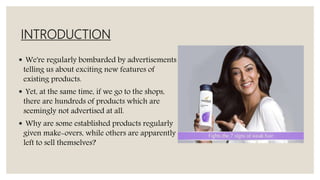
 We're regularly bombarded by advertisements
telling us about exciting new features of
existing products.
 Yet, at the same time, if we go to the shops,
there are hundreds of products which are
seemingly not advertised at all.
 Why are some established products regularly
given make-overs, while others are apparently
left to sell themselves?
CONCEPT
 The theory of a PLC was first introduced in the 1950s to
explain the expected life cycle of a typical product from
design to obsolescence.
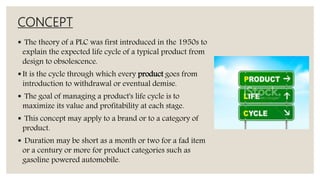
It is the cycle through which every product goes from
introduction to withdrawal or eventual demise.
 The goal of managing a product's life cycle is to
maximize its value and profitability at each stage.
 This concept may apply to a brand or to a category of
product.
 Duration may be short as a month or two for a fad item
or a century or more for product categories such as
gasoline powered automobile.
STAGES
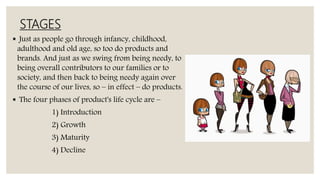
 Just as people go through infancy, childhood,
adulthood and old age, so too do products and
brands. And just as we swing from being needy, to
being overall contributors to our families or to
society, and then back to being needy again over
the course of our lives, so – in effect – do products.
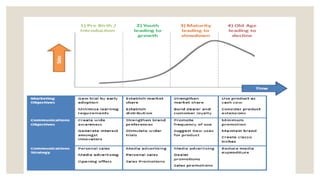
 The four phases of product's life cycle are –
1) Introduction
2) Growth
3) Maturity
4) Decline
INTRODUCTION STAGE
 This is the stage where a product is conceptualized and first brought to
MARKET. The goal of any new product introduction is to meet consumers'
needs with a quality product at the lowest possible cost in order to return
the highest level of profit.
 Sales may be slow as the company builds awareness of its product among
potential customers.
 Advertising is crucial at this stage, so the marketing budget is often
substantial.
 Techniques used to exploit early stages make use of penetration pricing
and skimming pricing.
GROWTH STAGE
 The growth phase occurs when a product has survived its introduction and
is beginning to be noticed in the marketplace.
 This is the boom time for any product. Production increases, leading to
lower unit costs.
 Sales momentum builds as advertising campaigns target mass media
audiences instead of specialized MARKETS (if the product merits this).
 Competition grows as awareness of the product builds. Minor changes are
made as more feedback is gathered or as new markets are targeted.
 The goal for any company is to stay in this phase as long as possible.
MATURITY STAGE
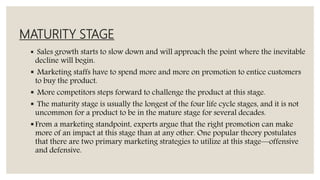
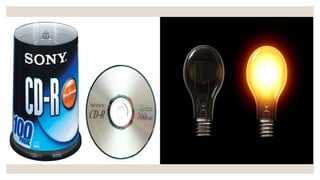
 Sales growth starts to slow down and will approach the point where the inevitable
decline will begin.
 Marketing staffs have to spend more and more on promotion to entice customers
to buy the product.
 More competitors steps forward to challenge the product at this stage.
 The maturity stage is usually the longest of the four life cycle stages, and it is not
uncommon for a product to be in the mature stage for several decades.
From a marketing standpoint, experts argue that the right promotion can make
more of an impact at this stage than at any other. One popular theory postulates
that there are two primary marketing strategies to utilize at this stage—offensive
and defensive.
DECLINE STAGE
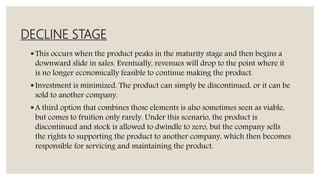
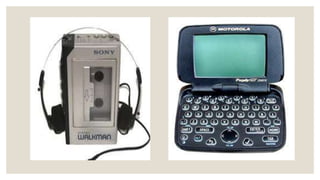
This occurs when the product peaks in the maturity stage and then begins a
downward slide in sales. Eventually, revenues will drop to the point where it
is no longer economically feasible to continue making the product.
Investment is minimized. The product can simply be discontinued, or it can be
sold to another company.
A third option that combines those elements is also sometimes seen as viable,
but comes to fruition only rarely. Under this scenario, the product is
discontinued and stock is allowed to dwindle to zero, but the company sells
the rights to supporting the product to another company, which then becomes
responsible for servicing and maintaining the product.
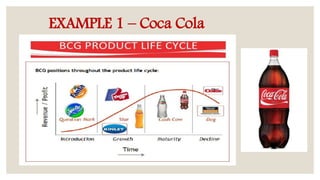
EXAMPLE 1 – Coca Cola
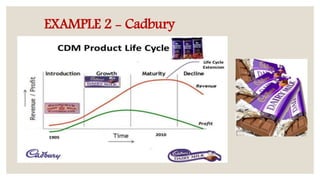
EXAMPLE 2 - Cadbury
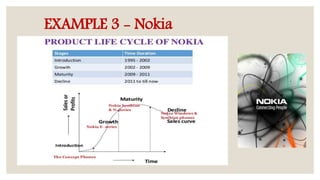
EXAMPLE 3 - Nokia
CONCLUSION
 Every product has got a life cycle and every product will pass
through the stage of decline some day.
 Through effective product line decisions and other strategies, we can
extend its profitability period much longer to our benefits.
Shanmukha Priya
Chadarada

Product Life Cycle

  • 1.
  • 2.
    CONTENTS Introduction Concept Stages - Introduction - Growth -Maturity - Decline PLC Graph Examples Conclusion
  • 3.
    INTRODUCTION  We're regularlybombarded by advertisements telling us about exciting new features of existing products.  Yet, at the same time, if we go to the shops, there are hundreds of products which are seemingly not advertised at all.  Why are some established products regularly given make-overs, while others are apparently left to sell themselves?
  • 4.
    CONCEPT  The theoryof a PLC was first introduced in the 1950s to explain the expected life cycle of a typical product from design to obsolescence. It is the cycle through which every product goes from introduction to withdrawal or eventual demise.  The goal of managing a product's life cycle is to maximize its value and profitability at each stage.  This concept may apply to a brand or to a category of product.  Duration may be short as a month or two for a fad item or a century or more for product categories such as gasoline powered automobile.
  • 5.
    STAGES  Just aspeople go through infancy, childhood, adulthood and old age, so too do products and brands. And just as we swing from being needy, to being overall contributors to our families or to society, and then back to being needy again over the course of our lives, so – in effect – do products.  The four phases of product's life cycle are – 1) Introduction 2) Growth 3) Maturity 4) Decline
  • 6.
    INTRODUCTION STAGE  Thisis the stage where a product is conceptualized and first brought to MARKET. The goal of any new product introduction is to meet consumers' needs with a quality product at the lowest possible cost in order to return the highest level of profit.  Sales may be slow as the company builds awareness of its product among potential customers.  Advertising is crucial at this stage, so the marketing budget is often substantial.  Techniques used to exploit early stages make use of penetration pricing and skimming pricing.
  • 8.
    GROWTH STAGE  Thegrowth phase occurs when a product has survived its introduction and is beginning to be noticed in the marketplace.  This is the boom time for any product. Production increases, leading to lower unit costs.  Sales momentum builds as advertising campaigns target mass media audiences instead of specialized MARKETS (if the product merits this).  Competition grows as awareness of the product builds. Minor changes are made as more feedback is gathered or as new markets are targeted.  The goal for any company is to stay in this phase as long as possible.
  • 10.
    MATURITY STAGE  Salesgrowth starts to slow down and will approach the point where the inevitable decline will begin.  Marketing staffs have to spend more and more on promotion to entice customers to buy the product.  More competitors steps forward to challenge the product at this stage.  The maturity stage is usually the longest of the four life cycle stages, and it is not uncommon for a product to be in the mature stage for several decades. From a marketing standpoint, experts argue that the right promotion can make more of an impact at this stage than at any other. One popular theory postulates that there are two primary marketing strategies to utilize at this stage—offensive and defensive.
  • 12.
    DECLINE STAGE This occurswhen the product peaks in the maturity stage and then begins a downward slide in sales. Eventually, revenues will drop to the point where it is no longer economically feasible to continue making the product. Investment is minimized. The product can simply be discontinued, or it can be sold to another company. A third option that combines those elements is also sometimes seen as viable, but comes to fruition only rarely. Under this scenario, the product is discontinued and stock is allowed to dwindle to zero, but the company sells the rights to supporting the product to another company, which then becomes responsible for servicing and maintaining the product.
  • 15.
    EXAMPLE 1 –Coca Cola
  • 16.
    EXAMPLE 2 -Cadbury
  • 17.
  • 18.
    CONCLUSION  Every producthas got a life cycle and every product will pass through the stage of decline some day.  Through effective product line decisions and other strategies, we can extend its profitability period much longer to our benefits.
  • 19.