Presented By:-
                Deepa Pillai          2011062
                Dhairya Gada          2011072
GROUP 8         Garima Shah           2011076
                Paras Jain            2011093
                Kallol Kumar Sarkar   2011096
Introduction
                   
 The Indian rupee(Devanagari:           ) is the official
  currency of “The republic of India”.

 Today, the currency is available in the form of “Bank
  notes” and “coins of the rupee”.
Convertibility
               
 Currency convertibility refers to the freedom to
  convert the domestic currency into other
  internationally accepted currencies and vice versa at
  market determined rates of exchange.

 Export-Import of goods.
 Pursuing Higher education abroad.
 Tourism.
Types of Convertibility
           
 CURRENT ACCOUNT CONVERTIBILITY- allows
  residents to make and receive trade related
  payments. Example- import-export.

 CAPITAL ACCOUNT CONVERTIBILITY- means
  the freedom to convert the local financial assets into
  foreign assets.
Capital Convertibility
             
 Non-Convertible capital
    Cuba(peso) and North Korea(won)
    Non participation in FOREX market
    Major challenge for domestic currencies there.
 Partial Convertible Capital-
    Indian Rupee
    RBI’s restriction on the inflow and outflow of capital
 Full Convertible Capital-
    US dollars
    No restrictions or limitation on the amount to be traded
    Thus, this is one of the major currency traded in FOREX market
History of Rupee Convertibility
                         
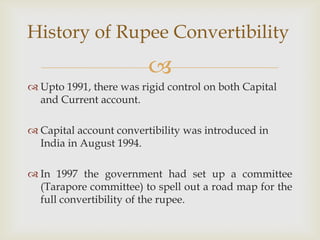
 Upto 1991, there was rigid control on both Capital
  and Current account.

 Capital account convertibility was introduced in
  India in August 1994.

 In 1997 the government had set up a committee
  (Tarapore committee) to spell out a road map for the
  full convertibility of the rupee.
Tarapore Committee
                         
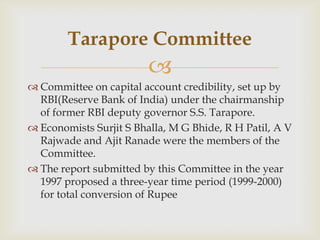
 Committee on capital account credibility, set up by
  RBI(Reserve Bank of India) under the chairmanship
  of former RBI deputy governor S.S. Tarapore.
 Economists Surjit S Bhalla, M G Bhide, R H Patil, A V
  Rajwade and Ajit Ranade were the members of the
  Committee.
 The report submitted by this Committee in the year
  1997 proposed a three-year time period (1999-2000)
  for total conversion of Rupee
Tarapore Committee
                               
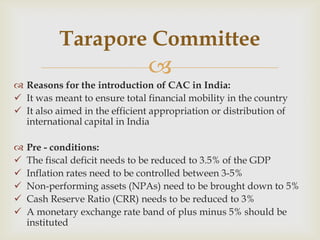
 Reasons for the introduction of CAC in India:
 It was meant to ensure total financial mobility in the country
 It also aimed in the efficient appropriation or distribution of
  international capital in India

   Pre - conditions:
   The fiscal deficit needs to be reduced to 3.5% of the GDP
   Inflation rates need to be controlled between 3-5%
   Non-performing assets (NPAs) need to be brought down to 5%
   Cash Reserve Ratio (CRR) needs to be reduced to 3%
   A monetary exchange rate band of plus minus 5% should be
    instituted
The Second Tarapore Committee on
    Capital Account Convertibility
                               
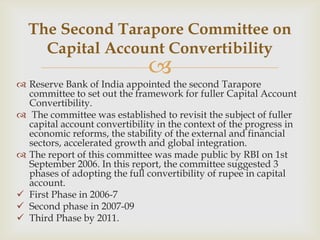
 Reserve Bank of India appointed the second Tarapore
  committee to set out the framework for fuller Capital Account
  Convertibility.
 The committee was established to revisit the subject of fuller
  capital account convertibility in the context of the progress in
  economic reforms, the stability of the external and financial
  sectors, accelerated growth and global integration.
 The report of this committee was made public by RBI on 1st
  September 2006. In this report, the committee suggested 3
  phases of adopting the full convertibility of rupee in capital
  account.
 First Phase in 2006-7
 Second phase in 2007-09
 Third Phase by 2011.
Recommendations
                 
 Following were some important recommendations of this
  committee:
 The ceiling for External Commercial Borrowings (ECB) should
   be raised for automatic approval.
 NRI should be allowed to invest in capital markets
 NRI deposits should be given tax benefits.
 Improvement of the Banking regulation.
 FII (Foreign Institutional Investors) should be prohibited from
   investing fresh money raised to participatory notes.
 Existing PN holders should be given an exit route to phase out
   completely the PN notes.
 At present the rupee is fully convertible on the current account,
   but only partially convertible on the capital account.
Full Capital Account Convertibility
                

     Pros And Cons
RBI too cautious?
             
The government is adopting a cautious
 approach, taking into consideration all
 aspects and the risks involved in
 opening up the economy by allowing
 convertibility   of    the   currency.
Conclusion
                        
 Not only is there instability in the international arena, but India’s
  domestic economy is also going through ups and downs.
 The rising prices and the appreciation of the rupee are adversely
  affecting India’s exports and the Balance of Trade.
 Moreover, the fiscal deficit has been highly underestimated by
  ignoring the deficits of individual states and through issuance of oil
  bonds to the public sector oil companies, making severe losses due
  to the heavy subsidies on oil.
 The government is yet to compensate these companies and these
  deferred payments have been left out from the deficit.
 Also, corruption, bureaucracy, red tapism and in general, a poor
  business environment, are discouraging the inflow of investment.
 Poor infrastructure and socio-economic backwardness act as
  deterrents to FDI inflow.
Conclusion
                     
 Hence, India still needs to work on its fundamentals of
  providing universal quality education and health services
  and empowerment of marginalized groups, etc.
 The growth strategy needs to be more inclusive.
 There is no point trying to add on to the clump at the top of
  the pyramid if the base is too weak. The pyramid will soon
  collapse!
 Thus, before opening up to financial volatility through the
  implementation of FCAC, India needs to strengthen its
  fundamentals and develop a strong base.
 Hence, India should either wait for a while or implement
  CAC in a phased, gradual and cautious manner.


THANK
YOU!!!

Rupee convertability

  • 1.
    Presented By:- Deepa Pillai 2011062 Dhairya Gada 2011072 GROUP 8 Garima Shah 2011076 Paras Jain 2011093 Kallol Kumar Sarkar 2011096
  • 2.
    Introduction   The Indian rupee(Devanagari: ) is the official currency of “The republic of India”.  Today, the currency is available in the form of “Bank notes” and “coins of the rupee”.
  • 3.
    Convertibility   Currency convertibility refers to the freedom to convert the domestic currency into other internationally accepted currencies and vice versa at market determined rates of exchange.  Export-Import of goods.  Pursuing Higher education abroad.  Tourism.
  • 4.
    Types of Convertibility   CURRENT ACCOUNT CONVERTIBILITY- allows residents to make and receive trade related payments. Example- import-export.  CAPITAL ACCOUNT CONVERTIBILITY- means the freedom to convert the local financial assets into foreign assets.
  • 5.
    Capital Convertibility   Non-Convertible capital  Cuba(peso) and North Korea(won)  Non participation in FOREX market  Major challenge for domestic currencies there.  Partial Convertible Capital-  Indian Rupee  RBI’s restriction on the inflow and outflow of capital  Full Convertible Capital-  US dollars  No restrictions or limitation on the amount to be traded  Thus, this is one of the major currency traded in FOREX market
  • 6.
    History of RupeeConvertibility   Upto 1991, there was rigid control on both Capital and Current account.  Capital account convertibility was introduced in India in August 1994.  In 1997 the government had set up a committee (Tarapore committee) to spell out a road map for the full convertibility of the rupee.
  • 7.
    Tarapore Committee   Committee on capital account credibility, set up by RBI(Reserve Bank of India) under the chairmanship of former RBI deputy governor S.S. Tarapore.  Economists Surjit S Bhalla, M G Bhide, R H Patil, A V Rajwade and Ajit Ranade were the members of the Committee.  The report submitted by this Committee in the year 1997 proposed a three-year time period (1999-2000) for total conversion of Rupee
  • 8.
    Tarapore Committee   Reasons for the introduction of CAC in India:  It was meant to ensure total financial mobility in the country  It also aimed in the efficient appropriation or distribution of international capital in India  Pre - conditions:  The fiscal deficit needs to be reduced to 3.5% of the GDP  Inflation rates need to be controlled between 3-5%  Non-performing assets (NPAs) need to be brought down to 5%  Cash Reserve Ratio (CRR) needs to be reduced to 3%  A monetary exchange rate band of plus minus 5% should be instituted
  • 9.
    The Second TaraporeCommittee on Capital Account Convertibility   Reserve Bank of India appointed the second Tarapore committee to set out the framework for fuller Capital Account Convertibility.  The committee was established to revisit the subject of fuller capital account convertibility in the context of the progress in economic reforms, the stability of the external and financial sectors, accelerated growth and global integration.  The report of this committee was made public by RBI on 1st September 2006. In this report, the committee suggested 3 phases of adopting the full convertibility of rupee in capital account.  First Phase in 2006-7  Second phase in 2007-09  Third Phase by 2011.
  • 10.
    Recommendations   Following were some important recommendations of this committee:  The ceiling for External Commercial Borrowings (ECB) should be raised for automatic approval.  NRI should be allowed to invest in capital markets  NRI deposits should be given tax benefits.  Improvement of the Banking regulation.  FII (Foreign Institutional Investors) should be prohibited from investing fresh money raised to participatory notes.  Existing PN holders should be given an exit route to phase out completely the PN notes.  At present the rupee is fully convertible on the current account, but only partially convertible on the capital account.
  • 11.
    Full Capital AccountConvertibility  Pros And Cons
  • 12.
    RBI too cautious?  The government is adopting a cautious approach, taking into consideration all aspects and the risks involved in opening up the economy by allowing convertibility of the currency.
  • 13.
    Conclusion   Not only is there instability in the international arena, but India’s domestic economy is also going through ups and downs.  The rising prices and the appreciation of the rupee are adversely affecting India’s exports and the Balance of Trade.  Moreover, the fiscal deficit has been highly underestimated by ignoring the deficits of individual states and through issuance of oil bonds to the public sector oil companies, making severe losses due to the heavy subsidies on oil.  The government is yet to compensate these companies and these deferred payments have been left out from the deficit.  Also, corruption, bureaucracy, red tapism and in general, a poor business environment, are discouraging the inflow of investment.  Poor infrastructure and socio-economic backwardness act as deterrents to FDI inflow.
  • 14.
    Conclusion   Hence, India still needs to work on its fundamentals of providing universal quality education and health services and empowerment of marginalized groups, etc.  The growth strategy needs to be more inclusive.  There is no point trying to add on to the clump at the top of the pyramid if the base is too weak. The pyramid will soon collapse!  Thus, before opening up to financial volatility through the implementation of FCAC, India needs to strengthen its fundamentals and develop a strong base.  Hence, India should either wait for a while or implement CAC in a phased, gradual and cautious manner.
  • 15.