Basic
marketing
Topic
Product life
cycle
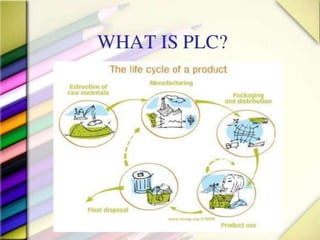
Product Life Cycle
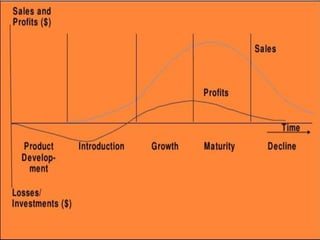
The theory of a product life cycle was first
introduced in the 1950s to explain the
expected life cycle of a typical product from
design to obsolescence, a period divided into
the phases of product introduction, product
growth, maturity, and decline. The goal of
managing a product's life cycle is to
maximize its value and profitability at each
stage. Life cycle is primarily associated with
marketing theory.
Product life
cycle
INTRODUCTION
This is the stage where a product is
conceptualized and first brought to
market. The goal of any new product
introduction is to meet consumers'
needs with a quality product at the
lowest possible cost in order to return
the highest level of profit.
The introduction of a
new product can be
broken down into five
distinct parts:
Idea validation, which is when a company
studies a market, looks for areas where
needs are not being met by current products,
and tries to think of new products that could
meet that need. The company's marketing
department is responsible for identifying
market opportunities and defining who will
buy the product, what the primary benefits of
the product will be, and how the product will
be used.
Conceptual design occurs when an idea has
been approved and begins to take shape.
The company has studied available
materials, technology, and manufacturing
capability and determined that the new
product can be created. Once that is done,
more thorough specifications are developed,
including price and style. Marketing is
responsible for minimum and maximum sales
estimates, competition review, and market
Specification and design is when the product
is nearing release. Final design questions are
answered and final product specs are
determined so that a prototype can be
created.
Prototype and testing occur when the first
version of a product is created and tested by
engineers and by customers. A pilot
production run might be made to ensure that
engineering decisions made earlier in the
process were correct, and to establish quality
control. The marketing department is
extremely important at this point. It is
responsible for developing packaging for the
product, conducting the consumer tests
through focus groups and other feedback
methods, and tracking customer responses to
Manufacturing ramp-up is the final
stage of new product introduction.
This is also known as
commercialization. This is when the
product goes into full production for
release to the market. Final checks
are made on product reliability and
variability.
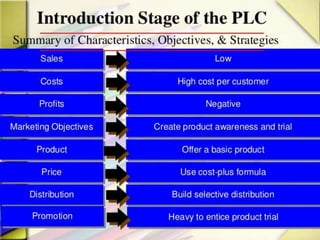
In the introduction phase, sales may be
slow as the company builds awareness
of its product among potential
customers. Advertising is crucial at this
stage, so the marketing budget is often
substantial. The type of advertising
depends on the product. If the product is
intended to reach a mass audience, than
an advertising campaign built around
one theme may be in order. If a product
is specialized, or if a company's
resources are limited, then smaller
advertising campaigns can be used that
target very specific audiences. As a
product matures, the advertising budget
associated with it will most likely shrink
since audiences are already aware of the
product.
Techniques used to exploit early stages
make use of penetration pricing (low
pricing for rapid establishment) as well
as "skimming," pricing high initially
and then lowering price after the "early
acceptors" have been lured in.
GROWTH
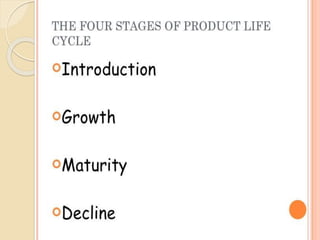
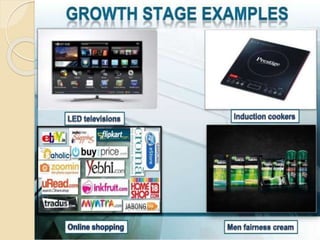
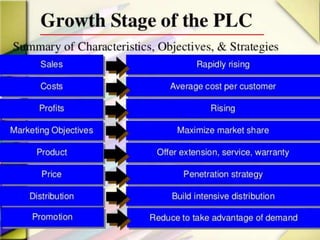
The growth phase occurs when a product
has survived its introduction and is
beginning to be noticed in the
marketplace. At this stage, a company
can decide if it wants to go for increased
market share or increased profitability.
This is the boom time for any product.
Production increases, leading to lower
unit costs. Sales momentum builds as
advertising campaigns target mass
media audiences instead of specialized
markets (if the product merits this).
Competition grows as awareness of the
product builds. Minor changes are made
as more feedback is gathered or as new
markets are targeted. The goal for any
company is to stay in this phase as long
as possible.
It is possible that the product will not
succeed at this stage and move
immediately past decline and straight
to cancellation. That is a call the
marketing staff has to make. It needs
to evaluate just what costs the
company can bear and what the
product's chances for survival are.
Tough choices need to be made—
sticking with a losing product can be
disastrous.
If the product is doing well and killing it
is out of the question, then the
marketing department has other
responsibilities. Instead of just building
awareness of the product, the goal is
to build brand loyalty by adding first-
time buyers and retaining repeat
buyers. Sales, discounts, and
advertising all play an important role in
that process. For products that are
well-established and further along in
the growth phase, marketing options
include creating variations of the initial
product that appeal to additional
audiences.

MATURITY
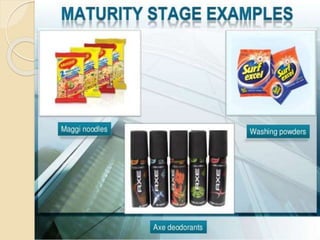
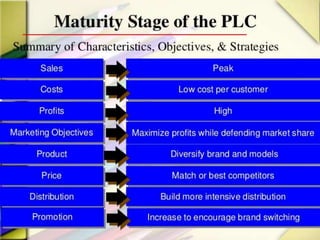
At the maturity stage, sales growth has started
to slow and is approaching the point where
the inevitable decline will begin. Defending
market share becomes the chief concern, as
marketing staffs have to spend more and
more on promotion to entice customers to
buy the product. Additionally, more
competitors have stepped forward to
challenge the product at this stage, some of
which may offer a higher-quality version of
the product at a lower price. This can touch
off price wars, and lower prices mean lower
profits, which will cause some companies to
drop out of the market for that product
altogether. The maturity stage is usually the
longest of the four life cycle stages, and it is
not uncommon for a product to be in the
mature stage for several decades.
A savvy company will seek to lower unit
costs as much as possible at the
maturity stage so that profits can be
maximized. The money earned from
the mature products should then be
used in research and development to
come up with new product ideas to
replace the maturing products.
Operations should be streamlined,
cost efficiencies sought, and hard
decisions made.
From a marketing standpoint, experts argue
that the right promotion can make more of an
impact at this stage than at any other. One
popular theory postulates that there are two
primary marketing strategies to utilize at this
stage—offensive and defensive. Defensive
strategies consist of special sales,
promotions, cosmetic product changes, and
other means of shoring up market share. It
can also mean quite literally defending the
quality and integrity of your product versus
your competition. Marketing offensively
means looking beyond current markets and
attempting to gain brand new-buyers.
Relaunching the product is one option. Other
offensive tactics include changing the price of
a product (either higher or lower) to appeal to
an entirely new audience or finding new
applications for a product.
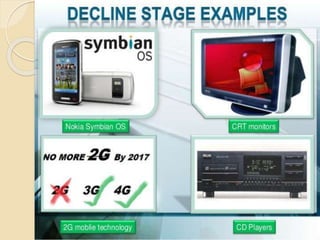
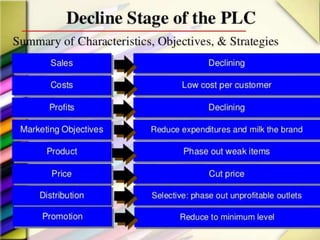
DECLINE
This occurs when the product peaks in the
maturity stage and then begins a
downward slide in sales. Eventually,
revenues will drop to the point where it is
no longer economically feasible to
continue making the product. Investment
is minimized. The product can simply be
discontinued, or it can be sold to another
company. A third option that combines
those elements is also sometimes seen
as viable, but comes to fruition only
rarely. Under this scenario, the product is
discontinued and stock is allowed to
dwindle to zero, but the company sells
the rights to supporting the product to
another company, which then becomes
responsible for servicing and maintaining
the product.
BIBLIOGRAPHY
 Grantham, Lisa Michelle. "The Validity of the
Product Life Cycle in the High-tech Industry."
Marketing Intelligence and Planning June
1997.
 Hedden, Carole. "From Launch to Relaunch:
The Secret to Product Longevity Lies in
Using the Right Strategy for Each Stage of
the Life Cycle." Marketing Tools. September
1997.
 Kumar, Sameer, and William A. Krob.
Managing Product Life Cycle In A Supply
Chair. Springer Science and Business Media,
Inc., 2005.
 Pavlovic, Val. "PLM Is No Passing Fad."
Internal seminar.ppt gunjan   copy

Internal seminar.ppt gunjan copy

  • 1.
  • 2.
  • 4.
    Product Life Cycle Thetheory of a product life cycle was first introduced in the 1950s to explain the expected life cycle of a typical product from design to obsolescence, a period divided into the phases of product introduction, product growth, maturity, and decline. The goal of managing a product's life cycle is to maximize its value and profitability at each stage. Life cycle is primarily associated with marketing theory.
  • 7.
  • 9.
  • 10.
    This is thestage where a product is conceptualized and first brought to market. The goal of any new product introduction is to meet consumers' needs with a quality product at the lowest possible cost in order to return the highest level of profit.
  • 11.
    The introduction ofa new product can be broken down into five distinct parts:
  • 12.
    Idea validation, whichis when a company studies a market, looks for areas where needs are not being met by current products, and tries to think of new products that could meet that need. The company's marketing department is responsible for identifying market opportunities and defining who will buy the product, what the primary benefits of the product will be, and how the product will be used. Conceptual design occurs when an idea has been approved and begins to take shape. The company has studied available materials, technology, and manufacturing capability and determined that the new product can be created. Once that is done, more thorough specifications are developed, including price and style. Marketing is responsible for minimum and maximum sales estimates, competition review, and market
  • 13.
    Specification and designis when the product is nearing release. Final design questions are answered and final product specs are determined so that a prototype can be created. Prototype and testing occur when the first version of a product is created and tested by engineers and by customers. A pilot production run might be made to ensure that engineering decisions made earlier in the process were correct, and to establish quality control. The marketing department is extremely important at this point. It is responsible for developing packaging for the product, conducting the consumer tests through focus groups and other feedback methods, and tracking customer responses to
  • 14.
    Manufacturing ramp-up isthe final stage of new product introduction. This is also known as commercialization. This is when the product goes into full production for release to the market. Final checks are made on product reliability and variability.
  • 15.
    In the introductionphase, sales may be slow as the company builds awareness of its product among potential customers. Advertising is crucial at this stage, so the marketing budget is often substantial. The type of advertising depends on the product. If the product is intended to reach a mass audience, than an advertising campaign built around one theme may be in order. If a product is specialized, or if a company's resources are limited, then smaller advertising campaigns can be used that target very specific audiences. As a product matures, the advertising budget associated with it will most likely shrink since audiences are already aware of the product.
  • 16.
    Techniques used toexploit early stages make use of penetration pricing (low pricing for rapid establishment) as well as "skimming," pricing high initially and then lowering price after the "early acceptors" have been lured in.
  • 19.
  • 20.
    The growth phaseoccurs when a product has survived its introduction and is beginning to be noticed in the marketplace. At this stage, a company can decide if it wants to go for increased market share or increased profitability. This is the boom time for any product. Production increases, leading to lower unit costs. Sales momentum builds as advertising campaigns target mass media audiences instead of specialized markets (if the product merits this). Competition grows as awareness of the product builds. Minor changes are made as more feedback is gathered or as new markets are targeted. The goal for any company is to stay in this phase as long as possible.
  • 21.
    It is possiblethat the product will not succeed at this stage and move immediately past decline and straight to cancellation. That is a call the marketing staff has to make. It needs to evaluate just what costs the company can bear and what the product's chances for survival are. Tough choices need to be made— sticking with a losing product can be disastrous.
  • 22.
    If the productis doing well and killing it is out of the question, then the marketing department has other responsibilities. Instead of just building awareness of the product, the goal is to build brand loyalty by adding first- time buyers and retaining repeat buyers. Sales, discounts, and advertising all play an important role in that process. For products that are well-established and further along in the growth phase, marketing options include creating variations of the initial product that appeal to additional audiences.
  • 25.
  • 26.
    At the maturitystage, sales growth has started to slow and is approaching the point where the inevitable decline will begin. Defending market share becomes the chief concern, as marketing staffs have to spend more and more on promotion to entice customers to buy the product. Additionally, more competitors have stepped forward to challenge the product at this stage, some of which may offer a higher-quality version of the product at a lower price. This can touch off price wars, and lower prices mean lower profits, which will cause some companies to drop out of the market for that product altogether. The maturity stage is usually the longest of the four life cycle stages, and it is not uncommon for a product to be in the mature stage for several decades.
  • 27.
    A savvy companywill seek to lower unit costs as much as possible at the maturity stage so that profits can be maximized. The money earned from the mature products should then be used in research and development to come up with new product ideas to replace the maturing products. Operations should be streamlined, cost efficiencies sought, and hard decisions made.
  • 28.
    From a marketingstandpoint, experts argue that the right promotion can make more of an impact at this stage than at any other. One popular theory postulates that there are two primary marketing strategies to utilize at this stage—offensive and defensive. Defensive strategies consist of special sales, promotions, cosmetic product changes, and other means of shoring up market share. It can also mean quite literally defending the quality and integrity of your product versus your competition. Marketing offensively means looking beyond current markets and attempting to gain brand new-buyers. Relaunching the product is one option. Other offensive tactics include changing the price of a product (either higher or lower) to appeal to an entirely new audience or finding new applications for a product.
  • 31.
  • 32.
    This occurs whenthe product peaks in the maturity stage and then begins a downward slide in sales. Eventually, revenues will drop to the point where it is no longer economically feasible to continue making the product. Investment is minimized. The product can simply be discontinued, or it can be sold to another company. A third option that combines those elements is also sometimes seen as viable, but comes to fruition only rarely. Under this scenario, the product is discontinued and stock is allowed to dwindle to zero, but the company sells the rights to supporting the product to another company, which then becomes responsible for servicing and maintaining the product.
  • 35.
    BIBLIOGRAPHY  Grantham, LisaMichelle. "The Validity of the Product Life Cycle in the High-tech Industry." Marketing Intelligence and Planning June 1997.  Hedden, Carole. "From Launch to Relaunch: The Secret to Product Longevity Lies in Using the Right Strategy for Each Stage of the Life Cycle." Marketing Tools. September 1997.  Kumar, Sameer, and William A. Krob. Managing Product Life Cycle In A Supply Chair. Springer Science and Business Media, Inc., 2005.  Pavlovic, Val. "PLM Is No Passing Fad."