Module 7
New Product Development and
Product Life-Cycle Strategies
1
Dinesh Kumar
LBSIM- New Delhi
New Product Development Strategy and
Process
• It can be defined as strategy which aims at bringing a
new product or service to market. Which involves the
following steps.
▫ Idea Generation & Screening
▫ Concept Development & Testing
▫ Business Analysis
▫ Beta Testing
▫ Technical Implementation
▫ Commercialization
▫ New Product Pricing
2
Brief Explanation to Steps of Product Development Strategy
• Idea Generation & Screening
• continuous systematic search for new product opportunities
• Concept Development and Testing –
• Testing the product on the parameter of utility, features, reaction of potential
customer based on sample questions and the production cost
• Business Analysis
• Estimating selling price, sales volume and profitability
• Beta Testing
• Producing a physical prototype, test it and make the changes, try selling in the test
market area to determine the customer acceptance
• Technical Implementation
• Finalizing the Quality Mgt System, resource estimation, Department Scheduling, Supplier
Collaboration, plan for Contingencies – what if planning.
• Commercialization
• Launching the product, produce and plan advertisement and other promotional activities,
Critical path analysis is most useful at this stage
3
Disruptive Innovation
• Disruptive innovation, a term of art coined by Clayton
Christensen, describes a process by which a product
or service takes root initially in simple
applications at the bottom of a market and then
relentlessly moves ‘up market’, eventually
displacing established competitors.
4
5
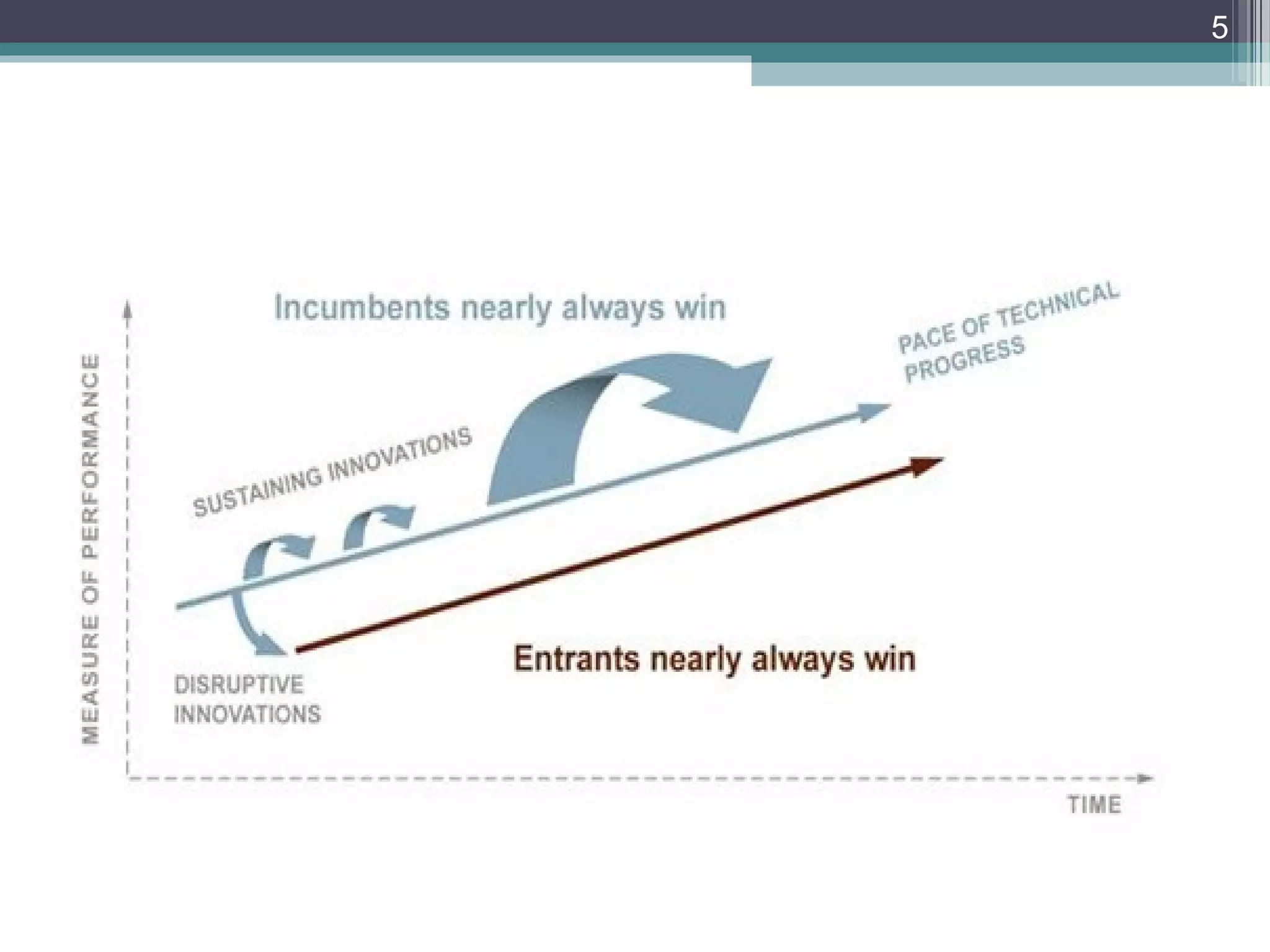
Disruptive Innovation Theory Explained
There is a simple, important principle at the core of the
disruptive innovation theory: companies innovate faster
than customers' lives change. Because of this, most
organizations end up producing products that are too
good, too expensive, and too inconvenient for many
customers. By only pursuing these “sustaining
innovations," companies unwittingly open the door to
entrants that can offer simpler, more convenient and
lower-cost products to those customers who have no
need to keep up with the accelerated pace of innovative
change.
Micromax Mobile is one of the example of Disruptive
Innovation
6
Product Life Cycle
7
Dinesh Kumar
Saurabh Verma
Pankaj Goyal
Harsh Pahuja
8
A company’s positioning and differentiation strategy
must change as the product, market, and competitors
change over the product life cycle(PLC)
When we say that a product has a life cycle we assert
four things:
i.Products have a limited life.
ii.Products sales pass through distinct stages, each
posing different challenges, opportunities and
problems to the seller.
iii.Profits rise and fall at different stages of the
product life cycle.
iv.Products require different marketing, financial,
manufacturing, purchasing, and human resource
strategies in each life – cycle stages.
Why a product life cycle?
Product Life-Cycle Strategies
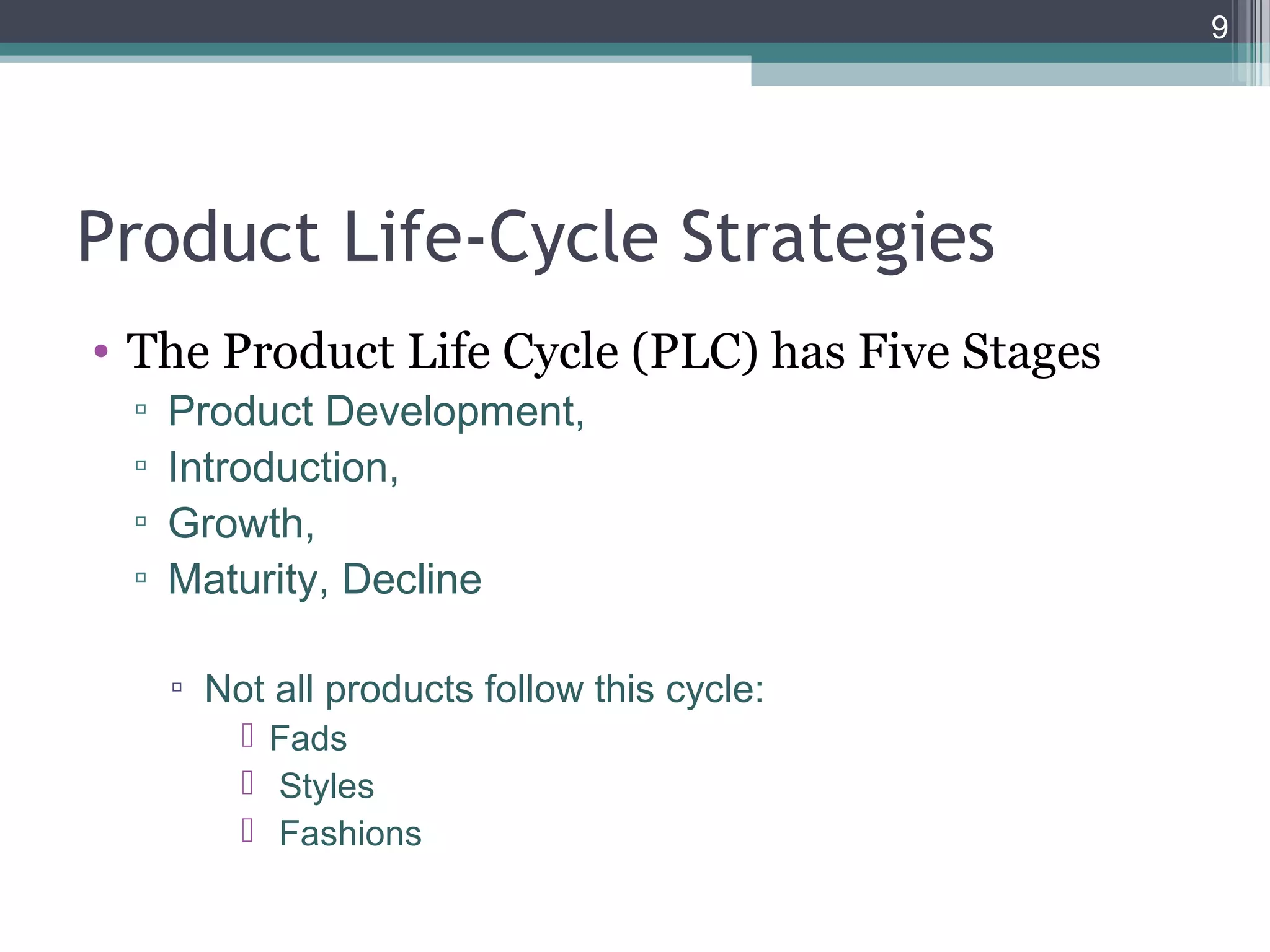
• The Product Life Cycle (PLC) has Five Stages
▫ Product Development,
▫ Introduction,
▫ Growth,
▫ Maturity, Decline
▫ Not all products follow this cycle:
 Fads
 Styles
 Fashions
9
10
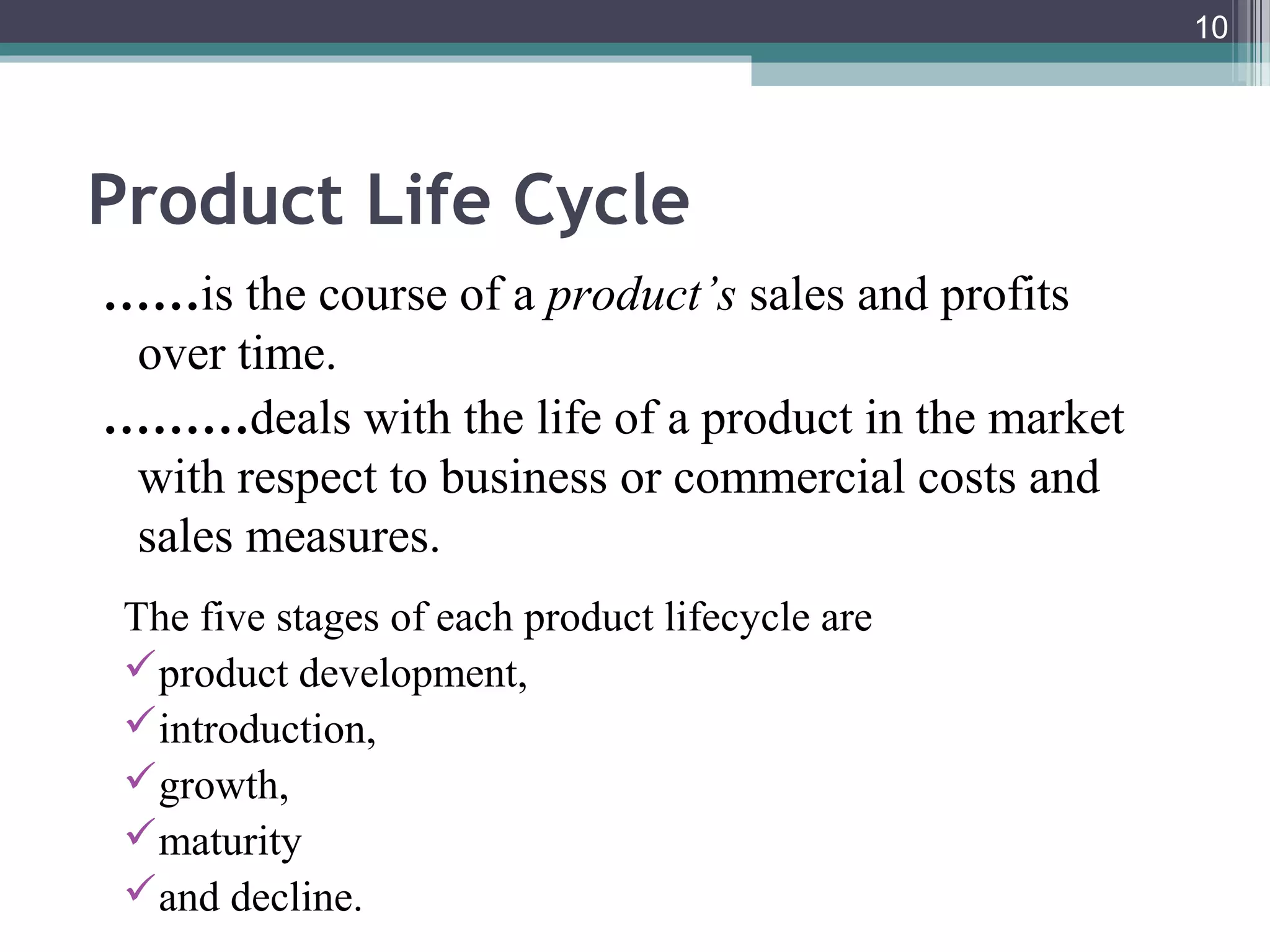
Product Life Cycle
……is the course of a product’s sales and profits
over time.
………deals with the life of a product in the market
with respect to business or commercial costs and
sales measures.
The five stages of each product lifecycle are
product development,
introduction,
growth,
maturity
and decline.
Time
Product
Develop-
ment
Introduction
Profits
Sales
Growth Maturity Decline
Sales and
Profits
Sales and Profits Over the Product’s Lifetime
Product Life Cycle
Three special categories of
PLC
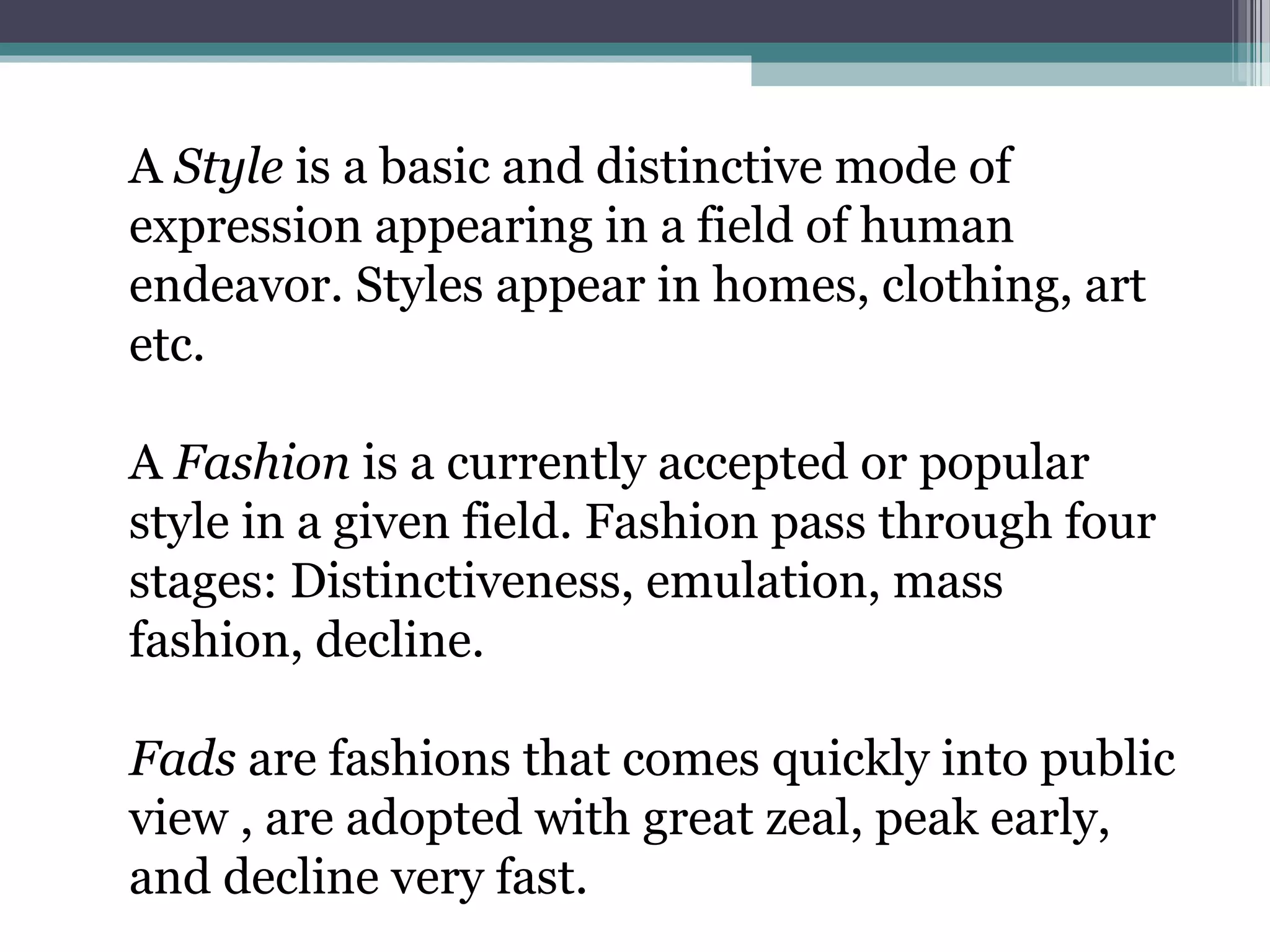
A Style is a basic and distinctive mode of
expression appearing in a field of human
endeavor. Styles appear in homes, clothing, art
etc.
A Fashion is a currently accepted or popular
style in a given field. Fashion pass through four
stages: Distinctiveness, emulation, mass
fashion, decline.
Fads are fashions that comes quickly into public
view , are adopted with great zeal, peak early,
and decline very fast.
Product Life-Cycle Strategies
14
Product
development
Introduction
Growth
Maturity
Decline
Begins when the company
develops a new-product idea
Sales are zero
Investment costs are high
Profits are negative
PLC StagesPLC Stages
Product Life-Cycle Strategies
PLC StagesPLC Stages
15
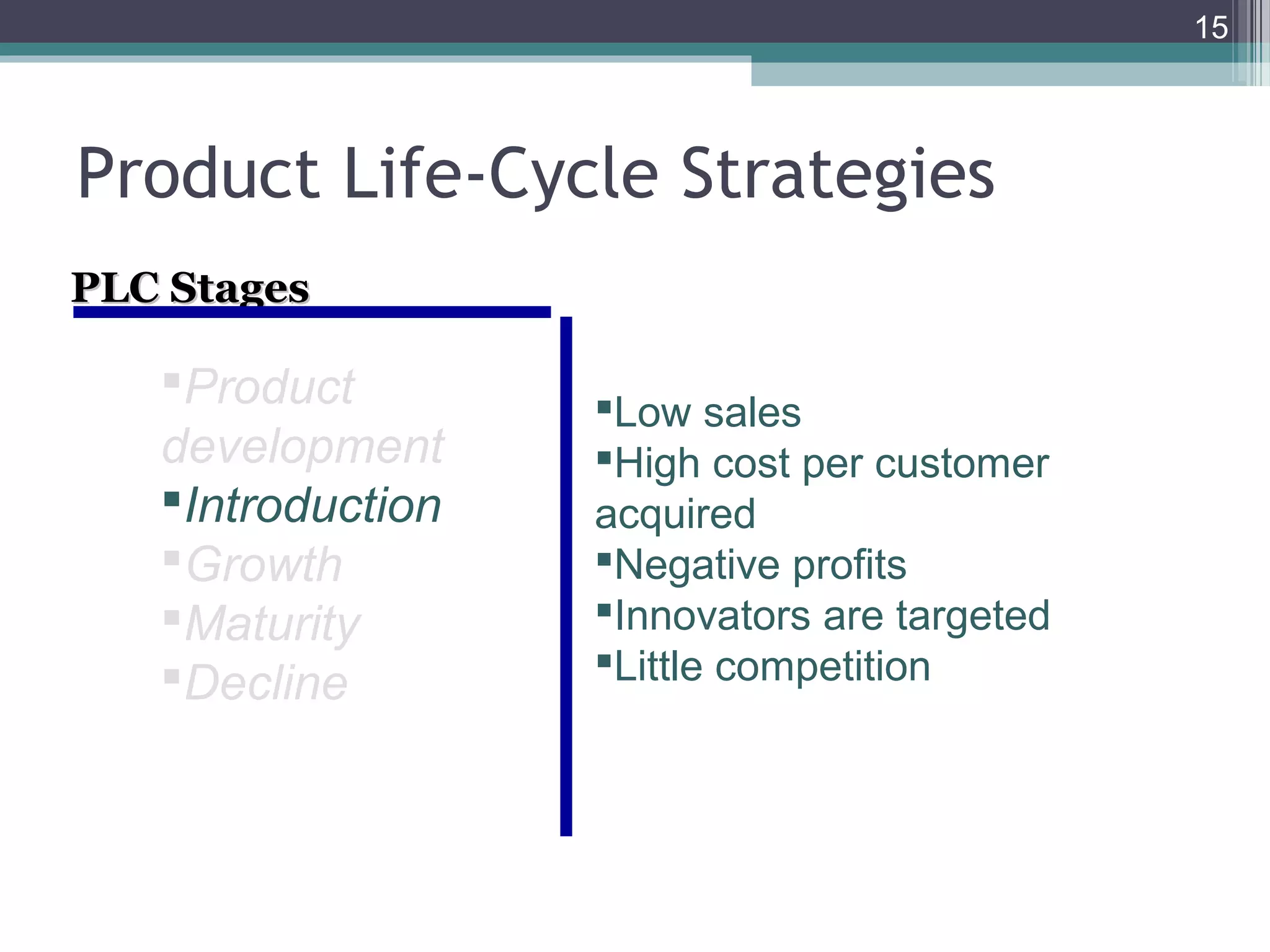
Product
development
Introduction
Growth
Maturity
Decline
Low sales
High cost per customer
acquired
Negative profits
Innovators are targeted
Little competition
Marketing Strategies: Introduction Stage
 Product – Offer a basic product
 Price – Use cost-plus basis to set
 Distribution – Build selective distribution
 Advertising – Build awareness among early adopters
and dealers/resellers
 Sales Promotion – Heavy expenditures to create trial
16
Product Life-Cycle Strategies
17
Product
development
Introduction
Growth
Maturity
Decline
Rapidly rising sales
Average cost per
customer
Rising profits
Early adopters are
targeted
Growing competition
PLC StagesPLC Stages
Marketing Strategies: Growth Stage
• Product – Offer product extensions, service, warranty
• Price – Penetration pricing
• Distribution – Build intensive distribution
• Advertising – Build awareness and interest in the
mass market
• Sales Promotion – Reduce expenditures to take
advantage of consumer demand
18
Product Life-Cycle Strategies
19
Product
development
Introduction
Growth
Maturity
Decline
Sales peak
Low cost per customer
High profits
Middle majority are
targeted
Competition begins to
decline
PLC StagesPLC Stages
Marketing Strategies: Maturity Stage
• Product – Diversify brand and models
• Price – Set to match or beat competition
• Distribution – Build more intensive distribution
• Advertising – Stress brand differences and benefits
• Sales Promotion – Increase to encourage brand switching
20
Product Life-Cycle Strategies
21
Product
development
Introduction
Growth
Maturity
Decline
Declining sales
Low cost per
customer
Declining profits
Laggards are
targeted
Declining
competition
PLC StagesPLC Stages
Marketing Strategies: Decline Stage
• Product – Phase out weak items
• Price – Cut price
• Distribution – Use selective distribution: phase out unprofitable
outlets
• Advertising – Reduce to level needed to retain hard-core loyalists
• Sales Promotion – Reduce to minimal level
22
Thank you
23

Product life cycle

  • 1.
    Module 7 New ProductDevelopment and Product Life-Cycle Strategies 1 Dinesh Kumar LBSIM- New Delhi
  • 2.
    New Product DevelopmentStrategy and Process • It can be defined as strategy which aims at bringing a new product or service to market. Which involves the following steps. ▫ Idea Generation & Screening ▫ Concept Development & Testing ▫ Business Analysis ▫ Beta Testing ▫ Technical Implementation ▫ Commercialization ▫ New Product Pricing 2
  • 3.
    Brief Explanation toSteps of Product Development Strategy • Idea Generation & Screening • continuous systematic search for new product opportunities • Concept Development and Testing – • Testing the product on the parameter of utility, features, reaction of potential customer based on sample questions and the production cost • Business Analysis • Estimating selling price, sales volume and profitability • Beta Testing • Producing a physical prototype, test it and make the changes, try selling in the test market area to determine the customer acceptance • Technical Implementation • Finalizing the Quality Mgt System, resource estimation, Department Scheduling, Supplier Collaboration, plan for Contingencies – what if planning. • Commercialization • Launching the product, produce and plan advertisement and other promotional activities, Critical path analysis is most useful at this stage 3
  • 4.
    Disruptive Innovation • Disruptiveinnovation, a term of art coined by Clayton Christensen, describes a process by which a product or service takes root initially in simple applications at the bottom of a market and then relentlessly moves ‘up market’, eventually displacing established competitors. 4
  • 5.
  • 6.
    Disruptive Innovation TheoryExplained There is a simple, important principle at the core of the disruptive innovation theory: companies innovate faster than customers' lives change. Because of this, most organizations end up producing products that are too good, too expensive, and too inconvenient for many customers. By only pursuing these “sustaining innovations," companies unwittingly open the door to entrants that can offer simpler, more convenient and lower-cost products to those customers who have no need to keep up with the accelerated pace of innovative change. Micromax Mobile is one of the example of Disruptive Innovation 6
  • 7.
    Product Life Cycle 7 DineshKumar Saurabh Verma Pankaj Goyal Harsh Pahuja
  • 8.
    8 A company’s positioningand differentiation strategy must change as the product, market, and competitors change over the product life cycle(PLC) When we say that a product has a life cycle we assert four things: i.Products have a limited life. ii.Products sales pass through distinct stages, each posing different challenges, opportunities and problems to the seller. iii.Profits rise and fall at different stages of the product life cycle. iv.Products require different marketing, financial, manufacturing, purchasing, and human resource strategies in each life – cycle stages. Why a product life cycle?
  • 9.
    Product Life-Cycle Strategies •The Product Life Cycle (PLC) has Five Stages ▫ Product Development, ▫ Introduction, ▫ Growth, ▫ Maturity, Decline ▫ Not all products follow this cycle:  Fads  Styles  Fashions 9
  • 10.
    10 Product Life Cycle ……isthe course of a product’s sales and profits over time. ………deals with the life of a product in the market with respect to business or commercial costs and sales measures. The five stages of each product lifecycle are product development, introduction, growth, maturity and decline.
  • 11.
    Time Product Develop- ment Introduction Profits Sales Growth Maturity Decline Salesand Profits Sales and Profits Over the Product’s Lifetime Product Life Cycle
  • 12.
  • 13.
    A Style isa basic and distinctive mode of expression appearing in a field of human endeavor. Styles appear in homes, clothing, art etc. A Fashion is a currently accepted or popular style in a given field. Fashion pass through four stages: Distinctiveness, emulation, mass fashion, decline. Fads are fashions that comes quickly into public view , are adopted with great zeal, peak early, and decline very fast.
  • 14.
    Product Life-Cycle Strategies 14 Product development Introduction Growth Maturity Decline Beginswhen the company develops a new-product idea Sales are zero Investment costs are high Profits are negative PLC StagesPLC Stages
  • 15.
    Product Life-Cycle Strategies PLCStagesPLC Stages 15 Product development Introduction Growth Maturity Decline Low sales High cost per customer acquired Negative profits Innovators are targeted Little competition
  • 16.
    Marketing Strategies: IntroductionStage  Product – Offer a basic product  Price – Use cost-plus basis to set  Distribution – Build selective distribution  Advertising – Build awareness among early adopters and dealers/resellers  Sales Promotion – Heavy expenditures to create trial 16
  • 17.
    Product Life-Cycle Strategies 17 Product development Introduction Growth Maturity Decline Rapidlyrising sales Average cost per customer Rising profits Early adopters are targeted Growing competition PLC StagesPLC Stages
  • 18.
    Marketing Strategies: GrowthStage • Product – Offer product extensions, service, warranty • Price – Penetration pricing • Distribution – Build intensive distribution • Advertising – Build awareness and interest in the mass market • Sales Promotion – Reduce expenditures to take advantage of consumer demand 18
  • 19.
    Product Life-Cycle Strategies 19 Product development Introduction Growth Maturity Decline Salespeak Low cost per customer High profits Middle majority are targeted Competition begins to decline PLC StagesPLC Stages
  • 20.
    Marketing Strategies: MaturityStage • Product – Diversify brand and models • Price – Set to match or beat competition • Distribution – Build more intensive distribution • Advertising – Stress brand differences and benefits • Sales Promotion – Increase to encourage brand switching 20
  • 21.
    Product Life-Cycle Strategies 21 Product development Introduction Growth Maturity Decline Decliningsales Low cost per customer Declining profits Laggards are targeted Declining competition PLC StagesPLC Stages
  • 22.
    Marketing Strategies: DeclineStage • Product – Phase out weak items • Price – Cut price • Distribution – Use selective distribution: phase out unprofitable outlets • Advertising – Reduce to level needed to retain hard-core loyalists • Sales Promotion – Reduce to minimal level 22
  • 23.